• Skip to primary navigation
  • Skip to main content
  • Skip to primary sidebar

Coaching for Leaders

Leaders Aren't Born, They're Made

Login
  • Plus Membership
  • Academy
  • About
  • Contact
  • Dashboard
  • Login
Episode

766: Using AI to Make Networking Easier, with Ruth Gotian

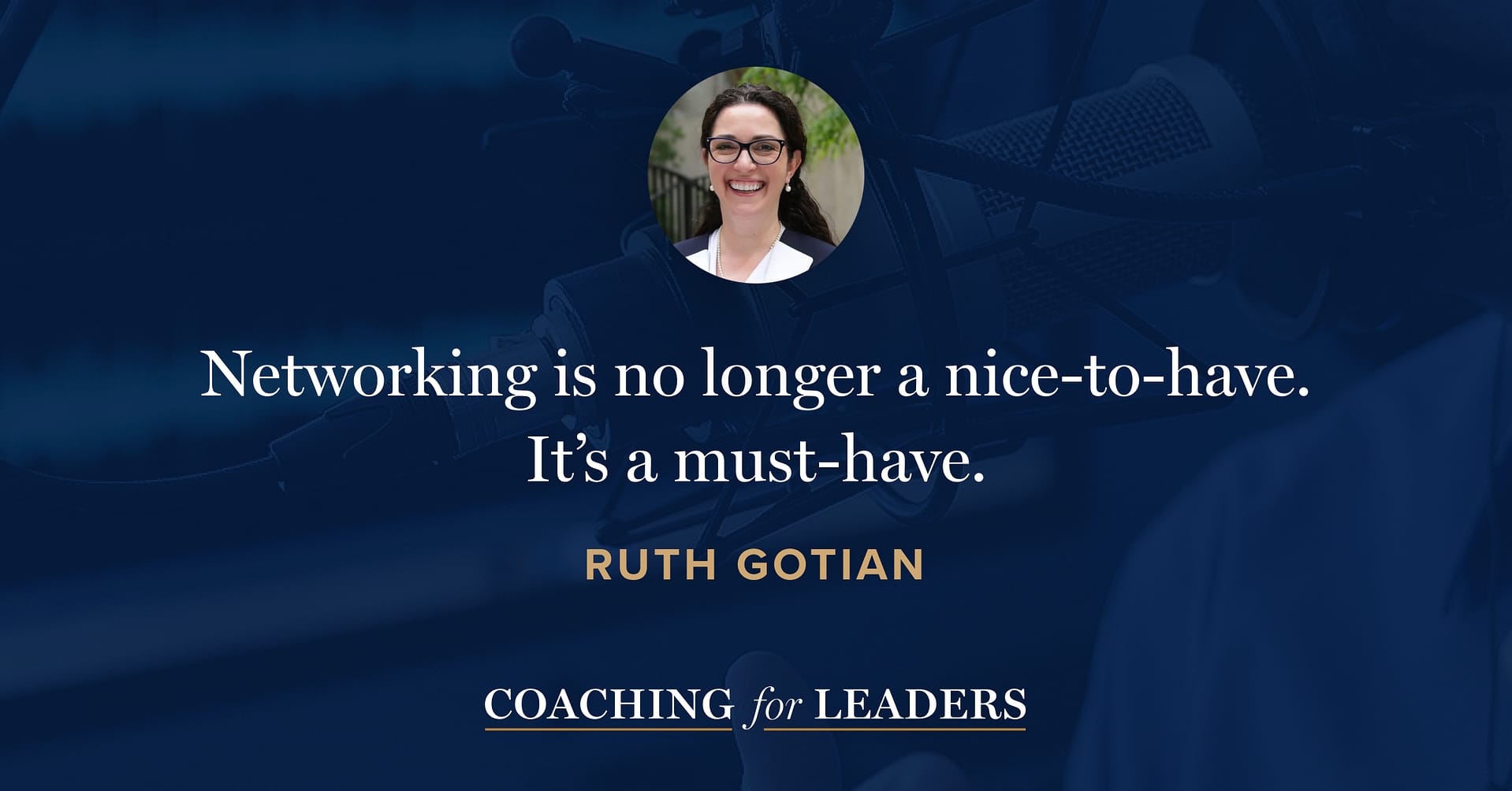
Networking is no longer a nice-to-have. It’s a must-have.
https://media.blubrry.com/coaching_for_leaders/content.blubrry.com/coaching_for_leaders/CFL766.mp3

Podcast: Download

Follow:
Apple PodcastsYouTube PodcastsSpotifyOvercastPocketcasts

Ruth Gotian: Networking in the Age of AI

Ruth Gotian is the former Chief Learning Officer and Associate Professor of Education in Anaesthesiology at Weill Cornell Medicine. Thinkers50 has ranked her the #1 emerging management thinker in the world, and she's a top LinkedIn voice in mentoring. She's the author of The Success Factor and, with Andy Lopata, The Financial Times Guide to Mentoring.

Most of us recognize the value of building a better network, but we also know the time and dedication it takes. In this conversation, Ruth and I explore how we can use AI tools to do some of the administrative legwork so that we can spend more time on the real relationship-building.

Key Points

  • McKinsey reports that since the pandemic, most people’s networks have shrunk or stalled.
  • Consider the 90/9/1 rule: 90% of people lurk in online communities, 9% interact somewhat regularly, 1% post and lead the conversation.
  • Use AI to enhance, not replace, your communications. Invite AI to do the administrative legwork (i.e. brainstorming, proofreading) so you focus on the human aspects.
  • Ask AI to analyze speaker and attendee lists in advance at conferences in the context of your goals.
  • Consider being the person that puts together an in-person dinner or gathering at a conference. Use AI to help you prep questions and discover the best people to invite.
  • Ask AI to help complete your LinkedIn profile. An All-Star LinkedIn profile makes it substantially more likely that you’ll get surfaced to others.

Resources Mentioned

  • Networking in the Age of AI by Ruth Gotian

Related Episodes

  • How to Grow Your Professional Network, with Tom Henschel* (episode 279)
  • How to Build a Network While Still Doing Everything Else, with Ruth Gotian* (episode 591)
  • The Key Elements of a Powerful Personal Brand, with Goldie Chan* (episode 757)

Discover More

Activate your free membership for full access to the entire library of interviews since 2011, searchable by topic. To accelerate your learning, uncover more inside Coaching for Leaders Plus.
Using AI to Make Networking Easier, with Ruth Gotian

Download

Dave Stachowiak [00:00:00]:
Most of us recognize the value of building a better network, but we also know the time and dedication it takes. In this episode, how we can use AI tools to do some of the legwork so that we can spend more time on the real relationship building. This is Coaching for Leaders, episode 766.

Dave Stachowiak [00:00:21]:
Produced by Innovate Learning: Maximizing Human Potential.

Dave Stachowiak [00:00:29]:
Greetings to you from Orange County, California. This is Coaching for Leaders, and I’m your host, Dave Stachowiak. Leaders aren’t born, they’re made. And this weekly show helps you discover leadership wisdom through insightful conversations. One thing that all of us need to do a decent job at, maybe not a perfect job, maybe not even a great job, but a decent job, is building our professional networks. Not only building them, but continuing to invest in the professional networks that we have and are growing. Almost all of us recognize the importance of that, but we don’t necessarily put the time and attention into it that we should. And now, so many amazing tools and strategies are available to help us make this easier through AI.

Dave Stachowiak [00:01:17]:
And I’m so glad to welcome back today a guest expert, a great friend of the show who’s helped us in so many ways of building our relationships, of mentoring, of thinking about high achievers, and today, a conversation on how we can do better at networking with AI. I’m so pleased to welcome back Ruth Gotian to the show. She is the former Chief Learning Officer and Associate Professor of Education in Anesthesiology at Weill Cornell Medicine. Thinkers50 has ranked her the number one emerging management thinker in the world, and she’s a top LinkedIn voice in mentoring. She’s the author of The Success Factor and also, with Andy Lopata, The Financial Times Guide to Mentoring, both of which we featured previously. Ruth, always a pleasure to see you. Welcome back.

Ruth Gotian [00:02:00]:
So good to be here again!

Dave Stachowiak [00:02:02]:
Yeah, I always learn so much from you. So anytime you are on, it is a pleasure to get into your work. And I recently watched and completed your most recent LinkedIn learning course, and there’s a quote that you mention in the course from McKinsey. And it says since the COVID-19 pandemic, most people admit that their network has either shrunk or stalled. I hadn’t really thought about that, but then when I read that I thought, oh, that makes sense. And I think like, this is also really interesting in the context of networking in that we, a lot of us have the assumption that relationships, that trust doesn’t happen as well in a virtual environment, that we can’t build trust in a virtual environment. And it’s just. It’s just not true, is it?

Ruth Gotian [00:02:58]:
I don’t believe that’s true. For the listeners, Dave and I have never met in person, and I’ve been a guest on the show several times, and I love, love, love our conversations, both on the air and off the air. And I wrote an entire book on mentoring with Andy Lopata, and we had never met in person until after we submitted the book manuscript. So I truly believe that trust can be formed, but the challenge is that, it’s formed over time. It’s these little things that you do over time that help breed and infuse trust. Most people are expecting it to happen in one conversation, like a transaction. But that’s not how trust is built. That’s not how it’s formed.

Ruth Gotian [00:03:42]:
That’s not how it’s enhanced. It’s always these little things that you say and do, and the interactions that you have over time that are building that trust.

Dave Stachowiak [00:03:52]:
And to go back to our earlier point of the pandemic and not connecting with people as much in person, a lot of those kinds of things tended to happen just spontaneously before, because we would see people regularly. Even if we weren’t really intentional about building relationships, building our network, we just sort of accidentally, a lot of us would end up doing that because we would bump into people, we would see people at events, we would see people in the office. Now we have to be way more intentional about it, don’t we?

Ruth Gotian [00:04:23]:
That’s right. And I think that intention could be done in a fun way, in an easy way, in a way that aligns with your values. So I’ll give you a perfect example. I travel quite a bit, doing keynotes, and one of the things that I always do is, whatever town I’m in, I go look at the local bookstore, and at the airport, I look at what books are for sale. And whenever I see a book by an author who I know, and I tend to know a lot of the authors in my space, I will take a picture, I will send it to them, and I’ll say, “Found your book at the LAX airport, found your book in San Diego, found your book in Boston”. And I tell them where it is. Because who doesn’t like to see their work in the wild? But it doesn’t just have to be that.

Ruth Gotian [00:05:14]:
I saw a T-shirt that had a saying that I thought was so apropos to somebody who I know, and I would take a picture and send it to them and say, “Saw this shirt, thought of you”. And that was it, and that just starts that conversation going. There’s no ask, there’s no transaction. It’s just, oh, you were top of mind, I thought of you, I’m sending it to you.

Dave Stachowiak [00:05:39]:
One of the things that I really appreciate about you, and that example is just a perfect, a perfect illustration of it, is that you show up, Ruth, in so many consistent ways with people. And that is something that I think for a lot of us, we intend to do, but the actual behaviors, we don’t. And you cite one of these in the course, which is this 99:1 rule, which I’ve heard before, but I’m not sure everyone else has. Could you tell us about what that rule is and the implication for showing up?

Ruth Gotian [00:06:14]:
Sure. This is the 90/9/1 rule, really governs most online communities. It’s really the percentage of people who are on, versus lurking, versus active users. And let’s use LinkedIn as an example only because it’s the biggest professional platform. But understand that it is the MO it’s the same for any online community. So the 90/9/1 rule means that 90% are lurkers, meaning they see what you post, but they’re not engaging. They’re just looking from afar.

Ruth Gotian [00:06:52]:
They are the lurkers. 9% might occasionally interact, they’ll give you that thumbs up, up, maybe they’ll write a post like, good job, or done, or I agree. But less than 1% actually create content, less than 1%. Now, if you think of LinkedIn with 1.2 billion, billion with a B users, less than 1% are creating content, sharing thoughts, sharing ideas, the bar is so low to get your ideas out there.

Ruth Gotian [00:07:26]:
Now, where does this come with networking if you are not ready to post your ideas out there? You can move from the lurker to the engager, where you are engaging with other people’s content. You can like it, you can create a thoughtful comment, more than two words, you can share their content, you can share their content with your own reflection. All of those would help you move up to a category. And by doing that, and if you do it enough, people start to associate you around certain ideas, and they begin to know you, and after they know you, they begin to like you.

Ruth Gotian [00:08:05]:
And after they like you, they begin to trust you. Because when you start putting this stuff out there, your Persona comes out. People always tell me, people I’ve never met before, the first time I meet them, they say, I feel, Ruth, that I already know you. I said, how do you know me? We’ve never met before. Because your content is so authentic. And when it’s authentic, as opposed to polished and perfect, that’s when people really get to know you. And people are more attracted to what aligns with them, what they can relate to. People can relate to your struggles more than they can relate to your wins, because the wins are few and far in between, but the struggles, everyone has them.

Dave Stachowiak [00:08:47]:
This, for me, is so hopeful because anytime anymore, any of us log into any of these platforms, LinkedIn as an example, like, you’re flooded with so much that’s happening, and it feels like the entire world is online and posting, and that you’re the only person that’s not showing up. And you did the numbers on this, the percentage of LinkedIn users that actually post weekly, regularly, and it’s 0.3%. Like, if you look at the actual stats from LinkedIn, that’s a really tiny, tiny number. And for me, that’s really helpful, because I think about LinkedIn and broadly showing up in networking and using some of the AI tools as we’re going to talk about, that if you do a little bit, just a little bit, you right away engage in a way that most people are not doing. And it’s an opportunity now with all this technology and these tools, that if you do a tiny, tiny little bit, boy, you can really start to make some genuine connections and build relationships that other people aren’t necessarily.

Ruth Gotian [00:09:53]:
Absolutely, and I’ll give a tip to the listeners of this show, because as people have heard me before, know that I am an active listener of this podcast long before I ever met Dave. So the first time I felt I knew you, before we ever met, virtually at least, because I had heard hundreds of the conversations that you’ve had before. And if people are not ready to post their own content, and they are big fans of the Coaching for Leaders podcast, one of the things that they can do, and this could be a weekly thing, so people know to start looking at you for this: “Just listened to the Coaching for Leaders podcast with Dave Stachowiak. His guest today was Ruth Gotian. Here are three things that I learned”.

Ruth Gotian [00:10:41]:
And then you offer the link to the podcast. If you start doing that every week, people after a while, will start to look for it, because you have now summarized the conversation for them. And if they’re interested in learning more about networking and professional development, or success and high achievement, they will know to look and listen to that specific episode. So you now, as the poster of that summary, become the curator of information, and you have just elevated yourself to a new status.

Dave Stachowiak [00:11:18]:
And to reinforce what you just said, there are probably half a dozen to a dozen people that regularly do that on LinkedIn, who have been listeners to the show. And I either know them all, or have had a conversation, or at least are aware of them, and we’ve gone back and forth a number of times on LinkedIn because they do stand out. And you would think there’s more people that would do that, but no, not necessarily. And I was thinking about what you said earlier of like, finding the book in the bookstore too, and someone thinking like, well, you know, you have relationships with a lot of authors, most people don’t. But just because you don’t have a relationship today doesn’t mean you can’t take a picture of the book, post it up on LinkedIn, write about, like two or three things you learned from it that were really helpful. Those kinds of things done consistently, like, start to build traction for making connections on platforms like LinkedIn or really, any platform.

Dave Stachowiak [00:12:11]:
It’s really, it’s really amazing if you start getting consistent with it.

Ruth Gotian [00:12:16]:
Absolutely. And you know, once is something that happens once, twice is a pattern, by three times, you’re the go-to person. So, you start curating that within your network, they will start to look for it. And what happens is they know it’s coming out on a specific day and they start to wait for it because you have now become the go-to person for it. And as you said, most people do not do it. So it’s a great way to stand out and start building trust. And look, you know the names of the people who have done it with your podcast Dave.

Ruth Gotian [00:12:49]:
You know them, even if you’ve never met them, but their names are now cemented in your brain.

Dave Stachowiak [00:12:55]:
And AI has opened up an opportunity for us to get a little bit better at doing this, whether it’s on LinkedIn, or whether it’s attending a conference or, I want to ask you more about your dinners because I’m like, so interested in how you do that. But before we get into, like, the how, one of the things you talk about is that AI, and I think you and I are really aligned on this, AI is there to enhance, it is not there to replace. Tell me about that distinction.

Ruth Gotian [00:13:25]:
Before I attend a conference, I would spend hours looking over the program, looking over the speaker list, attendees if I could find them, and start to make some lists of, of who’s attending, who’s speaking, what I have in common with them, either in the topics they’re speaking about, or we both went to the same school or whatever it is. AI can now do that for me, and that has replaced hours and hours and hours of work. Now, it doesn’t replace the communication, they’re not reaching out for me, but it helps to curate a list of who will be there, and what we have in common. Because one of the first things you need to do when you meet someone, is you want to be able to connect with them. And I believe we’re all a Venn diagram, we have something in common with every single person. When I do these keynotes and I tell them that, they never believe me.

Ruth Gotian [00:14:22]:
And then we do this exercise, and I show them in under three minutes, I can prove I have something in common with every single person in attendance at this conference. Hundreds, thousands. And I do this exercise and they, they don’t believe me until they, they actually see it happen. But seeing what we have in common is so critical. And I think what’s important to realize is that AI can really help with that and really shave off a lot of time. So I think what you’re able to do is if you’re able to upload the conference program, see what you have in common that’s not related to work, because you don’t want to talk about work, you want to see what in person, what personal item, personal characteristic, attribute value you have in common. Maybe it’s a favorite food, maybe it’s a favorite vacation destination.

Ruth Gotian [00:15:13]:
Whatever it is, try it out.

Dave Stachowiak [00:15:15]:
I had never thought about doing that until you taught me about that a few months ago, of taking a conference program or attendees and all that and putting it into AI. And then one of the things that you talk about as well is, tell AI about your goals, like why are you going to this conference, why are you going to this event, this association meeting, whatever. And based on those goals, who are the kinds of people that maybe you should think about connecting with? And to your point, this is not replacing the connection, the reach out, it is doing the administrative legwork that you could never do on your own, or if you did like you said, it would take hours to do, but it’s replacing that administrative legwork so you can put then more time and attention into the actual connection, communication with people.

Ruth Gotian [00:16:01]:
Exactly. And we’re going to start talking about those dinners soon because that is where the magic happens.

Dave Stachowiak [00:16:06]:
Yeah, well, let’s talk about that, because one of the things, you’ve inspired me on this, and I’m actually going to be doing some of this in the future with our academy and pro members, of getting together with people. And it was inspired by something you’ve been doing as a practice of getting people together when you go to events. Could you share, like, how you approach that and the way it works?

Ruth Gotian [00:16:27]:
Absolutely. So we started off the conversation by saying people have let their network stall. They haven’t invested in those relationships, and I believe we need to invest in those relationships without ever asking for anything. So, whenever I travel either to do a keynote or at a conference, there’s usually a dinner on your own time. And I become the organizer of those meals, and I hand-pick people who I know. So if I’m in a town, I will see who do I know who lives in that town. So, for example, I was recently in Boston.

Ruth Gotian [00:17:06]:
Who do I know who lives there? There is a partner in a law firm, a university president, a former CEO, a Harvard professor. They don’t know each other, but I know them. And I become the connector. So I ask them, I tell them, I’m organizing a dinner with some interesting people, do you want in? And it’s a small group, five or six people. And what I do then is I will find a restaurant, ideally with a quiet place, if you get your own room, that’s even better. And as the organizer, you have to facilitate a conversation.

Ruth Gotian [00:17:45]:
So what we work on is, as my friend Sam Horn says, a one-table conversation. We are all included in this one conversation. It’s not that you’re only talking to the person on your right or your left. We all introduce ourselves in a very specific way, and if you want ways how to introduce yourself and how to really create curiosity, you can put that question into AI. Give me 10 ways to kick off conversations. And then I create a theme so that we can have a conversation around a specific theme. What happens every single time, without fail, is that collaborations happen, partnerships happen, friendships happen.

Ruth Gotian [00:18:31]:
We start as strangers, by dessert, we are friends. One of the people who was at the dinner was hosting, she works for one of the corporate education groups, she was hosting an event for top athletes, and managers, and agents, and commissioners, et etera. One of the people at the dinner was a partner in a law firm in the sports and entertainment field, and she invited this lawyer to the event. The two of them would never have the opportunity to meet in any capacity. Their worlds just do not cross.

Ruth Gotian [00:19:05]:
But as a result of that dinner, that flourished and brought them together. Now, I was recently in London for Thinkers50, and I knew here was the opportunity to do this again. So here I actually partnered with someone, because this way you’re each bringing in a few people. And because it was in London and I’m not that familiar with the area, I thought somebody local would be helpful. So I asked my co-author Andy Lopata to co host it with me. And we each invited some people, and we invited our wish list from Thinkers50, the biggest management thinkers. And, nobody wants to eat alone, so we invited these people and again we had 17 people, and a one table conversation. We were able to get our own room and really host that conversation.

Ruth Gotian [00:19:59]:
And as the organizers we would just stir the pot just a little bit in a way that got people to think bigger. So we looked at the past and our ideas for the future, people started collaborating. It was absolute magic. I am going to another event next month, and one of the people who was at the London dinner texted me. She said, are you going to this conference? I said yes. She said are you hosting one of your famous dinners? I said yes. She said can I get on the invite list? I said absolutely.

Ruth Gotian [00:20:34]:
So it’s become the go-to place because you are getting people together.

Dave Stachowiak [00:20:41]:
Once you have done that and done a bit of this, how does that fit in and, where does AI come into this for you?

Ruth Gotian [00:20:46]:
Yeah, so that’s actually the pre-work. So the pre-work is, if you invite all of these people, you need to send some sort of communication in advance. And it could be the day before: We’re greatly looking forward to the dinner. We’re meeting at 6 o’clock in this restaurant or the hotel lobby or whatever it is, the reservations in my name, etcetera. Here is who is attending. Now the best way to do this, and this is from quite a bit of trial and error, is you have the name of the person, you link it to their LinkedIn, and then a one-sentence description of who they are. That’s it, one sentence, not the whole paragraph bio, one sentence.

Ruth Gotian [00:21:27]:
Ruth Gotian, studies high performance and success, wrote the best-selling book The Success Factor, view her TEDx talk; whatever it is, that’s it. And you do that for every single person who attends. So you’re not sharing their emails because you’re doing it as a bcc. You need to get permission, and I’ve always gotten permission after the dinner to do it. But beforehand you are just sending the list of who’s coming and you link to their LinkedIn. This allows people the time to start safely stalking the other people and looking them up, and already to start thinking about conversation topics they want to have with that person. They also see what they have in common.

Ruth Gotian [00:22:10]:
Oh, we went to the same School, Oh, we’re from the same hometown, Oh, we have so and so in common, Oh, I see you are on Dave’s podcast, whatever it is, see what you have in common with that person. And remember I said we’re all a Venn diagram. We all have things in common with other people. Now I had someone who tried this once and she put the attendees into ChatGPT and asked for commonalities, and asked for a little bio on each person. And the bios that ChatGPT were good, except chatgpt hallucinated and it started to make things up.

Ruth Gotian [00:22:48]:
Well, what we decided to do then, or what she decided to do was as we read their bios in the restaurant, we had to decide what was real and what was not. So that is the downside of using the AI for the bios. But I think there are more positives than negatives. Now if I am, have enough energy and I’m focused enough, I can say how people I think have something in common. So for example, I will say this one and this one are both musicians because so and so plays the tuba, and the other person plays the saxophone. These people are authors, these people have done TED talks, so I am already instigating those starter conversations, just to get things going.

Ruth Gotian [00:23:35]:
But if you know how to do facilitation especially, you don’t have to worry about that because just from the intros alone, you will have enough to keep going.

Dave Stachowiak [00:23:45]:
And then you, I know, are also really intentional of after those events of, utilizing the starting point for those relationships, but also following up. And also, AI comes into this too. And I thought one of the interesting things that you turn to AI for is helping you recommend and suggest ways that you might continue to connect, suggest content links, those kinds of things that relate to those relationships.

Ruth Gotian [00:24:14]:
Absolutely. Look, you’re not going to be an expert on everything. What do I know about being a lawyer for sports and entertainment purposes? I don’t. That person happened to be in attendance at one of the places where I was speaking, and he’s the only person I remember from the audience, because of the questions he asked and the follow-up afterward. He continued to stay in touch, certain points that I brought up during the talk, he would discuss as well. And that continued for years and years, that professional relationship. I think there’s a very structured and great way to keep in touch with people that would be helpful, and AI can definitely help.

Ruth Gotian [00:24:56]:
And I think I’ve spoken about the 24/7/30 model.

Dave Stachowiak [00:25:00]:
Yeah.

Ruth Gotian [00:25:01]:
So after the dinner I always ask, “Can I share everyone’s email?” They say yes, and then people start with, you know, thank you very much, I’m looking forward, next time we’re in whatever town, let’s do this dinner again… Always works. 24 hours after you meet someone, send them a message, LinkedIn, Messenger, email, whatever works. “So great meeting you, loved our conversation about so and so, look forward to staying in touch”.

Ruth Gotian [00:25:26]:
That’s it. One sentence. You want to know how to say it beautifully? Ask AI, just make sure it’s in your tone. A week later, follow up again. “Dave, I’ve been thinking about our conversation about AI and networking, have you ever tried so and so? I heard a podcast about it. Here’s the link, thought you might be interested”.

Ruth Gotian [00:25:44]:
30 days later, you follow up again. “Did you attend that conference? Did you try it? Did it work?” Somehow, you start engaging 24 hours later, 7 days later, 30 days later, you now start to engage. Then, if you connect with them on social media, you are able to engage with their content, move from the lurker to the engager. Doesn’t have to be every post, but enough that they will start remembering your name and associating it with where they met you all the time. I think it’s very helpful, I think it really works. You don’t need to keep in touch with people every quarter, but when something comes to mind about them, shoot them a quick messenger.

Ruth Gotian [00:26:25]:
They’re always grateful. Trust me, always.

Dave Stachowiak [00:26:28]:
And you said something really big there too, that I’d love to highlight, which is it being in your voice. And I think everyone has a little bit different comfort level with AI, and how much it does things for you, with you, those kinds of things. And I find, just my own personal practice, I don’t use AI, no people do, but I don’t use AI to generate anything from scratch that I would write, or send, or content I would do. What I will do, is I’ll sometimes use AI as a starting point for brainstorming of like, okay, I’m thinking about doing this kind of thing, or sending this kind of a message. Like what would be the big things I might think about including? And almost always it surfaces something that I think, ooh, that’s a really good idea, I didn’t think about including that in this message. And then I’ll end up writing it myself, and then I usually go back to AI afterwards, and I always proofread, like I will use it as a tool, so I’m still myself.

Dave Stachowiak [00:27:27]:
And I know some people are more comfortable with AI doing more drafting and doing a first draft of that, but I find that I still want to do the writing. Maybe that’s just me being old school, I don’t know. But I do find that both the starting point for ideas and then the proofreading and critique afterwards has really helped me to craft and send messages that are more. Are more relevant. But also sometimes don’t miss the obvious things.

Ruth Gotian [00:27:54]:
I do it in the exact same way. I will add that I do one more thing. I use the voice command in AI. I use chatgpt, everyone has their favorite, the one they started on is usually their favorite. There’s a little microphone in the search bar that you can use. And as I’m walking or driving, I will start talking about a topic.

Ruth Gotian [00:28:18]:
Just have this stream of consciousness about all the ideas that I have around a particular topic. And I could talk and talk and talk and talk everything I think about this particular topic. And then I will ask AI to organize my rambling into some organization. I say I want to post it as an article, a newsletter, whatever it is, and it starts to organize the ideas for me. Then again, I write it, I am just like you. I will then ask if certain parts sound clunky to me, I will ask, AI has become my editorial assistant.

Ruth Gotian [00:28:55]:
Can you publish these three sentences, polish these three sentences for me? It’s sounding too choppy. I’m using the same words, whatever it is, this way it definitely sounds like my voice, because remember, I spoke it. And if you read my articles and my newsletters, or watch my LinkedIn learning courses, or hear my keynotes, you will see I use certain phrases over and over again. Those are my phrases, I know them. Those are the ones I always use to refer to certain things. So anyone who knows me will know that that is definitely Ruth Gautian’s words, because I’ve heard her say it before. Now what happens is when all this starts to enter and starts getting submitted into AI, AI will start putting it out, and you could say in Ruth Gautian’s voice and tone and style, and it’ll start saying that for you.

Ruth Gotian [00:29:50]:
So it knows how to polish things in your voice so it sounds like you. But it doesn’t have enough nuance yet. It doesn’t have enough details, those details only you can provide. Because you know them, so you need to feed it that information. Then it could put some glitz and glamour and bedazzle it for you.

Dave Stachowiak [00:30:10]:
Well, speaking of details, one of, and perhaps we should have started here, is one of the regularly things I hear from folks in our community is they’ll say, again, coming to LinkedIn as the example, just because it’s the largest professional network, they’ll say, you know, I really need to just update my profile of the background information, the headline on LinkedIn. And I think that that’s a place where so many of us, I do too, we struggle with how to more objectively describe ourselves and get out of that mode of like, I feel like I’m bragging and all those kinds of things and baggage that we have, of just starting to like, populate a profile on LinkedIn. And I think this is a place where AI can help a ton of, like, doing some of that thinking and drafting. And that’s probably one place I haven’t done this, but that’s probably one place where I would be more comfortable of, like, giving it a little bit more license to be more objective and to describe me without the emotion that I would bring to that situation as a starting point. Just to get started, to get things populated on your profile, because that’s a huge thing for this too.

Ruth Gotian [00:31:15]:
Absolutely. And in fact, LinkedIn has shown that the All Star profiles, the All Star profiles are the ones that have your bio in there, and your employment history, etcetera, all of that in there, are 40 times more likely to be found by recruiters. 40 times. So let’s unpack this a little bit. The bio, you’re limited to the certain number of characters you have, again, you can feed all that information to ChatGPT. Say, I’m using this for a LinkedIn profile, I am looking for a new job.

Ruth Gotian [00:31:47]:
I want to stand out, I want to focus on X, here’s the character limitation. Write it in my style and tone so that it appeals to whoever your target audience is. And give me 5 variations, 10 variations, whatever you want. Always ask for variations, because that is a differentiator. Otherwise you’re one and done, and you get what you get, and you don’t get upset. But if you start asking for variations and then you start to say, I want more of this, I want less of that, that’s when it starts getting better and better and better. So that’s a great step for step one.

Ruth Gotian [00:32:24]:
Now, the other things you can do, I was just at a LinkedIn conference, and I was sitting next to the head engineer and the head AI engineer, and they said two things. One, don’t just list your job. You actually have to put words under it, what your responsibilities are at that job. That helps feed the algorithm in your favor. So you want the bio, you want the jobs, and you want what it is that you did within your job. AI must appear somewhere on your profile. Now, you know AI has created a whole ecosystem. There are AI coders, there are AI data analytics, there’s ethics in AI. I mean, there’s so many ways to use it.

Ruth Gotian [00:33:07]:
Put it somewhere, because that will float you to the top. Now, most recruiters are on LinkedIn searching for people, and this will help you get to the top. The other thing you are going to want to do is, if you are, it doesn’t have to do with AI so much, but if you are looking to work at a particular company, you want to connect with the leadership of that company, starting with the CEO. This way, if you’re looking at Coca-Cola, for example, you’re looking to work there, and you connect with their CEO and their leadership. When they post a job, and you’re one of the thousands and thousands of people who apply for the job, the ones that will rise to the top are those that have one degree of connection to the leadership. So that’s just a little insider tip.

Dave Stachowiak [00:33:54]:
Amazing. You’ve given me so many things to think about and, three or four practices. I’m thinking both in the dinners, and thinking about talking to ChatGPT, or whatever tool, and summarizing afterwards, I’d never thought to do that. What a great way for doing this. And all of this again, the both and of, course, let’s use this technology, this tool to do the administrative work for us so that we can then do a better job at being able to engage in the human way that AI should never replace, right? To really build those genuine relationships. And that brings me to that last question I often ask of you, Ruth, and I’m curious, like what you’ve changed your mind on specifically in relation to AI and building connections with people?

Dave Stachowiak [00:34:43]:
You’ve been on a journey with this pretty extensively over the last year or two of using all these new tools as you have done. So what, if anything, have you changed your mind on?

Ruth Gotian [00:34:53]:
I was an early believer that AI is going to take over our jobs, I don’t believe that. I don’t believe that AI will take over all jobs. I think it’ll take over the lower level of administrative jobs, but I think those who know how to leverage it are going to stand out exponentially. If you know how to connect with people, because AI helped you do your homework, what you have in common, what you can relate to with a person, those things will make you stand out and jump to the front of the line.

Dave Stachowiak [00:35:27]:
Ruth Gotian is the author of The Success Factor and The Financial Times Guide to Mentoring. Ruth, always a pleasure to talk with you and have you challenge my thinking in new ways. Thanks for your time.

Ruth Gotian [00:35:39]:
Thanks for having me.

Dave Stachowiak [00:35:46]:
If this conversation was helpful to you, three other episodes I think you’ll want to check out. One of them is episode 279: How to grow your professional network. My friend Tom Henschel from The Look and Sound of Leadership podcast was my guest on that episode. Tom and I had a high-level conversation about networking and relationships, and he talked about some wonderful distinctions and analogies in that conversation, that I still think about all the time. And in fact, one of our Academy members just mentioned to Tom and I in the last few weeks, how that conversation shaped so much of his view about relationships and people. And 10 years later, after listening to that conversation, he’s still using it actively in so many of his interactions, as am I. I think it’s a wonderful framework for just thinking about how to build great professional relationships in the workplace, and of course, across industry. Episode 279 for that. Also recommended a previous conversation with Ruth, episode 591: How to build a network while still doing everything else.

Dave Stachowiak [00:36:47]:
We hit on some aspects of that in this conversation, but we did a much deeper dive in that in episode 591, which is the reality that, we all recognize that networking is important. We all know we should be doing a bit more of it, be a little more intentional about it, but it’s something that for most of us is never urgent, and how do we actually prioritize it in the midst of all the other things we all need to do every single day? We talked about that reality in episode 591, and also, what are some of the tactics and mindsets that will really help you to prioritize it just a bit more, add a little bit of time and intention each day, each month to build a network that you’ll be so proud of as you look back years later. Episode 591 for that. And then also recommended is the recent conversation with Goldie Chan, episode 757: The key elements of a powerful personal brand. Of course, anytime thinking about networking, building relationships, our personal brands go hand in hand with that conversation. Goldie walked us through some of the key elements in episode 757, I think it’s a great compliment to this conversation today with Ruth. All of those episodes you can find on the coachingforleaders.com website, and I’m inviting you today, if you’ve never done it before, set up your free membership at coachingforleaders.com. You’re going to want to do that so you can get access to the entire library, searchable by topic.

Dave Stachowiak [00:38:03]:
And one of those topic areas is networking, another one is AI. We’ve done a bunch of episodes on both topics in recent years, especially on networking, of course, and we’ve highlighted so many other things that’ll be helpful to you, just on these two topics. All of that’s inside of the free membership. Go over to coachingforleaders.com. Once you set up your free membership, you can go into the episode library, search for exactly what you’re looking for. By the way, there’s a ton of other benefits of the free membership, including free audio courses, my own personal library, my book and interview notes, a ton inside there. Coachingforleaders.com for access to all of it. Coaching for Leaders is edited by Andrew Kroeger. Next Monday, I am glad to welcome Graham Allcott to the show. We are going to be talking about why being nice might not be kind.

Dave Stachowiak [00:38:53]:
Join me for that conversation with Graham, and I’ll see you back on.

Topic Areas:AINetworking
cover-art

Coaching for Leaders Podcast

This Monday show helps you discover leadership wisdom through insightful conversations. Independently produced weekly since 2011, Dave Stachowiak brings perspective from a thriving, global leadership academy of managers, executives, and business owners, plus more than 15 years of leadership at Dale Carnegie.

Listen Now OnApple Podcasts
  • More Options
    • YouTube Podcasts
    • Spotify
    • Overcast

Activate Your Free Membership Today

Access our entire library of Coaching for Leaders episodes from 2011, searchable by topic.
Listen to the exclusive Coaching for Leaders MemberCast with bonus content available only to members.
Start Dave’s free audio course, 10 Ways to Empower the People You Lead.
Download our weekly leadership guide, including podcast notes and advice from our expert guests.

... and much more inside the membership!

Activate Your Free Membership
IMAGE
Copyright © 2026 · Innovate Learning, LLC
  • Plus Membership
  • Academy
  • About
  • Contact
  • Dashboard
×

Log in

This site is protected by reCaptcha and the Google Privacy Policy and Terms of Service apply.
 
 
Forgot Password

Not yet a member?

Activate your free membership today.

Register For Free
×

Register for Free Membership

Access our entire library of Coaching for Leaders episodes from 2011, searchable by topic.
Listen to the exclusive Coaching for Leaders MemberCast with bonus content available only to members.
Start Dave’s free audio course, 10 Ways to Empower the People You Lead.
Download our weekly leadership guide, including podcast notes and advice from our expert guests.

... and much more inside the membership!

Price:
Free
First Name Required
Last Name Required
Invalid Username
Invalid Email
Invalid Password
Password Confirmation Doesn't Match
Password Strength  Password must be "Medium" or stronger
This site is protected by reCaptcha and the Google Privacy Policy and Terms of Service apply.
 
Loading... Please fix the errors above