• Skip to primary navigation
  • Skip to main content
  • Skip to primary sidebar

Coaching for Leaders

Leaders Aren't Born, They're Made

Login
  • Plus Membership
  • Academy
  • About
  • Contact
  • Dashboard
  • Login
Episode

797: How to Improve Your Charisma, with Olivia Fox Cabane

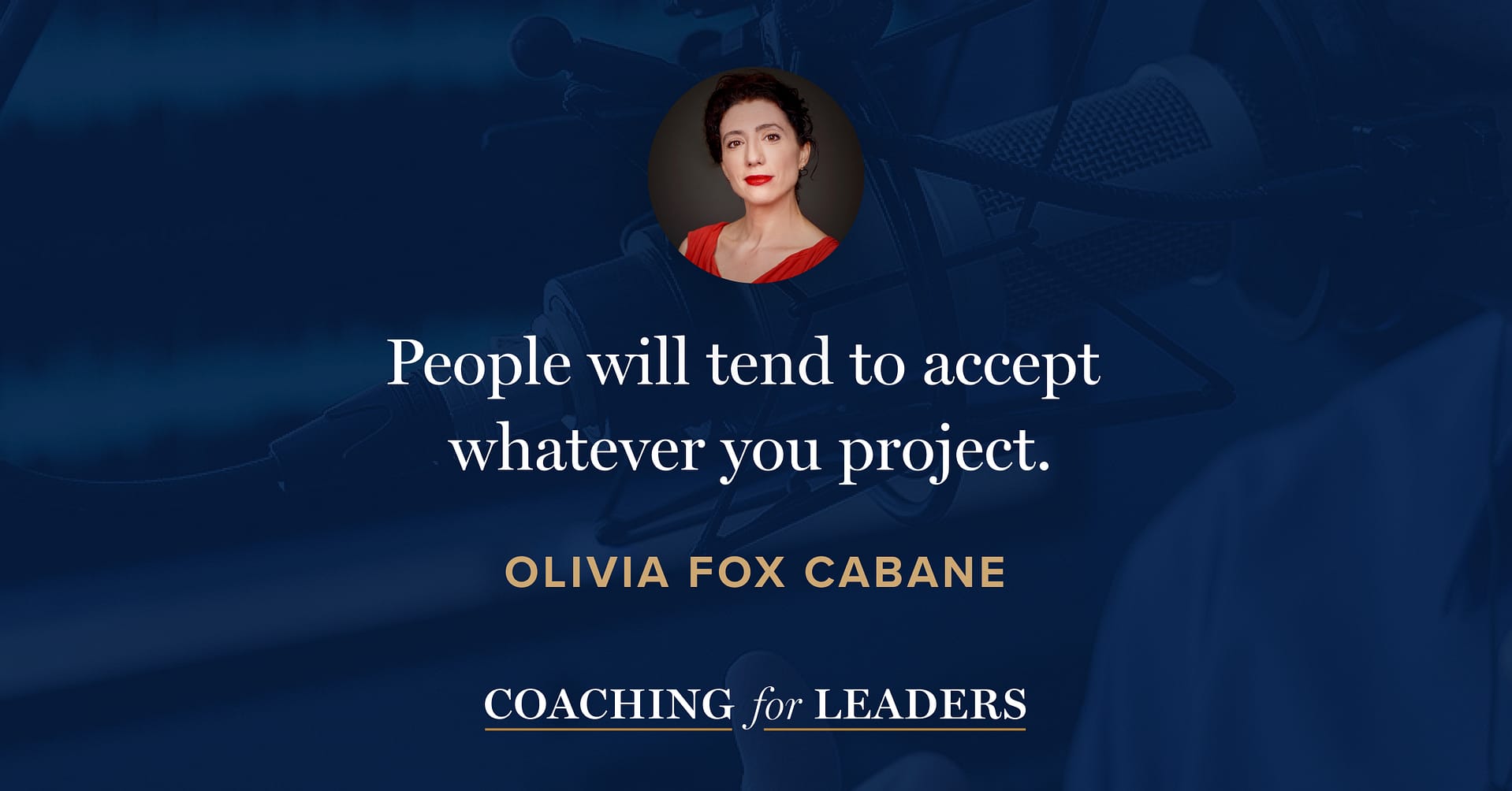
People will tend to accept whatever you project.
https://media.blubrry.com/coaching_for_leaders/content.blubrry.com/coaching_for_leaders/CFL797.mp3

Podcast: Download

Follow:
Apple PodcastsYouTube PodcastsSpotifyOvercastPocketcasts

Olivia Fox Cabane: The Charisma Myth

Olivia Fox Cabane is one of the world’s leading authorities on the science of charisma and the bestselling author of The Charisma Myth, which has been translated into 27 languages. Previously Director of Innovative Leadership for Stanford StartX, Olivia has lectured on charisma, leadership, and innovation at Harvard, Yale, MIT, the Marine War College and the United Nations. She has been featured in The New York Times, The Economist, and The Wall Street Journal and has recently released the revised version of The Charisma Myth: How Anyone Can Master the Art and Science of Personal Magnetism (Amazon, Bookshop)*.

Charisma. We all notice leaders who’ve got it. Many of us wish we had more of it. Good news though – like so many leadership skills we talk about on this podcast, you can get better at it. In this conversation, Olivia and I explore how almost anyone can improve their charisma.

Key Points

  • Charisma is a skill that you can learn and practice.
  • While some people have natural strengths for charisma more so than others, people are not simply born charismatic. Many just start young.
  • You don’t have to be naturally outgoing. You can be a very charismatic introvert.
  • Presence + Power + Warmth = Charisma
  • Power is the “Can you move mountains for me?” question. Warmth is the “Would you want to move them for me?” question. Presence is the “Are you aware of which mountains I need moved?” question.
  • A small amount of improvement can make a big difference on how you are perceived.

Three quick tips to improve your charisma:

  • Lower the intonation of your voice at the end of your sentences.
  • Reduce how quickly and how often you nod.
  • Pause for two full seconds before you speak.

Resources Mentioned

  • The Charisma Myth: How Anyone Can Master the Art and Science of Personal Magnetism by Olivia Fox Cabane (Amazon, Bookshop)*

Interview Notes

Download my interview notes in PDF format (free membership required).

Related Episodes

  • Six Ways to Recover From a Bad First Impression, with John Corcoran (episode 169)
  • The Way to Make Sense to Others, with Tom Henschel (episode 518)
  • How to Make a Better Impression on Camera, with Mark Bowden (episode 643)

Discover More

Activate your free membership for full access to the entire library of interviews since 2011, searchable by topic. Go beyond the podcast to find the right ideas and apply them with confidence in Coaching for Leaders Plus.
How to Improve Your Charisma, with Olivia Fox Cabane

Download

Dave Stachowiak [00:00:00]:
Charisma. We all notice leaders who have it, and many of us wish we had more of it. Good news though, like so many leadership skills we talk about on this podcast, you can get better at it. In this episode, how almost anyone can improve their charisma. This is Coaching for Leaders, episode 797.

Dave Stachowiak [00:00:38]:
Production Credit: Produced by Innovate Learning, Maximizing Human Potential.

Dave Stachowiak [00:00:38]:
Greetings to you from Orange County, California. This is Coaching for Leaders, and I’m your host, Dave Stachowiak. Leaders aren’t born; they’re made. And this weekly show helps leaders thrive at key inflection points. I say that phrase at the start of every single episode— leaders aren’t born; they’re made— and it’s because we often look at people that we think are extraordinary leaders, and often are extraordinary leaders. And we see all the things that they do so well, and we think, “wow, they’re just so naturally good at that”. And of course, we all have our natural talents. And yet, also, and the good news for all of us is, almost every area of leadership we can get better at. We can build our skills, and guess what? Charisma, no different.

Dave Stachowiak [00:01:20]:
Oftentimes we think about charisma as something people either have it or they don’t. And today’s guest is going to share with us that charisma is something absolutely we can learn and get better at. I’m so pleased to welcome Olivia Fox Caban. She is one of the world’s leading authorities on the science of charisma and the bestselling author of The Charisma Myth, which has been translated into 27 languages. Previously director of the Innovative Leadership for Stanford StartX, Olivia has lectured on charisma, leadership, and innovation at Harvard, Yale, MIT, the Marine War College, and the United Nations. She’s been featured in the New York Times, The Economist, and The Wall Street Journal, and has recently released the revised version of The Charisma Myth: How Anyone Can Master the Art and Science of Personal Magnetism. Olivia, such a pleasure to have you.

Olivia Fox Caban [00:02:09]:
Thanks. It’s really great to be here.

Dave Stachowiak [00:02:11]:
I mentioned this in the introduction that we all know someone who has so much charisma. We see them walk into a room, maybe we’ve worked with them, maybe we’ve worked for them, maybe it’s a friend, and they just light up the place. And it seems like everyone hangs on every word. And I think a lot of us look at that kind of person, and we think, “Gosh, I wish that I was more like that”, because I know how important charisma is. And one of the things that really gives me so much hope in getting into your research is you say charisma is a skill that you can learn and practice. I don’t think we normally think about charisma like that, do we?

Olivia Fox Caban [00:02:48]:
Yeah, I think the single biggest myth about charisma is that it is an innate quality, you either have it or you don’t. And to be honest, the research is fairly recent. The key studies came out in 1989 showing that no, actually charisma is nothing but behavior. And a little later on, the studies show that not only is it nothing but behavior, but in addition, that behavior can be learned.

Dave Stachowiak [00:03:18]:
And you don’t need charisma to be successful, and you make that point very clearly in your work. That said, it helps, right?

Olivia Fox Caban [00:03:28]:
I do want to be clear that charisma is a great added boost. It’s the X factor that can get things done faster or bigger, but you don’t even need it to get people to do what you want them to do. Robert Cialdini’s masterpiece on influence can help you become an expert in the field of compliance, as it’s known. But that will simply get people to comply. Charisma is everything else. It’s how you get people to be inspired. But the stunning thing is that no one realizes really just how deep the ramifications of charisma go.

Dave Stachowiak [00:04:07]:
You say in the research that, contrary to popular belief, people are not simply born charismatic. And I think about that, and I think that makes sense on a logical level. And yet it just seems like so many people are. What’s the disconnect between why it seems, and maybe just my own experience, but it seems like you run into people like, gosh, it just seems like they’ve always been like that, or I knew them when they were younger, and they were like that. What’s the disconnect there?

Olivia Fox Caban [00:04:39]:
So let me be upfront. There are genetic predispositions. It’s just the same way that not everyone’s going to become Michael Phelps. Not everyone’s going to become Bill Clinton. There are certain advantages to certain kinds of personalities. So extroversion will be an advantage for certain forms of charisma, but hey, introversion will be an advantage for other forms. Self-awareness is an advantage for all forms, but there are certain people who, first of all, they may have certain genetics that were helping. Second, they started so early in life.

Olivia Fox Caban [00:05:14]:
There are these great stories about Clinton where apparently on the kindergarten playground, he was already a little politician going around, getting to know everyone, talking to the teacher, getting to know the kids’ names. Remarkable.

Dave Stachowiak [00:05:26]:
Hmm.

Olivia Fox Caban [00:05:27]:
So they practice these skills so early that, by the time we meet them in usually teenagehood or early adulthood, it seems like it’s always been that way.

Dave Stachowiak [00:05:37]:
So essentially, I mean, it’s really, in a way, there’s like a huge amount of hope there of like, hey, at whatever age you are, if you start the process of actually getting a little bit more intentional about that, and do it consistently, there’s a lot you can do to change how you show up and how much you can index on this.

Olivia Fox Caban [00:05:57]:
Oh, I’ll go actually a bit further than that. In controlled laboratory experiments, researchers were able to raise and lower participants’ level of charisma as if they were turning a dial. Instantly. It’s that fast.

Dave Stachowiak [00:06:11]:
Wow. Okay. Well, and the other thing that I think was really— there’s so many things that are interesting in your work. One of them that stuck out to me, as an introvert, a card-carrying introvert myself, is you don’t have to be naturally outgoing to be charismatic. And there’s lots of examples of how people can be very charismatic introverts. Fascinating.

Olivia Fox Caban [00:06:33]:
Yeah, there really are. The key myths of charisma: One is people think it’s innate. It’s not. The other one was, people think that you have to be an extrovert. No, because what people don’t realize is that charisma isn’t just how you make people feel about you; it’s also how you make them feel about themselves. And introversion is a huge advantage for the more focused charisma types where, as an introvert, you don’t need the spotlight to be on you.

Olivia Fox Caban [00:06:59]:
You’re perfectly happy listening. And so you are able to provide that kind of charisma.

Dave Stachowiak [00:07:04]:
Fascinating. Okay. There’s an equation that we have to talk about because it captures the key elements of charisma and what’s important for us to be thinking about. And then, how do we get better at it? Of course, the second part of it. Tell me about the equation, the 3 elements, and what’s significant about them.

Olivia Fox Caban [00:07:25]:
So when you look at the research, you can essentially group the charismatic behaviors into categories. And certain studies have different names. So for example, power is sometimes called dominance, sometimes called assertiveness, but it’s really— you can see it’s in the broad power category. Warmth is sometimes called friendliness, sometimes called attentiveness, but again, broad warmth category. So what’s really interesting is that you can kind of draw a parallel between the components of charisma, the way we overreact, over-index on power, presence, and warmth, you can kind of draw a parallel, a useful metaphor, if you will, in the way that we overreact to sugar, salt, and fat. Each of them individually, we’re programmed to have our taste buds go, ooh, nice. But you put them all together, and your taste buds go, ooh, wow, junk food. And that’s when it gets really addictive.

Dave Stachowiak [00:08:21]:
Yeah.

Olivia Fox Caban [00:08:21]:
And in a sense, you can think of power, presence, and warmth as, can you move mountains for me? And, do you want to move mountains for me? So, an example is someone who can move mountains but has no intentions of doing it won’t have an impact on your life. Someone who really wants to move your mountains but doesn’t have the power, same thing, not going to have the same impact. And, someone who can and would want to but is so busy or distracted that they can’t even notice which mountains you need moved, again, won’t have the impact. So, it makes sense as just a useful metaphor that power, presence, and warmth- those are the attributes that we evaluate human beings on first. It also falls into the friend or foe, fight or flight category. Friend or foe is the warmth question. Fight or flight is the power question. That’s how we evaluate humans immediately in the how big an impact can you have on my life?

Olivia Fox Caban [00:09:17]:
And someone who can move the mountains, wants to move them, and knows which mountains you need moved, that person can really walk your world. It makes sense that you would have the instinct to just completely be bowled over by them.

Dave Stachowiak [00:09:33]:
I’d love to look at all 3 of these in detail, because there’s so much in each one of them. And let’s start with presence. And that’s the one where you say it’s the, are you aware of which mountains I need moved question in my life, right? And one of the things you say about presence is that you don’t fake it. That’s, that’s number one. And then secondly, good news for us again: it’s learnable. Tell me more about that. What is it that— what is it that when people try to fake it just doesn’t work?

Olivia Fox Caban [00:10:04]:
Yeah, so point number 1, you can’t fake it. If you’ve ever been in a conversation and only half your brain was present when the other half was busy doing something else, there’s a good chance that your facial expressions were split-second delayed, your eyes slightly glazed over. And here’s the thing: even a delay as short as 17 milliseconds, people will catch that because that is how fast we read facial expressions. And something that fast will still register as what’s called an incongruence, and it will come across subconsciously as something that’s not quite right, as you might even come across as inauthentic.

Dave Stachowiak [00:10:41]:
I think this is one of the really hard ones for leaders, especially, is because the nature of the roles of so many people in our community is that there is a lot going on on any given day. There’s 14 meetings lined up. There’s all these things happening. You’re thinking about good news, bad news, the email you just received last hour that you need to address later today. And it just lends itself— leadership lends itself to being distracted all the time. And I’m wondering, for someone who’s in that environment all the time, how do you train yourself to start to get a little bit better at this? Because it is learnable. When you help people get better at the presence, what do you do?

Olivia Fox Caban [00:11:23]:
So it is learnable, and here’s the other good news is that because indeed everyone’s so distracted, even a tiny increase in presence can have outsized effects. So one of my favorite tricks is, if you’re in a conversation, you feel that you’ve been wandering, quick, focus on the physical sensation in your toes. Just a second. But what this does is it forces your brain to scan your whole body from head to, of course, toe, and it brings you really physically back in the moment.

Dave Stachowiak [00:11:53]:
Wow.

Olivia Fox Caban [00:11:53]:
Then you get back to the conversation. But this is just an insta-presence trick. Now, if you want the deeper process, it is the learn to put your phone away, learn to put it on silent. And aside from all the tactical tricks of quieting the external distractions, the honest answer is, and I’m so sorry, but there just isn’t a better training program than meditation.

Dave Stachowiak [00:12:21]:
Ah, what is it about meditation that works so well?

Olivia Fox Caban [00:12:25]:
Well, it really is a gym for the mind. I mean, that’s kind of how it was designed. The same way that you go to the physical gym to exercise your muscles, meditation really is a training program. And what’s really interesting is, just like with visualization, you can see physical structures in the brain change physically after a certain amount of meditation. It can change depending on the kind of meditation, but the good news is that even incredibly short meditations… One of the best meditators I know likes to give students a one-breath exercise. Just focus on one single breath, but you focus on everything about this one breath. And if you do this once a day, it’s already an improvement.

Olivia Fox Caban [00:13:12]:
So you can start with really the tiniest steps and realize that because everyone’s so distracted all the time. If you can give people your full attention for even just a few minutes, it makes a huge impact.

Dave Stachowiak [00:13:24]:
We’ve had a number of habit experts, and even some meditation experts on the show over the years, and invariably, everyone almost gives the same advice as they say the people who try to do something like meditation and set themselves up for, I’m going to meditate for 10 minutes or 15 minutes, fall off the horse really quickly or never even really get started. But the person who does exactly what you just said, of like, “Let me take 30 seconds. Let me take a minute and just quiet my brain and maybe just notice the one breath”, and just start to do a little bit of that consistently. One is they end up going a lot farther with meditation. But the beauty of it is, as you say, a little bit of getting better at this makes a big difference, because it’s such a challenge for all of us. So like someone who actually does a little bit of that, it can really show up in some substantial ways.

Olivia Fox Caban [00:14:15]:
And it’s the foundation of charisma. It’s really— presence is the one without which the other 2 don’t work. Distraction is a killer of charisma. If you’re on your phone, I don’t care how powerful and warm you are, you will not be charismatic.

Dave Stachowiak [00:14:34]:
And the other thing that I think is really interesting about this, and also in a way really helpful for leaders, is that this isn’t a quantity of time thing. I don’t need to be present for 45 minutes, although it’s a nice gift when you can do that. But it’s, it’s the actual quality of interact, even if it’s really short. That’s what makes the difference, right?

Olivia Fox Caban [00:14:55]:
Charisma doesn’t depend on how much time you have, but on how fully present you are during the interaction. If you are fully present and you have the other 2 elements, you can be amazingly charismatic. And it will be an incredibly memorable moment in under 5 minutes. And this is one of the key examples that people keep telling you about Clinton; they’re like, I only met him once, and he shook my hand for 30 seconds, and I’ll never forget it. And he made me feel like the most important person in the room. Under 5 minutes, you can have a wow effect with charisma.

Dave Stachowiak [00:15:27]:
Okay, so power is one of the other elements of these key 3. And power is the can you move mountains for me question, right? And this is, this is the one that of the 3 I think of, and I just look at it like, if I set aside like what I know about your work for the moment, I think about it coming to it objectively. Well, maybe I can’t move mountains; maybe I don’t have the influence, the power, the position, whatever, to be able to do something to be helpful. And so it seems like the one that I can control the least of the 3. And I’m curious, for someone who wants to get better at this, how do you approach that from a power standpoint?

Olivia Fox Caban [00:16:09]:
The great news is that power is actually one of the ones you control the most.

Dave Stachowiak [00:16:14]:
Oh, interesting.

Olivia Fox Caban [00:16:15]:
Because we don’t have the time to verify someone’s actual level of power in first impressions, which is where charisma happens. And what we do is, if you think about it, the reason first impressions happen so fast— humans make judgments about one another in under 2 seconds— is because this really comes from our survival instincts where we only had 2 seconds to decide if the shape cruising into our field of vision was human or non-human, friend or foe, fight or flight, basically whether it was fight, flight, or relax. And those who made the decisions accurately survived, thrived, multiplied, and produced us.

Dave Stachowiak [00:16:52]:
Right.

Olivia Fox Caban [00:16:53]:
And those who couldn’t, right, ended up as somebody else’s crunchy protein snack.

Dave Stachowiak [00:16:56]:
Yeah.

Olivia Fox Caban [00:16:57]:
So because of those instincts, we are constantly inferring from the clues. And the clues for power, we do look a little at titles, at cars, clothing, whatever the status symbols are. But the single most powerful clue from which we infer power is body language.

Dave Stachowiak [00:17:20]:
Ah.

Olivia Fox Caban [00:17:20]:
How much confidence you emit in your body language is the single most responsible factor for how powerful you, you will be seen as.

Dave Stachowiak [00:17:29]:
And that’s something we can all do something with, right? When you see somebody show up in a way that demonstrates that power through body language, what is it that they’re doing differently that a lot of the rest of us miss?

Olivia Fox Caban [00:17:44]:
So it comes across in a lot of small ways, but there’s one source. The single source is your mind. The really interesting thing is, because there’s so much body language emanating from us every minute, it’s not something we can control consciously, but it is something that we can control subconsciously by choosing the image that we are focusing on. So one of the most useful tools for charisma is the same tool that more than 80% of Olympic athletes use. It’s visualization. And being able to choose an image that makes you feel powerful is the first rule of having a powerful body language. Whatever your mind believes, your body will manifest.

Dave Stachowiak [00:18:31]:
Ah, what’s an example of an image that you’ve seen either work for you or work for others that, that actually brings that alive?

Olivia Fox Caban [00:18:39]:
Well, the old classic is really think of a time in your life when you felt incredibly confident. Maybe you had accomplished something that you didn’t think you could, or maybe you had succeeded at something amazing. Any time, and it really doesn’t matter what it was or at what age; it’s the memory and feeling that it is. That is the source. Now, there are mechanics. There absolutely are. So one of the mechanics that you can work on and should work on is vocal intonation. So you know how, especially the younger generations, they have the tendency to have their voice go up even when it’s not actually a question?

Dave Stachowiak [00:19:20]:
Yeah.

Olivia Fox Caban [00:19:20]:
Uptalk.

Dave Stachowiak [00:19:20]:
Yeah.

Olivia Fox Caban [00:19:21]:
Right? Drives me crazy. And the sad thing is that that is one of the things that is one of the quickest killers of power, because in vocal intonation, what conveys competence, authority, trustworthiness is the opposite. It’s the voice that goes down. So to just give you an example, I’m going to say a nonsense sentence, and I’m going to ask you to pay attention to your emotions. Your brain will eventually cut in and say, hang on, that’s absolute nonsense. But I want you to pay attention to your emotions when I say the following: the critical error that most people make in their lives is absolutely the color of their toilet paper, and if only they changed from blue to pink, their lives would measurably improve. Eventually your brain will cut in, but for a while your emotions went along thinking, huh, this person seems pretty authoritative, right?

Dave Stachowiak [00:20:18]:
Yeah.

Olivia Fox Caban [00:20:19]:
So this is one of the keys of how people measure authority and competence is in the way that the voice goes down at the end of a sentence and even in the middle of sentences.

Dave Stachowiak [00:20:32]:
Huh. It’s one of those things that I hadn’t really ever thought about, but listening to you say that and use that language in that way, it, it brings a sense of gravitas and connection in a way that it doesn’t if you’re just at the higher levels.

Olivia Fox Caban [00:20:48]:
It does. Now, this is one of the cases where I do have to bring some bad news, is that gender really does make a difference. The same way that the data has shown that for— to reach the same level of perceived authority and competence, women have to dress more formally than men. So a startup founder can show up, if he’s male, in a hoodie and ripped jeans. And a female startup founder would have to dress notably differently to be taken as seriously as the guy would. But with the voice, this is one of the cases where women can pay a particular penalty if they have the uptalk in terms of loss of perceived authority and gravitas.

Dave Stachowiak [00:21:32]:
Huh. Interesting. When you’re helping someone to get better at this, this is one of those things that, again, intellectually, it’s like, “OK, that makes sense. And I hear it. And I hear others”. How do you get better at it yourself? Is it, is it, is it the process of just like recording, paying attention to it? What do you see that works?

Olivia Fox Caban [00:21:49]:
So recording and paying attention to it is great. It’s going to require some courage because listening to our recorded voice is hard for all of us. But if there’s a particular habit that you want to break, if you happen to be uptalking a lot, you can have training sessions, and this will require you spending a little bit of money specifically in— get, let’s say, $21 bills in front of you and have a buddy you can practice with. And every time that you do the thing, whatever it is, the habit that you want to break, you have to rip up one of those dollar bills.

Dave Stachowiak [00:22:27]:
Hmm.

Olivia Fox Caban [00:22:28]:
You can’t give it to charity. You can’t give it to your friend. It can’t be given to anyone. It has to be destroyed. That is usually so painful for people that in less than $20, they have gotten rid of whatever that habit was.

Dave Stachowiak [00:22:40]:
All right, great. Okay, we talked about presence and power, and then there’s the warmth question. And the warmth is the, would you want to move a mountain for me, right?

Olivia Fox Caban [00:22:53]:
Yeah, the warmth is really, do you care for me? Do you have my best interests at heart? But again, the fascinating thing is that we infer. So all that we’re accurately able to measure is, is warmth, enthusiasm, passion present? We can’t actually correctly guess what it is directed towards or what the origin is. So Steve Jobs, for example, didn’t care about his audience or his customers famously, but there was genuine passion, warmth for the product that he was talking about, and that can give the warmth. So with warmth, what’s really interesting is that you just need to be able to emit warmth. It is best, it is most congruent if that warmth is actually about the person you are facing. But sometimes, if the person you’re facing is a really difficult person, sometimes you’re going to have to use— you could, for example, use really crazy visualizations. Like, if you can imagine for just a few seconds that the person that you’re facing that morning, whatever is the worst nightmare you can imagine. They got a terminal illness diagnosis, their spouse asked them for a divorce, their dog got run over, whatever.

Olivia Fox Caban [00:24:09]:
If you can get that in your head for just a few seconds, that will get the right neurotransmitters that will get you the right body language. So my favorite tool for warmth is this one. It’s really useful before job interviews. It’s the best you can use before first impressions. Before you walk into the room, take just a few minutes, go into a private space- if there’s a bathroom, if there’s a corner somewhere- and imagine that whoever it is that you’re meeting is a long-lost best friend. Really deeply imagine that you are about to meet someone that you really like and try to get it as real as possible. Take a cue from the athletes. The way they do it is that they try to get as many of the 5 senses involved as they can.

Olivia Fox Caban [00:24:53]:
Try to smell the wood fire burning when you were camping out together, or hear when they sang the songs really badly off-key, just make it real. And the fascinating thing is this: if you walk into the room with a body language that’s emanating the we are best buds, the mirror neurons in their brain, part of whose job it is to replicate in them what they see in you, there is a good chance that it will do in their brain a “I don’t know why, but I feel like I’ve known and liked this guy forever”.

Dave Stachowiak [00:25:25]:
And I think that thinking about that, sometimes people hear something like that and they say, oh, well, it’s not genuine. That’s not really me. And I think that it is genuine in that you’ve made a decision that you want to have a strong connection with someone. And then you’re putting the tactics behind that in order to do that. And I think one of the things we often run into, certainly in leadership, is the leader intends really well. They do really care a lot about the other person. And that person has no idea, because they haven’t really taken the action and the behavior to bring that into their interactions. And so by taking a moment to stop and think about and to consider the person as a dear friend, you start to put the actions behind the intentions and the genuineness that you already have.

Olivia Fox Caban [00:26:14]:
Yeah, I see it as, you know, in a lot of cases, charisma will get you to finally get the credit you deserve for the actions you’re already taking. And in a sense, because charisma in today’s day and age is having an outsized effect, I really want to democratize the field because I’d like to— for all the people who are already doing the work, to get the recognition when all that’s lacking is charisma.

Dave Stachowiak [00:26:43]:
You have a couple of invitations for us. The book is so thorough. I mean, there’s so much in like difficult situations, how to approach that. Neurodiversity, either you, someone else, how do you approach charisma? I mean, there’s so much that, that I hope folks will get the book and get into it, because there’s a lot of aspects of this. Let’s start with just a couple of quick things that I think anyone could do. We talked about one of them already, which is lowering the intonation of your voice at the end of a sentence. That’s one. One of the other ones is reducing how quickly and how often you nod.

Dave Stachowiak [00:27:17]:
I read that and I was like, huh, that seems really odd. What is it about that that works and is helpful?

Olivia Fox Caban [00:27:24]:
So this is one of those that is really important in certain situations. And it’s one of the best examples of how situationally dependent charisma is. In situations where you want to emit warmth and understanding, if someone’s having a hard time, go ahead and nod all you want. However, if you happen to be in a situation where you want to emit gravitas and authority, then stillness and poise are important. And nodding— what I often see people do 3, 4, 5, 6 times in succession— is going to kill any authority and gravitas you have.

Dave Stachowiak [00:28:05]:
What is it that, that causes that to be an obstacle?

Olivia Fox Caban [00:28:10]:
It’s really interesting that if you look at status signifiers, it turns out that status shows up in body language.

Dave Stachowiak [00:28:19]:
Mm-hmm.

Olivia Fox Caban [00:28:20]:
And high-status people tend to emit less of the reassuring motions and especially less of the self-soothing. So if you look at 2 humans, the lower-status one will often tend to do what’s called self-soothing behaviors. Well, they’ll touch their hair or readjust their clothing, or they’ll nod a lot. And all of those are subconscious messages that say, am I okay right now? I’m speaking to this important person. Is my hair okay? Is my shirt out of place? I need to really get them to understand that I’m really paying attention because they’re a really important person, which is the opposite of what you want to emit if you are the big gorilla in the situation.

Dave Stachowiak [00:29:01]:
Oh, interesting. So, if it’s warmth, if you’re listening, if you’re really trying to nod, connect as much as possible. But if it’s a different situation where you’re thinking about the gravitas, bringing a message, trying to influence up on stage, maybe then it’s like, oh, be a little more cautious of that. Be aware of that, whatever that is for you. And likely then that sends a more confident message.

Olivia Fox Caban [00:29:23]:
Yeah, it’s really a question of what is the situation? What is your goal? What is— if you think about it, authority charisma, for example, the high gravitas, high power would be absolutely wrong if it’s in a situation where you’re at a funeral, absolutely not the authority charisma. That’s when you want warmth charisma, the Dalai Lama style of charisma.

Dave Stachowiak [00:29:44]:
Yeah.

Olivia Fox Caban [00:29:44]:
But if you’re on stage, you might want to have either the authority or the visionary. So it’s really a question of what is right for your personality, the situation, and your goal.

Dave Stachowiak [00:29:56]:
Another invitation you make of us is, pause for 2 full seconds before you speak. What is it that’s significant about that?

Olivia Fox Caban [00:30:06]:
So this is one that’s getting increasingly important as the pace of life gets more frantic. People don’t often realize how often they aren’t letting the other person fully finish the last sentence. They’re jumping in as the last word is leaving the other person’s mouth, and that gives the feeling that you were just waiting to speak. You weren’t actually fully focusing on them. 2 seconds is a general idea, just pause for a beat. Essentially, you are giving the other person the sense that you are really taking in what they’re saying. Now, you don’t have to do this all the time.

Olivia Fox Caban [00:30:45]:
It’s just a good focus that— are you really letting them say everything they want? And are you not jumping in because you were, in fact, just preparing what you wanted to say?

Dave Stachowiak [00:30:58]:
Hmm, comes back to both those elements of presence and warmth, right? Like a simple thing. But if you do it, and as you mentioned earlier, a little bit of this, if you’re doing it and other people aren’t, or just adjusting a tiny bit, can go a really long way.

Olivia Fox Caban [00:31:14]:
It really can. And in some cases, you do have to be careful where, for example, deep eye contact can get a neurotransmitter called phenylethylamine coursing through your bloodstream and theirs. And this is the same chemical that produces the phenomenon that we call love at first sight. And in one of my favorite studies, they got 2 rows of participants to count the number of times the other person blinked. And the researchers didn’t care about the blinks. They just wanted people to stare at each other without feeling self-conscious. And after just a few minutes, participants reported increased affection and some even passionate feelings for one another. So use with caution.

Dave Stachowiak [00:31:50]:
Yeah, well, and I think that comes to another point that you make in your work is that you can— this can be used for nefarious reasons too, right? Charisma. And we’ve certainly seen lots of examples of that in the world. And I think back, Olivia, to— I used to teach for Dale Carnegie, and the book How to Win Friends and Influence People was a big part of my— of a lot of the courses. And once in a while someone would ask, well, this, this book, How to Win Friends and Influence People, couldn’t you use it to manipulate people? And the answer was, well, of course you could, right? Of course you could if your intentions were that way to try to manipulate someone. And so, with any tool with power is, a big part of this is also coming to it with the right intention, coming with the intention of, I’m utilizing these skills, these tools, because I’m trying to help people, I’m trying to build our team, I’m trying to help our organization be successful. And if you have your heart in the right place, then this works to do some great things. If it doesn’t, then it’s the opposite.

Olivia Fox Caban [00:32:49]:
That’s exactly right. The 2 guardrails that I see are intent and impact. If your intent is good and your impact is good, then use all the tools at your disposal. Charisma is a tool like any other. A knife in the hands of a surgeon can heal; in the hands of a criminal, it can hurt. It really is a tool that will do whatever you want it to do.

Dave Stachowiak [00:33:11]:
The book has been out as a revised version now, but you did a previous version of the book many years ago, and I’m curious, in coming to all of this research, again, bringing it into the revised version of the book, what, if anything, have you changed your mind on in your work?

Olivia Fox Caban [00:33:32]:
So the biggest one is I was completely wrong. With a lot of other people, I was assuming that lower baritone voices are by nature more charismatic, and the science just proved me wrong. When with Steve Jobs, for example, who had a voice that was so high it occasionally went into the female register, and a voice that was incredibly charismatic thanks to its fluctuation, its intonation, and all the components it brought. So, you can be charismatic no matter where your voice is pitched, as long as you get the fluctuation right.

Dave Stachowiak [00:34:07]:
Olivia Fox Caban is the author of The Charisma Myth: How Anyone Can Master the Art and Science of Personal Magnetism. Olivia, thank you so much for your work and for taking the time to share it with us.

Olivia Fox Caban [00:34:19]:
Thanks, Dave. This was great.

Dave Stachowiak [00:34:26]:
If this conversation was helpful to you, 3 other episodes I’d recommend. One of them is episode 169: 6 Ways to Recover from a Bad First Impression. John Corcoran was my guest on that episode, and we talked about the reality for many leaders— throw myself in this category too— that we always don’t always feel like we make the best first impression. And there’s a lot of ways we can do better. And if we don’t make a good first impression, there’s also a lot of things we can do to recover from it. I think it goes hand in hand with this conversation today on charisma. John and I walk through 6 ways we can get better at that, not only for relationships we’ve already started, but new relationships beginning.

Dave Stachowiak [00:35:04]:
Episode 169 for all of that. Also recommended, episode 518: The Way to Make Sense to Others. Tom Henschel was my guest on that episode, host of the Look and Sound of Leadership podcast. Tom has been on the show many times over the years. We had a conversation in episode 518 on how to get your message across in a way that makes sense to your audience, and we talked about his extremely helpful model, sorting and labeling. Tom is a master at teaching leaders how to land their message. We talk in that episode step by step of how to do that. Again, fits in very well with today’s conversation.

Dave Stachowiak [00:35:39]:
Episode 518 for that. And then finally episode 643: How to Make a Better Impression on Camera. Mark Bowden was my guest on that episode, and we talked about the reality that almost all of us show up on camera in some way these days. Years ago, you were only on camera if you were in PR, or you were the CEO, or you were a public speaker. Today, almost all of us are on camera pretty regularly, if not daily, at least weekly on Zoom and Teams. And it is a different skill set of showing up on camera in a way that lands and also influences. And as we talked about today, of course, charisma.

Dave Stachowiak [00:36:12]:
Episode 643 for that. All those episodes you can find on the coachingforleaders.com website. We have our free membership set up, of course. And one of the things folks have told me in the recent past— our audience survey last year in particular highlighted this— is folks say, hey, it’s been so great to have the free membership, the ability to search by topic, but could you make it even easier to find what I’m looking for if I’ve got a specific question and find an answer fast? How do I surface the best podcast episodes, articles, insights that are in the Coaching for Leaders library? And we have been using a tool internally and for some of our members called Ask CFL in recent months. It is powered by AI. It has taken the entire Coaching for Leaders podcast library, indexed it, and also been able to have real-time regular conversations on what you’re looking for and how to help you surface it in real time. It is fabulous; I’ve been using it myself for many months, and we are now including it as part of Coaching for Leaders Plus.

Dave Stachowiak [00:37:12]:
So if you would like access to that tool, with the ability to search the entire library, and to be able to find exactly what you’re looking for with the power of AI, with the ability to find relevant snippets from past episodes and to surface those instantly, it’s now part of Coaching for Leaders Plus. For details, go over to coachingforleaders.plus. It’ll give you the opportunity to find answers quickly, and to be able to track down whatever it is you’re looking for, whether it is a resource for a difficult conversation, a long-term leadership challenge. Spend less time searching and more time putting good ideas into practice. Again, coachingforleaders.plus for more on that. Coaching for Leaders is edited by Andrew Kroeger. Next Monday, I’m glad to welcome Pam Manfredo Curtis to the show. Pam and I are going to be talking about how to get unblocked.

Dave Stachowiak [00:38:05]:
And it’s a fascinating conversation. I hope that you’ll join in with us. Have a great week and see you back on Monday with Pam.

Topic Areas:Executive PresenceInfluence
cover-art

Coaching for Leaders Podcast

This Monday show helps you discover leadership wisdom through insightful conversations. Independently produced weekly since 2011, Dave Stachowiak brings perspective from a thriving, global leadership academy of managers, executives, and business owners, plus more than 15 years of leadership at Dale Carnegie.

Listen Now OnApple Podcasts
  • More Options
    • YouTube Podcasts
    • Spotify
    • Overcast

Activate Your Free Membership Today

Access our entire library of Coaching for Leaders episodes from 2011, searchable by topic.
Listen to the exclusive Coaching for Leaders MemberCast with bonus content available only to members.
Start Dave’s free audio course, 10 Ways to Empower the People You Lead.
Download our weekly leadership guide, including podcast notes and advice from our expert guests.

... and much more inside the membership!

Activate Your Free Membership
IMAGE
Copyright © 2026 · Innovate Learning, LLC
  • Plus Membership
  • Academy
  • About
  • Contact
  • Dashboard
×

Log in

This site is protected by reCaptcha and the Google Privacy Policy and Terms of Service apply.
 
 
Forgot Password

Not yet a member?

Activate your free membership today.

Register For Free
×

Register for Free Membership

Access our entire library of Coaching for Leaders episodes from 2011, searchable by topic.
Listen to the exclusive Coaching for Leaders MemberCast with bonus content available only to members.
Start Dave’s free audio course, 10 Ways to Empower the People You Lead.
Download our weekly leadership guide, including podcast notes and advice from our expert guests.

... and much more inside the membership!

Price:
Free
First Name Required
Last Name Required
Invalid Username
Invalid Email
Invalid Password
Password Confirmation Doesn't Match
Password Strength  Password must be "Medium" or stronger
This site is protected by reCaptcha and the Google Privacy Policy and Terms of Service apply.
 
Loading... Please fix the errors above