• Skip to primary navigation
  • Skip to main content
  • Skip to primary sidebar

Coaching for Leaders

Leaders Aren't Born, They're Made

Login
  • Plus Membership
  • Academy
  • About
  • Contact
  • Dashboard
  • Login
Episode

788: How to Work with Poisonous People, with Leanne ten Brinke

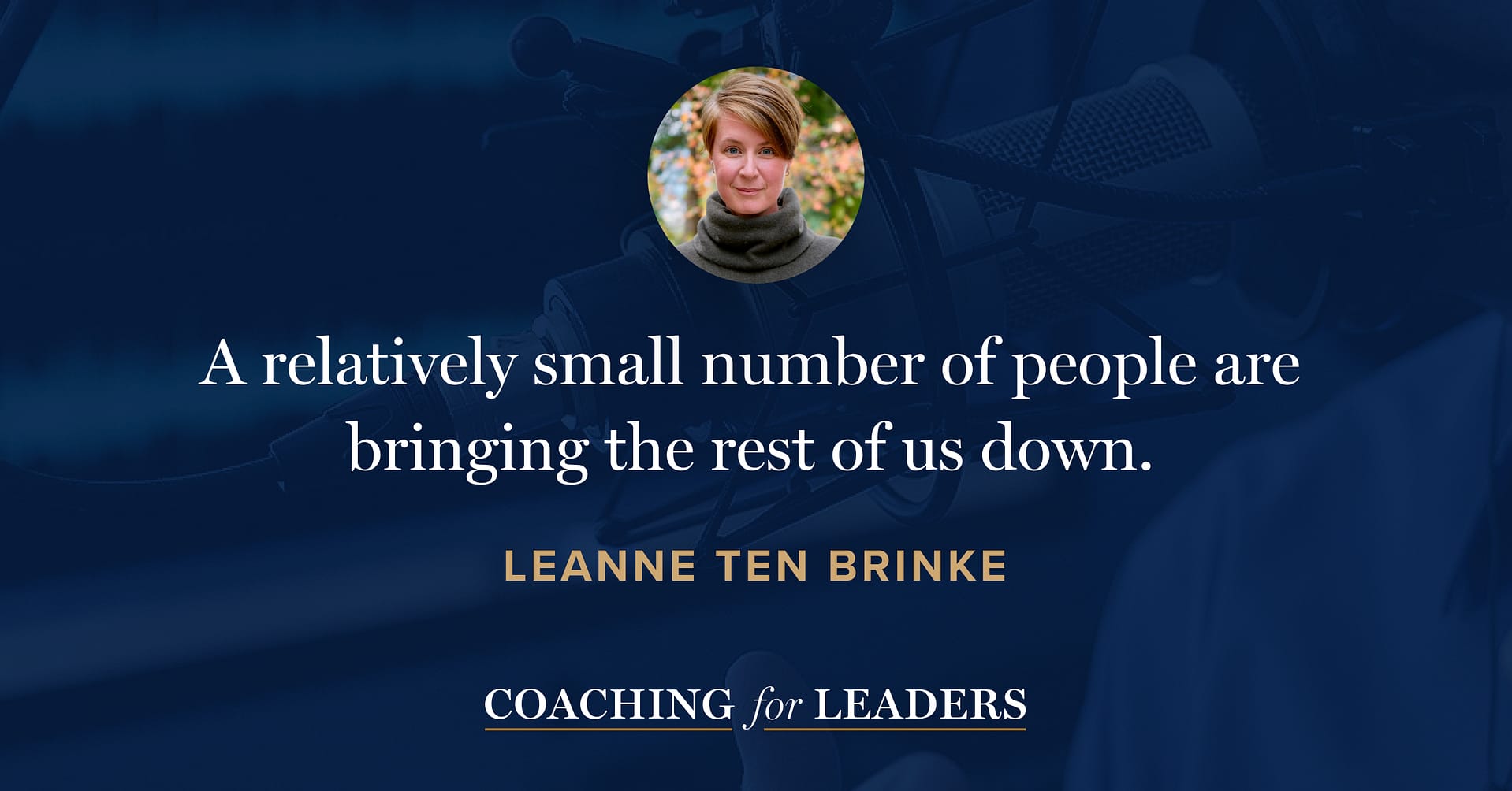
A relatively small number of people are bringing the rest of us down.
https://media.blubrry.com/coaching_for_leaders/content.blubrry.com/coaching_for_leaders/CFL788.mp3

Podcast: Download

Follow:
Apple PodcastsYouTube PodcastsSpotifyOvercastPocketcasts

Leanne ten Brinke: Poisonous People

Leanne ten Brinke is an Associate Professor at the University of British Columbia, where she directs the Truth and Trust Lab. Her research investigates trust, deception, and dark personality traits across diverse populations—from incarcerated individuals to hedge fund managers and politicians. She reveals how dark personality traits shape our institutions and relationships, while offering practical strategies to recognize and counteract their harmful influence. Her book is titled Poisonous People: How to Resist Them and Improve Your Life (Amazon, Bookshop)*.

If you are a leader, you are going to deal with poisonous people. Sometimes they will show up as clients, sometimes your boss, sometimes your peers, and sometimes the people you manage. Regardless of where they show up, this conversation with Leanne will help you handle this tough dynamic.

Key Points

  • Dark traits exist on a spectrum. While only 1% of the population rises to a clinical level of psychopathology, 10-20% of the population has a dark personality profile.
  • There are many more people with psychopathy per capita in senior management positions than in the general population.
  • Poisonous people generally aren’t interested in shifting their personality. As such, you will not change them. Given that reality, aim to better manage the relationship.
  • Establish clear boundaries with poisonous people and put things in writing you might normally assume. Dark personalities are really good at exploiting unspoken norms.
  • Find ways to create win-wins with poisonous people. They don’t do well with trade-offs, because they don’t like to lose anything.
  • Avoid face-to-face negotiations with them. Their charm and charisma will win you over in the moment. Text-based dialogue will help you objectively negotiate better.
  • Use the carrot instead of the stick. Reward good behavior when it happens (just not by giving them power over others).

Resources Mentioned

  • Poisonous People: How to Resist Them and Improve Your Life by Leanne ten Brinke (Amazon, Bookshop)*

Interview Notes

Download my interview notes in PDF format (free membership required).

Related Episodes

  • How to Handle a Boss Who’s a Jerk, with Tom Henschel (episode 164)
  • How to Start Better With Peers, with Michael Bungay Stanier (episode 635)
  • How to Show Up Authentically in Tough Situations, with Andrew Brodsky (episode 727)

Discover More

Activate your free membership for full access to the entire library of interviews since 2011, searchable by topic. To accelerate your learning, uncover more inside Coaching for Leaders Plus.
How to Work with Poisonous People, with Leanne ten Brinke

Download

Dave Stachowiak [00:00:00]:
Sorry to say that if you’re a leader, you’re gonna deal with poisonous people. Sometimes they’re gonna show up as clients, sometimes your boss, sometimes your peers. And sometimes it’s gonna be the people you manage, regardless of where they show up. This episode will help you handle this tough dynamic. This is Coaching for Leaders, episode 788.

Dave Stachowiak [00:00:24]:
Production Credit: Produced by Innovate Learning, Maximizing Human Potential.

Dave Stachowiak [00:00:31]:
Greetings to you from Orange County, California. This is Coaching for Leaders, and I’m your host, Dave Stachowiak. Leaders aren’t born, they’re made. And this weekly show helps leaders thrive at key inflection points. Well, here’s one of the realities of leadership: You’re gonna work with someone who is difficult, maybe even in the category of poisonous. And when you get into that situation, not if, but when, how do you handle that well? How do you manage that situation effectively? And how can you precipitate the best possible relationship with that person, regardless of who they are and what position they may have? Today, a conversation on exactly how to do that. I’m so pleased to welcome Leanne ten Brinke to the show.

Dave Stachowiak [00:01:13]:
Leanne is an associate professor at the University of British Columbia, where she directs the Truth and Trust Lab. Her research investigates trust, deception, and dark personality traits across diverse populations, from incarcerated individuals to head fund managers and politicians. She reveals how dark personality traits shape our institutions and relationships, while also helping with practical strategies to recognize and counteract harmful influence. Her book is titled Poisonous: How to Resist Them and Improve Your Life. Leanne, thank you so much for sharing your work with us. Glad to meet you.

Leanne ten Brinke [00:01:52]:
I’m glad to meet you, too, Dave. Thanks for having me.

Dave Stachowiak [00:01:54]:
This population of people, not an easy population to study, to be around, to get your life’s work into. What is it that attracted you to really learn about and research, and help people get better at this?

Leanne ten Brinke [00:02:09]:
Yeah, I always, when I get asked this question, I always wish I had, like, a better kind of villain origin story, but really, it was in grade 11 sociology class. My teacher, Ms. Louise Lorafish, she rolled in the, like, TV, VCR, convo, maybe that that is aging or dating me right now, but…

Dave Stachowiak [00:02:26]:
I remember those days.

Leanne ten Brinke [00:02:28]:
I know! That was always like a very exciting day to be in class, right? And she played this documentary about people with psychopathy. And it was kind of the, well, it was the first time I had heard about psychopathy, and it just seemed like such a, you know, different emotional experience, just a different way of moving through the world than I had ever kind of seen or understood. Certainly different than my own experience. And it was also the first time I realized that you could, like, study people for a living, which seemed so fascinating to me. And so I was just kind of hooked from there. And that’s when I started delving into the world of criminal psychology and kind of moved through different spaces from there.

Dave Stachowiak [00:03:13]:
Well, and it’s interesting you mentioned criminal, because when we think about psychopaths, that’s where our mind goes. Most of us, we think about that 1% of the population that has the, clinically are psychopaths. We often think of criminals. And your work is broader than that, though, in that we’re talking about poisonous people. And so when we think about that broader spectrum, who are we talking about?

Leanne ten Brinke [00:03:38]:
Yeah, so when I use the term poisonous people, I’m talking about those who have elevated levels of what psychologists call the dark tetrad of traits. And so this is a combination of four traits that are all related to each other. They are psychopathy, Machiavellianism, narcissism, and sadism. And so they each have their own kind of unique flavor, but they overlap in the sense in which they are all callous and manipulative, and they tend to be antagonistic. So they’re, they’re hostile toward other people. It’s more like you’re working against them instead of with them. And so these are all traits that exist on a continuum.

Leanne ten Brinke [00:04:18]:
If you looked at a graph of where people fall on these traits, it’s a relatively normal curve. It’s not like there’s a big a hump at the high end and a hump at the low end. There’s lots of shades of gray in between. And so what I’m talking about are people who score relatively highly, but there’s lots of kind of gray area in there. And what you use as a cutoff of, like, at what point does someone quote, unquote, qualify as a poisonous person, is going to impact the number of people who meet that kind of criteria?

Dave Stachowiak [00:04:53]:
Yeah. And it’s, I think, one of the really big messages I hear from you and your research is there’s a spectrum here. And so there’s, to paint the broader picture, there’s the 80 to 90% of the population, most of us, that don’t generally fall into this category. And then on the other end, there’s that 1%, the clinical psychopaths, right?

Dave Stachowiak [00:05:16]:
That’s the kind of thing we tend to think of when we think of psychopaths. And then for those doing the mental math, there’s another 10 to 20% in there. And that’s the part that’s really interesting of like, they’re not people that clear the bar of being clinical psychopaths, but they’re what you would call a dark personality profile. What’s that population like? That 10 to 20% of people?

Leanne ten Brinke [00:05:39]:
Yeah. So, you know, they… It’s interesting. It’s kind of like. It sounds unfamiliar, right, because we tend to think in these kind of black and white kind of buckets, right?

Dave Stachowiak [00:05:50]:
Yeah, yeah.

Leanne ten Brinke [00:05:51]:
Psychopath. You’re kind of like a serial killer type situation. But violence is not necessarily associated; it’s not like a criteria for psychopathy. Although it does tend to come along with that. We do know there’s lots of rule breaking is associated with psychopathy, so that could be kind of white-collar crimes or just breaking social norms. People with psychopathy tend to be quite manipulative and grandiose. They tend to be superficially charming.

Leanne ten Brinke [00:06:20]:
So the first time that you meet them, they might come across as quite likable and engaging. Although this does tend to wear off over time. They tend to have a pretty shallow emotional experience. So they don’t experience remorse or guilt in the same way that other people do. Which might explain why they engage in so much of this kind of rule-breaking or harmful behavior to others, because they don’t have that kind of internal punishment that the rest of us experience whenever we do things like that. And they tend to be pretty impulsive, so they’re very willing to take risks, and they live kind of a fast life. Less concerned about reputation over time, but very concerned about success right here and right now.

Dave Stachowiak [00:07:03]:
There’s some really interesting leadership implications for this, too, and that I think I know. I’ve had this experience in my life where someone close to me has described someone as a poisonous person, and clearly is. And then if you don’t know that person when you meet them for the first time, you often have the experience of, well, this person seems really captivating and charismatic and really fun to be around and lights up the room. And I, and the opposites happen to like some- I can think of times like someone in my life, I’m like, oh my gosh, this is such a poisonous person, and someone who didn’t know them them and then later on reflected back to me like, oh, I don’t know what you’re talking about. They’re so nice, you know, I mean, they can be really disarming and really charming, and like you said, especially in initial interactions, can’t they?

Leanne ten Brinke [00:07:55]:
Yeah, absolutely. And one of the reasons for these kind of differing experiences, where like, you know, first interaction, they might come across really charming, engaging, you think that they’re a great person, and then that wears off over time, is that people with these traits are manipulative. And as part of that, they tend to tell a lot of lies. And one of the problems with that is that people on the other end of that communication tend to have a truth bias. So by and large, we tend to believe the things that we hear unless we have some, you know, great reason to be suspicious or to think otherwise. And so we tend to believe their lies. So they’re both telling more lies, and just by virtue of that, they’re getting away with more lies because the rest of us are kind of sitting ducks. They also tend to be, you know, psychopathy is, is one part of the dark tetrad, but narcissism is another part of that.

Leanne ten Brinke [00:08:51]:
So those traits overlap. If you score high on one, you tend to score relatively high on the other. And we know that people with narcissism tend to come across quite confident, and that confidence can be read as competence. Right? And so that’s another potential problem, especially in organizations, when we’re thinking about promoting people, for example. If we’re reading people’s confidence as equal to their ability to do the things that they say they can, we might end up kind of choosing the wrong people for higher-level roles.

Dave Stachowiak [00:09:27]:
Well, speaking of higher-level roles, one of the lines I underlined in the book is this one, you write: One study found that there are about three times as many people with psychopathy per capita in senior management positions than in the general population. I read that, and I underlined it, and I thought to myself, yep, that is exactly lining up with my experience in working with our members, and listeners, and clients over the years of the people they’re interacting with. What I’m curious about is, do we know why that is?

Leanne ten Brinke [00:10:02]:
Yeah. So that stat comes from this great study by Paul Babiak, and Craig Neumann, and Bob Hare. And they didn’t explore exactly why these individuals had been promoted, but their results give us some hints. So we know that people with high levels of these traits tend to, tend to come across as very confident. They come across as kind of creative thinkers. But if you actually ask people like, oh, are they a good manager or do they follow through on the task that they’re supposed to be doing? The answer is no. So they tend to be like these kind of strategic thinkers, and they’re perceived that way as like tactful communicators, but it’s more like they talk the talk instead of walking the walk.

Leanne ten Brinke [00:10:50]:
That’s actually the name of the paper, which I thought was quite clever.

Dave Stachowiak [00:10:53]:
Oh, interesting.

Leanne ten Brinke [00:10:55]:
So that’s one of the reasons, is that they just, like, you know, might dupe us into thinking that they have these abilities or that they are willing to do some work that they don’t actually follow through on. But I think that’s only kind of part of the picture. And it. Honestly, I think it lets us off the hook a little bit because there’s also other research which suggests that we sometimes very willingly put these kind of domineering, callous, and manipulative people in positions of power quite willingly. So research finds, across a whole bunch of different studies now, that when we feel scared, when we’re in the midst of high economic inequality, when we’re in the midst of military action around us, like, we’re scared. And we want to have a strong leader who is going to support our group, make sure that our group wins. Right? And in those instances, we tend to gravitate toward these very domineering leaders.

Leanne ten Brinke [00:11:53]:
And that is the kind of leadership that people with dark traits provide. And so I think the problem with that approach is that we also know that people with dark personality traits tend to kind of enshrine, like chaos and division, and they isolate employees from each other whenever they’re put in these positions of power. And so while we might want someone really strong to usher our organization or our group more broadly into a better position, I do not think that dark personalities are the people we should trust to do that.

Dave Stachowiak [00:12:32]:
Well, it gets back to what we were talking about earlier, that on their face, they can be very attractive, charming, confident, charismatic. And so when we… I think, just thinking about the picture you painted, when things are uncertain, we, for better or worse, as human beings, as our society, we tend to look to that kind of person to bring order. And sometimes we shoot ourselves in the foot as an organization by elevating those folks when maybe they’re not the best person for the role. Right?

Dave Stachowiak [00:13:05]:
Which leads to the, okay, what do we do? Right? I think, though, one of the really helpful things about your work is, you have surfaced some really helpful, you frame them as rules of, if you are in a situation where you are working for someone who’s a poisonous person, you have a colleague, maybe someone reports to you, who’s a poisonous person, what can you do? Before we get into them, though, I think maybe it’s helpful to say what we can’t do, because we’re generally not going to change them. We’re not going to change their traits, are we?

Leanne ten Brinke [00:13:33]:
Yeah. So I mean, personality is defined as consistent patterns of thinking, feeling, and behaving over time and context. And that consistent and pattern part is very important part of that definition. Right? Personalities can change, but they tend to do so very slowly and usually only if we put a lot of effort into doing so. And people with dark personality traits tend to be very unmotivated to change. Like it’s more of a you problem than a them problem. Right?

Leanne ten Brinke [00:14:04]:
And so no matter how much you want them to change, that is not kind of correlated with the likelihood that they actually will change. So I think unless you see some real cues that they intend to take up some therapy, try to do something to change their personality, I think you can be pretty certain that this is going to be a long-term type of problem that you’re going to have to manage. And so, then I think there’s a couple of different things. You know, you can, there’s always a choice to kind of stay or go. And that can be, it’s difficult to make that decision. No one else can make that decision for you.

Leanne ten Brinke [00:14:46]:
And obviously, that can be incredibly complicated for a million different reasons. But one thing that I think can be useful, especially in the organizational context, is to think about sunk costs. If you are sticking around in a job where you’re working with a colleague or a boss who has these traits and it is just draining you, you might be thinking like, I put so much time and energy into getting this job, into working my way up in this job, that it would be a shame to leave now. That’s, you know, that kind of sunk cost fallacy. But one thing that is really useful to think about, if that is in fact what’s just keeping you stuck there, is to think about the cost to other people if you stay. So research finds that with sunk costs, we might be very willing to kind of endure those costs ourselves, to keep going to work, even though it is stressful and draining to ourselves. But research finds that we don’t keep that stress at work. Right?

Leanne ten Brinke [00:15:48]:
We get in our cars, we get on the train, we come home, and we bring that stress home with us. And research finds that if you are working for a boss with high levels of these psychopathic traits, you also tend to have more conflict at home. And so, are you willing to put your family, your friends, your kids through this kind of conflict that you are bringing home because of that stress that is coming from work? And maybe that will be the thing that will kind of release you from that sunk cost that’s keeping you there. That said, you know, if you got to stick around in this job, you really want to stick around in this job, there are things that you can do to make it better. So perhaps you don’t have so much stress to bring home with you.

Dave Stachowiak [00:16:35]:
Yeah. And I so appreciate you framing that perspective, because I think there’s the tendency to, when confronting the reality that in most of these situations, you’re not going to really affect a person’s behavior that much, like if they are truly kind of in this dark personality profile. But once you sort of make peace with that a little bit, then I think you get to a healthier place of, okay, what can I do to manage the situation better? That’s going to be better for them, better for me, better for my team and my organization. To your point, better for my family. If in a situation where you’re being influenced by this person and, also with the very realistic, this is not going to be a great, healthy relationship, but there’s some things I can do that will help make it better. And that’s maybe a good lead into one of the rules that you have for us, which is establishing clear boundaries with someone who falls in this category. And you point out that people with darker personalities are really good at exploiting unspoken norms.

Dave Stachowiak [00:17:38]:
Tell me more about that.

Leanne ten Brinke [00:17:40]:
Yeah. So, I mean, if you think about it, a lot of the ways in which we interact with other people are not governed by, like, norms that are written down. They’re governed by these social norms that are kind of unspoken, but which we all abide by. And it just allows our interactions to go more smoothly. But I spoke with one individual as I was writing my book, and she had been diagnosed with psychopathic personality disorder. So she had very high levels of psychopathic traits. And she actually described that she made it kind of a mantra of hers that she would only follow explicit rules because those were the only ones that could be, like, proved against her. Right?

Dave Stachowiak [00:18:21]:
Huh.

Leanne ten Brinke [00:18:22]:
She- If there were just social norms handed down, she kind of just didn’t, didn’t consider those. Like, if that would get in the way of her getting what she wanted, that was not at all a problem to her. She would very quickly violate those unwritten social rules. So there is some benefit to writing these things down, and there’s actually research to support that. So there’s this great paper where researchers told people, and maybe this, you know, is similar to a scenario that you might have at work, where people in the study got a bunch of money, and they got to distribute it amongst a group of people. So you might imagine like a manager getting to distribute bonuses amongst their team.

Leanne ten Brinke [00:19:04]:
And if they were given no instructions, people with high levels of psychopathic traits tended to keep most of that money for themselves. Right?

Dave Stachowiak [00:19:12]:
No surprise.

Leanne ten Brinke [00:19:14]:
Not particularly fair or kind. Probably not very good for team morale either. But there was no rules. So, like, they would, they did what was good for them. Right? But whenever people were given rules saying, ” You must distribute this fairly, you know, we’ll check up on it, and we’ll redistribute it. If you don’t follow the rules”. Then people with high levels of psychopathic traits distribute the money fairly, just like everybody else.

Leanne ten Brinke [00:19:42]:
So writing these things down and keeping an eye on people’s behavior is useful. It does not mean that they will always follow the rules, because rule-breaking is kind of part of that personality trait, but it increases the likelihood that they will. And this is something that, like, maybe you’re in a workplace where you have a respectful workplace policy. Right? I know I have one of these at my workplace. And when I saw it, I was like, this is kind of crazy. Like, why do I need to write this down? Right? But this is exactly why you need to write this down. Now that I’ve done this research, I’m like, oh, that’s why they wrote it down. That makes sense.

Leanne ten Brinke [00:20:20]:
Because if there, if it is not written down, there’s nothing that you can do when they violate it. Right? And simply just writing it down and making those boundaries and rules explicit is helpful in terms of kind of corralling their behavior.

Dave Stachowiak [00:20:33]:
When it’s someone who’s poisonous, who has power over you, and I’m thinking, most notably with our audience, it’s a manager. My direct manager is, falls in this category of being a poisonous person. What does established, clear boundaries look like? Is there a way to do that artfully with someone who’s got power that still gets to making this a little bit better?

Leanne ten Brinke [00:20:57]:
Yeah, I mean, I think you need to think about what is your job? What does your job require you to do? Like, maybe, and I think I have been in the experience, other people probably have as well, where a boss with some of these traits is sending you messages at 3 am, being like, you need to do this, and I need it done, you know, at this ungodly hour in the morning, I need it done yesterday. And those are not your working hours. Right? I don’t need to be at your beck and call. That is actually not in my, in my contract. Right?

Leanne ten Brinke [00:21:30]:
So you could say simply just say things and literally write it down, put it in email, put it in Slack, put it wherever, where like, I’ll be responding to emails between these times and these times. Right? So, literally making it explicit that these are your boundaries.

Dave Stachowiak [00:21:47]:
It is really interesting getting into your research, looking at all the, by the way, there’s some incredibly powerful and also heartbreaking examples in the book. But it is also really interesting when people get clear with boundaries when things go in writing, when the things that a lot of us just sort of take as social norms actually get documented and get really explicit, how it does make a lot of these situations go better, sometimes better permanently, like really manageable. Again, it’s not like that person becomes best friends or anything like that or would still want to work with that person necessarily, but it, it really does shift it in some, some, some healthy ways to manage it better.

Leanne ten Brinke [00:22:27]:
Yeah, I mean, it sounds like a small thing, but I think it is actually quite useful, and research shows that it’s quite useful to write these things down. And beyond even just people with dark personality traits just having like a shared understanding of what your job is, when you’ll be doing it, those kinds of things are really helpful to kind of everyone on your team, so that they know what they can and should expect of you, and then what you can and should expect of other people.

Dave Stachowiak [00:22:56]:
Yeah, well, and I think you said it, it’s, it’s a small thing to us often, because a lot of us don’t think about it, we just think oh, it’s a social norm. But, but wow, it can make a really big difference in a situation like this, so it’s huge. So one of the other rules that you invite us to think about is to find win-wins with people who have dark traits. And you say that people in this, people with the dark traits, they aren’t good with trade-offs. What do you mean by that?

Leanne ten Brinke [00:23:27]:
Yeah, so we actually did some research while I was at UC Berkeley. I was in the Haas School of Business, and I was really interested in how personality traits would impact people’s ability to negotiate. I kind of thought that people with these dark traits would be like really impressive negotiators. They would extract as much value as possible, essentially from every negotiation. And what I found is that whenever people had very divergent interests, right, like they both, they wanted the opposite things out of a negotiation. One person wanted to get as much money for this item, and the other person wanted to pay as little as possible for the same item. The people with high levels of dark traits, particularly psychopathy, they got more money. They, they won, so to speak, in those kinds of interactions.

Leanne ten Brinke [00:24:18]:
But where they did really poorly is where they had an interest in a particular item, and they didn’t care so much about, say, another item. You could trade those off. Right? And be like, oh, I’ll give you the thing that you want, and you give me the thing that I want. And like, everybody wins. Right? That would be the most optimal way to negotiate on these two issues. But they could not do that.

Leanne ten Brinke [00:24:40]:
They were not good at, like, give something you don’t even care that much about to get something you really care about that felt like losing to them. They didn’t want to give up something to get something. So they tended to do relatively poorly on those kinds of, like, integrative bargaining solutions.

Dave Stachowiak [00:24:58]:
And when you say they did poorly, they did poorly for themselves, or that the negotiation in general just went to, tended to go poorly for both parties.

Leanne ten Brinke [00:25:07]:
Yeah, it was as a dyad. So if you took the kind of total psychopathy score for the two people involved in that negotiation, the higher it was across those two people, the less optimal their solution was in that integrated bargaining.

Dave Stachowiak [00:25:25]:
Interesting.

Leanne ten Brinke [00:25:26]:
scenario, yeah. So you only need one person with the high traits to get that kind of poor outcome. But if you’ve got two people with high levels of those dark traits, then neither one is really willing to give a little to get a lot. And so you get very suboptimal solutions in that case.

Dave Stachowiak [00:25:45]:
Yeah. And it’s, I mean, it’s really, again, really interesting, like how a person with some of these traits thinks about it really differently than the larger population of- A lot of times we think about negotiation like, oh, I’ll give up something that I don’t feel as strongly about, but they’re like, no, I’m losing if I do that. And so, the key here is, find the things that you both really care about that, like, it’d be wins for both parties. I think that’s the, that’s the shift I’m hearing.

Leanne ten Brinke [00:26:10]:
Exactly. And it can be like, it can be a win for them for a different reason than it’s a win for you. Like, maybe you think that it’s, this is the right thing to do, this solution is the right thing to do. That is probably not going to be particularly compelling to them if it also happens to be a thing that is likely to get them attention. That’s the thing that they care about. If it’s a thing that’s likely to make them money. If it’s a thing that’s likely to gain them more dominance. So you can do some work, of just like, framing accordingly.

Leanne ten Brinke [00:26:41]:
Like, the reason why this outcome is beneficial to you doesn’t have to be the same reason why the outcome is beneficial to them.

Dave Stachowiak [00:26:49]:
Well, one of the rules around negotiation, specifically, when you’re negotiating with a poisonous person and is you say, avoid doing it face to face. Which, when I was getting into that, I was thinking, like, how different that advice is for what we normally tell people to do, like difficult situations. Sit down, do it first face-to-face, do it live. That’s where you get the most rich interaction. That’s where, like, we’ve all heard that advice many, many times. We’ve talked about on the show many times. But with a person with dark, with dark traits, you say, no.

Dave Stachowiak [00:27:22]:
What’s the reason for dating going the other way?

Leanne ten Brinke [00:27:25]:
Yeah. So this is really interesting work. And actually, Juliana Schroeder at UC Berkeley just had a paper come out like a couple of days ago on how conflict interactions go much better when they’re kind of in person versus in written form, which sounds like the opposite, right, of what I’m talking about here and what you just said. And I think that that is true except for in the case of dark personality. So if you know that you are talking to someone with high levels of these traits, we know that they can be very charismatic in person. Right?

Leanne ten Brinke [00:28:02]:
They can be very convincing in person. They can also be very domineering in person. Right? They can be kind of intimidating. Right. Perhaps physically, they can be threatening. And it can be very difficult to perhaps hold to your boundaries in person when they are requesting that you do something that would violate those things. And research has found that in negotiations, if you do that negotiation in person with someone with dark traits, you tend to get a, a raw deal relative to if you do that over text or email.

Leanne ten Brinke [00:28:34]:
And the reason for that is that it takes away some of their. Their charm in person, which is how they get, you know, a better deal for themselves than you get. And it also gives you time to manage your emotions, to kind of think through your responses, maybe allow you to hold to those boundaries a little bit better when it feels like they’re being pushed on, because people with dark personality traits tend to push on those boundaries. And it also provides you with a record of what was said. Right? So we can’t kind of change the landscape a little bit later and say, ” Oh, we agreed to this”, when actually, in fact, you’ve got it in writing what you literally agreed to.

Leanne ten Brinke [00:29:21]:
So I totally. I get the advice, like whenever there’s conflict and, you know, having difficult conversations often go better in person. That’s when you’ve got another person in front of you who cares about your perspective. Right? And who wants an outcome that is win-win for both of you. Right? They want to resolve this conflict. They want everyone to be happy with the outcome.

Leanne ten Brinke [00:29:45]:
That is not the case for someone with high levels of these traits. They want to win, and more than that, they want you to lose.

Dave Stachowiak [00:29:52]:
Yeah. They’re operating from an entirely different playbook. So if you use the same playbook that you would use in most situations, it just is likely to backfire. And again, so many examples you talk about in the book that when people do this, I mean, the kinds of things we wouldn’t normally think to do, like handle a situation like that over text, a lot of people who listen the show would be like, why would I do that? And yet when they do, they tend to do better with this kind of a person. It’s really interesting.

Leanne ten Brinke [00:30:18]:
Yeah, absolutely. It totally takes away some of their power. Their power of persuasion seems to be in that kind of face-to-face interaction. And so simply just moving to text takes that away.

Dave Stachowiak [00:30:30]:
One more thing you highlight is to use the carrot, not the stick, which we talked earlier about, establishing clear boundaries and being really clear with that. So in a way, this almost sounds a little different of like, wait a minute, shouldn’t we be having consequences when someone violates boundaries? What is it about rewarding good behavior that tends to work with these folks versus maybe a punishment?

Leanne ten Brinke [00:30:59]:
Yeah, so what’s really fascinating about psychopathic personality traits is that there are neurological differences. If you have very high levels of these traits, your brain works a little differently than other people’s. And one of the ways in which it works differently is that it is less sensitive to punishment. And so if I am punished for doing some kind of behavior, whenever I gravitate toward that in the future, I get this kind of knee-jerk reaction like, oh, no, don’t do that again. That didn’t work out very well for me last time. People with high levels of psychopathic traits don’t really experience that, so the punishment doesn’t hit as hard. Now, you can still punish. If you do, you should draw attention to that punishment because attention is part of the problem, part of why they don’t kind of register it in the same way.

Leanne ten Brinke [00:31:47]:
So if you’re gonna like take away part of their bonus for some sort of workplace infraction, then make sure you call their attention to it every time you take a little bite out of their bonus. That might help improve the consequences of deception or sorry, of punishment a little bit. But what’s really useful is that they are like, punishment doesn’t work so great, but they are very reward sensitive. So if you can reward them for doing good things, you’re more likely to get more of that behavior in the future. Right? With punishment, we’re trying to like extinguish behavior. With reward, we’re trying to amp up a behavior that we like. And it’s absolutely possible that someone with high levels of these traits can do good things.

Leanne ten Brinke [00:32:31]:
Sometimes they can be honest or fair or produce really good work for you, whatever that kind of work is. And when they do that, you should not be thinking like this is a bad person. I never want to give them any kind of reward. You should be thinking, ” Oh my God, what a great opportunity for me to reinforce this behavior so that I get more of it in the future”.

Dave Stachowiak [00:32:56]:
I’m hearing two really clear things there. One of them is, I don’t think either of us are suggesting there shouldn’t be consequences for violating norms. Right? But what we are suggesting is that just think about the both-and here of knowing that that’s not likely to be as effective with this population. And then the second part of it is, find the, like, reward the good behavior, the things that are true. Don’t just make stuff up, obviously, but when someone truly does the behavior who’s kind of like falls in this category of person, but they truly exhibit good behavior of like noticing that, affirming that, responding to it, that can go a long way to help the relationship to be a lot healthier, them to do the actions in the workplace that are going to support them. And that can work in lots of direct, even if that person’s your manager, that can work in that direction.

Dave Stachowiak [00:33:44]:
If you call attention to like, oh, this thing that you did. I noticed you didn’t text like, you texted me this morning versus last night. Thank you so much for doing, I mean, there’s so many ways you could affirm that, right?

Leanne ten Brinke [00:33:54]:
Absolutely. And I think you can also think about the things that are rewarding to them. You know, so things like they’re interested in attention and praise, they’re interested in money. So if you are, you know, if you’re a manager and you have the opportunity to provide a bonus, that could be a good way as well. One thing that I would not recommend is putting them in positions of power over others. That is something that they really want, but that is likely to have lots of negative downstream consequences. I think what you would want to do is you could give someone a new title.

Leanne ten Brinke [00:34:29]:
You could give them, you know, an office with a view. You could give them a raise. But giving them power over people is probably not the right way to reward them.

Dave Stachowiak [00:34:39]:
I know there’s someone listening right now who’s like, yeah, I wish our organization had followed that rule because the person I’m working for is that situation. But yeah, I mean, to state the obvious, like a lot of the things we traditionally think of that we would do with most people, it’s thinking about it with a different playbook with this kind of a person. So, Leanne, I have two really big thoughts at the end of this conversation. One of them is, I hope that the person we’ve described, the folks listening, I hope that’s not the person who’s your boss. I hope that’s not the person who’s the number one colleague you have to work with each day. But secondly, if that person is, you need to get this book and read it cover to cover, and it’s a fairly short read. You’ve done an amazing job of helping to understand the practical research behind this, the rules of how to work with people. So many of the implications we didn’t even talk about.

Dave Stachowiak [00:35:28]:
And so, Leanne Ten Brinke is the author of Poisonous People: How to Resist Them and Improve Your Life. Leanne, thank you so much for doing this work for all of us. So appreciate it.

Leanne ten Brinke [00:35:39]:
I appreciate chatting with you, Dave.

Dave Stachowiak [00:35:46]:
While I hope you’re not dealing with a poisonous person now, we also know from the statistics, as we talked about in this conversation, that so often leaders are handling this on a pretty regular basis. If that is the case for you, my heart goes out to you, and I hope that this conversation was helpful to you in getting started on some next steps. In addition, there’s several other episodes that’ll be useful to you if you find yourself in a tough situation with folks. One of them is episode 164. My friend Tom Henschel and I, Tom, from the Look and Sound of Leadership podcast, talked about how to handle a boss who’s a jerk. We talked about some of the things we mentioned in this conversation. Also, some additional tactics and strategies if the person that you’re running into with that poisonous perspective is your boss right now. Episode 164, I think, is a great compliment to this conversation to put them together for what you do next.

Dave Stachowiak [00:36:35]:
Also helpful episode 635: How to Start Better With Peers. Michael Bungay Stanier was my guest on that episode. We talked about his framework for keystone conversation and how to create what he calls the best possible relationship. Oftentimes, we think of our relationships, of course, of wanting them to be as ideal as possible, and that’s just not realistic with many relationships, and it’s certainly not realistic with a poisonous person. In episode 635, we talked about what’s a framework we can start with, getting to a place of that language that Michael uses, of what’s the best possible relationship given the situation, given the people who are showing up with it. I think it’s a great compliment again to this conversation. And then finally, I’d recommend episode 727: How to Show Up Authentically in Tough Situations. Andrew Brodsky was my guest on that episode, and we talked about something that Leanne and I mentioned in this conversation, too, which is a lot of the assumptions that we’ve had and the good advice that many of us heard over the years, of always have that tough conversation in person, always do it face to face. That does work really well in many situations, but there are some situations where not only does that not work as well, but in fact can be counterproductive.

Dave Stachowiak [00:37:43]:
Andrew and I talked about that from his research on looking at virtual communication. Where does in-person help a lot? Where does over the phone help? Where does sometimes being on Zoom or handling things by text more helpful? So many nuances to that that I think a lot of times I know I didn’t appreciate until getting into their work. Episode 727 for that. All those episodes you can find on the coachingforleaders.com website, and I’m inviting you today to set up your free membership at coachingforleaders.com, because one of the topic areas we have inside the library is difficult situations. Leaders deal with difficult situations all the time and difficult conversations all the time. That’s why we’ve done dozens and dozens of episodes like this over the years to help you to zero in on the situation you’re dealing with right now, and most importantly, to be able to have some practical next steps that make things easier for you, for your team, and help everyone to thrive just a bit more. Going over to coachingforleaders.com and setting up your free membership will give you access to the entire library, searchable by topic. Full access on all the podcast apps for free of our entire library, of course, but the apps don’t allow you to search by topic. And that’s why we’ve created that on the website so you can track down what you’re looking for right now.

Dave Stachowiak [00:38:52]:
Coachingforleaders.com to set that up. Plus, you’re going to get all the benefits of free membership, including my weekly FocusFive message. I’m sending one message a week with five things that will help you to thrive in whatever inflection point you’re at right now. Coachingforleaders.com to set that up for yourself. Coaching for Leaders is edited by Andrew Kroeger. Next Monday, I’m welcoming David Epstein to the show. We are going to be talking about the counterintuitive secret to creativity and focus. And what is that counterintuitive secret? Well, comes down to one word, constraint.

Dave Stachowiak [00:39:28]:
Join me for that conversation with David. Have a great week and see you back on Monday.

Topic Areas:Difficult SituationsInfluence
cover-art

Coaching for Leaders Podcast

This Monday show helps you discover leadership wisdom through insightful conversations. Independently produced weekly since 2011, Dave Stachowiak brings perspective from a thriving, global leadership academy of managers, executives, and business owners, plus more than 15 years of leadership at Dale Carnegie.

Listen Now OnApple Podcasts
  • More Options
    • YouTube Podcasts
    • Spotify
    • Overcast

Activate Your Free Membership Today

Access our entire library of Coaching for Leaders episodes from 2011, searchable by topic.
Listen to the exclusive Coaching for Leaders MemberCast with bonus content available only to members.
Start Dave’s free audio course, 10 Ways to Empower the People You Lead.
Download our weekly leadership guide, including podcast notes and advice from our expert guests.

... and much more inside the membership!

Activate Your Free Membership
IMAGE
Copyright © 2026 · Innovate Learning, LLC
  • Plus Membership
  • Academy
  • About
  • Contact
  • Dashboard
×

Log in

This site is protected by reCaptcha and the Google Privacy Policy and Terms of Service apply.
 
 
Forgot Password

Not yet a member?

Activate your free membership today.

Register For Free
×

Register for Free Membership

Access our entire library of Coaching for Leaders episodes from 2011, searchable by topic.
Listen to the exclusive Coaching for Leaders MemberCast with bonus content available only to members.
Start Dave’s free audio course, 10 Ways to Empower the People You Lead.
Download our weekly leadership guide, including podcast notes and advice from our expert guests.

... and much more inside the membership!

Price:
Free
First Name Required
Last Name Required
Invalid Username
Invalid Email
Invalid Password
Password Confirmation Doesn't Match
Password Strength  Password must be "Medium" or stronger
This site is protected by reCaptcha and the Google Privacy Policy and Terms of Service apply.
 
Loading... Please fix the errors above