• Skip to primary navigation
  • Skip to main content
  • Skip to primary sidebar

Coaching for Leaders

Leaders Aren't Born, They're Made

Login
  • Plus Membership
  • Academy
  • About
  • Contact
  • Dashboard
  • Login
Episode

How Leaders Turn Conflict Into Progress, with Priya Parker

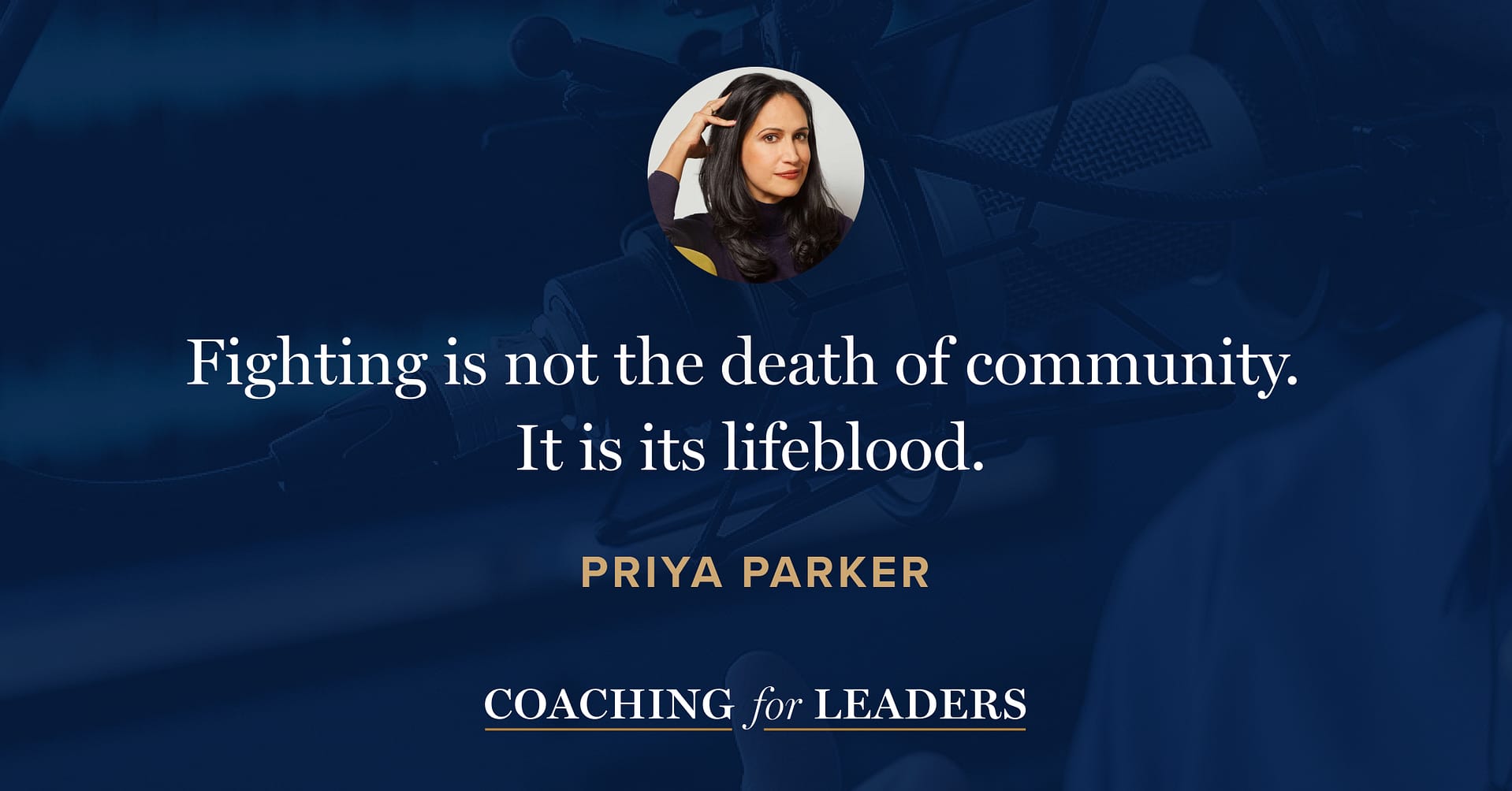
Fighting is not the death of community. It is its lifeblood.
https://media.blubrry.com/coaching_for_leaders/content.blubrry.com/coaching_for_leaders/CFL802.mp3

Podcast: Download

Follow:
Apple PodcastsYouTube PodcastsSpotifyOvercastPocketcasts

Priya Parker: The Art of Fighting

Priya Parker is a facilitator, strategic advisor, bestselling author of The Art of Gathering, and executive producer and host of the New York Times podcast, Together Apart. Trained in the field of conflict resolution, she has spent 20 years guiding leaders and groups through complicated conversations about community, identity, and vision at moments of transition. She is the author of the new book, The Art of Fighting: The Transformative Power of Conflict (Amazon, Bookshop)*.

Often we assume that good leaders and good teams don’t fight. In this conversation, Priya tells us that, “Fighting is not the death of community. It is its lifeblood.” We explore how to turn conflict into progress.

Key Points

  • Even experts who handle group conflict often find it challenging, fearful, and unsettling.
  • Becoming a durable, sustainable group does not happen without a fight.
  • One of the biggest myths that hold leaders back is that “good” people and “good” groups don’t fight.
  • There’s a seniority caveat to conflict. Leaders often confuse what needs to be felt with what needs to be said.
  • It’s a lie to believe that “if only” one thing hadn’t happened that conflict would not have occurred. If it wasn’t that, it would have been something else.
  • Milestones, transitions, schedule changes, and celebrations are often triggering events for conflict. Instead of thinking, “This is the worst timing,” expect conflict at these times.

Resources Mentioned

  • The Art of Fighting: The Transformative Power of Conflict by Priya Parker (Amazon, Bookshop)*

Interview Notes

Download my interview notes in PDF format (free membership required).

Related Episodes

  • How to Create Meaningful Gatherings, with Priya Parker (episode 395)
  • The Way Out of Major Conflict, with Amanda Ripley (episode 529)
  • How to Help Difficult Conversations Go Better, with Sheila Heen (episode 655)

Discover More

Activate your free membership for full access to the entire library of interviews since 2011, searchable by topic. Go beyond the podcast to find the right ideas and apply them with confidence inside Coaching for Leaders Plus.
How Leaders Turn Conflict Into Progress, with Priya Parker

Download

Dave Stachowiak [00:00:00]:
Often we assume that good leaders and good teams don’t fight. But fighting isn’t the death of community. It turns out it’s exactly what keeps it going. In this conversation, how to turn conflict into progress. This is Coaching for Leaders, Episode 802.

Dave Stachowiak [00:00:18]:
Production Credit: Produced by Innovate Learning, Maximizing Human Potential.

Dave Stachowiak [00:00:26]:
Greetings to you from Orange County, California. This is Coaching for Leaders. And I’m your host, Dave Stahowiak. Leaders aren’t born, they’re made. And this weekly show helps leaders thrive at key inflection points. What’s an inflection point we all run into pretty regularly in our work? Conflict. Conflict comes up for all of us. It comes up personally, certainly, but it also comes up professionally.

Dave Stachowiak [00:00:51]:
It comes up in our teams, our groups, our organizations, sometimes even our industries. And it is a challenging thing for all of us to navigate, even though theoretically most of us know that conflict is important and valuable, when we get into it, it’s often so hard to figure out how do we approach it and what do we do next. Today’s conversation is going to help us to navigate that well, and I’m so glad to welcome someone who’s so good at this, and it’s going to help us to really illuminate a path that’ll help us to take that next step. I’m so pleased to welcome back to the show Priya Parker. She is a facilitator, strategic advisor, bestselling author of The Art of Gathering, and executive producer and host of the New York Times podcast, Together Apart. Trained in the field of conflict resolution, she has spent 20 years guiding leaders and groups through complicated conversations about community, identity, and vision at moments of transition. She is the author of the new book, The Art of Fighting: The Transformative Power of Conflict. Priya, welcome back to the show.

Priya Parker [00:01:50]:
Thank you so much for having me.

Dave Stachowiak [00:01:52]:
There is a tendency to think that someone who writes a book about the value of conflict really loves conflict and handling conflict, and all this comes really naturally. And I know from getting into your work and reading 2 of your books that that is not necessarily the case, is it?

Priya Parker [00:02:10]:
I am third-generation ostrich on both sides. When, when conflict arises, everyone in my lineage has been taught to duck. And many of the best fighters I know, and many facilitators I know, are recovering conflict-averse people who have realized it’s a learnable skill and that there’s great loss in avoidance.

Dave Stachowiak [00:02:38]:
Well, throw me in the category of this as well too.

Priya Parker [00:02:42]:
Really?

Dave Stachowiak [00:02:43]:
Recovering. Oh, absolutely. Absolutely.

Priya Parker [00:02:45]:
We can form a club.

Dave Stachowiak [00:02:46]:
Exactly. Exactly. Well, this leads into conflict, which is, you write in the book, I’m gonna read a couple of sentences: We treat conflict as harmful, immoral, or toxic. Yet conflict is everywhere in every relationship and group. It’s normal, natural, and necessary. In fact, it’s hard to become a durable group without a fight. What is it that’s so necessary about conflict?

Priya Parker [00:03:11]:
Conflict is relevance. We don’t fight about the things we don’t care about, and we don’t fight with people we don’t care about. And I should say, The Art of Fighting is not about screaming at strangers on the internet.

Dave Stachowiak [00:03:26]:
Right.

Priya Parker [00:03:26]:
It really is the core, the question central to this book is, how do you fight with those you want to belong to? Whether a team, whether a church or synagogue, whether a family. And so much of what we think about in terms of conflict is sort of fighting with the enemy. Right? Or those people out there. And yet conflict is the, kind of, the beating pulse of what is central to a group. So when we don’t actually have the skills to approach it, and if we actually see it as immoral or toxic or dysfunctional, we’re often leaving a lot of the most important energy and care on the table. And we tend to also think that by not facing a particular fight, we’re sort of protecting the group. But often avoidance leads to exiting to blander groups, also to distance. And so part of what I wanted to do was, I’m a conflict resolution facilitator, and I work in many organizations, and I decided I want to write this book, The Art of Fighting, in the summer of 2020, which you may or may not remember; there were a lot of reckonings happening.

Dave Stachowiak [00:04:44]:
Yeah.

Priya Parker [00:04:45]:
And there were groups and companies and organizations imploding all over the place. And I am a facilitator, and so I was in many of those Zooms. And organizations and leaders bring in lawyers, and lawyers can do very important work. And then, there’s some leaders who also realize that they need to restitch the fabric between people. And so I found myself inside many of these tiny little Zoom squares. And one of the things that I saw, and my clients would agree with me, was that our organizations and our teams tend to oscillate between unhealthy peace, which is sort of avoidance, pretending everything’s fine, never having the real conversations, and unhealthy heat or unhealthy conflict, which is then escalation, burning the house down, domination, manipulation, even abuse. And part of what I saw when I was invited inside to work with these organizations is we see conflict as dysfunctional. So then we also then don’t aspire to it as a learnable skill, which it is.

Priya Parker [00:05:50]:
And then we also don’t have collective conflict rituals to help us hold the heat. We have court, and we have union negotiations, but those are very extreme and also very specific collective constructs that we need, but we should have so many more ways to help us hold heat.

Dave Stachowiak [00:06:12]:
And also super expensive and time-consuming, both of those too, right?

Priya Parker [00:06:16]:
Absolutely. I mean, I’ve had labor organizers on the labor side of union negotiations tell me, “We have so few ways to have collective voice in any of these organizations that often union negotiations are actually holding way too much”. The union negotiation process isn’t designed to talk or argue about mission or talk or argue about interpersonal dynamics. It’s designed to negotiate, often, material benefits. But because we don’t have other ways of sort of releasing steam of, not just one-on-one feedback, but ways for groups to hold heat- these rituals we have are bursting at the seams.

Dave Stachowiak [00:06:56]:
There’s a big assumption about conflict that many of us hold. And that assumption is that, quote unquote, good people and quote unquote good groups don’t fight. That if people and groups had their act together, conflict wouldn’t be necessary. And when you hear that from leaders, either say that explicitly or just are saying that in the context of a conflict that’s come up, what do you tell them?

Priya Parker [00:07:24]:
Welcome to a massive myth. Welcome to, I mean, a distortion. And I’ll get a call, and whether it’s a leader, whether it’s a manager, whether it’s somebody who’s realizing that their group needs to have a conversation that they’ve been avoiding, the predominant feeling on the phone from the caller is, “Priya, make this go away”.

Dave Stachowiak [00:07:49]:
Mm-hmm.

Priya Parker [00:07:50]:
I don’t make these feelings go away, make this problem go away, make this conflict go away. And the first thing I say to them is, I’m not here to make this go away. I’m here to help you actually better understand what is happening, why it is happening, to ask quote-unquote dumb questions, and then to help you determine what the actual need is of the group. I see conflict as really relevant data. And if I’m successful at the end of that call, I’m also helping that person see that all groups fight. All, in fact, conflict is functional. You can’t form without a group without conflict. Literally, in group theory and group dynamics, Bruce Tuckman’s work from the 1960s, 1965- he wrote a paper that basically said that all groups to form, to perform, they have to first Storm, which is there, a group forms, whether you’re a team, whether you are at church, whether you’re a trivia night, and it goes fine for a little bit.

Priya Parker [00:08:54]:
And then if it lasts long enough, which is a big if, if it lasts long enough, meaning if there’s enough juice in it, if there’s relevance in it, if people seem to be enjoying it, if there’s a there there, a period of conflict ensues. And it has to, because that’s when a group goes from sort of an event or a happening into a structure. And you have to answer questions like, what are we doing here? What are we about? What time of day do we meet? Which day do we meet? A lot of fights actually happen because of schedule changes. And if you don’t actually know how to have this question of who are we and what are we about, your group’s gonna fall apart. And then once it gets through that storm, you can then norm, meaning this is how we do things, these are our agreements, and then perform.

Dave Stachowiak [00:09:38]:
You write on this: Thinking of conflict as something to bury or put back in the bottle or disappear is common among group amateurs. The artful fighter knows better. And I think about what you just said a few moments ago of sometimes asking the, what may seem like a dumb question, in moving from the shifting from fear in a conversation to curiosity. That’s a key shift in this, isn’t it?

Priya Parker [00:10:03]:
It’s a key shift. It’s a key shift. And if you are like me, and you may not be, when I first, if conflict arises, my heart starts pounding, my mouth gets dry, my hands get sweaty. Sometimes I feel faint, like my body is telling me to flee. And we have so much fear around conflict or the expectation of loss around it that we’re not taught, at least I wasn’t, to have the skills. These are learnable skills. I’ve learned them like a high-performance athlete. To notice, oh, there’s my body again, doing all these physical things.

Priya Parker [00:10:42]:
And, and even reading it as relevance, like an early warning detect, “Oh, there’s relevance here”. And then second, as much as possible, to become curious, why is this happening? Having a, a certain amount of distance to be able to say, why is this happening here? Huh? And also, part of what I do in The Art of Fighting is map out what are likely moments in the life of a group or a team or a community that increases the likelihood for what I call existential conflict. And so, there are actually moments, and then if you know that, you’re like, oh, this is why that’s happening. We’ve had a, one reason, one common trigger: a massive flood of new members, or, wow, we’ve had, counterintuitively, massive success. Sometimes groups, when they have massive success, triggers existential conflict. Well, what do we do now? We’ve done what we came out to do. What should we do with all this power?

Dave Stachowiak [00:11:33]:
Yeah.

Priya Parker [00:11:33]:
And so, part of the curiosity stance is almost looking at it as a fascinating topic, which it is, and realizing that we can actually grow what I call our group intelligence. One of the metaphors I give in the book is: I went to business school, I went to MIT, and I remember reading as a case study years ago that when commercial aviation first started, they had to make a— the airlines had to make a decision whether or not to put a doctor on every plane. Like, there’s the staff, the steward, the pilot- do they need to put on a professional doctor? And they ran some studies and saw that that likelihood, there was enough doctors in the general population that the likelihood that if anything went wrong on an airplane, there would actually be a doctor.

Dave Stachowiak [00:12:19]:
Mm-hmm.

Priya Parker [00:12:19]:
And so they made the choice not to staff doctors on planes. And similarly, my hope with The Art of Fighting is that even if this is not a skill within the general population, within everybody, that if a group experiences a fight, which all groups will, there’s an artful fighter on the plane. There’s someone who’s curious. There’s someone who says, wait, wait, wait, wait, wait. What if we see this as relevance? Or, wait, wait, wait, wait, wait. What if we actually see this as the most important conversation we can have? Or, wait, wait, wait, wait, wait. We actually need infrastructure for this fight. We shouldn’t just throw everyone in a room together.

Dave Stachowiak [00:12:54]:
And I so appreciate you mentioning it a moment ago that even if you are that person and you recognize the importance of it and you know what to do, that it’s still hard and you still have all the human reactions to conflict.

Priya Parker [00:13:06]:
Yes.

Dave Stachowiak [00:13:06]:
I mean, as many years as you’ve done this, as much experience as you have, you have that feeling still. And I think it’s interesting. Oftentimes I’ll talk with executive leaders who are— a conversation that’ll come up occasionally is I need to dismiss somebody. And they will sometimes be struggling with how much it’s bothering them. And the message that I will often say back is, of course, it should bother you. It would be concerning if it wasn’t bothering you because you’re making a huge decision that’s obviously going to impact someone’s career. And yes, it may be the right decision. And yes, for all the reasons that they’re handling something.

Dave Stachowiak [00:13:45]:
But that part of this, just the nature of conflict and handling anything difficult is, yeah, it’s going to be hard. It’s going to be difficult. You’re going to experience those things. And if you sort of know that going into it and you can watch and be present to that, it doesn’t stop you to handle the tough conversations.

Priya Parker [00:14:01]:
Yes. When I’m on these calls, often there’ll be a moment where it goes silent and I sort of toggle back. I mean, I’ll toggle back to the Zoom and look. And this happened in a book interview that I was for The Art of Fighting. The woman was crying, and I looked at her while she was telling me about, in this case, she was talking about a Passover that her family had been doing once a year for decades and was no longer working for her. And she was crying. And I looked at her, and she said, “I’m so sorry. I wish I didn’t care so much”.

Dave Stachowiak [00:14:33]:
Hmm.

Priya Parker [00:14:33]:
And I said, no, no, no, no. It’s so— do not apologize. Your emotions are actually incredibly important. And so we assume that the people who are better at it just don’t care. But actually, you can both feel your feelings and feel the weight of the action you’re gonna take and do it with integrity and dignity.

Dave Stachowiak [00:14:55]:
Hmm. There is a header in the book called The Seniority Caveat, and you write on this: The artful fighter has an awareness of power dynamics and knows that it’s not always appropriate to share your feelings with the rest of the group, particularly if you’re a leader. What is it that leaders get wrong on this?

Priya Parker [00:15:17]:
We often botch things up when we try and only relate to people, particularly in hard moments, as a peer, and either deny or hide, or not acknowledge the power that we have over somebody. And one of the things I see when I work with leaders is, in trying to connect with the people that they’re leading, their managees, they can sometimes abdicate or deny their authority. And so even something as simple as, ” This hurts me as much as it hurts you”, if you’re firing someone, and it’s like, no, no, no, no, it’s not. Your feelings aren’t the same. There’s a power dynamic here. You have the power to fire them. And it’s a different stance than if you’re having a conflict with your brother or with your spouse, right? Or with your husband. That’s a different power dynamic.

Priya Parker [00:16:14]:
And so part of the invitation here, particularly in the workplace, is that artful fighters and artful gatherers, by the way, are aware of power dynamics in our gatherings. Often our gatherings, our meetings, are under-hosted. I often say people think The Art of Gathering is about connection, but it’s also about power. Hosting something, knowing what the meeting is about, making sure that there isn’t one chatty volunteer that dominates the entire training and no one else can get a word in edgewise, is using your power for the good of the group. And so similarly, the art of fighting is knowing what type of power you have and knowing when and how to share your opinion and your feelings, but also not have the first time you’re dealing with a conflict or a difficult situation necessarily be the moment you are trying to lead someone. I work with leaders, and I often say, “Feel your feelings. It’s very important you do, but feel them with me first”. Process it yourself so then you can go, and you can hold the group in whatever it is that is needed.

Dave Stachowiak [00:17:15]:
The distinction I heard in getting in your work in this part of the book is leaders confusing what needs to be felt with what needs to be said.

Priya Parker [00:17:24]:
Yes, yes. And not realizing that because they have power, their tears can sort of become the thunderstorm of the workplace.

Dave Stachowiak [00:17:35]:
Yeah.

Priya Parker [00:17:36]:
And again, it’s not being not human. It doesn’t mean actually not showing any emotion. There’s nuance here, but it is not having the first draft of the experience be in front of the people that you’re also trying to manage and lead. I mean, I see this in reckonings often. And these are really tender moments. And I was working with an organization where, as in many organizations, particularly in the summer of 2020, but this happens in the life of organizations where there was a complaint, a formal complaint filed within the organization, which triggers an institutional investigation. Sometimes it’s internal, sometimes, and the board does it, sometimes it’s external. Then there’s a report that comes out, and often that process itself is a series of interviews.

Priya Parker [00:18:22]:
So you’re already— So, then there’s one complaint, and it might be about one very specific scenario, but because of the way the legal system works within the organization, you run 80 interviews, and all sorts of other stuff comes up.

Dave Stachowiak [00:18:34]:
Hmm.

Priya Parker [00:18:34]:
And then, the group, the investigators, need to come out with a report, and then the report is either shared internally or externally. So, how you choose to share that report is really important. Ans, part of my invitation with artful fighting is to expand our range of options of how we choose to hold these moments. And so in this organization, a report came out. Only the leaders could see it. It was sensitive, and for legal reasons, they couldn’t share it with the entire organization, which broke even more trust. So then the leaders decided, ” Can you please send us a 2-page summary of the themes of the report?” So they’re willing to do that. The 2-page summary comes back; I’m holding it, I look at it, and anyone, you don’t have to be a rocket scientist to see that even though there’s themes, there’s certain people in the organizations, there’s a certain line of leadership that the report implicates.

Priya Parker [00:19:36]:
So in that case, part of the group intelligence as they brought me in is asking, who should read this first and in what context? And who should read this together? And what kind of space do they need in order to, as I call it, let the arrow pierce? And so, in that case, my group intelligence was saying, you don’t read this together for the first time with the entire company, with the entire firm. So, we brought together 6 of the leaders who were part who were basically leadership, and simultaneously let them read the report together on a Zoom. And then we facilitated a 2-hour kind of processing of the report and got them, because they were also peers, they had the same amount of power, they were all implicated. It was a really tender moment. They didn’t know if they’d keep their jobs, but part of what they got to do together was process and let the arrow pierce and share how they’re feeling and feeling regret, remorse, embarrassment; in some cases, felt deeply misunderstood. All of that, good, it’s important. Let it out in a contained, well-held, appropriate space. And then once they got through that and built trust together, then it was time to share it with the entire organization.

Priya Parker [00:20:47]:
But at that point, because they had processed together, they weren’t then spewing all over the place in front of the rest of the 70 staff. They could then come back together and play the role they needed to play when the report was also shared with the organization.

Dave Stachowiak [00:21:03]:
Comes back to that importance of the seniority caveat too, right? Of thinking about—

Priya Parker [00:21:06]:
Yes.

Dave Stachowiak [00:21:07]:
The importance of handling that, and I also think this. Thank you for sharing that example, and it reminds me of something else that comes up so strongly as a message in the book, which is, something happens in an organization, like someone files a complaint, or it’s something that seems like, to some people or maybe even many people, like it’s a little thing. And there’s a question that you pose in the book that says, you know, what if all this is happening because of that one little thing? And there’s this trap of getting caught up in the if only, right? Like, if only so-and-so hadn’t been at the lunch today, right?

Priya Parker [00:21:51]:
Yes.

Dave Stachowiak [00:21:52]:
If only so-and-so hadn’t called this other person or accidentally forwarded this email, none of this would have ever happened. And you hear this a lot when people come to you with conflict.

Priya Parker [00:22:03]:
I call it the if-onlys.

Dave Stachowiak [00:22:05]:
Yeah. How do you handle that? And what do you tell people when they sort of bring that line of thinking to you?

Priya Parker [00:22:10]:
I say, “If it wasn’t this, it’d be something else”. I mean, one of the ironies of conflict is it often happens at what we think of as happy moments. People often say, ” You’re a conflict resolution facilitator. Why are you so interested in gatherings?” Well, gatherings have a lot of conflict in it, in them. Not at the gathering, but often in the planning for it, right? So in wedding planning, all of the weddings are often the last forcing mechanisms we have in modern life for a family to ask questions like, well, who are we? And how we, how do we do these rituals? And who is paying? And who does get invited? And what are our symbols? And do we say the word God? And do we allow alcohol at the wedding? Why or why not? These are collective moments that force a new generation to contend and have an opportunity to have a voice, and then battle out, sort of, who are we? What does it mean to be a Parker now? And similarly in organizations, it’s often happy moments, quote unquote, where also- where there’s a lot of conflict: anniversaries of organizations, partner meetings of organizations, any symbolic, quote unquote, tribal moments where a collective of people get to go see, and through the symbology of choice, who gets stage time? What are we saying is the product that has defined this company for the last 50 years? What is the song that plays? All of these are moments in which we are making sense of and also understanding, well, who are we and who gets to decide? And so it’s often at these moments people are very confused. It’s like, well, this is not just, not this time. Like, why do we have to have this now? But I call these jackpot moments in part because when you win the lottery, studies show when you hit the lottery, you hit the jackpot, people think it’s gonna be this amazing moment, but often it’s a moment of crisis for a lot of, like, how do we spend the money? Oh my gosh, everyone’s coming outta the woodwork.

Dave Stachowiak [00:24:07]:
Yeah.

Priya Parker [00:24:08]:
Families getting large fights. How do you spend that money? How do you, right? And jackpot is also a term from forestry, which means packed fuel that’s easily ignited.

Dave Stachowiak [00:24:18]:
Hmm. Interesting. It’s, well, I think that just relates to so many of our assumptions and preferences for so many of us that oftentimes there’s this feeling like, “Okay, we could deal with this conflict, but this is like the worst time because we’re just about to have this big event. We’re just about to have this milestone. Like, why does this have to be happening now?”

Priya Parker [00:24:43]:
Yeah.

Dave Stachowiak [00:24:43]:
And part of what I hear so clearly from you is that’s exactly when these situations are going to happen. And when you are ready for that, and you’ve made peace with that reality, and you approach it in a healthy way, then you can do so much in the context of those big situations.

Priya Parker [00:25:00]:
Yes. And framing it as you do on this podcast as learning, right? Oh, interesting. That thing’s happening. Yes, I’m in it. It doesn’t mean that you’re so detached, right? Yes, this is all— I’m also part of the system. I’m part of this group. But when you can kind of take a learner’s mind, it becomes at least a little bit more interesting. And when we don’t grow these skills, we don’t have group intelligence as leaders; we’re actually really hurting our companies.

Priya Parker [00:25:27]:
I mean, both The Art of Gathering and The Art of Fighting, I sort of jokingly call group help books rather than self-help books.

Dave Stachowiak [00:25:36]:
Yeah.

Priya Parker [00:25:37]:
And I think as leaders, we need to grow our group help skills. I have a newsletter, I have a Substack, and training ground I call Group Life. And once a month I teach a group help lab where we actually teach the skills, not of how do you give a better speech or how do you think about how many steps you take a day, but actually how do you host a meeting that people cancel other things to be at?

Dave Stachowiak [00:26:03]:
Yeah.

Priya Parker [00:26:03]:
How do you host Thanksgiving? How do you have the right amount of heat with your family? And when and how do you cool things down? And what are the elements of that? These are deeply human skills. There’s an example of a company that I included in the book. I found it so fascinating in part because it started with something that is often the case that seemed really tiny. So, can I tell you the story?

Dave Stachowiak [00:26:28]:
Please.

Priya Parker [00:26:29]:
So, this was a British firm. It was a law firm. They’re about 30 years old and maybe a little younger. And they were a firm that said they want the partners, the 4 partners, founders said they wanted to grow the next generation and start attracting people that weren’t just like them. And this was the summer of the World Cup when it was in Qatar, and a new intern came. And was kind of shocked when someone rolled the television out to the main floor of the firm and put on the World Cup, and was shocked at how many lawyers were wearing Team England football jerseys. And this person was gay and also kind of horrified that FIFA was holding the World Cup in Qatar, where homosexuality is illegal. And there was a bunch of human rights abuses, but he was even more shocked that his pristine law firm was sort of watching this match. And this law firm, again, in trying to bring in new voices, trying to bring in new people, had the Slack channel that was called Elephant in the Zoom.

Dave Stachowiak [00:27:41]:
Oh, wow.

Priya Parker [00:27:43]:
And what they were trying to do was, they invited people: if you have a question, if there’s something you don’t understand, if there’s something you’re not totally sure where to say it, put it in the Slack channel. It’s just a- and again, comes from a good place, comes with good intention, but it wasn’t anonymous. And this intern dropped into the Slack channel something like, ” Can we talk about why we’re watching the World Cup matches during the workday when it’s hosted in a country where there’s human rights abuses?” And what he didn’t realize was he touched a core and central cultural nerve of that firm.

Dave Stachowiak [00:28:18]:
Hmm.

Priya Parker [00:28:18]:
And they were a group that watched Team England no matter what sport, whether it was Wimbledon, whether it was World Cup, like, this is what we do. And there developed a, a contra— like a standoff on the, on the floor of the firm. People were starting to get like, really upset about the whole thing. 3 days later, eventually one of the partners learns about it from his assistant because the partner’s not on Slack. Right? So even this is like, we’ve created all these communication channels that often more senior people aren’t even on. His assistant literally shows the comment and all the comments on her phone to him. So this leader, who is not yet an artful fighter, but comes from a good place, has this kind of folk memory of how they used to do things when they were a smaller firm, which is gather everyone around a table and just talk it out. So, he sends a calendar invite to the entire firm that says, World Cup: Where do we stand? And it’s a Zoom link to the entire company.

Dave Stachowiak [00:29:22]:
Oh, wow.

Priya Parker [00:29:23]:
Again, not an artful fighter, and part of what— but comes from a good place. This is why I was like, we need to know these skills. And so, what ended up happening is half the group had no idea what they’re talking about. Half the group is like, why are we fighting about this? This is not a big deal. It put a lot of exposure onto that one intern, and they got on, and it was hybrid, so half the people were on Zoom, half the people in the room. The loudest voice started first. They didn’t set up any context, and the whole thing just kind of fell apart. And long story short, they didn’t have awe.

Priya Parker [00:29:56]:
They didn’t have sufficient awe for the group. Groups are complex creatures. They’ve grown big. Though it came from an intention of inclusion, it’s an inappropriate conversation for that large group to have. It disproportionately puts way too much weight on this new person. And so instead, what they should have done, and I’m not trying to be hard on them, I actually think it’s a wonderful example because change the details, we all do this at some level, right? It’s sort of like, let’s just all get together and talk about it.

Dave Stachowiak [00:30:29]:
Oh, for sure.

Priya Parker [00:30:29]:
Yeah. As groups grow, they actually need infrastructure. And what they should have done first is to pause and zoom out and actually ask, first, why is this happening? And not oscillating between, “Oh my gosh, these kids these days”, they flip out about nothing, all the way to, “Wow, we are such a backwards place”. Hold all of the judgment at bay and instead ask, Why is this happening? And what is the need of the group? Not what is the need of the intern, not what is the need of the partner, what is the need of the group? And if I was advising them, I think to come down underneath what this is a symptom of is, if we say we are a place that wants to attract people who are different from us, what happens when a deeply beloved tradition no longer includes or works for the people we are wanting to attract? That’s a worthy grapple.

Dave Stachowiak [00:31:36]:
Yeah. Well, and it speaks to the importance of both of these books and this conversation, because when I think about the example you just shared, and thank you for sharing it, the having the elephant in the Zoom Slack channel and the partner hearing about it, and rather than trying to sweep it under the rug or pretend it didn’t happen, set up a conversation to try to resolve the situation. On its face, you think of those things like, “Wow, good things that a lot of organizations do, really good intentions”, right? And then goes so wrong when the conversation happens.

Priya Parker [00:32:09]:
Right.

Dave Stachowiak [00:32:09]:
And then I just think it speaks to the importance of, especially from a leadership standpoint, having the tools and tactics that you need in order to handle this well with groups. And so I have shared with you offline, and I’ll say here, The Art of Gathering changed my mind on so many things in bringing groups together. And for our academy, for example, the first session when we bring our academy members together is almost entirely inspired by The Art of Gathering. And you’ve changed my thinking so much on that. So this is such a—

Priya Parker [00:32:40]:
Well, thank you.

Dave Stachowiak [00:32:41]:
I know we’re not talking about The Art of Gathering today, but The Art of Gathering and The Art of Fighting, I think, are just such an important 1-2 conversation as far as being able for leaders to handle this well. And there’s so much we’re bypassing in this conversation because part of— I know what people are thinking is, okay, where do I start? What’s the how-to? That’s the book. So go get the book and get into the details. I mean, we could spend hours going into all the tactics, but I think once you get the big stuff, which we’re doing in this conversation, I think you’ll know what are the, then the tactical steps that you can take. Which leads me to my last question for you, Priya, in thinking about putting this together, this book, especially after The Art of Gathering and all the conversations you had and the stories that you share in the book, I’m wondering what, if anything, you changed your mind on?

Priya Parker [00:33:30]:
I think I, I don’t know if this changed my mind, but I, what I think I was really surprised by was the importance of humor and play in conflict. And I found a study that NASA did that they put together when they’re sort of trying to triangulate and figure out what are the, what are 4 astronauts who can be in close quarters together for 18 days at a time?

Dave Stachowiak [00:34:00]:
Yeah.

Priya Parker [00:34:00]:
And what is the most important variable that allows for de-escalation in conflict or not getting totally annoyed with one another? And the most important single trait was humor. And I think I came into The Art of Fighting thinking, like, okay, we gotta skill up. And like, at some level, like, this is serious business. And through many of the examples, through research, but also through real stories of how somebody in the room- and not sarcasm, not mean humor, but really kind of could counterintuitively bring in, at the hardest moments, laughter, joy, humor- how much it did to kind of water the garden of the group. And so I think something I’ve changed my mind about is what ingredients can coexist when we are what we think of doing as fighting, and that fighting can actually be pro-social, and it can, meaning that it’s fighting to connect, fighting for a better relationship, and how important qualities that I assumed were more present in the art of gathering are actually crucial in the art of fighting.

Dave Stachowiak [00:35:13]:
Priya Parker is the author of The Art of Fighting: The Transformative Power of Conflict. Priya, always grateful for your work. Thanks again for sharing it with us.

Priya Parker [00:35:22]:
Thanks so much for having me.

Dave Stachowiak [00:35:29]:
If this conversation was helpful to you, 3 other episodes I’d recommend. One of them is the last time I talked with Priya here on the podcast, episode 395: How to Create Meaningful Gatherings. We talked about her previous book, The Art of Gathering, a book that taught me so much about bringing people together. As much training as I’ve had over the years on training and facilitation, there’s still so many principles from that book I use regularly in my work and facilitate in our academy cohorts. It’s a great complement to this conversation. Of course, you heard echoes of it here today. Episode 395 for that. Also recommended episode 529: The Way Out of Major Conflict.

Dave Stachowiak [00:36:06]:
Amanda Ripley was my guest in that episode. And we talked about conflict at a larger scale, when you get to the level of industries, communities, organizations. It’s really fascinating how complex and challenging conflict can be. And it doesn’t matter how much training and how much knowledge you have about conflict. When you get into it, you fall into so many of the common patterns. And Amanda and I talked about that. And we talked about what you can do to approach it in a healthier way, episode 529 for that. And then finally, I’d recommend episode 655: How to Help Difficult Conversations Go Better.

Dave Stachowiak [00:36:40]:
Sheila Heen was my guest on that episode. We talked about her book that she co-authored along with her colleagues, Difficult Conversations, many years ago. It’s been on my shelf all this time. And one of the key messages from that book is intent does not equal impact. Of course, you heard echoes of that in today’s conversation as well. Episode 655, a great place to help make your conversations better at every level. All of those episodes, of course, you can find on the coachingforleaders.com website. And if you haven’t set up your free membership, go to coachingforleaders.com.

Dave Stachowiak [00:37:11]:
There’ll be a place there where you can set up your free membership and access all of the library of podcasts since 2011, searchable by topic. We’ll help you track down exactly what it is that you are looking for right now that’ll be helpful to you. And thinking that, speaking about what might be helpful, I happened to be on LinkedIn a couple of weeks ago and did a 1-hour answering any question people had. And I think I got about 20 or 30 questions on LinkedIn in an hour and tried to respond to all of them. And one of the questions that I got from one of our listeners was this: What are the 3 most common things you see leaders overlook, especially new leaders? There are definitely 3 things that I see people overlook. I knew the answer to that question right away, and I’ve detailed it out in one of my recent journal entries. Dave’s Journal is publishing every single week. I’m writing a reflection on a specific topic, often integrating some of the lessons here from the podcast to bring directly to you right from me, written by me, available as part of Coaching for Leaders Plus.

Dave Stachowiak [00:38:13]:
So if you’d like to get access to that, plus more of the benefits inside of Coaching for Leaders Plus, just go to coachingforleaders.plus. You’ll find all the details there to join in with us. And thanks all of you for your support, who are members already. Coaching for Leaders is edited by Andrew Kroeger. Next Monday, I’m glad to welcome Robyn Davis to the show. We’re going to be talking about how to help your team make the most of trade shows. Almost every organization participates in events, and conferences, and shows, and very few leaders approach them strategically.

Dave Stachowiak [00:38:48]:
We’re going to talk about some of the details of how to do it next week. Join me for that conversation with Robyn. Have a great week and see you back on Monday.

Topic Areas:Difficult SituationsTeam Leadership
cover-art

Coaching for Leaders Podcast

This Monday show helps you discover leadership wisdom through insightful conversations. Independently produced weekly since 2011, Dave Stachowiak brings perspective from a thriving, global leadership academy of managers, executives, and business owners, plus more than 15 years of leadership at Dale Carnegie.

Listen Now OnApple Podcasts
  • More Options
    • YouTube Podcasts
    • Spotify
    • Overcast

Activate Your Free Membership Today

Access our entire library of Coaching for Leaders episodes from 2011, searchable by topic.
Listen to the exclusive Coaching for Leaders MemberCast with bonus content available only to members.
Start Dave’s free audio course, 10 Ways to Empower the People You Lead.
Download our weekly leadership guide, including podcast notes and advice from our expert guests.

... and much more inside the membership!

Activate Your Free Membership
IMAGE
Copyright © 2026 · Innovate Learning, LLC
  • Plus Membership
  • Academy
  • About
  • Contact
  • Dashboard
×

Log in

This site is protected by reCaptcha and the Google Privacy Policy and Terms of Service apply.
 
 
Forgot Password

Not yet a member?

Activate your free membership today.

Register For Free
×

Register for Free Membership

Access our entire library of Coaching for Leaders episodes from 2011, searchable by topic.
Listen to the exclusive Coaching for Leaders MemberCast with bonus content available only to members.
Start Dave’s free audio course, 10 Ways to Empower the People You Lead.
Download our weekly leadership guide, including podcast notes and advice from our expert guests.

... and much more inside the membership!

Price:
Free
First Name Required
Last Name Required
Invalid Username
Invalid Email
Invalid Password
Password Confirmation Doesn't Match
Password Strength  Password must be "Medium" or stronger
This site is protected by reCaptcha and the Google Privacy Policy and Terms of Service apply.
 
Loading... Please fix the errors above