• Skip to primary navigation
  • Skip to main content
  • Skip to primary sidebar

Coaching for Leaders

Leaders Aren't Born, They're Made

Login
  • Plus Membership
  • Academy
  • About
  • Contact
  • Dashboard
  • Login
Episode

786: The Problem with Reorgs and How to Do Better, with Phil Le-Brun

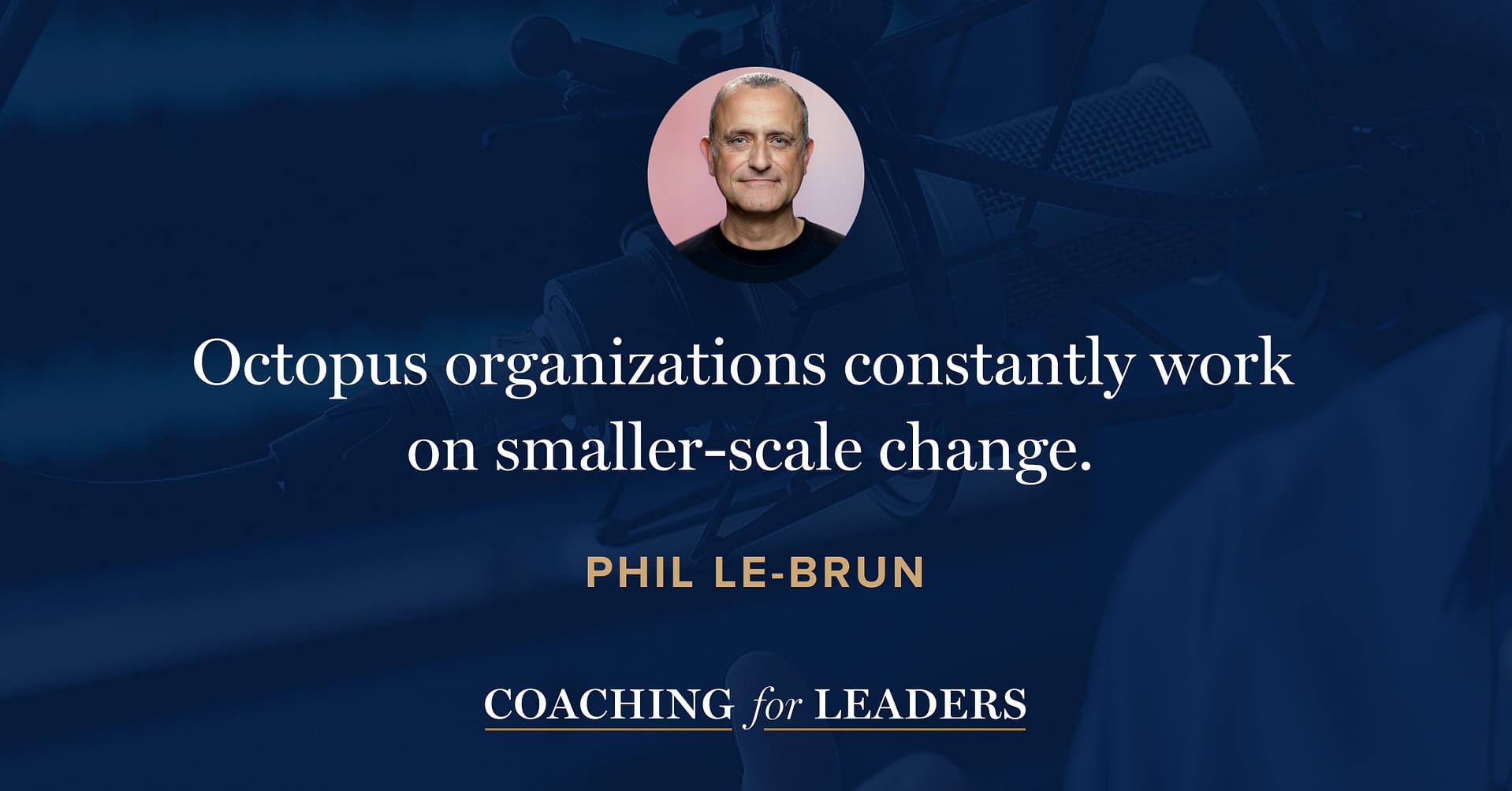
Octopus organizations constantly work on smaller-scale change.
https://media.blubrry.com/coaching_for_leaders/content.blubrry.com/coaching_for_leaders/CFL786.mp3

Podcast: Download

Follow:
Apple PodcastsYouTube PodcastsSpotifyOvercastPocketcasts

Phil Le-Brun: The Octopus Organization

Phil Le-Brun is an executive in residence at Amazon Web Services and a former corporate VP and international CIO at the McDonald’s Corporation. He is a sought-after speaker and has been featured in Harvard Business Review, The Wall Street Journal, and The Guardian. He is the co-author with Jana Werner of The Octopus Organization: A Guide to Thriving in a World of Continuous Transformation (Amazon, Bookshop)*.

Most of us have gone through some version of a reorg. A lot of leaders have also implemented their own reorgs. Sometimes they work. Many times, they don’t. In this conversation, Phil and I discuss what goes wrong with reorgs and how we can do better.

Key Points

  • Organizations traditionally looked like the tin man from The Wizard of Oz: perfectly planned, many interchangeable parts, not flexible.
  • An octopus organization adapts, works independently to serve the larger whole, and is innately curious.
  • A reorg that starts with an org chart misses the complex organic connections you are unlikely to fully understand.
  • Prioritize structural stability while building internal flexibility.
  • Nurture the complex informal human networks that deliver value.
  • Be honest about objectives and communicate a reorg early.
  • Engage people by starting with smaller-scale change. Clarify the problem to be solved instead of the structural “answer.”

Resources Mentioned

  • The Octopus Organization: A Guide to Thriving in a World of Continuous Transformation by Phil Le-Brun and Jana Werner (Amazon, Bookshop)*

Interview Notes

Download my interview notes in PDF format (free membership required).

Related Episodes

  • How to Get the Ideal Team Player, with Patrick Lencioni (episode 301)
  • How to Approach a Reorg, with Claire Hughes Johnson (episode 621)
  • How to Help Employees Handle Tough Moments, with Anthony Klotz (episode 777)

Discover More

Activate your free membership for full access to the entire library of interviews since 2011, searchable by topic. To accelerate your learning, uncover more inside Coaching for Leaders Plus.
The Problem with Reorgs and How to Do Better, with Phil Le-Brun

Download

Dave Stachowiak [00:00:00]:
Most of us have gone through some version of a reorg. A lot of leaders have also implemented their own reorgs. Sometimes they work, many times they don’t. In this episode, what goes wrong with reorgs and how we can do better. This is Coaching for Leaders, episode 786.

Dave Stachowiak [00:00:20]:
Production Credit: Produced by Innovate Learning, Maximizing Human Potential.

Dave Stachowiak [00:00:28]:
Greetings to you from Orange County, California. This is Coaching for Leaders, and I’m your host, Dave Stachowiak. Leaders aren’t born, they’re made. And this weekly show helps leaders thrive at key inflection points. An inflection point that comes up all the time in organizations is the reorg. So many of us have been through reorgs. We have led them, we have been part of them. We have had them done to us many, many times. And the reorg is one of those things that we love to hate. Some organizations do it really well, some organizations not so much. And yet we don’t often think about the big picture behind reorgs today, what tends to go wrong, and also how we can do just a bit better.

Dave Stachowiak [00:01:10]:
I’m so pleased to welcome Phil Le-Brun to the show. He’s an executive in residence at Amazon Web Services and a former corporate VP and international CEO at the McDonald’s Corporation. He is a sought-after speaker and has been featured in the Harvard Business Review, Wall Street Journal, and The Guardian. He is the co-author, along with Jana Werner, of The Octopus Organization: A Guide to Thriving in a World of Continuous Transformation. Hi Phil. Welcome to the show.

Phil LeBrun [00:01:37]:
Thank you for having me, Dave.

Dave Stachowiak [00:01:39]:
We’re going to start with the Wizard of Oz because where else would we start? And there’s a beautiful analogy you and Jana make in the book of the Tin Man versus the Octopus, which of course, is the title of the book. I’m wondering if you could, could you share your thinking behind that distinction and why those two very, very different characters highlight so much of how you think about organizations.

Phil LeBrun [00:02:06]:
Well, for your listeners who remember the Tin Man, he was a heartless, soulless creature, mechanical rust bucket. And that’s probably a poor description of a lot of organizations, but if you think about how many organizations developed in the 19th, earlier 20th century, it was all about predictability, about compliance, reducing variability, treating workers as interchangeable components. And it was really a factory model, running organizations as if they were factories or mechanical constructs. That works if we’re producing a thousand nails an hour, or 100 cars an hour, where we actually knew the patterns to replicate. It’s a bit like changing a wheel on a bicycle; you take the old one off, you put the new one on. But that simply isn’t how organizations work today, particularly in an environment which is volatile, ambiguous, where we don’t even quite know what problems to solve, let alone how to go about them. And the octopus we just found, was this beautiful metaphor. It was a biological metaphor for organizations, and we believe it better reflects how organizations really work.

Phil LeBrun [00:03:16]:
If you think about an octopus, two-thirds of its neurons are actually in its arms. So it has shared vision, shared clarity through a central brain. But each of the arms can act independently. It grows up without parents. It has to discover the environment it’s operating in. It’s innately curious. It learns very quickly through doing. It doesn’t have protective armor.

Phil LeBrun [00:03:40]:
It relies on its adaptability and agility to be resilient. And finally, it can even reprogram its RNA. So as it moves from hot water to cold water, or vice versa, it can adapt to the environment it operates in. We just found that a beautiful metaphor for how I think we want most of our organizations to operate today.

Dave Stachowiak [00:04:02]:
Indeed, it is a fabulous metaphor for the world as we find it today, that’s so different from the world of a generation ago that you described, with the predictability and the interchangeable parts. And that is where I’m thinking about reorgs. Because speaking of what we tend to do traditionally in a lot of organizations, reorgs are one of those things that, maybe not so much for leaders, but for a lot of individual contributors and employees inside organizations, they hear the word reorg, and they tend to roll their eyes at it. And I think a lot of us, even from the leadership standpoint, do too. And there’s a wonderful line in the book, where you highlight a fictional leader who says, “I’ve heard clear from you that previous reorgs have been disruptive, just like last leader said, and this reorganization will be the last one needed”. We’ve all heard that lie before, right? And people mean it.

Dave Stachowiak [00:05:04]:
Well, I think most of the time when they say it, but it so often reorgs just are the things that not only do we roll our eyes at, but they don’t go well. What is it that goes wrong with a typical reorg, in a lot of places?

Phil LeBrun [00:05:21]:
We’re simply changing the wrong thing. So, if you think of an org chart, an org chart is an artifact, it’s an artificial construct of how your organization really operates. And there’s something appealing to us humans about it. You can see which box you’re in, which boxes you work with, which function you’re in, the bigger box. It sort of gives you a sense of identity, but in no way does it represent how work really happens and what we find, particularly as organizations are transforming, they’re learning, they’re innovating, work happens despite your organizational structure, not because of it. Work gets done horizontally across your organization, not within each of those neatly packaged silos.

Phil LeBrun [00:06:03]:
And it doesn’t represent the social fabric. The fact that John in IT calls up Amanda in marketing, which there’s no process for, it’s not on the org chart, but that’s how work really, really gets done. So it seems leadershipy to rewrite the org chart, but what you’re actually doing is just destroying the social fabric. Because everyone goes into fight or flight mode. They’re thinking, what’s this box mean to me? Can I do the job? Is my job at risk? And what we actually believe in is, if you change the mental models and the behaviors in an organization, that really gets to the heart of how organizations operate.

Dave Stachowiak [00:06:45]:
You write on this: You’re messing with complex organic connections in ways you’re unlikely to fully understand when you do a reorg that just. We all sort of know that internally what you just described, the organic nature of relationships, and yet, when we do a reorg, we don’t typically account for that, do we?

Phil LeBrun [00:07:07]:
No, because I think it can be quite overwhelming. If you, if you start to really analyze how your organization operates, which is really hard. There was an interesting, I believe it was a Harvard Business Review study done years ago, that said the average manager understands about, at best, 40% of what his or her teams do. So this idea that several levels removed from how the work gets done, you’re going to redesign the org chart, and you know only a small fraction of how your own organization operates, and it’s not how it’s documented in the manual, we all know that, is a little bit farcical. But, you know, we fall into these patterns, don’t we? Everyone else does it. We want to set up a Spotify model, or a product operating model, or an agile organization, or pick your flavor of the month. And people reach for the recipe book, but, you know, we’re not baking a cake here.

Phil LeBrun [00:08:01]:
It’s almost the opposite. We’re trying to take a fully baked cake, take all of the ingredients out, separating the flour from the cake, and then reorganizing it. You can’t do that with a cake, nor can you do it with an organization.

Dave Stachowiak [00:08:13]:
Coming back to the octopus analogy, you say that octopus leaders prioritize structural stability while building internal flexibility. That sounds really good, but what does it look like in practice?

Phil LeBrun [00:08:28]:
Yeah, so rather than frequent wholesale changes, which we know leads to a massive drop in productivity for a long period of time and then, often not even the improvements the leaders were looking at in the first place, you want to create a feeling of safety. You know, people know where they are on the org chart. They know there’s these different functions, but within that, create some organic adaptability. The ability to move people where the skills are needed at any points in time. The ability to form long-lived teams, for instance. So one of the things we do at Amazon is we create two pizza teams. Two pizza teams have a business outcome to achieve. They’re clearly the why and the what’s behind the outcome are clearly explained.

Phil LeBrun [00:09:14]:
But the team itself is allowed, it’s given agency to go and figure out how to achieve that outcome. It’s based on this principle that we hire brilliant people as leaders. We need to help get the dependencies and the barriers out of the team’s way so they can be successful, as opposed to what we normally do, which is impose even more dependencies and barriers through bureaucracy and governance. And it’s all well-intended, but all it does is take away agency from those teams.

Dave Stachowiak [00:09:46]:
I’ve heard about the two pizza framework, and of course, the thinking behind that is if you’ve, if you have enough people that you can’t feed them with two pizzas, then that’s probably too large a group of people getting involved with this. And I’m wondering, when you think about it from a standpoint of flexibility, is there something there about just smaller numbers of people moving on something quickly that helps this to work better?

Phil LeBrun [00:10:12]:
Yeah, there’s this concept of the Dunbar number. So how many trust-based relationships can you actually build, that doesn’t even apply to an organization, that’s you as an individual. How many trust-based relationships can you hold at any point in time? And if you think of how most organizations operate, so if you believe, like we do, that most valuable work gets done across the organization, not within silos. How most organizations approach this is, they’ll have one person in each function participate part-time on a project. So let’s say there’s eight people participating part-time. If you do the maths, there’s 28 different connections between all those people, and those people are only working part-time. So it’s really hard to build up trust-based relations. Something goes wrong, 28 different communication paths that could go wrong, and we impose more governance, more management, we actually make the problem worse instead.

Phil LeBrun [00:11:06]:
So, within Amazon, we typically use the two pizza model. So teams that are no larger than can be fed on two American-sized pizzas, so say somewhere between 8 and 12 people. They are dedicated towards a business outcome, and that’s all they do. Because our ability as humans to multitask is almost non-existent, despite what we often believe of ourselves. So give them a business outcome, create a team that has cognitive diversity because that’s where the sparks of innovation happen, and let them get on with it. That’s how work really gets done in organizations. And in doing that, allow the team the time to go through storming, norming, forming, high performing, and ideally keep that team intact for a long period of time. Particularly if you’re building a product which requires continual love, care, and nurturing. I can’t remember who said it, but there was a quote that says the worst form of corporate vandalism is to disband high-performing teams.

Phil LeBrun [00:12:07]:
And that’s our belief. Put these people together and create a certain amount of attrition on that team because you want new folks to come in, experience what it’s like to work in the team. You want to give people on the team chances to go elsewhere. But that structural stability is really important because you are focused on something the customer wants, and you want to keep attention on that particular product, and you want to create a lot of that tacit, you want to keep that tacit knowledge around how decisions were made within that, too.

Dave Stachowiak [00:12:37]:
You and I both work with a lot of people who have very high expectations of themselves and others and of their teams. And one of the challenges that I run into regularly in supporting leaders is, is helping folks who have really high expectations start small and do a little bit less tactically at the beginning. And I say that because one of the things you point out is that an octopus organization is constantly working on smaller-scale change, rather than trying to do the massive reorg, the massive shift. And I’m wondering what you see in leaders who actually pull that off and make it work.

Phil LeBrun [00:13:23]:
Yeah, I take some inspiration from a couple of people here. One is Indra Nooyi, the former CEO of Pepsi, who we had the pleasure of interviewing. And she talks about what she looks for in leaders. And there’s two things, and it’s not the obvious things, size of org, title, and such like; it’s storytelling and curiosity. And I think they’re both applicable to running these sorts of teams. The storytelling is simply being able to describe in ways that build an intellectual and emotional connection with your team, why what they are doing is important, and what problems are they solving and what the context of that problem is. That’s really important because, often, we have people work on initiatives, and it’s a little bit of an initiative, and they don’t really know how all of this adds up to something greater. I recall a story where JFK went to NASA and bumped into a janitor in 1963.

Phil LeBrun [00:14:19]:
And he said to the janitor, ” What do you do?” In most organizations, that janitor would say, well, I mop the floor where my boss tells me to. But not this janitor. This janitor says, “I’m part of the team that’s going to put man on the moon”. How amazing is that? That you can see a connection between what many would consider a mundane job and a really big objective. And then, the second thing that Indra looks for in leaders is curiosity. This idea that the leader is actually probably the least informed, often about how to do something, because they’re furthest from the customer. So, being that coach, asking questions, asking questions that others may be thinking but are too nervous to ask. So that’s one aspect I would sort of lean on when I think about these teams.

Phil LeBrun [00:15:08]:
The other is what Patrick Lencioni talks about, which is leaders who are hungry, humble, and smart. Leaders who really are going to push their teams to do exceptional things, to have them think big, to have them think differently. But leaders who are also humble enough to know they don’t have the answers. Coming back to this idea that Indra Nooyi expresses, which is leaders who are quite comfortable in their own skin, say, I don’t know how to solve this problem. If I did, I wouldn’t put a team together. You’re the experts here. And then the third element is this idea of smart, high EQ, the ability to be the coach, to create an environment where psychological safety flourishes, where people can express views, where arguments about how to solve a problem are seen as a positive thing. Not this false consensus organizations that we often see, where everyone tries to create harmony, and what you end up with is the worst sort of solution.

Dave Stachowiak [00:16:10]:
You said the word coach a couple of times in the last minute or two. And I was thinking about that in the context of that smaller scale change, because I think oftentimes when, when a reorg doesn’t work and when we get the eye rolling and the sort of like, “oh my gosh, are we doing this again” response, a lot of times it’s a leader, a small group of leaders going into a room, like a locked room and like, making some decisions at a high level and not necessarily having those, a lot of more of those real time conversations. And you saying the word coach just reminds me of the importance, we keep hearing about it again and again on from, so many people are doing research on this, that the regular conversations, the dialogue, the being curious, the daily questions, the daily interaction, the involvement in this process as we’ll talk about, I think more in a bit is that like, just that quantity of interaction is so important for this, and it gets us away from the ivory tower. We’re going away and making a decision and then coming back and imposing it on everyone. It just, it just seems like such a healthier way to approach it.

Phil LeBrun [00:17:15]:
Oh, it is. And you know, I’m lucky. I went through some, I’ve been a recipient of coaching, I’ve had the opportunity to coach others, and Jana probably more so. And if you think about a typical reorg you describe, it’s exactly as you describe it. This small group of senior leaders go in a room with a bunch of external folks they’ve brought in. They come up with the perfect organization chart, which we’ve already established is nonsensical. They launch it on the organization, and immediately they start talking about people resisting change.

Phil LeBrun [00:17:50]:
But we know what happens, and in fact, we spoke to the authors of Reorg, Stephen Heidari-Robinson and Suzanne Heywood, who spoke about this eloquently in their book, which to say, look, 70% of the organization, they’ve only got one question on their mind when leadership does that, and it’s, do I still have a job? And leaders can’t even answer that question often, or you’re beyond that, why are you doing this to me? Why didn’t I get a voice? You brought me in because I’m an expert at whatever it may be, and you’re telling me how to do the job you brought me in to do in the first place. So it robs people of agency. It often lacks the clarity people need about why are we doing this in the first place? It suppresses curiosity because people are in survival mode. Contrast that to what we see in great organizations where leaders understand they don’t have the answers. They become coaches, they are genuinely curious.

Phil LeBrun [00:18:45]:
So if you’re working for me, I’ll probably ask you questions for two reasons. One is because I’m genuinely curious about what you do and why you do it. The other is, I don’t have the answers. But my job as a leader is to help you think through how to approach a problem. And I think it’s a really powerful distinction between mentoring and coaching. As a mentor, I’m going to tell you how I’d approach the issue. In today’s world, you take something like agentic AI or generative AI, I’m clueless, probably as a leader, because I’ve never used those technologies. But we’re still dealing with business problems, and customers, and organizational dynamics.

Phil LeBrun [00:19:22]:
What I can do a good job at is asking you questions to help you think through your mental model, your assumptions, how you approach this, and leaving you with a sense, actually, “I am confident I do know my stuff. I can do this”. Rather than building in yet another organizational dependency.

Dave Stachowiak [00:19:41]:
Jana and you have some really helpful invitations for us in thinking about reorgs, and maybe I know we have folks in our audience who are in the midst of them right now, we have folks who are in the middle of planning, thinking about them. One of the things you say is that at their best, leaders are honest about their objectives, and that they also know people are going to see through the attempts to hide the real intentions behind this. Right? And I think we’ve all seen that happen in organizations before. When a leader is really honest about what they’re trying to achieve, if it is a reorg, if something’s happening, how does that sound in a way that really lands?

Phil LeBrun [00:20:21]:
Yeah, it’s, you know, it’s one of the most important things a leader can do, is build that trust and honesty in an organization. I’ve worked for leaders who I’d follow to the end of the earth because they’ve done that, they’ve been honest. They said, ” Hey, Phil, I don’t know how this is going to end up. I’ve got your back. We are doing this because of these reasons”. But if we take the opposite situation, which too often happens, there’s this overconfident leader who stands up and says, ” Hey, we’re going to transform because we want to leverage our corporate synergies to drive a differentiated customer experience. I’m excited about this opportunity”. None of that stuff’s true.

Phil LeBrun [00:20:57]:
We use these yoga babble words because, either we don’t understand what we’re trying to do clearly enough to explain it, or we do understand, and we’re frightened to communicate it. And what I’ve just said in that yoga babble phrase is, there’s probably going to be layoffs. Efficiency and leverage are code words in too many corporate organizations for that. If I’m more honest about it, say, look, our costs are growing as fast as our profits, it’s obviously unsustainable. We need to find ways of working smarter. We believe in some cases, we do things once rather than duplicating across the organization. That’s why we’re organized.

Phil LeBrun [00:21:36]:
That’s why we’re organizing it. And by the way, we’re not too sure this is going to work. Please help us. Please provide feedback. I’m inviting you, as a knowledgeable, passionate employee, to actually be part of this change. I’m also saying I don’t know all of the answers. How can I possibly know all of the answers in a complex organization? As an employee, I far more appreciate that rather than what happens when leaders communicate overconfidently is, I’m going to fill in the blanks. And those blanks are probably going to be quite negative because I’m going to immediately assume something’s going to be done to me, which is going to be unpleasant.

Phil LeBrun [00:22:17]:
And that’s where this pseudo-resistance to change problem comes in in organizations.

Dave Stachowiak [00:22:22]:
One of the other really important invitations is that organizations who do this well communicate about a reorg early. And I was thinking about that. We had Anthony Klotz on the show not long ago, and he was talking about the jolts that tend to come up in so many people’s careers. And one of the things that, of course, happens when there’s a reorg is people realize pretty quickly that you, as in the leader or the senior team, have been sitting on news for a while because you’ve been in the back room planning, either literally or figuratively planning this. And so I totally get that, that desire to want to get out in front and say something earlier. The challenge is that it’s often not fully baked. And I’m wondering, how do you thread that needle of involving people early, doing the coaching things we talked about earlier, but at the same time talking about something that, it could really go a different direction because it’s going to change as it emerges?

Phil LeBrun [00:23:26]:
Yeah, I think what we’d encourage people to do is start to talk about what outcomes you’re trying to drive. So don’t talk about the reorganization. And maybe as leaders, don’t even start with thinking you need a reorganization. Start to communicate widely what problems you are trying to solve. What are those outcomes? Maybe it’s reducing time to market. Maybe it’s your cost basis going up too quickly. Involve people in brainstorming. I mean, be clear that this is just brainstorming.

Phil LeBrun [00:23:56]:
This time, no decisions are being made. But I think what leaders are often surprised about is how much knowledge is in their own organization. We see this all the time within our current roles. When we talk to organizations at a leadership team level, they’ll often talk about, well, we’ve got all of these problems, but we’re going to have to get some external help in to figure out the solutions. When we dive deep into the organization and talk to people at the front line, they know what the problems are. They often know what the real problems are versus what leadership think they are. They’re also incredibly switched on. They know where a lot of the solutions are.

Phil LeBrun [00:24:31]:
So this is actually a much more cost-efficient way, a much more trustworthy way of driving change, is by bringing people along by starting with the problem. And then, if reorganization is the solution, start small. I mean, if you blow up the org chart, it’s soul-destroying. Test it with people, if they feel like they’ve got agency, if they feel like they’re being made part of the solution, you’ll get some amazing results from it. And we always marvel at the fact that people often feel like they can’t make a difference at work. They can’t wait until the day’s over, and then they go home and invest an incredible amount of intellectual and emotional energy in hobbies, which gives them no extrinsic reward. Why can’t we tap into a lot of that passion in the workforce?

Dave Stachowiak [00:25:17]:
And when you do something small, it’s so much easier to undo, right? Like it’s, you make a huge reorg, and it’s a lot harder to undo that. And I mean, you and Jana point out in the book, like how much work just logistically goes into reorging, especially a large organization, I mean, 6, 12-month systems, all the things that happen in order to do that. When it’s small, it’s so easy to undo if there’s, if you’re learning along the way, which of course we all are. I mean, speaking back to the octopus right, at adapting, I mean, who isn’t having so much change around them every 90 days these days? And so that adaptability, it just makes it so much more sensible in a way. And, like you said, it doesn’t mean that there’s not still then, a reorg. I don’t think anyone saying there should never be reorgs, but you go into it a lot more thoughtfully, or you say, hey, there’s this small change we’re making, this test system, this thing that we’re just involving a few people with. This actually gets us halfway there. Let’s think about how we could do a little bit More of that organically versus making a big change throughout the organization.

Phil LeBrun [00:26:22]:
100%, and that’s part of why we rail against transformations. Transformations are soul-destroying. If I go through an 18-month transformation, I’ve blown up the organization. I’ve changed people’s job descriptions, I’ve changed compensation, and how people are rewarded. Man, I can’t wait to get to the end of 18 months so I can stop and get back to normal. And that’s where the issue starts is, in today’s world, and in fact in yesterday’s world, we can’t do that. I mean, it’s what we call a day one culture in Amazon, which is this idea that if you involve people in continuous transformation every day you can get better. It doesn’t need to be soul-destroying.

Phil LeBrun [00:26:56]:
The idea of running an organization, a change in the organization, coexists rather than being separate entities. And the best way of doing that is through experimentation, trying different cultural hacks, bringing teams together. This is what we try to describe in the book with our levers. This idea that, make a decision one level lower in the organization, remove one governance group. All of these are reversible decisions. And the other problem with big transformations is they’re big bets. If a leader blows up the organization and redesigns it, it’s highly unlikely he or she is going to say, ” Whoops, made a mistake. Let’s go back to the old way of working”.

Phil LeBrun [00:27:36]:
So you start to get into this loss aversion. I’ve invested this amount of time so far, we’re going to make it work. I know it’s going to work eventually. And you waste so much time and energy in trying to get something that should never have been done to some sort of stable, productive outcome, which probably isn’t quite what you anticipated as a leader.

Dave Stachowiak [00:27:59]:
I’m thinking about a few people who I work with and who listen to the show, that are on their second or third major reorg in the last five years, because their organization has continually entered into this process. And some of those folks will hear this conversation and say, ” Yep, I’m with you. I totally get it. This isn’t the best way to do it”. And yet they work for an organization that this is the way that change happens, is every time there’s a change, there’s a reorg. For someone who’s a leader in an organization like that, that the cultural ecosystem around them is very much reorg, reorg, that’s the way we process things. What’s like one thing they may do as an individual leader just to make things a little bit better within that system?

Phil LeBrun [00:28:46]:
Yeah, and this is this idea that everyone can be a leader in an organization. There’s often a lot of learned helplessness we find in organizations. Leadership’s making me do this. You can create stability within your own organization. You can be open about what you do know. You can be, yes, talk about the things that aren’t going to change, we’re still going to be focused on the customer.

Phil LeBrun [00:29:08]:
We still need to run our systems reliably. Celebrate the successes there. So, rather than get everyone panicking about everything’s changing, create some sort of oasis of calm within your organization and broadcast your successes, too. Because you’re right, I mean, it seems leadershipy to come in, do your 90-day assessment, blow up the organization, because that’s what every leader does. Show, demonstrate, even through small efforts, that you can produce better outcomes by not doing that, by focusing on behaviors, by focusing on mental models, not by moving arbitrary boxes on an org chart. I’ve yet to find many leaders out there who can genuinely point to a successful transformation which started with the org chart.

Dave Stachowiak [00:29:57]:
It’s a good starting point for us when we’re staring at that org chart, thinking about what we might want to change. It looks good often on paper, but, to your point earlier, it doesn’t appreciate and understand so many of the organic connections that, by being a little more coach-like, by being a little bit more curious, by starting small, you see. And you certainly see better than you do if you just start with the organization and how it’s structured. It was really delighted, Phil, with like, when you get into your work and Jana’s work, like how passionate you both are about wanting to help organizations do better and adapt better. And I’m curious, as you’ve put all this research together, and the lived experience of leading in organizations so well, what, if anything, have you changed your mind on? On how, how we can all do better at being the octopus?

Phil LeBrun [00:30:52]:
I think the thing that springs to mind, and firstly, thank you for calling out the passion. I hope that comes through because that is genuinely what motivates us. We talk as, the team I work with, we talk to about 1500 customers a year. And these organizations are full of incredible people. Often, we’re told, ” Hey, we don’t have enough developers”. And then you look at it, and you find developers spending 80% of their time in meetings, or waiting for people to do things before they get back to delivering work. These are all highly intelligent leaders. It’s really about changing their mindset.

Phil LeBrun [00:31:27]:
And one of the changes for me was, many years ago, going from this idea that I as a leader had to have all of the answers to the fact to the personal comfort that is mission impossible. If I have all of the answers, I’m probably focused on the wrong things, and it’s not practical anyway. So, this idea that I have to switch mental models as a boss, sometimes I need to be directive. If the house is on fire, I’m not going to ask for consensus about whether we should evacuate or not. If we’re dealing with a really novel issue, I’m not going to be directive, because I don’t know what the answer is. But I can be a coach, I can be a shield for the team. I can remove dependencies. I can bring clarity to the why we’re solving a particular problem.

Phil LeBrun [00:32:15]:
That was a big shift for me. The second one was also recognizing who my first team really was. For many years, I thought my primary responsibility was running my team. It’s not. My primary responsibility is with my peers, ensuring there is clarity across the organization about what we’re trying to achieve, where the barriers are, where the roadblocks are. One of the primary reasons transformations fail is, we say things like we’re going to be a digitally transformed organization, or a customer-centric organization, or a platform-based organization. And everyone nods because we don’t want to feel foolish by asking questions.

Phil LeBrun [00:32:50]:
And we go off and decide what that means for our team, not what it means for the organization. So they’re the two big changes I’ve been through, and it’s not comfortable, when you’re in an organization and you, as a leader, are sitting there saying, I don’t actually know what the answer is, but let me help you think it through. It sort of challenges your whole initial view of what a leader is, which mine was, I was the guy with all of the answers.

Dave Stachowiak [00:33:14]:
Phil Le-Brun is co-author of The Octopus Organization: A Guide to Thriving in a World of Continuous Transformation. Phil, thank you so much for your time.

Phil LeBrun [00:33:23]:
Dave, thank you for having me. And it’s been delightful talking to you.

Dave Stachowiak [00:33:27]:
The same. If this conversation was helpful to you, three other episodes I’d recommend. One of them is episode 301: How to get the ideal team player. Patrick Lencioni was my guest on that episode. Pat and I talked about his model of hungry, humble, and smart. Whether it is a reorg, or a new hire, or other change happening, and you’re looking for the right person for your organization. Pat’s framework, so helpful to think of. How do you actually find that ideal person and connect with them in a way that helps the organization move forward? Episode 301 for details from him on how to think about that proactively.

Dave Stachowiak [00:34:11]:
Also recommended episode 621: How to approach a Reorg. Claire Hughes Johnson was my guest on that episode. Executive at Stripe, they’ve done a bunch of reorgs over the years. Many of them have been very successful, and she walked through step by step, what are the things you should be thinking about logistically as you do a reorg? I think it goes hand in hand with this conversation. Episode 621 for her thinking there. And then finally, I’d recommend episode 777: How to help employees handle tough moments.

Dave Stachowiak [00:34:41]:
Anthony Klotz was my guest on that episode, and even when a reorg is for all the right reasons and done well, and no one’s losing a position, it is still tough. It’s change for everyone. And we talked, in episode 777, how to help people navigate that. How do you help employees handle those tough moments, not only in reorgs, but any kind of situation that you see coming as a leader, that’s going to be tough.

Dave Stachowiak [00:35:06]:
And sometimes we don’t see those situations coming. But one thing Anthony and I talked about in that conversation is that, actually, a lot of the time, we can anticipate things that are going to land poorly with our teams. And by being proactive, there’s a ton we can do to make that go better for everyone again. Episode 777 for that.

Speaker C [00:35:25]:
All those episodes you can find on the coachingforleaders.com website, and I’m inviting you to set up your free membership@ at coachingforleaders.com, because you have full access to the entire library of episodes that I’ve aired since 2011. Of course, you can get all the episodes from the entire catalog on any of the podcast apps, but we have gone a step beyond that on the website to make them searchable by topic, so that you can find what you’re looking for. We’re filing this episode under Organizational Change. We have had so many related conversations on org change over the years. It’s a great starting point for you if you are in the midst of thinking about that right now, or planning a reorg, or handling any other aspect of change. And of course, so many of us are in many ways. Coachingforleaders.com to set that up. You also get access to my weekly Focus5 message. Every single week, I send out a message with five things that I think will be helpful to you.

Speaker C [00:36:16]:
Recently, I wrote a message on five strategy ideas that have come from the podcast in recent years that I think you should know, that are helpful for almost every leader. Every week I’m writing a message like that. Five things, very quick, will give you something actionable that’ll help you to move forward. Your free membership is the way to set that up, coachingforleaders.com, for that. Coaching for Leaders is edited by Andrew Kroeger. Next Monday, I’m glad to welcome Chris Duffy to the show. Chris and I are going to be talking about better leadership through humor. Join me for that chat with him and see you back next Monday.

Topic Areas:Organizational Change
cover-art

Coaching for Leaders Podcast

This Monday show helps you discover leadership wisdom through insightful conversations. Independently produced weekly since 2011, Dave Stachowiak brings perspective from a thriving, global leadership academy of managers, executives, and business owners, plus more than 15 years of leadership at Dale Carnegie.

Listen Now OnApple Podcasts
  • More Options
    • YouTube Podcasts
    • Spotify
    • Overcast

Activate Your Free Membership Today

Access our entire library of Coaching for Leaders episodes from 2011, searchable by topic.
Listen to the exclusive Coaching for Leaders MemberCast with bonus content available only to members.
Start Dave’s free audio course, 10 Ways to Empower the People You Lead.
Download our weekly leadership guide, including podcast notes and advice from our expert guests.

... and much more inside the membership!

Activate Your Free Membership
IMAGE
Copyright © 2026 · Innovate Learning, LLC
  • Plus Membership
  • Academy
  • About
  • Contact
  • Dashboard
×

Log in

This site is protected by reCaptcha and the Google Privacy Policy and Terms of Service apply.
 
 
Forgot Password

Not yet a member?

Activate your free membership today.

Register For Free
×

Register for Free Membership

Access our entire library of Coaching for Leaders episodes from 2011, searchable by topic.
Listen to the exclusive Coaching for Leaders MemberCast with bonus content available only to members.
Start Dave’s free audio course, 10 Ways to Empower the People You Lead.
Download our weekly leadership guide, including podcast notes and advice from our expert guests.

... and much more inside the membership!

Price:
Free
First Name Required
Last Name Required
Invalid Username
Invalid Email
Invalid Password
Password Confirmation Doesn't Match
Password Strength  Password must be "Medium" or stronger
This site is protected by reCaptcha and the Google Privacy Policy and Terms of Service apply.
 
Loading... Please fix the errors above