• Skip to primary navigation
  • Skip to main content
  • Skip to primary sidebar

Coaching for Leaders

Leaders Aren't Born, They're Made

Login
  • Plus Membership
  • Academy
  • About
  • Contact
  • Dashboard
  • Login
Episode

772: How to Measure Your Meeting’s Success, with Rebecca Hinds

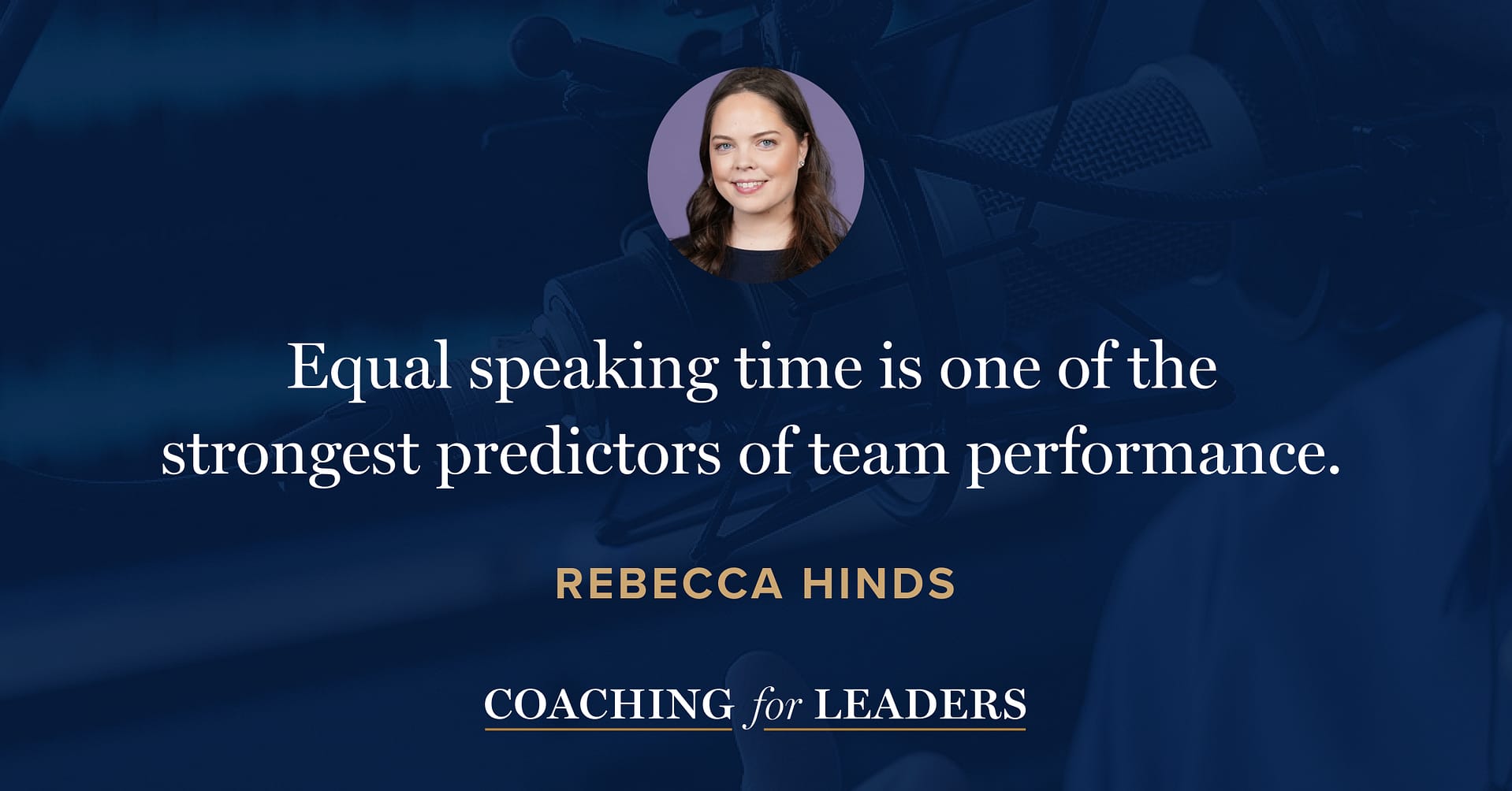
Equal speaking time is one of the strongest predictors of team performance.
https://media.blubrry.com/coaching_for_leaders/content.blubrry.com/coaching_for_leaders/CFL772.mp3

Podcast: Download

Follow:
Apple PodcastsYouTube PodcastsSpotifyOvercastPocketcasts

Rebecca Hinds: Your Best Meeting Ever

Rebecca Hinds is a leading expert on organizational behavior and the future of work. She founded and led the Work Innovation Lab at Asana and the Work AI Institute at Glean, where she partners with leading experts to help organizations transform their work with AI. She is the author of Your Best Meeting Ever: 7 Principles for Designing Meetings That Get Things Done (Amazon, Bookshop)*.

Considering the amount of time we all spend in meetings, it’s odd that most organizations do so little to measure meeting results. If that’s sounding familiar, this conversation between Rebecca and me will show you exactly how to get started.

Key Points

  • Metrics that only measure the costs of meetings (dollars and time) can be useful, but rarely capture the full picture.
  • Use Return on Time Invested (ROTI) anonymously to survey attendees to determine if a meeting was a good use of time. Also ask, “What would it take for you to improve your rating by one point?”
  • Survey sparingly to avoid survey fatigue. Bringing in a survey 10% of the time is a benchmark to start from.
  • If the amount of time in meetings vastly exceeds 10 hours a week, there’s likely an opportunity to scale back or redefine the work before or after meetings to use time better.
  • Equal speaking time in meetings is a key indicator of team performance. Be transparent with employees about any technology you use to capture data.
  • Punctuality and attendance rate are indicators of how valued meetings are for people.

Resources Mentioned

  • Your Best Meeting Ever: 7 Principles for Designing Meetings That Get Things Done by Rebecca Hinds (Amazon, Bookshop)*

Interview Notes

Download my interview notes in PDF format (free membership required).

Related Episodes

  • How to Lead Meetings That Get Results, with Mamie Kanfer Stewart (episode 358)
  • Moving Towards Meetings of Significance, with Seth Godin (episode 632)
  • How to Lead Engaging Meetings, with Jess Britt (episode 721)

Discover More

Activate your free membership for full access to the entire library of interviews since 2011, searchable by topic. To accelerate your learning, uncover more inside Coaching for Leaders Plus.
How to Measure Your Meeting’s Success, with Rebecca Hinds

Download

Dave Stachowiak [00:00:00]:
Considering the amount of time we all spend in meetings, it’s odd that most organizations do so little on measuring meeting results. If that’s sounding familiar, this episode will show you exactly how to get started. This is Coaching for Leaders, Episode 772.

Dave Stachowiak [00:00:18]:
Production Credit: Produced by Innovate Learning, Maximizing Human Potential.

Dave Stachowiak [00:00:26]:
Greetings to you from Orange County, California. This is Coaching for Leaders, and I’m your host, Dave Stachowiak. Leaders aren’t born, they’re made, and this weekly show helps leaders thrive at key inflection points. Something that is on the mind of almost all of us is meetings, and whether it’s a meeting we’re leading, or a meeting we’re attending, we all love to hate meetings, don’t we? And we also— many of us are charged with leading meetings that are going to be successful for the team, and for the organization. And one way we can think about that more proactively is how do we actually measure their success? We think a lot about effectiveness of meetings, but we don’t necessarily take the next step in order to measure it well. Today, I’m so glad to welcome an expert, who’s going to help us think about some of the key metrics we can think about, where we can begin, and actually begin to put it into practice right away. I’m so pleased to introduce Rebecca Hinds.

Dave Stachowiak [00:01:22]:
She’s a leading expert on organizational behavior and the future of work. She founded and led the Work Innovation Lab at Asana and the Work AI Institute at Glean, where she partners with leading experts to help organizations transform their work with AI. She is the author of the book Your Best Meeting Ever: 7 Principles for Designing Meetings That Get Things Done. Rebecca, so glad to have you.

Rebecca Hinds [00:01:47]:
Dave, thank you so much for having me. I’m looking forward to the conversation.

Dave Stachowiak [00:01:50]:
Oh, me too. I’ve loved getting into your work, and thinking about the leverage point of meetings, which is so critical for so many of us in our work. And I was struck by something you talk about very early in the book, of the Simple Sabotage Field Manual. This goes way back to World War II, and some of the efforts that the US and the Allies were utilizing in order to win the war. And a lot of times we think about battle as guns and, you know, all the things that we traditionally think of with battle. But there was a psychological aspect to it, and there was— meetings were a big leverage point on this, weren’t they?

Rebecca Hinds [00:02:29]:
That’s right. So the, the Simple Sabotage Field Manual was developed in the 19— in 1944 during World War II by the Office of Strategic Services, which was essentially the precursor to the CIA. And this manual, which was pretty recently declassified in the context of when it was written in 2008, it was essentially meant for ordinary citizens who were living in enemy territory during World War II; a guide on how to sabotage the enemy from within. And as you articulated, not through traditional forms of warfare, but through these subtle acts of sabotage that anyone could deploy. And one of these strategies was meetings. The manual advised people to bring up irrelevant issues, insist on doing everything through channels when communicating with the enemy, and weaponize meetings to inject all of these different inefficiencies into enemy operations. And, you know, we fast forward today, and it’s both ironic and unfortunate that we’ve adopted many of these tactics, only now we call it business as usual.

Dave Stachowiak [00:03:43]:
Yeah, indeed. When you look at the manual, it is really— it’s funny, but it’s also a little alarming when you look at some of the tactics of like how to how to slow things down, that so many organizations have adopted, not because they’re intending to slow things down, but just because, we just don’t really have great hygiene on this, do we, as, as organizations?

Rebecca Hinds [00:04:07]:
And it’s one of the few things that is in our control. So much of our business processes and business operations are dependent on what our customers do, what our competitors do. Meetings are something that are almost exclusively in our control from the perspective of how we design meetings, and they’re highly, highly dysfunctional.

Dave Stachowiak [00:04:31]:
And, and there’s like a good news part of this too. One, what you just said, that we can— we have a lot of agency over this, at least many of us in many organizations, to do something different. And the other thing that I think is interesting is that, in fact, you write in the book, people aren’t always reacting to the meeting itself. They’re reacting to how they think they’re supposed to feel. We all love to complain about meetings, as I mentioned in the intro. And yet when you actually get people alone, and like ask questions and do some research on surveys, sometimes the story isn’t as bad as we often tell ourselves, or we say in just the politics of organizations. There are really good examples of things happening, too.

Rebecca Hinds [00:05:14]:
You’re, you’re absolutely right. And there’s fascinating research, and in particular research led by one of my collaborators, Steven Rogelberg, who has essentially found that when people rate meetings publicly, they tend to rate meetings less effectively than when you ask the same people to rate their meetings in private. And that is exactly as you’ve articulated. It’s because we’re socially conditioned to believe that meetings are bad. In large function, that is because so many of our meetings are bad. We know that bad is stronger than good, as my collaborator Bob Sutton will say. And so they do have this natural, pervasive impact on how we feel about meetings in general. But this is exactly why measurement is so important.

Rebecca Hinds [00:06:01]:
And you can’t just go into an organization, or your own organization, and ask people how effective are meetings in general, because you trigger, I call it the “meeting suck reflex”, this visceral reflex where we know there are few things that bond people more strongly, and more quickly than bonding over that hour-long meeting that could have been a 2-line email.

Dave Stachowiak [00:06:25]:
Yeah, indeed. Well, let’s look at some of the metrics, and shocker, there’s no silver bullet, right? Like, as we all know, there’s not one thing that if we just do this, like, all of our meetings are magically going to be better. The good news, though, is there is- a lot of things that we can consider and different data points and variables that if we do put some time and attention to, will really help us to do a bit better. And before we get into some of those, one of the, the reminders you have for us is to watch out for, and even if you can’t avoid, some of the misleading metrics that are out there. And it’s always hard because there are metrics that are useful in some categories and not in others. And one of the ones that you talk about in the book is this metric, I think a lot of us have heard, even if we haven’t done it, of quantifying the meeting cost. Like, if you add up people’s salaries in the room, divide up by the amount of time in the meeting, that, that shows a number that can be really large, of like how much this meeting is costing.

Dave Stachowiak [00:07:29]:
But there’s some color to like when to use this and when not to, right? Could you say a bit about that?

Rebecca Hinds [00:07:34]:
Sure. So this is, you know, if we’re strictly looking at the cost of meetings, which is enormous, measuring that cost in terms of salaries of the people in the room, the length of the meeting, that has a time and a place. And in particular, if your meetings are a mess, you have a whole bunch of what I call “meeting debt built up”, legacy meetings, and you’re ready to take charge, then showing people the cost of meetings can help with jolting them out of inertia. Often, we don’t recognize just how costly meetings are, and salaries are the tip of the iceberg. There are lots of other costs that we, we should ideally be, be considering. But as we become more sophisticated in how we measure meetings and become more intentional about design, it’s important to move away from those strictly cost-based metrics, and adopt a more holistic approach, for a couple reasons. One, we know that if you’re over-indexing on cost, you start to incentivize the wrong behaviors. And I’ve seen this in a couple organizations, in particular that have rolled out these cost calculators that are embedded in the, the scheduling of the meeting, you start to incentivize hyper, hyper efficient meetings in a way that can often be detrimental, because we know that the cost of a meeting doesn’t necessarily correlate with the value.

Rebecca Hinds [00:09:10]:
You can have a very expensive meeting, but if it triggers a whole host of different positive effects, it reduces lawsuits, or it triggers a new product line, right? These are things where we know meetings can be highly valuable and outweigh a very expensive price tag, if we’re just looking at salary costs. And second is, just measuring cost doesn’t give us any information about how to design better meetings. It’s a data point, but it doesn’t do a lot to give the organizer, give the attendees more information on how do we actually think about reducing this cost and improving our meetings at large?

Dave Stachowiak [00:09:56]:
And you make this point so beautifully in your work that these metrics, the, the cost, the dollars, the clock, oftentimes from a standpoint of— I’m trying to think of a better term than shock value, but there’s, there’s something to be said for like just making people aware of like, okay, cost and time and like starting to think about that. It’s not the end-all, but it’s like, helpful as like one data point just to get people out of their normal habits of, let’s just have this standing meeting every Tuesday morning at 10:00 AM because we’ve been doing that for years, and actually start to ask some of the questions, which I think dovetails nicely to some of the things that really are effective as far as measurement and that work well. And one of them you invite us to consider and put into practice is something called “return on time invested”, ROTI. What is that and what’s helpful about it?

Rebecca Hinds [00:10:47]:
Sure. So, and I think it’s, it’s useful to, to mention that the, the premise of the book is we need to treat meetings as products. Meetings are the most important product in our entire organization, and yet they’re the least optimized. We don’t measure them, we don’t refine them, we don’t iterate often. And so when we think about measurement in particular, in the product development world, we often, arguably, you know, very often measure something called return on, return on investment, ROI. So we should be applying that same discipline to meetings if we are to treat them like the important product they are. And so, return on time invested, ROTI, is a way to, as the organizer of a meeting, get a better sense of, is your meeting effective? Is it worth the time people are investing? And so it’s a simple 0 to 5 scale. This is something that I, I first learned from my colleague Elise Keith.

Rebecca Hinds [00:11:52]:
After about 10% of your meetings as the organizer, ask attendees to rate on a 0 to 5 scale, was this meeting worth the time invested? And as a bonus, what would enable you to boost that score by 1 point? What could I do differently as the organizer? And again, this isn’t a perfect or comprehensive metric by any stretch, but it does get you out of some of these biases associated with measuring our meetings. Because, unlike meetings in general, which we have this visceral negative reaction to, everyone has a pretty decent sense of the value of their time, and they have a good sense after a meeting of, was this meeting a good use of my time or a complete waste of time? And that can start to give you valuable feedback. And often I find that for the organizer, it’s not just the 4 rating, or the 5 rating that gives the most useful information. It’s understanding that almost always there’s some sort of split in the ratings, where you have half the attendees rating the meeting a 1 or 2, half the attendees rating it a 4 or 5, and this also can lead to much more intentionality in terms of the attendees in the room. Do I really need all these attendees? For the attendees where clearly this isn’t a good time investment, should I remove them from the meeting? Or how can I design this meeting so that it is worth your time?

Dave Stachowiak [00:13:32]:
There’s a couple of things you’ve mentioned here that I think are so critical, and I’d love to dive in on. And one of the things you said reminded me of years ago, I was doing work with a large corporation, and it wasn’t in regards to meetings, but I happened to attend a bunch of their meetings during that season. And they had a practice that was different, but slightly similar to what you just described. At the end of every meeting, they’d go around the table, and everyone had to give a 1 to 10 rating, at every meeting, of how the meeting went. And I, I attended I don’t know how many meetings over that time, and virtually every single meeting, every single person said 8 or 9 as they’d go around the table.

Dave Stachowiak [00:14:08]:
And they did it 100% of the meetings, they always did it live, and I remember walking out of the room a few times and even talking with a few people, and I was thinking to myself, there is no way that all these people thought this meeting was an 8 or 9 just from the context of what was happening and observation. How do you guard against that, to get a little bit more truth in a tool like this?

Rebecca Hinds [00:14:31]:
So, and I’ve seen this as well, so it’s important that this is anonymous. In very, very few cases, if you have an extremely psychologically safe environment, you’re inviting, you know, real-time feedback, real truths and hard truths, then perhaps you know, you can do it anonymously and get— unanonymously and get valuable information, but you are going to have incentives in the room, such that if it’s not anonymous, people are going to be skewed in their ratings, absolutely. I’ve seen it positive and negative in terms of the skewing. Some people are so fed up that they will rate their meetings even more negatively because they are so disgusted with the meeting in a way that, you know, you’re getting these biased inputs as well. And so, anonymous is important. Making sure that you as the organizer aren’t biasing in any way is important.

Rebecca Hinds [00:15:32]:
We know that the organizer of the meeting tends to rate the meeting much more effective than anyone else in the room, or the person who’s spoken the most in the, in the meeting. This is again research from my, my good colleague Steven Rogelberg, where we should be especially keen to understand, for the people who didn’t dominate the airwaves, or didn’t contribute to the design of the meeting, weren’t the organizer, what is their sentiment around the meetings? And is this a good use of their time in particular?

Dave Stachowiak [00:16:06]:
So making it anonymous is key. And you also said something a moment ago, which I think is really important. You said this isn’t 100% of the time, this is like 10% of meetings. What’s the, what’s the thinking behind just doing it occasionally?

Rebecca Hinds [00:16:21]:
We know that survey fatigue is very real in organizations, and again, people start to resent being asked to evaluate meetings or other organizational work practices consistently. So I found through trial and error, it’s not a hard, hard rule, but typically, you know, 10% is a good, a good mechanism. It also gives you time to implement changes, where if a meeting’s a total train wreck, probably measuring, you know, day after day isn’t going to give you much new useful information. You have enough time to settle in, implement the design changes that have emerged through the analysis, and feedback collection mechanism, and then implement with, with enough time.

Dave Stachowiak [00:17:10]:
And I love the question you said a moment ago too, of the rating there anonymously, and then also the follow-up question, what would it take for you to improve your rating by 1 point? So if you’ve rated it in the meeting a 2, what would make it a 3? That gives you some data that’s then actionable, that you can then decide for the next series of meetings, OK, what might I do? What might we do in order to shift things a bit?

Rebecca Hinds [00:17:33]:
Absolutely. And what I see most of the time, those feedback suggestions that emerge through the ROTI, almost always they’re related to something that the organizer should have done asynchronously, either before or after the meeting. Often, they’re not just due to what’s actually happened in the meeting. It’s we don’t have enough context, or we haven’t tracked the action items in a way that will encourage getting them done after the meeting. And so, often it’s related to the asynchronous part of meetings rather than the synchronous part. But you, you do for sure get useful information in terms of how you’ve led the meeting, whether folks have had a chance to participate, whether it’s been engaging, whether it’s been relevant to them.

Dave Stachowiak [00:18:21]:
There’s a number of other metrics you highlight for us to look at. And again, in the spirit of there’s no one silver bullet, but it’s the totality of starting to think about all these different things as indicators for us. One of them is the amount of time in meetings, and not time as in one individual meeting itself, but how much time do we spend as an individual in meetings during a week? And I think it’s interesting that there is a tipping point once you get to a certain number of hours of meetings per week, of effectiveness and ability to do work and all that. What do you look at when you’re thinking about that?

Rebecca Hinds [00:18:53]:
Sure. And this one’s a little bit of a dangerous one, because we know that our meeting load should differ depending on our role in the organization, whether we’re a manager, whether we’re in customer-facing roles, versus others. But my good friends at Worklytics, which is an amazing collaboration analytics platform that I’ve worked with over the years, they have in their data seen a tipping point at 10 hours per week in meetings. And so I think it’s a useful guardrail to understand, if you’re significantly above that 10 hours per week in meetings, is something wrong in terms of how you’re deploying meetings, how you’re using meetings? Often I find with these individuals that are way above the norm, or way above this 10-hour threshold, usually they’re treating meetings as information exchange, or usually there’s a lack of trust within the organization where people are overscheduling meetings. And it’s very rarely the case that these individuals need that 20 hours a week in meetings. Usually, there’s a way to, to improve fundamentally how they’re deploying these meetings, and the mindset that they’re approaching meetings with.

Dave Stachowiak [00:20:13]:
And one starting point for that is thinking about what can be done asynchronously, offline, outside of meeting time. There’s a whole part of the book, by the way, on this, which we’re not getting into today, but there’s a, there’s a lot to do. That’s the good news is, if you find yourself at 20, 25, which is hours a week in meetings, which we know from the data a lot of people are, that boy, if you can even- it’s really interesting to me, Rebecca, how often, like, when we talk about this with our members in our Academy, just putting a little bit of time and attention to this, it is not at all unusual, when someone comes back to us after putting some attention to this and says, hey, I freed up an hour or two a week, which you think, like, in the grand scheme of things, okay, an hour or two a week isn’t a lot. But when you multiply that out over months, even if you’re still at 10, 15, 20 hours a week, if it’s 20 instead of 25, that’s huge as far as how much time you can put toward other things over the course of a month, or a year.

Rebecca Hinds [00:21:09]:
Absolutely and Dave, it’s fascinating when we do— often I’ll lead organizations or advise organizations on running what I call a meeting doomsday. So this is a complete calendar reset over a period of 48 hours. And what we see in that type of reset in particular, is some time savings comes from deleting meetings entirely, recognizing that there are certain meetings that are legacy meetings, they no longer deserve to be added back to the calendar after this cleanse, but most of the time savings comes from the redesign. So there are meetings that were on the calendar, but they weren’t optimized, and folks start to realize “Hey, that 30-minute meeting doesn’t need to be a 30-minute meeting”. It can be a 15-minute meeting, or it can be a 25-minute meeting. That 6-person meeting doesn’t need to be 6 people.

Rebecca Hinds [00:22:05]:
It can be 4 people. And those small changes added up over, you know, 10, 20 meetings per week make a big difference in terms of the, the time savings. So if you look at your calendar and think all of these meetings are essential, perhaps there’s components of each one that you can again move asynchronously, or redesign in a way that will accumulate in terms of the time savings.

Dave Stachowiak [00:22:32]:
One of the other metrics for us to notice and be aware of, and this is airtime, like sharing the voice in meetings, who’s talking, how often are people talking. And this is one of those things that I think a lot of managers, people who lead meetings a lot, I think, are aware of at some level, like, okay, am I getting people engaged? But we don’t often take the next step to measure it, and then do something with that. And when you invite people to do this, what do you find is helpful to approach it with, and what’s significant about it?

Rebecca Hinds [00:23:08]:
It’s a, it’s a great question, and the research is quite clear in the sense of, equal airtime is one of the strongest predictors of team performance. And so absolutely, if I had to choose one metric that is important beyond Rody to use AI, a lot of these meeting platforms have these types of capabilities, some better than others, and more robust than others. But this is starting to become table stakes in terms of how we can diagnose effective meetings. Airtime is, is one of the most important ways we do this because we often have a skewed sense, especially as the organizer, of just how much we talk in meetings. Understanding again, the purpose of this is not surveillance. The biggest positive changes happen when you’re putting this information in the hands of attendees. They start to self-police, self-monitor, recognize that they are talking for 70% of the meeting. This can be especially helpful for senior leaders, people who are naturally extroverted, males in particular.

Rebecca Hinds [00:24:22]:
Also looking at some of those dimensions that we know are status-oriented within the organization, understanding how much the males speak in the meeting versus the females can give very valuable data points in terms of how you’ve designed the meeting, and whether you’ve designed it to be inclusive, and whether you’ve designed it to be worth people’s time and engaging so that they feel a sense of ownership to, to speak up and contribute.

Dave Stachowiak [00:24:52]:
There’s a chapter heading or subheading in the book that says Big Brother Won’t Fix Broken Meetings. And so I think, whenever we start talking about looking at things like airtime, or as we’re going to talk in a moment, like multitasking, those kinds of things, there, there is the tendency in some organizations to- that all of a sudden start to become a surveillance culture, and that’s not at all what you’re recommending. And, but I’m wondering, like, when you’re working with leaders and organizations to kind of figure out threading the needle on that, of like giving people the data they need but at the same time not having people feel like they’re watched, recorded, measured every moment. How do you thread that needle in a way that works, and what helps to make that work?

Rebecca Hinds [00:25:38]:
It’s hard, and this is highly dependent on the level of psychological safety within the organization. The more psychological safety you have, the more you can be explicit in terms of the purpose of this, the importance of equal airtime, the more you can have shared conversations around you know, the skews in airtime. But in the, in the least psychologically safe environments, having the conversation, framing it around “meetings are essential, our time matters, I respect your time as attendees, as the organizer of a meeting, we’re going to use this information to help us show up for each other better, in a way that we’re investing our time more effectively in meetings”. Those types of framings, not showing other people’s individual metrics in the meeting, not tracking individual metrics, starting to look, you know, at more anonymous ways to share the information can be critical. And then again, putting the information in the hands of employees, they’re, you know, they’re intelligent enough to understand that if they’re speaking 70% of the time, that’s probably an area that they can improve around, and think around. And I’ve seen it consistently when you give people information, in terms of how they’re participating in meetings, outside of meetings, how they’re collaborating. That information is often something they don’t fully appreciate, and you start to see pretty quickly in both directions. People who are over-collaborating, over-speaking, start to dial it down, and people who are under-collaborating, under-speaking, start to recognize that they probably should be contributing more to the, the team effort.

Dave Stachowiak [00:27:34]:
I love that invitation to, like, when the data is collected, if there is that system of it’s the data is for the person, the team, right? Like, sharing that with them, letting them make decisions, and then, like you said, like, oftentimes when people see the data, like, okay, I’m talking a lot, I’m talking really little, there, there’s an opportunity to people to start to self-adjust a bit too. And, and you do highlight multitasking as another thing to watch for. What’s significant about that, and how does that fit into this as well?

Rebecca Hinds [00:28:03]:
Multitasking is one of the biggest deterrents of an effective meeting. We know multitasking in so many ways is, is a myth. There’s overwhelming research to suggest that really what we’re doing is task switching. It’s virtually impossible for most people to truly multitask. And so we’re not giving our full attention to the meeting, which often begs the question of, does this meeting need to exist? Usually, there’s some components of the meetings that can be moved asynchronously, but it gives you a good sense of, again, whether employees, attendees are engaged in the meeting. And the, the key is to then ask, okay, why are they multitasking? Are they multitasking because they’re so overwhelmed with work where they just can’t afford to spend this time in the meeting? Because that has a different solution, potential solution, than are they multitasking because they’re bored stiff in the meeting, and this hasn’t been designed for them? Versus what we’re seeing increasingly is, are they multitasking because they brought along their AI note-taker bot to the meeting, and they don’t feel a need to now participate because they’ve cognitively offloaded this hard, important human work traditionally to, to the AI bot. These should all, you know, beg those types of questions and understanding, okay, we have this outcome measure, we have this metric. What is driving this? And usually it’s a very human-type behavior that we can address through various different solutions.

Dave Stachowiak [00:29:43]:
Well, and speaking of human behaviors, two of the other metrics that you invite us to look at are things that, like, on their face kind of seem obvious, and maybe they’re so obvious to me, like, I don’t even think about it most of the time, but is punctuality rate and attendance rate. It’s just how often do meetings start on time? And, what percentage of people who were invited show up? And those are pretty interesting indicators of whether things are working or not too, aren’t they?

Rebecca Hinds [00:30:13]:
Absolutely. And there, you know, there’s a reason why I included them in the top 5 is, because I think they give you a lot of information that we often don’t appreciate. Punctuality— we know that people show up on time for meetings that truly matter to them. Now, sometimes, and again, this is why asking why digging in is so important. Sometimes people are in, you know, meeting overload. They have back-to-back meetings, where physically it’s not possible to get to the, the next meeting. Sometimes that drives a low punctuality rate. Usually, it’s because people don’t care enough to show up on time.

Rebecca Hinds [00:30:51]:
And when people know that the meeting has been intentionally designed, sometimes it’s called mental proof, right? When we know that someone, the organizer, has invested the time, effort, care, into designing a well-functioning meeting, we show up wanting to reciprocate that effort. And one of the ways we show up is we show up on time, we show up ready to contribute. And so thinking about punctuality rates, we also know that showing up late, even just a couple minutes, triggers these negative impacts on the effectiveness of the meeting. People start to resent the person who’s shown up late. They start to feel like their time has been wasted, and there are all these trickle-down effects that then impact the overall effectiveness of, of the meeting as well.

Dave Stachowiak [00:31:43]:
It’s fascinating to think about all these, all these indicators that we can look at. And oftentimes, I think one of the reasons that we don’t think about measuring meetings more intentionally is, we don’t know where to start. And there’s a whole bunch of things that we can do, like that you’ve mentioned in this conversation, that we can do to start. And again, not an end-all, any one of them, but a starting point for thinking about, what can I do to take the next step? And you do also tell us in the book, beware metrics as targets. Where does this go wrong when we start using these things as a target?

Rebecca Hinds [00:32:24]:
And, and I’ll say, before we, we talk about metrics as, as targets as well, you know, previously measuring meetings was very challenging. It was very challenging because we didn’t have analytics, we didn’t have AI. It was also very challenging because most of our meetings were fully in the office and face-to-face physically, in a way that measuring meetings was, was very complex and taxing.

Dave Stachowiak [00:32:52]:
Yeah.

Rebecca Hinds [00:32:52]:
Now, now these are things that, you know, it’s, it’s pretty easy, and especially when you think about the relative cost of meetings. It’s pretty easy to set up, you know, a weekly digest to just measure these, these 5 key metrics in a way that will trigger a lot of soul searching in terms of whether these meetings actually deserve to be on, on the calendar in a way that I think, you know, people often don’t appreciate just how accessible some of these, these meeting metrics are now with the latest technology. And even if you’re running fully in-person meetings, opening up a laptop and having AI or an analytic tool analyze the face-to-face physical conversations can, can also allow you to glean some of these insights even in a fully face-to-face setting. So in terms of the, the beware of metrics as targets, and we’ve, we’ve talked a little bit about this already, but we know that depending on what we’re measuring, especially if these are things that are on display for, for all attendees of the room, we’re going to incentivize different behaviors. And what I worry a lot about now in particular is we’re seeing a hyperfocus on efficiency. We’re in the era of efficiency as a result of AI, employees, businesses are being enticed and driven to do more with less. What I see pretty quickly happening with organizations who say, you know, meetings are a drag, we know that meetings are preventing employees from deep work, and important real work, what I see is, the first meetings that tend to be cut are the meetings that matter most.

Rebecca Hinds [00:34:46]:
They’re the one-on-one meetings with the direct report and the manager. And we’ve seen this, this narrative around, and it’s largely driven by Jensen Huang at Nvidia, where he doesn’t have one-on-one meetings with his 50 or 60 direct reports. And so, that has triggered this narrative around you know, do we actually need these, these one-on-one reports with one-on-one meetings with our direct reports? Absolutely. We need them. Absolutely. I talk about development meetings in, in the book, the importance of those team building meetings, right? That’s what meetings are for. They’re for the things that absolutely can’t happen asynchronously, and building connection, building teams, mentoring, inspiring your team, right? These are things that meetings are uniquely suited to do. And if we hyperfocus on some of these metrics around meeting time, meeting cost, very quickly we’re going to see the wrong behaviors being incentivized around cutting those, those key development, team building, people building.

Dave Stachowiak [00:35:54]:
I so appreciate you saying that and sharing this. There’s, there’s so much we can do, and also colored with the reality of like on any one of these things, not going too far, not having it as an end end, an end goal in and of itself, but just as indicators of where we can begin. Rebecca Hines is the author of Your Best Meeting Ever: 7 Principles for Designing Meetings That Get Things Done. Rebecca, thank you so much for sharing your work with us.

Rebecca Hinds [00:36:17]:
Thank you so much for having me, Dave. This has been fun.

Dave Stachowiak [00:36:26]:
If this conversation was helpful to you, 3 other episodes I recommend. One of them is episode 358: How to Lead Meetings That Get Results. Mamie Kanfer Stewart was my guest on that episode, host of The Modern Manager podcast. Mamie talked about the different kinds of meetings that we attend and lead, and also a framework for who to invite, and who do you keep informed. A really simple but powerful framework on that, episode 358 for more details. Also recommended episode 632: Moving Towards Meetings of Significance. Seth Godin, someone who’s inspired many of us in thinking about how we do our best work, and how do we collaborate so well with others. Some wonderful thoughts from him on episode 632, on how do we really elevate meetings to really become significant interactions, and really make the most of the time and resources that we have to connect in person, or to connect live with people.

Dave Stachowiak [00:37:19]:
Again, episode 632 for that. Also, a fabulous episode is 721: How to Lead Engaging Meetings. Jess Britt, one of our Coaching for Leaders fellows, and I talked about, what are some things you can do to really bring out the most in people in dialogue and conversations, and how to start and how to get people interactive. So many wonderful tips in that episode, episode 721 from Jess. Uh, great complement to this conversation today. All those episodes you can find, of course, on the coachingforleaders.com website. I’m inviting you today to set up your free membership at coachingforleaders.com, because if you do, you’ll get access to the entire library of episodes I have aired since 2011, searchable by topic. And one of those topic areas is facilitating meetings.

Dave Stachowiak [00:38:04]:
There’s almost 2 dozen episodes that are under that topic area over the years, on how we all get better at doing this. You could literally listen the entire day to episodes on Coaching for Leaders about meetings, just by going into that category. Wouldn’t that be fun? In all seriousness, though, we spend so much time in meetings, and we, I know it’s not always the most exciting topic, and yet by getting just a little bit better at replicating the good practices, even if it’s just one thing across all the meetings we’re in, wow, it can make such a difference. So the facilitating meetings area, a great resource for you inside of the library. That’s all inside of the free membership. There’s tons more inside the free membership too. All my interview notes, my own personal library.

Dave Stachowiak [00:38:48]:
Book notes, audio courses, a lot more, coachingforleaders.com is where to go to get access to all of that. Coaching for Leaders is edited by Andrew Kroeger. Next Monday, I am back with Nir Eyal. He is returning to the show to talk about how to shift your motivation, something that we’re all trying to shift our motivation in positive ways. Nir and I are talking about that in detail next week. Join us for that conversation on Monday, and have a great week.

Topic Areas:Facilitating Meetings
cover-art

Coaching for Leaders Podcast

This Monday show helps you discover leadership wisdom through insightful conversations. Independently produced weekly since 2011, Dave Stachowiak brings perspective from a thriving, global leadership academy of managers, executives, and business owners, plus more than 15 years of leadership at Dale Carnegie.

Listen Now OnApple Podcasts
  • More Options
    • YouTube Podcasts
    • Spotify
    • Overcast

Activate Your Free Membership Today

Access our entire library of Coaching for Leaders episodes from 2011, searchable by topic.
Listen to the exclusive Coaching for Leaders MemberCast with bonus content available only to members.
Start Dave’s free audio course, 10 Ways to Empower the People You Lead.
Download our weekly leadership guide, including podcast notes and advice from our expert guests.

... and much more inside the membership!

Activate Your Free Membership
IMAGE
Copyright © 2026 · Innovate Learning, LLC
  • Plus Membership
  • Academy
  • About
  • Contact
  • Dashboard
×

Log in

This site is protected by reCaptcha and the Google Privacy Policy and Terms of Service apply.
 
 
Forgot Password

Not yet a member?

Activate your free membership today.

Register For Free
×

Register for Free Membership

Access our entire library of Coaching for Leaders episodes from 2011, searchable by topic.
Listen to the exclusive Coaching for Leaders MemberCast with bonus content available only to members.
Start Dave’s free audio course, 10 Ways to Empower the People You Lead.
Download our weekly leadership guide, including podcast notes and advice from our expert guests.

... and much more inside the membership!

Price:
Free
First Name Required
Last Name Required
Invalid Username
Invalid Email
Invalid Password
Password Confirmation Doesn't Match
Password Strength  Password must be "Medium" or stronger
This site is protected by reCaptcha and the Google Privacy Policy and Terms of Service apply.
 
Loading... Please fix the errors above