Early Academy Applications Open
Apply
  • Skip to primary navigation
  • Skip to main content
  • Skip to primary sidebar

Coaching for Leaders

Leaders Aren't Born, They're Made

Login
  • Plus Membership
  • Academy
  • About
  • Contact
  • Dashboard
  • Login
Episode

798: How to Get Unblocked, with Pam Manfredo Curtis

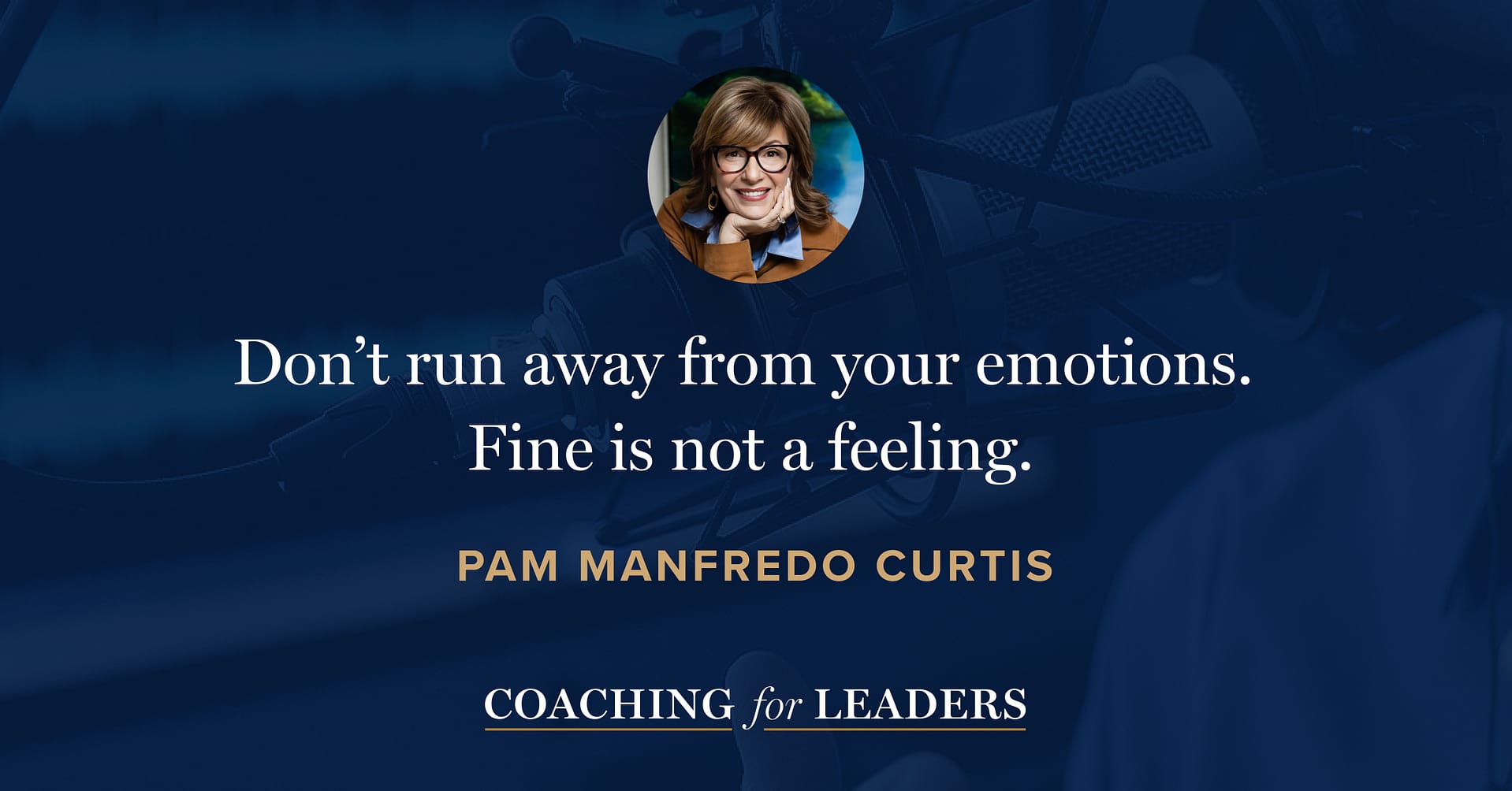
Don’t run away from your emotions. Fine is not a feeling.
https://media.blubrry.com/coaching_for_leaders/content.blubrry.com/coaching_for_leaders/CFL798.mp3

Podcast: Download

Follow:
Apple PodcastsYouTube PodcastsSpotifyOvercastPocketcasts

Pam Manfredo Curtis: The Origin of a Leader

Pam Manfredo Curtis is an executive coach and Founder and President of Manfredo Curtis Associates. Her coaching approach involves mining the hearts and souls and childhoods of her CEO clients so they can reach their full potential—to lead authentically, to achieve extraordinary results, and to forge deep, emotional connections, both professionally and personally. She hosted SiriusXM’s Corner Office Confidential and is the author of The Origin of a Leader: Transforming Family Patterns into Leadership Power (Amazon, Bookshop)*.

All of us get blocked, and when we do, our tendency is to set aside or sometimes to run away from our emotions. Today’s guest invites us to do the exact opposite so we can actually tap into our leadership power. In this conversation, Pam and I explore how to learn more about yourself and to use that insight for good.

Key Points

  • A significant predictor of how you show up as a leader is your childhood.
  • As you learn about yourself, you realize that everyone else already knows these things about you.
  • Create an emotional timeline by drawing a line from birth to today and highlighting the highs and lows of your life’s events.
  • It’s significant what shows up on your timeline – and also how the length of the highs and lows relate to each other.
  • When you understand how childhood impacts your leadership and who you are as a human being, you see how it affects an essential need as a leader: power.
  • By creating a timeline, you will be motivated to change in positive ways, see connections you’ve never seen before, and have more empathy for yourself and others.

Resources Mentioned

  • The Origin of a Leader: Transforming Family Patterns into Leadership Power by Pam Manfredo Curtis (Amazon, Bookshop)*

Interview Notes

Download my interview notes in PDF format (free membership required).

Related Episodes

  • The Way to Be More Self-Aware, with Tasha Eurich (episode 442)
  • Discover Who You Are, with Hortense le Gentil (episode 459)
  • How to Discover Self-Awareness Through Enneagram, with Ian Morgan Cron (episode 605)

Discover More

Activate your free membership for full access to the entire library of interviews since 2011, searchable by topic. Go beyond the podcast to find the right ideas and apply them with confidence inside Coaching for Leaders Plus.
How to Get Unblocked, with Pam Manfredo Curtis

Download

Dave Stachowiak [00:00:00]:
All of us get blocked. And when we do, our tendency is to set aside or sometimes even run away from our emotions. Today’s guest invites us to do the exact opposite so we can actually tap into our leadership power. In this episode, how to learn more about yourself and use that insight for good. This is Coaching for Leaders, episode 798.

Dave Stachowiak [00:00:25]:
Production Credit: Produced by Innovate Learning, Maximizing Human Potential.

Dave Stachowiak [00:00:34]:
Greetings to you from Orange County, California. This is Coaching for Leaders, and I’m your host, Dave Stachowiak. Leaders aren’t born; they’re made. And this weekly show helps leaders thrive at key inflection points. And when we get to the inflection points in leadership, and of course, in our lives, a lot of the times we come up on obstacles, we come up on blocks. And oftentimes, those blocks aren’t just what’s going on today. They’re also informed and sometimes even put in place by what has happened to us long ago, our own personal stories. Today, a conversation that’ll help us to look at the bigger picture, how we show up as people, our experiences, how that informs us as leaders, and how we can do a better job at being able to tap into our power as leaders through understanding and appreciation of that.

Dave Stachowiak [00:01:28]:
I am so pleased to welcome Pam Manfredo Curtis to the show. She’s an executive coach and founder and president of Manfredo Curtis Associates. Her coaching approach involves mining the hearts and souls and childhoods of her CEO clients so they can reach their full potential to lead authentically, to achieve extraordinary results, and to forge deep emotional connections, both professionally and personally. She hosted SiriusXM’s Corner Office Confidential and is the author of The Origin of a Leader: Transforming Family Patterns into Leadership Power. Pam, hello. So nice to have you on.

Pam Manfredo Curtis [00:02:05]:
Oh, I’m thrilled to be here, Dave. Thanks so much for having me.

Dave Stachowiak [00:02:09]:
I have enjoyed getting into your work so much and all of the insights that it’s brought up. In thinking about the work that all of us do is helping ourselves as leaders get better, but also just thinking about it on from a personal level and a selfish level too, which we’re going to get into in this conversation. And I think that leads into a quote that I highlighted very early in the book. You write, in all my research and decades of coaching high-level CEOs, I’ve discovered that the most significant predictor of how you show up in your interpersonal interactions as a leader and as a human is your childhood. What is it that’s so significant about our childhoods?

Pam Manfredo Curtis [00:02:51]:
Yeah, thank you so much for asking, Dave. And thank you, by the way, for drawing what we’ll call later an emotional timeline before this call. That will be fun to talk about.

Dave Stachowiak [00:03:01]:
Yeah.

Pam Manfredo Curtis [00:03:02]:
So first of all, the first system that we are raised in is our childhood home. And in that home, we observe our parents, our grandparents, our siblings, and how they have conversations with us, with each other, how they invite or don’t invite people into the home, whether they encourage us to share what we believe, what we think, or they tell us that we should keep our thoughts to ourselves, our thoughts and our feelings. It is the first world that we, therefore, observe and attempt to role model as we grow up. And think about it, we’re in that environment in most cases for about 18 years. And so, there are patterns that evolve over time by what we have witnessed. And some are beautiful, encouraging, stable homes. Some are more challenging mentally. And then there are some that— where trauma exists.

Pam Manfredo Curtis [00:04:06]:
And so even how the trauma was handled, if there was trauma, matters for how we deal with conflict or give feedback and all those things as we get older. So it is the first system that we are raised in. And I always say that, and this is a little provocative, but 80% of the reasons why we show up the way we are as leaders, as adults who influence in other systems, are due to that childhood home.

Dave Stachowiak [00:04:36]:
You mentioned a few moments ago an emotional timeline tool, and we’re going to talk about that here in a bit and actually get into mine a bit.

Pam Manfredo Curtis [00:04:45]:
Yay!

Dave Stachowiak [00:04:45]:
And you say on the emotion piece— we’ve already said the word emotion a bunch in this conversation— that not to run away from your emotions and that fine is not a feeling. Tell me more about that. Where’s that- Where does that show up for leaders?

Pam Manfredo Curtis [00:05:01]:
Yeah. I mean, how many times have you asked somebody, ” So, how are you doing?” And they’re like, I’m good. I’m fine. I’m okay. I’m great. And that means nothing. I mean, directionally, it can indicate some sort of condition that surrounds you, but the feelings are much richer and actually tell us a lot about what’s happening within us. So what we do is that, first of all, emotions are data, and they can tell us, like, how do we experience what is going on around us? If I interact with somebody who makes me really uncomfortable, do I get scared? Do I get lonely? Do I feel a sense of community or do I wanna run from that? Versus if I see somebody who’s part of my community and who loves me, I might experience joy.

Pam Manfredo Curtis [00:05:55]:
And our emotions, we use them as we look at our lives to figure out what does this data mean to us? What do these events mean to us? And the way we do it is we tune into the visceral responses in our bodies, whether our stomachs get tight, our arms get tight, our legs get really tense, or we feel hot, joyful cheeks as they go on around us. So it informs us about our experience in the world. Does that help?

Dave Stachowiak [00:06:27]:
Yeah, it does. And I highlighted a line you write in the book on this. And you say, as you learn your development areas, you realize that everyone else already knows these things about you and still thinks you’re a decent person and leader. And that really struck me because I think, one, how I’ve experienced that so often in working with clients, and I’ve also experienced that so often in myself. At times when I’ve gone through coaching work or assessments and said to someone like, oh, I’ve discovered this about myself, and oftentimes people are like, oh yeah, yeah, didn’t you already know that? We did.

Pam Manfredo Curtis [00:07:04]:
Right, right.

Dave Stachowiak [00:07:05]:
It’s funny how that works. Sometimes we’re the last to know.

Pam Manfredo Curtis [00:07:09]:
Well, it’s funny, like, when I talk to— I always do— I talk to spouses of my clients when I do what’s called a 360 assessment of people. And when I share back the feedback from this report on how they show up with their strengths and development areas, they typically share it with their wives or husbands or partners. And then the partners will always say, “Well, I knew that. I could have told you that. You didn’t have to go through this. I know that.” Right? Of course. Always happens.

Dave Stachowiak [00:07:36]:
Yeah, indeed. Well, that is maybe a great lead-in to a tool that you have invited so many leaders to participate in. And it’s an emotional timeline. And I’ll ask you to describe it in just a moment. But before I do, when I read the book and I went through this process, I thought, Ooh, I’m gonna do this. And so I actually wrote out my timeline for the first act one, which we’ll talk about, and I shared it with you. And you were very kind to ask me, “Do you mind if I talk about this on the podcast and ask you some questions about it?” And I told you, “Yes, absolutely.” Especially if this is helpful for others to take that first step to do a little bit of this yourself, either on your own with Pam’s book, like going through this process, I think is really, really helpful for every leader to do. So with that setup, Pam, perhaps you could frame what is the timeline? What’s the importance of doing it, first of all? And then just what does it look like logistically? And maybe we’ll get into mine a bit.

Pam Manfredo Curtis [00:08:34]:
Perfect. Perfect. So first of all, the goal of this is to get a picture of what your life looks like. And we divide it into Act 1, which are your childhood years from 0 to 18. And then Act 2 and beyond is about the implications of that childhood on the rest of your life, basically. So we are looking at emotional highs and lows of your life. And they— in this picture that you do as part, and it’s explained in origins, you chart this thing out. Now, when I work with clients, people come to an interview with me, and they come with this prepared visual, which may take our listeners today, like, I promise it can take 30 minutes.

Pam Manfredo Curtis [00:09:28]:
It’s not gonna take days.

Dave Stachowiak [00:09:29]:
Yeah.

Pam Manfredo Curtis [00:09:29]:
You may add things later, but it will take you about 30 minutes to do it. And then I interview them for 2 and a half, 3 hours. Now, I show you, dear listeners, in the book, the questions I would ask you. And you are thinking about the questions as you look at the visual in front of you. But it is meant to see which events had the biggest impact on you, and were they joyful events, or were they sad events or tough events? And the reason why I’m also— I’m going back, Dave, to just a question that you talked about, which was around the emotions. Underneath all emotions are love or fear. And so I’m trying to understand which ones are flowing out of love and joy, and which ones are more difficult, maybe due to fear reasons or some other thing that’s happened that’s more negative. So I can explain how to do it.

Dave Stachowiak [00:10:29]:
Please.

Pam Manfredo Curtis [00:10:30]:
So first of all, for the listeners, the simplest way to do this is to take, you know, we all may know about an 8.5 by 11 piece of white paper. Doesn’t have to be that, but you turn it horizontally. And in the center of the page, from left to right, you draw a straight line across it. On the left-hand side, you put the day you were born, the year you were born, the day you were born. And on the right-hand side, at the other end of the document, right, you put— and you’re using pencil, pen, whatever you want— you’re putting your age today. And this straight line is representative of kind of like zero emotions, like just like neutral. And then what you do is you take key events that are either positive or negative that you remember, very poignant ones, and plot them relative to the line. So for example, if I get married, right, maybe that’s the most joyful day.

Pam Manfredo Curtis [00:11:34]:
And so that’s an inch above the line, just in terms of joy. But when I have a child, maybe that’s 2 inches above the line. If maybe I lost a job, that may be 1 inch below the line. And if I, you know, or if I lost a child, that may be 3 inches below the line.

Dave Stachowiak [00:11:56]:
Hmm.

Pam Manfredo Curtis [00:11:56]:
So it’s, it’s the relative emotional power that these events have on me. And that’s as you draw these events on a timeline, there is this visceral— this thing that I talked about before, this visceral connection to your body that goes, “wow, I feel so happy, or this is really sad. This is really, really sad”.

Dave Stachowiak [00:12:21]:
Yeah.

Pam Manfredo Curtis [00:12:21]:
You know? So for the listener, Dave, what would you say your mental framework was as you were drawing this? What was your— how did you feel emotionally as you did it?

Dave Stachowiak [00:12:32]:
Ooh. I would say fairly neutral for 2 reasons. One is that’s just kind of the space I was in, in doing it. And secondly, I was also trying to be intentional about not necessarily coming to it from a high or a low, but just trying to be objective to the extent that I could be.

Pam Manfredo Curtis [00:12:51]:
Got it. Okay. And we’re going to talk about maybe a little bit when we talk about Act 1 and Act 2 and Act 3, objectivity versus like tuning into our emotions about these things, because the way the book is set up of 3 acts in a play is a lovely way to kind of be objective about your life, the characters in your play, because it is your life. And we- if we get above a stage, we can watch ourselves. However, when you start drawing these events, and you start processing, how do I really feel about it? That can go inside of us, and it can either bring joy, or it can be difficult, right?

Dave Stachowiak [00:13:28]:
Mm-hmm.

Pam Manfredo Curtis [00:13:28]:
It can make us sad or or angry. So let me just describe a little bit about Dave’s ETL, as we call it, for a minute. And so what I noticed, there are about— so he did use the 8.5 by 11 paper. Thank you so much, Dave. And there is 1, 2— well, there’s 1, 2, 3, 4, 5. There are 5 items that are positive on the line with 4 below. And this is from age 0 to 18. And there’s lovely variability in the length of the lines, which tells me that you might, Dave, be able to differentiate emotionally what was a really positive thing versus a difficult thing.

Pam Manfredo Curtis [00:14:12]:
And what you talk about here is— and of course I haven’t asked you anything yet.

Dave Stachowiak [00:14:17]:
No, you haven’t.

Pam Manfredo Curtis [00:14:18]:
But you list that friendships was a positive thing when growing up and family time and vacations, but that there were also— it looks like the word is moves, right? And that there was a loss of friendships because of moves that happened for you, is that— was that one move or multiple moves, Dave?

Dave Stachowiak [00:14:35]:
It was multiple moves. In one case, it was a move when I was very, very young, like age 0 to 5. We lived in Connecticut. And so I remember that being a really joyful time. Lots of— we had next-door neighbors that were like dear friends of ours.

Pam Manfredo Curtis [00:14:50]:
Oh, wow.

Dave Stachowiak [00:14:50]:
And lots of wonderful, like the idyllic going out in fields and playing with friends every day and losing track of time and all those things. I have great childhood memories of that. And then we moved back to where my family is from, which is the Chicago area. And that was a big transition of losing those friendships and also gaining new friendships when we moved. And then later on in my childhood, I had a dear friend who in the Chicago area who then moved on, ironically, back east. And I lost, yeah, I lost that friendship. And that was, that was a sad time. That was a sad time, like losing that friendship when I was a kid.

Pam Manfredo Curtis [00:15:29]:
Of course, of course. And it looked like sports was a difficult— where, when, so sports follows this- It’s almost as low as the other moves and loss of friendship, not terribly low, but a little bit low. Yeah.

Dave Stachowiak [00:15:41]:
Yeah. I was not an athletic kid at all. And I was a little bit overweight as a kid, and I never was good at sports. And so anytime there was any sort of physical education thing or sports teams, and my parents were really good about like encouraging us to go do some team sports, like neighborhood softball and things like that. But that was always a place where I just didn’t feel confident. Like anytime there was the, like, in school picking the who got to pick who’s on whose team, I was always one of the last kids to get picked. It was like a good day when I was like second or third last, you know?

Pam Manfredo Curtis [00:16:17]:
Yeah.

Dave Stachowiak [00:16:18]:
Yeah. That kind of a thing. That was sort of like a recurring theme of just never feeling confident, never feeling like I was able to do as well as other kids, and just sort of that.

Dave Stachowiak [00:16:28]:
Yeah. There was like a cloud that was always sort of over me whenever those moments came up in activities and with other kids.

Pam Manfredo Curtis [00:16:34]:
That’s hard. And how old were you then?

Dave Stachowiak [00:16:36]:
Oh gosh, I think most of that was probably in elementary to middle school, but probably more elementary school to middle school-ish areas.

Pam Manfredo Curtis [00:16:45]:
For sure. And then what shows up on your timeline, understandably, is that then you were bullied, I guess, in middle school, which is a lower line.

Dave Stachowiak [00:16:54]:
Yes.

Pam Manfredo Curtis [00:16:55]:
Right?

Dave Stachowiak [00:16:55]:
Yes, yes, it is. And I was one of those kids, and folks who have worked with me know this because I often will share this story, is, I was super introverted, but also extremely shy and fearful of people as a kid. And outside of my own immediate family, I really had a hard time with establishing and being the catalyst for friendships and certainly talking to, like, other adults outside of my parents. Like I was really, really fearful of talking to people in interactions. And so I was like target number one for bullies in middle school, you know, coming to that kind of personality.

Pam Manfredo Curtis [00:17:33]:
Yes.

Dave Stachowiak [00:17:33]:
Yeah. As were a lot of people. And thankfully, like the world’s different on this today as far as how we recognize this in schools. But yeah, that was— I recall middle school being just not fun on a lot of those things. I mean, there were certainly really positive things that happened then too, but a lot of things that I would have called at the time friendships were things that were people who were using power in different ways and bullying behavior. And some of that came up, and thankfully there was nothing ever horrific or like abuse or anything like that that came up. But there was a lot of that psychological stuff that comes up in middle school anyway. But I got more of a dose of it than the average kid, I think, just because of my personality and kind of my, my traits, and also not being good at sports and all that stuff fed into that.

Pam Manfredo Curtis [00:18:20]:
Well, and then though, there’s this big shift upward. Is that citizenship it says in 8th grade?

Dave Stachowiak [00:18:26]:
Yeah.

Pam Manfredo Curtis [00:18:27]:
Which was a really joyful time for you.

Dave Stachowiak [00:18:29]:
I won an award at the end of 8th grade. The local Rotary Club in our hometown sponsored an award that I didn’t know this at the time until after I received the award, but the— all the 8th grade teachers got together and voted for one boy and one girl every year to win what they called the Citizenship Award. It was the Rotary Award, and it was for citizenship and friendship and values. And it was like all the things that I felt like I didn’t— I struggled with, and I didn’t, I didn’t have the opportunity to do a good job with. And I always sort of felt like I was the person who tried to be really nice to people and kind, and that just was never rewarded.

Pam Manfredo Curtis [00:19:13]:
Yes.

Dave Stachowiak [00:19:14]:
And then it was, and it really publicly was, like in front of the entire school. The entire 8th grade faculty basically got together and said, you and this other girl, Elizabeth, win this award for citizenship, and we all acknowledged that. And it was the first time in my life I got to be best at something.

Pam Manfredo Curtis [00:19:35]:
Wow.

Dave Stachowiak [00:19:36]:
And it was also, also I really had the conscious thought shortly after that of like, oh, people noticed. And that was new for me. Like, oh, all this, the kinds of ways I was showing up and the things that didn’t ever seem to be rewarded and the loneliness and some of that, I was like, Oh, people really noticed that. And I realized I wasn’t giving myself as much credit for some of the things I was doing well. And it really was a defining moment for me. Like, when I look back at my childhood, I wouldn’t have said it at the time so much, I don’t think. But now looking back, I think, wow, that was a defining moment in how I showed up. And it laid the seeds to shift me in some really, really great ways.

Pam Manfredo Curtis [00:20:25]:
Well, and I think the word you just used was shift me. So let me, let me just back up and share a few things that I see.

Dave Stachowiak [00:20:32]:
Please.

Pam Manfredo Curtis [00:20:32]:
Or that I wondered, just even listening to you. And this, please, listener, as you do this, you’re doing a drawing. And then again, I’m going to give you some questions to reflect about and think about, like characters in your life. But here’s some of the things that I just, listening to you, Dave, pop for me. So, first of all, the loss of moving and of dear friends early in your life, that is a real thing. And one of the environments I talk about is the nomad, when we move from place to place, and we lose some of the dear friendships, how that affects us, our strengths and our development areas, and so forth. And the difficulty in sports was fine, but the bullying part- what this tells me is that between these 3 events or series of events, you developed, I assume, empathy. Empathy that this is where we either choose to live the way we have been treated, or we, you know, it develops a strength in us, and we can harness it for the good of others.

Pam Manfredo Curtis [00:21:36]:
And so going through being bullied and having difficulty with sports or losing these friendships taught you, as you even just implied, like how to care about the citizens in my world and how to take care of people and protect them and stand up for them. And so to be recognized for that gift just validates that you learned from these early memories is the first thing I hear. Is that true for you, Dave, just as you—

Dave Stachowiak [00:22:04]:
Yeah, yeah. And that still really resonates with me today, of thinking about those times in my life and thinking, certainly on my better days, like, how can I be an example of the experiences I’ve had and the strengths I’ve been able to develop for others to make the world better? And I, I still feel like I pull on those. I mean, it’s been like, what, 30, 35 years?

Pam Manfredo Curtis [00:22:26]:
But that’s the point, right? Look at what you do with this podcast. It’s, it’s you are trying to bring goodness to the world, right? And make their lives better because you get it. You get it. Now, there would be lots of questions I’d have. Like, I, of course, would want to inquire a lot about what really— how were you bullied? Who did it? If I was sitting with you, I’d wanna get into a lot of details about that. If it was a series of events over time or if it was one.

Dave Stachowiak [00:22:53]:
Yeah.

Pam Manfredo Curtis [00:22:53]:
Because that bullying situation can be something that creates a block later. And how that is determined is whether your parents— I know nothing about your parents yet- how your parents handled that situation. If you talked to your parents or grandparents about that, how they responded when that situation happened. Did they support you? Did they go and help you challenge the situation? Did they stand up to the school members? Did you get to speak eventually to these characters in your life who hurt you and speak up on this account? So, how that was processed has a huge impact on whether it turns into something like a block later. And yet, you really use this for good in your life, which is beautiful. Yeah.

Dave Stachowiak [00:23:40]:
Yeah.

Pam Manfredo Curtis [00:23:40]:
Because of the drawing, right? What people— what the listener will eventually, if you read or you listen to the book, I always start with a lot of questions about mom and dad, or if there’s a stepdad or whoever it is, but your parents. And I always start with mom. And I ask a lot of questions about who that person was and/or is, but how they showed up when you were young. And were they present for you? The attachment theory stuff was—

Dave Stachowiak [00:24:10]:
Right.

Pam Manfredo Curtis [00:24:11]:
How close you were with your parent, and were they around? Did they talk to you? Did they not? Um, I talk about Dad and what kind of person Dad was, and how did they show up as a couple, and what did they mirror for you. But so, for example, if Mom and Dad— if people bullied them or hurt them, how did they handle it? And what did you learn by observing that? Or not, or— and so there’s a lot of conversation and exploration around these events correlated with the characters in your life, and to see what patterns moved.

Dave Stachowiak [00:24:48]:
Yeah. Right?

Pam Manfredo Curtis [00:24:49]:
Does that make sense, Dave?

Dave Stachowiak [00:24:50]:
It does. And I think that brings up one of the things that I noticed in putting this together and writing this out is that I noticed when I wrote things down, a lot of the things I wrote down, like family time, sports, friendships, were not so much events. They were sort of like things that happened over time. And I had a hard time, especially 0 to 18, really thinking without— other than a couple of the key ones we talked about, I had a hard time really thinking of super high highs and super high lows and just things even to put on the chart. And I think there’s like some things to unpack there. And one of them is, one, I had an amazing childhood, like overall, and I have amazing parents who are my 2 biggest champions in the world and have supported me and my brother in so many amazing ways. And one of the other things I sort of noticed going through this, like, huh, some of the highs and lows I’m having a harder time identifying. And I got to thinking about that.

Dave Stachowiak [00:25:56]:
And both of my parents are not very emotionally expressive people.

Pam Manfredo Curtis [00:26:02]:
Hmm.

Dave Stachowiak [00:26:03]:
And in our household, when we were kids, there was a lot of activity. There were a lot of good things happening. There was a lot of support and love and stability and all the things you talk about in the stability piece of the book. What there wasn’t a lot of is conversation about emotions.

Pam Manfredo Curtis [00:26:17]:
Mm-hmm.

Dave Stachowiak [00:26:17]:
And I noticed that in writing this out of like, oh, it’s a little harder for me to sometimes identify some of those real highs and lows, especially earlier on in my life. And if I, like, turn the picture back on myself today, what are the things that I still find that I struggle with sometimes, both as a husband and a parent, is getting into the emotional pieces and surfacing those. It’s very easy for me to go to the logical, objective parts. And so I was also thinking coming out of this, like, “Huh”, you know, it’s, it’s looking back on this is like, for me, both a wonderful affirmation of how far I’ve come on so many of those things in my life and in my— and both as a, as a person and also as a professional, but also like the opportunity to do even better at that as a husband, as a father, and to do what your parents did for you, which you talk about in the book, like at dinner at night. How do you feel about this? Like being really intentional about that. And I’m like, oh boy, there’s definitely opportunities I still miss on that.

Dave Stachowiak [00:27:15]:
And that was really nice to come to this and think about that. And I don’t know, I’m curious what you think about just that armchair psychology of me looking at myself.

Pam Manfredo Curtis [00:27:26]:
Yes. No, I think it’s wonderful. Well, first of all, most people grow up— so many of my executives, they grow up not knowing how to talk about their emotion. That’s the majority. You know, analytic skills, to your point, being logical, rational, delivering results is always what is rewarded, right? Doing things.

Dave Stachowiak [00:27:47]:
Yeah.

Pam Manfredo Curtis [00:27:47]:
I come from a mother who’s a school psychologist, right? And a father who worked with United Airlines with a lot of flight attendants, and people mattered. Emotions mattered. The team mattered. So- and I had a godmother and a grandmother who believed in psychological safety and asking me how I felt. And so it is what we practice, but there’s no judgment. It’s— I think your situation is much more common than mine in this. Not that, believe me, things weren’t perfect, but, but I think that’s very common. I do believe that everyone can learn how to tune into their emotions and articulate what they are.

Pam Manfredo Curtis [00:28:30]:
And one of the things we do is that check-in to say, what am I thinking?

Dave Stachowiak [00:28:34]:
Mm-hmm.

Pam Manfredo Curtis [00:28:35]:
What am I feeling? And what are my hands in this moment? And it is something that you have to practice, and you have to practice for yourself. And there’s a whole appendix of emotions, but it’s, it is about what am I feeling? And I, I do believe it grows. And this is one of the most profound things that executives will say to me is, when their kids suddenly notice that they’re asking how they feel and what’s going on for them. And the leaders are vulnerable about what they’re feeling. And sometimes then the relationship improves in that moment. So I do believe it’s a skill and a gift that we can all groom within ourselves. Yeah?

Dave Stachowiak [00:29:15]:
Yes. And it leads me to think of 3 things you identify in working with leaders of like, OK, why would you do this? What’s the benefit of going through the timeline and thinking about this? And you highlight 3 of them in the book. And you say, one, it reminds you of your mortality, and the best day to change is today. And secondly, you see connections you haven’t seen before. And third, you feel empathy for yourself and others. And I, going through this, I’m like, yeah, it really does all 3 of those. And I think it’s, it’s an opening to start to see some of the things that are patterns that then also illuminate, okay, this block that I’m having today, this thing that’s not quite working as leader, maybe there’s a pattern here that I can, once I illuminate and understand, then I can do something about it.

Pam Manfredo Curtis [00:30:08]:
Yeah. Yeah. So should I talk a little bit just about a block and what that is a little bit here? Would that be helpful, Dave?

Dave Stachowiak [00:30:16]:
Please.

Pam Manfredo Curtis [00:30:17]:
So Act 1 of the book, right? We’re thinking about your life in 3 acts of a play of your life. And Act 1 is looking at that, those first 18 years. Act 2 is thinking about the implications of that childhood on who you are. Like you just talked about, Dave, I loved it, where you don’t remember a lot of different events. You remember dinners or time together or things like that, but just everyday life that seems so positive for you.

Dave Stachowiak [00:30:47]:
Mm-hmm.

Pam Manfredo Curtis [00:30:47]:
And sometimes, that just may mean because people live certain behaviors beautifully, like certain values and behaviors every day in a beautiful way. But then there are things that happen like this bullying thing, and, you know, if it was a pattern a long time, Dave, that would be a different story. But some people, when they’re bullied when they’re younger, they— it doesn’t go away.

Dave Stachowiak [00:31:11]:
Yeah.

Pam Manfredo Curtis [00:31:12]:
So what a block is, is if you imagine that… Imagine you’re in a national park and there’s a big river of water that’s flowing, and there are boulders around you, but suddenly a boulder falls into the river, this intense leadership energy water. The boulder falls in, and it stops the flow of the water. A block is kind of like that. We have a lot of leadership energy within us; I call it the flow. But if something happened to us and we didn’t work through it, we didn’t resolve it, we didn’t have conversations about it, we didn’t express the hurt that we felt or the impact of that event on our lives, then it may stop us from speaking our truth if someone reminds us of the person who hurt us. We may be quiet in a room. We may hide behind chairs. We may— because we’re trying to protect ourselves. Leaders will ask me, why is that person not sharing their perspective in the room? Well, maybe they were hurt, and you’re reminding them of that person. So there’s this stoppage of you at your best self.

Dave Stachowiak [00:32:21]:
Hmm.

Pam Manfredo Curtis [00:32:21]:
And so what we try to figure out is, what happened? And again, when I was saying before, let me know all the details about what happened, and then understand how you think that might have impacted you. And then we do a whole process to say, so if we’re gonna— gonna get somebody to clear that, how do we do that? And it starts with, what’s my goal? Do I want an apology? Do I just need to say it out loud? Do I need just to talk to the parents of the people who were involved who didn’t protect me, or my own parents? What do I need? And it’s amazing that, when you do share this experience or achieve your goal, which is a long process, by the way, it frees this leadership energy. And that’s what releases this energy that goes into the referent power that changes the way you can have conversations with people and build relationships, give feedback, and so forth, Act 3 of the book. So anyway, I think clearing blocks is the most profound thing that transforms the leaders I work with. Without a doubt, the biggest changes I see is when somebody confronts a block and overcomes it. It’s brilliant.

Dave Stachowiak [00:33:36]:
Well, I have 2 invitations for folks coming out of this conversation. One is, I hope that you might take our invitation to do this for yourself, to grab the piece of paper, to draw the line, and then to start to think about what are the things that show up on your line. And then the second invitation would be to go get Pam’s book. And it’s, you’ve done, as you mentioned, a really wonderful job of outlining, here would be the questions I’d ask, and here would be the process we’d go through. And here are the things that illuminate that, and it’s a really nice path to be able to follow. And I should also add, going back into childhood sometimes brings up stuff that it’s really, really helpful to talk with a coach or a therapist. And we’ve had that conversation on the show many times.

Pam Manfredo Curtis [00:34:19]:
Yes.

Dave Stachowiak [00:34:19]:
I’m going to reference some of our past conversations at the end of the episode today. But as a reminder, you may start this yourself, but you may very quickly also discover that connecting with someone who can really support you through this is great to do. And I think to the extent you can do that, always super helpful and super profound. Pam, one last question for you. As you have put this book together, as you’ve invited leaders to look back in so many profound ways at their lives, their childhoods, I’m curious, in doing this work, bringing this together, what, if anything, have you changed your mind on?

Pam Manfredo Curtis [00:34:52]:
Yeah. So what changed for me, first of all, like, the biggest changes happen for people who are about 35 to 55 because they’ve lived a life where, where they both have had successes and failures and they’re not ashamed to look at them, their lives, so they can become much more self-aware. But people will say to me, I wish I did it earlier because I wonder the kind of environment I created for my own kids.

Dave Stachowiak [00:35:20]:
Hmm.

Pam Manfredo Curtis [00:35:21]:
And, and for my spouse and I, what is the system I created? Whether I’m doing it for my teams at work or for my family, have I created harm or have I created a world of empowerment and joy? And so the amount of time that my executives like to talk about that, about their kids and their families and how they’re showing up there, is profound. And, you know, we talk about all that because it’s all about the whole person. But I wish more and more that we could put more emphasis on that because it’s, it’s truly wonderful.

Dave Stachowiak [00:35:59]:
Pam Manfredo Curtis is the author of The Origin of a Leader: Transforming Family Patterns into Leadership Power. Pam, thank you so much for writing this book and creating the space where we can have conversations like this. I’m so grateful.

Pam Manfredo Curtis [00:36:12]:
Thank you so much. I’ve really enjoyed talking to you, Dave. Thank you.

Dave Stachowiak [00:36:15]:
Me too. If this conversation was helpful to you, 3 other episodes I’d recommend for your listening. One of them is episode 442: The Way to Be More Self-Aware. Tasha Eurich was my guest on that episode, and we talked about some real practical steps you can take to build your self-awareness. We know that’s been foundational for many years for leadership success, for emotional intelligence, and Tasha does a marvelous job in that conversation of really providing us some real practical steps to get started. Episode 442, a good complement to today’s conversation. Also recommended, episode 459: Discover Who You Are. My guest was Hortense le Gentil.

Dave Stachowiak [00:36:57]:
Hortense and I talked about the invitation to come at understanding ourselves from more of a peripheral lens. We did a little bit of that today in this conversation. And oftentimes, the questions that don’t, on their face, seem as direct are the ones that can offer the most insight. And we talked in that conversation on some detailed ways that we can come to that insight, not only for ourselves but for others. Episode 459 for that. And then finally, I’d recommend episode 605: How to Discover Self-Awareness Through the Enneagram. Ian Morgan Cron was my guest on that episode. We talked about Enneagram.

Dave Stachowiak [00:37:36]:
It’s one of the many assessments out there that help us to provide some more insight into our own personalities, our tendencies. They are all useful. They are all imperfect, all these assessments, but they can also provide some really helpful lenses to provide the language and the understanding to begin conversations. That’s where assessments are so powerful. Many in our community have told me over the years, Enneagram is very helpful for doing that. In episode 605, we looked at it specifically and how it may be helpful to you in discovering your self-awareness. All of those episodes, of course, on the Coaching for Leaders website. We’ve had many, many episodes over the years under the category of personal leadership, understanding more about ourselves.

Dave Stachowiak [00:38:17]:
Leadership is not about us, of course, but it does start with us understanding ourselves better first. When we do that, we can more effectively support others. And so, I’d invite you to set up your free membership. And also, while you’re online, you may want to find out a bit more from me. You heard a bit more about my story in this conversation today, and I’m regularly providing that perspective in my weekly journal. One of the realities of leadership is it rarely gives you an hour to think. And that’s why each week I share a concise journal entry that highlights one practical leadership idea that I think will be helpful to you immediately in your work.

Dave Stachowiak [00:38:56]:
It’s just a couple of minutes to read. It comes right from me. And it is part of my journal for our members, and a part of Coaching for Leaders Plus. If you’d like to find out more about that and the other benefits inside of Coaching for Leaders Plus, just go over to coachingforleaders.plus. You’ll find out more, and you can get started with membership right away. Coaching for Leaders is edited by Andrew Kroeger. Next Monday, I am pleased to welcome Aiko Bethea to the show.

Dave Stachowiak [00:39:26]:
Aiko and I are going to be talking about how How Leaders Stay Grounded. Great follow-up to our conversation today. Join me for that conversation with her, and I’ll see you back on Monday.

Topic Areas:Personal Leadership
cover-art

Coaching for Leaders Podcast

This Monday show helps you discover leadership wisdom through insightful conversations. Independently produced weekly since 2011, Dave Stachowiak brings perspective from a thriving, global leadership academy of managers, executives, and business owners, plus more than 15 years of leadership at Dale Carnegie.

Listen Now OnApple Podcasts
  • More Options
    • YouTube Podcasts
    • Spotify
    • Overcast

Activate Your Free Membership Today

Access our entire library of Coaching for Leaders episodes from 2011, searchable by topic.
Listen to the exclusive Coaching for Leaders MemberCast with bonus content available only to members.
Start Dave’s free audio course, 10 Ways to Empower the People You Lead.
Download our weekly leadership guide, including podcast notes and advice from our expert guests.

... and much more inside the membership!

Activate Your Free Membership
IMAGE
Copyright © 2026 · Innovate Learning, LLC
  • Plus Membership
  • Academy
  • About
  • Contact
  • Dashboard
×

Log in

This site is protected by reCaptcha and the Google Privacy Policy and Terms of Service apply.
 
 
Forgot Password

Not yet a member?

Activate your free membership today.

Register For Free
×

Register for Free Membership

Access our entire library of Coaching for Leaders episodes from 2011, searchable by topic.
Listen to the exclusive Coaching for Leaders MemberCast with bonus content available only to members.
Start Dave’s free audio course, 10 Ways to Empower the People You Lead.
Download our weekly leadership guide, including podcast notes and advice from our expert guests.

... and much more inside the membership!

Price:
Free
First Name Required
Last Name Required
Invalid Username
Invalid Email
Invalid Password
Password Confirmation Doesn't Match
Password Strength  Password must be "Medium" or stronger
This site is protected by reCaptcha and the Google Privacy Policy and Terms of Service apply.
 
Loading... Please fix the errors above