Academy Applications Now Open
Apply
  • Skip to primary navigation
  • Skip to main content
  • Skip to primary sidebar

Coaching for Leaders

Leaders Aren't Born, They're Made

Login
  • Plus Membership
  • Academy
  • About
  • Contact
  • Dashboard
  • Login
Episode

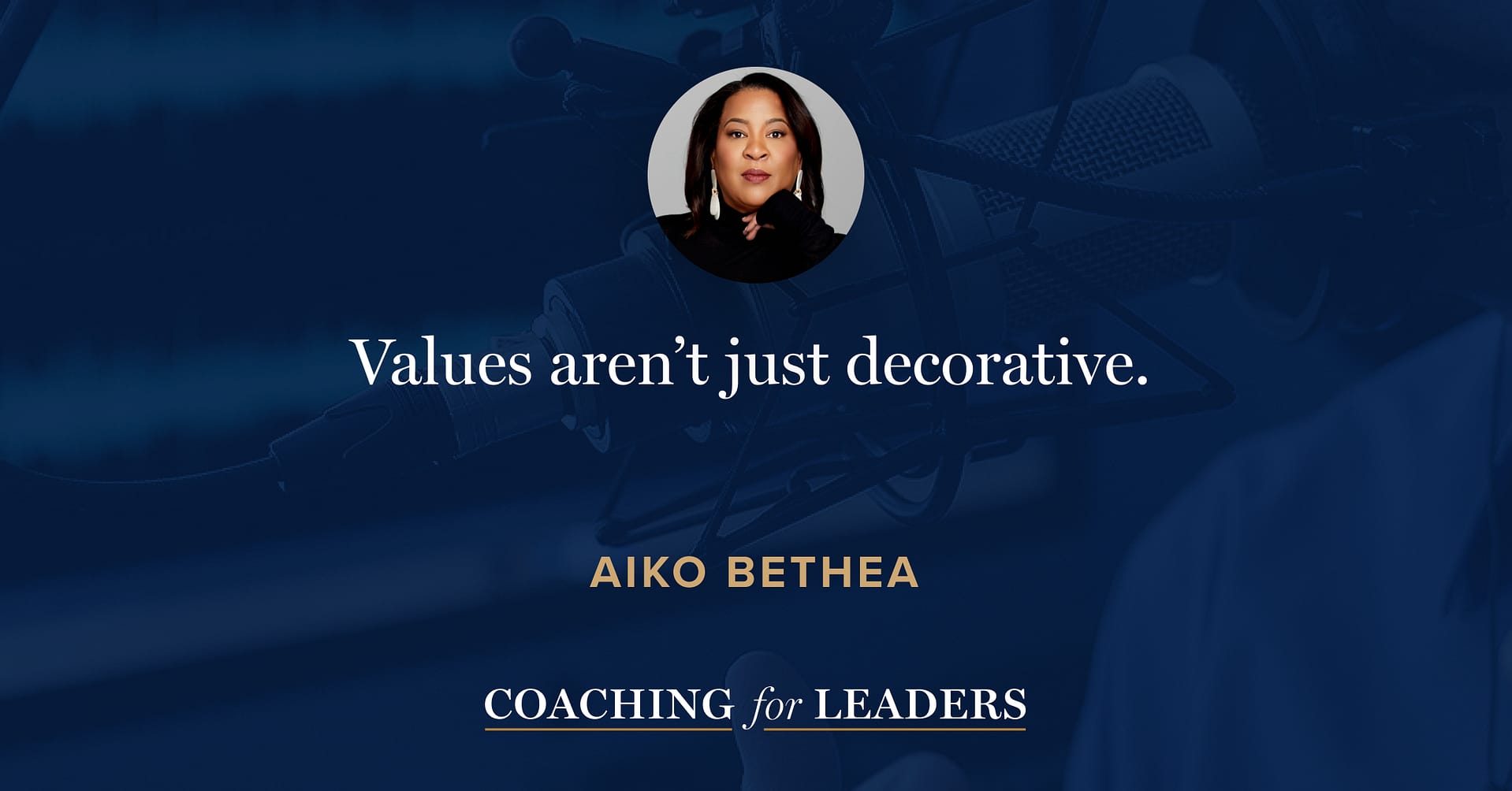
799: How Leaders Stay Grounded, with Aiko Bethea

Values aren’t just decorative.
https://media.blubrry.com/coaching_for_leaders/content.blubrry.com/coaching_for_leaders/CFL799.mp3

Podcast: Download

Follow:
Apple PodcastsYouTube PodcastsSpotifyOvercastPocketcasts

Aiko Bethea: Anchored, Aligned, Accountable

Aiko Bethea is the Founder and CEO of RARE Coaching & Consulting, a leadership development firm that partners with Fortune 100 companies, nonprofits, and global organizations to build accountable, values-driven cultures. She is listed as #3 on the list of Top Executive Coaches of 2026 by the Industry Leader and has spent over a decade coaching C-suite leaders across industries, and served previously as deputy director at the Bill & Melinda Gates Foundation. She is the author of Anchored, Aligned, Accountable: A Framework for Transcending BS and Transforming Our Lives and Work (Amazon, Bookshop)*.

I have seen so many activities over the years to help leaders clarify their values. I have built some of them myself. And most of them, including the ones I’ve built, miss a big question: what do those values actually mean? In this conversation, Aiko and I explore that question in detail to help us all do a better job of staying grounded.

Key Points

  • In an era of information everywhere, it’s more challenging than ever to engage our inner awareness.
  • An anchor keeps a ship in place during the storm. Our values do the same for us as leaders.
  • Values aren’t just decorative. Simply naming a value doesn’t tell us much about what it means.
  • Explore the behaviors that come out of labels we use for values. Those behaviors help us better align with others – and ourselves.
  • A value label may mean one thing to one person and something entirely different to someone else. Curiosity will help you uncover what really matters to people.
  • Beware naming values that are simply aspirational. Instead, zero in on what is actually true for you.

Resources Mentioned

  • Anchored, Aligned, Accountable: A Framework for Transcending BS and Transforming Our Lives and Work by Aiko Bethea (Amazon, Bookshop)*.

Interview Notes

Download my interview notes in PDF format (free membership required).

Related Episodes

  • Leadership in the Midst of Chaos, with Jim Mattis (episode 440)
  • How to Discover What Others Value, with Joe Hart (episode 616)
  • The Way to Build Collective Power, with Ruchika T. Malhotra (episode 759)

Discover More

Activate your free membership for full access to the entire library of interviews since 2011, searchable by topic. Go beyond the podcast to find the right ideas and apply them with confidence inside Coaching for Leaders Plus.
How Leaders Stay Grounded, with Aiko Bethea

Download

Dave Stachowiak [00:00:00]:
I’ve seen so many activities over the years to help leaders clarify their values. I have built some of them myself, and most of them, including the ones I’ve built, miss a big question. What do those values actually mean? In this episode, how to help us all do a better job of answering that question and staying grounded. This is Coaching for Leaders, episode 799.

Dave Stachowiak [00:00:26]:
Production Credit: Produced by Innovate Learning, Maximizing Human Potential.

Dave Stachowiak [00:00:35]:
Greetings to you from Orange County, California. This is Coaching for Leaders, and I’m your host, Dave Stachowiak. Leaders aren’t born; they’re made, and this weekly show helps leaders thrive at key inflection points. I think one of the things that almost all of us have heard, seen, talked about, thought about, are values. Every time I read a leadership development book or go to a leadership program, almost always there’s a conversation about values. And yet, we often don’t go further into that conversation to really dive in on what do values mean? Why are they important to us? How do they actually show up? And what are the behaviors behind those values? And how do we embrace them in such a way that not only serves us, but also supports the organization that we support and helping make the world a better place? And today, I’m so glad to be able to welcome an expert that’s going to help us to really think about how we approach our values in a way that is genuine and true for all of us. I’m so pleased to welcome to the show Aiko Bethea. Aiko is the founder and CEO of Rare Coaching and Consulting, a leadership development firm that partners with Fortune 100 companies, nonprofits, and global organizations to build accountable, values-driven cultures.

Dave Stachowiak [00:01:56]:
She’s listed as the number 3 top executive coach of 2026 by The Industry Leader and has spent over a decade coaching C-suite leaders across industries and served previously as deputy director at the Bill and Melinda Gates Foundation. She is the author of Anchored, Aligned, Accountable: A Framework for Transcending BS and Transforming Our Lives and Work. Aiko, such a pleasure to have you here.

Aiko Bethea [00:02:21]:
Thank you so much for having me, Dave.

Dave Stachowiak [00:02:23]:
I loved getting into your work, and I grabbed the 3rd paragraph of the book because I think it speaks to so much of this conversation that we’re about to have. And you write in that paragraph: In a world where we can gather information from anywhere, and where artificial intelligence can channel the voices of anyone, our inner awareness loses calibration. We live plugged into countless connections, yet we still feel an epidemic of loneliness and alienation. We have automated solutions to everything at our fingertips, yet we still crave rest and spaciousness. I read that, and I thought, “boy, I don’t think it’s ever been easy to know ourselves. But perhaps today, it’s harder than it’s ever been”, isn’t it?

Aiko Bethea [00:03:12]:
I’d agree. I think even in the work that we do with our clients, we note that a lot. And maybe the time that they have, where there’s actually some stillness, is when they’re in a session with their executive coach. It’s not something that just happens naturally. It’s almost like you have to be very intentional about it.

Dave Stachowiak [00:03:31]:
We hear the word values a lot. And as I mentioned in the intro, anytime we’re talking about leadership, we read a leadership book, almost always the word comes up. What is it that’s significant about identifying what they are for each of us?

Aiko Bethea [00:03:48]:
Oh, values are your true north. They signify what’s most important to you. They signify when the rubber meets the road: what is it that I should go to? They help us to live a life that’s not filled with regret. They help us to make decisions quicker. They help us to be aligned in how we show up. They help us to navigate very difficult moments in a way that is truest to us and most honest to us.

Dave Stachowiak [00:04:17]:
You write on this: Being connected within and grounded in our values and who we truly aspire to be supports us in being vigilant and holding ourselves accountable, interrogating our stealth intentions, and even having joy and conviction in a dystopian world. And, you said the word anchored a moment ago and used the analogy of an anchor in thinking about values. What is it about an anchor that captures this so well?

Aiko Bethea [00:04:45]:
So what do you think about when you think about the word anchor? What comes up for you, Dave?

Dave Stachowiak [00:04:48]:
A ship.

Aiko Bethea [00:04:49]:
A ship. And what’s the anchor doing?

Dave Stachowiak [00:04:52]:
Holding it in place.

Aiko Bethea [00:04:53]:
That’s right.

Dave Stachowiak [00:04:53]:
Wherever it is and whatever the weather is, right?

Aiko Bethea [00:04:57]:
That’s right. Keeping you grounded no matter in the storms, no matter how strong the currents are. I would also say what I thought about what happens when you’re not anchored, you’re unmoored.

Dave Stachowiak [00:05:09]:
Hmm.

Aiko Bethea [00:05:10]:
You’re just floating out here, almost not knowing a destination and intentionality. And being unmoored doesn’t even feel the least bit secure. But the idea of being anchored is that there’s this degree of intentionality and that no matter how harsh the winds are or the storms are, you’re going to be steady in that moment.

Dave Stachowiak [00:05:30]:
Hmm.

Aiko Bethea [00:05:31]:
And I offer that as a metaphor for readers, because when the world around us feels always so uncertain, or even unfamiliar and chaotic, or the word I used there that you stated was dystopic, then we have to have a place to actually be centered and grounded. I think it’s— gone are the days when people securely looked outward and said, “I want to be like that person”. Or “Let me look out here for some security and model in terms of external facing”. And it is that for that reason, it’s even more important and critical that we are able to self-stabilize and truly to be the ground. And I see the core starting point or compass for that is knowing your core values.

Dave Stachowiak [00:06:20]:
Yeah. Well, and this gets to the heart of something that really was insightful for me of getting into your work is that we oftentimes tend to approach values as a bit of an exercise, and we’ll get a list or a group of cards and we’ll narrow it down and find our core values. And we’ve got a few words that come up for us. And I’ve done that a million times, and I’ve invited other people to do it a million times. And, there’s a sentence that’s 4 words in the book that really struck me. And the sentence is: Values aren’t just decorative. And as I thought about that, I think that there’s the tendency for a lot of us to go through some exercise, whatever it is, to figure out, “here are my core values”. And we’ve got a list of 2 or 3 or 5 or whatever that looks like.

Dave Stachowiak [00:07:15]:
And it’s not that that isn’t necessarily a helpful thing to do, but part of what I hear from you in your work is that it’s insufficient by itself. Tell me more about that.

Aiko Bethea [00:07:26]:
Absolutely. As you know, the first chapter of the book is focused on BS, and those are usually the things that get in the way of us being true to ourselves and in alignment. There are things that also get in the way of a client or us being able to name truly what our top 2 values are, because we can be very performative. What is it that my family or community of origin expects of me? And so now I’m going to say faith and family, because folks love to say the things that, oh, I’m supposed to say, or they actually haven’t done the work to be introspective to understand what is it that’s most important to Dave? What impact would it have? And what are the behaviors when I’m doing it? Why is it important versus, oh yeah, because yeah, of course it’s family. Isn’t that what everybody says is family? My family’s so important to me versus recognizing the threads. So it requires us to be much more introspective. To get there, we have to get all of these other presuppositions out of the way, right? So that I can truly answer what is it that’s important to Aiko. And Aiko, you don’t have to think about what your family would say you should do or your community.

Aiko Bethea [00:08:32]:
Hey, you shouldn’t have to be so worried about what Dave’s going to say and be people pleasing. You don’t have to worry about it. So I have to remove that clutter or be aware of it so I can be very honest about what is important to me. It’s not an exercise that someone does in 30 minutes because you want to thread between, ah, you said this is important, but what about it is important? And that’s why in the book I ask people to name what are the behaviors that represent that value, that word that you named as your value? Because, truthfully, the word itself doesn’t matter. And one of the examples I give in the book is this idea of you and I, we both might say family is our value. And I say, well, Dave, what does that look like when you’re playing out that value? And you might say, you know what, Aiko, if I have to work 80 hours a week, I will. And my family is never going to go without. The lights will always be on.

Aiko Bethea [00:09:28]:
We’ll always have health insurance. No one has to worry about anything financially, et cetera. And I might say, “Man, family is mine too”. And what it looks like is I might work part-time or stay home, and there’s some things that we may have to go without, but I am never going to miss a birthday, a wedding, a funeral, a soccer game, whatever it is. And it’s not that one is better than the other, but just in somebody understanding that, they’re going to be able to approach and understand both of us differently, but in a way that resonates with us. So if we had the same boss, right, the boss would talk to you really differently than me about a promotion.

Dave Stachowiak [00:10:11]:
Hmm.

Aiko Bethea [00:10:12]:
They might say, Dave, we want to promote you. We think it’s going to be a great opportunity for you. But what— and you’re going to have to— you actually will have a larger team, so you won’t have to work as many hours. The pay isn’t that much more, but you’re not going to have to work as many hours. May not fly as well for you because you’re going to be thinking about compensation, etc. And for me, a leader might say, our same boss might say, Aiko, I want to promote you. And what it looks like is you’re going to get paid substantially more. But the busy season is during the time when your kids are always, when your kids are at home, and you do the big family vacation, and you have that annual family reunion.

Aiko Bethea [00:10:53]:
I’m going to kind of think of, you know, look at them a little bit sideways because that’s not going to inspire me. But then if the leader says, and because we know that, we’re going to ask Beth to step in during that really heightened season to support you during that time because we really want you to be able to be in this position and succeed. Wow! Am I ever going to leave that company or that boss?

Dave Stachowiak [00:11:16]:
Hmm.

Aiko Bethea [00:11:17]:
Like they would know how to inspire me. They know how to demoralize us because of what, you know, your leader saying you’re going to get a better title and a larger team to do work, so you have less time. You’re going to be thinking, what? But the way the leader was able to approach me, understanding what resonates with me, totally inspired me, made me maybe be more loyal to the company. I’m going to feel like I’m more aligned with my values. For you, you might say, man, promotion sounds really great, but something doesn’t feel right about this. But if you knew your value of family and the behaviors around that, you would say, that compensation is super important to me. We’re going to have to negotiate this.

Aiko Bethea [00:11:57]:
And then if they came back and said, hey, we can’t raise the salary, but we’re going to give you X amount of additional time off, which actually equates to X amount in your salary, you might be like, oh, now this translates. Okay, I guess I can see this.

Dave Stachowiak [00:12:14]:
Yeah.

Aiko Bethea [00:12:14]:
But because somebody knows this about us, they’re able to communicate with us, align with us, or even break difficult news to us in a certain way. Someone can say, hey, I know that compensation is really important for you, Dave. In this particular role, this is what you’ll get instead. If they had come out of the gate and said that to you, you’d be like, oh, okay, they get it. They understand it. And it helps you to make a decision quicker because you’re able to say, this doesn’t sit right. Oh, it’s because of this. And now you can make a decision quicker, and you can— you’re in a better position to ask for what you need, because you know your values and the behaviors behind them and the impact you want to have.

Dave Stachowiak [00:12:50]:
Boy, I’m thinking about what you just said in that example of the value of family and how the word is the same, and yet how that value manifests is so different for those 2 different people, right? And, in a way, it’s like when you think about it intellectually, like, well, of course, it’s so obvious. Of course, that’s going to be different for every single person. And yet, I come back to thinking about all the conversations, the exercise, the leadership development processes that tend to go around values, is that we end up identifying a word or we figure out a word for someone else, and we make so many assumptions about what that word means. And we never really ask the second or third question, either for others or sometimes for ourselves on like, what does that really mean? And what I’m really hearing from you is the distinction here is the word is not an ending point. It’s the starting point for what the value really is.

Aiko Bethea [00:13:51]:
That’s absolutely right. And it’s really hard to hold yourself accountable to a word. But when you put the behaviors alongside it, then I can understand: am I doing that thing that’s so important to me? That should lead me to have X, Y, and Z impact? Whoa, I’m not. Because you could actually, if you took the promotion, you could, all day long, say, oh my gosh, I have more time with my kids, et cetera, but I still don’t feel like this is an even trade. Or I could say I’m making so much more money, but it still doesn’t feel right to me because I haven’t put it together that, oh, but I’m not seeing my kids as much.

Dave Stachowiak [00:14:28]:
Hmm.

Aiko Bethea [00:14:28]:
Oh, but I’m not. But if you’re doing that exercise, it’s so much more front of mind. You can be so much more intentional. The thing that I do want to point out is that understanding your values doesn’t mean that, oh, when I’m in a space where my values aren’t aligned, I need to jump ship. Because many people, it’s like, oh my God, my company is absolutely not in alignment with what my values are, and they say they’re a values-driven company. And what we have to remind you was that, one, it’s a privilege to always be in a workplace that’s in complete sync and alignment with your values.

Dave Stachowiak [00:15:05]:
Hmm.

Aiko Bethea [00:15:06]:
And the great thing about knowing your values and behaviors that go with them is that, one, you notice more quickly when there’s misalignment. And now I can make a decision. So I’ve made decisions many times to stay in a position or in a company where I realized, wow, there’s this misalignment here. But I knew it was a misalignment, but it made me more accountable and intentional about, but why are you doing that? So I had a clear reason about why I stayed in a space that didn’t align with maybe one of my values of loyalty or justice. But I knew why, and it helped me to reset boundaries within that workplace so that I could still perform, and perform well, and not go so far where I felt like I was betraying myself. It helped me to understand, huh, this is going to only last for so long. And you should probably start making plans and thinking about what might be your next move that’s going to allow you to be in more alignment. So I wasn’t just on the hamster wheel. I was very awake at the wheel.

Dave Stachowiak [00:16:11]:
Hmm.

Aiko Bethea [00:16:12]:
But many of us, we stay in the doldrums or continuously going to this workplace or being in some type of relationship with folks, friends, family, et cetera, but we don’t reset boundaries. We don’t take that beat to say, whoa, something has to change here. We just keep having kind of like an internal inflammation, and something doesn’t feel right. And we start dulling our senses because we ignore it. And sometimes all of that stuff in chapter 1, the BS gets in the way of us naming, “Actually, I don’t like going to Thanksgiving. Because this thing always happens, and it’s so misaligned with who I want to be. And so therefore, if I haven’t done that, I keep going and it doesn’t feel right. Maybe I get resentment, I get burnout, I’m exhausted.

Aiko Bethea [00:16:59]:
I go home, and I’m mad at everybody at home that I did this, or I feel demoralized. Versus me recognizing it and saying, you know what, either I’m not going to go this year, or I’m just going to go for an hour, and then I’m leaving. Now I get to reset boundaries, be very awake at the driver’s seat. I know what’s happening. I might even know exactly who I need to avoid there, or say I’m going to go every other year, but I am in the driver’s seat because I know what I need, what I aspire to, what motivates me, what inspires me. Just by knowing those 2 values, behaviors, the impact I want to have helps me be aligned in who I want to be or to know when I have to make a decision. It doesn’t quite feel right, but how do I still have agency and hold myself accountable for, I’m going to stay at X workplace because, because we need to have health insurance, because I actually understand the moments when I’m being driven to do something counter to my values, and I can actually work around that on a different team. More agency, more ownership, more self-leadership, better life.

Dave Stachowiak [00:18:04]:
And as you point out, this is reality for almost all of us in, maybe it’s not specifically in the workplace, although I think for most of us it is, in that even when we have good alignment, there’s not alignment on everything. There’s always values that conflict, even in the best-aligned workplace and the best-aligned situation. And certainly in our families, in our personal lives, we run into the Thanksgiving example. We all have a relative that’s somewhat—

Aiko Bethea [00:18:31]:
Or a few.

Dave Stachowiak [00:18:32]:
Or a few, right? Exactly. That’s like, OK, right. This is going to be how this is going to go again this year. How am I going to— make a different decision maybe that’s in alignment with my values because I know where I’m at. And again, it speaks to the behaviors that you, you mention in this. It’s so critical.

Aiko Bethea [00:18:50]:
Absolutely. Absolutely.

Dave Stachowiak [00:18:52]:
You mentioned 2 of your values a moment ago, and you talk about loyalty in the book. And I think it’s just a great illustration of this point because a lot of times we hear a word like loyalty in our Western US language here, and we make assumptions about it. And leaders hear a word like that of someone’s values, and they make assumptions about that. I wonder if you could share a bit about how you think about that value, just to illustrate how it really does show up differently for every individual.

Aiko Bethea [00:19:24]:
Sure. And it’s probably a great example about what you were saying. The word itself doesn’t matter. It’s the behaviors. And for me, when I came up with the word loyalty and recognized it as my value, the behavior looks like telling the truth no matter what. Like I’m in a, in a relational stance with somebody where I can tell them the truth no matter what. And I expect for them to tell me the truth no matter what, no matter how hard it is. I know that Dave is going to tell me the hard thing.

Aiko Bethea [00:19:52]:
And someone would say, wow, that doesn’t sound like loyalty because I know myself, where a lot of where I grew up at, people would say that loyalty is ride or die. Right? No matter what, I’m going to have your back, Dave, even though I know you’re dead wrong; I’m going to have your back. Whereas for me, it really is steeped in truth, because I think the aspect about loyalty that probably stands out most is this relational context between people, and what makes me a devotee of someone and allows me to be so close to them that I can say that I’m loyal to them and they’re loyal to me, is that they’re going to tell me the hard truth no matter what. Now, somebody else, they could say, oh man, that value just sounds like honesty or truth. But to me, it’s so ingrained in my relationship with somebody and the behavior I expect of them when we’re in relationship. I expect them to have of me because I had to think about why is this behavior connected to the word loyalty for me? And it was looking at that relational component.

Dave Stachowiak [00:20:53]:
It’s such a great illustration of the assumptions that often we make. I think about words that tend to come up in a lot of people’s values. Integrity would be one I hear a lot. I’ve used before, when thinking about my values, and how that means such different things to different people. Like when you really unpack that and start talking about what does that mean for you? What does that look like? What are the behaviors that are involved with that? It starts to become really different for everyone. And one of the invitations I really hear from you strongly for us as leaders is: listen for what people say, of course, about their values. And then ask the question afterwards of, what does that look like? What does that mean? And I’m curious, when you see leaders do that well, when you see people get to the behavioral part and explain that, what is it that the questions that people ask and the curiosity they show up with that helps some of that to start to be apparent, not only to the leader, but to the person who’s articulating that word?

Aiko Bethea [00:21:54]:
I think asking them, even the visualization exercise of, what are you doing when you’re in alignment with that value? What’s happening around you for the people? How are they speaking to you? What are you doing together? Tell me a situation where you felt like, I am in flow with this value. It is really— I feel like I am in sync. Sometimes it may just be somatic, about not even calling in the word or the value and just saying, give me a time where you felt like you were in flow.

Dave Stachowiak [00:22:23]:
Hmm.

Aiko Bethea [00:22:24]:
Describe a relationship that you have right now that feels like it is the magic relationship. And then ultimately, when they describe either a best friend, a relative, a situation, it’s these attributes that come forth. And they say, oh my gosh, it’s this that was so important: It is humor and play. In all of these, we’re having fun, and we are laughing, and we’re being kind to each other. And we are— untethered, and there’s not a compliance, a rule, a regulation, and we are smiling, and we’re seeing each other. Oh, what? You know, with the idea of play, but we now understand what it looks like because sometimes people can’t come up with a value or behavior. But then when you think about when something felt like, wow, it was your true, like you were, this was your true north.

Aiko Bethea [00:23:14]:
Then we test it. Hey, in a time that was really difficult, what happened and how did you behave, and how did you navigate it? And that person might say, humor. I had to go to such and such, and we, you know, we laughed about it so much until we could get to the root of what was happening. And I felt like I was reinvigorated. I was able to go in the next day lighter to understand what was happening and to explain to people what was happening. But it was only through being able to be with my best friend who always makes me laugh, and we’re joking through it. It wasn’t so intense. That I was able to say what I needed to say and to get to this point.

Aiko Bethea [00:23:53]:
What are times when it’s really hard for you? What’s happening? And they might say, it’s when it’s so intense and it’s so— everything is rigorous with no moment of break. We never get to see each other and we’re just doing everything that in terms of task after task after task. And you’re like, whoa, this play is so important to this person, this idea of play.

Dave Stachowiak [00:24:11]:
Hmm.

Aiko Bethea [00:24:12]:
So now they know the behaviors. It’s not something that’s throwaway. It actually helps them through very difficult moments if they leverage it as well. All important. And one of the questions I asked you even before the show about your 2 values was, what was the impact you want?

Dave Stachowiak [00:24:27]:
Yeah.

Aiko Bethea [00:24:27]:
Because oftentimes we can take actions that are very much in alignment with our value. So for me, with loyalty and telling people the truth no matter what, and them telling me the truth, if I’m squeezing my team of, I need you to tell me the truth, right? No matter what.

Aiko Bethea [00:24:45]:
And people feel like they’re always being deposed by me because I want the truth. And I’m like, that’s just my value. And I need that. But the impact is that people are afraid, they’re clamming up, they don’t want to be around me. The action might seem like it’s in alignment with my value, but the impact isn’t, which means that I need to shift something. I need to shift my behavior so that I am more in alignment to get the impact I want. Either way, it’s the how that may be shifted, but the value is still loyalty. But I need to change it so that I’m getting the impact.

Aiko Bethea [00:25:18]:
Some people, they stop at that next level. Well, I did what was totally in alignment with my value. So that’s it; they can take it or leave it. That’s who I am. No, you have to look at what’s the juice that came out of the squeeze? Was that what you wanted?

Dave Stachowiak [00:25:31]:
Yeah.

Aiko Bethea [00:25:32]:
And it doesn’t feel right. So no, for me, that impact should be that people are telling me the truth, right? I want the honesty. So deposing people and saying, I need the truth, and saying I invited them and I said I needed it is not in alignment with my value, and the impact is people are quieter. They’re shut down. They’re afraid. It’s actually counter to what I think should be in alignment with my values. And that last step about accountability, I’m going to hold myself accountable for that impact. Even though my intentions might have been X, Y, and Z, I’m going to hold myself accountable for that impact.

Aiko Bethea [00:26:06]:
So now I need to circle back and do something different. One of your values was kindness, right?

Dave Stachowiak [00:26:12]:
Yes.

Aiko Bethea [00:26:13]:
And the behavior of kindness looks like— what are you doing, Dave? What are the behaviors?

Dave Stachowiak [00:26:18]:
Yeah, for me, it’s, it’s show— allowing people to show up however they are in the world and creating the space for us just trying to figure out how to do our best work, to live and love in the way we want to and the people we care about. And for me, approaching that through a lens of kindness is the best way to honor that in people. And just recognizing that we’re all just trying to do our best in this world. I mean, there’s a tiny percentage of psychopaths in the world that don’t fall into that category, but the vast majority of us are trying to show up, do the best we can. And for me, it’s about giving the other person the benefit of the doubt, assuming good intent, showing up in a way of kindness.

Aiko Bethea [00:27:12]:
Yes

Dave Stachowiak [00:27:13]:
And, by showing up in that way, that then not only can I connect, hopefully, as a human being, in my work as a coach, also hopefully I can meet people where they are. And if I’m able to do that well and earn trust in doing that, then I can also invite them to take that next step and to make that easier for them in a place they want to go. And for me, that all comes through the lens of kindness.

Aiko Bethea [00:27:40]:
Nice. One of the things I’ll share when I’ve had clients having the similar behaviors with their values, which is this idea of meeting people where they are, believing people are doing the best they can.

Dave Stachowiak [00:27:53]:
Yeah.

Aiko Bethea [00:27:53]:
What has— I don’t know if this is the case for you. What I’ll share with you is sometimes when they’re like, I’m totally in alignment that I’m being kind, I’m inviting people to be who they are. I am not being judgmental, et cetera. And they still feel something’s out of whack. I don’t feel right. I am exhausted by the end of the day. I’m blah. And as we get deeper into our session or what have you, we realize, wow, this shadow side of that value is coming out, which is, it’s really hard for— let’s just say this client’s name is Beth. It’s really hard for Beth to hold people on her team accountable.

Dave Stachowiak [00:28:28]:
Hmm.

Aiko Bethea [00:28:29]:
Because it feels like she’s not being kind. She feels like I’m judging them. Or it might be really difficult for Beth to give them critical feedback because she’s like, my value is kindness. And—

Dave Stachowiak [00:28:42]:
Yeah.

Aiko Bethea [00:28:43]:
If I’m doing this, it feels so counter to who I am or who I want to be. But then as we go through the layers of unpacking, she’s able to say, wow, well, the impact I want to have is that people feel seen and heard by me. They feel; they don’t feel dismissed. They don’t feel overly criticized. They feel better and like they have more ability. So I don’t want to be beating them up. And so we go through, well, if you don’t give Dave that critical feedback, is that helping him to feel seen? Is it helping him to do better? And then as we go through it, actually, no, I actually am not even giving him an opportunity.

Dave Stachowiak [00:29:24]:
Mm-hmm.

Aiko Bethea [00:29:24]:
I’m not actually telling him what I see and experience and experiencing. I’m leaving him being blind, and I’m just being nice. So actually, that’s not the impact I want to have. And so it helps them, wow, to be aligned with my value. Actually, I’m going to be kind, and I’m going to do this hard thing because that is actually the kind thing to do. To allow Dave to feel seen, heard, supported. I’m not supporting him when I don’t tell him the feedback that he wants. So I walk through that as the example of the shadow side of values and why that exercise of impact is so important. Because that’s what helps us get in alignment with not only our behaviors and actions, but to understand, are we actually doing what we think we’re doing in terms of serving our values?

Dave Stachowiak [00:30:12]:
Yeah, this is what’s so powerful about this. And you referenced kindness and consistency on my values. We had a quick chat before we started recording about just what the values are. And to the power of what you’re talking about, you asked a second question of, “Well, how does that show up? What does that look like?” And it already got me thinking just in this conversation of different ways that that shows up— the shadow, what does consistency really mean? And it gets beyond just the label, and it starts to really identify how does that actually show up for me? And it’s not about the word for any of us; it’s being able to understand what does that word mean and how does that play out? And from a leadership standpoint, knowing that, knowing what that means for someone that you lead, that you support, a peer, a stakeholder, it’s huge then, on being able to appreciate, to align, and also, to your point, at the right time to challenge. I think about kindness, and where the shadow shows up for me is Graham Alcott made this great distinction on the show earlier this year of, nice is telling people what they want to hear and kindness is telling people what they need to hear. And that’s a shadow area that I fall into occasionally, is— and I’ve gotten better at it, but it’s starting to uncover all of the aspects of that.

Dave Stachowiak [00:31:40]:
So you also understand and appreciate where do I need to keep myself moving, challenge myself, keep myself accountable, right? So that I really embody this value in the way that I want to so much.

Aiko Bethea [00:31:53]:
That’s right. And your other value I thought about with consistency and the way you described it was like showing up. And you said movement towards this progress. And I think as we start talking, it was like towards improvement, learning, and growth, et cetera. If somebody gives me feedback and I say, man, Dave, they keep telling me that I’m not doing A, B, or C. Even though I’m not at all the team meetings and sometimes I show up late, I’m getting everything done.

Dave Stachowiak [00:32:21]:
Mm-hmm.

Aiko Bethea [00:32:22]:
I’m getting all of my work done. I report back; I’m giving people what they need that’s on the list. Wow, that probably still is not going to fly for you because yours with consistency of showing up and there’s progress, it’s not good enough to just be checking things off the box, especially if it requires me to be forward-looking and proactive and I’m not coming to the team meetings. I am literally not showing up.

Dave Stachowiak [00:32:47]:
Yeah.

Aiko Bethea [00:32:47]:
It’s not going to work.

Dave Stachowiak [00:32:48]:
Yep.

Aiko Bethea [00:32:49]:
And if I knew what your value was about, you know, in terms of consistency, I’m going to have a different story to tell you. Hey, I’m showing up. I’m doing the things I have to do, X, Y, and Z. But just by knowing you, I know exactly what your boundaries are and expectations are, implicitly. You may not have never said it explicitly, but because the way that you named what your values are and what it looks like, I already know what your boundaries and expectations are. So it helps— values also helps you to, one, ask for what you need, but it also helps people to understand what your expectations are.

Dave Stachowiak [00:33:23]:
You’ve thought about values and worked with people on values perhaps more than anyone I’ve talked to in the recent past. And I’m curious, as you’ve been down this journey yourself of thinking about values, of bringing values into your work, of helping people anchor and teaching people about it, what, if anything, have you changed your mind on?

Aiko Bethea [00:33:44]:
I don’t know if I would say it has to do with values per se, but in going through the exercise of values and landing where I did, it actually is what let me know what I had to release in order to own what my values were. And it was this idea of what it’s supposed to be, how I should be. And for me to say, actually, what’s really important to me is X, Y, and Z. It’s not these other things that maybe my family would say is important, or others. This is so critical to who I am that it doesn’t shift and it doesn’t change. And I will walk away from other things or walk into the fire for other things because this is so core to who I am.

Dave Stachowiak [00:34:27]:
Aiko Bethea is the author of Anchored, Aligned, Accountable: A Framework for Transcending BS and Transforming Our Lives and Work. We’re only hitting on one of the pieces of the framework, so much more in the book. Aiko, thank you so much for your work and sharing it with us.

Aiko Bethea [00:34:45]:
Thank you so much for this conversation, Dave.

Dave Stachowiak [00:34:53]:
If this conversation was helpful to you, 3 other episodes I’d recommend. One of them is episode 440: Leadership in the Midst of Chaos. General Jim Mattis was my guest on that conversation. We talked about his experience as a former Marine Corps general and former Secretary of Defense of the United States, leading one of the largest organizations in the world, and how value showed up at the highest leadership levels and also in the most difficult situations on Earth. Episode 440 for some inspiration from him. Also recommended episode 616: How to Discover What Others Value. Joe Hart was my guest on that episode. Joe, the CEO of Dale Carnegie, had a long and successful career with Carnegie for over 15 years and learned so much from Carnegie’s work in this area.

Dave Stachowiak [00:35:36]:
And Joe and I had a wonderful conversation highlighting some of the practical things you can ask to really discover about what other people value. And by the way, that question is not to ask people, what do you value? That’s a really hard question for most people to answer. Instead, Joe and I talked about what are some things you can ask that actually help bring that out into the conversation. Episode 616 for that. And then finally, I’d recommend episode 759: The Way to Build Collective Power. Ruchika T. Malhotra was my guest on that episode, and I’m thinking about her. Not only does the conversation complement this topic today, but she also talked about Aiko in that conversation, their friendship, and what a wonderful example she is of that. Episode 759, a great complement to this conversation.

Dave Stachowiak [00:36:23]:
All of those episodes you can find on the coachingforleaders.com website. But today I’d invite you actually to go beyond the podcast, because we have so many tools beyond just the podcast to be helpful to you. And every single week I get emails, questions from our members, from our listeners, questions like, how do I hold someone accountable without damaging the relationship? Or how do I earn credibility in a new leadership role? Those are questions that we have tackled many times on the podcast. And that’s why I have created a new tool called Ask CFL. You can ask a leadership question, any question in plain language, and get practical guidance immediately that’s drawn from 15 years of conversations, all of my writing, all my journal entries. We have indexed the entire Coaching for Leaders podcast library, everything that’s ever been said on the podcast, every single word. And we’re now using the power of AI in order to surface that to you immediately and to find snippets of episodes that are most relevant to you right now to make it easier for you to find things fast. It’s now part of Coaching for Leaders Plus.

Dave Stachowiak [00:37:35]:
If you’d like to find out more on that tool, plus tons of the other resources inside of Coaching for Leaders Plus, just go over to coachingforleaders.plus. It’ll give you immediate access, and you can begin jumping in and go way beyond what we’re doing here on the podcast. Coaching for Leaders is edited by Andrew Kroeger. Next Monday, I’m glad to welcome Stephanie Evergreen to the show. We’re going to be talking about how to make your message clear; key competency for every leader. Join me for that conversation with Stephanie. Have a great week, and see you back on Monday.

Topic Areas:Personal LeadershipValues
cover-art

Coaching for Leaders Podcast

This Monday show helps you discover leadership wisdom through insightful conversations. Independently produced weekly since 2011, Dave Stachowiak brings perspective from a thriving, global leadership academy of managers, executives, and business owners, plus more than 15 years of leadership at Dale Carnegie.

Listen Now OnApple Podcasts
  • More Options
    • YouTube Podcasts
    • Spotify
    • Overcast

Activate Your Free Membership Today

Access our entire library of Coaching for Leaders episodes from 2011, searchable by topic.
Listen to the exclusive Coaching for Leaders MemberCast with bonus content available only to members.
Start Dave’s free audio course, 10 Ways to Empower the People You Lead.
Download our weekly leadership guide, including podcast notes and advice from our expert guests.

... and much more inside the membership!

Activate Your Free Membership
IMAGE
Copyright © 2026 · Innovate Learning, LLC
  • Plus Membership
  • Academy
  • About
  • Contact
  • Dashboard
×

Log in

This site is protected by reCaptcha and the Google Privacy Policy and Terms of Service apply.
 
 
Forgot Password

Not yet a member?

Activate your free membership today.

Register For Free
×

Register for Free Membership

Access our entire library of Coaching for Leaders episodes from 2011, searchable by topic.
Listen to the exclusive Coaching for Leaders MemberCast with bonus content available only to members.
Start Dave’s free audio course, 10 Ways to Empower the People You Lead.
Download our weekly leadership guide, including podcast notes and advice from our expert guests.

... and much more inside the membership!

Price:
Free
First Name Required
Last Name Required
Invalid Username
Invalid Email
Invalid Password
Password Confirmation Doesn't Match
Password Strength  Password must be "Medium" or stronger
This site is protected by reCaptcha and the Google Privacy Policy and Terms of Service apply.
 
Loading... Please fix the errors above