• Skip to primary navigation
  • Skip to main content
  • Skip to primary sidebar

Coaching for Leaders

Leaders Aren't Born, They're Made

Login
  • Plus Membership
  • Academy
  • About
  • Contact
  • Dashboard
  • Login
Episode

805: How Leaders Can Better Support Women, with Leanne Dzubinski

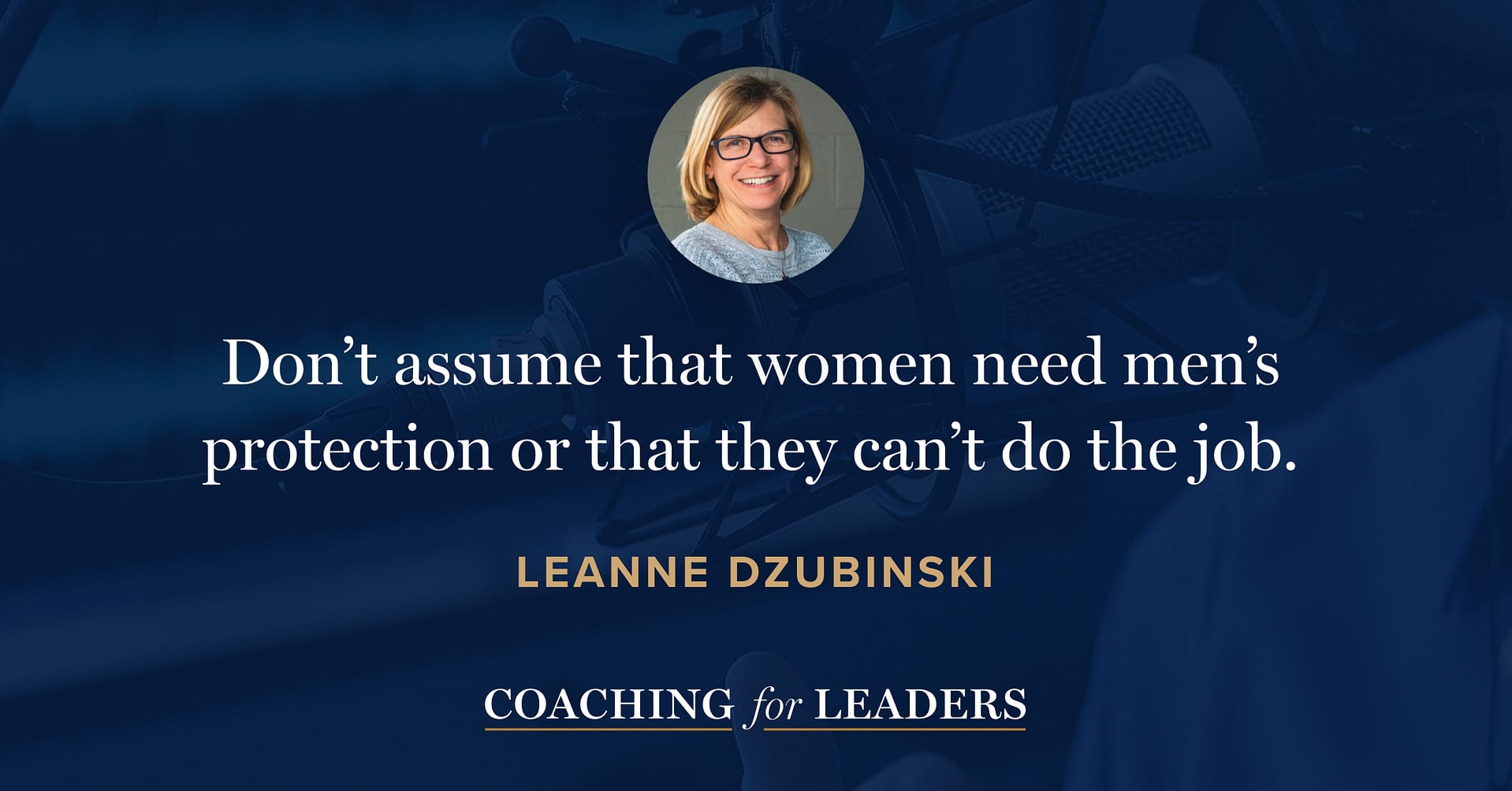
Don’t assume that women need men’s protection or that they can’t do the job.
https://media.blubrry.com/coaching_for_leaders/content.blubrry.com/coaching_for_leaders/CFL805.mp3

Podcast: Download

Follow:
Apple PodcastsYouTube PodcastsSpotifyOvercastPocketcasts

Leanne Dzubinski: Glass Walls

Leanne Dzubinski is an expert on naming and eliminating gender bias in organizations. She is the Dean of Faculty Development and Global Education at Westmont College and a sought-after speaker, consultant, and expert witness who shares tools and strategies that enable women to thrive and organizations to improve their practices. She is the coauthor, along with Amy Diehl, of Glass Walls: Shattering the Six Gender Bias Barriers Still Holding Women Back at Work (Amazon, Bookshop)*.

Most leaders recognize that bias exists in the workplace for many underrepresented leadership groups, including women. In this conversation, Leanne and I explore how devaluation shows up and how leaders can do a better job at removing it from their teams and organizations.

Key Points

  • Six bias barriers show up substantially when researching women in the workplace. One of them is devaluation.
  • Office housework is a common way that women’s contributions become devalued. Leaders should be conscious of distributing this work to everyone and/or providing a reward structure for doing it.
  • Diminishment includes pet names like “girl” and “young lady” that some use to refer to women. This includes removing titles of women in places where they appear for men. Leaders should consider asking how people want to be addressed.
  • Benevolent sexism consists of seemingly chivalrous comments and behavior based on stereotypical assumptions about women. Leaders should let women decide what opportunities they participate in and avoid making decisions for them.
  • Salary inequality is well documented in research. Salary transparency helps reduce this inequality, and salary reviews also help correct disparities.
  • Leaders calling attention to injustice, even through rephrasing inappropriate language, sets the tone for a more supportive workplace.

Resources Mentioned

  • Glass Walls: Shattering the Six Gender Bias Barriers Still Holding Women Back at Work by Leanne Dzubinski and Amy Diehl (Amazon, Bookshop)*

Interview Notes

Download my interview notes in PDF format (free membership required).

Related Episodes

  • How to Support Women of Color, with Minda Harts (episode 506)
  • The Power in Empowering Differences, with Ashley Brundage (episode 548)
  • How to Address Bad Behavior, with Nilofer Merchant (episode 779)

Discover More

Activate your free membership for full access to the entire library of interviews since 2011, searchable by topic. To accelerate your learning, uncover more inside Coaching for Leaders Plus.
How Leaders Can Better Support Women, with Leanne Dzubinski

Download

Dave Stachowiak [00:00:00]:
Most of us recognize that bias exists in the workplace for many underrepresented leadership groups, including women. In this episode, how devaluation shows up and how leaders can do a better job at removing it from their teams and organizations. This is Coaching for Leaders, Episode 805.

Dave Stachowiak [00:00:20]:
Production Credit: Produced by Innovate Learning, Maximizing Human Potential.

Dave Stachowiak [00:00:28]:
Greetings to you from Orange County, California. This is Coaching for Leaders, and I’m your host, Dave Stachowiak. Leaders aren’t born; they’re made. And this weekly show helps leaders thrive at key inflection points. One of the charges of leadership is to ensure that we are leading well for everyone in our organizations. And one of the places I know so many in our listening community have a heart for is thinking about how we can support every population of leaders and employees, and particularly this conversation today: what leaders can do to better support women. And I’m so pleased to welcome a guest expert that’s going to help us look at some of the common biases that are out there and what we in leadership roles can do to do so much better. I’m so pleased to welcome Leanne Dzubinski to the show.

Dave Stachowiak [00:01:19]:
Leanne is an expert on naming and eliminating gender bias in organizations. She is the Dean of Faculty Development and Global Education at Westmont College and a sought-after speaker, consultant, and expert witness who shares tools and strategies that enable women to thrive, and organizations to improve their practices. She is the co-author, along with Amy Diehl, of Glass Walls: Shattering the 6 Gender Bias barriers that are still holding women back at work. Leanne, such a pleasure to have you.

Leanne Dzubinski [00:01:49]:
Thank you, Dave. I’m really happy to be here.

Dave Stachowiak [00:01:51]:
I’m so glad we’re having this conversation because I know there are people who saw the title of this episode, are thinking about just what they’ve heard in your bio, and thinking, we’re almost 3 decades in on the 21st century. Is this still a thing that bias is showing up so prominently in the workplace on gender? And when you hear that kind of maybe, direct wondering question, or maybe you hear it subtly, how do you respond to it?

Leanne Dzubinski [00:02:23]:
Well, Dave, my first response would be, I so much wish they were right and that this wasn’t still showing up in our workplaces.

Dave Stachowiak [00:02:31]:
Yeah.

Leanne Dzubinski [00:02:31]:
But unfortunately, it is. The form of it shifts and is kind of fluid over time. But even in these last couple of years, with some of the shifts culturally that we’ve seen, these issues are becoming more prominent again rather than less. And so I think this conversation is more important than ever that we, that we be having it. So I’m grateful that we’re here today to talk about it.

Dave Stachowiak [00:02:55]:
Where you look in, you and Amy in your work look at 6 biases that come up most prominently when we think of gender bias that shows up. And we’re going to look at one of them today, but before we get into just looking at one, how did these 6 emerge, and how did these come up and be identified through both research and practice?

Leanne Dzubinski [00:03:15]:
Yes. So Amy and I have been working together on this topic for well over a decade now, and we started by just combining our dissertation research. She had researched women in higher education, and I had researched women in conservative religious organizations. And so we put that together and were able to name and surface about 26 different things that women were encountering when they went to work. But 26 is an awful lot. It’s hard to remember; it’s complicated. And so we enlisted a couple of quantitative researchers to help us develop a survey, and we sent that out to women in medicine, in law, in higher education, and in faith-based nonprofits to get their input.

Leanne Dzubinski [00:03:57]:
And from that survey, we had well over 1,000 responses. We were able to analyze and come up with these 6 main categories, of things that women encounter when they go to work.

Dave Stachowiak [00:04:08]:
We’re looking at one of the 6 in detail in this conversation. They’re all important. They’re all critical. When I looked at the 6 and considered them, the one that really came up for me so prominently, not because it’s more important than any of the others, but just when I think about what do I hear and see from the women who are in my life, our clients, our members, what kind of feedback do I get from the podcast? This one comes up a lot, perhaps more prominently than some of the others, just in regular conversation and things that I notice and see. And it’s the bias of devaluation. And we’re gonna get into the details of this, but on a big picture level, this word devaluation- how does it, what does that mean, and how does it show up?

Leanne Dzubinski [00:04:55]:
Devaluation is a way of detracting from women’s authority, making them seem less important, communicating that they don’t really belong at work. And it can happen in subtle ways; it can happen in more overt ways. And in some ways, it shows up in things that are just baked into our system in our society, like not paying women similarly to how their male colleagues are paid.

Dave Stachowiak [00:05:20]:
We’re going to look at a few of these areas that show up in the research, and I think sometimes this— the thing when I think about so many of these is, they’re so baked into so many of the social norms and the way people interact that I think a lot of times we don’t see it, and particularly, men don’t see this regularly. And so I think just looking at some of these patterns would be really helpful for us. And one of the ways that this emerges is in something you and Amy identify as, in the workplace, office housework. Tell me about what that means.

Leanne Dzubinski [00:05:58]:
Okay, so I’m going to back up just a tiny bit to your comment about baked in, because I think you and I have both been talking about that. In our original work, Amy and I identified things that we thought came primarily from our culture, and then things that got embedded into the organization, and then things that women internalized. And many of the things in this chapter, including the office housework, are really are coming, as you sort of mentioned, from our culture. Because they’re endemic in our culture, they’re also endemic in our workplaces. And so that’s why we, we tend to think of them as baked in, and also maybe why people don’t notice them, because we’re just so used to seeing them all the time everywhere. And office housework is a great example. So there’s plenty of studies showing that in the home, women do the majority of the housework, and what happens when women go to work is that they’re expected to pick up those same kinds of tasks.

Leanne Dzubinski [00:06:49]:
So office housework would be things like taking notes in a meeting or cleaning up almost literally anything: cleaning up the break room, taking out the trash, cleaning up the coffee maker, cleaning the refrigerator. Any kind of collaborative work, getting coffee or lunch or helping colleagues organizing things, all those kinds of tasks that keep a workplace running smoothly and are never reported anywhere in an annual performance review.

Dave Stachowiak [00:07:17]:
And this is the kind of thing that I think a lot of times people don’t notice, leaders don’t see, they don’t necessarily recognize. But when you stop to really examine it, and if I think about just places I’ve shown up, stories I’ve heard from clients and members over the years, this still happens a lot. It still comes up in a lot of situations, doesn’t it?

Leanne Dzubinski [00:07:39]:
It really does. And again, I think it’s because we’re all just socialized into this system where women are the ones who are expected to do this kind of work. And so in the workplace, it’s just the default assumption. And until we actually question it and raise it to our level of conscious awareness, it’s going to continue.

Dave Stachowiak [00:07:56]:
A great teacher for me has been Minda Harts, who’s been on the show before, of looking at some of the bias that shows up also for women of color. You and Amy point out this in your research too. And you write: Women of color are especially impacted by expectations to perform unrewarded work. There’s also a divide here when we think about race, on how this shows up and what people are asked to do, not asked to do, that shows up pretty prominently in the statistics, doesn’t it?

Leanne Dzubinski [00:08:25]:
It certainly does. It absolutely does. The expectation is stronger, and the pressure is higher for women of color. And while all women may experience backlash, negative reactions if they refuse to perform this kind of work, women of color, the backlash against them will be even stronger because the expectation is stronger.

Dave Stachowiak [00:08:45]:
We’re thinking about this conversation, of course, from the lens of leadership. And leaders have power in organizations, both the positional power, but also influence culturally, and what we can do as leaders to shift some of this narrative if it’s showing up in our organizations, if it’s showing up with our teams. And one of the invitations you make is to distribute this work amongst everyone. And if for some reason that doesn’t make sense, at least provide a reward structure, a formal part of a person’s role if they are doing and engaging in this. That’s a big piece of helping this to become less of a bias.

Leanne Dzubinski [00:09:24]:
It absolutely is a big piece. And I appreciate the way you’re pointing out that the responsibility for change in these kinds of areas really does rely on the leader and the leader’s approach to the situation, because, typically, they’re the one who has the organizational power to create a different system.

Dave Stachowiak [00:09:40]:
Yeah, and also some of this noticing where is this showing up, perhaps in one’s own behavior, and also, where is this showing up in behavior that you might observe a colleague or a peer jumping in on and maybe redirecting just a bit too? Like, there’s an opportunity for that here as well.

Leanne Dzubinski [00:09:59]:
There absolutely is, and I think I might say, rather than asking if this is happening, to go in and say, where is this happening? Because it’s almost certainly happening somewhere. And if you pay attention and open your eyes a little bit, you can probably figure out where it’s going on. And then you can figure out how to address it as the leader.

Dave Stachowiak [00:10:17]:
On that point, when you’ve worked with leaders who maybe are open to exploring this and saying, well, I don’t really think that this is showing up for us, for me and our organization, and to your point, it almost certainly is in some capacity. It’s just a matter of where. What do you find helps someone, especially a leader, to see that when they maybe haven’t seen it before?

Leanne Dzubinski [00:10:45]:
Honestly, I think one of the best leadership skills that leaders bring to work is the capacity for deep listening. By that, I mean the ability to listen without becoming defensive or just assuming that they already know the answer, but to slow down, to actually pay attention, to be willing to consider something. That doesn’t mean that everything you’re being told as the leader is correct, but the ability to at least consider it and maybe do a little perspective-taking and try to understand what the other person is experiencing, that goes a long way to helping you to see what’s happening.

Dave Stachowiak [00:11:22]:
One of the other biases you point out here is diminishment. What does that sound like when it shows up?

Leanne Dzubinski [00:11:29]:
Diminishment is ways of making women seem less important. It shows up— one of the ones that we got so many reports about is pet names or diminutives used for women. So calling women girls or speaking to a woman as Missy or kiddo or sweetheart- some of these kinds of terms that we would never apply to men. You wouldn’t walk up to your male lawyer and say, ” Hey, honey, how’s it going today?” But we had so many professional women reporting these kinds of experiences, and it’s very devaluing to them. There’s some other ways it shows up too, like leaving off women’s titles. So when women’s titles aren’t used in situations where men’s are, that’s another way of diminishing them.

Dave Stachowiak [00:12:14]:
This was the one that, when I saw it, I was thinking there’s a number of these pet names that you mentioned; some of them that show up, “Girl” is the one that I hear all the time still. And it just seems like, and when you think about it, it just, it doesn’t make any sense. I mean, it is really a diminishing term to refer to an adult in the workplace as a girl, and yet I hear it constantly still.

Leanne Dzubinski [00:12:42]:
Yeah, I know, it’s crazy. So sometimes I think it’s a sort of a slang term like, hey girl, but even that really is not professional. You can say that with your buddies when you’re out doing something. The women can say that, right? But the men should not be saying this to women at work.

Dave Stachowiak [00:12:58]:
Yeah, and there’s really some interesting, there’s so many weird things we do as a society that on one level, I think sometimes people frame in their minds as, “Oh, I’m being cute and funny and humorous”. I mean, the one that I’m thinking of is the term, you mentioned it in the research, “young lady”.

Leanne Dzubinski [00:13:18]:
Yes.

Dave Stachowiak [00:13:19]:
And I, I was, I just happened to be, my aunt and cousin were in town last year, and we sat down and had dinner, and I don’t remember how we got on the topic, but she was mentioning, like, anytime she travels, like all the different people she runs into at TSA, flight attendants, whatever. And she’s an 80-plus-year-old woman, and how often she’s referred to as “young lady”. And she despises it. She’s like, I don’t understand why- it’s like people think they’re being cutesy and funny, but it’s pointing out the obvious thing that I’m clearly not young. I’m an elderly woman, and yet it’s like this; it’s this patronizing thing. And she’s— and it— and when she said that out loud, I was like, yeah, that just— it— and I hear that all the time, too.

Dave Stachowiak [00:14:06]:
And it’s one of those things I think a lot of times we don’t think about because it’s cute and funny and we’ve seen other people do it in our, in some of our own minds, and we don’t realize how that lands.

Leanne Dzubinski [00:14:15]:
That is a really interesting story that she told you that. I actually have not heard it so much from older women as I have from younger women who find it dismissive. They may feel like they’re being scolded, right? Because that sounds like what a parent would say to their teenager. What do you think you’re doing, young lady? But yes, you’re absolutely right to apply it completely inappropriately to a woman, an adult woman in her 80s. Also, I think probably reflects some of the ageism that’s baked into our society. And older women are seen as disposable in ways that older men are not.

Dave Stachowiak [00:14:50]:
Yeah, yeah. I was thinking also about what you said about untitling. You know, in a situation where a man might have the title, the whatever, the position listed, the woman doesn’t. And just to underscore the point of this still showing up as a challenge, my wife and I both have doctoral degrees.

Leanne Dzubinski [00:15:09]:
Right.

Dave Stachowiak [00:15:09]:
She uses her title pretty regularly because she’s in higher education, and that’s the culture of higher education. I almost never use mine. And we regularly get mail from multiple institutions that we’re affiliated with or have donated money to over the years where it will say, Dr. Dave and Mrs. Bonni Stachowiak. And it’s, it’s so irrit— it’s irritating to me when I see it. And I try to, like, intervene on the mail and not have her see it because when she sees it, it’s super irritating to her too. And I just think we never see it the other way, by the way.

Leanne Dzubinski [00:15:44]:
Oh no, I have stories about this too. So an organization was sending mail to us. My husband is ordained. And so the address, the mail was addressed to Reverend Paul and Ms- Reverend and Mrs. Paul Dubinsky, right? And so I actually protested to them. So the next letter that came was addressed to Reverend and Dr. Paul Dubinsky.

Leanne Dzubinski [00:16:07]:
So they gave him an honorary doctorate, apparently, and completely erased me from this mail at all. That was the end of our donations to them.

Dave Stachowiak [00:16:15]:
Oh my gosh. That same thing happened to us at one point. Bonni and I got irritated enough that we actually, and we knew someone at one of the organizations who was really very progressive and thinking really kindly about these things and very conscious of them. But just institutionally, like the institution had the rules or whatever. And we’re like, could we get the name changed at some point? Is there a way to do this? And they came back. I don’t remember what they came back with on the next mailer, but it was like almost worse.

Leanne Dzubinski [00:16:44]:
It’s like, this is crazy.

Dave Stachowiak [00:16:46]:
But I think it just underscores the point that even when you say something, even when there’s someone internally in an organization who gets it and is working to try to change it, the system is so baked in that these undercutting, diminishing things, that more often are directed at women and, by the way, our transgender and non-binary friends too, like even more complicated in that situation, right? They take the brunt of it. And it’s the kind of thing that, day after day after day, you see that, and it diminishes your feeling in the workplace.

Leanne Dzubinski [00:17:22]:
It completely does. And I’m actually glad you brought up our non-binary people too, because one of the things I like to talk about when I’m talking about our work is that we know these things happen for non-binary people. We are talking in binary terms in our book because we researched people who identify as women. So I can’t really speak to those other issues, but I know they need to be researched and they are highly problematic.

Dave Stachowiak [00:17:46]:
Yeah. And we are, of course, framing a bunch of this conversation on the binary just because that is our society’s unfortunate reality, just how a lot of organizations and people think about this. But there’s so much complexity and nuance into this, of course. And speaking of nuance and complexity, one of the other ways this shows up is “benevolent sexism”. Amy, and you write on this: Benevolent sexism consists of seemingly chivalrous comments and behavior based on stereotypical assumptions about women. That kind of makes sense to me, but tell me an example. What does that sound like when this shows up?

Leanne Dzubinski [00:18:25]:
Benevolent sexism in some ways looks like our sort of old-fashioned notions of being a gentleman or being chivalrous. And I don’t mean things like opening a door. If my— if I’m loaded down with a bunch of boxes, I’m always grateful if somebody opens the door for me, and I will open the door for someone I see who’s loaded down.

Dave Stachowiak [00:18:42]:
Yeah.

Leanne Dzubinski [00:18:43]:
But this is more, focusing on women’s appearance, wanting to make sure that they look pretty, that they smile, that they’re pleasant for men to look at. It may show up as men making decisions for women without ever asking them, or giving them a choice or a chance to make a decision for themselves. Assuming that women wouldn’t wanna travel or wouldn’t wanna stretch assignment or wouldn’t want a promotion because it would take time away from their family. It diminishes women’s agency.

Dave Stachowiak [00:19:12]:
Yeah, it’s interesting that this, again, one of those societal things that tends to come over into the workplace. And also, I think the assumption from some leaders that I have a woman who’s an employee, and maybe has young kids at home, and I’m just going to assume that she does not want to go to the conference. That we’re getting everyone else the opportunity to do. And that decision gets made for her versus having a conversation with her, offering her the opportunity, and giving her the chance to decide if she wants to be a part of the conference and travel or whatever the opportunity is.

Leanne Dzubinski [00:19:55]:
Yeah, that’s exactly right. I actually had this happen to me this week. I was dealing with a difficult situation, and so I wanted some advice. So I emailed a couple of male colleagues and said, “Hey, have you ever run into this? You know, what do you think?” And one of them emailed back, and he is one of the strongest champions for women that I know, but his email back to me was, “Well, I’ll take care of it for you”. Effectively, that’s what he was saying. And while I greatly appreciated his support, I didn’t need him to take care of it for me.

Dave Stachowiak [00:20:23]:
Hmm.

Leanne Dzubinski [00:20:24]:
You know, so I thanked him, and I took some of his advice and some of the other man’s advice, and I handled it, and I let them know. And he meant, he was not at all meaning to be anything other than kind and supportive. I know that. And yet the impact on me was a little bit like, does he think I can’t do this?

Dave Stachowiak [00:20:41]:
Yeah, like jumping in of, let me, let me just sort of take care of things for you because that’s my, that’s my role. Like what we would say gender-wise. Yeah, it’s really, I think one of the things I think of for leaders is, you know, to your point, be curious, like ask, like, someone comes with a situation, like you did. Is this something you’d like my support on? Is this something that you’d like my just ideas, some suggestions? Are you— am I just— can I just help by listening? Taking a moment to ask a second or third question in a complex situation, really helpful. And then the other thing I’m hearing too is, you know, a situation where someone may or may not opt out of something because of family, childcare responsibilities, whatever; let them make that decision. Don’t make that decision for them.

Leanne Dzubinski [00:21:27]:
Absolutely. And that is, that’s one of the most demoralizing things for women to find out later. They didn’t even have the choice.

Dave Stachowiak [00:21:34]:
Yeah. It’s, it’s, it’s interesting how often so many of these assumptions just still come up when we think about childcare, kids, family time. I was sharing with Leanne offline that I called our pediatrician’s office last week to schedule our well exam for our kids annually. And they couldn’t find our record, and so we were doing the whole, like, oh, what’s your phone number attached to the record? That kind of thing, even though we’ve gone there for years. And at one point they said to me on the line, “Well, it’s not going to be your number on the record. It’s going to be your wife’s number”. I was just thinking, like, how interesting that is.

Dave Stachowiak [00:22:13]:
It’s funny because I’m actually the one who normally takes the kids to the doctor, so it was like sort of amusing to me. And then it was funny that it, of course, was not her number on the record, but it was just like, this is still today. We just make assumptions that childcare, not traveling, taking care of kids, whatever, I mean, that’s just going to be the way it is. And if you don’t fit into that mold, you have to kind of rewrite that script every time in every situation.

Leanne Dzubinski [00:22:38]:
Right. And you can flip it around and find the same kind of thing. So imagine I’m taking my car for the oil change, right? And they, they say, “Well, you need to check with your husband about doing this and this and this to your car”. And I’m like, I’m the one standing here. You tell me what needs to be done to my car.

Dave Stachowiak [00:22:54]:
Yeah, yeah, exactly. Speaking of invitations for leaders, one we didn’t mention in the— we were talking earlier about untitling people and some of that diminishing language. I think one of the things that I heard from you and Amy, and just the spirit of your research is, you know, there— by the way, I also should acknowledge there are people who prefer the more traditional, like, Mr. and Mrs. Dave… So, there are people who prefer that, women who prefer that kind of language. And if that’s, if that’s your thing, like, great, whatever works for you.

Dave Stachowiak [00:23:25]:
But ask how people want to be referred to, like, if you’re wondering, okay, does someone want to use a title? How do they want to be referred to? Bonni and I have an organization that we’re associated with that they ask, like, when you become associated with them, how do you want your name to appear on mailers when we reach out to you? And just that, just taking a moment to ask, then you make it equitable for everyone.

Leanne Dzubinski [00:23:49]:
Oh, that’s lovely. Yeah.

Dave Stachowiak [00:23:50]:
Let’s talk about salary inequality because this is so well documented in the research. It’s probably one of the most well-documented things that comes up. And I can’t— again, I think this is one of those things where, even though a lot of us know the numbers that we in, in a lot of our organizations today, we think, well, is this really still an issue? Like, this isn’t an issue in my organization. When you look at the research, what do the numbers say today?

Leanne Dzubinski [00:24:22]:
It is still a problem. And another piece of research that’s newer that I’ve been reading recently is what kind of what you just alluded to. When you interview women, they know that this is a problem, but they don’t believe that they personally are affected, which is so interesting. None of us wants to feel like we’re on the receiving end of this kind of bias. So, we think, “oh, everybody else’s organization is doing it, but not mine”, or “all the other women lower down in my organization are not being paid fairly, but I am”, and it’s just not true.

Dave Stachowiak [00:24:53]:
Huh, that’s really interesting. I’ve heard the same thing from women in our membership, our community, of saying, I know this is an issue out there; it’s not an issue in my organization. And maybe it’s not, but I do think it’s, in a way, how would you know, right? I mean, unless you’re really actively talking with people, there’s really active salary transparency in an organization; sometimes you don’t know.

Leanne Dzubinski [00:25:17]:
You don’t know, right? Some organizations, some government organizations, some higher ed institutions have fixed salary scales. And so you can kind of know that if someone is at your same level, they’re making the same amount. But then you never know if somebody got a sweet side deal either, right? They got extra money for this or a bonus for that. That actually means their salaries are not equitable.

Dave Stachowiak [00:25:39]:
When you see organizations that are doing a good job at guarding against this reality that we know is well-documented, we know comes up in the research a ton, there’s tons of evidence, what is it they do from a leadership standpoint that tends to move the needle where you do find equitable salaries?

Leanne Dzubinski [00:25:59]:
The biggest step is to be transparent about pay. The more secret it is, the more inequitable it can be. And so if you try to make it illegal for employees to discuss pay, for example, that’s, for me, that’s always a red flag. It means there’s some shenanigans going on somewhere in there.

Dave Stachowiak [00:26:20]:
I find, I don’t have any numbers to point to, but my sense is, in recent years, I hear more and more anecdotally about organizations that are doing salary reviews and correcting discrepancies than I used to 5 or 10 years ago. It seems like that was something I never heard about. And now I do, with some regularity, hear leaders in all industries in our membership talking about their organization doing some version of that. Do we have a sense of how helpful that is or hasn’t been as far as moving the needle on this?

Leanne Dzubinski [00:26:57]:
It should be very helpful. I don’t have data on how far it has moved the needle particularly, but for the employees within organizations that are willing to do that kind of salary audit and standardizing and being transparent about it, then the situation is definitely better for those who work there than for their friends who are in other more secretive organizations.

Dave Stachowiak [00:27:19]:
The final area you highlight in this area of bias is something you call a credibility deficit. What does that look like? What does it sound like?

Leanne Dzubinski [00:27:28]:
In some ways, this is one of the most infuriating forms of devaluation, and it’s when a woman just isn’t believed. She makes a statement within her area of expertise, and she isn’t believed, or worse, and this is frequent, the- whoever’s asked her the question turns to the closest male who happens to be standing around and says, ” Is that right? Or is she right?” And that man may or may not know anything about the topic, but the assumption is if it comes out of a man’s mouth, it must be right. And if it comes out of a woman’s mouth, it might or might not be true.

Dave Stachowiak [00:28:02]:
One of the things you invite leaders to do if they observe this and see this happening in their organization is, to the extent you can, use it as a teachable moment. And I’m curious, what that looks like? Like when you see someone do that well in a way that’s gracious, but also just, you just, you know, confronts it a bit. What does that look like?

Leanne Dzubinski [00:28:27]:
Yeah, I think that would look like the leader saying something to the man who’s done the questioning, “You know, we hired this woman because of her expertise in such and such, and we know that she does her work, and when she tells us things, we can take her seriously”. And sometimes, if you’re good at on-the-spot humor, inject a little humor into it, I’m not necessarily always good at that, but I try because it can help diffuse and not sound so accusatory.

Dave Stachowiak [00:28:59]:
Calling some attention to it, even if you do it with humor.

Leanne Dzubinski [00:29:02]:
Yeah, but gently. You don’t want to yell at the man, he’s acting according to how he’s been socialized, we’ve all been socialized that way. So it’s not about shaming or accusing. It’s more about, again, bringing it to conscious awareness so that we can all do a little better.

Dave Stachowiak [00:29:16]:
Thinking about that, I think there are a lot of folks in our community, when I think of the leaders I talk with, that really aspire to guard against biases like we’ve talked about in this conversation. And that said, we all go wrong on this. I look at this list, and I think, okay, there’s places I’ve absolutely gone wrong on this over the years. And I know for certain there are times I’ve seen this behavior in an organization, in a team. Maybe it was my manager, maybe it was a peer, and I saw someone else display some of these behaviors, and I didn’t do anything to intervene.

Leanne Dzubinski [00:29:56]:
Hmm.

Dave Stachowiak [00:29:57]:
And I think that that’s an opportunity all of us have to interrupt some of this behavior in our organizations when we see it. And I’m curious, from your perspective, when you talk with someone who has power in an organization, like a leader, and they see some of this behavior, and they’re not the ones necessarily doing it themselves, but they see this behavior going on, what is it that helps to intervene, to interrupt, to call attention to it a bit? Is there a way that you found that just makes that go better for people in starting down that path?

Leanne Dzubinski [00:30:31]:
I find one of the best things leaders can do is to model what they want others to do. And so becoming self-aware of their own behavior first, and then starting to change that as consistently and constantly as possible in meetings, in organizational communication. To show, okay, we’re going to do this in a different way, and we’re going to do it better. You said it isn’t necessarily them, so another way you can do it is if a comment is made that’s not quite correct, you can, as the leader, you can follow it up and just gently correct in the sentence, how it should have been said. Without calling out the other person, but you just repeat it, but in the, in better terms. Does that make sense?

Dave Stachowiak [00:31:14]:
Yeah. Yeah, it does. It does. It’s almost like I’m noticing what was said. I’m restating it in a way that is much more helpful and appropriate. And by just that little nudge, that people in the room notice that something got shifted, even if there isn’t necessarily an interruption or a confrontation. It’s a, “I’m changing the way we talk about this”.

Leanne Dzubinski [00:31:42]:
Exactly. Because we all know that the people in the room are paying very close attention to the leader. And so if the leader ignores it, that tells them they’re free to ignore it. But if the leader does something about it, then that communicates to them they also need to do something about it.

Dave Stachowiak [00:31:57]:
I remember when Vanessa Bonds came on the show, she had a wonderful phrase that she borrowed from someone else, and I can’t remember who, but “a leader’s whisper sounds to everyone else like a shout”.

Leanne Dzubinski [00:32:06]:
Yes, that’s great.

Dave Stachowiak [00:32:08]:
And isn’t that true?

Leanne Dzubinski [00:32:09]:
Exactly.

Dave Stachowiak [00:32:11]:
And oftentimes, the leader is the last one to recognize that. But when you have a fancy title, like director or vice president or senior manager or executive director or whatever, and you shift the language ever so slightly, it kind of— sometimes I think it seems to the leader that, does that really matter? Does it make a difference that I chose a word slightly differently or I reframed something? But that’s the kind of thing that everyone else notices really strongly. And it can set a really positive tone for what happens next.

Leanne Dzubinski [00:32:45]:
Absolutely.

Dave Stachowiak [00:32:46]:
I often ask people what they’ve changed their minds on. And this research is evolving, changing all the time, of course. I’m curious, over the last few years, as you and Amy have continued to do this work and support so many, what, if anything, have you changed your mind on in your work?

Leanne Dzubinski [00:33:03]:
Yeah, so when we started working together, because we were coming from relatively different fields, I think we both assumed that bias was much stronger in more conservative fields and domains and much weaker in more liberal ones. So just comparing, for example, what we started with, which was higher education versus religious organizations. And over the years, as we have worked on this and have researched more and more and more kinds of fields and kinds of places where women work, we’ve really become convinced that it’s not that straightforward, that all of these things show up, but different forms may be more prevalent in certain kinds of fields than others.

Dave Stachowiak [00:33:50]:
When you see a different form show up? What is it that looks different?

Leanne Dzubinski [00:33:56]:
Well, so for example, some organizations may be really, really, really strongly built around a male culture. And so that may be the thing that the women are bumping up against all the time. In others, it may be more like what we’ve been talking about where the stuff is more subtle. The male culture things may still exist, but they won’t be the prominent ones. The prominent ones will be the diminishment and the untitling kinds of things that just very subtly communicate to women that they should really go back home and don’t belong in the workplace.

Dave Stachowiak [00:34:26]:
It all shows up. It just shows up a little differently in how it manifests, but across organizations, cultures, politics, it’s there. So leaders, the more we can do to be conscious of this, be thinking about this, and interrupting, reframing, the better workplace there is for everyone.

Leanne Dzubinski [00:34:44]:
That’s right, because all the research shows that when the employees are flourishing, we have better creativity, we have better organizational outcomes, the bottom line improves. It’s just good for all of us when we pay attention to these things and make the workplace hospitable for women as well as men.

Dave Stachowiak [00:34:59]:
Leanne Dzubinski is the co-author of Glass Walls: Shattering the 6 Gender Bias Barriers Still Holding Women Back at Work. Leanne, thank you and Amy so much for your work.

Leanne Dzubinski [00:35:09]:
Yeah, thank you, Dave.

Dave Stachowiak [00:35:16]:
If this conversation was helpful to you, 3 other episodes I’d recommend. One of them is episode 506: How to Support Women of Color. Minda Harts was my guest on that episode. Minda’s been on the show several times over the years. She has been leading the conversation on supporting women of color in the workplace for many years. And as we talked about in this conversation, women of color often face unique challenges that other demographics do not. Episode 506, we talk about those challenges and, most importantly, what leaders can do to begin to address them. Minda is a great resource for all of that.

Dave Stachowiak [00:35:48]:
Episode 506 for that. Episode 548, I also recommend, The Power of Empowering Differences. Ashley Brundage was my guest on that episode. Ashley and I talked about a topic that many leaders have not done much thinking about and certainly not received a lot of support and training on, which is how to support transgender employees in the workplace. Ashley and I talked in detail about that. Episode 548 for more details there. And then finally, I’d recommend episode 779: How to Address Bad Behavior. Nilofar Merchant was my guest on that episode, and we talked about when behavior happens that isn’t appropriate, how do we handle it? Yes, maybe on this topic of devaluation, but also any topic where behavior is not matching up with what should be happening in the organization.

Dave Stachowiak [00:36:32]:
Nilofar has some wonderful recommendations for us and what we can say and do as leaders to address it. Episode 779 for that. All those episodes, of course, you can find on the coachingforleaders.com website. And one other resource that’s now available is “Ask CFL” inside of Coaching for Leaders Plus. Many of you have told me over the years that the recommendations I make of other episodes at the end of these conversations are really helpful to dive in further. And we have now made that even more powerful for you because we have indexed every single word, every transcript, every single conversation that’s happened on the podcast since 2011. And we are now making it available inside of Coaching for Leaders Plus for you to interactively ask questions in real time so that you can find exactly what you need right now. And also the specific references and past episodes, resources, quotes, books.

Dave Stachowiak [00:37:26]:
Many of you reach out to me and say, “Hey, I know I heard this on the podcast several years ago, or a particular episode or particular reference”. Ask CFL is now there available for you. It is part of Coaching for Leaders Plus, one of a number of the benefits inside of Coaching for Leaders Plus. For details on how to access it and much more, go to coachingforleaders.plus. Coaching for Leaders is edited by Andrew Kroeger. Next Monday, I am pleased to welcome Bill Flynn to the show. Bill and I are going to be talking about how leaders can escape the hero trap. So many of us fall into it, and how do we step beyond it? Join me for that conversation with Bill, and hope you have a great week.

Topic Areas:Diversity and Inclusion
cover-art

Coaching for Leaders Podcast

This Monday show helps you discover leadership wisdom through insightful conversations. Independently produced weekly since 2011, Dave Stachowiak brings perspective from a thriving, global leadership academy of managers, executives, and business owners, plus more than 15 years of leadership at Dale Carnegie.

Listen Now OnApple Podcasts
  • More Options
    • YouTube Podcasts
    • Spotify
    • Overcast

Activate Your Free Membership Today

Access our entire library of Coaching for Leaders episodes from 2011, searchable by topic.
Listen to the exclusive Coaching for Leaders MemberCast with bonus content available only to members.
Start Dave’s free audio course, 10 Ways to Empower the People You Lead.
Download our weekly leadership guide, including podcast notes and advice from our expert guests.

... and much more inside the membership!

Activate Your Free Membership
IMAGE
Copyright © 2026 · Innovate Learning, LLC
  • Plus Membership
  • Academy
  • About
  • Contact
  • Dashboard
×

Log in

This site is protected by reCaptcha and the Google Privacy Policy and Terms of Service apply.
 
 
Forgot Password

Not yet a member?

Activate your free membership today.

Register For Free
×

Register for Free Membership

Access our entire library of Coaching for Leaders episodes from 2011, searchable by topic.
Listen to the exclusive Coaching for Leaders MemberCast with bonus content available only to members.
Start Dave’s free audio course, 10 Ways to Empower the People You Lead.
Download our weekly leadership guide, including podcast notes and advice from our expert guests.

... and much more inside the membership!

Price:
Free
First Name Required
Last Name Required
Invalid Username
Invalid Email
Invalid Password
Password Confirmation Doesn't Match
Password Strength  Password must be "Medium" or stronger
This site is protected by reCaptcha and the Google Privacy Policy and Terms of Service apply.
 
Loading... Please fix the errors above