• Skip to primary navigation
  • Skip to main content
  • Skip to primary sidebar

Coaching for Leaders

Leaders Aren't Born, They're Made

Login
  • Plus Membership
  • Academy
  • About
  • Contact
  • Dashboard
  • Login
Episode

779: How to Address Bad Behavior, with Nilofer Merchant

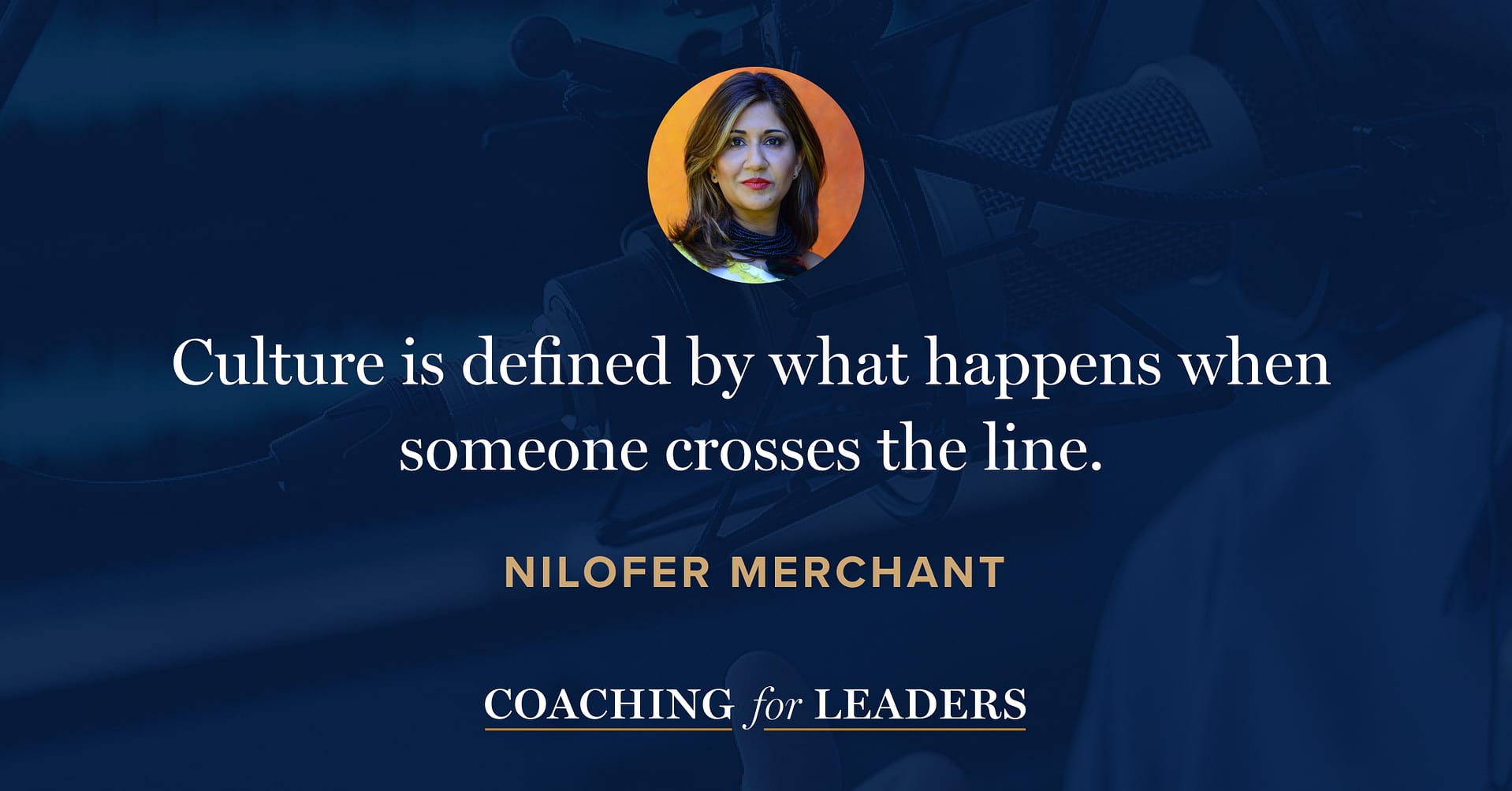
Culture is defined by what happens when someone crosses the line.
https://media.blubrry.com/coaching_for_leaders/content.blubrry.com/coaching_for_leaders/CFL779.mp3

Podcast: Download

Follow:
Apple PodcastsYouTube PodcastsSpotifyOvercastPocketcasts

Nilofer Merchart: Our Best Work

Nilofer Merchant is ranked among the world’s top management thinkers by Thinkers50 and is the founder of The Intangible Labs, where she defines the leading indicators of modern work. She’s launched more than 100 products totaling $18B in revenue, and her TED Talk, Sitting Is the Smoking of Our Generation, ranks in the top 10% of all TED Talks. She is the author of Our Best Work: Break Free from the 24 Invisible Norms That Limit Us (Amazon, Bookshop)*.

When bad behavior happens in an organization, it’s the job of the leader to address it. In this conversation, Nilofer and I explore the strategies and tactics that will help you do this with clarity and effectiveness.

Key Points

  • Bad behavior isn’t just “bad apples” – it’s also the organizational norms of “the barrel” that reinforce these behaviors.
  • Most management norms are not persuasive; they are persistent.
  • Begin by getting clarity on what’s acceptable and what’s not.
  • Interrupt behavior without escalation. Consider phrases like, “Ouch,” or “I don’t know if you mean to…” or, “Did you intend that to be hurtful?”
  • Culture is not defined by words on the wall—­it’s defined by what happens when someone crosses the line.
  • Ask everyone to enforce norms, not just the person who was harmed.

Resources Mentioned

  • Our Best Work: Break Free from the 24 Invisible Norms That Limit Us by Nilofer Merchant (Amazon, Bookshop)*

Interview Notes

Download my interview notes in PDF format (free membership required).

Related Episodes

  • The Way to Be More Coach-Like, with Michael Bungay Stanier (episode 458)
  • How to Respond Better When Challenged, with Dolly Chugh (episode 615)
  • Being Nice May Not Be Kind, with Graham Allcott (episode 767)

Discover More

Activate your free membership for full access to the entire library of interviews since 2011, searchable by topic. To accelerate your learning, uncover more inside Coaching for Leaders Plus.
How to Address Bad Behavior, with Nilofer Merchart

Download

Dave Stachowiak [00:00:00]:
When bad behavior happens in an organization, it’s the job of the leader to address it. In this episode, how to do that with clarity and effectiveness. This is Coaching for Leaders, episode 779.

Dave Stachowiak [00:00:15]:
Production Credit: Produced by Innovate Learning, Maximizing Human Potential.

Dave Stachowiak [00:00:23]:
Greetings to you from Orange County, California. This is Coaching for Leaders, and I’m your host, Dave Stachowiak. Leaders aren’t born, they’re made. And this weekly show helps leaders thrive at key inflection points. One of the challenges that comes up for so many leaders, certainly many of the folks in our listening audience, is how do you handle the difficult situation when there’s bad behavior in the organization? How do you address it? And how do you redirect a bit so that that bad behavior doesn’t become a cultural norm? It’s a challenging thing that all of us face, and we can all influence this to be better. Today, I’m so glad to welcome a guest who’s going to help us think about this in a new way and how we can take some tangible steps to improve. I’m so pleased to introduce Nilofer Merchant. She is ranked among the world’s top management thinkers by Thinkers50 and is the founder of The Intangible Labs, where she defines the leading indicators of modern work.

Dave Stachowiak [00:01:25]:
She’s launched more than 100 products totaling 18 billion in revenue, and her Ted Talk, Sitting is the Smoking of our Generation, ranks in the top 10% of all TED talks. She’s the author of Our Best Work, Break Free from the 24 Invisible Norms That Limit Us. Nilofer, what a pleasure to have you on. Welcome.

Nilofer Merchant [00:01:45]:
So glad to be here, Dave. Thanks for having me.

Dave Stachowiak [00:01:48]:
I was struck by a story you tell in the book about Alex. And the reason I was struck by it is the story itself, but because I think it is so similar to so many of the stories I’ve heard over the years. And I know you have as well, too. Would you share her story?

Nilofer Merchant [00:02:07]:
Sure. So this is a very dear friend. And the way I ended up learning about the story is she was like, can I come over? And she was walking around my kitchen just venting like you couldn’t believe. And what she was sharing was this. Her boss had told her that good ideas will get stolen all the time, and so don’t worry about it. And I don’t know if this has ever happened to you, but of course, so many of us who are innovators and idea generators and change agents and leaders, right, who are just coming up with stuff, we end up working really hard on things, and then somebody else will come along and try to take credit for it. And, and then this boss was basically saying, sure, go ahead, like that’s fine. And this one particular thing that was happening, Alex had worked on for over six months.

Nilofer Merchant [00:02:56]:
She had designed the idea, like come up with the idea, designed all the research, done it on top of their day job, the whole team, and then they were getting ready to present it to the executive team to basically be like, you know, here’s this thing, a tada moment. And in prep for that, they had gone around the organization socializing it a little bit, so other people were prepared and integrated. And one of those people who heard the idea then took it to the exec team and presented it. And they didn’t quite say it was online, but they didn’t say it wasn’t theirs. And you know, and it’s just, you know, what’s that sin of a mission that just happened? And then when Alex heard that it happened, she went to her boss and said, hey, this is, you know, this is happening, blah, blah, blah. And he said, no big deal, ideas get stolen all the time.

Nilofer Merchant [00:03:46]:
And one of the things she came to me to say is, is that okay? Is that okay? Is this just me not accepting what is such an ordinary thing? And should I do something? Should my boss do something? She was just like, really wondering, where does this problem lie? Is it me not accepting the reality of situations, and my ego’s too involved? Or is it my boss who’s not protecting my interests and our interests as a team? Or is it something else? And her first inclination was, I must not be doing something right. I think a lot of us who are leaders actually do because we want the locus of control. And I was like, no, it’s not you, and it’s not even your boss. It’s the situation. It’s that in this organization, we think bad behavior is okay, and then we don’t stop it. And so the next time it happens, we just excuse it again as if to say boys will be boys kind of stuff. And we kind of shake our head as if there’s nothing we can do.

Dave Stachowiak [00:04:43]:
It’s such a challenging problem. And of course, there’s a cost to this too, of not addressing behavior that isn’t appropriate, that’s bad behavior. What’s the cost of not addressing it?

Nilofer Merchant [00:04:56]:
Well, let’s back up and just share the larger context of work today, which I think is both so obvious and yet is worth really noticing. First of all, 80% of employees are disengaged. That data has been unchanged for many years and in fact has just taken a recent drop, that’s Gallup research. 60 to 70% of ideas are not heard inside almost every organization. So that represents billions of untapped innovation opportunities. People are either quiet quitting, or, because of AI, losing their jobs. And that bottom rung of the ladder that most of us need in order to even just start learning how to enter the workforce is virtually gone. And so, when we are having this conversation about what is the cost, it is large because we have work that isn’t working for most of us.

Nilofer Merchant [00:05:50]:
And then in the specific, it’s to say, hey, listen, the person who just came up with that idea that’s going to help you is being told that that idea has no worth, that it can be borrowed by anyone, and all that matters is that the flower got picked, not that the field that created the flower is actually worth nourishing. And so what will happen over time is that field will dry up. And either by leaving the organization or just no longer offering the idea, that will matter. And that has a huge cost, right, for the people involved, but also the team, the company, the industry, the economy. It’s a cascading set of problems that are huge.

Dave Stachowiak [00:06:29]:
And if I’m remembering the rest of the story, that your friend ultimately did depart the organization, and so they got the benefit of the idea her team worked on. But long term, as you said, that it’s thinking about the flower and not thinking about the field that the long-term contributions vanished.

Nilofer Merchant [00:06:46]:
And in fact, the ad, the thing that she was working on ended up resulting in an ad that went all the way to the Super Bowl.

Dave Stachowiak [00:06:53]:
Oh, wow.

Nilofer Merchant [00:06:55]:
And it’s so profound that it went that big. And then the next year, by the way, they didn’t have anything else, they haven’t since. Because that person who is being told your ideas don’t count went somewhere else. Because, by the way, talent doesn’t beg. And so the minute you’ve told talent that their talent doesn’t matter, talent will move.

Dave Stachowiak [00:07:14]:
Yeah, I was, I was thinking about something you said earlier, that it’s not just, it’s not her, it’s not even her boss. And something you wrote in the book that struck me as well. You write, it’s not just individuals who do bad things, a few bad apples that harm. It’s also the organizational norms, the barrel that creates rot and reinforces bad behavior. I was thinking about that, and how often it’s the case, in so many things, we see it in the media, we see it in news, we see it in the- in relationships and organizations, that when something doesn’t work, we tend to point to, oh, it’s just that person, it’s that bad behavior. But you invite us to really look at the bigger picture. And there is a bigger picture here, isn’t there?

Nilofer Merchant [00:07:58]:
There really is. So we could talk about it as a systems issue or culture issue, but what I’m trying to do is really name the pivot of change. So change can happen at three levels, and this is really useful for any of us doing any of our work. One level is what I’ll call the micro level, which is the individual, and change happens at an individual level. It’s Dave, you and I realizing for ourselves that maybe we’re being ineffective in how we’re managing our time, and we need to prioritize high-quality work at the beginning of the day. So, we’ll realize that, and then it’s within our locus of control mostly to figure out how to design our day better. That’s the micro level.

Nilofer Merchant [00:08:40]:
Then there is the macro level, which is systems or cultural change. And most of us point to that because we understand that we’re part of a system, we’re the fish in the water. And we kind of go, oh, well, we’re not going to be able to create cultural change at our organization. I’m just one person. And so I’ll point to this big thing which seems unchangeable because, of course, it’s complex and multi-tiered and so on. Then there’s the thing in the middle that we mostly ignore when we’re talking about change management, which is the relational or interactional layer, the meso layer, miso mezzo. But that meso layer in the middle is where people come together. And as soon as we come together and we decide what something will be, it changes both the individual behavior and the culture.

Nilofer Merchant [00:09:28]:
And the metaphor I use in the book is if the entire dance floor is doing, I don’t know, ballroom dancing, and you know, you want to do the salsa, all you have to do is stop doing the ballroom dance, and all of a sudden the dance floor changes, and then find another person to do the salsa with. And all of a sudden, things are changing because the floor is no longer dominated with one thing. And other people can go, oh, I actually also want to do the salsa, and they can join you, or maybe a conga line starts up, right? And so all of a sudden the culture changed from the default norm of ballroom dancing to some change. And then, as change is evident, other people join in. And that relational layer is how any of us can start to affect our organization. Not because we wait for someone else to say, hey, you can salsa dance, but to say, I want a salsa dance. I want inside my organization, my team, to have a better set of norms that will allow us to cease and desist bad behavior.

Dave Stachowiak [00:10:25]:
This is a book, of course, about norms and the power of norms. And you talk about the norms, the norm of commencing. I hope I’m saying that correctly, speaking of pronunciation. But it is, it is so powerful, isn’t it? Like what most people are doing and what we adhere to without thinking about changing, it’s a very, very powerful influence on our behavior.

Nilofer Merchant [00:10:50]:
And, you know, the thing about most management norms is they’re not questioned. And so it’s not so much that they’re persuasive, it’s just that they’re persistent. And if we just stop for a moment and go, is this serving innovation? Is this serving our ability to create value? Is this serving my team? And I had a little moment to go, “gosh, it really isn’t”. If I keep walking around saying, people will steal your ideas, what will happen to my team? And you can kind of play it out, because all you have to do is sit there and think, how would I feel if people stole my ideas?

Dave Stachowiak [00:11:22]:
Indeed.

Nilofer Merchant [00:11:22]:
And none of us would want that to happen to us. And so then we can sit there and go, oh, well, I don’t want it to happen to my team either, because I know that that’s affecting everything. And then we can go, oh, what’s the shift in ballroom dancing that we can start here?

Dave Stachowiak [00:11:35]:
There’s a really nice distinction you paint of the limiting norm, and as you say, the persistence that often happens with these. The limiting norm of just whatever happens happens. We don’t necessarily question it, versus the leading indicator of what we allow happens, how we approach things, what we decide to do, what we decide to address or not, that then sets the norm in the organization. And so us being, when we’re seeing the kind of behavior in our organizations, our teams, that is not lining up with what we want, we have the opportunity to shift it just a bit.

Nilofer Merchant [00:12:10]:
And, you know, one of the ideas I’m leveraging here is, a Nobel Prize winner in economics came along, I want to say it was in the 70s or 80s, and disrupted one of the biggest norms in economic thought, which is if you allow people to use the resources of the commons, people will basically deplete the commons, and sort of take whatever they can get. They’ll play Hungry Hungry Hippo, and everything will just get taken off the board. And she came along and actually proved just the opposite, which is if you ask people who are in a community to actually take care of the shared interest, because it’s in their shared interest to have it, over time, they will. And this is the same thing we need to do now inside our organizations to say, what is it we want in our comments? And to start a set of influences that any of us can start. That’s, to me, the key is literally tomorrow you could try this thing, and it will change what happens in the next month, year. And more importantly, in terms of outcomes that we create, because this is such a leading indicator for how we create those outcomes.

Dave Stachowiak [00:13:25]:
There’s five wonderful steps you articulate that I think are a great starting point for almost any of us, especially if we find ourselves in a situation where we’re seeing behavior, we’re noticing behavior that isn’t quite the behavior that we’d want for our organization, or for our team. And the first of those five steps is, getting clarity on what’s acceptable and what’s not. And you mentioned this in your work, and I noticed this a lot, too. A lot of teams and organizations just don’t really think to do this. Like, never really spend the time to identify that. When teams do, what does it look like?

Nilofer Merchant [00:14:03]:
For us to be able to say, hey, here we don’t steal people’s ideas. You know, that’s a, that’s a- just a norm that you can just say. So if, imagine if Alex’s boss had heard that the idea got reported without tracing it to its source, and had gone to both the person and said, listen, that was out of line. And then gone to the executive team and said, just so you know, a member of my team has been working on this for six months. We’re planning on presenting it to you next week. The way it was presented to you might not have been intentionally deceptive, but it left you with a false impression. And so, I want you to know who actually created it so we can give credit where it’s due, and that’s what’s acceptable inside our organization so we do innovation well.

Nilofer Merchant [00:14:44]:
Just imagine that. I mean, that’s, what? Did I do 5 sentences there? 10? I don’t know how long I just spoke for, but it wasn’t very long. And so it’s just saying that’s not okay.

Dave Stachowiak [00:14:56]:
I think oftentimes we think about, and this maybe even leads to one of the later steps in this framework. But a lot of times we think about, there has to be a huge intervention, an improvement plan, a big sit-down conversation when we see behavior that’s not working. And then obviously, a lot of people think like, well, that’s, that’s not really comfortable to do. And the conversation never happens. And one of the things I really hear, the spirit of your work is like, yes, there is a time and a place for those kinds of things as you go down through the process. But there’s also the opportunity perhaps a lot more, to do exactly what you just described, which is a few sentences. Sometimes just a phrase or a reaction can go a long way, can’t it?

Nilofer Merchant [00:15:42]:
You know, one of the things I love doing when I’m in meetings, and someone’s monologuing is I raise my hand really high up, and it causes the person to pause. It has to, right? Because everyone starts noticing the hand up. And so it’s a weird thing because it’s almost like you’re in third grade, raising your hand. But, and then they pause, and I go, “I don’t know if you mean to, but this conversation’s been a monologue for the last few minutes, and I’d like it to return to a conversation so that everyone can participate”. And it’s such a funny thing to say it because I swear to God, you do it like once, and you won’t need to do it again for the next six months, because that person will actually get social feedback that says, it’s not okay to do a monologue all the time. And a lot of people do it without, you know, they’re trying to prove they’re important, they’re trying to take up enough space, whatever reason they’re doing it. But once given the social clue that it’s actually not being well received, and the whole group will nod its head. I mean, undoubtedly, I am always the person who raised my hand.

Nilofer Merchant [00:16:43]:
But then, like a whole bunch of people, body language-wise, will effectively do the nodding of the head, or the sigh or the chuckle, and then all of a sudden the elephant is named in the room. So what are the short ways in which we give feedback into the system that says, that’s not acceptable to me? And then the social norm will start to evolve out of that. And so, it can also be like, you join up with a colleague and say, you know, that guy always monologues, and is there something we want to say the next time he does it? And you can find your own version of the sentence, right? Whatever that looks like for you, that’s very comfortable and short. And go, okay, we’re going to cut this behavior out, because it means that someone’s taking up more than their share of voice in the meeting, which means the rest of us aren’t able to contribute, and we’re not actually moving the needle. So, let’s figure that piece out and just, you know, I really wrote the book to be at least two people reading it together, so you guys can become co-conspirators and change, and getting clarity on what’s acceptable can start with a simple as that kind of action.

Dave Stachowiak [00:17:45]:
Yeah, and you find your phrase that works for you. I love that phrase of like, I don’t know if you mean to, but you know, completing the sentence, or like, oh, I noticed something that really didn’t land well. I heard one recently, it may have been a past guest who said this on the show, but did you mean that to be hurtful?

Nilofer Merchant [00:18:01]:
Yes. That’s a beautiful phrase.

Dave Stachowiak [00:18:03]:
It’s not mine, I’m stealing it from someone else and I don’t remember who right at this moment. But I think it’s just like interesting how speaking of norms and commons, like if you, in the moment, say something and indicate something that just says, hey, this thing that just happened, I’m noting that this isn’t okay, and it doesn’t need to be a 45-minute conversation. Yes, maybe it will at some point if the behavior continues. But I’m putting up a marker that says, here is what I’m noticing, and here is, I’m shifting this behavior. And maybe I’m the leader in the room, and maybe I’m not, but either way, I’m signaling a shift of how we treat each other.

Nilofer Merchant [00:18:45]:
And you know, it’s- this is where I’m saying, don’t make it so individual-focused, find colleagues to start this with. Because undoubtedly, if it’s bugging you, it’s bugging other people. Undoubtedly. I’ve just seen this so often. And so it gives us an opportunity to go, is that bugging us too? And does it cost us anything? And just to have that conversation, and then go, okay, what would we want to do differently? And now we’re starting to get conscious. Right? And what I’m coming to realize over my many years of sort of practicing all this is it actually hurts people more in the long run to have something unsaid.

Nilofer Merchant [00:19:19]:
So Alex, having to leave the organization was so much more costly than the boss saying that, you know, 5 or 10 sentences of that’s not okay.

Dave Stachowiak [00:19:29]:
Yeah.

Nilofer Merchant [00:19:29]:
And because imagine if even if they hadn’t been able to change the outcome. The boss’s ability to back her said something to her about whether or not her work was valued. And I think sometimes I don’t say things like early on, because I’m thinking to myself, like, if somebody’s doing a monologue, if I use that example again, I’m thinking, well, everybody in the room can see that this person is doing a monologue. Why do I have to say anything? Right? And what I’m just realizing is I might just be slightly, I might just have slightly more distance. I might have slightly more political capital. I might have a little bit of charm available to me that day, whatever it is, right?

Nilofer Merchant [00:20:06]:
And I can go, gosh, that’s really, that’s really not doing what you want it to do. And finding a way to say it is so much the kinder thing. Sometimes we think of kindness as not saying it, but kindness is actually the sturdy way in which we lead our team.

Dave Stachowiak [00:20:23]:
One of the other steps you invite us to consider is design for everyone’s needs. And you point out that the quote, unquote rules of the workplace are often shaped by whoever has power. And I’m curious, like, when you think about that, like, what does that tend to look like? And what can we do that’s better?

Nilofer Merchant [00:20:45]:
Yeah. So the default, and this is what we’re seeing in society as a whole, too, is, we solve for the person who has the most power. Because, by the way, that actually says that’s how we get to keep our job. So the reason we’re doing it is because, the data says, and it’s Jeff Pfeffer’s research out of Stanford, who also does work on power. His work basically says, listen, it doesn’t matter whether or not you succeed at the work or not, if you get to keep your job. What matters is whether or not your boss feels aligned with you. And so the reason that people default to what the boss wants is to keep their job and to stay safe. And what I’m actually saying is, yes, but that’s not accomplishing the organizational goal.

Nilofer Merchant [00:21:28]:
And I’m naming that, because that is the point of all this. And so you don’t want to do this alone because that puts you too vulnerable in the organizational thing. You want to find a couple other people to pal up with and say, let’s name this. So the next time the leader just hijacks the meeting, one person and another person can raise their hand together and say, but we had an agenda, where are we? How does this fit with the agenda? Right? And then we’re not calling out the boss for being, doing bossing behavior. We’re calling out what is our need together? Why did we come together? And if you can do that together, you actually end up not putting each of us at risk. Which is why it’s so important for us to actually become co-conspirators in this process, is to de-risk our actions, individual actions, so that we start to make it a relational shared goal.

Dave Stachowiak [00:22:18]:
Steps three and four are a bit related, and we talked about step three a little bit already, which is creating consequences that are clear and escalating. And then step four is holding folks accountable who violate those expectations. And there’s a phrase here that you cite that I think really reinforces something you said earlier. And it’s interrupting behavior without escalation. That seems really key in this to me.

Nilofer Merchant [00:22:48]:
Yeah, it’s, you know, if someone’s talking, you know, doing that, sort of taking over the agenda, all you do is you ask, how is that tied to the agenda? Help me see how this is tied to the agenda? Because I want to track better.

Dave Stachowiak [00:23:00]:
Yeah.

Nilofer Merchant [00:23:01]:
And there’s something so beautiful about that because, it’s an interruption, it’s not saying you suck. It’s not saying you’re doing something wrong, it’s not doing all that behavior. It is trying just to get us realigned so that our face is turned towards the sun, towards the thing we’re all here to do, not towards the king, which is where power resides. And that can escalate, right?

Nilofer Merchant [00:23:27]:
So we can go, here’s our first interruption. And then if that doesn’t work, there could be another set of things. And maybe we don’t solve it all in that first meeting. Maybe we come back and say, hey, it felt like we got derailed there.

Dave Stachowiak [00:23:38]:
Yeah.

Nilofer Merchant [00:23:39]:
Do we want to change that for next time?

Dave Stachowiak [00:23:41]:
A lot of times, like, we’ve been socialized to assume that interruption is never okay. Like we should never interrupt, particularly whoever is facilitating, has power, whatever. And it kind of gets back to what you said earlier of like, kindness might be the, actually interruption, that might be the kindest thing we can do for the organization, for the team. The meeting is, by interrupting respectfully, right? But interrupting and saying, hey, here’s a thing that is not working and not escalating, but just a point of order that redirects things a bit. That’s helpful for everyone.

Nilofer Merchant [00:24:17]:
Exactly. And it’s one of those things where we might also be helping that leader, right? That leader who is so used to just talking and, therefore isn’t doing the work that we need to all be doing. And so I want us to think about it as, what is the way in which we’re leading towards the things that we need? And we can lead from any position at the table. So we’re there, and we say, how’s that tied to the agenda? And then, wow, it seemed like we got derailed. Is there anything we want to do better the next time? You do that three, four, five times,

Nilofer Merchant [00:24:52]:
and you can see that we’re starting to create consequences that are clear and escalating. Using our voice, certainly, but also creating new protocols for, is this really how we want to behave? If we spend all the time on the agenda creation, do we want to throw it out the window in the first five minutes because somebody had a shower idea? And by the way, that might actually be acceptable of, it might actually be an inspired idea, it might actually be useful. But if we don’t say that, to say, is this the agenda that we really want to be on? Then no one’s making an intentional choice. And that’s the piece we can all get better at doing. If we can get more intentional about it, we can go, is this working for us? And if it’s not, then we can start to create accountability. And accountability isn’t me busting you, it’s us saying, is this what we want? Is this what we want?

Dave Stachowiak [00:25:41]:
Yeah. Speaking of the kind of like the, me busting you framework of accountability, which again, there’s a time and a place for a strong accountability conversation or action. But one of the things I’m thinking about is we have a couple of members in our community right now that are in organizations where the, the person’s role is not going to change, government or union environment. And they have brought situations to some of us and said, hey, I, I can’t really do anything because this person’s job is not going to disappear. They are in this position, they’re going to be in the role. There’s not really a- ever going to be a consequence, stopping short of someone committing a crime or something like that. They’re going to be in this role.

Dave Stachowiak [00:26:32]:
And they often will look at that situation, say, like, well, really, what can I do? And I’m wondering when you, when you talk with people who are in that situation, who they, they have, the team that they have, they’re not necessarily going to make any changes, there’s not going to be a formal disciplinary process. How do they, how do you approach accountability?

Nilofer Merchant [00:26:51]:
Such a good question. Right? I think the first Step we’ve already sort of said, but it’s worth naming, which is we say that we don’t find that acceptable. The second could be that we choose not to cooperate. There’s something about the, I don’t have to like what you’re doing, and I can go limp. So that now it’s not that I’m helping you to keep doing what you’re doing, I’m just going to hold limp, and then somebody else has to figure out how to drag my dead body over the finish line, kind of thing. And that’s fine. I’m willing to go limp. So there’s ways of doing it.

Nilofer Merchant [00:27:24]:
And then- But I think one of the greatest things we can do is say that’s not okay for me. Because here’s the thing, if it’s not okay for you, why not say it? And for whatever reason, you might still need to participate. But for you to be able to say that’s not okay. Back at Apple, early, early on in my career, I was with a team. Gosh, it was, it was in sales, the USA organization of Apple. And the management team, which I was not a part of, was our sort of sense my group of people that I was working with.

Nilofer Merchant [00:27:55]:
Our sense was every time we went into a meeting, the decisions were already made. And so we sat there and thought, gosh, that feels really weird that like, it’s like they’re not even listening to us. And at one point, somebody started asking around just like, are they doing a pre-meeting? And it turns out that entire batch of leaders was playing golf the day before.

Dave Stachowiak [00:28:16]:
Ah.

Nilofer Merchant [00:28:17]:
And we were just like, well, if they’re playing golf the day before, more than likely they’re talking about the agenda because I mean, we all work together, right? So they were calling it an off-site. And we figured out they were probably just pre-working it, not with any bad intent. Again, they were just all together, and they were probably so by the time they were in the room, they had a formulated set of ideas for what should be happening next. And so any of us who were therefore not in the group chat at the golf course were not able to influence change. And so one of us said, you know what, I’m actually pretty athletic. I wonder if I can learn to play golf well enough and just join them, and then go in and advocate for these things. And she literally took, I want to say it was about six months, I hope my memory’s right. And she went and got the right golf clubs, she took lessons, she worked every week.

Nilofer Merchant [00:29:01]:
It was hilarious to me. Because she would report back to us like, oh, I can now hit this far. And like, here’s what a nine iron’s for. It was just really fun to hear her kind of, coming up to speed. And then at one point she wrote a note that said, hey, I’m kind of realizing you guys are playing golf, and I’m really good at golf. Here’s my stats and I would love to come join you the next time you guys are playing. Is that possible? And it was such a beautiful way of creating accountability because, or saying, at least I’m not okay with you guys making decisions without us being in the room.

Nilofer Merchant [00:29:36]:
And all of a sudden, the off-site got canceled, and the meetings changed.

Dave Stachowiak [00:29:40]:
Oh, interesting.

Nilofer Merchant [00:29:41]:
It didn’t mean that everything ended up becoming better, right? Because we still were not always heard, but it meant that we were basically saying, hey, listen, dude, we noticed that what you’re doing is not allowing the vast majority of us to participate in the decision-making process. So that the meetings are becoming just optics, and we’re not okay with that. And it was a very funny way to do it, right? It had some, it had some underlying humor and zest in it, you know, and I’m like, that’s a way to say I’m not okay with the norm as it exists. And again, no need to call someone out and say, bad, bad, bad. It’s more like a call-in, like, I’d like to play. Can we play?

Dave Stachowiak [00:30:20]:
Yeah.

Nilofer Merchant [00:30:21]:
And if we can do that, start to create a different conversation. And again, the goal isn’t on bad behavior, it’s on what do we need?

Dave Stachowiak [00:30:31]:
I was thinking about what you just said in the context of that leader who doesn’t have the choice of who’s on their team. And it’s interesting, when I see people do what you just described, of hey, I may not be able to exit someone, I may not be able to go down a performance process, whatever, but I can say I’m not okay with this. And I can mention things, and I can change the dynamics. It’s really interesting how often, not 100% of the time, but a huge percentage of the time it does shift the behavior in with that person and with the team. It doesn’t make everything better, but it does often make a noticeable change, such that is significant to the organization. It’s significant, and how people are showing up. And I think oftentimes if we can’t do the last thing on the disciplinary thing, we just assume, well, I can’t do anything.

Dave Stachowiak [00:31:23]:
And like, if you’re willing to do a lot of the, the things we’ve talked about in this conversation, you can go so far of shifting change.

Nilofer Merchant [00:31:30]:
And I think that’s what you and I are basically passing along to the listener, is there is agency here.

Dave Stachowiak [00:31:37]:
Yeah.

Nilofer Merchant [00:31:38]:
And I think your point about, because we don’t have ultimate accountability for, can I force that person to change, by the way? Can any of us force anyone to change, really?

Dave Stachowiak [00:31:47]:
Yeah, exactly.

Nilofer Merchant [00:31:48]:
Right. It’s kind of a, it’s, we’re holding out for a goal that is almost unreachable anyway. Why not go, okay, what can I do? What can I do? And then more importantly, what can we do? Because we are making choices together about what is it that’s acceptable to us?

Dave Stachowiak [00:32:06]:
Yeah. The fifth step is, ensure that everyone, not just the person who’s harmed, reinforces the norms. What’s significant about that?

Nilofer Merchant [00:32:18]:
One of the things we can do is if we say, for example, that monopolizing the room and not doing monologues is a norm that we really think is important, then we just say to everyone, regardless of their level, hey, dude, you can call it out. And you guys can find funny little ways to call it out. And I once worked with a team, and they started doing the M in the shape of a YMCA kind of M, which stood for monologue. And they just started doing it when they heard it happening.

Dave Stachowiak [00:32:53]:
Nice.

Nilofer Merchant [00:32:54]:
And it was so interesting that as soon as people started doing it, one person started it, another person started it, etcetera. They came up with their own little signal that cost so little in terms of time, cost so little in terms of intervention, energy, and the person at the front of the room could kind of go, oh, dude, I’m doing that again. Because I just try to assume people want to do better, if not our best work. I’ve rarely ever found people who are sociopaths, who don’t want to help do the best work. What they are doing is behavior that they’ve been socialized to believe is acceptable. And so if we actually go, hey, as a group, we don’t think that’s cool, and we start holding up the YMCA M, the person who’s been historically doing it, and not even getting any feedback that they’re doing it again can go, oops, there’s that thing. And they can make decisions about whether or not they want to change.

Nilofer Merchant [00:33:49]:
But if we can make it a social norm to say, we’re noticing that this is not the best use of our time, it will cause us to work together, right? And human beings are beautiful in this one way, we are social beings. So the minute a couple of us start going, that’s not working for us, then we can actually create new social norms because we’re capable of going, yeah, this is what will actually help us do better work, if not our best work.

Dave Stachowiak [00:34:14]:
Yeah.

Nilofer Merchant [00:34:15]:
And just moving that needle towards that is going to help people have more courage, more confidence, more agency, more clarity. And the more each of us can then do it, we’ll show up with more calm, creative energy about how to do it, right? That M was a creative act again, of figuring out, okay, how can we do that for each other? And each team can find its own creative way to go, okay, how can we do the things we care about better?

Dave Stachowiak [00:34:41]:
Nilofer Merchant is the author of Our Best Work, Break Free from the 24 Invisible Norms That Limit Us. Nilofer, thank you so much for your time and your work.

Nilofer Merchant [00:34:51]:
Thank you, Dave. I so enjoyed this conversation.

Dave Stachowiak [00:34:59]:
If this conversation was helpful to you, three related episodes I’d recommend. One of them is episode 458: The Way to Be More Coach Like. Michael Bungay Stanier was my guest on that episode, author of The Coaching Habit. One of the things I appreciated about that conversation with Michael is his reminder that sometimes it’s okay to interrupt. A lot of us have been taught we should never interrupt, that’s impolite to do so. And yes, that is true in a lot of situations. But sometimes it’s actually beneficial to all parties to cut the conversation a bit shorter than it otherwise would have happened. And I think that’s especially relevant to this conversation. Episode 458, a helpful reminder for Michael, also recommended episode 615: How to Respond Better When Challenged.

Dave Stachowiak [00:35:43]:
Dolly Chugh reminded us that sometimes the bad behavior is coming from us. We don’t intend it. We certainly have our heart in the right place most of the time, and yet sometimes our behavior lands in a way that we don’t intend. When we get challenged, how we respond is critical to what happens next, and relationships, and of course, culture inside the organization. Episode 615 for a really helpful nudge for all of us on thinking about our own behavior. And then finally, I’d recommend episode 767: Be Nice May Not Be Kind. Graham Allcott was my guest on that episode, and we talked about the two words that oftentimes we substitute for each other, nice and kind.

Dave Stachowiak [00:36:23]:
But they are not the same at all. Graham and I talked about the distinction between them and why clarity is so important in how we are giving feedback to others, and engaging others effectively. So many of you told us that conversation was helpful to you. Again, that’s episode 767 for more. All of those episodes, of course, you can find on the coachingforleaders.com website, and I’m inviting you to set up your free membership at coachingforleaders.com. It’s going to give you access to the entire library of episodes that I’ve aired since 2011. So much wisdom inside the library of past conversations, including many on organizational culture. This conversation is filed under there. We’ve had dozens of conversations over the years that will be helpful to you, along with management skills, one of the other areas this conversation will be filed under.

Dave Stachowiak [00:37:10]:
You can access all of that by going to coachingforleaders.com, setting up your free membership. Or if you already have it set up, just logging in and beginning right there. Coaching for Leaders is edited by Andrew Kroeger. Next week, I’m glad to welcome Shirzad Chamine to the show. We are going to be talking about moving from self-sabotage to self-mastery, an important shift for all of us as leaders. Join me for that conversation with him. Have a great week and see you back on Monday.

Topic Areas:FeedbackManagement SkillsOrganizational Culture
cover-art

Coaching for Leaders Podcast

This Monday show helps you discover leadership wisdom through insightful conversations. Independently produced weekly since 2011, Dave Stachowiak brings perspective from a thriving, global leadership academy of managers, executives, and business owners, plus more than 15 years of leadership at Dale Carnegie.

Listen Now OnApple Podcasts
  • More Options
    • YouTube Podcasts
    • Spotify
    • Overcast

Activate Your Free Membership Today

Access our entire library of Coaching for Leaders episodes from 2011, searchable by topic.
Listen to the exclusive Coaching for Leaders MemberCast with bonus content available only to members.
Start Dave’s free audio course, 10 Ways to Empower the People You Lead.
Download our weekly leadership guide, including podcast notes and advice from our expert guests.

... and much more inside the membership!

Activate Your Free Membership
IMAGE
Copyright © 2026 · Innovate Learning, LLC
  • Plus Membership
  • Academy
  • About
  • Contact
  • Dashboard
×

Log in

This site is protected by reCaptcha and the Google Privacy Policy and Terms of Service apply.
 
 
Forgot Password

Not yet a member?

Activate your free membership today.

Register For Free
×

Register for Free Membership

Access our entire library of Coaching for Leaders episodes from 2011, searchable by topic.
Listen to the exclusive Coaching for Leaders MemberCast with bonus content available only to members.
Start Dave’s free audio course, 10 Ways to Empower the People You Lead.
Download our weekly leadership guide, including podcast notes and advice from our expert guests.

... and much more inside the membership!

Price:
Free
First Name Required
Last Name Required
Invalid Username
Invalid Email
Invalid Password
Password Confirmation Doesn't Match
Password Strength  Password must be "Medium" or stronger
This site is protected by reCaptcha and the Google Privacy Policy and Terms of Service apply.
 
Loading... Please fix the errors above