• Skip to primary navigation
  • Skip to main content
  • Skip to primary sidebar

Coaching for Leaders

Leaders Aren't Born, They're Made

Login
  • Plus Membership
  • Academy
  • About
  • Contact
  • Dashboard
  • Login
Episode

809: Get People Behind Your Ideas, with Matt Abrahams

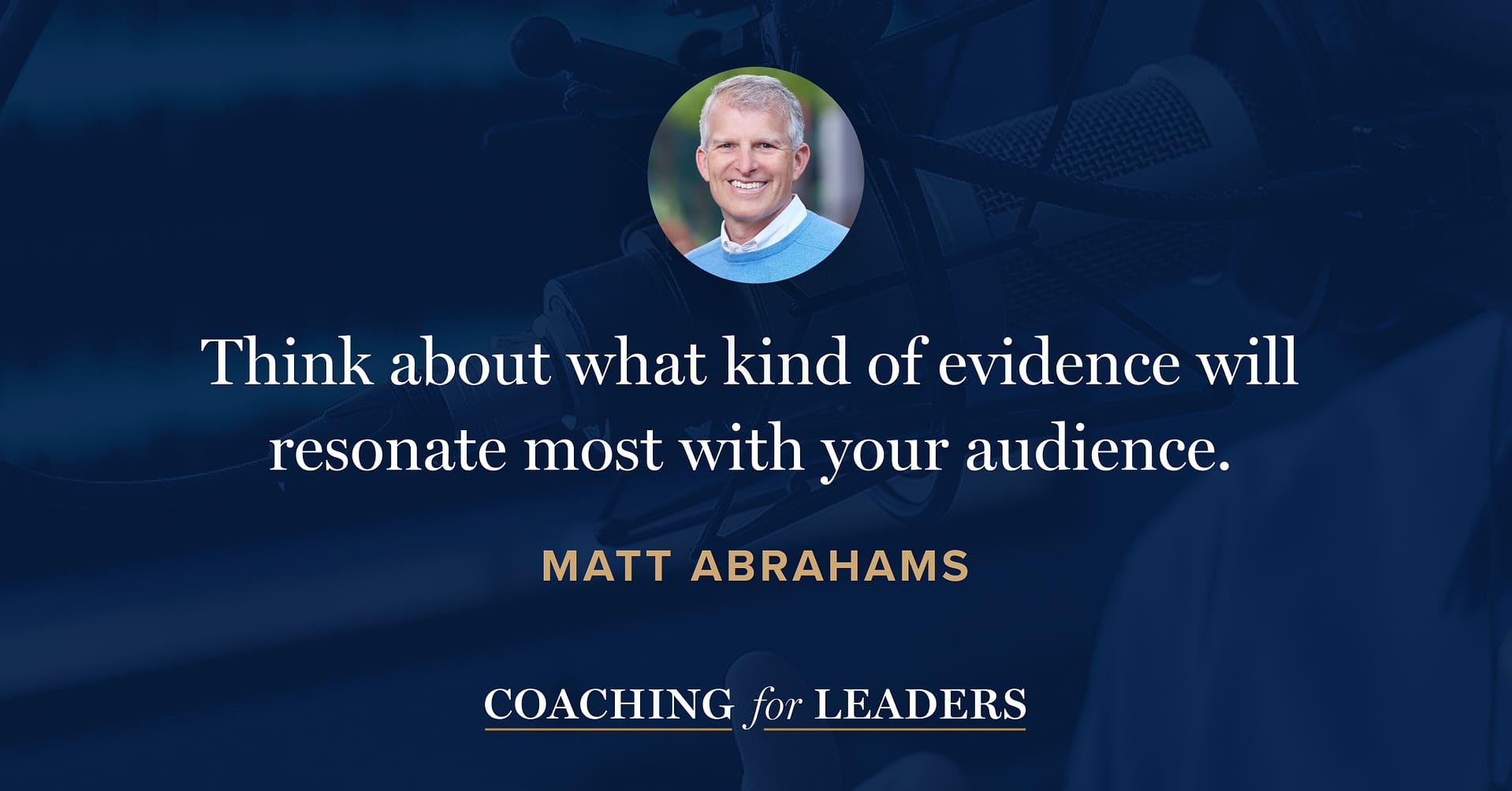
Think about what kind of evidence will resonate most with your audience.
https://media.blubrry.com/coaching_for_leaders/content.blubrry.com/coaching_for_leaders/CFL809.mp3

Podcast: Download

Follow:
Apple PodcastsYouTube PodcastsSpotifyOvercastPocketcasts

Matt Abrahams: Think Faster, Talk Smarter

Matt Abrahams is an educator, author, podcast host, and coach. He is a lecturer in Organizational Behavior at Stanford University’s Graduate School of Business and a keynote speaker and communication consultant for Fortune 100 companies. He is the host of the popular podcast Think Fast Talk Smart and the author of Think Faster, Talk Smarter: How to Speak Successfully When You’re Put on the Spot (Amazon, Bookshop). He just released a new Masterclass certificate course on Strategic Communication.

Every leader needs to pitch their ideas. In this conversation, Matt and I explore the frameworks that work and how to deliver them with effectiveness and confidence.

Key Points

  • To pitch an idea, use the framework of Problem-Solution-Benefit.
  • It’s a thinking error to assume that everyone understands the problem. It’s your job to connect the dots.
  • Cite evidence that will resonate with your audience and address what may be preventing movement.
  • When detailing a complex solution, chunk it into relevant pieces.
  • The “benefit” is what your audience gets from your solution, not you. If you’re having trouble identifying this, ensure your motives are in the right place.
  • Analogies are hugely helpful in getting a complex message across. Be mindful of the baggage they can also carry.
  • Show that your proposed solution is consistent with prior actions so your audience is more likely to buy in.

Resources Mentioned

  • Think Faster, Talk Smarter: How to Speak Successfully When You’re Put on the Spot by Matt Abrahams (Amazon, Bookshop).

Related Episodes

  • The Way to Make Sense to Others, with Tom Henschel (episode 518)
  • How to Change People’s Minds, with Michael McQueen (episode 676)
  • The Way to Handle Q&A, with Matt Abrahams (episode 681)

Discover More

Activate your free membership for full access to the entire library of interviews since 2011, searchable by topic. To accelerate your learning, uncover more inside Coaching for Leaders Plus.
Get People Behind Your Ideas, with Matt Abrahams

Download

Dave Stachowiak [00:00:00]:
Every leader needs to pitch their ideas. In this episode, the frameworks that work and how to deliver them with effectiveness and confidence. This is Coaching for Leaders, Episode 809.

Dave Stachowiak [00:00:14]:
Production Credit: Produced by Innovate Learning, Maximizing Human Potential.

Dave Stachowiak [00:00:21]:
Greetings to you from Orange County, California. This is Coaching for Leaders, and I’m your host, Dave Stachowiak. Leaders aren’t born; they’re made. And this weekly show helps leaders thrive at key inflection points. One of the charges of leadership is influencing, pitching our ideas, making the case, asking for budget, being able to influence key stakeholders. It is something that comes up fairly regularly. For some of us, it’s almost a daily occurrence of being able to make the case and influence better. Today, a conversation on how to do that when you do need to pitch your idea, when you need to get in front of someone and make the case.

Dave Stachowiak [00:01:03]:
How do you do it? And I can’t think of a better person to talk about that with than Matt Abrahams. Matt is an educator, author, podcast host, and coach. He is a lecturer in organizational behavior at Stanford University’s Graduate School of Business and a keynote speaker and communication consultant for Fortune 100 companies. He is the host of the popular podcast Think Fast, Talk Smart and author of the book Think Faster, Talk Smarter: How to Speak Successfully When You’re Put on the Spot. And Matt just released a new masterclass certificate course on strategic communication. Matt, it is always a pleasure to talk to you. Welcome back to the show.

Matt Abrahams [00:01:41]:
Dave, I am thrilled to be back with you. I have enjoyed our conversations both on your show and on my show as well.

Dave Stachowiak [00:01:49]:
As have I. I’ve learned so much from you and the podcast, and the book, and we, in turn, have also learned a lot from our children, both of us. I know from some of our past conversations, and I’d love to start by talking about your son and a story you talk about in your book about him pitching your wife and you for a guitar. And it turns out that, without having listened to, I don’t know if he’s listened to your podcast, but like a lot of 12-year-olds, he’s pretty good at making a pitch, and he sort of followed the process for doing this one. I’m wondering if you could walk us through, like, how did this come about? What did he do? And I think that’s a good lead into how to do this better as a leader too.

Matt Abrahams [00:02:32]:
Yes, kids are great at so many communication things, it just comes so naturally to them. So, my older son is like many kids, would take on new habits, new experiences, and then quit immediately. You know, really gung-ho. We’d invest time, money, effort, and then after a week or two, moved on to the next thing. He got really interested in music. Now, I’m very proud of a few things in my parenting. There are many things I’m not proud of.

Matt Abrahams [00:03:01]:
One is I introduced my kids to the music I grew up in- with. And so, late ’70s, early ’80s, sort of rock music. And my kids got really into it. And my older son really took to guitar because a lot of that music has lots of good guitar playing. And he wanted to get a guitar. And my wife and I looked at each other and rolled our eyes and said, “Oh my goodness, here’s another thing that we’re just gonna invest in. We need to, really help him understand that you can’t just do everything you want, that this is an investment.

Matt Abrahams [00:03:29]:
You have to actually think about it, prioritize, et cetera”. So we told him that, and he, rather than fighting us, he retreated for a while. It was, oh, probably a week or so. And he came back with a formal pitch to not only have us get him a guitar, but to help him get guitar lessons.

Dave Stachowiak [00:03:50]:
Hmm.

Matt Abrahams [00:03:50]:
And what he did that was so miraculous in this, one, besides being articulate in it, was he really under— he, he came at it from our perspective. He came at it from saying, not only will this keep me entertained and busy, something I can do so you don’t have to be monitoring and helping me get places, but I know that learning music also helps with math skills, helps you focus and get attention. And my friends are also interested. And maybe we can get together and jam and form a band. And we had been talking to him about doing other things with his friends besides video gaming. 12-year-old boys, at least in that era, big-time video gamers. So he did a miraculous job of putting together a pitch that was coherent, concise, and addressed many of the concerns that he knew we had. And the, that perspective-taking is probably the thing that impressed me the most, that he was able to make it relevant and salient from our perspective.

Matt Abrahams [00:04:52]:
And the punchline is we did buy him the guitar. He did learn to play it. He still plays it to this day. He did not join a band, but he still has fun with it.

Dave Stachowiak [00:05:02]:
Oh, cool. That’s great. And it’s really, when I think about your story and, our kids have done versions of this too over the years. When they’ve been really effective is, they’re really good at meeting the audience, in that case, in that case, me or you, of where they are. And I think that’s something that we often miss in a professional context too, is we don’t— we know the problem and all the things that we want from the perspective of the person who’s making the pitch or the case. What we don’t often do an effective job of is putting ourselves in the other person’s shoes. And really structuring the ask around that.

Dave Stachowiak [00:05:42]:
And it’s one of those things we all kind of know intellectually, but when we actually communicate it, we don’t necessarily follow through on that, do we?

Matt Abrahams [00:05:51]:
No, not at all. We often, in our communication, not just in pitching and persuading, but we often think about it from our perspective. What, how do we benefit? How does this help us, instead of really thinking about the other person, their needs, and their relevance? What’s relevant to them? Most of us, when we do persuade, we focus on all the reasons why somebody should do something rather than thinking about the things that prevent them from doing it. And some of the time, being persuasive is not just about tailoring your message, not just about saying what— why somebody should change, but sometimes the most effective persuasion is targeted at what’s preventing somebody from changing. So it’s even more than just making it relevant for your audience. It’s where do you target that’s important as well.

Dave Stachowiak [00:06:39]:
You and I both love a good framework, and you have 3 steps for us that are simple and powerful on making the pitch of the idea, the case, whatever it is you’re trying to do. And the 3 steps are problem, solution, benefit. I’d love to get into the details of all 3, but before we do, at a high level, what does that framework look like, and how do these 3 fit together?

Matt Abrahams [00:07:05]:
So I, as you well know, I am a huge proponent of structure and frameworks. When you are in the moment, when you are having to communicate, having a path ahead of you helps. It helps you actually connect to the people you’re communicating with because you know where you’re going. If you’re in your head, trying to think about how do I put this together while you’re in the midst of it, it actually distances yourself. Communication is all about connection. So frameworks are logical connections of ideas. Problem, solution, benefit is a tried and true influence framework. You start by describing the problem, the issue, the challenge at hand.

Matt Abrahams [00:07:43]:
You talk about how your proposal addresses it, how you solve that problem. And then finally, what— in what way does the person or people or organization benefit from that action? You can hear in that a logic. You start with the problem, which invokes the question, the curiosity: how do we address it? And once we address it, why should we do that? What, what, what do we get out of it? So there’s a natural logic of flow. I like to tell people that structure in general, this one in particular, help you be a tour guide. Your job when you communicate, especially pitching or persuading, is to take your audience, be it one person or many, from where they are to where you want them to be, just like a tour guide does.

Dave Stachowiak [00:08:22]:
Hmm.

Matt Abrahams [00:08:22]:
An effective tour guide does many things, but at least 2. One, they orient you to where you’re going. So when I establish there’s a problem, that orients you the direction we’re going. We’re going to solve it. And it also connects the ideas. Any tour guide— I was a tour guide many, many years ago when I was in college. The problem that most tour guides face is people will wander off and get lost when you move from one place to the next. They get curious, and they go somewhere else.

Matt Abrahams [00:08:46]:
Your job as a tour guide is to keep people together, and a structure does that because it naturally leads from one place to the next. There’s a built-in transition. Once I’ve explained the problem, I can say, okay, so now how do we solve it? So it connects the pieces together. So problem, solution, benefit is one of many structures and an incredibly useful structure for influence and persuasion.

Dave Stachowiak [00:09:08]:
When I was at Dale Carnegie years ago, Matt, I would often be called in to help clients to make a pitch internally for whatever they were. Maybe it was a key customer, maybe it was a senior leadership team. And we would talk through a process very similar to this. Exactly. Almost. And it was always interesting to me how often people would sort of brush through the first part of this, which is the problem of it, the first step. And I think one of the thinking errors that a lot of us make, and I’ve made it too, when making a pitch, is that because the problem has been so front and center for us, the person or team who’s making the pitch or the request, that we just sort of assume that everyone understands the problem and feels the pain, and knows the details of what’s not working with the issue. And, a lot of times, especially if it’s talking to senior leadership or stakeholders, they don’t have a clue that there’s even a problem.

Dave Stachowiak [00:10:13]:
Or if they do, they just sort of tangentially know about it. And that’s why I think this is so key of like starting here really intentionally to outline what is the problem.

Matt Abrahams [00:10:22]:
That’s right. And what is the problem from the perspective of the audience? And it might be different than your perspective. And let me go a little deeper, Dave, if you don’t mind.

Dave Stachowiak [00:10:31]:
Please.

Matt Abrahams [00:10:31]:
You actually have a choice. You can frame what you’re talking about as a problem. A problem is where something is wrong that needs to be remedied or fixed. But you could also frame the very same thing as an opportunity. Some— nothing’s wrong, but things could get better. Words matter. How you frame something matters. If you’ll allow me, I want to give a quick 10-second sharing of my favorite framing research.

Matt Abrahams [00:10:54]:
What these researchers did is they went to a group of people and said, “Imagine you have a terrible disease. We have a potential cure. It has a 67% failure rate”. They then went to another group, just like the first group, and said, ” Imagine you have a terrible disease. We have a potential cure. It has a 33% success rate”.

Dave Stachowiak [00:11:11]:
Hmm.

Matt Abrahams [00:11:12]:
Let me pause right there. Same thing, right?

Dave Stachowiak [00:11:14]:
Yep.

Matt Abrahams [00:11:15]:
Yet one is a failure, one is a success. Who takes it more? The people who see it framed as a success. Words matter. If you think your audience would respond better to your proposal framed as an opportunity versus a problem, then you should consider and do that framing. Now, how do you decide? Well, as you well know, Dave, all communication comes back to who the audience is. What will be most relevant to them? So, and I’m gonna use big stereotypes here, and I don’t mean to offend, but if you’re talking to somebody who’s technical, highly financial, deeply scientific, framing it as a problem might help you. Those folks like to solve problems, typically. In school, they did problem sets.

Matt Abrahams [00:11:56]:
They didn’t do opportunity sets. So if you’re talking to that type of audience, problem framing might work for you. If you’re talking to people in sales, marketing, HR, opportunity might be the better way to frame it. So how you position the problem, for whom you position the problem or opportunity, really can make a difference and aid in your success in what you’re advocating for.

Dave Stachowiak [00:12:19]:
Well, and that underscores one of the points I hear from you so consistently, which is, cite the evidence and examples and research or whatever it is, the data that’s going to resonate with your audience. And so often we think about what resonates with me, what’s the thing that I’m irritated by, what’s the thing I see not working. And that’s part of the story. But we got to start from the audience’s perspective because if you’re, for example, talking to senior leadership who tend to look a lot at numbers, you know, money, market exposure, those kinds of things, and you’re not really framing whatever’s going on through that lens, that you’re not likely to earn their attention because it doesn’t seem to be relevant to them.

Matt Abrahams [00:13:02]:
That’s absolutely right. That’s absolutely right. All communication starts from the audience.

Dave Stachowiak [00:13:08]:
I love it. Well, that takes us to the solution, step 2 in problem-solution-benefit. And you teach that when the solution is complex, which in many conversations it is, talking about highly technical things, organizations, lots of complexity, you say, itemize it. Tell me what you mean by that, and how does that look in practice?

Matt Abrahams [00:13:33]:
Yeah, so I, I’m not talking about doing lists. Too many lists are hard for people to process. We don’t remember lists well. Think about it. When you go to the grocery store, how many items do you need to buy before you have to write it down? For me, it’s 3. So,

Dave Stachowiak [00:13:48]:
yeah,

Matt Abrahams [00:13:48]:
when I say itemize, what I mean is break it down into constituent parts. So many times we come in with a solution that is multifaceted and very complex. And if there’s a way that you can group it together, in fact, in the academic literature, they call it chunking. It’s not the most elegant name, but it’s really, can you put related ideas together? So rather than just listing everything or getting so— keeping it so high level, can you break it into phases, break it into constituent parts so that people understand and have an appreciation of the complexity of the solution, or the variability of the solution? What we want to avoid is oversimplifying, because in many cases, the solution is not simple. And when people think it’s simple and it’s not, you build a lot of resistance. So I like this idea of breaking it into constituent parts, chunking them together where it makes sense, and clearly identifying them. When you make the solution accessible, people not only feel they have a better understanding of it; you increase your credibility. So people act, and credibility is important for trust and connection, et cetera.

Matt Abrahams [00:15:01]:
So spending time really articulating the solution at the level that’s appropriate for your audience is critical to your persuasive success.

Dave Stachowiak [00:15:10]:
And then the third part is benefit, problem, solution, benefit. What’s distinct about benefit from solution? Because, in a way, when you think about it, you’re like, okay, problem, and then here’s the solution, and we’re talking about the benefits and all that. Why is benefit its own thing, and what’s different and important about highlighting that that’s not just the solution?

Matt Abrahams [00:15:29]:
I appreciate the question. Actually, I thought you were gonna ask a different question, Dave. I thought you were gonna ask if you use opportunity, what’s the difference between opportunity and benefit? So I’m gonna answer both questions. The one you asked and the one that I asked on your behalf. So it is the- let me start by going back to a quote that I heard many, many years ago. The very first psychology professor I ever had said something that has stuck with me. He said, the funny thing about common sense is it’s not so common.

Dave Stachowiak [00:15:55]:
Hmm.

Matt Abrahams [00:15:56]:
We assume that if I explain to you the solution, that you will immediately and magically understand all of the benefits. It is in my best interest as a communicator striving for clarity and fidelity to make sure that you see the benefit from the perspective that I see it and believe it to be true. So we actually need to name those benefits to help. So naming the benefits not only makes sure that you’re aligned- so this is really an alignment activity- but it also can serve as a motivational activity. We know that people are motivated by emotion and that people are motivated by positive outcomes. So if I, in the framing of the benefits, can show you how this is positive and get you emotionally connected to it, it’s much more likely to lead to success.

Dave Stachowiak [00:16:47]:
Hmm.

Matt Abrahams [00:16:47]:
So it starts from the fact that I just need to make sure you’re seeing the world the way I’m seeing it. That’s that common sense comment. And then, I want to actually have the benefits serve to help motivate you to enact or follow through. Now, the question that I thought you were going to ask, which you probably would have next, ’cause I know you’re, you, you think deeply about things, is if you use opportunity, solution, benefit, isn’t an opportunity just a recasting of the benefits? And, and to some sense, it is, but the benefits are much more specific and the opportunity tends to be more generic. So I might say, if I’m doing opportunity, solution, benefit to try to get you to invest in a software tool, the opportunity pitch might be, we can be more efficient. We can get this work done in a more efficient manner.

Matt Abrahams [00:17:35]:
Here’s the solution. And then the benefits are we can cut time in half. We can save 30%. Do you hear how the benefits are much more specific?

Dave Stachowiak [00:17:44]:
Yep.

Matt Abrahams [00:17:44]:
Whereas the opportunity is a bit more generic. So I often get that question. So I, I was prepared not only to answer it, but also to ask it of myself.

Dave Stachowiak [00:17:52]:
I’m, I’m so glad you did because I think that, again, is something that kind of goes back to what we were talking about earlier, with the problem is oftentimes we think a lot about the solution.

Matt Abrahams [00:18:03]:
Mm-hmm.

Dave Stachowiak [00:18:03]:
But we don’t necessarily appreciate how we need to set up and really position the problem and explain the problem. But we also don’t often connect the dots at the end. And again, to the point you’ve made several times in this conversation, but I don’t think we can say it enough, is it’s the benefit to the person you’re pitching to. It’s not the benefit to you. It’s the benefit to the person who’s the audience, the organization, whoever the stakeholder is. It’s— you’re outlining for them: if this solution takes place, here’s the likely thing you can expect. And so you’re connecting the dots for them rather than handing them the dots and expecting them to connect it themselves. Sometimes they might, but you’re walking them through that. So it is really, really simple.

Matt Abrahams [00:18:46]:
Yeah, exactly. And, and that help— that does 2 things. One, it increases fidelity, the accuracy and clarity of information. And two, it, it, again, as a tour guide, we like our tour guides when they help take us through things that are helpful for us. So it bolsters liking and credibility. And those are, those are, as you well know, really important elements of effective leadership and relationships.

Dave Stachowiak [00:19:11]:
Well, speaking of being a tour guide, one of the things that you are masterful at, you teach all the time, and you also teach as part of this process, is analogies and utilizing analogy. And the tour guide is an amazing analogy, right? Because you’re meeting people with something that they already understand and appreciate. Everyone’s been on a tour somewhere, and so they have had that experience. And you’re using it to illustrate a larger concept. When you think about bringing analogies into this process and helping people to pitch better, use an analogy, what is it that you find that helps them to start to bring that in just a little better?

Matt Abrahams [00:19:53]:
So you’re right, analogies are incredibly powerful. We learn new information often, most frequently by connecting it to existing information. And that’s what an analogy does. So, you are actually leveraging neural pathways that we have for learning. So you expedite the connection and communication you have by leveraging analogies. Now, one thing before I go into any more detail about analogies, we have to be careful because analogies are often culturally and contextually specific. I’ll give you a quick example. Here in the United States, we use a tremendous amount of sports analogies.

Matt Abrahams [00:20:28]:
Hit it out of the park, push it across the goal line. It’s a slam dunk. Those are great if you know those sports.

Dave Stachowiak [00:20:34]:
Yep.

Matt Abrahams [00:20:34]:
I had a student once in my strategic communication class at Stanford’s Business School who, in the middle of a presentation, used an analogy to the game of cricket. And that’s what he heard: crickets. Because here in the US, at least, cricket is not a well-known sport.

Dave Stachowiak [00:20:49]:
Yeah.

Matt Abrahams [00:20:49]:
And he stopped, and he looked at all of us, and he said, that’s how I feel when all of you use American football analogies. The point is, you have to use analogies that are appropriate for context and culture. When you go to communicate, one of the most powerful ways to engage somebody, to increase the memory of what you’re saying, is to find an analogy. And sometimes an analogy can just be something referring to something else that people already know. Like, I could say, this project is similar to the project we did 2 years ago. That’s an analogy of similar kind. Or I could do, as what I have done today, where I’ve said crafting persuasive messages is like being a tour guide. Those are very different.

Matt Abrahams [00:21:29]:
But when you pair an analogy, you have to be careful because you bring both good and bad. One of my colleagues at Stanford who teaches strategy, his name’s Jesper Sorensen, has done some research into how companies use analogies when pitching.

Dave Stachowiak [00:21:45]:
Hmm.

Matt Abrahams [00:21:46]:
So a lot of people will say, we’re the Netflix of this, or we’re the Uber of that.

Dave Stachowiak [00:21:50]:
Yeah.

Matt Abrahams [00:21:51]:
Yeah. And that’s leveraging an analogy. But the, but the problem in his research he’s found is often you bring baggage with you. So I don’t mean to pick on any company, but think of any company. Most companies that have been around for a while have some negative stuff out there. There’s some baggage. And when you say we are like that, not only do people understand, okay, your business model is gig economy, or your business model is sending things in and, you know, SaaS stuff, but there’s also the baggage. So you have to be careful when you use analogies.

Matt Abrahams [00:22:20]:
That said, spending time thinking about how can my point relate to something that people already know? Can be very empowering to your audience when you find the right analogy. So how do we find the right analogy? To me, it’s a puzzle. It’s a game. I actually enjoy doing it. Talk about it, brainstorm about it, use AI to help you do it, and then test it out. Test it on others, because the connection you make between the 2 ideas might not be the same thing others make. So I tested out tour guide and message creation on several people, and they said, “I get it; that makes sense.” And that’s why I use it.

Dave Stachowiak [00:22:54]:
I love it. And I think this comes back to, again, our core message on, like, who’s the audience that you’re trying to influence? I think the cricket example is fabulous. Like, hey, if you’re talking to a sports organization here in the States, like, great, use sports analogies all day long, right? But if you’re given a presentation on a technical thing in Copenhagen, no, like, don’t use American football as an analogy. Like, that’s just— that just doesn’t make sense at all. And so, like, this comes down to who’s the audience for this. And one of the things I sort of stumbled into over the years was having, especially if it’s a high-visibility thing, I mean, sometimes you don’t know in advance, you’re, you’re thinking on your feet, you’re talking to someone, you’re making a pitch. But a lot of times, you know, you’re going to be making a pitch, you’re going to be presenting something, is talking to some people who are, who either are the stakeholders who are going to be in the room or know them. And running some of your analogies past people first, like, hey, I’m thinking of framing it this way.

Dave Stachowiak [00:23:52]:
Is this going to land with this audience? It can be super, super helpful on doing that, right? And then the other thing, I think you illustrated this really well, Matt, and to your point about bringing baggage along, like using a really simple analogy, like a tour guide, doesn’t bring so much of the baggage. I mean, I suppose everyone’s been on a bad tour, right? At some point.

Matt Abrahams [00:24:12]:
Right.

Dave Stachowiak [00:24:12]:
But when you say something like— and we hear this all, all the time, like I’m the Netflix of or the whatever.

Matt Abrahams [00:24:17]:
Yes.

Dave Stachowiak [00:24:19]:
You just bring all the baggage, the politics, the news of those organizations. But if you take something that’s a little simpler or more generic, that still people could understand, like a tour guide, for example, you get the benefits still of the analogy, but you don’t bring sometimes as, as much of the baggage along.

Matt Abrahams [00:24:35]:
Yes, that’s, that’s right. But again, we are not the best judges, so test it with other people. I might think, oh, this analogy doesn’t have baggage, and somebody’s like, oh, did you think about that? So definitely take it, take time to test them out.

Dave Stachowiak [00:24:48]:
Your point about AI is really great too. I, like you, I mean, we could probably geek out all day long on, like, figuring out analogies for things. So I have always found that interesting and fun, but I also recognize that it’s not interesting and fun for everyone. And it’s often the stopping point, which keeps people from actually using analogies. And I found AI, even for myself, to be really helpful for this, of like, “Hey, I’m trying to explain this thing to this audience. What would be a couple of analogies I might consider?” And almost always, every time I’ve done that, AI generates something where I’m like, oh, I would never have thought about that as an analogy. And it’s never perfect, but it often gets me started on that process and gets me moving.

Matt Abrahams [00:25:29]:
I agree. And you’re using AI the way I believe we should all use AI, which is as a thought partner. It’s helping you to think through and figure out what might be the most appropriate analogy or way to structure something, but you’re not having it do it for you. You’re using it as a way to connect and to think. And I 100% appreciate that as a really useful way to use AI.

Dave Stachowiak [00:25:55]:
You write in the book, if you can show that your proposed solution is consistent with prior actions or ways of addressing an issue, your audience will be more likely to buy in. In sales, we call this the foot-in-the-door technique. And you make the invitation for a consistent solution in using this process. Tell me a bit more about that. What does that look like, and what’s important about it?

Matt Abrahams [00:26:19]:
Foot-in-the-door and door-in-the-face are 2 of my favorite persuasion techniques. And these are names that academics gave to them because they date back to the day where people would knock on your door and try to sell you encyclopedias or vacuum cleaners.

Dave Stachowiak [00:26:33]:
Oh, yeah.

Matt Abrahams [00:26:34]:
And they would purposely— Try to get their foot in the door so you can’t slam the door in their face. Or the opposite, door in the face, where you actually want them to slam the door and then you want them to open it again. So both of these are playing on, at least to some extent, on this notion of consistency. Human beings like to be consistent. We like things that are consistent. Now, there are some of us who are risk-takers and say we like novelty, but at a foundational level, most of us like consistency. And if I can demonstrate what I am advocating for, trying to persuade you of, influence you on, is consistent with something you have already done or already believe, I’m making my life easier.

Matt Abrahams [00:27:13]:
So let— I’m actually, if you don’t mind, I’m gonna really geek out on this because this actually happened near Stanford in the late ’60s, the foot-in-the-door research. Very quickly, what they did is they went to a neighborhood very close to Stanford, and they went to people, knocked on the door, and they said, people are driving very quickly in your neighborhood. Would you sign this petition to say, hey, people should slow down? Almost everybody signed the petition. Then what they did is they went back to all of those neighborhoods and they said, hey, would you mind hanging, putting this sign? It was a big, obnoxious sign in your front yard that says, ” Please slow down”. And they asked people in the neighborhoods where the people had signed the survey, and then they went to a very similar neighborhood nearby and asked them to put the sign in, but they hadn’t signed the petition.

Dave Stachowiak [00:27:56]:
Hmm.

Matt Abrahams [00:27:56]:
And of course, in line with consistency, the people who had signed the petition were much more likely to put the sign in their yard than those who hadn’t. In other words, they had asked people to be consistent with a behavior and attitude that they expressed, and therefore people acted on it. And the same is true. So how does this look in your persuasion? Well, if you are working in a company and your company has strong mission, vision, values, you could say, “Hey, implementing this new tool or new process is in alignment with our value of transparency, efficiency, whatever the value is”. So by highlighting to people what you’re advocating for helps them to be consistent with something they have already expressed interest in or value. It helps you to be persuasive. Now, door in the face works the opposite, where you actually want people to say no, and then you make a smaller ask, and they say yes. My other son, my younger son, we talked about my older son.

Matt Abrahams [00:28:53]:
My younger son, when he got his driver’s license, wanted to get a car. So he came to me and said, ” Dad, will you buy me a new car?” The answer was, um, instantly no.

Dave Stachowiak [00:29:02]:
Yeah.

Matt Abrahams [00:29:02]:
He, he knew it was gonna be no, so he came back a little bit later and said, ” How about a used car?” And that’s an example of door in the face. I am more likely to give him the used car because he asked for the more expensive new car, than had he just come in with the used car in the first place. And so these are techniques that you can use to help yourself be more persuasive. Now the question becomes, are you being manipulative or not, and that’s the question you and I can discuss and debate. But these are techniques that help people be more persuasive.

Dave Stachowiak [00:29:36]:
One of the last messages you have in the book on this is the invitation to tone down perfectionism, which is a great reminder for me because as someone who sets high standards for myself, I always think about putting together a pitch or presentation of trying to nail it in the best possible way. What’s important about just toning that down and not trying to come in and be perfect?

Matt Abrahams [00:30:01]:
Yeah. So here’s the problem. When we strive for perfection, we focus so much on what we’re saying while we’re saying it that we actually are disconnecting from the people we’re communicating with. And the goal of communication at the highest level is to connect. In fact, the root of the word communication is all about to make common, to connect. The biggest, the best example, I think, Dave, is memorizing. So if you’re going to try to be persuasive and you want to memorize your pitch, that means as you are delivering your pitch, part of your brain is comparing what you’re saying to what you intended to say. And that gets in the way of you actually being connected and therefore being able to adjust and adapt to what’s happening in the moment.

Matt Abrahams [00:30:48]:
It, it essentially boils down to cognitive load. Your brain only has so much cognitive bandwidth, and if part of that bandwidth is dedicated to perfection, judging and evaluating to a high degree, then you have less effort to focus on connecting. So I often tell my students it’s about connection, not perfection. Now, let me be very clear: I am not saying you should not judge and evaluate what you say; you should. But folks like you and like me, we run around with that knob turned all the way up to 11 on a 10-point scale with judging and evaluating, and that inhibits our ability to connect. So if we can dial it down to a 5 or a 6, we can be in a much better place.

Dave Stachowiak [00:31:26]:
Matt, I so appreciate you being such a great teacher to me and so many of us on this and everything communication-related. It’s just been fabulous, like getting into your work and congrats on the podcast and like all the traction you’ve gotten with it. It’s just really amazing. And I often ask people at the end of conversations, as you know, what you’ve changed your mind on. I asked you that last time you came on the show, though, so I’ve got a slightly different question for you this time. AI, you know, AI is like obviously exploding for everyone everywhere, but in the context of communication, it— a lot of questions are coming up for this. How is AI changing how you think about your work, the book, the messages you send? Just curious, like what’s on your mind in regards to it?

Matt Abrahams [00:32:11]:
Yeah, I have spent a lot of time as of late thinking about AI’s impact on communication. And AI invites what I’m calling an authenticity crisis. It allows us the ability to be, to have our communication, especially written communication, to be perfect and polished. And yet that reduces the humanness in communication so much so that big companies, for example, are hiring people only when they bring them in, in person, to communicate. So, they can be sure that somebody isn’t virtual on an interview, getting prompts or cues and clues from an LLM. Companies are asking people pitching them for business to come in so they know there isn’t this Cyrano de Bergerac, where somebody’s telling you what to say while you’re saying it.

Dave Stachowiak [00:32:59]:
Mm-hmm.

Matt Abrahams [00:32:59]:
So we have to find ways to exert our humanness. And we do that by— sharing context and insights that AI just wouldn’t know. So when you ask me a question, like you did earlier in our interview, I got really excited and said, “Hey, back once when my— the very first thing my first psychology professor ever said”, that context lets you know that I’m human. AI isn’t going to know that that’s the first thing my psychology professor said. So things that we do to demonstrate proof of human, and humanness is going to become even more important. Because in a world of AI where we can all be perfect and polished in our communication, the ability to respond in the moment with our human communication is going to differentiate us. That is not to say that AI cannot help us. As you alluded to earlier, we can ask AI questions.

Matt Abrahams [00:33:54]:
We can use it as a thought partner. It is a wonderful tool to help us better understand our audience, to test our messages. It is when we allow it to craft those messages that we begin to atrophy our empathy, and we begin to give away some of the things that make us uniquely human. So in the updated book, I spend a lot of time talking about very specific strategies we can use to leverage AI, but not give away some of our humanness. So thank you for the opportunity to share some of that.

Dave Stachowiak [00:34:23]:
Matt Abrahams is the author of Think Faster, Talk Smarter: How to Speak Successfully When You’re Put on the Spot, and the host of the podcast of almost the same name. Think fast, talk smart. Matt, thanks as always for your work. Appreciate it.

Matt Abrahams [00:34:36]:
Thank you, Dave. Always wonderful to be in conversation with you.

Dave Stachowiak [00:34:46]:
If this conversation was helpful to you, 3 other episodes I’d recommend. One of them is episode 518: The Way to Make Sense to Others. My friend Tom Henschel was on that episode, and we talked about his fabulous model for sorting and labeling. If you’re trying to get your message across to someone else, whatever that message is, whether it’s an idea, a pitch, a presentation. Tom’s framework for sorting and labeling is one I use every single day. Bonni and I talk about it often; it is one of the most useful frameworks, I think, for leaders to be able to get a message across clearly, episode 518, Tom and I walk through step by step exactly how to do that, and tool he has featured for years on his outstanding podcast, The Look and Sound of Leadership, a great complement to the show as well.

Dave Stachowiak [00:35:30]:
Also recommended, episode 676: How to Change People’s Minds. Michael McQueen was my guest on that episode, and we talked about the reality that even if you have all of the evidence lined up, even if you have all the logical arguments to say for folks about why they need to go with your idea and maybe even why they may be wrong, it’s probably not enough. Michael and I talked about the emotional part of also connecting with people, not just beyond the facts and figures, but how do you approach it in a human way that actually motivates people to have agency over changing their mind, episode 676. I think a great complement to this conversation. And then finally, I’d recommend the last time that Matt was on the show, episode 681: The Way to Handle Q&A. Matt is exceptional at this as well. We talked about how do you handle a Q&A session? Oftentimes, they come after a pitch or a presentation, and I have seen some spectacular presentations fall apart over the years in the pitch and the decision because someone didn’t handle the Q&A well. And I’ve seen the opposite happen too.

Dave Stachowiak [00:36:33]:
A mediocre pitch or presentation and then a Q&A that’s handled brilliantly can oftentimes be the deciding factor. And if you haven’t thought much about how to handle a Q&A session, as most leaders haven’t, episode 681 is a great starting point for you. All of those episodes you can always find on the coachingforleaders.com website. And if you haven’t set up your free membership, do so at coachingforleaders.com because you’re going to be able to search the entire library by topic, so that we can help you track down exactly what you’re looking for. And if you’re looking for a bunch more, one of the new tools inside of Coaching for Leaders Plus is Ask CFL. It is a tool that has indexed the entire library of all the episodes we have aired since 2011. Every single episode, every single word, every single transcript, all of it. So if you’ve got a question that you’re trying to track down, and it’s not one of the related episodes I mention every week, it’s a good resource to tap into. It is now part of Coaching for Leaders Plus.

Dave Stachowiak [00:37:36]:
You can find out more by going over to coachingforleaders.plus. Coaching for Leaders is edited today, as always, by Andrew Kroeger. Next Monday, I am glad to welcome back to the show Robert Cujo Teschner. Cujo and I are gonna be talking about how to build a plan that works. Join me for that conversation with him. Have a great week, and see you back on Monday.

Topic Areas:Executive PresenceInfluencePresentation Skills
cover-art

Coaching for Leaders Podcast

This Monday show helps you discover leadership wisdom through insightful conversations. Independently produced weekly since 2011, Dave Stachowiak brings perspective from a thriving, global leadership academy of managers, executives, and business owners, plus more than 15 years of leadership at Dale Carnegie.

Listen Now OnApple Podcasts
  • More Options
    • YouTube Podcasts
    • Spotify
    • Overcast

Activate Your Free Membership Today

Access our entire library of Coaching for Leaders episodes from 2011, searchable by topic.
Listen to the exclusive Coaching for Leaders MemberCast with bonus content available only to members.
Start Dave’s free audio course, 10 Ways to Empower the People You Lead.
Download our weekly leadership guide, including podcast notes and advice from our expert guests.

... and much more inside the membership!

Activate Your Free Membership
IMAGE
Copyright © 2026 · Innovate Learning, LLC
  • Plus Membership
  • Academy
  • About
  • Contact
  • Dashboard
×

Log in


Forgot Password

Not yet a member?

Activate your free membership today.

Register For Free
×

Register for Free Membership

Access our entire library of Coaching for Leaders episodes from 2011, searchable by topic.
Listen to the exclusive Coaching for Leaders MemberCast with bonus content available only to members.
Start Dave’s free audio course, 10 Ways to Empower the People You Lead.
Download our weekly leadership guide, including podcast notes and advice from our expert guests.

... and much more inside the membership!

Price:
Free
First Name Required
Last Name Required
Invalid Username
Invalid Email
Invalid Password
Password Confirmation Doesn't Match
Password Strength  Password must be "Medium" or stronger
 
Loading... Please fix the errors above