• Skip to primary navigation
  • Skip to main content
  • Skip to primary sidebar

Coaching for Leaders

Leaders Aren't Born, They're Made

Login
  • Plus Membership
  • Academy
  • About
  • Contact
  • Dashboard
  • Login
Episode

771: Fixing Fairness in the Workplace, with Lily Zheng

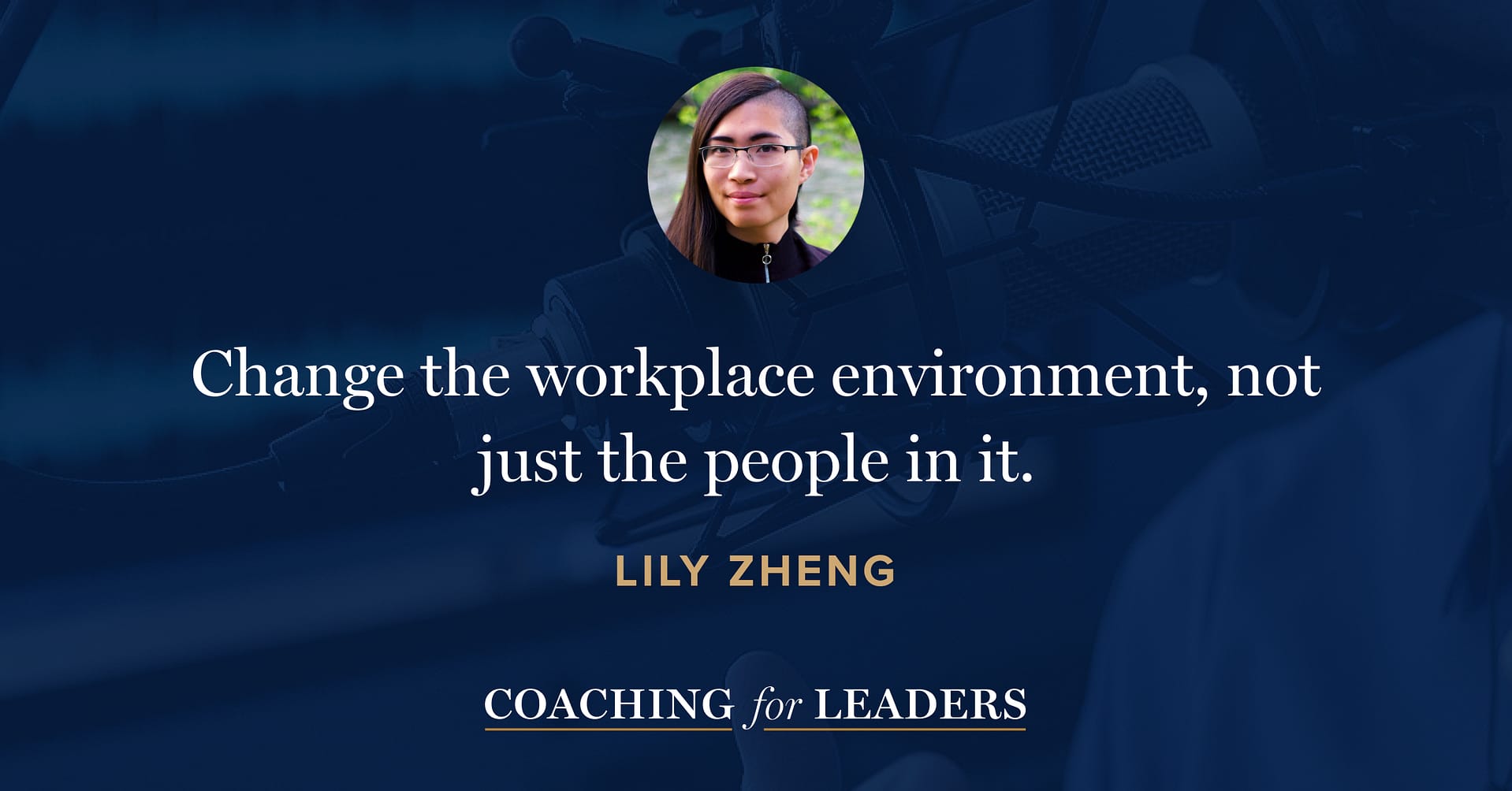
Change the workplace environment, not just the people in it.
https://media.blubrry.com/coaching_for_leaders/content.blubrry.com/coaching_for_leaders/CFL771.mp3

Podcast: Download

Follow:
Apple PodcastsYouTube PodcastsSpotifyOvercastPocketcasts

Lily Zheng, Fixing Fairness

Lily Zheng is a sought-after speaker, strategist, and organizational consultant who specializes in hands-on systemic change to turn positive intentions into positive outcomes for workplaces and everyone in them. A dedicated changemaker and advocate, Lily has had their work published in the Harvard Business Review, New York Times, and NPR. They are the author of Fixing Fairness: 4 Tenets to Transform Diversity Backlash into Progress for All (Amazon, Bookshop)*.

When it comes to fairness in the workplace, our society is quick to zero in on what divides us. Yet, there is broad agreement across all demographics on many key principles. In this conversation, Lily and I explore how leaders can influence the system to better work for everyone.

Key Points

  • Many of us assume that fewer people support the value of diversity than actually do. When asked, 82% of people support pro-diversity statements.
  • The most popular/traditional approaches to fixing fairness in the workplace tend to be the least effective.
  • Our tendency is to focus on the behavior of individuals, when in fact organizational systems have the most significant impact on fairness.
  • When considering a fairness initiative or intervention, begin with the practice of understanding and storytelling, just like many change initiatives.
  • Resist the temptation to check boxes with “quick fixes” such as simply bringing in a speaker or hosting a one-time event. This rarely helps in any sustainable way and sometimes worsens existing dynamics.
  • If you have a seat at the leadership table, make the case for thoughtful design and involvement of stakeholders at all points in the process, just as many effective organizations do on any strategic change initiative.

Resources Mentioned

  • Fixing Fairness: 4 Tenets to Transform Diversity Backlash into Progress for All by Lily Zheng (Amazon, Bookshop)*

Interview Notes

Download my interview notes in PDF format (free membership required).

Related Episodes

  • Supporting Return to Work After Maternity Leave, with Danna Greenberg (episode 639)
  • The Power of Unlearning Silence, with Elaine Lin Hering (episode 678)
  • How to Lead a Meaningful Cultural Shift, with David Hutchens (episode 755)

Discover More

Activate your free membership for full access to the entire library of interviews since 2011, searchable by topic. To accelerate your learning, uncover more inside Coaching for Leaders Plus.
Fixing Fairness in the Workplace, with Lily Zheng

Download

Dave Stachowiak [00:00:00]:
When it comes to fairness in the workplace, our society is quick to zero in on all the things that divide us. And yet, there’s broad agreement across almost every demographic on a lot of the key principles. In this episode, how leaders can influence the system to better work for everyone. This is Coaching for Leaders, episode 771.

Dave Stachowiak [00:00:23]:
Production Credit: Produced by Innovate Learning, Maximizing Human Potential.

Dave Stachowiak [00:00:31]:
Greetings to you from Orange County, California. This is Coaching for Leaders, and I’m your host, Dave Stachowiak. Leaders aren’t born, they’re made, and this weekly show helps leaders thrive at key inflection points.

Dave Stachowiak [00:00:46]:
We have been through a whole bunch of inflection points in what’s happening in the world in recent years, and one of the things that has been on the mind of so many leaders and organizations is how do we make the workplace more fair. There’s been a lot of attempts at doing that, but a lot of struggles. There’s been a lot of politics and, and discussion and disagreement on how. Today, a conversation on the next steps. How can we do a better job as leaders of thinking strategically, of approaching fairness in the workplace in a way that works for almost everyone? I’m so pleased to welcome Lily Zheng to the show. Lily is a sought-after speaker, strategist, and organizational consultant who specializes in hands-on systemic change to turn positive intentions into positive outcomes for workplaces and everyone in them. A dedicated changemaker and advocate, Lily has had their work published in the Harvard Business Review, New York Times, and NPR. They are the author of Fixing Fairness: 4 Tenets to Transform Diversity Backlash into Progress for All.

Dave Stachowiak [00:01:50]:
Lily, what a pleasure to have you on.

Lily Zheng [00:01:52]:
Thank you so much for having me. I’m really excited for this conversation.

Dave Stachowiak [00:01:55]:
I am so excited for this conversation too, because this is a topic that is— it’s so important, it’s so relevant right now. And everyone who’s listening to this already knows that so many of the things that we’ve called DEI, diversity, equity, inclusion programs, have become such a political flashpoint in the past few years. And you would go on the assumption, just looking at the news and seeing the conversations that are happening, that nobody agrees on anything. But it turns out there’s some broad agreement on some big things. And there’s a number that caught my eye in your work and research— 82%. Could you tell me about that number and what’s significant about some of the broad agreement that is out there?

Lily Zheng [00:02:41]:
Yeah, yeah. Well, what a, what a great question to get us started. So, it turned out researchers wanted to understand what level of support these big ideas around diversity, equity, and inclusion had in the United States. And so what they did is they asked people, thousands of people, to what degree they agreed with statements like, “I think diversity is good for the country”. “I think we should try to make our environments more inclusive”, these kinds of statements. And broadly, they also asked people a really interesting second set of questions, which is, what would you estimate other people think about this? So they asked not only what individuals thought, but what they thought the majority of the people around them believed. And there are two really big findings from this study. I’ll kind of share, share the results.

Lily Zheng [00:03:35]:
And the first one is that people were pretty skeptical about the folks around them. Most people believed that around like 55% of the people around them would agree with pro-diversity statements. Right? 55. So people said, you know, 50/50. I think half this country thinks that diversity is valuable. I think the other half doesn’t agree. Now, what was the actual percentage? 82. 82% of people believe that diversity is good for this country.

Lily Zheng [00:04:08]:
82% of people agreed broadly with these kinds of pro-diversity statements, and there were several of them. And I just want to pause here and highlight that huge gap. Basically, the supermajority of people in this country believe that diversity is a good thing, right? And that’s our gut feeling, right? When we look around, we say like, hey, would this country be a better place if everyone looked the same? And most of us think, well, probably not, right? Like, this is, this is America. We’re multicultural. We’re, we’re a melting pot, right? Like, this is a place where people can come and be themselves, and we make space for everybody. And it turns out 82% of people agree with that. But because, because of this political environment we’re in, even though we’re in the supermajority, we doubt, we wonder if maybe the other side is actually 50% of us. We wonder if we’re, maybe even in the minority of people who believe in the value of diversity.

Lily Zheng [00:05:09]:
But we’re not. Almost everybody, almost everybody believes that diversity is better for this country. And I find that extremely hopeful in these really tense, really politicized times that we find ourselves in.

Dave Stachowiak [00:05:25]:
As do I. And it’s really such a hopeful finding. And it frames so much of what I think we’ll talk about today, which is, all right, well, how do we actually bring that into the work we’re doing? Because, on a micro level, so many of the programs that have been attempted by so many organizations and industries have not had the intended effect. And you write in the book, a meta-analysis looking into the impacts of 30 years of diversity initiatives over 700 workplaces found that the most popular approaches to workplace DEI were ironically the least effective. And you point to a lot of things that have not worked with organizations trying to make the workplace more fair. When you see some of the traditional and popular approaches fall short, what is it that goes wrong?

Lily Zheng [00:06:18]:
So the workplaces that do diversity, equity, and inclusion wrong are usually the ones that underestimate it. They think this work is really easy. They think this work is a one-and-done. And so what you see these workplaces do is they will oftentimes spend a lot of effort pursuing one limited siloed intervention, whether that intervention is a 90-minute diversity training, a racial sensitivity workshop, an unconscious bias training. Many workers have attended some of these, or even, bringing in a speaker to mark a cultural heritage month or a celebration. All of these efforts are well-intended. All of these efforts come from a place of saying, well, we want to show our commitment to DEI. But what few of these things do is treat DEI not as an ideology to show a commitment to, but instead as a set of outcomes to achieve in the workplace.

Lily Zheng [00:07:25]:
One analogy that I use is if you’re trying to get your sales team to make more sales, the first thing you do is not hold a webinar and pay a bunch of money for a speaker to talk about how much they care about sales, right? That’s completely backwards. Yeah. We instead say, well, let’s create some goals. Let’s do some tracking. Let’s understand what drives sales. Let’s train our people on how to do that. And let’s be a little hard on them and hold them accountable for actually hitting these targets. Then when it comes to DEI, we instead say, Oh, you know what? Let’s just navel gaze.

Lily Zheng [00:08:01]:
Let’s just throw a big party. Let’s do what practitioners call food, flags, and fun. And then let’s, let’s ask ourselves in 6 months why nothing changed and act surprised, right? Like, we don’t take the same approach to solving DEI problems as we do with virtually every other problem that we face in the modern workplace. And that’s one of the reasons why so many of these efforts, even though they’re well-intentioned, fall flat.

Dave Stachowiak [00:08:28]:
Something I have changed my mind on so much in the last 20 years of doing work across all aspects of leadership training, development, leadership development, executive development, is the power of the organization and the culture around an organization. And if you can find a way to approach that and do better as far as systems and structure, how it drives change in so many wonderful ways. And the opposite, unfortunately, also true, when you spend time just trying to change an individual or have one heroic person trying to change a culture or a system, that almost always, they fail. And part of what I hope is that as folks are listening to this, I think the vast majority of folks in our listening audience aren’t necessarily the person that’s been— I’m trying to think of the right word here. It’s not the person who’s been elected in their organization to fix fairness, but they are often the person who is at the table who is thinking about, with other leaders and with the executive team, how do we do a better job at this? And one of the things that I really appreciate about your work is that you’re really thoughtful about how do we actually look at the system and the bigger picture and the environment. And I think it might be interesting to just like look at some of the things you do in this so that, for all of us who are sitting at those tables in the coming months and years and hearing the organization struggling with some of these and how we do this better, like where we can start and what we can actually do that helps us to enter into this space better? And one of the things that you always start with is, a process of understanding and working with organizations that are willing to do that. When, when you think about understanding and beginning there, what does that look like?

Lily Zheng [00:10:17]:
Yeah, so something I want to start with is what you shared about earlier, this idea that the role of the environment, the role of the system is really powerful. And a metaphor that I’ve used in the past is helping people understand that people are not like clay, they are like water. And so rather than trying to mold all of the people inside of our workplaces, into, let’s say, the shape of a square or a flower. What we can do instead is to create, let’s say, a vase, a shape of the organization that we want people to be in, to make a vase like that’s shaped like a flower, and people will fill the contours of that vase. We can drive behavior by designing the environment that people find themselves in. If our environment is fair, people will find themselves acting fair. If our environment is cutthroat, people will find themselves acting cutthroat.

Dave Stachowiak [00:11:21]:
Indeed.

Lily Zheng [00:11:22]:
And so when we start trying to understand, right, this very first step of changing our workplaces for the better, I ask the clients that I work with, what shape is your workplace in? What behaviors are incentivized? If you just drop a random person inside, right after 6 months, what will they be doing? How will they be acting? What are they feeling? And why is that the case? And it turns out in lots of our workplaces, right, you can find any old person off the street, and within a couple of months they will be, let’s see, not collaborating super well with their colleagues. They will be not really feeling like they can make decisions for themselves because of the command and control culture in their workplace. They will find themselves relatively isolated from their colleagues. And is that because they are a not particularly assertive person that hates collaboration? No, because that’s the shape of the organization that they found themselves in. So this first step of understand is really,describe the shape of your workplace, right? What is incentivized? What is the culture like? What behaviors are normalized and routinized that your leaders incentivize from the top? Right? So that’s the very first step. And the way you find that out, you talk to people, you survey folks, you interview people. There’s some really fascinating research you can do called, what is it, network analysis. That’s it. Where you analyze all of the different communications that happen throughout your workplace, whether on email or on Slack, and you use that to spell out kind of where the hubs of influence are in your workplace.

Lily Zheng [00:13:07]:
It’s really fascinating stuff. But either way, you can build a very clear understanding of what your workplace is like and what behaviors are incentivized that result in your status quo.

Dave Stachowiak [00:13:18]:
And to our earlier point, we think to do this in a lot of other situations, organizational culture and climate surveys, engagement surveys, when we’re doing broad organizational change. But for whatever reason, we often don’t think to do this when we’re thinking about fairness, and how to do that better, and how to architect those systems. And I was thinking about what you said that there’s this old adage in the organizational behavior world that I remember from school, that if you put a quote-unquote good person in a bad system, that the system will win almost every time. That so much of the, the behaviors— if we bring someone into an organization that has a certain set of behaviors, good or bad, they’re gonna, they’re gonna take on those behaviors. We all know that, by the way. We’ve all experienced that in organizations. And so being able to really see, like you said, that image of that vase or the square, whatever it looks like right now, starting to understand that, appreciate that, going through a process of doing that. One of the things that I hope that folks will think about is, hey, if we’re not actually starting there like we would with any other process of thinking about change effectively, that there’s an opportunity here to start with the understanding process, to actually ask some questions, to collect some data, to look at the broader perspective, so we know where we’re beginning from.

Lily Zheng [00:14:36]:
Right, right. And it’s not exactly the easiest thing for leaders to do, which is another thing to mention, right? Like, a term that I like to use is FOFO, fear of finding out. And I see it all the time in this work, where you have a leader who suspects— they suspect that if they were to ask the questions, they would find answers. And they don’t like the answers that they imagine that they would receive. So what do they do? Well, they kind of put their head underground, right? They say, well, look, I know, I know we’ve got some problems, but I kind of just want to push through it and to act like we don’t know. And if we claim that we don’t know, then maybe we don’t have to do anything about it. And this happens more often than we might think, right? Like, I think a lot of our leaders were so overwhelmed by our environment that the possibility of raising yet another challenge, even if it’s an honest truth that we should be grappling with, kind of sparks in us this feeling of avoidance, rather than bravery.

Lily Zheng [00:15:36]:
And it’s something that I think all of us need to confront in ourselves and work through.

Dave Stachowiak [00:15:41]:
Indeed, I’ve done it. I know I’ve done it because it’s— oh yeah, me too. Yeah, you get into this place where you start thinking about, like really asking some of these questions, and you think, ooh, I know this is gonna bring up some stuff. And when it brings up some stuff, I’m not sure I’m ready, willing, able, have the resources to do the work. And so, as a result, why ask the question in the first place? It’s so easy to get there and to justify it.

Lily Zheng [00:16:06]:
Yes, unfortunately.

Dave Stachowiak [00:16:08]:
You— speaking of justifying things, you point out that our tendency— maybe, maybe an organization does a little understanding, maybe it doesn’t— but regardless, that the tendency is to rush into problem solving. And one of the steps that you invite organizations to do is to think about rallying. And you write on this: A well-communicated narrative not only builds momentum and excitement around the need to improve upon the status quo, but also explicitly counters each driver of backlash. What does that look like?

Lily Zheng [00:16:45]:
Yeah, yeah. So I feel like both of us are pretty, pretty familiar with organizational change models. You know, the Lewinian model, right, that talks about unfreezing.

Dave Stachowiak [00:16:57]:
Yes, yes.

Lily Zheng [00:16:58]:
Great. So in both the Lewinian model of unfreezing and in this model, which I call Rally, right, there’s this understanding that the status quo is very sticky. People like the status quo, even if it’s awful, even if it’s terrible. And so to get change to happen, even if you understand how bad the status quo is, you actually need to convince everyone else that the status quo is worth changing. And that means storytelling. That means reaching out to everyone in the workplace and saying, hey, you know, this terrible aspect of this, of the status quo that we’ve all taken for granted, isn’t that kind of awful? And you’ll get resistance. You’ll, you’ll get people saying like, okay, yeah, it’s not the best, but I’ve just come to live with it.

Lily Zheng [00:17:44]:
And change is scary. And you just have to be relentless. You have to say, but this is awful, this is terrible. You’re losing sleep. You’re not very productive. You’re losing team members. You’re losing sleep.

Lily Zheng [00:17:55]:
You’re not being very productive. And eventually they’ll say like, okay, okay, I get it. I get it, it’s awful! What do we do about it? That’s the process of rallying your workplace to not just jump into throwing a solution at a problem, but to do that hard work of building a shared understanding of why that problem is a problem in the first place, right? With some of my clients, I call it truthmaking. Which is just a fancy way of just saying, like, you get people to align that there is this shared reality, there is this shared truth, and the truth sucks. The truth is awful. And so we need to come together to make that better.

Lily Zheng [00:18:34]:
So whether it’s talking to all of your senior leaders, whether it’s talking to workers who are upset, whether it’s helping people connect the dots between their daily experiences not being as good as they could be and these broader themes that we’re talking about, these abstract ideas of fairness or respect and inclusion. You have to do that work to bring people together, to make them mad enough or upset enough to actually change the status quo. Because it takes a lot of energy to change the status quo, as everyone that’s tried to do change-making work knows. To unstick it, you really have to get people excited.

Dave Stachowiak [00:19:12]:
And I heard a key word there, which was story, the importance of story in this. That sounds critical.

Lily Zheng [00:19:19]:
Yes. Yes. Well, so look, if— If I say, hey, Dave, it turned out last year our turnover rates were 15% higher than industry average, and I find this unacceptable. We need to bring our rates down by 6%. What does that inspire in you? Like, not much, I bet. Yeah. Like, okay, sounds great. Sounds like work.

Dave Stachowiak [00:19:40]:
Yeah. Another KPI.

Lily Zheng [00:19:41]:
It is work, right? And then if instead you say, hey, your highest performer, your highest performer last year, like, changed so much for our workflow, and losing them was such a loss for our team and our culture. And I know that you miss them. How do we prevent that from happening in the future? Right? Like, I just said the same thing. These two are the exact same thing. But I translated the, the sterility, right, the sterile statistic into something that people can recognize, into, you know, something that makes us say, wow, turnover isn’t just this clinical term. It means we lose the people that matter most, that do the best work, that connect us, that make us be our best selves. And if we want to prevent this from happening in the future, we have to become a better workplace where they want to work at, right? Like, talk to people like they’re humans, and connect with people like they’re humans. And we can solve these problems together.

Lily Zheng [00:20:43]:
Now, now, you know, is the turnover is that a useful one to have? Yeah, like I share that with some of my stakeholders, but that’s not the only language I speak. And we need to get good at translating how we talk about change work so that it resonates with everyone who we’re trying to reach.

Dave Stachowiak [00:20:56]:
So many of us get frustrated with politicians from across all the different parties because they do all kinds of ridiculous things in order to get us to vote for them and go along with them. And one tactic, though, that politicians use that works really well is rather than talking about just numbers, they often tell a story about a person, an individual. And it’s powerful. And it’s powerful because it’s not just the sterile numbers, statistics, one more KPI that we were talking about. It actually highlights a specific situation, a specific person. And I, I really appreciate the invitation from, from you is like, when we’re having conversations about this in the organization of like, let’s actually have conversations about stories, things that have happened or not happened in the organization that people can relate to, and they can hang their hats on. And as a result, give them that, that desire, that motivation to say, hey, OK, things aren’t the way that they should be.

Dave Stachowiak [00:22:00]:
Here’s some real, clear examples of that. And here’s how we get better and inspire us to want to do something different.

Lily Zheng [00:22:06]:
Yeah. Yeah, absolutely right? It’s so crucial. To reach people in a medium that can make these ideas seem real, because we have so much on our plates every day. It takes a lot to get us out of our seats and willing to make those changes to how we behave, how we engage, how we interact with each other. We have to have something to believe in. We have to have something bigger to fight for, and stories are a way to make that something feel tangible.

Dave Stachowiak [00:22:38]:
You invite us also to think a lot about design when thinking about doing something different, fixing fairness in the workplace. And the invitation is don’t push hard, push smart. How do you go about that?

Lily Zheng [00:22:53]:
OK, well, I have— oh, man, I’m holding myself back from nerding out for the next 30 minutes. But there is so much research on what works and what doesn’t. And when it comes to fixing fairness, when it comes to eliminating discrimination, addressing favoritism, creating more respectful workplaces, the way that a lot of companies approach this is through this— how do you describe it? Like a saturation approach, right? We’re going to train every single member of our workplace on the dos and the don’ts, right? We’re going to give you a list of 10 phrases to say and 10 phrases to not say… And I’ve seen these things go down. Sometimes companies, to their credit, expend millions, millions of dollars in these kinds of training efforts. Remember when Starbucks closed all of their stores for a day?

Dave Stachowiak [00:23:44]:
Oh, yeah.

Lily Zheng [00:23:46]:
Yeah, yeah. Right. Did it do anything? Probably not. But it was a great publicity stunt, probably cost them a lot of money to get all those trainers. But, you know, most companies will take this approach where they’ll, they’ll say, look, we need to, we need to reach everybody. We need to teach everybody what is good and what is not good. And what gets a lot less attention is whether very small tweaks in the design of an environment might actually make a much, much bigger difference than these wide-scale, extremely expensive tailored approaches that reach one heart and mind at a time, right? I shared earlier about how the least discriminatory workplaces are ones that have a standardized HR process.

Lily Zheng [00:24:33]:
Like, how boring and mundane is that? Do you know how long it takes to develop an HR process? Not that long. You can actually just take one from the internet, like develop a scoring rubric, and build that within a couple of weeks, if not a couple of days, if you’re really motivated. And then you just change your practices. The scale and the impact you can make with something that’s just this simple is enormous. And so when we look at how we design interventions, right, it’s not about how much money can we spend? It’s about how much do we understand our environment, right? Like if we see our environment as a, as a precarious pyramid on which a whole bunch of things are stacked, if we just poke this little thing in the corner, maybe the whole thing will change. But we have to understand the system well enough to know that we can do that, to know that that’s the corner we should poke. So that’s why understand is the very first part of this process, because if we don’t know what we’re fixing, our solution is not likely to work.

Lily Zheng [00:25:42]:
But on, you know, on the contrary, if we understand very well, we can do a solution that might be very cheap, that might be very easy, that might not expend much social capital to deploy, and make a huge difference with it, whether it’s by a slight tweak to a system, whether it’s by incentivizing a very small number of leaders to change their behavior, whether it’s by engaging with a very small proportion of our employee workforce. If we work smart and we think, what is the root cause of some of these biggest challenges we’re facing to fairness, to inclusion, to access, to representation, we can make a really big impact without necessarily breaking the bank.

Dave Stachowiak [00:26:25]:
And another key piece of this is, involving people in this process of not just jumping in and telling people what to do, but actually working with them to figure out a plan of how the organization addresses this. No surprise, like best practices on so many things are to do that, involve people rather than just dictate. And so why would it be any different for this? I’m curious, like, when you’ve seen an organization do that well, what is it— what’s an example of, like, involving people in a way that, that is very different than just dictating?

Lily Zheng [00:27:02]:
Yeah, yeah. So there’s this effect that I like to cite a lot. It’s called the IKEA effect, which is aptly named because it turns out, when you build your own little piece of cheap IKEA furniture, you end up very attached to it. Now, why do you end up attached to it? It’s just a piece of furniture. It cost you $15 at IKEA. It’s made of wood. Because you built it! You built that with your own blood, sweat, and tears and probably messed it up twice, right? Because the instructions are hard.

Dave Stachowiak [00:27:30]:
Yeah, there are examples in our house of this.

Lily Zheng [00:27:36]:
Yeah, mine too, right? And I find this really powerful as a metaphor for workplace decision-making. When people feel like they had a, had a part to play, if people feel like they had a hand in shaping a decision, they find themselves much, much happier with it, even if that final decision, by the way, is not exactly what they would’ve done on their own. And so, when we involve people in decision-making, not just in a token sense, not just by saying like, “hey, submit some feedback, and I’m going to completely ignore it”. But when we say, hey, legitimately, we don’t know the path to go forward, we want to understand how to solve this problem, we need your help. When we engage people like this, regardless of the outcome, people find themselves feeling included, people find themselves feeling attached, they feel respected as part of the process. And so when I say we need to involve people in decision-making, this is what I’m talking about, right? This kind of participatory process that asks leaders to very slightly loosen the reins to say, “hey, it’s okay to not have full control over everything. We’ve defined the problem. We’ve defined what a good vision looks like. But the how of where we get there, maybe that’s something we can come up with together”.

Lily Zheng [00:29:02]:
You, as an individual, or even you as a leadership team, you don’t have to have all of the answers. Maybe the collective knows something that you yourself does not. So let’s ask, let’s do that hard work. Let’s take a little bit of extra time and go through that process. And we’re rewarded when we do that, not just in better decision-making, which is the obvious outcome, but something that we can’t see as often, which is greater trust. When we engage our workforce, they say, wow, these leaders could have just command and control, done whatever they wanted, and made us deal with it. But they asked little old me what I thought. I really appreciate that.

Lily Zheng [00:29:41]:
These are leaders that I want to follow, and I know that even if I don’t agree with everything that they do, that they care about what someone like me thinks, and that matters.

Dave Stachowiak [00:29:51]:
I appreciate you talking about in the book that you turn down a lot of work, and the reason you do, is because you see when organizations reach out to you that they’re not ready, willing, able to go through this process to really think about this differently. And my invitation for all of us, and everyone listening is that we would also do the same on our end of leaders and organizations of thinking about what might have passed for a good idea, or a good intervention or trying to help with fairness 5 years ago, 2 years ago, is that we raise our standards on approaching this in the same way we do any other organizational intervention, of looking at change or training or culture, whatever it is. And so I so appreciate your getting us really thinking about this in a new way, raising our standards so that we can do better as an organization. And we are just, we’re just hitting a tiny bit in the book. So, if this is you, your organization right now, if you’re looking for ways to really inspire, and also to systemically look at how do we do better at fairness in our organization? The book is a great place to start on that. And Lily, as I think about the book, I’m curious, like, as you went through this whole process of putting together the book, all the things you’ve seen in recent years, the projects you’ve been doing helping organizations do this better, what, what, if anything, have you changed your mind on?

Lily Zheng [00:31:18]:
Oh my gosh, so much. So when, when you’re a practitioner in this work and new research comes out, it’s terrifying because sometimes you see findings that contradict what you’ve been teaching for the last 5 years. Like, I remember, oh, when was it? It was like back in 2022, or no, no, it was earlier. It was in like 2020. At the time, I was teaching that when you strip identifying demographic information from things like resumes, that that is just a universal best practice, that that’s good. Right? When you take out mention of people’s names, when you take out what mention of the schools that they went to, their gender, all of these things, that that’s just good. And it turned out that new research that’s come out in the last 5 years actually suggests that when you do that, that actually might increase discrimination against certain candidates. So for example, right, let’s say you have a resume from a, a mother, right? A parent.

Lily Zheng [00:32:24]:
And you see a gap in this person’s employment. Well, if you contextualize it by knowing that, oh, you might have taken a year or two out of the workforce to raise your newborn child, then you can say, oh, you know, I understand why you might have done that. If you don’t know that information, if you don’t know this person’s gender, if you don’t know that they’re a parent, and all you see is resume 1 versus resume 2 with a gap, you’re always going to pick resume 1. And it turns out that the messiness of all of this tells us that people’s identities, we can’t just eliminate consideration of them, because our identities make us who we are. Our identities impact our career trajectory, our life trajectory. And so, rather than trying to erase all of these aspects of what makes us people and try to be clinical about just our qualifications, it turns out it doesn’t work that smoothly in practice. We actually need to evaluate the whole person. And that forces us to have this really messy conversation about how do you measure skill? How do you measure qualification when it’s not just about what school you went to, or how many years of experience you have, right? When it’s really about these, these broad factors, not just your qualifications, but also, you know, your skills, your abilities, your experience.

Lily Zheng [00:33:51]:
How can we actually evaluate these things and also not be discriminatory? I wish I had better answers, right? But I knew that in 2020, this, this very simplified approach of, oh yeah, just scrub all of the demographics and you’re good. That doesn’t quite work the way that we thought it would. So I had to change my mind, and I’m still trying to find out a neat way to talk about what we do instead.

Dave Stachowiak [00:34:15]:
We’re all learning on this as we go, aren’t we? Lily Zheng is the author of Fixing Fairness: 4 Tenets to Transform Diversity Backlash into Progress for All. Lily, thanks so much for your time.

Lily Zheng [00:34:25]:
Thanks so much for having me.

Dave Stachowiak [00:34:32]:
If this conversation was helpful to you, 3 related episodes I’d recommend. One of them is episode 639: Supporting Return to Work After Maternity Leave. Dana Greenberg was my guest on that episode, and in thinking about the context of fairness, a lot of times when we think about leave, whether it’s maternity leave or paternity leave, we think a lot in organizations about policies and procedures and the entering leave, and how that’s all structured. And in many organizations, there’s a process and a system for doing that. What there isn’t in a lot of places is a lot of conversation or even structure on what happens when that employee comes back from leave, whenever that is, and how, as a leader, you can do a wonderful job of supporting employees who are returning from a leave. Episode 639, a great roadmap for you if that’s you right now, or if you’re leading a team right now where there are transitions happening like that of people entering or coming back from leave.

Dave Stachowiak [00:35:28]:
Also recommended, Episode 678: The Power of Unlearning Silence. Elaine Lin Hering was my guest on that episode. We talked about the reality that many people experience, which is feeling like they’ve been socialized to not say the things that they need to say, or that they should say inside of an organization. Elaine and I talked about that reality, how it shows up, and probably most importantly, what we can do if that’s us or what we can do if we are supporting folks who maybe are running into that. Episode 678 for that. And then finally, I’d recommend Episode 755: How to Lead a Meaningful Cultural Shift. David Hutchins was my guest on that episode. We talked in this conversation today about the cultural aspects of fairness.

Dave Stachowiak [00:36:12]:
And David, in that conversation, invited us to use the power of story in order to make cultural shifts inside of our organizations, whether it’s around fairness, whether it’s around strategy, whether it’s around something else entirely, story is so powerful in doing that. And David knows story better than anyone we’ve had on the show. Episode 755 for that. All of those episodes, of course, you can find on the coachingforleaders.com website. I’m I’m inviting you today, if you’ve not before, to set up your free membership at coachingforleaders.com, because it’s going to give you access to the entire library of episodes that I’ve aired since 2011, all searchable by topic, all available for you to be able to track down the episode notes, my own personal library, so many other resources that are inside of the free membership. One of those resources is my detailed interview notes. Every interview I can, I’m sharing my detailed notes along with relevant quotes from the book or the work that the guest expert has shared with us.

Dave Stachowiak [00:37:12]:
I’ve highlighted a number of things from Lily’s book that we didn’t talk about in this conversation are all part of those notes. They’re PDF downloads on almost every episode. You can access them for free by setting up your free membership. Just go over to coachingforleaders.com to do so. Coaching for Leaders is edited by Andrew Kroeger. Next Monday, I am glad to welcome Rebecca Hines to the show. She is an expert on meetings, and we are going to be talking about something that we all think about but actually rarely do, which is how to measure your meeting’s success, and how to actually think about that, looking at the research that supports it.

Dave Stachowiak [00:37:52]:
Join me for that conversation with Rebecca, and see you back on Monday.

Topic Areas:Diversity and InclusionOrganizational Culture
cover-art

Coaching for Leaders Podcast

This Monday show helps you discover leadership wisdom through insightful conversations. Independently produced weekly since 2011, Dave Stachowiak brings perspective from a thriving, global leadership academy of managers, executives, and business owners, plus more than 15 years of leadership at Dale Carnegie.

Listen Now OnApple Podcasts
  • More Options
    • YouTube Podcasts
    • Spotify
    • Overcast

Activate Your Free Membership Today

Access our entire library of Coaching for Leaders episodes from 2011, searchable by topic.
Listen to the exclusive Coaching for Leaders MemberCast with bonus content available only to members.
Start Dave’s free audio course, 10 Ways to Empower the People You Lead.
Download our weekly leadership guide, including podcast notes and advice from our expert guests.

... and much more inside the membership!

Activate Your Free Membership
IMAGE
Copyright © 2026 · Innovate Learning, LLC
  • Plus Membership
  • Academy
  • About
  • Contact
  • Dashboard
×

Log in


Forgot Password

Not yet a member?

Activate your free membership today.

Register For Free
×

Register for Free Membership

Access our entire library of Coaching for Leaders episodes from 2011, searchable by topic.
Listen to the exclusive Coaching for Leaders MemberCast with bonus content available only to members.
Start Dave’s free audio course, 10 Ways to Empower the People You Lead.
Download our weekly leadership guide, including podcast notes and advice from our expert guests.

... and much more inside the membership!

Price:
Free
First Name Required
Last Name Required
Invalid Username
Invalid Email
Invalid Password
Password Confirmation Doesn't Match
Password Strength  Password must be "Medium" or stronger
 
Loading... Please fix the errors above