• Skip to primary navigation
  • Skip to main content
  • Skip to primary sidebar

Coaching for Leaders

Leaders Aren't Born, They're Made

Login
  • Plus Membership
  • Academy
  • About
  • Contact
  • Dashboard
  • Login
Episode

793: How to Finish What You Start, with Chris Bailey

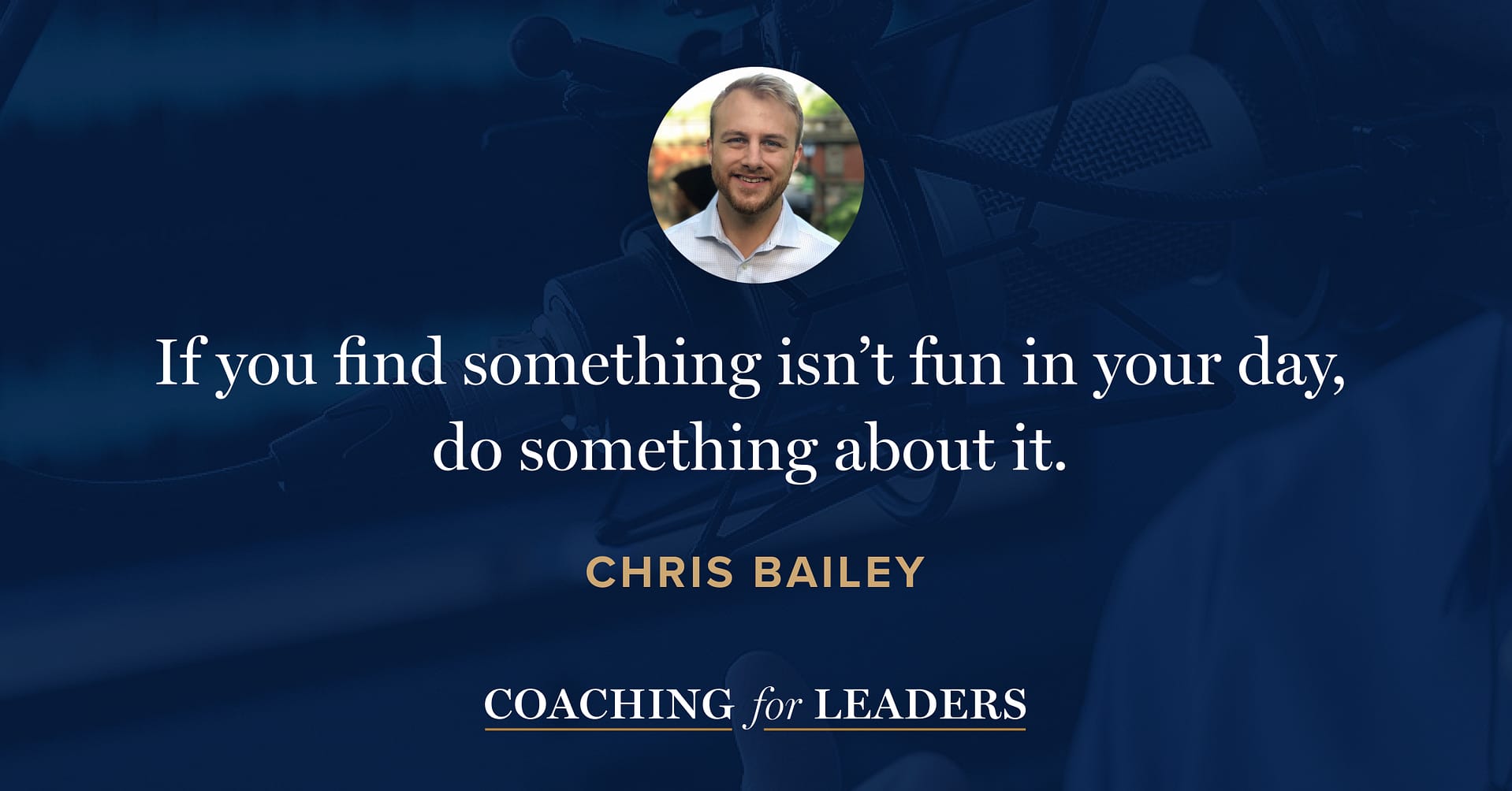
If you find something isn’t fun in your day, do something about it.
https://media.blubrry.com/coaching_for_leaders/content.blubrry.com/coaching_for_leaders/CFL793.mp3

Podcast: Download

Follow:
Apple PodcastsYouTube PodcastsSpotifyOvercastPocketcasts

Chris Bailey: Intentional

Chris Bailey is an author and lecturer who explores the science behind living a more productive and intentional life. He has written hundreds of articles on the subject and is the bestselling author of The Productivity Project, Hyperfocus, and How to Calm Your Mind. His newest book is Intentional: How to Finish What You Start (Amazon, Bookshop)*.

Starting is often a lot easier than finishing. Our mindsets and our tactics can make a big difference in how far we really go. In this conversation, Chris and I discuss the best ways to finish what we begin.

Key Points

  • Procrastination is triggered by six characteristics of aversion: boring, unpleasant, frustrating, far off in the future, unstructured, and/or meaningless.
  • The more we activate the logical centers in our brain, the less aversion we run into.
  • Almost everything can be more fun if we put the right structure around it. Gamification, countdown timers, and artificial deadlines can drive our behaviors in substantial ways.
  • Make goals about others. Rather than simply “reading 10 pages,” shift to “reading ten pages to be a better mentor.”
  • Most of us have a preference for either performance goals or learning goals. Identify which works better for you and for the people you lead.
  • Define a target pace and map your progress against it. We often do this with organizational projects, but rarely for our own goals.
  • Pair joyful tasks together with the ones that don’t bring joy as a means to keep you moving.

Resources Mentioned

  • Intentional: How to Finish What You Start by Chris Bailey (Amazon, Bookshop)*

Interview Notes

Download my interview notes in PDF format (free membership required).

Related Episodes

  • How to Become the Person You Want to Be, with James Clear (episode 376)
  • How to Change Your Behavior, with BJ Fogg (episode 507)
  • Make Your Task List Work for You, with Liane Davey (episode 785)

Discover More

Activate your free membership for full access to the entire library of interviews since 2011, searchable by topic. To accelerate your learning, uncover more inside Coaching for Leaders Plus.
How to Finish What You Start, with Chris Bailey

Download

Dave Stachowiak [00:00:00]:
Starting is often a lot easier than finishing. Our mindsets and our tactics can make a big difference in how far we really go. In this episode, the best ways to finish what we begin. This is Coaching for Leaders, Episode 793.

Dave Stachowiak [00:00:18]:
Production Credit: Produced by Innovate Learning, Maximizing Human Potential.

Dave Stachowiak [00:00:26]:
Greetings to you from Orange County, California. This is Coaching for Leaders, and I’m your host, Dave Stachowiak. Leaders aren’t born; they’re made. And this weekly show helps leaders thrive at key inflection points. The reality of leadership is that it is broad. What that means is, for a lot of us, is there’s always things we’re working on. There’s always things we’re trying to get better at. There are always things we’re trying to move on. Some of those things we get started on, and we’re super excited about, and we keep going. Indefinitely.

Dave Stachowiak [00:00:59]:
And there’s also a lot of things that, even though we know it’s good for us, even though we see the benefits, even though we’ve got the plan intellectually, once we start, it’s sometimes hard to keep going. Today, a conversation on how we can finish what we start by being a bit more intentional and using some really helpful tactics that are practical in a way that keeps us moving, not only for ourselves, but for our teams. I’m super excited to welcome Chris Bailey to the show. Chris is an author and lecturer who explores the science behind living a more productive and intentional life.

Dave Stachowiak [00:01:31]:
He has written hundreds of articles on the subject and is the bestselling author of The Productivity Project, Hyperfocus, and How to Calm Your Mind. His newest book is Intentional: How to Finish What You Start. Chris, a pleasure. Welcome to the show.

Chris Bailey [00:01:46]:
Dave, my Polish friend, how are you?

Dave Stachowiak [00:01:49]:
I am lovely. I am lovely.

Chris Bailey [00:01:51]:
My fellow Polish friend.

Dave Stachowiak [00:01:53]:
My fellow Polish friend.

Chris Bailey [00:01:54]:
Nice to chat with you.

Dave Stachowiak [00:01:55]:
Here we are. Yeah, nice to chat with you. I loved the book and, thinking about this, finishing what we start, because we are so good at starting things, aren’t we? Most of us. And yet it’s the finishing thing that we get in trouble with a lot, isn’t it?

Chris Bailey [00:02:12]:
It’s kind of like that saying that— and I find intentionality, honestly, one of the most beautiful topics in the world. I think it’s what makes us human on a lot of different levels. But then we have these sayings that the road to hell is paved with good intentions and stuff like that.

Dave Stachowiak [00:02:29]:
Yeah.

Chris Bailey [00:02:29]:
And so it makes you question really what gives. We have these intentions that, like you’re saying, we follow through with. And then we have the others that just, they get swept away because we’re in the fray of our daily life, or they’re ugly things that we just have to do that we kind of kick down the street like it’s a tin can to another day. And so, that becomes the art of productivity. It’s easy to accomplish things that we have a deadline for. Deadlines are an incredible way to add structure and a framework to the things that we want to accomplish. It’s easy to accomplish the things that we care about. There’s a lot of books on habits, too.

Chris Bailey [00:03:11]:
People don’t need help making habits like eating a chocolate bar every day or something or watching more TV, but they need habits for the ugly stuff, and intentionality can help us get there too.

Chris Bailey [00:03:24]:
It’s really this fascinating topic because intention is always what’s behind what we follow through with, but we don’t always follow through with every intention.

Dave Stachowiak [00:03:36]:
You write on this, the strength of an intention is a function of our desire minus our aversion. Every single task has an amount of both. Tell me more about that.

Chris Bailey [00:03:47]:
Well, they fluctuate over time too, don’t they? And it is an interesting thing, with every task, every project, every commitment that we have, there are these 2 ingredients that attract us to something and repel us away from that same thing, desire and aversion. So you think about any— in the book, I call it our timeline of goal attainment. So, across our timeline of goal attainment, for any goal that we want to achieve, our desire is often way higher at the beginning than it is closer to the end of us doing this. If you’re going on a trip to Spain and one of your lifelong ambitions has been to learn Spanish, and you’ve kicked it down the street to a later day constantly throughout your life. Probably right after you book the tickets, your desire is going to be through the roof, right?

Dave Stachowiak [00:04:39]:
Oh yeah.

Chris Bailey [00:04:39]:
When you set that goal again, when you set that resolution again, but then it fades, it tapers down into this aversion, which is just this ugly feeling that we have when it comes to doing certain tasks in our work, based on attributes that they can have. So it’s this interesting kind of calculus where it’s desire minus aversion that creates our overall will to want to do something at any moment over that timeline of a goal. But the desire is usually high right at the beginning, and then it just often plummets, like with the Spanish example.

Dave Stachowiak [00:05:16]:
Yeah. Yeah. I recall when BJ Fogg was on the show years ago, he had this this great point of that our, our, we overestimate our future motivation. Almost all of us, like we think, okay, I’m going to start on this. And I’m going to keep that motivation level high throughout the length of the goal, the task, whatever it is that we’re doing. And it’s just almost never true.

Chris Bailey [00:05:38]:
Yeah.

Dave Stachowiak [00:05:38]:
To your point that, getting comfortable with the reality that you’re going to start something and you’re going to be really excited about it for 4 days or a week or 2 or whatever it is. And there’s going to be that inevitable dip. And I think the key question is like, all right, when you get to that, what do you do? Right? Like, that’s really kind of the hack on this.

Chris Bailey [00:05:58]:
Yeah, exactly. I think you start by dissecting just why is something so aversive? So, and this was, this was the interesting thing in digging into the science behind just how aversion works and what is it even? So it’s this ugly feeling that we experience, but the fascinating thing to me is it’s possible to dissect it a little bit, somewhat, where there’s certain triggers that a task can have that make it more aversive to us. And every single one of us, our relationship is different for every single task, right? You might love doing your taxes. I don’t know you that intimately, Dave, but maybe you do. I don’t know.

Dave Stachowiak [00:06:39]:
Let’s say no.

Chris Bailey [00:06:39]:
Yeah. Well, some people get pleasure from pain, I suppose. But, you know, so we all relate differently, but there are certain triggers that a task can have that make us more averse to it and make it— make us more likely to procrastinate on it, which is when something’s boring. So using it, let’s carry on with the using our, uh, doing our taxes example. So it’s boring, right? The process is boring. The second trigger of the 6 is when something’s frustrating. So the process of doing is just tedious. It’s painful.

Chris Bailey [00:07:10]:
You know, we hit all these little blocks and stuff along the way. The third is whether it’s unpleasant. So whether we appraise a task to be unpleasant. Fourth is when something is far away in the future. So, yeah, I think a lot more people will agree to run a marathon 2 years from now versus 6 months from now, even though the training timeline might be comparable, 6 months ahead of time. Unstructured is one, you know, touched on it a little bit, but when there’s no clear path to doing something, that makes something far more aversive, which, and that’s a nice one when something’s unstructured, and we find we put it off because of that. It’s, it’s much easier to tinker with that one a little bit. And the last trigger is when something’s meaningless.

Chris Bailey [00:07:51]:
And so, that means it’s misaligned to what we value. So, yeah, there’s these 12 fundamental human values that we all have in different amounts, from self-direction to pleasure to security to universalism, protecting people and nature. And the more misaligned something is with what we actually deeply care about on that fundamental human level, the more likely we are to put it off. So boring, frustrating, unpleasant, far away, unstructured, and meaningless. Like our taxes, you can go down the list and see that most of these are true for them or bookkeeping. Pick your example, that closet that you need to clean up or reno in the basement, whatever. And you can cross-reference the things that you’re putting off in your life, in your work. The projects that are ugliest for you, and you’ll see that most of them have the— well, all of them, when you find them aversive on some level, have some combination of these 6 triggers in different amounts.

Dave Stachowiak [00:08:55]:
You write, “the more we activate the logical centers in our brain as we pursue our goals, the less aversive we find them, which makes us less likely to procrastinate on them”. And I was thinking about that in the context of what you just said, that there’s some really wonderful invitations you make on just the tactical ways to approach this. In the book, and you, you started hitting on a couple of them already. And I, I was thinking about that first, that first characteristic you mentioned, things that are boring. And there’s some really fun ways that we can actually reframe just how we’re thinking about- through gamification, through creating deadlines and timers and like all kinds of stuff. Tell me a little more. And like when you see people do that well and kind of trick themselves a little bit into making something way more interesting.

Chris Bailey [00:09:44]:
What does that look like? Yeah, well, I think so often our work isn’t fun enough. And this is— it seems like weird productivity advice to give, but if you find something isn’t fun in your day, do something about it. Can you, can you have— can you do some, some taxes or something over a glass of wine or 2 and double-check your work the next day? Could you go to a coffee shop and have a wonderful— well, my biggest thing is food, as you can probably tell. Could you put a dollar in a frivolous spending account for every minute you spend doing something that you find just so ugly, but that you’ve wanted to do for a long time?

Dave Stachowiak [00:10:31]:
Yeah.

Chris Bailey [00:10:31]:
Make it fun for yourself, whether it’s through a bribe or by making it more pleasurable in the moment. And it seems so simple, the advice. But I don’t think we invest in self-kindness enough with productivity. So we think, okay, doing our taxes is always this slog. And so I’m just going to have to get through it. But do you? Do they have to be a slog? Could you find some way to gamify it for yourself? So the boredom trigger I find really interesting. Just because you find something boring doesn’t mean that it has to be that way.

Dave Stachowiak [00:11:06]:
Yeah, there’s almost always a way to make something more interesting and fun. And as you were saying that, I was thinking, Bonni and I have been working on a little project with our kids this summer. We’re taking a trip toward the end of the summer, and both because we’re working on just some good goal-setting financial habits with the kids, but also, our budget’s a little tighter this year than it was in past years. We decided to- “hey, we’re going to save $1,000 toward this trip at the end of the summer”. And we set up a little tracking sheet in the kitchen, and there’s a little, there’s a little tile, like $25 increments of tiles. And we’ve gotten all of us involved, like, hey, if we choose to not go out for dinner, or if we choose to not go to the movies, or if we choose to do something that we would normally do, or the kids doing a project around the house that isn’t part of their normal responsibilities, like everyone can contribute to getting a tile on that board. And it has been really fun to see the dynamic change around the house just in the last few weeks of our son deciding, like, ” Hey, let’s actually— his idea— like, let’s not go see the movie we were planning to go see. Let’s stay home and stream it because it just came out on streaming”.

Dave Stachowiak [00:12:18]:
And let’s save that money and get a tile on our board. And it’s really interesting how, like, both of our kids have said, hey, this is actually pretty easy. Like, when you break it down… And it’s actually fun. And something that normally is just awful when you think about, like, oh, I’m trying to like budget better. That just does not sound fun to anyone. And yet, by framing it as a game and making it visual, it’s changed the dynamic of the conversation in our house. And it’s actually been really, really fun. And isn’t it interesting, just like how a small change like that- one, it’s a, Chris, it’s a silly 8.5 by 11 sheet that I had ChatGPT make and do the graphics on.

Chris Bailey [00:12:58]:
Love it.

Dave Stachowiak [00:12:58]:
It took 10 minutes, but how much that changed the dynamic of everything.

Chris Bailey [00:13:02]:
Yeah. And what that maps on top of the research too, where one of the best ways to make a goal less ugly, less aversive, is to make it about other people, involve other people too. So I’m sure if you just had your own spreadsheet or you and your wife had one, and you’re okay, how do we save, scrimp, and save? What do we cancel? What do we, what do we do here to get to the grand? That’s way less fun. That’s way less involved. That’s way less engaging than being with other people and doing a goal alongside other people. And that maps on top of the meaning component of it all too, where we talk about the 12 values. 6 of those 12 values are centered around other people.

Chris Bailey [00:13:44]:
And values are this driving— they sound like a mushy topic a lot of the time, I’m going to be honest with you, but there is research behind the values that we all share. And it shows that half of what motivates us, which is our values, involves other people.

Dave Stachowiak [00:13:59]:
Hmm.

Chris Bailey [00:13:59]:
They’re things like serving other people through benevolence, or universalism is one I mentioned, feeling secure with other people. Right? And so it becomes this beautiful expression of what truly motivates us, which is these values through our everyday actions when we make them about other people. So it’s a wonderful shortcut. And you— we chat about how procrastination is this purely emotional, visceral reaction to something that we don’t want to do. And so firing up the logical part of our brain can be a wonderful strategy. Yeah.

Dave Stachowiak [00:14:30]:
So on that, I think it’s really— it’s really interesting thinking about it being about others. And I think there was an example you talk about in the book of, a lot of times, we set a goal or habit of like, hey, I want to read more. I want to read 10 pages a day or whatever. And there’s a lot of folks in our community. In fact, a lot of the leaders who come into our academy say, “hey, I actually want to read and consume more information because I know there’s tons of material out there that I should be getting into. And I’ve got the stacks of books and all that”. And one, really, I think, neat example of this is just how you think about what you’re doing and making it about others. So, rather than just saying, hey, I want to read more, it’s, I want to read more because I want to be a better mentor.

Dave Stachowiak [00:15:14]:
I want to be a better leader for my employees. It’s not that you’re tactically changing what you’re doing. You’re still setting a goal to read, but you’re actually framing it around a value, around something that’s helpful for others. And there’s just something really powerful about framing it that way, isn’t there?

Chris Bailey [00:15:31]:
Oh yeah, it’s so true. And it’s interesting the extent to which the frame of a goal affects our motivation and our drive to follow through with something. So, I’m sure a lot of people listening to this are familiar with the whole growth mindset. Seeing these obstacles, these challenges as not really roadblocks and things that we need to get angry about, but almost things that can be teachers for us and that we can learn from. And that goes to the frustration component of procrastination, where one of the most helpful strategies for overcoming the frustration we have to certain things is seeing things as a learning goal rather than a performance goal. And so, to use the marathon example, the performance goal would be, okay, I want to run this marathon in this amount of time. Whereas a learning goal might be, okay, I want to learn about advanced running and pacing techniques so that I can lower my time overall. So, you know, one is a performance-based goal, which is, it’s this pass or fail essentially when it comes to a goal that we have. And the other is this learning goal where it’s okay, I want to devour everything I can about this topic so I can learn, and I can integrate those things into this goal that I’m pursuing.

Chris Bailey [00:16:52]:
And the interesting thing is the actions that you take under both goals, they might be basically the exact same. You might end up going into those pacing techniques with a performance goal anyway, but a learning goal, just like a growth mindset, it’s a growth mindset, kind of the opposite side of the same coin. It absorbs the frustration that we have to following through with certain things. So if you find that frustration is something that comes up with your list of things that you’re procrastinating on, that is something that can be incredibly helpful. And another tactic to pair that with is, is making a list of everything that you’re procrastinating on in your life, in your work. And so list every possible thing that you can think of. If there’s an email that’s like 3 weeks old at the bottom of your inbox that just makes you feel it makes you tense up, right? Email apnea is a real phenomenon. Sometimes our breathing changes when we just get exposed to certain messages from certain people.

Chris Bailey [00:17:59]:
But if you make a list of everything from that one email to that massive project that you keep putting off, or that difficult conversation that you want, you really ought to be having, or that basement closet that you want to clean, and then list the costs of putting these various things off. Because that’s the fascinating thing that we’re just chatting about. This procrastination phenomenon is purely emotional. It’s purely visceral. There’s no logic embedded within the phenomenon of procrastination whatsoever. It’s purely emotional. But by listing the costs of doing something and logically going through your work, your life to make this procrastination list, you actually fire up the logical part of your brain, which can overcome—

Chris Bailey [00:18:46]:
that emotional response in your brain. Because, when we consider putting something off, to go into the neuroscience on it a little bit, essentially the logical regions of our brain, the activation in them, go way down when we consider procrastinating, and the emotional regions go way up. And so they almost go to war with one another, and eventually one of them wins out. And this happens constantly, not just for the things that we’re procrastinating on, but for decisions that we’re making too.

Chris Bailey [00:19:16]:
So, it could be that ugly project that you don’t want to do. Procrastination and emotion and logic, they all, they go to war with one another, and eventually one side wins out. But it could be something as simple as somebody brings in that tray of donuts, and you have to have this internal battle of, okay, do I want one of these things? Do I give in to feel good? As another Canadian procrastination researcher, Tim Pychyl, puts it, he defines procrastination as giving in to feel good, actually.

Chris Bailey [00:19:48]:
You know, giving in with your logic, with your goals to feel good about something, which can be nice sometimes, but we all have goals that are short-term and long-term, right? Enjoying our life to, getting that fitness goal accomplished. But it’s interesting just the extent to which activating the logical centers of our mind can overpower the emotional centers. And an incredible way to do that is with that listing, the cost listing, the things that you’re putting off, and seeing the things to go to the frustration element, see them as things that you’re learning rather than performances that you have. It can really diffuse a lot of the pressure we have around some of these things on our list.

Dave Stachowiak [00:20:34]:
I’m thinking about the distinction you made between a learning goal and a performance goal. And I think there’s a real clear leadership aspect to this too, because you point out that a lot of us tend to have a preference one way or the other for just how we tend to approach things. And again, to your point, it’s not— a lot of times the actions are the same. It’s just how we’re framing it. And it’s interesting you brought up running as an example. I have a friend who we’ve run out 2 or 3 half marathons in the last few years. And for both of us, we tend to— we tend to frame it as like a learning goal, I think, if I’m understanding it correctly, in that we could, we could really care less about the event itself and how, or how fast we go.

Chris Bailey [00:21:18]:
Yeah.

Dave Stachowiak [00:21:18]:
The entire reason we’ll do it is, we’ll register for a half marathon 3- 4 months out. And the whole point of doing that is to keep active and keep running in that time leading up to the race. And in fact, we’ve both had times, I think, where we didn’t even go to the race the day of because that was not the point. Like, the point of doing it was, yeah, pay the registration fee, but to actually work toward the goal of having an event. And I think that that’s, in my mind, like, really helpful from thinking about this from a learning goal. But the reason I’m thinking about it from a leadership context is, if you’re working with peers, you’re working with your team, working with employees, if you have someone who’s like a performance goal person, great, like all in on that, right? But also, there are learning goal people too. And thinking about how you frame what you’re learning, what you’re doing, what you’re coaching on in that context could totally change how someone approaches that and really change their motivation level for it too.

Chris Bailey [00:22:18]:
Yeah. And that’s something that comes up again and again and again in productivity research is if you want people to be less connected outside of work hours, one of the best things you can do as a manager is send fewer emails yourself across those hours, because people look to you as this role model figure, and they look at the behaviors, the norms that essentially you’re setting for the group. So, if you’re a performance goal person, or if you’re a learning goal person, know that people will be coming at it from the other side. And if you have somebody who seems frustrated by something like that, that’s really the trigger that should— the tripwire, I would say even, to get you reflecting on, okay, why are they so frustrated by this thing that they’re trying to accomplish? And maybe they are seeing it as a performance goal because they’re in that kind of environment. They’re, you know, you’re probably leading a high-performing team, something along those lines. But what’s beautiful about this learning mindset, this growth mindset, is we view challenges that we face across this timeline of goal attainment as opportunities for growth, right? They’re opportunities to learn more about the thing that we’re endeavoring to accomplish rather than these threats to how well we end up performing. And so that’s the main reason. That’s the main reason from the research that the learning goals absorb the frustration of these things.

Chris Bailey [00:23:51]:
So if you’re a performance goal person, know that people will have an overall lower level of frustration with the work that they do. And because— with a learning goal, and because frustration has that procrastination connection and that aversion connection- people will feel better about the work that they do at the same time. And likely while performing at the same level, if not higher. Now, that said, there are some goals that are better suited to that performance goal, right? If you’re running- if you’ve trained for the marathon, then it’s time to run. Maybe that’s the point, you know, at the day of the run to set an intention that looks like a performance goal.

Dave Stachowiak [00:24:35]:
Oh yeah.

Chris Bailey [00:24:36]:
But before that, you want to absorb frustration. If you want to learn, if you want to feel better along the way, if you want something to be more fun, setting that learning goal can be really helpful.

Dave Stachowiak [00:24:47]:
Agreed. There’s 2 other tactics you talk about that I think are really nice and also things that are easy to do. And I think people have even heard some of them before, but it— and we’ve all done them before, but we don’t think, often, to do it in the things where we’re getting aversion around. And one of them is defining a target pace. Tell me about that.

Chris Bailey [00:25:07]:
Yeah, so this is kind of like— it reminds me a little bit of your printed paper for the trip savings goal because, whenever I write a book, and I’ve done this from the very first book through to book number 4. I don’t know if you count Audible Originals as a book, but let’s say 4.5 books. Let’s count that as half of a book.

Dave Stachowiak [00:25:26]:
Yeah.

Chris Bailey [00:25:27]:
I do this for every single essentially cumulative goal that I have because it’s wonderful. So essentially, you make a spreadsheet, and then you look at the timeline of the goal that you have, the deadline that you have to hand in your manuscript if you’re writing a book or whatever it is, a savings goal, if you have a savings goal that you’re accumulating over time. So you have a linear line on this sheet that you print off, and that’s your pace. So if you are writing a book over 52 weeks and the book is gonna be 52,000 words, the line will go up at a pace, a linear pace of 1,000 words a week.

Dave Stachowiak [00:26:06]:
Right.

Chris Bailey [00:26:06]:
And it’s quite nice because then you can chart your own rate of progress against that idealized pace of goal attainment. So, you think, okay, am I ahead of schedule? Can I do a bit more research into the book right now? Or am I behind schedule? So, I just need to clear my week or clear a day or two this week to hunker down on this big project. And it’s wonderful because a lot of the goals that are far off in the future trigger a version of procrastination. It’s tough to bring something closer to you in time sometimes. And there are ways of doing this. You can set milestone goals for along the way. You can have an accountability partner. So accountability is basically staring you in the face once, twice, a week, every day, even.

Chris Bailey [00:26:52]:
But this pace of goal attainment, if you have this high level of self-accountability, can be a wonderful strategy for actually charting that pace. And I remember writing my very first book; I was doing this. I was charting my progress relative to the pace. And I was in Ireland, and I broke my leg and needed reconstructive surgery on my leg in Ireland. I was held up in a hospital for a week or two. I had to fly back. It was actually, well, not, I won’t say nice, but it was nice that I got a free first-class ticket back home because I needed to keep my leg elevated. So that was, that was a nice part of the experience back then.

Dave Stachowiak [00:27:29]:
That’s a, that’s a very positive way to frame that.

Chris Bailey [00:27:31]:
I guess so, maybe I’m an optimist at heart. But I remember at the time with very little energy, but I looked at that sheet that I had, and I saw that I was so far ahead of schedule. I was a month or two ahead of schedule.

Dave Stachowiak [00:27:45]:
Hmm.

Chris Bailey [00:27:46]:
And seeing that just put me totally at ease. I could feel like all this weight evaporate off of my shoulders because I knew I was so far ahead. And so I could see that even though I was writing fewer words, especially in the hospital, I wasn’t writing in the hospital. But in the recovery period after that, I could still be on pace. And so, it’s this nice strategy to lower that level of negative self-talk too, which can often get in the way of productivity. It most definitely increases around procrastination, this negative self-talk, because we have more noise in our head about whether we should eat the donut or write the book.

Dave Stachowiak [00:28:28]:
Yeah. And thanks for sharing that example. And it’s so interesting how we almost always think to do that in our projects, in our teams, and organizations. So, like, we’ll set— we’ve got the Gantt charts and everything and the project plan, and we know exactly if we’re on track and how often we don’t ever do that for our own personal goals, habits, except very rarely do we think like, okay, I’ve got this thing I want to get better at. I’m going to work on it for the next 90 days. Let me actually spend—

Chris Bailey [00:28:56]:
Yeah.

Dave Stachowiak [00:28:57]:
5 minutes to make a chart, to make a little thing, whatever. Like, it doesn’t have to be anything fancy. It’s probably better if it’s not. It’s just something really simple. But boy, it can change motivation, like, in such a substantial way. It’s, it’s just really powerful.

Chris Bailey [00:29:12]:
Yeah, yeah, it is quite nice. And I, I do understand it on some level where, yeah, I love being productive at work. I love getting a lot accomplished throughout the day and stuff like that. But when I’m off the clock, I just want to do nothing.

Dave Stachowiak [00:29:25]:
Yeah.

Chris Bailey [00:29:25]:
I don’t want to, I don’t want to do much. And so, using productivity tactics like that in your home life, it’s often like, oh, isn’t that going to make it less fun? But you actually, it actually does make it more fun because you see that the low, the level of self-talk that you have goes down, especially around those ugly things that you’re putting off. Like, there’s always the things that we have to do. And this is where I think productivity comes in. I’m fundamentally, to use this podcast as a confessional, I suppose. I’m fundamentally a lazy person. So, my view for productivity advice is, it exists to allow us to accomplish the things that we have to do in a smaller amount of time, so we have more time to do whatever the heck we want to do throughout the day, throughout our lives. And so, there’s the stuff that we have to do in our home life that it’s the law called Parkinson’s Law in action, which says that our work tends to expand to fit how much time we have available for its completion.

Dave Stachowiak [00:30:26]:
Yep.

Chris Bailey [00:30:26]:
If you have to reno that basement closet and you’re going to do it on Saturday, and then Saturday the clock is ticking, you wake up, so I’ll do it a bit later. No worries. And then the afternoon comes, and then the level of negative self-talk goes up even more. And then you think, okay, then you delay it to Sunday. And that’s not a pleasant experience.

Dave Stachowiak [00:30:48]:
Yeah.

Chris Bailey [00:30:49]:
That’s not a pleasant experience. The more pleasant thing would be just get it done right away, obtain these characteristics of aversion, make it a bit more interesting for yourself, perhaps, maybe involve other people, whatever it might be, make it closer in the future. And then you can have time to relax and enjoy life. That’s why I think productivity exists for our home life. More meaning in that context, not only for more accomplishment.

Dave Stachowiak [00:31:17]:
Yeah, and more fun too.

Chris Bailey [00:31:19]:
Yeah, why not?

Dave Stachowiak [00:31:21]:
The last tactic I was thinking about that you talked about, I mean, it pairs right with that, is thinking about like the proverbial, like, all right, I gotta clean out the closet. Pair it with something fun. Like, put on your favorite music, put on your favorite podcast, get a family member to, like, do something fun with it. Like, think about what you could donate and what’s something here that would be really useful to someone. Like, there’s just so many ways that if you just put in one element of pairing something positive with something that’s like, we’ve got a big aversion to, it can just get you started. And if you get started, then it’s easy after that.

Chris Bailey [00:31:52]:
At least easier. It keeps going, yes.

Dave Stachowiak [00:31:54]:
Yeah. Okay, Chris, I think we’ve hit on 5 pages of the book. There’s so much in the book around intentionality. There’s so many wonderful invitations you have for us on just moving forward. You mentioned values and intention stacking. There’s, there’s, there’s wonderful models. So, I know a lot of folks in our listening audience are always thinking about how do I move a little bit better, a little bit more consistently. So this is a great way to get started on that.

Dave Stachowiak [00:32:18]:
And Chris, I’ve got one last question for you. As you have put together this book, this is your 4th one, you’ve done a ton of thinking on this, you’ve done a ton of research, you’ve helped people do this way better. What have you changed your mind on in the recent past, in just thinking about finishing things and being more productive?

Chris Bailey [00:32:34]:
Hmm, hmm, hmm. There’s so many things. I would say values is something I’ve changed my mind on. So, whenever I’ve heard the term values or anything like that, something similar to anything along those lines, my eyes have glazed over, and I’ve thought, okay, another consultant who has come up with their own list of 100 values that they give to everybody they consult with. And I became almost cynical about them. And so I got curious one day, writing a book about intention. Values can be considered our ultimate intentions across a lot of different levels. I got curious, you know, I’ll just go to Google Scholar and type in values. And I was blown away by the research behind them.

Chris Bailey [00:33:23]:
And especially Shalom Schwartz’s theory of human values, which says that there are 12 values every single person in the world has to some extent. So, and once you see the values, you start to see them everywhere. And by the way, if somebody wants to see them, you don’t have to buy the book. You can just Google Chris Bailey, 12 values, and I have a few articles about them. But you look at the tensions in the world, and you see behind the tensions, to how many of them are this conflict between self-direction and security, or self-direction and humility and power. And you see behind the motivations of other people.

Chris Bailey [00:34:08]:
And so I find that quite beautiful, to kind of peek behind the so-called matrix of human motivation to see the values that underlie them. And once you start seeing them in yourself and other people, you see them everywhere, in what other people are motivated to do by default and deliberately. And I think the world becomes a bit more easy to understand and in some ways, beautiful as well. So I’ve changed my mind on values. I used to think they were BS. Now I see them everywhere I go.

Dave Stachowiak [00:34:43]:
Chris Bailey is the author of Intentional: How to Finish What You Start. Chris, thank you so much for your work and your wisdom. Appreciate it.

Chris Bailey [00:34:50]:
Oh, thank you, Dave. Awesome to chat with you.

Dave Stachowiak [00:34:59]:
If this conversation was helpful for you, 3 other episodes I’d recommend. One of them is episode 376: How to Become the Person You Want to Be. James Clear was my guest on that episode, author of the bestselling book Atomic Habits. James and I talked about the importance of identity, bringing identity into the things we’re trying to get better at. Not just setting a goal and checking it off the list, but actually taking on a new identity. It’s an inspiration behind much of the work behind our commitments in our academy. Episode 376 for that. Also recommended episode 507: How to Change Your Behavior. BJ Fogg and I had a conversation about how to start small, the power of tiny steps, and being able to do that consistently in order to really make meaningful shifts.

Dave Stachowiak [00:35:46]:
Episode 507, some great inspiration from him. And then finally, speaking of how to finish what you start, having a better task list is a good starting point for that. And episode 785, the recent conversation with Liane Davey, is a great starting point for that: Make your task list work for you. Liane and I talked about not just having one task list, but actually dividing into 3 separate areas to be a lot more intentional about how you’re using your time, how you’re interacting with colleagues, and how you’re handling the administrative stuff that comes up every single day, and how we can get better at that just by taking a tiny tweak to the structure of most of our task lists. Episode 785 for that. All those episodes you can find on the coachingforleaders.com website, where, if you set up your free membership at coachingforleaders.com, you’ll be able to access the entire library by topic. One of the big topic areas we’ve had data-based for many years is productivity. Lots of conversations over the years on this topic and so many others.

Dave Stachowiak [00:36:46]:
Go ahead and set up your free membership at coachingforleaders.com. You’ll be able to access the entire episode library on that and dozens and dozens of other topics, plus access to my interview and book notes. I have written up notes for my conversation today with Chris on the things we talked about, some of the things we didn’t have a chance to talk about in the conversation, and also the highlights from his book that I found most helpful. I do that for almost every interview, make it available to you afterwards. It’s part of the access of your free membership is all those interview and book notes, plus tons of other resources inside the free membership. You can get access to all of it just by going over to coachingforleaders.com. Coaching for Leaders is edited by Andrew Kroeger. Next Monday, I’m glad to welcome Jia Jiang to the show.

Dave Stachowiak [00:37:29]:
We are going to be talking about how to build the resilience that you need to match the ambition you already have. It’s a great follow-up to this conversation. Join me for that wisdom from Jia. Have a great week, and see you back on Monday.

Topic Areas:Productivity
cover-art

Coaching for Leaders Podcast

This Monday show helps you discover leadership wisdom through insightful conversations. Independently produced weekly since 2011, Dave Stachowiak brings perspective from a thriving, global leadership academy of managers, executives, and business owners, plus more than 15 years of leadership at Dale Carnegie.

Listen Now OnApple Podcasts
  • More Options
    • YouTube Podcasts
    • Spotify
    • Overcast

Activate Your Free Membership Today

Access our entire library of Coaching for Leaders episodes from 2011, searchable by topic.
Listen to the exclusive Coaching for Leaders MemberCast with bonus content available only to members.
Start Dave’s free audio course, 10 Ways to Empower the People You Lead.
Download our weekly leadership guide, including podcast notes and advice from our expert guests.

... and much more inside the membership!

Activate Your Free Membership
IMAGE
Copyright © 2026 · Innovate Learning, LLC
  • Plus Membership
  • Academy
  • About
  • Contact
  • Dashboard
×

Log in

This site is protected by reCaptcha and the Google Privacy Policy and Terms of Service apply.
 
 
Forgot Password

Not yet a member?

Activate your free membership today.

Register For Free
×

Register for Free Membership

Access our entire library of Coaching for Leaders episodes from 2011, searchable by topic.
Listen to the exclusive Coaching for Leaders MemberCast with bonus content available only to members.
Start Dave’s free audio course, 10 Ways to Empower the People You Lead.
Download our weekly leadership guide, including podcast notes and advice from our expert guests.

... and much more inside the membership!

Price:
Free
First Name Required
Last Name Required
Invalid Username
Invalid Email
Invalid Password
Password Confirmation Doesn't Match
Password Strength  Password must be "Medium" or stronger
This site is protected by reCaptcha and the Google Privacy Policy and Terms of Service apply.
 
Loading... Please fix the errors above