• Skip to primary navigation
  • Skip to main content
  • Skip to primary sidebar

Coaching for Leaders

Leaders Aren't Born, They're Made

Login
  • Plus Membership
  • Academy
  • About
  • Contact
  • Dashboard
  • Login
Episode

781: Bonni and Dave Reflect on Recent Episodes

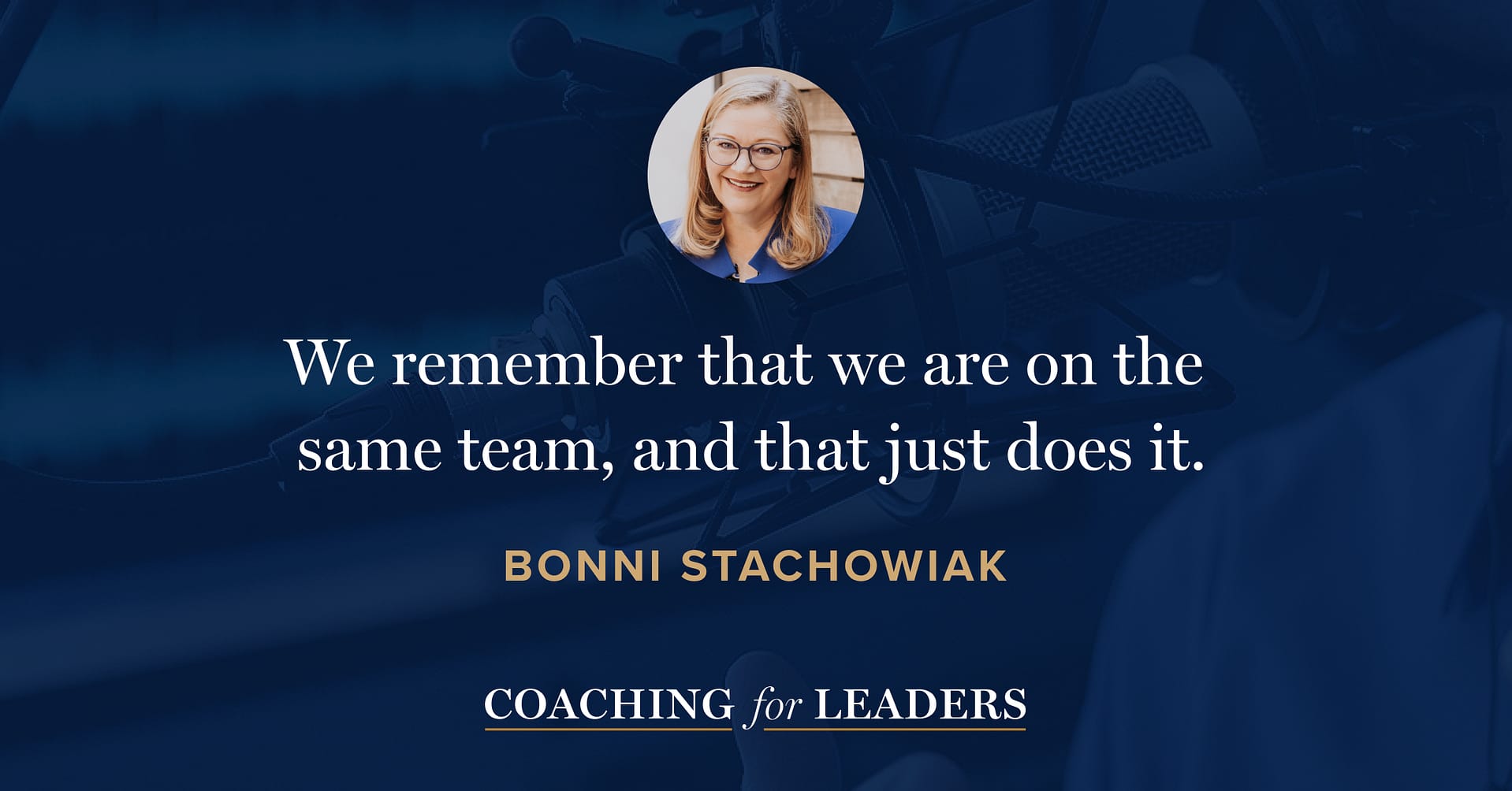
We remember that we are on the 
same team, and that just does it.
https://media.blubrry.com/coaching_for_leaders/content.blubrry.com/coaching_for_leaders/CFL781.mp3

Podcast: Download

Follow:
Apple PodcastsYouTube PodcastsSpotifyOvercastPocketcasts

Bonni Stachowiak: Teaching in Higher Ed

Bonni is the host of the Teaching in Higher Ed podcast, Dean of Teaching and Learning and Professor of Business and Management at Vanguard University, and my life partner. Prior to her academic career, she was a human resources consultant and executive officer for a publicly traded company. Bonni is the author of The Productive Online and Offline Professor: A Practical Guide (Amazon, Bookshop)*.

In this reflection episode, Bonni and I look back on recent past episodes and discuss questions, feedback, and insights that have surfaced from recent conversations.

Key Points

Dave responded to this question from Margaret Andrews:

  • What does success look like for you?

“You can have everything in life you want if you’ll just help enough other people get what they want.” -Zig Ziglar

“Success is the progressive realization of a worthy ideal.” -Earl Nightingale

Bonni responded to this question:

  • What feedback have you received over the years about how your actions and behaviors impact others?

Resources Mentioned

  • To be of use by Marge Piercy

Related Episodes

  • How to Get Way Better at Accepting Feedback, with Sheila Heen (episode 143)
  • Six Questions Every Leader Should Ask Themselves, with Margaret Andrews (episode 750)
  • How to Lead a Meaningful Cultural Shift, with David Hutchens (episode 755)

Discover More

Activate your free membership for full access to the entire library of interviews since 2011, searchable by topic. To accelerate your learning, uncover more inside Coaching for Leaders Plus.
Bonni and Dave Reflect on Recent Episodes

Download

Dave Stachowiak [00:00:00]:
Hey, we’re doing something a little differently today. Bonni’s joining me on this episode, and we’re reflecting back on some recent episodes to discuss questions, feedback, and insights that have come out of them. This is Coaching for Leaders, episode 781.

Dave Stachowiak [00:00:17]:
Production Credit: Produced by Innovate Learning, Maximizing Human Potential.

Dave Stachowiak [00:00:25]:
Greetings to you from Orange County, California. This is Coaching for Leaders, and I’m your host, Dave Stachowiak. Leaders aren’t born, they’re made, and this weekly show helps leaders thrive at key inflection points. Every so often, a couple times a year, Bonni and I get together and have a conversation about questions. Questions that have come in from you, our listeners, and responding to them in the best way we can. And we were thinking about this recently, it had been a bit of time since Bonni had been on the show. Hello, by the way. Welcome back.

Bonni Stachowiak [00:00:58]:
Hello. Thanks for having me.

Dave Stachowiak [00:01:00]:
Everyone always loves having you on and hearing your voice and your perspective, as do I, which is why I married you.

Bonni Stachowiak [00:01:09]:
That’s good, because we’ve been married a long time. So if you didn’t like having me around, that’d be trouble. Cause more than two decades at this point.

Dave Stachowiak [00:01:16]:
Yes, that would be trouble. We’re going strong. So everyone loves hearing from you. I was thinking about our Q&A episodes, and how helpful a lot of times people say your perspective is. And I was also thinking it’s also odd if you- the question that came in or that we featured wasn’t especially relevant to the person listening at the time. And anyway, we were talking about all kinds of different things we could do, and we’re trying something new today.

Dave Stachowiak [00:01:40]:
And so you all tell us what you think after you hear this episode, we would love to know. I’d love to know, especially is we’re going to actually take a step back and reflect on some of the recent episodes that we’ve aired in the last six months or so, and do a little bit of just pulling out some of the things that have come up we’ve reflected on, gotten some feedback on, and maybe do a little bit of a deeper dive on that. And so that’s where we’re going to go today. And we’d love to hear what you think of this once you hear from it. So, Bonni, let’s just jump in on our first topic. So one of the episodes that has come up a bunch, in my thinking, in the last several months, for a couple reasons, is episode 750, which aired back in the fall with Margaret Andrews.

Dave Stachowiak [00:02:29]:
And the episode was titled: Six Questions Every Leader Should Ask About Themselves. And the reason I’ve been thinking about it a lot, Bonni, is two big reasons. One is it was the most downloaded episode we’ve had over the last six months. So it clearly struck a nerve, either the title or the content, or probably a combination of both, and Margaret was fabulous. By the way, Margaret is the author of a book called Manage Yourself to Lead Others. It’s also a hugely popular professional development program at Harvard. And one of the we zeroed in on that episode was Six Questions for Self-Understanding.

Dave Stachowiak [00:03:03]:
And that’s the other reason that I’ve been thinking a lot about it, is because I’ve been thinking about her questions. And it’s come up in the context of a number of conversations that have happened since then with our members and listeners. And she articulated six questions that we talked about that episode, we’ll link to it at the end so you can get into the details if you want. I thought it would be really fun for us to each take one of these questions and respond to it. And so we’ve each picked a question, and I’ve picked the third question that she posed for us. And I think Bonni has picked the sixth question. So, I’m just going to start.

Dave Stachowiak [00:03:36]:
And so, there are six questions, we’re going to have them in the notes, but the third question that she invites us to consider in self-understanding, which is so important because she points out in her work that our differences are our features, not our flaws. And knowing ourselves well helps us to lead others better, and also, you know, leading ourselves. And so one of the questions that she invites us to reflect on is what does success look like for you? And if you heard that episode, you heard her talk about this question through the lens of both the professional and the personal. I thought about this first, Bonni, through the lens of professional, and I’m going to mostly zero in on that for thinking about responding to this, and maybe you’ll have some questions for me.

Dave Stachowiak [00:04:30]:
But I also have some thoughts on it personally, but I think we’ll get to that later on in the conversation, based on our last point. So I had, as I was thinking about this question, what does success look like for you? I’ve been thinking about it and reflecting on it the last few months since hearing that episode, and hearing her wisdom on it. And I think I have three, three things that have come up for me. The first one is a quote from Zig Ziglar from years ago that I heard him say on many of the talks of the tapes I used to listen to. And Zig had this great line. He said, you can have everything in life you want if you’ll just help enough other people get what they want. I’ve always loved that line, and I’ve really tried to focus, certainly my career and my professional work around it in every aspect that I can.

Dave Stachowiak [00:05:21]:
And the way that it comes up for me most joyfully on a regular basis, is in the episodes that we are on the podcast, and I really find so much joy in interviewing someone and getting into the depths of their work, as much as I can. Of finding something that I find in their work or their book or whatever they’re bringing in expertise and, and zeroing in on that, and getting as detailed on questions and some of the practical things as we possibly can and, and helping them shine in a conversation that really features their work well. And then to have them hopefully at the end of that conversation say, wow, that was really great! Like, we really had an in-depth, practical conversation. It was really great that we got into the depth of this. And then to if we do a good job of that, and especially if I do a good job of that, then weeks later when I hear the episode air of have people reflect that back to both of us to say, wow, that was really helpful, or I did something with this, or that perspective helped me to think about how I lead in my organization, or has brought joy into my work in some way. That is super, super joyful for me. And the other time that this comes up a lot is in working with our members, our academy members especially, and seeing them get to where they need to go, get what they need and want in their work and their organization, and to have a win come out of that.

Dave Stachowiak [00:06:52]:
And fortunately, I get to hear that a lot in my work. I get to hear that almost every day, either over email or verbally. And it really keeps me going, Bonni. It’s really, it’s really fun and really joyful. And I heard Zig Ziglar, no, not Zig, I heard Seth Godin talk about this, talk from Zig Zig- or talk about this quote from Zig Ziglar a while back, he’s apparently a fan of the quote too.

Dave Stachowiak [00:07:19]:
And he said it’s really nice if you can get to a place in your life where you sort of set the first part of that quote aside, where you can have everything in life you want if you’ll just help enough other people get what they want. And you can just think about, how do I help other people get what they want? And not worry so much about what you’re getting out of it, because if you do a good job with the second, the first one will take care of itself. And you and I both have a lot of privilege in our work and in our relationships, and where we live, and the education we’ve had. And I do still think about, like, what are the things I get? But I find that I think about that lesson less than I used to and it’s not top of mind for me very often. And I feel really grateful that a part of success for me is being able to just help people get where they want to go, and not have to worry too much about what that means for me, at least most of the time. So, yeah, that’s the first part.

Dave Stachowiak [00:08:16]:
I could say more, but I think maybe I’ll transition over to you, because you grabbed the last question she asked, which is what feedback have you received over the years about how your actions and behaviors impact others?

Bonni Stachowiak [00:08:30]:
I think a lot about feedback, and I’m going to share some reflections about feedback broadly, and then talk about fairly recent, in the last year, feedback that I got from the team that I lead. When it comes to getting feedback on our ideas, as leaders, we can be really effective if we help ourselves and we help other people, and separate ideas from the people. So, can we help create a culture and create norms where ideas can sit out there, they’re no longer attached to us, they’re not attached to our sense of worth, our sense of value. And can we create this psychological safety that lets us take ideas and be able to build upon them, and do so in a way that doesn’t unintentionally violate other people’s dignity? Because that’s, that can be tough. So if we model that as a leader, that can be helpful. But just to also recognize as leaders that, my gosh, that is very hard for many people to do, and is going to take some real strengths to be able to make that a norm, culturally speaking. And then when it comes to the results, if you’re going to have these kinds of helpful retrospectives, how did we do at achieving what we wanted to do in the first place? We’re going to need to get more effective at deciding in advance how we’re going to measure success, and then do that favor to our future selves, both as individuals and also as a team, to be able to know we’ll be able to look back effectively. Did we achieve what we had hoped to achieve? It is very easy to lose sight of why we we’re doing things in the first place, and then not get very effective feedback on ultimately what we were able to achieve. And then finally, when we think about the how, as we were traveling toward what we had aspired to do, this is where, I think, gets back to her question, back to Margaret’s questions.

Bonni Stachowiak [00:10:41]:
What feedback have I received over the years about how my actions and behaviors impact others? To me, this is really what I honed in on about the question. How have I been able to get feedback about- and I hate it’s such an overused cliche, but this idea of a journey. I mean that, you know, we’re, we are traveling together. We have come together, we have shared our ideas, our hopes, our dreams, our struggles, the challenges, and then we’re on our way. And as we are going, what role was I able to play in pursuing those things? And I was invited, at my university, to give a session on high-performing teams just under a year ago. And I remember feeling particularly vulnerable about it, because I thought, as much as I, Dave and I, if listeners don’t know this, we met in a teams class when we were earning our master’s degrees.

Dave Stachowiak [00:11:42]:
We did.

Bonni Stachowiak [00:11:43]:
I’ve always been a big fan of teams. I love that I met Dave in a team’s class, and very early in our relationship, as we fell in love and started to talk about what it would be like to have a life together, it was, I mean we still, today we still, I think that is one of the reasons we have a very, very long term, loving, trust based relationship is because we are on the same team. And that is kind of one of those things that we don’t easily lose sight of. Certainly, we’re human beings, so it can happen usually around something dumb, like how someone loads a dishwasher, the temperature, or whatever. But generally speaking, we remember that we are on the same team and that just, my gosh, that just does it. So in this, in this session, I was asked to lead. I felt, I didn’t really understand why I felt so much vulnerability because, teams, growing high-performing teams, is something I believe so wholeheartedly in. I am very well read in the topic, and I have been told many times I am very effective at leading high-performing teams, and part of the high-performing teams.

Bonni Stachowiak [00:12:52]:
For people who might wonder what I mean by that, I’m just going to share a few, a few thoughts around, if I say, what is a high-performing team? I’ve already mentioned trust and psychological safety, that is an important component to me. Clarity and a shared purpose, I sort of made some mention of that. Healthy conflict, healthy conflict, and decision making, ownership, and accountability. And I did talk about this one already, results and continuous improvement. And finally, serving and supporting one another.

Bonni Stachowiak [00:13:30]:
So to me, the last thing I’ll say about that, that session that I led, it felt vulnerable to do that, but I thought, you know, that maybe it would help someone to get to hear your reflections on this. And so I thought, well, I could create a very informal self-assessment of, you know, what, what you could go down it and say, you know, how effectively am I at doing these things? And then I asked my, the people who report to me, our leadership team, to give feedback to me. First, give feedback on our team, so how well do we, and I’ll just read a couple of these off, I feel safe admitting mistakes, uncertainty, or needing help on this team. So I asked the group of people, would we all, including me, would we all fill this out? Team members assume good intent and give each other the benefit of the doubt. We can disagree openly without it becoming personal or political. That’s just an example of some of these.

Bonni Stachowiak [00:14:31]:
It’s an informal instrument, it’s not like it’s published anywhere or anything like that. But then I ask them, when I draw from many of your past episodes of Coaching for Leaders, what is one thing? And I ask them to think about it in terms of a behavior that I do that contributes to the health of this high-performing team? What is one thing that I do that holds it back? And, last thing I’ll say about the question that I’m reflecting on, and also about what Margaret reflected, she had said that she believes that, and it was such an off-the-cuff. I mean, I don’t, I don’t, certainly, where I’m sitting here today, I’m feeling a little bit like I wanted to resist the idea that we take all feedback. And I thought like, I don’t know because Dave’s mentioning getting some hard feedback today that he will find to be helpful, and I got some hard feedback.

Bonni Stachowiak [00:15:31]:
We, we got the, we needed to sign, I needed to sign the new privacy policy for a podcast app. So I went up there, I don’t normally look at my reviews for my podcast, but instead I went up there and looked at the reviews, and there was a not nice, not helpful comment up there. And I thought, you know what? I’m having a really hard few weeks here. And I thought, I don’t want that swimming around in my head, I just don’t. So I texted my friend Carrie, and I said, “Carrie, I need your help”, cause it had to do with how I laugh.

Bonni Stachowiak [00:16:04]:
This person doesn’t like how I laugh. So they don’t want. They can’t really stand to listen anymore because they would, if they listened, then they would be forced to have to listen to me laugh. So I was like, you’ve told me before that you like my laugh, would you tell me that again, Carrie? Would you tell me again that you like my laugh? That, you know, that I’m good company? That’s part of who I am, I need to hear that today. Could you tell me that again? Because you have told me it before.

Bonni Stachowiak [00:16:29]:
I need to hear that today. So I guess, and I don’t think Margaret was not the context of that. I don’t think, Margaret, if she was here with us, I don’t think she would say, yes, we should all go read all of the comments on someone’s random thing. You know, and one of the things that Carrie had texted me back, she’s like, this person doesn’t deserve to give you feedback because they clearly haven’t been listening for as long to get the richness of who you are, what you have done for this community of people over all of these years. Like, that’s kind of this, like, who do we allow to give us feedback? And to what extent might that be edifying for us? And I think probably if all three of us were talking, including Margaret today, and maybe we’ll add Carrie into the mix too, all four of us are talking, that that would be an important conversation to, in terms of knowing ourselves, how might we be molded by the feedback that we get?

Bonni Stachowiak [00:17:28]:
And I just knew that I didn’t want to, this particular day, at this particular season of my life, I did not want to allow that person to live rent-free to the extent that I’m going to be able to. I really wanted to shake, I wanted to carve out, I wanted to be reminded by somebody who knows me well, but who didn’t always know me well, but who could, who has celebrated that part of me before. And to be able to ask for what I needed and what I wanted today. And it was a healing balm to my soul. And I am grateful that we have friends like that, who know us and who we can reach out, and just be “Hey, I need some help here.

Bonni Stachowiak [00:18:07]:
I need some help”. And she already knew I was having a very difficult time. So it’s gonna help me here. Can you help me here? So, yeah.

Dave Stachowiak [00:18:14]:
Cool. For the record, I really like your laugh. So you got another fan here.

Bonni Stachowiak [00:18:19]:
Yeah, I’ve been trying on this. I will admit. I will admit, I’m a human being. I am a human being. So I have consciously been trying not to laugh. And then I’m just like, come on, man, you know, we don’t got that kind of time. We don’t got that kind of time in life.

Dave Stachowiak [00:18:35]:
Just to quote Anne Lamont.

Bonni Stachowiak [00:18:36]:
To quote Anne Lamont.

Dave Stachowiak [00:18:37]:
I don’t have that kind of time. Yeah. Okay, thanks. Thanks for sharing this. I was thinking about what you said about, I’ll put this in the notes for everyone. We did a beautiful episode with Sheila Heen years ago, called “Thanks for the feedback”. And she has a whole book on, like, we all get feedback.

Dave Stachowiak [00:18:53]:
Some of it’s helpful, some of it, like, we should completely ignore. And then there’s like a whole bunch of stuff in between. And I really like the way that she… She’s the author, one of the authors, original authors of Difficult Conversations by the way. She’s just a wonderful way of, like, parsing through that and thinking about- we talk so much in leadership about how to give people feedback, and we almost never say anything about how to receive feedback. And she just did a beautiful job of articulating that.

Bonni Stachowiak [00:19:17]:
I loved that episode. And such a wonderful series of books, not just one book.

Dave Stachowiak [00:19:21]:
Oh, yeah, yeah. Her work, her team, amazing. Speaking of feedback, I had another thing that came up listening to- I listened to, someone asked me recently, ” Do you listen to all the episodes?” And I actually didn’t early on, years ago, Bonni. And then you told me, I don’t know, eight or nine years ago, when you started a podcast, like, oh, I listen to every episode because I should.

Dave Stachowiak [00:19:46]:
I want to hear, like, what I said, and like, speaking of feedback, like, learn from what I could do differently and better and all that. And I thought, wow, that’s a really good idea. And ever since then, I’ve listened to every episode, which, going back 10, 11, 12 years. And I was listening to the episode that David Hutchins and I aired together, episode 755, on how to lead a meaningful cultural shift. David is our resident storytelling expert, he’s amazing, I’ve known him for years. Every time he comes on the show, I just love talking to him.

Dave Stachowiak [00:20:14]:
So many of you reach out and tell me how much you appreciate David’s work and all his storytelling resources. And on that episode, he was telling a story about Garry Ridge, who was the former CEO of WD-40, just an unbelievably respected leader, done some amazing things, has written a book, and he told the story about, he was making the point about, leaders go first, like leaders should take the first step in demonstrating all kinds of things. And I fully agree with that. And he told the story about how apparently Garry had, at one point, when he was CEO of WD-40, had done a 360 where he collected all the feedback, all the things people said about him that were nice, but all the things that people said that were critical, and sent it out to the entire company for people to be able to read it. And he was really working on starting a conversation around transparency and culture and sharing feedback and all that, which was awesome. And I’m so glad he mentioned that, because it was a great example of the point he was making about leaders going first. And I listened to that, and I thought right after that episode aired, ooh, I hope most people don’t think to do that.

Dave Stachowiak [00:21:23]:
And the reason that I had that thought was, I think what Garry did was great as CEO, and like sending that out. I think most leaders should be pretty careful, pretty careful about doing something like that. And I have had a whole bunch of times over the years, Bonni, where either we’ve done something in our academy or I’ve been supporting a leader who got an assessment and got one of Those like huge 360s or big reports, or it was like 75 page report, and they came to me or us and said, hey, should I send this out to my team? Should I send this out to people in the organization? And it’s very, I love the intention behind that of like, oh, I want to be transparent. I want people to see the full version of me, and see the struggles, and see the critical things, so that they see that I’m willing to learn and grow and get feedback and all those things. And I think if you’re the CEO and you’re someone like Garry Ridge, and you’re trying and you’re doing that… If you’re the top person and you have the, and it’s safe for you to do that, which I think if you’re the CEO it is, most of the time, as a cultural opportunity to set the culture in tone, I think it’s, that’s a great thing to do.

Dave Stachowiak [00:22:34]:
I think for the average senior director in most large organizations, I would be really careful about doing that. And the reason is, is because it’s so easy when you send out something that’s just got so much data and information in it, for someone to zero in on one thing. On page 74, one quote that may or may not be true about you, speaking of feedback, Bonni, and, like, what’s valuable and what’s not. Like, how easy it would be for anyone on the internet to pull up, like, all the reviews of you and I and our podcast, and we send out that whole documentation to everyone, and someone, like, cherry pick one thing that was said of, like, oh, someone said this, and then all of a sudden start to build a narrative around that. And I just have seen that happen so many times in organizations where someone, like, sends out something really well-intended, and then someone pulls something around that, and then starts to create a narrative that’s really not helpful. And it doesn’t reflect who you are, it doesn’t reflect which message you wanted to send out.

Dave Stachowiak [00:23:34]:
So the reason I’m bringing this up is, I think the intention of sharing feedback and letting people know what you’re working on is wonderful, I encourage people to do that all the time. I encourage our academy members to do it all the time. I would curate it a bit, though, especially if you’re sending it out in an organization where there may not be a lot of psychological safety, and if there isn’t, you might even be hesitant about doing that at all. But I think you also shape a bit of that narrative. Yes, mention the things you’re not doing well, but also mention those things that you think are valuable feedback, and that you’re planning to move on. And the things that are well, mentioning those things and highlighting those, and I also think making that much more concise for people.

Dave Stachowiak [00:24:12]:
Don’t make people do the work to figure out what are the things they should pay attention to you. As a leader, if you’re going to be sending out feedback that you’ve received, make it easy for people to decide what are the positive things, what are the things that you’re working on and you’re going to demonstrate, and you’ve also committed to do. And I think if you put a little bit of thought and effort behind that, I think that goes so much more, so much more effectively for you.

Bonni Stachowiak [00:24:37]:
I was going to mention back to the feedback that I had received through that very informal instrument. The thing that I found particularly helpful was very zeroed in. What is one thing, one behavior that I do that contributes? What is one thing, one behavior that I do that holds us back? And specifically, in terms of what is one behavior that holds us back? Something that I appreciated about the feedback is that there was a lot of nuance around, a lack of clarity around roles, but it very quickly went to where there have been lots of changes. I mean, gosh, over years, when I think back to how much massive change has gone on, it was really helpful to me, because I’ll tend to put too much on myself. Like, I would want there not to be a lack of clarity about people’s roles, but it was so nice to read in there.

Bonni Stachowiak [00:25:34]:
Sometimes we did, because that was one of the questions, by the way. There was a question around roles and expectations are clear; we know who is doing what. And that was the one that had- they all, by the way, had very nice scores. Yay! I win the prize, I guess.

Bonni Stachowiak [00:25:49]:
But the- this was the one that still had a high score, but was not as high as the other ones. But they wrote on there what, because I asked for behavioral input, they can’t think of how any leader would have not had, you know, not a perfect score on that, because just such a massive amount of change. And if you read about and learn about organizational change, you actually need to be good at setting up these temporary systems to navigate the ambiguity. And they celebrated that about me.

Bonni Stachowiak [00:26:22]:
I wanted to also echo what you said, Dave, just about- I was trying to think while you were sharing your input, I can’t imagine why it would ever be helpful for anyone to send out an entire thing. Because like you said, it’s just too much. There’s too much to take in.

Dave Stachowiak [00:26:36]:
Yeah.

Bonni Stachowiak [00:26:36]:
And unless you’re working with people that are really good, most 360s, it is too much. Because it’s, I mean, it’s so broad. And unless your organization is committed to those things that it’s measuring for years and years and years across the entire organization, I mean, that can be a lot. So that’s just something to be really, really careful about- But yeah, not asking people to do the work, but also not asking yourself to do the work, it’s too much. It gets confusing when you get that much feedback, and you don’t know how to translate that into action, into specific concrete things that you can begin to mold, and become patterns for yourself. I mean, goodness gracious. Yeah, I’m glad you brought that up.

Dave Stachowiak [00:27:13]:
Yeah. And if you don’t shape the story, a story will be told about you that someone else will shape. And I think someone else still may, still may shape the story. But if you lead with the story, if you, rather than just sending out a bunch of data, and kind of hoping people pick whatever is going to be relevant, I think you shape the narrative. If you’re sending out feedback, here’s what I’ve found, here’s what I heard that I’m good at. Here are the two or three things that I heard that aren’t working.

Dave Stachowiak [00:27:37]:
There may be fourteen, but here’s the two or three that I heard, and here’s the two or three I’m going to move on to make some shift on. I think you’re doing so much better than the average leader, and if you do that, huge, huge. Okay, the final reflection point. I met a group of our members, our academy members, and graduates in Boston not long ago, Bonni, earlier this year. And we had a wonderful conversation, and we were talking about crossroads, and the crossroads that people were at. And one of the folks in the room, just someone I just love dearly, and has just been an extraordinary leader in our community over the years. He said, “I’ve had a really tough time the last year or so with just leadership in our organization”. And clearly a bunch had happened, where he has become very disillusioned, understandably, given what’s happened, or politics, restructuring stuff.

Dave Stachowiak [00:28:28]:
He’s like, “I’ve become very disillusioned with this word leadership”. And I was thinking about what you texted Carrie. He said, I just need people to tell me tonight that like something broader with leadership, beyond just like the corporate whatever stuff that we often think about leadership. I just need to hear like something a little bit more like bigger about leadership, other than just like restructuring, and budgets, and all that stuff. And as I reflect on the conversation we had that evening, I wasn’t a part of all the smaller conversations that happened. I was thinking, I don’t know if we really answered his question. Like, some of us did, but I don’t know if we ever did. And so I’ve been thinking about that question for the last few weeks. And I had a bigger picture thought about leadership.

Dave Stachowiak [00:29:11]:
And my bigger picture thought is the thing that I think about a lot is, parenting, and our kids, around leadership. And there was, when Obama was elected back in 2008, there was tons of crises going on. There was like bird flu, there was the financial crisis. There was like eight or nine things that when he took office were like these massive, huge front-page news stories of like, all this chaos going on in the world. And I remember hearing an interview that he, someone, one of the major networks sat down with him and did an interview, and the question was asked of him, something to the effect of, ” Where do you entertain the most doubt?” And he did not hesitate in his answer at all. He said, “I entertain the most doubt of being a dad right now, and like trying to think of like, how to support my girls and all this stuff”. And he went on and talked about being a dad and doubt. And I remember hearing that interview and just being so irritated with him at the time, of thinking, you have all this stuff that, like, we as a public just elected you to handle.

Dave Stachowiak [00:30:18]:
And the places you’re entertaining doubt is parenting, that’s the thing that comes up. And now, all these years later, Bonni, having now become a parent, I think how true that answer is for me. I’ve come 180 degrees on it, of thinking now as a parent, as a father. There are a lot of places I entertain doubt on things, but the place that I probably entertain the most is, as a parent and trying to decide, like, what’s the right, where do I intervene? Where do I step back? Screen time things… But I was just thinking, like, when I think about leadership, and when I really, like, think about how do I do a better job, and how do I take the things that I learn on the show, and try to get better, oftentimes the first place I’m thinking about it is with our kids and, like, how do I do a better job of showing up as a parent? Well, and I don’t know if there’s an answer in there anywhere, but that’s just what was coming on my mind, of thinking about the broader, like, what really matters with leadership? Yeah, there’s all the business, corporate, organizational, nonprofit things that we all think about with leadership.

Dave Stachowiak [00:31:20]:
But I think at the end of the day, for me, it comes down to family. Then how do I show up there or not? And that’s the hardest part.

Bonni Stachowiak [00:31:26]:
I loved this question. I loved that it didn’t have an easy resolution, because I don’t think that that’s possible. I’ve been thinking a lot about death because I’ve been spending time in hospitals, or shall I say, a hospital. And it’s weird to record an episode like this because they’re always recording.

Dave Stachowiak [00:31:46]:
Not because of your health, just to be clear. So people know, like, you’re fine.

Bonni Stachowiak [00:31:50]:
Yes.

Dave Stachowiak [00:31:50]:
Some extended family stuff going on.

Bonni Stachowiak [00:31:52]:
Yes. But it’s weird to record it nevertheless, because despite the news that we are all someday going to pass away, it’s just not knowing what this will… What life will look like when this airs. But I just wanted to share that context, that in addition to that, there’s also been some coming changes at my organization.

Bonni Stachowiak [00:32:14]:
So I have been thinking about this, not just every day, but almost every moment of every day. And something that keeps rising up for me comes from a poem by Marge Piercy, it’s called “To be of use”. And as soon as I read Dave’s reflections on this question, or series of questions, I thought, part of why I also wrestle with words like corporate and leadership when it’s, you know, used in certain- and scaling and efficiency, and all the things,

Dave Stachowiak [00:32:47]:
10x baby, 10x!

Bonni Stachowiak [00:32:52]:
Some aspects of artificial intelligence. It depends what, you know, aspect of it we’re talking about. But yeah, 10x I think because, because it just comes down to like, what difference does it make? So that this contrast keeps coming up in my own mind as I think about my own purpose is, to not be used, to not be used up, but to be of use.

Bonni Stachowiak [00:33:14]:
And you know, I’m just thinking about the trips to the hospital and like, seeing the volunteers that are there. I’m very intrigued by, by the way, I don’t, fortunately, I haven’t had a lot of experience in hospitals, so it feels very new to me. And just, I’m very curious about, what leads a person to volunteer at a hospital. What I’m so curious- Every person that I would see, I would be thinking, I wonder what brought you here. And then even the security guards were so kind and helpful and things… So anyway, I just wanted to read a little bit.

Bonni Stachowiak [00:33:45]:
I’m not going to read the whole thing, but Dave is going to put it in the show notes. I would encourage you to go and read. This is To Be of Use, by Marge Piercy. She writes: The people I love best jump into work headfirst, without dallying in the shallows, and swim off with sure strokes almost out of sight. They seem to become natives of that element, the black sleek heads of seals bouncing like half-submerged balls. And it just reminded me, kind of, the other thing that’s been resonating with me a lot, Dave, is just, I live in the future. That is a great strength of mine.

Bonni Stachowiak [00:34:25]:
It’s not particularly helpful at this exact moment, with this exact situation. So practicing this is what is needed in this moment. This is what is needed in this moment. And that just, that first part of, the people I love best jump into the work headfirst, I loved that. And as I go a little bit later, she writes, “I want to be with people who submerge into the task, who go into the fields to harvest and work in a row, and pass the bags along. Who are not parlor generals, and field deserters, but move in a common rhythm”. And what I love about this part is just the idea that we’re not, we’re not designed to do it alone.

Bonni Stachowiak [00:35:13]:
Sometimes we do it alone, and we think we’re alone, and we can convince ourselves that we’re absolutely alone, and how lonely that feels. But I love just this rhythm of idea that we can be in solidarity with others, and working toward the common good. I just find this imagery so beautiful, and I’ll read the last little bit here of her words: The work of the world is common as mud, botched, it smears the hands, crumbles to dust, but the thing worth doing well done has a shape that satisfies clean and evident Greek amorphous for wine or oil. Hopi vases that held corn are put in museums, but you know they were meant to be used. The pitcher cries for water to carry, and a person for work that is real. So I will say to this person who is wrestling with words like corporate, and leadership, and 360s that are not done well, etcetera, etcetera, I will say to you, that’s the human yearning for work that is real.

Dave Stachowiak [00:36:35]:
Three past episodes came up directly in our conference conversation. One of them is episode 143: How to get way better at accepting feedback. We talked about Sheila Heen’s wisdom on that, and of course, the perspective that, oftentimes we learn how to give feedback, we don’t often think much or have done a lot of practice on how to receive feedback. Episode 143 is a step by step how to think about it for all of us. Also recommended episode 750: 6 questions every leader should ask themselves. Margaret Andrews was my guest on that episode. Bonni and I responded to two of those questions, four more, a very insightful conversation from her, and a great starting point for thinking about how to lead more effectively.

Dave Stachowiak [00:37:18]:
And of course, leadership starts with us first being able to lead ourselves. Well, episode 750 for that. And then I mentioned the episode with David Hutchins: How to lead a meaningful cultural shift. Episode 755, that’s when he mentioned the story from Garry Ridge. So many wonderful concepts from that conversation. And David, an expert in storytelling, also, one of our expert partners here at Coaching for Leaders. And if your organization is looking at making a cultural shift, or thinking about how to communicate differently in the season ahead, David and his team, an extraordinary resource for doing that.

Dave Stachowiak [00:37:56]:
So many of you in our community have reached out to him over the years and have brought him in to do so much great work with your teams. If getting better at storytelling, messaging, making those shifts is important Now, Episode 755, a great start, and of course feel free to reach out to David directly. All of those conversations you can find on the coachingforleaders.com website. And I’d love to have you hop on and let us know what you thought of this conversation today. You can hit the contact button, and should we keep doing reflection conversations like this? Also, you might receive my Focus 5 mailer each week. You can hit reply on that and let me know. And if you don’t receive it, the best way to get access to it is by going over to coachingforleaders.com, setting up your free membership, because it’s going to give you the ability to search all of our past episodes by topic, including the ones I mentioned. And you’ll also begin receiving the Focus 5 message each week. Every single week, I am finding five things, five topics on a theme that I think will be helpful to you in how you’re learning and growing, and leading effectively. Every week that comes to you on email.

Dave Stachowiak [00:39:01]:
The best way to get access to it is just setting up your free membership at coachingforleaders.com. Coaching for Leaders is edited by Andrew Kroeger. Next Monday, I am glad to welcome Gustavo Razzetti back to the show. We are going to be talking about how to help a team get unstuck, something all of us need to do in our leadership roles. Join me for that conversation with Gustavo. See you next week. Take care.

Topic Areas:BonniReflection
cover-art

Coaching for Leaders Podcast

This Monday show helps you discover leadership wisdom through insightful conversations. Independently produced weekly since 2011, Dave Stachowiak brings perspective from a thriving, global leadership academy of managers, executives, and business owners, plus more than 15 years of leadership at Dale Carnegie.

Listen Now OnApple Podcasts
  • More Options
    • YouTube Podcasts
    • Spotify
    • Overcast

Activate Your Free Membership Today

Access our entire library of Coaching for Leaders episodes from 2011, searchable by topic.
Listen to the exclusive Coaching for Leaders MemberCast with bonus content available only to members.
Start Dave’s free audio course, 10 Ways to Empower the People You Lead.
Download our weekly leadership guide, including podcast notes and advice from our expert guests.

... and much more inside the membership!

Activate Your Free Membership
IMAGE
Copyright © 2026 · Innovate Learning, LLC
  • Plus Membership
  • Academy
  • About
  • Contact
  • Dashboard
×

Log in

This site is protected by reCaptcha and the Google Privacy Policy and Terms of Service apply.
 
 
Forgot Password

Not yet a member?

Activate your free membership today.

Register For Free
×

Register for Free Membership

Access our entire library of Coaching for Leaders episodes from 2011, searchable by topic.
Listen to the exclusive Coaching for Leaders MemberCast with bonus content available only to members.
Start Dave’s free audio course, 10 Ways to Empower the People You Lead.
Download our weekly leadership guide, including podcast notes and advice from our expert guests.

... and much more inside the membership!

Price:
Free
First Name Required
Last Name Required
Invalid Username
Invalid Email
Invalid Password
Password Confirmation Doesn't Match
Password Strength  Password must be "Medium" or stronger
This site is protected by reCaptcha and the Google Privacy Policy and Terms of Service apply.
 
Loading... Please fix the errors above