• Skip to primary navigation
  • Skip to main content
  • Skip to primary sidebar

Coaching for Leaders

Leaders Aren't Born, They're Made

Login
  • Plus Membership
  • Academy
  • About
  • Contact
  • Dashboard
  • Login
Episode

774: What Innovative Leaders Do Different, with Linda Hill

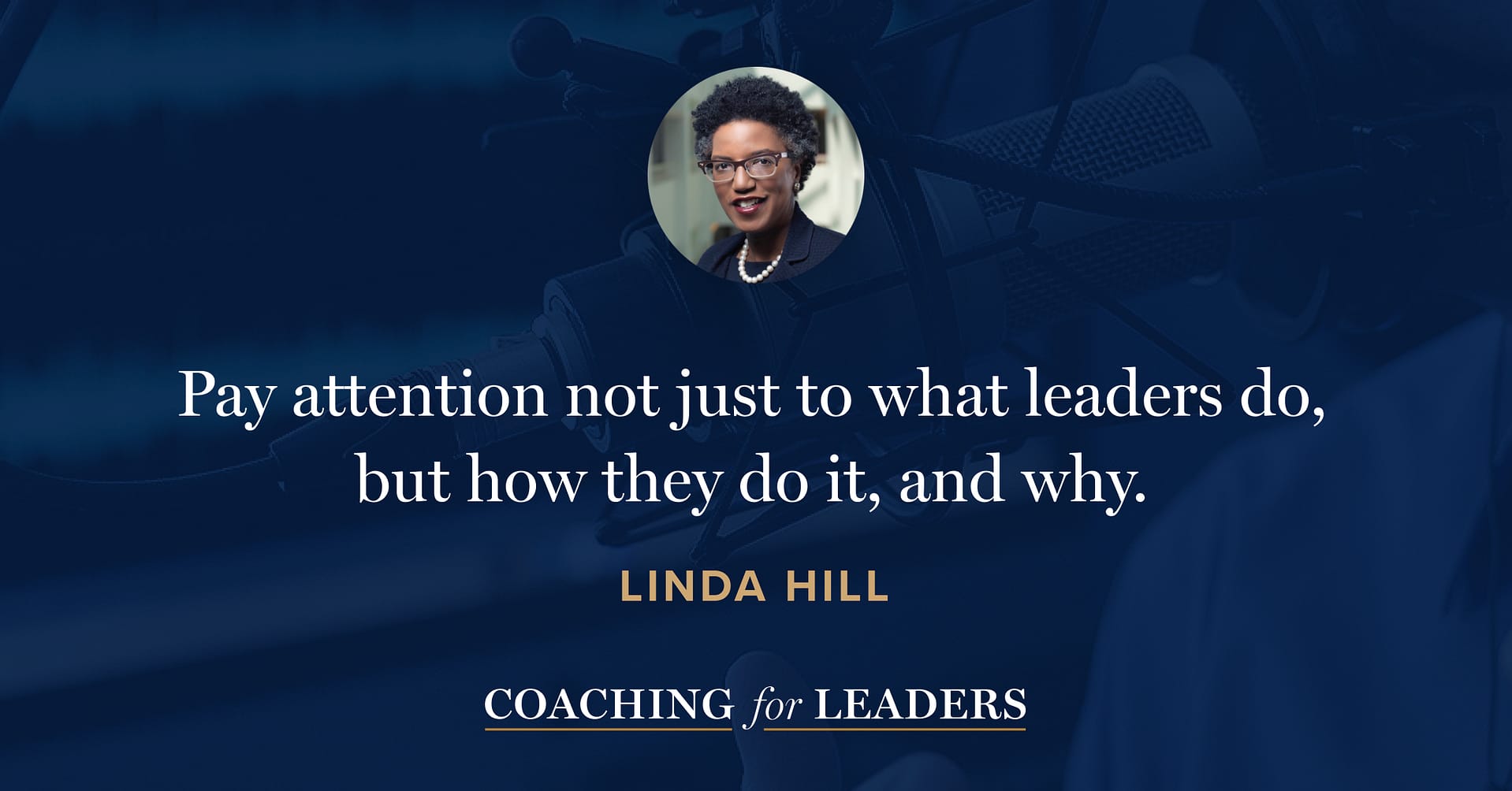
Pay attention not just to what leaders do, but how they do it, and why.
https://media.blubrry.com/coaching_for_leaders/content.blubrry.com/coaching_for_leaders/CFL774.mp3

Podcast: Download

Follow:
Apple PodcastsYouTube PodcastsSpotifyOvercastPocketcasts

Linda Hill: Genius at Scale

Linda Hill is the Wallace Brett Donham Professor of Business Administration and Faculty Chair of the Leadership Initiative at Harvard Business School. Globally recognized as a top leadership and innovation expert, Linda has been named by Thinkers50 as one of the world’s top five management thinkers. She is the co-author, along with Emily Tedards and Jason Wild, of Genius at Scale: How Great Leaders Drive Innovation (Amazon, Bookshop)*

We all want to think of ourselves as innovative, but it’s often not easy to know exactly what that means in practice. In this conversation, Linda and I explore what her research shows that leaders do to drive innovation successfully – and how each of us can get just a bit better.

Key Points

  • Rather than coming up with a vision and asking people to follow it, innovation is about creating the culture and capabilities to create the future together.
  • Innovation leadership shows up in three ways within organizations: the Architects, the Bridge Builders, and the Catalysts.
  • Instead of setting the stage for themselves, innovative leaders set the stage for others.
  • Often, we view horizontal relationships through the lens of organizational politics. The most effective innovation leaders view these relationships as leadership opportunities.
  • Traditional team structures are a starting point, but not an ending point. Leaders at Mastercard, Pfizer, and Cleveland Clinic all brought in team members from both inside and outside the organization.
  • Rather than thinking about a decision as final, it’s helpful for innovation leaders to frame it as a “working hypothesis.”

Resources Mentioned

  • Genius at Scale: How Great Leaders Drive Innovation by Linda Hill, Emily Tedards, and Jason Wild (Amazon, Bookshop)*

Interview Notes

Download my interview notes in PDF format (free membership required).

Related Episodes

  • How to Build an Invincible Company, with Alex Osterwalder (episode 470)
  • The Way Innovators Get Traction, with Tendayi Viki (episode 512)
  • Doing Better Than Zero-Sum Thinking, with Renée Mauborgne (episode 641)

Discover More

Activate your free membership for full access to the entire library of interviews since 2011, searchable by topic. To accelerate your learning, uncover more inside Coaching for Leaders Plus.
What Innovative Leaders Do Different, with Linda Hill

Download

Dave Stachowiak [00:00:00]:
We all want to think of ourselves as innovative, but it’s often not easy to know exactly what that means in practice. In this episode, what leaders do to drive innovation successfully, and how each of us can get just a bit better. This is Coaching for Leaders, Episode 774.

Dave Stachowiak [00:00:20]:
Production Credit: Produced by Innovate Learning, Maximizing Human Potential.

Dave Stachowiak [00:00:28]:
Greetings to you from Orange County, California. This is Coaching for Leaders, and I’m your host, Dave Stachowiak. Leaders aren’t born, they’re made, and this weekly show helps leaders thrive at key inflection points. An inflection point so many of us are at is thinking about innovation.

Dave Stachowiak [00:00:47]:
How do we do a better job as innovative leaders, and what do innovative leaders do differently? Today, I’m so glad to welcome one of the top experts on innovation to help us think about this in a new way, from what we often think about it traditionally, and also some great invitations and distinctions to help us innovate inside of our organizations better. I’m so pleased to welcome Linda Hill to the show. Linda is the Wallace Brett Donham Professor of Business Administration and Faculty Chair of the Leadership Initiative at Harvard Business School. Globally recognized as a top leadership and innovation expert, Linda has been named by Thinkers50 as one of the world’s top 5 management thinkers. She is the co-author, along with Emily Tedards and Jason Wilde, of Genius at Scale: How Great Leaders Drive Innovation. Linda, a pleasure to have you on.

Linda Hill [00:01:37]:
Pleasure to be here with you.

Dave Stachowiak [00:01:38]:
I was— I’ve been thinking about your work and looking at all of the research you’ve done. And one of the words that just keeps coming up for me is “distinctions”. And so many distinctions came up in thinking about innovation and what innovative leaders are doing. And, one key shift, I think, is rather than looking at what innovative leaders do, there’s an invitation from the three of you to really look at how they do it. What’s significant about that distinction?

Linda Hill [00:02:12]:
What I think is distinctive about what you learn when you focus on how leaders go about building organizations that can innovate time and again is that you discover that leadership and leading innovation is actually different than leading change. And it comes up really when you look at what they’re doing over time. So, as you know, I am an ethnographer, so I use the methods of anthropology to do my work. And I tend to do longitudinal studies of leaders in context, working with their colleagues over time, usually for maybe 3 to 5 years.

Dave Stachowiak [00:02:47]:
And one of the things that you and your colleagues have uncovered is, the different types of ways of looking at this. And, there’s architects, there’s bridge builders, and there’s catalysts. Could you tell us a bit about those three different types and what’s significant about them?

Linda Hill [00:03:05]:
Yes, so the first book that we wrote on leading innovation was a book called Collective Genius. And in that book, we looked at what do exceptional leaders of innovation do. And some of that work— and we’ll come back and talk about what we learned there— but we did find out that if you want to build an organization that can innovate time and again, there are 3 capabilities you need to build in that organization. And so the architect role is about how do you architect a social environment where you actually indeed do build those capabilities into the organization, so people will be able to innovate. And then what do you need to do to build a culture so that people will be willing to innovate? Now we’re going to go into that deeper. So that’s what the architect does. They basically create what we describe as a sense of community in an organization that allows people to be willing and able to innovate time and again. So the second role, what we found is, is this architect role is very foundational.

Linda Hill [00:03:59]:
You have to be able to build an organization that can innovate. But it turns out that what we’re seeing today is it’s not enough to do that, because we all need to be able to innovate with speed. And what organizations are finding, no matter how many resources you have, you don’t necessarily have the talent or the tools you need to do the kind of innovation you want to do. So you need leaders who know how to build robust partnerships with individuals or organizations outside your boundary to get access to that talent, or to get access to those tools.

Dave Stachowiak [00:04:30]:
Mm-hmm.

Linda Hill [00:04:30]:
The catalyst role is also one that we see is becoming ever more important. So bridgers build partnerships. Catalysts build movements across whole ecosystems. And this is something we’re seeing a lot of. So you as a catalyst leader, need to understand how to map out the ecosystem, who are the really key stakeholders, who do you get to need to work better together? And you need to figure out how to facilitate multi-party collaborations, sometimes cross-sector collaborations, if in fact you’re going to be able to innovate.

Dave Stachowiak [00:05:02]:
That really struck me as well too, of thinking about a lot of the traditional things I think we’ve all learned that good leaders do. Yes, there’s a lot that we want to continue to do, but the environment is changing so much, the technology, the way we do work, the internet, AI, everything, that some of the business as usual things that we’ve just taken as assumptions maybe aren’t as true. And that’s one of the reasons that some of the distinctions that come up in your work are so significant. And one of them that came up for me was thinking about vision. And, a lot of times we think about leadership through the traditional lens of, it’s the leader’s job to come up with a vision and ask people to follow it. And there’s still an important concept and focus of vision, of course. One of the things that I really hear in your work is that the distinction is a little bit more of a shift toward culture, that it’s about creating the culture and the capabilities to create the future together. And that strikes me as such a key distinction between what we traditionally think about vision, and thinking about really creating the environment, the culture for it, isn’t it?

Linda Hill [00:06:12]:
Yes. No, I have to tell you, that really surprised me. So I was brought to Harvard Business School by Professor John Kotter. And I’m sure many of you know John Kotter’s name, because he taught us about the distinction between leadership and management. I’m also a protégé of Warren Bennis, who very much talked about the distinction between leadership and management. And what they helped us understand is that leadership is about having a vision, communicating that vision, and inspiring people to want to fulfill that vision. So that’s the way I always thought about leadership. But as I began to collect data and talk to these leaders who had built these incredible teams, or organizations, or even ecosystems able to innovate time and again, a number of them literally said to me, you know, Linda, I don’t guess I lead, because I don’t have a vision.

Linda Hill [00:06:57]:
We’re trying to do something that’s so breakthrough, I don’t have the answer, I don’t know. I can’t tell people this is what we need to do, follow me. And, at first when I heard that, I thought it was sort of semantics. And it kind of scared me a bit, because I grew up on leadership versus management, and what leadership— it starts with vision.

Dave Stachowiak [00:07:14]:
Yeah.

Linda Hill [00:07:14]:
Now, I want to tell you that all of the leaders that we have studied have been visionaries. I want to be real clear about that. And so the other thing I want to say is, because sometimes people get a little confused, is that a lot of leading innovation requires you to be rather top-down in your leadership style. It’s not all participative. So I want to be clear. But what we found out when we began to do this research, and boy, is it really true today, because we live in such an uncertain world, that what leading innovation is about is, innovation is really a kind of problem solving, coming up with new and useful solutions to problems or maybe opportunities that you want to address. And so what these leaders have told us is, I don’t have the answer per se. So that’s not what this is about.

Linda Hill [00:08:00]:
So if leading change is about having a vision, and if you have the vision communicated and inspire people to follow you to the future, but when you’re actually trying to innovate, particularly time and again, it’s not about saying, “I have a vision”. It’s really about saying, “Let let me create an environment in which you will be willing and able to co-create the future with me”. And the mindset and the behaviors required for co-creation are different than the ones for followership. And I got to tell you, this is a very difficult distinction for people to really get. And I don’t know that, you know, maybe I try to give examples, I’m as clear as I should be about it. But when we wrote our first book, and Collective Genius actually came out in 2014, Genius at Scale is about to come out. When we wrote it at first, I think many people, I mean, I know that the publisher even said, Linda, do we want to call it collective genius? People don’t like the idea of collective. Of course, now we hear collective intelligence.

Linda Hill [00:08:54]:
We hear all of that all the time. But what we really focused on in that book was, it’s not that these leaders don’t have a way to align individuals. They don’t rely on vision. They rely on purpose, and purpose is a part of culture. So we actually saw in our work that purpose was popping out everywhere. And so I wasn’t surprised in some ways to see all these books on purpose that have come out in the last number of years. Because if you don’t have a purpose, if the work isn’t meaningful, why should people take the risks associated with the hard work of trying to do something new and useful, particularly if it’s going to be breakthrough? So it is a distinction, and I had to really rethink completely how I thought about leadership.

Linda Hill [00:09:38]:
And this was not easy for me. But so I don’t disagree with my mentors. I agree with them about what leading change is, very much agree with them. It’s just not what leading innovation is about. But, in fact, it is true that, you know, we talked, I just did a roundtable this morning with CEOs from MENA, and they, you know, leadership is becoming harder and harder, frankly. Because in fact, you need to, you need to either, you need to have architects, you need to have bridgers, and you need to have catalysts. And they all were describing to us, we didn’t say those words to them, what the challenge they had and the kind of talent they needed in the organization to really thrive. And they really all talked also about the importance of speed.

Dave Stachowiak [00:10:19]:
Well, and I know one of the things that you have found for years in your research, not just this book but throughout, is that the people who are stars in their work, they often get elevated in leadership, but they also have a hard time making the shift to leading. And one of the things I think that’s really interesting is when we think about innovation leadership specifically, one of the distinctions you highlight is, rather than setting the stage for themselves, the most effective leaders are setting the stage for others. What does that look like?

Linda Hill [00:10:50]:
Setting the stage for others, this is this architect role. How do you create the kind of social environment in which people will be willing and able to innovate? So what that means, and as I said, all of the leaders we study were visionaries. One of the leaders I got to spend a lot of time with was Ed Catmull, who was the co-founder of Pixar. We’ve looked at these companies. In fact, when I first started doing this research, I flew over to Silicon Valley. Pixar is actually across the bridge in Emeryville. But I went there because we were to, you know, these, this is where the innovative companies are.

Linda Hill [00:11:21]:
We’ve studied those sorts of companies, the Googles, the Ebays, etcetera. But we’ve also studied very regulated businesses, you know, banks, financial institutions, healthcare institutions, etcetera, airlines, and big companies with 100,000+ people that have been around for over 100 years. And we see the same patterns. So I really wanna say this is not about, oh yeah, that’s the way a startup works, no! What we see is this whole issue of co-creation. And I need to maybe define that a bit. So co-creation, when we know this, we’ve known it for a long time.

Linda Hill [00:11:56]:
Innovation is not the result of some individual having an aha moment. That’s not how it happens. Sometimes it is, maybe once, but it’s not gonna happen multiple times that way. Instead, what we know is that innovation usually happens as a result of the collaboration of people who have diverse experience, and sort of diversity of thought. You rarely get innovation without diversity of thought. And when you have diversity of thought, you’re going to have conflict potentially, because people are not going to necessarily have the same point of view. And those are critical ingredients for innovation. So, because those are critical ingredients for innovation, you got to make sure you have enough diversity, and you have leaders who know how to embrace and use that diversity so that you come— they all may have new ideas, but are they going to be useful? Only if you can leverage them.

Linda Hill [00:12:47]:
So the thing we learned at Pixar is that they talk about everyone having a slice of genius. Everyone in the organization has a slice of genius. Not all slices are equal. Okay, let’s be clear. And what is a slice of genius? A slice of genius is really a person’s talents and a person’s passions. So what you want to do as a leader is figure out how you set the stage so that you unleash those slices of genius in your organization. Now, if you unleash people’s talents and passions, and they are passionate, then you got to figure out how to leverage and harness them to get some collective outcome. So one of the things that these leaders know how to do in setting the stage, is they’re really comfortable amplifying the slices of genius in their organizations.

Linda Hill [00:13:35]:
In other words, amplifying diversity, which almost by definition means amplifying conflict, and they don’t minimize it. Most leaders we meet, and we know this because we also have a quantitative assessment to look at this, most leaders we meet tend to minimize those slices of genius and that diversity, because you are going to get conflict if people are passionate. And what do you need to do as a leader if you really want to unleash? Now, a lot of what my colleague Amy Edmondson writes about in terms of this, how do you create an environment of psychological safety, is very relevant to what we see. But we’ve identified sort of 6 tensions or dilemmas that you as a leader need to be able to manage, if you want to unleash on the one hand, and amplify because that’s the resource you’re going to use to come up with an innovative solution. But at the same time, you need to be able to figure out, once you’ve got all this diversity of thought and people are passionate, how do you bring them together so that they, in fact, will be able to work together, be aligned enough? And this is where purpose becomes very important. There are other pieces to the puzzle, but if at least we have a sense of shared purpose and we feel like we’re part of a shared community, that is the foundation and setting that stage for people who have different points of view, actually can be able to work together.

Dave Stachowiak [00:14:54]:
Well, that dovetails so beautifully in a couple of the other distinctions I was thinking about. And I think a lot of times we think about leadership, even though we all sort of know this isn’t really true, we think about leadership as, “okay, I’m the leader, or the— I’m leading this team, this part of the organization, we’re doing the innovation”. And one of the really interesting distinctions that came up for me, and thinking about what’s really working that the most innovative leaders are doing, is a lot of times when we think about horizontal relationships in the organization, or the industry, we often think about peer relationships as far as navigating organizational politics and how to do that. And there’s some really wonderful examples you cite in your research of organizations that have done this, of like moving away a bit from the traditional structure and, breaking frame by inviting in— Pfizer is an example— like inviting, inviting in high-potential leaders from not only their organization but from other divisions, bringing in people from other— MasterCard— like bringing in people from other industries, some of the leaders there, and cross-pollinating ideas. And it’s, it’s really different than what we traditionally think of as, what an organization looks like. But by breaking frame a bit, it allows leaders to really create an environment where a lot of ideas flourish.

Linda Hill [00:16:11]:
Yes, you know, it’s the first example you gave. It was somewhat accidental, and I have nothing to do with his success whatsoever, is we ended up studying— we started in 2015 studying the person who led the clinical supply chain at Pfizer. And I actually wanted to study him because I was— he was going through a digital transformation, and that’s what he was hired to do. And I wanted to see, what does that all entail? Now, what he didn’t know, and we didn’t know is come 2019, 20— 2019 and 2020, he ended up running those trials, the COVID vaccine trials amongst, and also some other very critical trials for the antiviral, etc. And as you know, they almost— many people feel it was a miracle. They ran those COVID trials in 266 days. Now, what I want to be clear about, because I think there’s been some confusion, they did not in any way do anything that wasn’t very consistent with science, safety, and quality. But they knew that they had to do things differently.

Linda Hill [00:17:14]:
So lucky for me, we actually ended up studying, if you will, the backstory of how they prepared themselves to be able to run those trials, because we started studying them in 2015. And, and one of the things he did right away, Michael came from the outside, which was highly unusual in Pfizer at that point. And he thought, well, how am I going to get to know Pfizer? And how am I going to make sure that all of my— those groups we’re most interdependent with, actually know us well enough? So he went to his peers and said, would you allow one of your high potentials to start attending my senior team meetings? And his peers were like, well, that’s a little bit unusual and confusing. But sure, if they want to do it, they can do it. So Michael did get a number of high potentials who joined, who started attending his team, his senior team’s meeting. He did not change anybody on the team, and they were all Pfizer people. And I think the average tenure of people in his, his part of the organization was something like 24 or 25 years. So he kept people, but he added in these points of view from these high potentials from other peers’ organization, as well as he went down and did skip level.

Linda Hill [00:18:26]:
He had somebody below in his own organization start attending the meetings. This became so popular, people wanted to attend those meetings because it was one of the few places you could get an enterprise-wide view of what was going on at Pfizer. So people began to sort of complain and call and say, can I come to your meeting? He ended up with about 16 people on his senior team. Now, that’s a big senior team who- attending his meetings. They’re not on it. And you’ve got to believe that his own, you know, the core group is like, why are we— why do we have all these other people here? Now, I tell you all of this because one of the reasons why they were able to run those, those trials in 266 days, when I talk to people at Pfizer, is when Michael’s team would call other groups and say, we need this from you to be able to do this, to run these trials, people would— they knew why Michael needed it. And one said, you know what, it’s because of Michael that I got promoted, because I became T-shaped by sitting in his meetings.

Linda Hill [00:19:21]:
I’m using the word T-shaped, I’m paraphrasing a bit. I actually got broadened, and actually I think I got promoted faster. And in fact, Michael has won awards for creating a whole generation of leaders as a consequence of exposing them broadly to each other, because they attended his meetings. So that horizontal— he created those horizontal leaders. And also, he built the kind of robust relationships and partnerships with others throughout Pfizer, that his team could call upon when they really needed them to do those trials.

Dave Stachowiak [00:19:54]:
It’s, it’s so impressive.

Dave Stachowiak [00:19:57]:
Of course, him not knowing that the pandemic was coming, but having put in— having the foresight to have brought in, build relationships across the organization, get different perspectives, as you mentioned earlier, creating the environment for innovation. And then, when this horrific thing happened, this pandemic, these relationships were built, the environment was already there. Yes, there was a ton of work to do, but it allowed them to move so quickly, which of course, we all benefited from and saw from the outside, even those of us without any— with me, without any, like, knowledge of, like, how fast things work. I’m like, wow, that happened so quickly. It enabled so much to happen because of that, that forward-lookingness.

Linda Hill [00:20:38]:
Yeah. And it was really what I— he’s someone that I must say, I’ve actually— many of my leaders I’ve studied for more than 5 years, and they’ve become my friends at this point. And I have to say, his— I always tell people when I’m teaching, we do have a case about him in our new book. One of the things I tell people is, it really matters that you lead. If Michael hadn’t on his own, he was hired to do digital transformation. He thought that would take him, quote, 3 years. It took him about 7 years to get done what he wanted to get done. And of course, there are now new technologies, and they’re adapting, and they’re putting AI into their processes.

Linda Hill [00:21:16]:
But Michael, through his own initiative, when he began to do the digital transformation, he said, you know, this is more about people and culture, than it is about technology. Mind you, there are lots of legacy technologies, lots of things to do there, but that wasn’t actually the hard part. And where did he start? Going back to our earlier conversation, not so much with vision. He is a visionary, but with purpose. So he said, you know what? My organization, we don’t have a sense of purpose. And I need to build a narrative about how digital tools and data will help us deliver on our purpose. And so he took— it took him almost 2 years of really traveling around.

Linda Hill [00:21:53]:
He first said to them, what’s— for me, our purpose is hope, hope for patients. And the faster we can bring hope to them, the faster we can run trials instead of the usual 8 or 9 years, the faster we help them improve their lives and their livelihoods. So speed matters and guess what? These digital tools and data are going to help us bring hope faster.

Dave Stachowiak [00:22:16]:
Yeah, it’s incredible. And one of the other distinctions that came up for me is thinking about Cleveland Clinic has opened a facility in Abu Dhabi. And of course, as everyone would imagine, it’s entirely different culture than they were founded in. And there’s so much learning that’s had to happen. You profile them in the book, and this distinction came up for me. These are my words, Linda, not yours. But, I came I was thinking about this distinction of private learning versus public learning.

Dave Stachowiak [00:22:46]:
And I think a lot of times we think about learning, leadership, coaching, as things that happen outside of the traditional workplace. We think about executive coaching one-on-one. And I thought one of the things that was really interesting, and I don’t know if public learning is the best way to frame this, but the Cleveland Clinic’s practice of getting leaders together for group coaching, and working together and coming to places where they’re really comfortable of saying, “I don’t know”, and using that as a part of their they’re learning in their environment. Could you share a bit about just what they did?

Linda Hill [00:23:16]:
Yes. So, you know, one of the things— and this is going back to what you said about STARS— so Dr. Rakesh Suri, who was the CEO that we, um, studied in— we studied two CEOs actually, the first and then him. But really, the chapter that you read, we focus on how he began to build a learning culture, which in fact, Cleveland Clinic Cleveland, the main campus, has a learning culture both as well. So one thing it is, I’m, I’m just gonna use the COVID example, but I, I, in some ways, we hate to think about COVID We made a very tough decision. We thought our book would come out in 2022, 2023, but we decided we would collect data throughout COVID, because there was a lot of innovation happening, and a lot of organizations were doing things differently. So what I’m gonna say quickly to go to, to answer your question is Dr. Suri, here’s a man who’s a cardiac surgeon, a pioneer, in robotic cardiac surgery.

Linda Hill [00:24:10]:
And what he also is, is a Rhodes Scholar. So this is a very smart, very capable person. Again, another star, who’s having to learn how to run a hospital that is 7,000 miles away from where he was working, you know, in Cleveland. He’s in Abu Dhabi. And they needed to understand, in many ways, the core culture of Cleveland Clinic main campus, which is, is a fabulous culture and it’s a fabulous hospital. They were gonna bring some of those principles, some of those values to Abu Dhabi, but they knew it wasn’t cut and paste. They really had to be able to adapt. And so Genius at Scale is about how you scale innovation, not just generate innovative solutions, but how do you launch and scale it, you know, 7,000 miles away in a whole different culture, where in fact, in Abu Dhabi, among other things, you treat the family, not the patient.

Linda Hill [00:25:04]:
It’s very different culture. So even with the digital tools that they were developing, you know, the, the models that were built for how to do scheduling were built kind of in the Western world ,and didn’t take into account Ramadan. And guess what? Ramadan’s not like Christmas. It moves throughout the year, right? So even some of the tools that they were developing, when you think about the data on which you did the learning, those models learned, they were the wrong— they learned on the wrong models. So they had to be very learning-focused. And when COVID hit, Dr. Suri said to me— and my husband’s a physician, he’s a professor at Harvard Medical School,

Linda Hill [00:25:41]:
And you know you need your physicians to be confident. But what he said to me is, “Linda, what does it mean to lead when you feel like you’re leading through a fog? What does it mean to lead when you can’t see, when you have no vision?” And that’s how he felt, if you will, when he first learned of COVID and saw what was happening with it. And he said, at first, I thought my job was to take charge and steer the ship, ’cause that’s what you do in a crisis. But then I felt, thought, nope, that’s not my job. Instead, I need to hyper-empower everyone in the organization. And the way I hyper-empower them, hyper-empower them first, is I make sure that they all understand there is nothing called business as usual. Nothing called business as usual.

Linda Hill [00:26:20]:
Everything we do is a working hypothesis. Working hypothesis! So this issue of- if it is a working hypothesis, then we’re going to have to make decisions. We’re gonna make the best decisions we can with the data we have. And guess what? A lot of it’s going to be sort of ambiguous, or even look conflictual, or we’re not going to have it. But we’re going to have to make a decision, and the only way we’ll know if that decision was right is when we get feedback of the impact of that decision. And he said, going back to— he said, that’s the only way we’re going to know.

Linda Hill [00:26:52]:
So he said, the faster we can get feedback on the impact of the decision we made or the action we took, the faster we’ll know if we’re on the right track and we should continue in that direction, or we’re not and we need to pivot. So the first thing we have to admit is there’s no business as usual, and I don’t know. So Dr. Suri, if you think about, he’s in Abu Dhabi, he’s a surgeon, etcetera. He says to the whole organization, after he’s done his thinking about all of this, he says to them, I’m scared, but I trust you. I’m scared, but I trust you. Going back to, you know, I don’t have all the answers, but guess what? Together we will have the answers that we need to get this done. And he felt he was late in making decisions, but I want you to know that they were testing for variants of COVID in early January.

Linda Hill [00:27:41]:
Early January. Think about when they start— we started doing that in the United States. And in early January, he— that is why he thought, I have no vision, because this virus is not operating the way— and I’ve seen everything, I thought, but no, I haven’t. So admitting that you don’t know, and telling people, by the way, I’m the head of this hospital, I’m, you know, I, I’m used to knowing, and this is a very smart man, a very visionary. “I don’t know, but I trust you that together, when we’re hyper empowered, we’re going to figure it out”. So I think that kind of, or, you know, that’s not what you think you’ll hear from a leader in Abu Dhabi, which is a pretty hierarchical place in many ways. And hospitals are notoriously hierarchical, and that’s what he said to them.

Linda Hill [00:28:26]:
And he spoke to them in terms of coaching, going back to private public. He had a coach, and when he had to start leading over with a camera. You know, he ended up in quarantine. He hired a coach to look at his face, to understand what were people seeing. Am I sending the right message to people? Do I look too intense? Do I look, you know, not interested enough, too tired? So this man understood how to use himself as an instrument to get things done, and that he needed to really perfect that because people needed him. He needed very much to be on top of leadership. He needed to lead in a way that people would feel hyper-empowered to make these tough decisions.

Dave Stachowiak [00:29:07]:
It’s really impressive, like, how much he did, and, and really thinking about— and the humility that comes along with it, it’s powerful. I think about, like, what you and Emily and Jason have created. I mean, you’ve baked a cake, and we have just taken a tiny slice out of the cake, of looking at innovation. I would invite folks to get into the book, especially if you are thinking about -involved with innovation in a larger organization. And so many in our audience are there. I mean, just, we’ve just kind of scratched the surface on the examples that are in the book. And like so many wonderful ideas we can borrow from other leaders who have gone before us, and figured out some of this, and of course are still learning. And speaking of still learning, I’m curious for you, having done this research over many years, looking at the longitudinal nature of of leadership and innovation. As you’ve put this book together, you and Emily and Jason, what, if anything, have you changed your mind on?

Linda Hill [00:30:07]:
Well, you know what I’ve changed my mind about? And this is going to sound maybe a little— I don’t know how it’s going to sound. I actually don’t think that I deeply believed in the power of the individual to make a difference, as bizarre as that may sound, being the head of the Leadership Initiative here at Harvard Business School. But I have met leaders who have taken on the most ambitious efforts. And again, partly because they know that they’re able to take them on because they know they’re not going to do it alone, because they do have this notion of the collective, and the power of the collective in setting the stage. And as you said, on the one hand, none of them are arrogant. They can be quite confident. Even Dr. Suri, I’m leading through a fog.

Linda Hill [00:30:54]:
But believe me, he was confident enough to even ask to admit how he was feeling, and ask other people how they were feeling because he understood that this is all emotional. So I’ve ended up meeting young people. As you know, I like to do my work, multi-generational work in everything I do, I always have right now Gen Z people on my projects, etc. And I’m just— the way the technology and the kinds of crises we’ve gone through. The silver lining is that people have— I’m just amazed by people’s imagination on what we can do and should do to make this world a better place.

Dave Stachowiak [00:31:33]:
Linda Hill is co-author of Genius at Scale: How Great Leaders Drive Innovation. Linda, thank you so much for your work, and taking the time to share it with us.

Linda Hill [00:31:42]:
It’s really a pleasure to be with you and your audience.

Dave Stachowiak [00:31:50]:
If this conversation was helpful to you, 3 related episodes I’d recommend. One of them is episode 470: How to Build an Invincible Company. Alex Osterwalder was my guest on that episode, and we talked about the importance of innovation as working to help the organization become more invincible, and we looked at a number of the myths that tend to come up when talking about innovation. Alex and I explored those, where we tend to go wrong as leaders, and how we can actually do way better, to do innovation that really works, so that we help create an organization that is sustainable. Episode 470 for that. Also recommended is a conversation with his colleague Tendayi Viki, Episode 512: The Way Innovators Get Traction. Tendayi and I talked about the reality that’s true for a number of leaders out there, who find themselves leading an innovation project inside of a larger organization, and oftentimes, the organization itself isn’t thinking very innovatively, or the culture around the leader of the team that’s doing innovation isn’t necessarily supporting wanting to do things differently.

Dave Stachowiak [00:32:56]:
How do you get traction if you’re leading a team that’s supposed to do something innovative, inside of a larger organization that isn’t quite ready for that? Tendayi and I talked about that in detail in Episode 512, some of the key strategies you can use, the mindsets, the tactics that help innovators inside of large organizations to do that well. And then finally, I’d recommend Episode 641: Doing Better Than Zero-Sum Thinking. Renee Mauborgne was my guest on that episode. We talked about the myth that comes up in a lot of conversations around- especially innovation, particularly in the for-profit world, that if you’re going to be innovative, you’re going to do something great, it means you have to take someone else down. It means you have to beat your competitor. It means that you have to steal market share, and that just isn’t true. It’s certainly not true all the time.

Dave Stachowiak [00:33:42]:
And Renee’s research, along with W. Chan Kim, her colleague, by the way, the authors of Blue Ocean Strategy, a tremendously successful series of books that have come out. We talked about how do you actually do non-disruptive creation in today’s world? There’s so many opportunities for doing that around innovation, so many exciting ways to think about that. Episode 641 is a great starting point for that, to get outside of just the traditional thinking and competitive nature. All of these episodes you can find on the coachingforleaders.com website. Of course, we have a category for innovation inside of the free membership. So if you have not set up your free membership, go over to coachingforleaders.com, set up your free membership.

Dave Stachowiak [00:34:24]:
It’ll give you access to the entire library of podcast episodes searchable by topic since 2011. All of those episodes are freely available on all the podcast apps that are out there. And the podcast apps don’t do a great job of surfacing ideas and episodes by topic, and that’s why we’ve built the free membership on the website so you can find what’s going to be most relevant for you right now. Dozens and dozens of topic areas that will support you. Go over to coachingforleaders.com to set up your free membership. Plus, you get access to a whole bunch of other resources inside the free membership, including my own personal library, which I’m adding things to all the time, coachingforleaders.com for that.

Dave Stachowiak [00:35:03]:
Coaching for Leaders is edited by Andrew Kroeger. Next Monday, I am glad to welcome David Jaeger to the show. We are going to be talking about a topic that comes up often, and yet many of us don’t really know what to do with it, which is how to motivate younger employees. We’re going to look at some of the generational aspects next episode. Join me for that conversation with David, and I’ll see you back on Monday.

Topic Areas:Innovation
cover-art

Coaching for Leaders Podcast

This Monday show helps you discover leadership wisdom through insightful conversations. Independently produced weekly since 2011, Dave Stachowiak brings perspective from a thriving, global leadership academy of managers, executives, and business owners, plus more than 15 years of leadership at Dale Carnegie.

Listen Now OnApple Podcasts
  • More Options
    • YouTube Podcasts
    • Spotify
    • Overcast

Activate Your Free Membership Today

Access our entire library of Coaching for Leaders episodes from 2011, searchable by topic.
Listen to the exclusive Coaching for Leaders MemberCast with bonus content available only to members.
Start Dave’s free audio course, 10 Ways to Empower the People You Lead.
Download our weekly leadership guide, including podcast notes and advice from our expert guests.

... and much more inside the membership!

Activate Your Free Membership
IMAGE
Copyright © 2026 · Innovate Learning, LLC
  • Plus Membership
  • Academy
  • About
  • Contact
  • Dashboard
×

Log in

This site is protected by reCaptcha and the Google Privacy Policy and Terms of Service apply.
 
 
Forgot Password

Not yet a member?

Activate your free membership today.

Register For Free
×

Register for Free Membership

Access our entire library of Coaching for Leaders episodes from 2011, searchable by topic.
Listen to the exclusive Coaching for Leaders MemberCast with bonus content available only to members.
Start Dave’s free audio course, 10 Ways to Empower the People You Lead.
Download our weekly leadership guide, including podcast notes and advice from our expert guests.

... and much more inside the membership!

Price:
Free
First Name Required
Last Name Required
Invalid Username
Invalid Email
Invalid Password
Password Confirmation Doesn't Match
Password Strength  Password must be "Medium" or stronger
This site is protected by reCaptcha and the Google Privacy Policy and Terms of Service apply.
 
Loading... Please fix the errors above