• Skip to primary navigation
  • Skip to main content
  • Skip to primary sidebar

Coaching for Leaders

Leaders Aren't Born, They're Made

Login
  • Plus Membership
  • Academy
  • About
  • Contact
  • Dashboard
  • Login
Episode

780: Moving From Self-Sabotage to Self-Mastery, with Shirzad Chamine

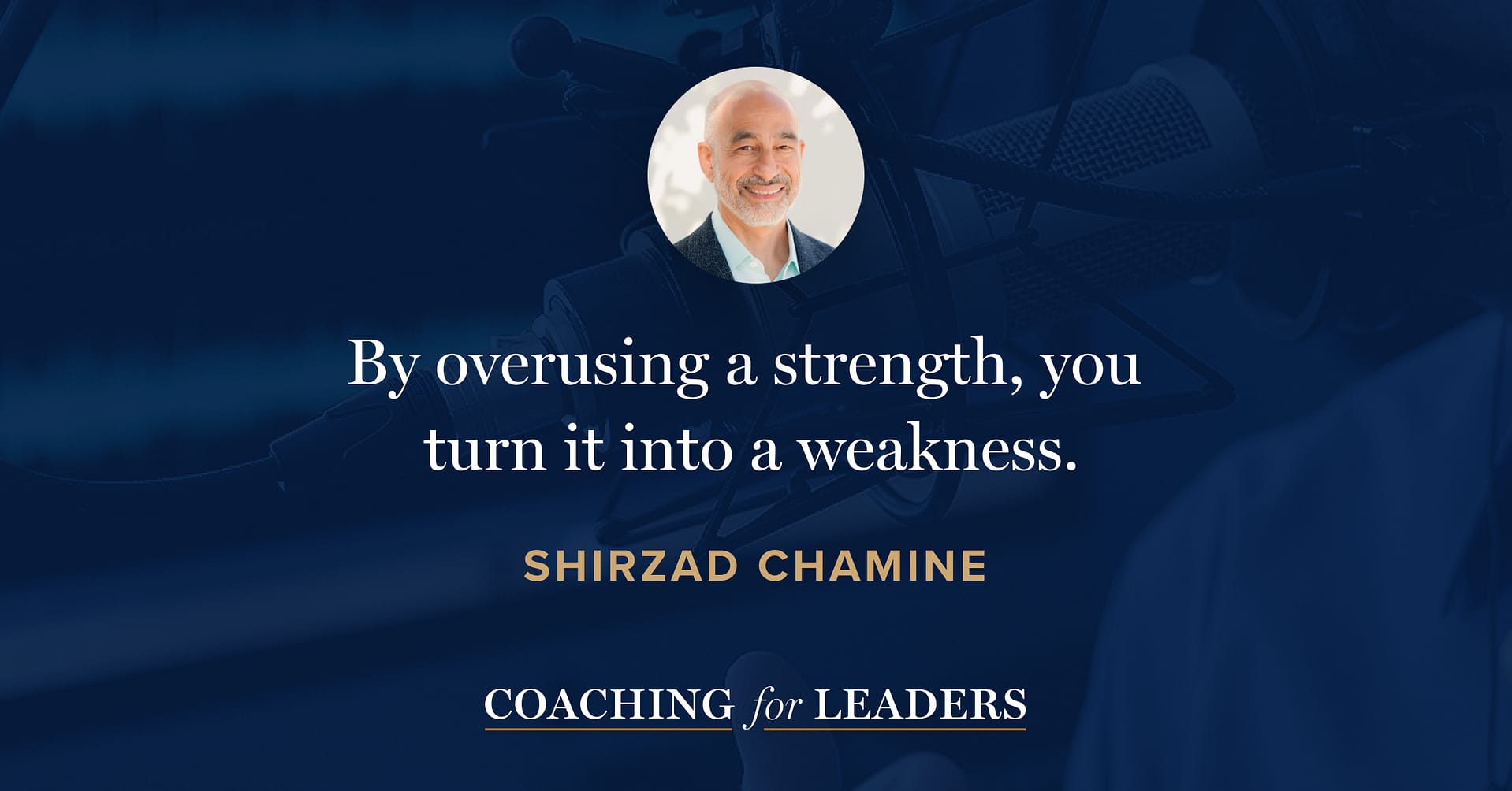
By overusing a strength, you turn it into a weakness.
https://media.blubrry.com/coaching_for_leaders/content.blubrry.com/coaching_for_leaders/CFL780.mp3

Podcast: Download

Follow:
Apple PodcastsYouTube PodcastsSpotifyOvercastPocketcasts

Shirzad Chamine: Positive Intelligence

Shirzad has been the CEO of the largest coach training organization in the world. He has lectured on Positive Intelligence at Stanford University and has trained faculty at Stanford and Yale business schools. He is the author of The New York Times bestseller Positive Intelligence: Why Only 20% of Teams and Individuals Achieve Their True Potential and How You Can Achieve Yours (Amazon, Bookshop)*.

By overusing our strengths, they can become our weakness. It’s just one of the many ways that leaders self-sabotage. In this conversation, Shirzad and I explore how to shift from self-sabotage to self-mastery.

Key Points

Most men lead lives of quiet desperation and go to the grave with the song still in them. -Henry David Thoreau

  • We are all a mixed bag of Darth Vader (saboteur) and Jedi knight (sage).
  • By overusing a strength, you turn it into a weakness.
  • Rather than attempting to eliminate all our saboteurs, it’s more helpful to be intentional about quieting them down.
  • The four most common saboteurs that show up for leaders are Controller, Stickler, Hyper Achiever, Hyper Rational.
  • Sage perspective: Every outcome or circumstance can be turned into an opportunity.
  • A 10-second brain shift can help quiet your mind and engage the sage. One way to do this is to rub your fingers together and notice the friction to get your mind out of autopilot.

Resources Mentioned

  • Positive Intelligence: Why Only 20% of Teams and Individuals Achieve Their True Potential and How You Can Achieve Yours by Shirzad Chamine (Amazon, Bookshop)*
  • Saboteur Assessment
  • Dave’s assessment results

Interview Notes

Download my interview notes in PDF format (free membership required).

Related Episodes

  • How to Tame Your Inner Critic, with Tara Mohr (episode 232)
  • The Path to More Joy in Work and Life, with Judith Joseph (episode 734)
  • How to See What’s Holding You Back, with Marty Dubin (episode 765)

Discover More

Activate your free membership for full access to the entire library of interviews since 2011, searchable by topic. To accelerate your learning, uncover more inside Coaching for Leaders Plus.

Moving From Self-Sabotage to Self-Mastery, with Shirzad Chamine

Download

Dave Stachowiak [00:00:00]:
By overusing our strengths, they can become our weaknesses. It’s just one of the many ways that leaders self-sabotage. In this episode, how to shift from self-sabotage to self-mastery. This is Coaching for Leaders, episode 780.

Dave Stachowiak [00:00:19]:
Production Credit: Produced by Innovate Learning, Maximizing Human Potential.

Dave Stachowiak [00:00:27]:
Greetings to you from Orange County, California. This is Coaching for Leaders, and I’m your host, Dave Stachowiak. Leaders aren’t born, they’re made, and this weekly show helps leaders thrive at key inflection points.

Dave Stachowiak [00:00:42]:
And one of the questions I often ask of leaders is, what is getting in your way right now? And the most common response I get to that question is, “well, myself”. There’s so many ways that we do get in our own way, and self-sabotage is one of them. In fact, that’s something that’s a challenge for many of us. And there’s such a desire for so many of us, so many leaders, to shift from self-sabotage to self-mastery. Today, a conversation on how we can get better, how we can continue to learn and grow, and how it can help so many of the people around us. I’m so pleased to welcome Shirzad Chamine. He has been the CEO of the largest coach training organization in the world. He has lectured on positive intelligence at Stanford University and has trained faculty at Stanford and Yale business schools.

Dave Stachowiak [00:01:37]:
He is the author of the New York Times bestseller Positive Intelligence: Why only 20% of teams and individuals achieve their true potential and how you can achieve yours. Shirzad, such a pleasure to have you on.

Shirzad Chamine [00:01:51]:
Yes, I’ve been so looking forward to this, Dave.

Dave Stachowiak [00:01:54]:
I think that oftentimes we, so many of us really do struggle with being able to capture our full potential. And it’s something I know you see so much in your work with leaders too, don’t you?

Shirzad Chamine [00:02:10]:
Yes. In particular, we believe that every human being is a mixed bag of their extraordinary self and their not so extraordinary self. The Stanford students that I’ve taught this to, they call this work Jedi mind training. So basically what they mean by that is that we show people there’s the inner Jedi and then there’s also the inner Darth Vaders, the ones that are not so beautiful and that are constantly sabotaging you. So, my work in the simplest form is to help people discover their profoundly powerful inner Jedi and strengthen that voice within, and then quiet the Darth Vaders inside, who are causing all sorts of damage and self-sabotage. And in so doing, they will perform a lot better and also feel a lot better. So it impacts both performance and, wellbeing at the same time.

Dave Stachowiak [00:03:05]:
One of the key distinctions that you make in that, and I think about the distinction between Jedi and the dark side, is surviving and thriving. Tell me more about that distinction.

Shirzad Chamine [00:03:19]:
Yeah. These Darth Vaders, we call them the saboteurs, we all have them, and their job was to help you survive in your childhood. So they’re agents of survival. And we did factor analysis research with more than a million people. And that’s how we came up with the 10 factors of self-sabotage. The 10 ways we self-sabotage. We also looked at the root cause of what are the positive forces on the inner Jedi, what’s that about? But on the dark side, the self-sabotage, the 10 ways, these saboteurs, they have names like the Judge, the Controller, the Stickler, the Avoider, the Pleaser, hyper achiever, restless victim, and so on. There are 10 of them.

Shirzad Chamine [00:04:06]:
Most people have a few of these running the show. And the reason we all have these is because, these are the ways we learned to survive our childhood. Mentally, physically, emotionally. This is how we learn to gain more love, more acceptance, more security as kids. They are the five-year-old operating system, that unfortunately, are no longer serving us. But as adults, we are constantly still running this operating system. So as leaders, we are too controlling, we are too judging, we are too much of a stickler or we are too avoiding or too pleasing or whatever. These saboteurs are running our mind and they’re sabotaging us.

Shirzad Chamine [00:04:50]:
They are how we learn to survive. But we no longer want to just survive. We want to thrive. And that’s where you want to switch to your inner Jedi rather than inner Darth Vaders. We call that the sage inside of you versus the saboteurs.

Dave Stachowiak [00:05:04]:
I saw a talk that you did a while back, where you spoke about presenting to a leadership development event with CEOs and presidents. And you had invited them to anonymously write on an index card something they’d not shared with anyone else about how they felt inside. And it speaks to so many of the things you just said, of we have those Darth Vaders inside of all of us. And what you shared with their permission on the cards was really striking that these saboteurs show up for all of us, don’t they?

Shirzad Chamine [00:05:43]:
Yeah, Dave, I’ve had the privilege of coaching some very famous people, many of them billionaires, many of them at the top of their industry as CEOs, founders. And the world thinks they are, you know, they got it all, and they’re happy and confident. And then when you get into a coaching relationship with them, you realize that actually they’re being constantly tormented by these saboteurs in private. The imposter syndrome is extremely common among high-achieving individuals who think that their success came from luck and circumstance. And any day now, the world is going to discover them for the fraud that they are. And then all the other saboteurs that I’m talking about, they’re really a source of continuous self-doubt, continuous anxiety, and it’s a hard way of living. And unfortunately, because we are not taught this stuff in school, most of us suffer alone. I mean, a lot of these CEOs thought they were the only ones who had these self-doubts, and so they suffered alone.

Shirzad Chamine [00:06:45]:
And it was profound relief to them when I showed them that this is just a human condition. We humans all have saboteurs. We are suffering alone. Let’s normalize the fact that this is what it is to be human. These saboteurs are common. I have them, you have them, and instead of pretending that we don’t have them, let’s just get on with it and say, okay, I sabotage myself this way. How do you sabotage yourself? And we even bring these conversations into teams. So within five minutes we normalize for a team the fact that we are all suffering alone, and all sabotaging our own effectiveness and the team’s effectiveness.

Shirzad Chamine [00:07:23]:
Let’s just normalize the fact that we all have them and then ask ourselves, how do we move beyond these, and do so individually as a leader or also collectively as a team?

Dave Stachowiak [00:07:33]:
It seems so obvious in a way, like why wouldn’t we just acknowledge what we already know is true, and yet how often we don’t talk about so many of these things. And I hope in this conversation we’ll do a bit of that. And in fact, we’ll look at my assessment as well here in a moment and highlight some of mine, and which come up. Before we do, I’m curious, which of these saboteurs tend to show up more for leaders?

Shirzad Chamine [00:07:58]:
Yeah, great question. So when we have done this, we have now like 2 million data points on this across many organizations. And what we find is that the saboteur profile is a little different depending on what level of the organization you are, and also what role you are in. And in particular, a saboteur like victim, for example, doesn’t show up as much in the upper sides of the organization, upper levels. It shows up more in the middle and towards the bottom. As you can imagine, the saboteurs that are very common for leaders are, I’ll mention a few: controller is one controller, stickler which is over perfectionism. There’s the hyperachiever, that takes a little bit of explanation.

Shirzad Chamine [00:08:47]:
And there is the hyperrational. So I would say those, the controller, stickler, hyperachiever, hyperrational tend to be the most common amongst senior-level leaders.

Dave Stachowiak [00:08:59]:
Well, you’ve already named two of my top ones on the list, so maybe, maybe we just jump in and look at those, because that might be helpful since folks know a bit about me, of course. And so I, at your invitation, and also at the invitation of one of our fellows, Sandy Welch, I got into the assessment. And by the way, the assessment is free, and we’re going to link to it @PositiveIntelligence.com/assessment so everyone can take this, and you can get really quickly assigned sense of how these show up for you. And I think Shirzad, I’ll just actually make my link available for everyone as well too, if folks are curious. So I’ll post that on the notes as well. So we’ll have that available. If you want to dive in, look at it along the way as you’re considering your own results.

Dave Stachowiak [00:09:48]:
And so we get the results, and it shows, like, here are the saboteurs that are most present in your life. The two that are on the top of my list are two of them you already mentioned that are common for leaders, stickler and, and hyperachiever. And for someone like me coming to this for the first time, looking at this list, what’s the best place to start, to start looking at this, and thinking about it, and decide like, how would this be helpful to me?

Shirzad Chamine [00:10:10]:
Yeah. First of all, one of the things that we do is we take away the shame and embarrassment of having saboteurs and normalize it. And one of the ways we look at these saboteurs is that they are taking your natural greatest strengths and by overusing and abusing those strengths, they convert it into a weakness. To give you an example, the stickler. When you tell me you have a stickler as a top saboteur, then I already know one of your greatest strengths is your ability to pay attention to detail, and to also bring order and organization. A sense of order and organization is important to you, and to bring order and organization to chaotic situations.

Dave Stachowiak [00:10:58]:
Yes.

Shirzad Chamine [00:10:59]:
And so those are awesome, awesome, awesome strengths. And what happens is, in your childhood, what happens is in order to get more love, more security, more attention, more independence, it’s natural that we go to our greatest strengths and then overdo those great strengths. And when they are overused and abused, they become our greatest weakness. So, how is the stickler, how does that become your greatest weakness? Where, well, taken too far, you would want too many things to be perfect. You spread your attention too thin on trying to make things perfect, where good enough would have been good enough. So rather than saying a lot of things around you, good enough would have been good enough. You’d waste too much time making things that don’t need to be perfect, perfect.

Shirzad Chamine [00:11:51]:
And in that, you take your eye off of the few things where perfection would actually be helpful. So you spread yourself too thin and that over-perfectionism also causes continuous angst and anxiety because life is messy, and things are constantly falling out of order and organization, and they’re constantly falling out of perfection. And so in a stickler mode, you’re constantly disappointed and anxious with yourself, and also with those around you are constantly falling short of that perfection. So we end up having people around us feel quite discouraged. To just give you an example, I was in a relationship with a leader who, if you did a 95% job for them, rather than really praising and appreciating 95% awesomeness, they would just point to the 5% that wasn’t still awesome. And after a while, you get so discouraged, you say, you know what? If I do a 95% job, I’m going to be told the 5% I was missing. If I do a 50% job, I’m still going to be told the 50% I was missing.

Shirzad Chamine [00:13:01]:
So why bother? Why work so hard when I’m constantly going to be told what’s not perfect enough? Right? So it can be very discouraging for ourselves and for those around us. So that’s an example of a great strength being taken too far, and then becoming an actual weakness.

Dave Stachowiak [00:13:19]:
Yeah. And when I look at some of the phrases under stickler, if you can’t do it perfectly, don’t do it at all. Right is right, wrong is wrong. Punctual, methodical, perfectionistic. Like some of the traits that show up, I look at it, and I think, oh my goodness. And that got in my way a ton when I had my first management roles and early on in my career, and in some cases, like some major missteps, because I was over-indexing too much on those strengths. And to your point, like, strengths are strengths, but when you overuse them, then they become weaknesses. And I got myself in so much trouble.

Dave Stachowiak [00:13:56]:
Not so much with other people per se, but just like I would be shooting myself in the foot a lot, early in my career as far as relationships and connections with customers and clients that could have been so much better and so much healthier. And I look at it today, Shirzad, all these years later, and even though it’s, it comes up on the assessment as the top one on my list, I look at it, and I feel a sense of joy, as strange as that is. And the reason I feel a sense of joy is, I read a lot of these, and I look, and I think I am so much better at this than I used to be.

Shirzad Chamine [00:14:30]:
Yeah.

Dave Stachowiak [00:14:32]:
And I’m not quite sure, and by the way, I don’t have that feeling with the other one. The next one we’ll talk about, hyperachiever, I don’t have the feeling of joy, but this one I do where I look at it and I say, okay, these like 20, 25 years later from a lot of those missteps, a lot of the things that are on this list, I feel like and maybe I’m just being self delusional, so you could tell me of like how to process this. But I look at them like, oh wow, I’m so much better than I used to be. There’s places I could go.

Shirzad Chamine [00:14:59]:
But yeah.

Dave Stachowiak [00:15:01]:
And how do you know, like when you look at something like this, and you process it, and you think like, oh gosh, I’m not sure that’s as much of an obstacle for me as much anymore. How do you actually calibrate and determine that?

Shirzad Chamine [00:15:14]:
Yeah, I mean, as we work on the saboteurs, they don’t go away, they just become less dominant and cause less damage. So from what you’re describing, it appears to me that you have worked on the saboteur even though you haven’t quite done our work, but there’s wisdom that you’ve brought in. So this saboteur is nowhere as strong as it used to be. And still that tendency might be there. If you really look into it, you’re going to see that you’re still going to pay a price of, when you are focused on the level of detail and over-indexing on that, then you may not be spending as much time seeing the bigger picture and more important forest for the trees. And so what we end up suggesting to people with the stickler’s saboteur is to think of an 80/20 bucket and put 80% of stuff that they worry about for being perfect in the bucket of good enough is good enough. And really ask themselves what’s the 20% where perfection is really that important? And so that they don’t spread themselves so thin and cause so much anxiety for themselves and others.

Shirzad Chamine [00:16:30]:
The hyperachiever that you said is the other one, that one takes a little bit of explaining, and we call it hyperachiever because it’s perfectly fine to be achievement-oriented. The issue when it becomes hyperachiever is that we condition our self-worth and self-love on our achievements. So we basically say, here’s the achievement target, and we work anxiously, work our butt off to try to achieve that target. And while we are trying to achieve that target, we are kind of anxious because we know if we don’t achieve that target, we are not worthy. Our sense of self-worth and self-love is too dependent on that achievement. So we kind of are too stressed along the way of making sure that achievement happens. Because oh my God, what if it doesn’t? And then when the achievement happen, we give ourselves an hour a day, if you are lucky, to celebrate and feel happy. And then we say, okay, but that’s the old achievement, now you got to achieve this next thing, and otherwise you’re not going to be worthy.

Shirzad Chamine [00:17:27]:
And so we basically suffer too much. We don’t enjoy the journey, we are too stressed along the way, and our moments of celebration are too few because they are dependent on the achievement, as opposed to what your sage, would do is your sage would have you feel unconditional love for yourself, unconditional acceptance for yourself. Your sense of self-love and self-worth is consistent regardless of whether you had a good day or bad day performing. And then you will absolutely set yourself those same exact achievement targets, if not more, but joyfully work towards those achievements, not because your identity depends on it, but because it’s fun to try to achieve that. So along the way, when glitches happen, you don’t freak out too much because glitches always happen. And so you recover back to the path faster, because you’re not freaked out too much. And it’s more likely you’re going to achieve that target, because you’re enjoying yourself and not freaking out too much every time something goes wrong. And so you joyfully move towards the target, you enjoy the journey itself, and then of course you enjoy the achievement, and then you set the next target, but not because your identity is on the line, but because it’s a fun thing to go achieve.

Shirzad Chamine [00:18:46]:
It’s a very different way of living and you actually achieve more if you are not making that achievement the condition for your self-worth and self-love.

Dave Stachowiak [00:18:57]:
Yeah, and isn’t that ironic? You know, and I think what you said earlier strikes me so true in this, like we’re all mixed bags on this, right? Like we all have the Sages, we all have the saboteurs. When I read this one, though, I almost feel like it should be at the top for me, because I feel a little bit less joy. Because when I read some of the things that you highlight on this of, good at covering up insecurities and showing a positive image, focus on thinking and action. What you said a moment ago, peace and happiness being more fleeting and short-lived, just kind of brief celebrations of achievement, and then moving on really quickly. Like those things really ring to me as true. And I think I’ve probably made less progress on that over the years than I have on the stickler piece of it. And which, which maybe begs the obvious next question is, when you see this in writing and like you sort of look at it like, yeah, guilty as charged. Right? That’s me. What’s a good starting point to think about? How to begin to shift this just a bit so you get a little bit more Jedi and a little bit less Darth Vader?

Shirzad Chamine [00:20:06]:
Well, so that brings me to the foundation of the research that we did. So the research was factor analysis research, asking the question, what optimizes or sabotages our well-being and performance? What optimizes or sabotages our well-being or performance? Factor analysis goes to the root cause of that. What we found on the sabotage part, that there are 10 factors, 10 ways we self-sabotage and those are the saboteurs. On the positive side, what optimizes well-being and performance? We discovered five factors, and we called them the five Sage powers. The positive part of you, called the Sage. And those five factors became the five Sage superpowers. And very, very importantly, this inner Jedi versus inner Darth Vader. They live in different parts of your brain.

Shirzad Chamine [00:20:59]:
So the saboteurs live in the area of the brain that has the limbic system, and brainstem, and a lot more of their left brain. The Sage lives in the part of the brain that has the middle prefrontal cortex, what we call the empathy circuitry. And then it’s more, more parts of your right brain. And the real issue is what part of your brain is activated. If the saboteur region of your brain is activated, then you are going to be feeling negative emotions of the saboteurs. The saboteurs generate all of your negative emotions, and that includes your stress. All stress and anxiety comes from the saboteurs and that part of brain activation.

Shirzad Chamine [00:21:42]:
And so self-doubt, shame, guilt, disappointment, regret, all of these negative feelings that we feel are because we are in saboteur mode, and having activated that region of the brain. The positive part of the brain is feeling all the positive emotions, such as empathy, curiosity, joyful creativity, being grounded in purpose and values, feeling that passion, being purpose-driven and calm, clear-headed, laser-focused Jedi action. All of those are in your Sage and in different part of your brain. Basically, the practice that we recommend is an incredibly simple practice, which is you want to pay attention to whether you’re in Saboteur or Sage. And the moment you catch yourself in Saboteur, the way you know is, you are in negative emotions. Stress, anger, shame, guilt, disappointment, regret, all those things we say, okay, I’m in saboteur mode, I’m in controller mode, avoider mode, stickler mode, victim mode, whatever. So you stop, and you label that. And then you begin to shift your brain activation using these 10-second exercises I’m about to show you.

Shirzad Chamine [00:22:54]:
And then, so that you quiet the Saboteur region of the brain, and energize the Sage region of the brain, so that then you do the third step, which is now that I’ve energized the inner Jedi, the Sage, I will use one of these five Sage powers, and respond to the challenge in front of me, in a way that’s positive response and in a way that has me perform better and feel better. So it’s a very simple, intercept yourself in Saboteur, energize the Sage brain, quiet the Saboteur brain, and then choose a Sage response, a positive response using the five superpowers of the Sage. And so right now I would love to show your listeners how to do that critical step of energizing the Sage brain, quieting the Saboteur brain. And I’ll show you the most popular, I mean, lots of CEOs and their executive teams around the world are practicing this. The most popular version is, gently take two fingertips of one hand, gently rub two fingertips of one hand against each other with such attention that you can feel the fingertip ridges on both fingers. So gently rub two fingertips against each other with such attention that you can feel the fingertip ridges on both fingers.

Shirzad Chamine [00:24:15]:
Just feel the texture, maybe the temperature, the touch between your finger points. And as you shift your attention to that, that if you do 10 seconds of this under functional MRI machine, and we do these 10 seconds at a time, we call these PQ reps, and these 10 second moments are, if you had your head under an FMRI machine, you would have noticed that it’s ever so slightly quieted the sabotage region of your brain, with all of its dark stuff, and ever so slightly energized the sage, the inner Jedi. Now of course, one of these 10-second reps doesn’t change your life, but within eight weeks of this kind of practice that we do, intercept the saboteur, go to SAGE using some of these techniques. Within eight weeks, we show that Harvard affiliated neuroscientists have shown that there’s such a rewiring of the brain that, in MRI imaging you can actually see decreased gray matter in the saboteur region of the brain, increased gray matter in the SAGE region of the brain. We are literally rewiring your brain, and you are basically getting more command over your mind, and rewiring your brain in a way that has us say, this is mental fitness. You’re actually building new brain muscles, you’re forcing atrophy in the muscles, the neural pathways of your saboteurs, and you are building up mental muscle power, building neural pathways in this age region. So we call this work mental fitness because it’s about muscle building, it’s about rewiring the brain.

Dave Stachowiak [00:25:57]:
I can’t remember if this is something I heard from you or for someone else who had gotten into your work, but the distinction between trying to quiet everything around you, versus actually quieting your mind. And when I think about what you just said and experience it, and doing it as you were saying it, it’s so interesting how just that practice for 10 seconds does quiet and focus the mind. It’s looking so much more internal. Whereas my sense is so much of the Saboteur framework is trying to attempt to falsely control like the rest of the world, the environment. But this is a practice of really quieting your mind.

Shirzad Chamine [00:26:45]:
And we basically use the word self-command. So what just happened? What just happened is your saboteurs live in the autopilot mechanism of your mind. Your mind is running on autopilot in a course of a day. Your mind, depending on which researcher you listen to, your mind generates between 10,000 to 60,000 thoughts. How many of those thoughts are you even aware you’re generating? And how many of those thoughts are even useful? And as you really look at that, you realize that your mind is running on autopilot and generating a whole lot of incredibly useless stuff, and some really harmful stuff, repetitive harmful stuff there. It’s not your command, you’re not running your mind, it is running itself. It’s an autopilot. So with this 10-second thing I just showed you, you go to self-command, you command your mind, stop all of that autopilot nonsense.

Shirzad Chamine [00:27:48]:
Focus on this physical sensation right now. It’s an exercise of self-command. And it just so happens that as you do that, it energizes the entire region of the of the brain where your sage lives. So on the one hand, you’re going to self-command using your middle prefrontal cortex, on the other, you’re energizing the entire region where all of these great sage powers live. It’s incredibly simple. It’s just deceptively simple. But it ultimately is you saying, I’m gonna run the show here. I’m not gonna be run by the operating system of a five-year-old that the saboteurs are.

Dave Stachowiak [00:28:26]:
If you had told me what you just shared 10 or 15 years ago, I would have been very kind and nodded and smiled, but I would have in the back of my mind thought there is no way that that works to like rub your fingers together, and actually have more command over your mind. And, and yet, I’ve been proven wrong so many times that I’ve totally changed my mind on this over the years. The power of small acts consistently done over intensity, of starting to do things like this as a practice of training. I’ve seen it happen so many times for myself and others that if you’re willing to be able to start and do this consistently, how much you can really, how much you can do.

Shirzad Chamine [00:29:13]:
And for those who are research-oriented and skeptical, feel free to go to our website. And there’s a 20-page research white paper written by a Harvard-trained neuroscientist, who ran a neuroscience lab that brings in lots of third-party researchers that validates the connection between the exercise. I’m just telling you about positive intelligence and the foundation of saboteur versus sage behavior. So that’s on the research front. If you’re interested, do your research so that you shift from your skepticism. Then on the pragmatic level, let’s just use an example of performance and use an example of, it’s a championship basketball game, NBA game, and last two seconds, the ball is given to the athlete, and if he makes it, he’s going to win the championship for his team. If he doesn’t make it, he’s going to lose the championship.

Shirzad Chamine [00:30:06]:
Now imagine what’s going to happen to that athlete if his mind is running on autopilot, including all of these saboteurs. That’s like the hyperachiever. Oh my God! I better make it. I better make it. I better make it. If I don’t make it, who am I? What’s going to happen to me? Everybody’s going to hate me.

Shirzad Chamine [00:30:24]:
If those are the thoughts in your mind, how likely is it that you’re going to make that easy shot that you could easily have made in practice? Athletes choke all the time in the most critical moments because of the voices in their head. Now what happens to that athlete if they have command over their mind? And when they receive the ball, their mind is at the peaceful place, their self-command is just focus on the ball in your hand and the basket. Just be present in this moment and enjoy throwing the ball, like you always do in practice. And he’s going to make it. So when you are in hyper-rational, hyperachiever mode and judge mode and all of these saboteurs and they’re running the show, you’re not going to perform as well. If you have command over your mind, you will tell it what is needed right now. What’s needed right now is, let go of all those voices.

Shirzad Chamine [00:31:15]:
Just focus on the ball and the basket. We do that all the time. We are sabotaging ourselves all the time because we are not commanding our mind. It is running the show in some harmful ways.

Dave Stachowiak [00:31:27]:
And it reminds me of the perspective you highlight about the sage superpowers, that every outcome or circumstance can be turned into an opportunity to do better.

Shirzad Chamine [00:31:38]:
Yes, that’s the sage perspective. So every circumstance can be turned to a gift or opportunity. So we don’t live life in fear of what’s going to happen. What happens if we fail at something because we actually learn, everything can be converted into a gift or an opportunity, including your mistakes and failures. So as a leader, this is an incredibly important thing I’ve brought to my teams. So, in a world we are living in right now with AI, there is absolutely no leader who can tell me they can predict the future more than three years in front of them. Because things are so radically shifting and changing. So coming from certainty and control, even if it was possible in the past, which it never was, but even if it was, it’s shattered right now with the age of AI, where the level of change and uncertainty is so much, and it creates a world in which we need to learn to try things and to as we try things, to know that when you try new things, there is an increased chance of failure, and to really have a completely different relationship with failure. Failure can absolutely be turned into gifts or opportunities.

Shirzad Chamine [00:32:48]:
So I have my team not live in terror of what happens if we try something and if it fails. Because our mantra is, whatever happens, we’re going to come back together and say, how can we turn this into a gift or opportunity? And the way we do that is, using the positive stage powers. It becomes a self-fulfilling prophecy. But if something goes wrong, if we make a mistake, something goes wrong. We are all freaked out. Shame on me, shame on me, shame on us. It’s horrible, horrible, horrible. We just shift ourselves individually and collectively to a negative mindset that’s going to take a bad thing and make it worse.

Shirzad Chamine [00:33:20]:
Waste a ton of mental, emotional energy. So that sage perspective that everything can be converted into gift or opportunity is a self-fulfilling prophecy. And we absolutely have made it a mantra of everything that we do in our company. And that’s how I have, I mean in the book I talk about the CEO of a public company, who had lost two-thirds of the value of the stock in the company over a period of a crisis that they had. And they were- he and the entire team was in such state of despair, and what I told him is, I wanted him every Monday morning in the staff meeting to start his team meetings with all the things that have happened, have happened and here we are, and what do we need to do so that in a few years we’re going to look back and say this thing that happened was the best thing that could have happened to us. Because look how we have turned it into a gift.

Shirzad Chamine [00:34:12]:
And asking that question, over and over and over again, what do we need to do so that we can look back and say this is the best thing that ever happened to us. That question will bring creative answers gradually, that had this company completely turn around, and indeed be able to take what had happened into a completely different strategy that had them consolidate their power in their industry, become much more powerful than they ever were. But you got to start with that perspective. And from that perspective you bring out of yourself the creativity you need in order to make it a self-fulfilling prophecy. We can, and we shall convert this into a gift. So let’s not live in fear of our mistakes and failures because they will happen. And let’s not have our team members run away terrified about it, because they will not gonna take chances and take initiatives otherwise, that you would want them to take.

Dave Stachowiak [00:35:06]:
I so appreciate you normalizing the saboteur conversation for all of us. And so we’ve got one big invitation for you is, go take the assessment. It just takes a few minutes, it’s completely free. Again, positiveintelligence.com/assessment we’re going to link up in the episode notes. I’m also linking my results, too. So if you’d like to take a look at just where my results land and, compare yours as a starting point, listening to this conversation, I hope you’ll take a moment to do so.

Dave Stachowiak [00:35:33]:
Shirzad Chamine is the author of Positive Intelligence: Why only 20% of teams and individuals achieve their true potential and how you can achieve yours. Shirzad, thank you so much for your work.

Shirzad Chamine [00:35:46]:
It has been such a pleasure, David. Thank you for having me.

Dave Stachowiak [00:35:56]:
If this conversation was helpful to you, three other episodes I’d recommend. One of them is episode 232: How to tame your inner critic. Tara Moore was my guest on that episode, and we talked about the reality of that inner voice that we all hear every day and, how do we tame it a bit? How do we make sure that it doesn’t take over? And how do we keep it from self-sabotaging? So many wonderful invitations from her in that conversation on how to do that in a very practical way. If your inner critic is talking to you a lot right now, episode 232 is a great place to start. I’d also recommend episode 734: The path to more joy in work and life. Judith Joseph was my guest on that episode, and we talked about the realities of high-functioning depression. Oftentimes, we only think about depression through some of the classic symptoms that many of us know, but we don’t think about the other kind of depression, of which there are many, the high-functioning kind. And a lot of leaders struggle with it and don’t know that they’re struggling with it.

Dave Stachowiak [00:36:55]:
Episode 734, good check-in for all of us on our mental health, and making sure that we’re getting the support we need to move forward in a very healthy way. And finally, I’d recommend episode 765: How to see what’s holding you back. Marty Dubin was my guest on that episode, and we talked about blind spotting, but not blind spotting as far as seeing blind spots out in the organization, how do we see blind spots in ourselves? It’s hard to do, but if we have the right mindset, we can get better at that practice, and Marty has some wonderful tactics for us and steps to do that. Well, I think it’s a great compliment to this conversation, episode 765 for that. All of those episodes, of course, you can find on the coachingforleaders.com website. If you set up your free membership at coachingforleaders.com, you have full access to all the episodes that I have aired since 2011, searchable by topic. That’s key because you can’t do that on the podcast apps very easily.

Dave Stachowiak [00:37:45]:
We make all the episodes freely available everywhere we know that you could find podcasts, yet it’s hard to find what you’re looking for on the apps, because there is so much there. We’ve created the website and the free membership so you can find exactly what you need by category. This episode is going to be filed under Personal Leadership, of course. We’ve had dozens and dozens of conversations over the years just on this topic. Go over to coachingforleaders.com, set up your free membership, and you’ll get access to so much, much more, including my weekly Focus5 message. I am finding five principles, ideas, resources, every single week.

Dave Stachowiak [00:38:18]:
I’m sending you a single message, so that you can continue to move forward in your learning and growth over email through those ideas and resources. It’s part of the free membership. Just go over to coachingforleaders.com to set that up. Coaching for Leaders is edited by Andrew Kroeger. Next Monday, I’m welcoming back a guest that you haven’t heard from in a while. That would be Bonni Stachowiak, I’m so glad to have her back. We’re not going to be doing a Q&A show, which we have done many times in the past. Instead, Bonni and I are going to reflect back on a number of conversations that have been aired here on the podcast over the last six or seven months, and reflect on some of the things we’ve heard, and do a little bit of a deep dive on some of those concepts that have come up.

Dave Stachowiak [00:39:00]:
Join me for that conversation and reflection with Bonni next week, and I’ll see you back on Monday.

Topic Areas:AssessmentsPersonal Leadership
cover-art

Coaching for Leaders Podcast

This Monday show helps you discover leadership wisdom through insightful conversations. Independently produced weekly since 2011, Dave Stachowiak brings perspective from a thriving, global leadership academy of managers, executives, and business owners, plus more than 15 years of leadership at Dale Carnegie.

Listen Now OnApple Podcasts
  • More Options
    • YouTube Podcasts
    • Spotify
    • Overcast

Activate Your Free Membership Today

Access our entire library of Coaching for Leaders episodes from 2011, searchable by topic.
Listen to the exclusive Coaching for Leaders MemberCast with bonus content available only to members.
Start Dave’s free audio course, 10 Ways to Empower the People You Lead.
Download our weekly leadership guide, including podcast notes and advice from our expert guests.

... and much more inside the membership!

Activate Your Free Membership
IMAGE
Copyright © 2026 · Innovate Learning, LLC
  • Plus Membership
  • Academy
  • About
  • Contact
  • Dashboard
×

Log in

This site is protected by reCaptcha and the Google Privacy Policy and Terms of Service apply.
 
 
Forgot Password

Not yet a member?

Activate your free membership today.

Register For Free
×

Register for Free Membership

Access our entire library of Coaching for Leaders episodes from 2011, searchable by topic.
Listen to the exclusive Coaching for Leaders MemberCast with bonus content available only to members.
Start Dave’s free audio course, 10 Ways to Empower the People You Lead.
Download our weekly leadership guide, including podcast notes and advice from our expert guests.

... and much more inside the membership!

Price:
Free
First Name Required
Last Name Required
Invalid Username
Invalid Email
Invalid Password
Password Confirmation Doesn't Match
Password Strength  Password must be "Medium" or stronger
This site is protected by reCaptcha and the Google Privacy Policy and Terms of Service apply.
 
Loading... Please fix the errors above