• Skip to primary navigation
  • Skip to main content
  • Skip to primary sidebar

Coaching for Leaders

Leaders Aren't Born, They're Made

Login
  • Plus Membership
  • Academy
  • About
  • Contact
  • Dashboard
  • Login
Episode

758: How to See What Others Miss, with Kirstin Ferguson

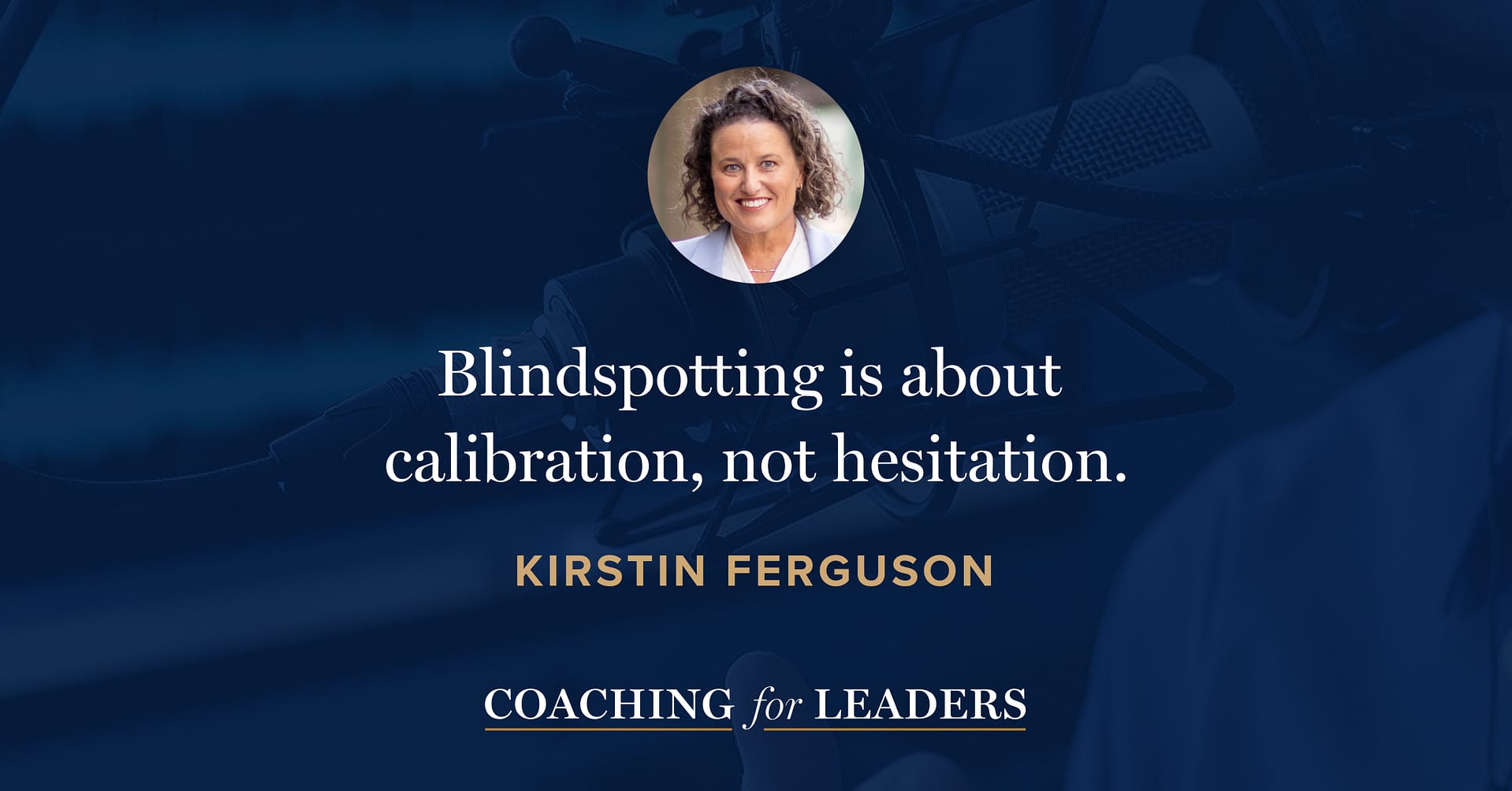
Blindspotting is about calibration, not hesitation.
https://media.blubrry.com/coaching_for_leaders/media.blubrry.com/coaching_for_leaders/content.blubrry.com/coaching_for_leaders/CFL758.mp3

Podcast: Download

Follow:
Apple PodcastsYouTube PodcastsSpotifyOvercastPocketcasts

Kirstin Ferguson: Blindspotting

Kirstin Ferguson has been recognized globally by Thinkers50 as one of the top 50 management thinkers in the world and is the recipient of the 2023 Distinguished Leadership Award. She was an officer in the Royal Australian Air Force, and then went on to lead an international consulting firm as CEO, before serving on the boards of major publicly listed, private, and non-profit organizations. She is the author of Women Kind, Head & Heart, and her newest book Blindspotting: How to See What Others Miss (Amazon, Bookshop)*.

If we stop to think about it, almost all of us recognize that we have blind spots. Given that reality, anything we can do that helps us see what others might miss will help us lead better. In this conversation, Kirsten and I explore the mindsets and practices that will help us uncover more of our blind spots.

Key Points

  • Experts are better at knowing when they are right, but also less likely to show appropriate doubt when they could be wrong.
  • There’s a time to be a seeker and a time to be a knower. Both are important in different situations, but leaders in many situations would benefit from more seeking.
  • Blindspotting is about calibration, not hesitation.
  • Accept your intellectual limitations. A key way to do this is saying these four words more: “I don’t know yet.”
  • Disentangling your ego will help your blind spot better. Shift away from your pride a bit by separating yourself from your knowledge and expertise.
  • Hunt down your biases. Admitting they exist is step one. Model vulnerability by talking about your past mistakes both with yourself and with others.

Resources Mentioned

  • Blindspotting: How to See What Others Miss by Kirstin Ferguson (Amazon, Bookshop)*.

Interview Notes

Download my interview notes in PDF format (free membership required).

Related Episodes

  • Getting Better at Reading the Room, with Kirstin Ferguson (episode 651)
  • How to Find What’s Missing, with Jeff Wetzler (episode 732)
  • How to Teach Your Expertise to Others, with Roger Kneebone (episode 743)

Discover More

Activate your free membership for full access to the entire library of interviews since 2011, searchable by topic. To accelerate your learning, uncover more inside Coaching for Leaders Plus.
How to See What Others Miss, with Kirstin Ferguson

Download

Dave Stachowiak [00:00:00]:
If we stop to think about it, almost all of us recognize that we have blind spots. Given that reality, anything we can do that helps us see what others might miss will help us lead better. In this episode, the mindsets and practices that will help us uncover more of our blind spots. This is Coaching for Leaders, episode 758. Production Credit: Produced by Innovate Learning, maximizing human potential.

Dave Stachowiak [00:00:33]:
Greetings to you from Orange County, California. This is Coaching for Leaders, and I’m your host, Dave Stachowiak. Leaders aren’t born, they’re made. And this weekly show helps you discover leadership wisdom through insightful conversations. One of the realities that we all face in leadership, if not directly, we certainly have it pointed out to us is what we have missed, what we don’t see. And of course, to lead effectively, we need to be able to see the things that other people miss, at least be able to do a good job at ourselves, of looking inward, at being able to uncover some of the biases, some of the things that tend to hold that back. Today, so glad to welcome an expert that’s so good at helping us to begin this journey, of starting to see what others miss and some of the practical steps we can take to get better.

Dave Stachowiak [00:01:29]:
I am so pleased to welcome back to the show Kirstin Ferguson. She has been recognized globally by Thinkers50 as one of the top 50 management thinkers in the world and is the recipient of the 2023 Distinguished Leadership Award. She was an officer in the Royal Australian Air Force and then went on to lead an international consulting firm as CEO before serving on the boards of major publicly listed private and nonprofit organizations. She is the author of Womenkind: Head and Heart and her newest book, Blindspotting: How to See What Others Miss. Kirstin, such a pleasure to have you back. Welcome.

Kirstin Ferguson [00:02:06]:
Oh, Dave, thank you for having me. I love speaking with you about everything, leadership, for your coaching for leaders. So thank you for having me.

Dave Stachowiak [00:02:14]:
Oh, my pleasure. I was. As I got into thinking about blind spots and reading the book, I came up on a big blind spot of my own in something you surface in the book and it is a story you tell about the UK Post Office scandal. And as I had never heard this story before, and I’m embarrassed to admit I haven’t, but I’m guessing other people haven’t heard it either and it illustrates the importance of what we’re talking about today I think so well. Would you mind sharing a bit of the story of just what happened in the UK with the Post Office and, and how this played out?

Kirstin Ferguson [00:02:55]:
Absolutely. And for Anyone else who hasn’t heard about the story, I absolutely encourage you. All you’ve got to Google is UK Post Office. And you’re going to reveal everything I’m going to be talking about because it’s a current story. It’s still playing out, but it began sort of at the turn of the century. Gosh, that makes us seem old, Dave. When the UK Post Office put in a new IT system, something all of us in organizations have been through at some point, and as soon as this IT system was put in, and it was just an accounting system for the local postmasters. So imagine, you know, you’ve got, in little towns all over the uk, retirees and other people in small villages running the Post Office.

Kirstin Ferguson [00:03:39]:
And this new accounting system came in and they were noticing, at the end of the day, it wasn’t kind of adding up. And they would contact the Post Office and say, look, something’s wrong with the system. And they’d be assured, look, no one else is having that problem. It must be something at your end. And they would send, the Post Office would send in investigators and they started charging these Post Offices with offences for accounting fraud and theft. And you can imagine, you know, there’s these poor postmasters all over the country being charged with serious offences. It turns out, for these postmasters who thought they were one of only a handful that might have been experiencing this and they did not believe that they had done anything wrong. In fact, there were hundreds and hundreds of postmasters.

Kirstin Ferguson [00:04:27]:
900 odd postmasters were sent to prison.

Dave Stachowiak [00:04:31]:
Oh, wow.

Kirstin Ferguson [00:04:33]:
A number of postmasters ended up taking their lives very sadly. And, you know, these are not criminal masterminds. We’re talking about the local person who runs the Post Office. So let’s then think about, well, what on earth was going on? The board of the Post Office and the executives who ran the UK Post Office obviously were aware that there was this increasing scourge of corrupt postmasters and they were being pressured to investigate. Are you sure, you know, this is what’s going on? Are you sure that it’s due to accounting irregularities and fraud and theft? You know, it seems very unusual and throughout decades, in fact, fact, the Post Office and the board of the Post Office maintained it could not be the fault of the IT system, it must be the fault of these postmasters. Now, the postmasters eventually realized that there was hundreds of them and they knew that they hadn’t done any wrong, anything wrong, and took the Post Office to court and the truth came out and there were whistleblowers from the IT company and of course, as we, you know, in hindsight, perhaps could have now predicted in this story, in fact, it was the IT system all along and it was nothing to do with the postmasters. Now this is a tragic story because those hundreds and hundreds of people’s lives were upturned. They were not believed for many years, many went bankrupt, you know, all the awful effects that happened to them.

Kirstin Ferguson [00:06:03]:
But what I’m really interested in, in what was going on inside the Post Office that no one was saying, look, this just doesn’t make sense. What are the chances that there is this criminal mastermind network of postmasters versus an IT system that perhaps has a glitch? And I’m so curious. Now, we’ve been able to hear through numerous inquiries that have happened in the UK since, including with the CEO of the Post Office and the board about their blind spot, because it’s easy for us to say, you know, how, how can this happen? I would never sit on a board and not be questioning this. You know, I would never have been part of that. But all of us have these corporate blind spots, let alone individual ones, where the answers keep being reinforced to us. We’re confirming the information that we’re seeing and it almost becomes something we now can’t see, that there could be another option. And so it is a really fascinating example of how those blind spots happen and how by not asking the right questions and not really stopping and saying to ourselves, look, as a board, in this case, what are we missing? Could it be that we are wrong and these 900 odd people aren’t? What is it that we’re not asking ourselves and not being honest about and calibrating our confidence in terms of how much we actually know what we know. There’s something called the curse of expertise, which I was really fascinated about and I think it would apply to everyone listening because we’re all experts in whatever it is we, we do.

Kirstin Ferguson [00:07:47]:
And everyone will have heard of the Dunning Kruger effect. You know, it’s always very funny where there’s those of us or others who know very little but think they know a lot. But the curse of expertise means we’re actually really good as experts at knowing when we’re right, but we’re terrible when not so good at knowing when we should doubt what we think we know, you know, when we might be wrong. And that is why we keep having these blind spots. If we think about that board of the Post Office, you know, they were very confident about what they thought they were right about, but they showed A complete inability to doubt what they thought they knew when they thought they may be wrong. They didn’t even ask that. Well, presumably they didn’t even ask that question. So I think that is where we need to be calibrating and being open to the idea that while we might be an expert in inverted commas at whatever it is we do, we simply do not know everything.

Kirstin Ferguson [00:08:47]:
And the world is changing so rapidly that being able to understand that we simply do not know will make us much more open to learning how we can pivot and learn and unlearn for the future to make us better leaders. Does that make sense?

Dave Stachowiak [00:09:09]:
Oh, it does so much. And it comes down to one of the. The real heart of this book, to borrow a word you used in a title of a previous book, is probably two words, be honest. And when you say be honest in this journey of doing a better job of blindspotting and being a seeker, this isn’t just a. The intellectual value that we all. Well, I shouldn’t say all, but most people espouse of like I’m being. I want to be honest with others. I see it almost first as we have to be honest with ourselves, which is a different way to look at it.

Dave Stachowiak [00:09:49]:
Just as important, if not more so.

Kirstin Ferguson [00:09:50]:
Absolutely. So the framework. Maybe I could back up a second, please. Blind spots we all understand. We have. I think, you know, no one’s. If you don’t think you’ve got a blind spot, that’s your Exhibit A of a blind spot.

Dave Stachowiak [00:10:04]:
Right.

Kirstin Ferguson [00:10:05]:
We all know we’ve got them. The reason I wanted to write the book was, okay, that’s great, but now what do I do? Like, practically, how can I come up with a way of finding and overcoming some of these blind spots? We’re never going to. This isn’t a magic bullet, you know, we’re never going to catch all of them. But knowing you’ve got them is half the battle. And so I wanted to come up with a way of thinking about it that is like powering up a flashlight to be able to see ahead. And you’ve really hit on one of these three. But being honest is number one for me. And it’s based on the theory of intellectual humility.

Kirstin Ferguson [00:10:43]:
It’s this idea, as you, of not. It’s not about integrity and not stealing and not that use of the word honest. This is about that idea of a mindset of being honest with ourselves, even if we can’t be honest with others about our intellectual limits. And there’s a sweet spot, as I mentioned. Everything is going to be around a sweet spot because you and I have a spectrum of knowledge. There’s some things that at one end I feel I know nothing and I can feel this sort of crippling self doubt. You know, on certain, certain topics, I know nothing and that’s not helpful. At the other end, we can experience intellectual arrogance.

Kirstin Ferguson [00:11:24]:
You know, I feel I know everything on a certain topic. A surefire way to miss something. Blind spotting is right in the middle. It’s that confidence that I don’t know everything, but I’m okay with that because I’m confident I’ll be able to find out. And so for me, the, the absolute key, four words that we need to be able to say to ourselves, if not to others, which can be very helpful. I’m sure we’ll talk about that. Is I don’t know yet. And the yet is so incredibly important because it’s telling yourself and others that I don’t know.

Kirstin Ferguson [00:12:01]:
Now I’m being honest with you. I really have no idea. I’ve never seen this challenge before, but I know I’m going to be able to figure it out. And I think when you said at the beginning, a lot of us feel that if we say something like that, we’ll lose credibility or we’ll lose trust from others. The opposite is true because we’ve all got these incredibly attuned BS meters. We know when someone doesn’t know what they’re talking about. We can tell. It’s so obvious.

Kirstin Ferguson [00:12:32]:
Yet our blind spot is we tend to think no one else can see that of us. So when we can, in certain circumstances, again, if you’re doing a surgery, I do not want you to tell me as my surgeon before, I don’t know how to do this. Trust me, I’ll figure it out along the way. But in the right circumstances, if you can say to your team, look, I don’t know. I’ve never dealt with this challenge before, but I’m confident we’re going to figure it out together. You will build trust. You will build confidence in those around you that you’re going to be able to see it through.

Dave Stachowiak [00:13:06]:
That’s what I love about this chapter of the book especially is the invitation, of course, to be honest, but also then the real clear practices to do a better job at that. And the first of those practices is what you call accepting your intellectual limitations, which goes to exactly what you were just saying, Kirstin. And as I was thinking about the wording of that, I’m thinking about what you said a moment ago. I think almost all of us, especially people listen to this show, would say, okay, I acknowledge that I have blind spots. Clearly we all do. There’s things we don’t know. But I think there’s a difference between acknowledging that and really actually accepting that. You know, what’s the difference between someone who just sort of intellectually agrees with that, but with someone who really accepts that and like really sees that?

Kirstin Ferguson [00:14:02]:
And I mean, I’ve written the book on this and I’ve got blind spots every day. So this is hard work because we default, you know, especially if we’re feeling anxious or nervous or stressed or whatever. It’s much safer, it feels safer to put on an air that I know what I’m talking about or not even consider these questions. But I know for myself where the difference in my mind is. If I go into a difficult conversation about something that I might feel a preconceived view on, and I reflect on those conversations afterwards, the better conversations are those where I go in. I might have a view because this isn’t about not having a position on things at all, but it’s about going into it and listening to another perspective with a genuine curiosity and then a genuine flexibility to perhaps take on some of what I’ve just heard. I can compare that to other conversations I’ve had where I’m not even thinking about blind spotting. I feel so invested in whatever it is, my view is that I’m really not listening to what their perspective is.

Kirstin Ferguson [00:15:14]:
And I come away none the wiser as to what I might have missed. I think all of us can reflect on those different types of conversations that we have and understand the benefits that often come from when we’re willing to open our minds just a little and just perhaps open up to the biases we might be bringing to that conversation. And I can think for myself that one of the things I’ve had to really be honest about, there’s a number of contentious issues that I’ve had to really think about. Well, I’ve come to that with a real bias for whatever reason, but one around working from home was where I’ve had to really adjust my thinking based on exactly what we’re talking about. Because when Covid first happened and we all started working from home, as a 50 something year old who’s had an established career, I thought about myself and I’m thinking, this is fantastic. I hope I never have to go to an office again. I love working from home. Let this never change.

Kirstin Ferguson [00:16:18]:
And I was a zealot for it. You know, I was writing in our papers, opinion pieces, I thought it was fabulous. Now I’ve got daughters in their 20s and I know other young workers, and over the time I’m listening to their experiences, which were very different. They were now missing out on a lot of mentoring experience and opportunity experience and all of those sorts of things. And I’ve really had to reflect on my own biases and my own lack of honesty about why I came to the view that I did. And it was completely tied up in my own perspective and what I, what I believed and what I wanted. And, you know, if we were to think about all of those really difficult conversations and blind spotting doesn’t have to come up in difficult ones, but around politics or whatever it might be, imagine if we all went into those conversations with a view that, look, I might not be right. I might need to be open to hearing some information and data that I’m not aware of.

Dave Stachowiak [00:17:22]:
Which leads into one of the invitations you make for us, which is to calibrate our confidence in situations like this. What does that look like?

Kirstin Ferguson [00:17:32]:
Well, it looks like asking ourselves, you know, what don’t I know about this situation? Or before I go into that conversation, or while I’m listening, what evidence would genuinely make me change my mind, why is it I’m holding on to something here and why? But if this person actually shares something that I’m not aware of, is that going to help me change my mind? And really being honest about, am I basing my decision or my views or perspective on past experiences, or am I actually looking at how things have changed? What’s the current relevant experience and evidence that may go against what I’m thinking? I think I look at the times, I’ve sat on boards for about 15 years and we’d always sit around a table, for example, if we’re going to do an acquisition and we’d sit around and tell ourselves we’ve done our due diligence and we’ve gone and done, done all the checks and all of those risk and rewards, weighed it all up. But now I look back and if I’m really honest, I don’t think we ever really sought out the views of someone who might be adamantly against what we’re about to do and then said, what are we missing? Why is it you are adamantly against it and not just sort of done it as a way of ticking a due diligence box, but actually listened to, to what they were saying about what their perspective was on what we’re missing now. Again, it doesn’t mean we might not have done it. But that act of actually accepting that you may not know everything is incredibly important to practice wherever we can because it’s going to help us see things we absolutely will otherwise miss.

Dave Stachowiak [00:19:21]:
Well, I was thinking about what you said earlier of the great things that come with expertise, but also a bit of the curse that comes with expertise, too. And boy, if you can get beyond that, how much you can do with it. And you cite so many wonderful examples in the book of leaders who have really intentionally done this, and one of them is Magic Johnson. And I think it’s really interesting. Like here’s someone who absolutely at the top of his game literally in the sports world and has tremendous expertise and after retiring decided to make a shift into the business world, a place where he didn’t have anywhere near the expertise and what he does is really, really interesting. Could you share that?

Kirstin Ferguson [00:20:03]:
Yeah. And I mean, not everyone’s going to be in the position of Magic Johnson to be able to do this, by the way. But I mean, his mindset was fabulous. He knew he was a learner. So even though he was being fated all over the world for his brilliance on the court, he knew he knew nothing about business. And so what he did was seek out people who could help him and advise him. And so I like that he went to the owners of the Lakers and said, tell me, you know the names of all the CEO members, I want to have lunch with them. And of course they would have said yes.

Kirstin Ferguson [00:20:41]:
And he had a hundred lunches with these high powered CEOs and basically said to them, here’s what I want to do. Tell me what I don’t know, what do I need to learn? And many of those stayed honors mentors for him. Now, as I said, not all of us are going to be able to sort of open our Rolodexes and do it that way. But his mindset of being a learner is something we can all do. It’s, you know, I’ve never done this before. I’ve never seen this problem before. Let’s go back to being a learner. How would I have approached this if, you know, this is my first day here in this organization, what do I need to learn and who do I need to ask? And the more, especially as leaders we can be asking our teams for ideas, the more we’re reinforcing to them that we need them.

Kirstin Ferguson [00:21:29]:
You know, they have a role in solving the great challenges of this organization as opposed to I’m the leader I can tell you how we’re going to fix it. You just follow where so many leaders feel that’s what they need to do, that their credibility comes from being the one with all the answers. I’ve always argued that’s absolutely not the case.

Dave Stachowiak [00:21:50]:
Yeah. But, yeah, I’m glad you mentioned it. And yeah, most of us don’t have those resources to make the connections he did. And yet the mindset, like example, is so powerful of virtually all of us, especially folks in our community, certainly have interactions with people who have expertise that they don’t. And I think oftentimes we don’t think to do the kind of thing he did. Like, we think of like, oh, here’s this person who’s got this expertise. Or we think about ourselves as. Maybe not consciously, but we think like, okay.

Dave Stachowiak [00:22:20]:
I have a title like vice president, and I’ve had this great career success and I know a lot. So if I’m going into this new area, I can apply all of that. And yeah, there are some things that transfer. There’s also a whole lot of things you have no idea about. And so being able to just sit down and talk to people who know something that you don’t. I mean, just. Just a willingness to do that. And obviously he went on to build this incredible business empire partially as a result.

Dave Stachowiak [00:22:44]:
I mean, it’s really a. What a great mindset to have.

Kirstin Ferguson [00:22:48]:
Yeah. And I think for, you know, I mentioned before about the changes that we’re experiencing. So I think we need to assume we don’t know how to do things in this new world based on our past experiences, because everything is so different. And the most effective leaders are those who stick with me here can unlearn. We need to unlearn what we have relied on for a long time because it may not still be applicable. And so the most effective leaders will unlearn, then learn, and then pivot as they need to. And for me, that is what blindspotting is about. It’s recognizing that if we keep just leading in the way that we’ve always led, or thinking in the way we’ve always thought, or making decisions how we’ve always made decisions, we are bound to be having blind spots we’re not even.

Dave Stachowiak [00:23:40]:
Seeing, which leads us right to one of the other practices that you invite for us, which is to disentangle our egos from it. It’s to shift away from our pride. And again, it’s one of those things that intellectually we all think about, that we go, okay, yeah, I might have some ego in some of this. I recognize I probably shouldn’t. And yet it’s so hard to see it when we have our pride wrapped up in something. Would you think about and see people do this and like really start to genuinely disentangle some of that to be able to set their pride aside? What helps them to begin that journey?

Kirstin Ferguson [00:24:17]:
Yeah. And you’ve picked on like the hardest practice because so many of us are defined by what we do. And so when someone, or even ourselves, if we have to feel we don’t know everything about what we do, it really starts to trigger our whole sense of self. And. But if we go back to magic, let’s just imagine you’re Magic Johnson and everyone in the world says you are absolutely the best at what you do. There is no doubt his ego would have been wrapped up in being this world famous basketball player that’s getting paid zillions of dollars to shoot hoops.

Dave Stachowiak [00:24:54]:
Right.

Kirstin Ferguson [00:24:54]:
He had to be able to disentangle his ego from being that person and sit opposite someone who he admired. So he was telling himself, I know nothing compared to this guy, you know, this or this woman. They know so much more about an area of business or whatever it is than I do. I know nothing. If I define myself only as being a lawyer for an example, and everything about my sense of self is wrapped up in winning cases and telling people I’m a lawyer and being the best lawyer I can possibly be, the idea of admitting I don’t know something about that or even not being a lawyer anymore, becoming a learner in something else is almost impossible. Because I’m saying to my whole sense of self, you no longer exist in the way you thought you did. So what we need to be able to do is to try and distance ourselves from what it is we do or what it is we think we know and think of it more. If I was an outsider, what would someone think I’m really good at? If I’m this lawyer, it’s helping people.

Kirstin Ferguson [00:26:09]:
I’m really good at finding solutions to complex problems. So really thinking a bit more left field about what it is you do and feeling that sense of self and pride in that, and then the actual title and the technical knowledge and all of that becomes a lot easier to think. Think, okay, well, I don’t know everything about that, but gosh, I’m going to learn.

Dave Stachowiak [00:26:33]:
It’s taking the things that we are expert and experienced at and just setting them aside a little bit, looking at them a little bit more objectively. And by doing that of being able to disentangle the pride and ego we all have in our work, like all of us do, at some level, and just being able to separate that a little bit. And if you start that journey, then you start to poke around there a bit, then it becomes a little bit easier to start to just separate that and to be able to set it aside. It’s still uncomfortable, but you get there a little bit more than you do if you don’t. Otherwise.

Kirstin Ferguson [00:27:08]:
I remember when I went from being a CEO, I then moved into just being a Just. But being a company director and sitting on boards. But for the first few months, I didn’t know how to introduce myself because my ego, now I look back, was wrapped up in saying, hi, I’m Kirstin Ferguson. I’m the CEO of. Of X, Y, Z. I defined myself really professionally by that position title, which is part of what we’re talking about. You then don’t have that position title. Oh, my goodness, who am I now? It seems ridiculous now for me to even believe that that’s what I was grappling with, but I was.

Kirstin Ferguson [00:27:48]:
And we all grapple with things like that all the time. And, you know, it didn’t take too long, but I realized that I needed to define myself in different ways, and I was able to do that. And that has sustained me through changing careers and doing different things and thinking about myself and what I can contribute professionally beyond a title. And I don’t know if that helps listeners, but it’s kind of the practical way that we can start to disentangle our ego from what it is we do.

Dave Stachowiak [00:28:18]:
And then you invite us also to this practice of hunt your biases. And. And you point out again the biological reality of, like, we’re all hardwired to conserve energy. Right? Like, when we see something that makes sense, we’re like, okay, I’m gonna. I’m gonna just naturally look for things that confirm that initial belief that I’ve created. And it helps us to conserve energy.

Dave Stachowiak [00:28:44]:
It helps keep us tay alive in times when we didn’t have the resources we do today. And one of the places that you suggest that we start here is just to admit that the biases exist and that. That. That’s really helpful as a starting point.

Kirstin Ferguson [00:29:02]:
It is. And, I mean, we should clarify. I’m not really talking about biases like age, sexuality, gender, ethnicity. This is thinking biases in particular. And so it’s really admitting that when I want to win an argument with my husband, I’m probably going to find evidence that supports my view on how to stack a dishwasher is a really silly example. You know, that he’s wrong. And I’m going to find all the things that tell me that I’m right, you know, and it’s knowing that’s what I’m doing.

Kirstin Ferguson [00:29:35]:
Or when my husband tells me he’s going to the hardware store and it’s only going to be five minutes. He actually has a bit of a planning fallacy that’s going on there. So, you know, they’re really silly examples. But we need to understand that every decision we’re coming to is coming loaded with baggage around our biases. To me, I love thinking about hubris because the more success we have doing something, the more of a bias that comes into our thinking because we start to think, well, it worked last time. It should have worked this time. And that can become a real challenge to us opening our eyes to what is different in this next situation or whether it truly is the best choice and we can rely on those past experiences far too much. So I think hunting our biases is, as you said, is almost as simple as going, okay, there’s guaranteed to be some biases in whatever I’m about to do.

Kirstin Ferguson [00:30:34]:
What are they? And let’s look for one. Just one will start you thinking about, okay, I probably need to overcompensate for that in other ways.

Dave Stachowiak [00:30:43]:
And I love what you suggest, which is to model vulnerability a bit and talk about that. A way into this, both for yourself and also to when leading others, is just to. It’s kind of going back to what Dale Carnegie wrote and how to win friends and influence people. Like 100 years ago, there’s a. There’s a chapter on talk about your own mistakes before criticizing the other person. And I, the first part of that, like, really comes into this of, like, if you really want to admit that your biases exist, part of that is just saying that out loud, saying that out to yourself, but also just saying that out loud to others.

Kirstin Ferguson [00:31:23]:
Absolutely. And if you are leading a team and you know we’re coming up with a decision, or you’ve got a view on a thing, invite them to say, what am I missing here? You guys can see what some of the biases I might be working towards better than I can, what am I missing? And you suddenly start making it safe to talk about biases and not knowing and getting things wrong or not having all the answers and. And as a leader, if we can create a psychologically safe team where talking about biases and intellectual limits is just par for the course, then of course you’re going to come up with better outcomes because everyone will be happy to share the biases that they’re coming to it with. And I think it just makes for a far more collaborative and innovative team where we’re all open about the reality because remember, the reality is we do not know everything. And so being open about that and making that very normal is a much more successful way to go.

Dave Stachowiak [00:32:25]:
Thinking about that phrase you said earlier, I don’t know yet. And so much about blindspotting is getting to the place sometime where you say I’m not only able but willing to change my mind on something. As you’ve written this book and thought so deeply about blindspotting and helped leaders to do this better, what have you changed your mind on?

Kirstin Ferguson [00:32:51]:
Yeah, it’s a really good question. And you know, I mentioned earlier about working from home. That’s certainly something I’ve changed my mind on. But even on, you know, more challenging issues, and we had a referendum in Australia and it was around our indigenous people whether they could get a special clause in our constitution that gave them a voice in our parliament. And I voted for that. And I was of the view, and still am, that that was the best outcome we could have had. Australia overwhelmingly voted against it. And it was a moment for me to realize, well, I’m in the minority of my view.

Kirstin Ferguson [00:33:31]:
It didn’t mean I’ve changed my mind. And that’s why I definitely want to emphasize this isn’t about changing our mind, but it was about opening my mind to what I’m missing that others have views on and realizing that actually other, my fellow citizens had a very different view on this topic than I did. What is it that’s going on for them? And I think this is where we can try and bridge some of the extreme polarization we see on so many issues and just seek to understand it. Doesn’t mean I need to change my mind. There are some things like marriage equality I will never change my mind on. I am pro marriage equality. It wouldn’t matter how many arguments I heard against, against it. I’m not going to change my mind.

Kirstin Ferguson [00:34:16]:
But the fact that there are others where I feel very much I may not know everything and I need to learn more about it. So it’s not about not having values. It’s about being willing to accept that I don’t have all the answers.

Dave Stachowiak [00:34:32]:
Kirstin Ferguson is the author of Blindspotting: How to See What Others Miss. Kirstin, thank you so much for your work and also for being an example of this in practice. So appreciate it.

Kirstin Ferguson [00:34:45]:
Thank you so much for having me.

Dave Stachowiak [00:34:53]:
If this conversation was helpful to you, three related episodes, I’d also recommend. One of them is episode 651. The last time Kirstin was on the show, we talked about getting better at reading the room. Talking about blind spots. That’s something that gets us all at one point or another. And most of us, like me, have, have many stories of times that we weren’t able to read the room effectively for whatever reason. And in that conversation, Kirstin and I look at the reality of, okay, you show up somewhere either physically or maybe just showing up in a new way, in a new space, in a new position. How can you actually do a better job at reading the room? So many of you told us that that conversation was really helpful to you.

Dave Stachowiak [00:35:35]:
I think a great, a great compliment to this conversation, episode 651 for that. Also recommended episode 732, how to find what’s missing. Jeff Wetzler and I had a conversation about curiosity and how we can utilize the curiosity that we all have inside us and turn that into a little bit more of a superpower in order to be able to hear what we’re not hearing. It goes right along with this conversation. If we can be a little more curious, if we can ask a question a little bit differently, can make a big difference on what we hear or don’t. Episode 732 for that. And then finally, I’d recommend episode 743, how to teach your expertise to others, at a lovely conversation with Roger Kneebone. He’s an expert on experts, has spent a ton of time over the years researching folks who have expertise and how do they interact with the rest of the world.

Dave Stachowiak [00:36:29]:
And this is the reality for a lot of leaders is they’ve gotten into the position they’ve gotten into because they have expertise in a particular discipline or industry or a technical process, and now they’re in a leadership role. And how do you actually teach that expertise? Well, it actually gets in your way a lot of the time because when you know something so well that you’re an expert, it’s really hard to kind of set that aside and be able to help others to develop that skill. We talk about how to do that more effectively in episode 743 and some good practices that will get you started. I think it’s a must. Listen and a great compliment to this conversation as well. All of those episodes you can of course find on our website at coachingforleaders.com they’re all available on all the podcast apps. But what’s not on the apps is the ability to surface what you’re looking for right now. Because we all have blind spots every single time.

Dave Stachowiak [00:37:17]:
Almost universally when I talk to a leader and we have a serious conversation about how they can get better at their work as leaders, almost everyone has two or three things right off the top of their head that they say, you know what? I kind of know exactly what I need to do. I’ve been getting feedback for the last several years and performance reviews. I’ve heard from peers. I’ve heard from family members. This is something I need to get better at. We all have those things that we know we need to improve on. And of course we have things that we don’t even see. One of the best ways to uncover both is to get into our library.

Dave Stachowiak [00:37:51]:
Find the thing that’s going to be relevant to you right now, and from there you may find the thing that may not even be on your radar screen yet. Going over to coachingforleaders.com will allow you to set up your free membership. Once you do, you have full access to the entire library of episodes that I’ve aired since 2011 and plus all the other benefits inside of the free membership, our free audio courses, my own personal library, all my book and interview notes. Much more coaching4leaders.com to set that all up. Coaching for Leaders is edited by Andrew Kroeger. Production support is provided by Sierra Priest. Next Monday, I’m glad to welcome Ruchika Malhotra back to the show. We are going to be having a conversation about the way to build collective power.

Dave Stachowiak [00:38:34]:
Join me for that conversation with Ruchika. Have a great week and see you back Monday.

Topic Areas:Personal Leadership
cover-art

Coaching for Leaders Podcast

This Monday show helps you discover leadership wisdom through insightful conversations. Independently produced weekly since 2011, Dave Stachowiak brings perspective from a thriving, global leadership academy of managers, executives, and business owners, plus more than 15 years of leadership at Dale Carnegie.

Listen Now OnApple Podcasts
  • More Options
    • YouTube Podcasts
    • Spotify
    • Overcast

Activate Your Free Membership Today

Access our entire library of Coaching for Leaders episodes from 2011, searchable by topic.
Listen to the exclusive Coaching for Leaders MemberCast with bonus content available only to members.
Start Dave’s free audio course, 10 Ways to Empower the People You Lead.
Download our weekly leadership guide, including podcast notes and advice from our expert guests.

... and much more inside the membership!

Activate Your Free Membership
IMAGE
Copyright © 2025 · Innovate Learning, LLC
  • Plus Membership
  • Academy
  • About
  • Contact
  • Dashboard
×

Log in


Forgot Password

Not yet a member?

Activate your free membership today.

Register For Free
×

Register for Free Membership

Access our entire library of Coaching for Leaders episodes from 2011, searchable by topic.
Listen to the exclusive Coaching for Leaders MemberCast with bonus content available only to members.
Start Dave’s free audio course, 10 Ways to Empower the People You Lead.
Download our weekly leadership guide, including podcast notes and advice from our expert guests.

... and much more inside the membership!

Price:
Free
First Name Required
Last Name Required
Invalid Username
Invalid Email
Invalid Password
Password Confirmation Doesn't Match
Password Strength  Password must be "Medium" or stronger
 
Loading... Please fix the errors above