• Skip to primary navigation
  • Skip to main content
  • Skip to primary sidebar

Coaching for Leaders

Leaders Aren't Born, They're Made

Login
  • Plus Membership
  • Academy
  • About
  • Contact
  • Dashboard
  • Login
Episode

784: How to Protect the Organization You Love, with Eric Ries

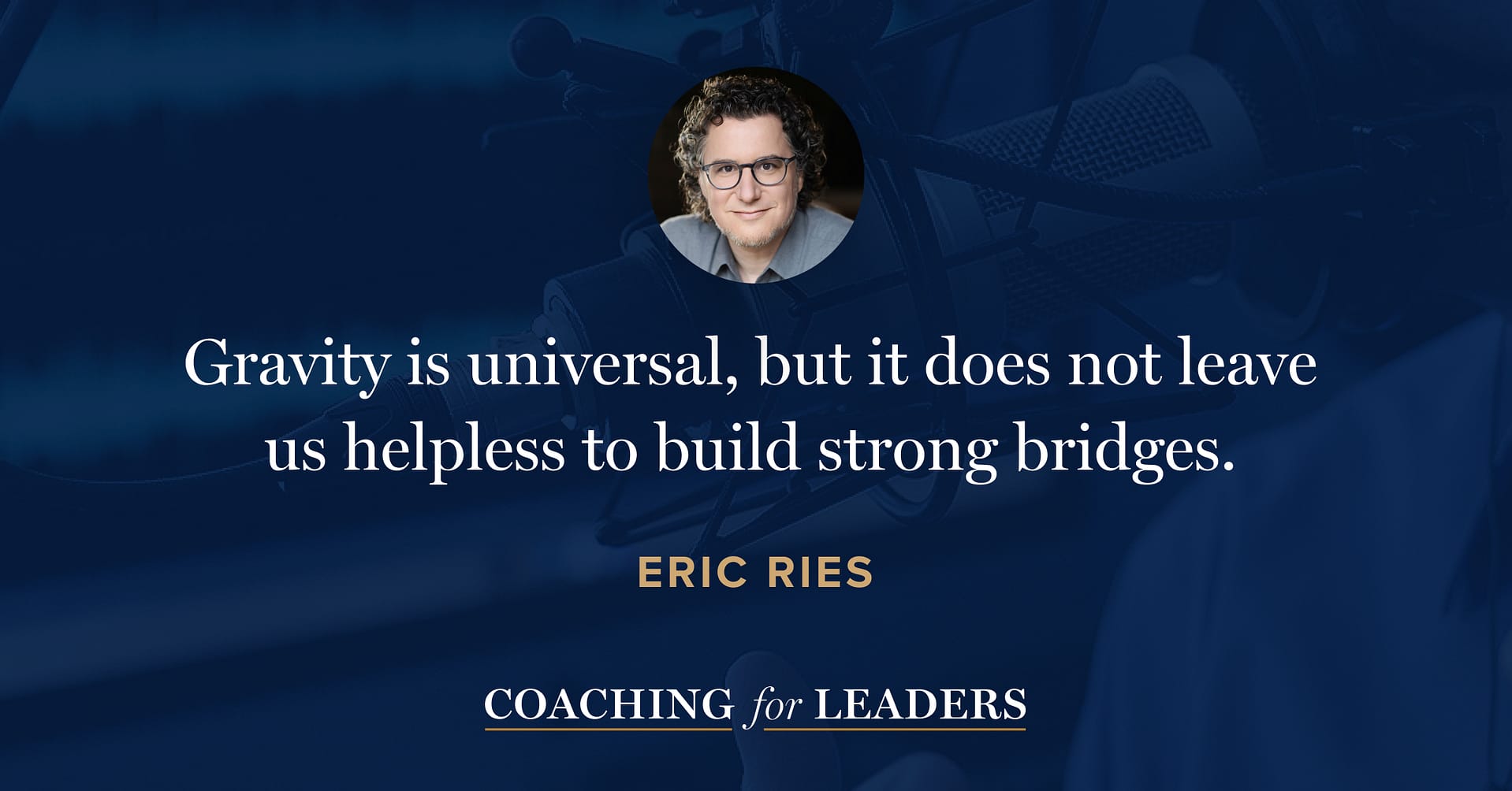
Gravity is universal, but it does not leave us helpless to build strong bridges.
https://media.blubrry.com/coaching_for_leaders/content.blubrry.com/coaching_for_leaders/CFL784.mp3

Podcast: Download

Follow:
Apple PodcastsYouTube PodcastsSpotifyOvercastPocketcasts

Eric Ries: Incorruptible

Eric Ries is the creator of the Lean Startup method, and the author of the New York Times bestseller The Lean Startup, The Leader’s Guide, and The Startup Way. Over the last two decades, his ideas about continuous innovation, long-term thinking, governance, and market reform have reshaped company building and management practices. He is the author of Incorruptible: Why Good Companies Go Bad…and How Great Companies Stay Great (Amazon, Bookshop)*.

If you build a great organization, the predators will come. With the right principles in place, not only can you protect what you love, but help many people flourish because of it. In this conversation, Eric and I show you exactly where to start.

Key Points

  • Most leaders are one acquisition, one IPO, one board meeting away from seeing something they love turn into something they hate.
  • If you build something great, they will come. The “they” are the predators who are willing to kill the golden goose.
  • Financial gravity is the force no one controls but everyone obeys. Appreciating its realities and laws will help you build stronger.
  • Rather than framing profit as good or bad, define profit as how you contribute to human flourishing.
  • Harder is easier. Rather than viewing principles as a burden, the best leaders see principles as opportunities.
  • Design the business model so the organization prospers only via mission attainment.

Resources Mentioned

  • Incorruptible: Why Good Companies Go Bad…and How Great Companies Stay Great by Eric Ries (Amazon, Bookshop)*

Interview Notes

Download my interview notes in PDF format (free membership required).

Related Episodes

  • Doing Better Than Zero-Sum Thinking, with Renée Mauborgne (episode 641)
  • Crafting the Modern Business Plan, with Seth Godin (episode 704)
  • Notice Disruption and Innovate Through It, with Steve Blank (episode 761)

Discover More

Activate your free membership for full access to the entire library of interviews since 2011, searchable by topic. To accelerate your learning, uncover more inside Coaching for Leaders Plus.
How to Protect the Organization You Love, with Eric Ries

Download

Dave Stachowiak [00:00:00]:
If you build a great organization, the predators will come. But with the right principles in place, not only can you protect what you love, but help many people flourish because of it. In this episode, how to do just that. This is Coaching for Leaders, episode 784.

Dave Stachowiak [00:00:20]:
Production Credit: Produced by Innovate Learning, Maximizing Human Potential.

Dave Stachowiak [00:00:29]:
Greetings to you from Orange County, California. This is Coaching for Leaders, and I’m your host, Dave Stachowiak. Leaders aren’t born, they’re made. And this weekly show helps leaders thrive at key inflection points.

Dave Stachowiak [00:00:43]:
All of us know of an organization, a business that we loved and did incredible things in our community, or maybe as a larger brand that we really loved and appreciated. And then it took a turn, for some reason. An investor came in, a private equity firm purchased it, and all of a sudden, it wasn’t the same. And there’s so much that we can do as leaders that can help protect something that’s really special in the organizations that we’ve grown. Today, a conversation about how to look at that in a different way, and how to reframe some of the language we often think about in organizations in a way that helps protect great things to help us all flourish even more. I’m so pleased to welcome to the show Eric Ries. Eric is the creator of the Lean Startup Method and the author of the New York Times bestseller The Lean Startup, The Leader’s Guide, and The Startup Way. Over the last two decades, his ideas about continuous innovation, long-term thinking, governance, and market reform have reshaped company building and management practices.

Dave Stachowiak [00:01:47]:
He is the author of Why Good Companies Go Bad and How Great Companies Stay Great. Eric, a pleasure to have you on.

Eric Ries [00:01:56]:
Oh, it’s really my pleasure. Thanks for having me on.

Dave Stachowiak [00:01:58]:
I read the Lean Startup, I think 10 or 15 years ago, when I started Coaching for Leaders or close to it, and had I not read it, I’m not sure I would be doing what I’m doing today. So thank you so much for your generosity of your work, and your consistency for so many years. I really appreciate it.

Eric Ries [00:02:16]:
Well, thank you for saying that. That’s really kind.

Dave Stachowiak [00:02:18]:
I’d love to start with a story that goes way further back, from the 1800s, a story of Robert Owen. And you tell this story in the book, you tell it as a tragedy. Could you share the story of Robert Owen and what is it he did and what happened to him?

Eric Ries [00:02:38]:
Sure, sure. I really like this story. It’s so instructional because, if you hadn’t already said that this story took place in the 19th century. If you didn’t already know that the story begins in the year 1800… It’s a completely contemporary story in so many remarkable ways, and as you’ll, as your listeners will hear from themselves in a moment. So Robert Owen was this really ahead-of-his-time business magnate in Scotland in the 19th century. And he took over this thing called the New Lanark Mills at a time when child labor was super common, when workers were seen as really like the main liability of business and as a cost center.

Eric Ries [00:03:16]:
So people worked excessively long hours in incredibly cruel conditions. Workplace discipline, you know, we talk about feedback and discipline at work, was like corporal punishment. Okay? That’s the era we’re talking about. And Owen had this really far-sighted idea that, what he called, he would go around, he would lecture to other industrialists, and he’d be like, listen, you spend so much money on machinery. This is the dawn of the industrial revolution, right? People are just starting to understand capital expenditures, what we call capex. You invest so much money in improving the efficiency of your machines. What if, you know, hear me out, but what if you treated your vital machines, the human beings that worked for you, with the same care? Wouldn’t that be better? And so he took over this mill, and he started to enact a series of reforms, like one after the other, that were like at least 100, and in many cases 200 years ahead of their time. Like really advanced stuff.

Eric Ries [00:04:07]:
I don’t even have time to go over all of the reforms are so, so, so many. And his theory was, was as follows: three-step plan to take over the world. Step one, to prove that his ideas could work in an industrial setting, that this was not some kind of nonprofit generosity, but rather, this was a business strategy that could make money. Second part of the strategy was then, because capitalism selects for value creation, we work in a market economy, every capitalist is trying to get ahead, trying to get some advantage on their fellows. So by showing them that this was a better way of working, he thought of it almost like a breakthrough new technology that other industrialists would naturally copy because, of course, they want to get ahead.

Eric Ries [00:04:53]:
And step three, my favorite part of the plan, he said, once you set this prosperity cascade in motion, it will become unavoidable, inevitable, unstoppable. Because those who attack it and say that it’s not going to work, or refuse to do it through their own ignorance, actually would help strengthen it. Because by refusing to adopt these methods or even attacking them, they would put themselves at a competitive disadvantage, and they would create yet more data to prove that this idea was a good one, and therefore it would take over the world. Now, some of you are listening, being like, that sounds like a really good plan.

Dave Stachowiak [00:05:28]:
Yeah.

Eric Ries [00:05:29]:
But I can’t help but look around and notice that Robert Owen did not, in fact, take over the world. What went wrong? Well, let’s go through the plan steps one by one. First of all, did it work? Absolutely. The mill went from bankruptcy to being incredibly productive, quadrupling its valuation, I think, within a few years. It had legendary high quality, high morale, high retention of employees. He would do things that are so modern. He would, there would be a downturn in inflation, or a downturn in demand, and instead of laying people off, he would pay them anyway to have them invest in efficiency improvements around the mill.

Eric Ries [00:06:02]:
So the loyalty was off the charts, the quality was off the charts. It was just, it was basically a success by whatever metric you choose to measure. Okay, did his investors and fellow industrialists love this idea? Unfortunately, no. Owen was nonstop, absolutely having nonstop battles with his own investors. This happened not once, not twice, but three different times. His investors got so angry at him for, quote, unquote, “wasting so much money on the welfare of his workers” that they tried to oust him. So the first time he tried to get ousted, he had to bring in a new set of investors, including the famous utilitarian philosopher Jeremy Bentham.

Eric Ries [00:06:36]:
Which one of my favorite little tidbits. New set of investors, buy out the old investors, and keep going. It happened a third time, he had to do it a third time. And after it happened three times, the investors finally had enough, and they finally got Robert Owen out. So it took 20 years, but basically all of his efforts were for naught. Even though he proved that this absolutely would work, even though he proved that this would put his competitors at a disadvantage, even though he proved this was value-creating, he was nonetheless ousted. And of course, they set to work abandoning his reforms.

Eric Ries [00:07:08]:
Now, what’s interesting about this story, you know, in the modern era, we have lots of stories like this. You know, greedy investors take over a company, ruin it. They tend to produce more catastrophic flameouts. Here it’s not like the company went bankrupt instantly. Rather, it became what we call a cash cow. It kind of drifted along on his quality reputation until eventually mechanized mills and things like that put it out of business. By that point, the organization had no vitality left. It would have no chance to just survive a disruption of that, of that type.

Eric Ries [00:07:35]:
So, that is the tragedy of Robert Owen. And I just feel like he’s such an archetype for so many business leaders who have approached finding a new breakthrough way of doing business with, frankly, a level of naivete about how the market would respond to it.

Dave Stachowiak [00:07:49]:
You write, entrepreneurs like Robert Owen repeatedly discover that an enlightened approach to business can create exceptional value. They assume the market will therefore reward and protect what they have built. Then they watch helplessly at what they’ve built systematically unravels. And as you mentioned, this comes up again and again and again. And there are so many examples in the book, it’s daunting on how many, even just in the last 10, 15 years, of how many organizations go through this pattern. And one of the headings in the book is titled “Of the force that no one controls but everyone obeys”. Tell me about that force.

Eric Ries [00:08:31]:
Yeah, so this took me a long time to understand, and when I first figured it out, I was actually really depressed. Like, it’s, it’s actually really sad. And you start to think about how long this has been going on. Robert Owen is an archetype of a pattern that’s been happening for more than 200 years. Probably it’s been going on longer if we had good documentation for it. And no matter how you measure it, it seems to be getting worse. So all of us now and Robert Owens say this would have been a relatively rare occurrence. But now all of us, every single person I talk to knows their favorite brand, their favorite company taken over by private equity or ruined in some way.

Eric Ries [00:09:08]:
And we know so many stories of founder-led, founder-driven companies who failed the test of succession. Companies that started out incredibly idealistic and then became malign or bureaucratic. This is now a fixture of our modern reality. So it’s sad, it’s sad to feel like, wow, is there really a law of nature that is causing this enlightened way of working to be ruined? But no, it’s not a law of nature, but it is a physical force, I call it financial gravity. And it’s one of the big ideas in the book that, we have to start to look beyond just leadership, culture, values, operations, like the surface level attributes of organizations. To understand what’s going on, we have to understand them at a deeper level. And so in the book, I tried to bring in metaphors from biology and from physics to think about every human being, but also every animal on earth evolved under the presence of the Earth’s gravity. So whatever else may be distinctive about every kind of organism you can think of, what they all have in common is they had to develop strategies to adapt to the reality of gravity.

Eric Ries [00:10:13]:
Financial gravity is similar. It is this force that our financial system broadcasts that warps people’s behavior, often unconsciously. And in the case of Robert Owen and many, many leaders like him, I tell quite a few of these stories in the book, what happens is because we think our market system rewards competitive advantage, it rewards value creation. Therefore, we go in with this very naive view that if we just do the right thing, create a lot of success, have a lot of leverage, we’ll be able to build the kind of company that we want, only to be shocked that success attracts predators. And so, gravity is the mechanism by which this happens, where people feel like what gets rewarded is turning the trustworthiness of these great companies into something that could be exploited for short-term profit. So we see these behaviors of extraction, of kind of betraying customers, betraying investors, betraying employees, we see those things in our modern world as super profitable.

Eric Ries [00:11:10]:
And I have this giant chart in the book of just dozens and dozens of companies, where they failed, not because they did, they made a mistake, or they screwed up somehow, but their failure was caused by their success. The success attracted people to them who dismantled the thing. So this naivete, I think, is one of the big problems that we deal with today, because we’ve been taught in ideology that this will kind of happen automatically. So part of the book is about how do we protect an organization from these forces that can cause- In the book, I just come straight out and call it corruption, because to me, making money without creating value is a corrupt act. But what’s strange about financial gravity is, although it seems like a universal law, there are these outliers, there are these exceptions. Most people can name at least one company that they’re familiar with that is an exception or an outlier. But that’s actually a really big deal, because if it was a universal law, there would be no exceptions.

Eric Ries [00:12:06]:
And in fact, as I started to study the exceptions, according to modern business financial theory, best practices, these outliers should not exist. They violate almost every best practice we are told is necessary to create a thriving and scalable business. And yet, they do. So, although we’re familiar with them, their very familiarity, I think, blinds us to how strange it is that there are these outliers in our midst. And so part of what I want to do with this book is try to understand the history, the physics, but also, what can we do about it? What can we learn from these outliers to start to apply their lessons into our own lives so that we can start building organizations where what happened to Robert Owen won’t happen to us? We need to protect our organization so it never falls to the temptation to switch over to one of those corrupt ways of making money.

Dave Stachowiak [00:12:51]:
And the good news is that, once you accept the realities of, I think gravity is a perfect analogy for this. Like, once you accept the math that Isaac Newton first wrote down, right? And you think about it, then it opens up the opportunity to think, okay, given that reality, now how do I design around it? How do I design an airplane to make it fly in the midst of gravity? How do I build a bridge that stands the test of time, and is completely safe, and doesn’t fall into the river? Right? I mean, there’s so much opportunity to do that. And you’ve created a bit of a blueprint around that. And it starts, first of all, with creating something worth protecting, right? But which, that’s, I don’t want to call that the easy part, but that’s probably the, the more obvious part. The part that I think we miss is the, how do you build it with structural integrity? And one of the invitations you make for us is shifting how we think about the word profit. Tell me more about that.

Eric Ries [00:13:55]:
Yeah, this is going to strike some of your listeners as strange, but I think it’s critically important. It was a transformational moment in my own life when I made this shift, and it has made my life so much easier in so many ways. Taking all these dilemmas, and I’m not talking about moral dilemmas, I’m about strategic dilemmas, that I used to find really difficult and complicated, and just made them simple. So a lot of my own success personally, has just been powered by having this, this revelation. And yet, when people hear it for the first time, they often find it a little bit scary. So I’ll just, you know, just stay it, I’ll state it plainly, and then work through why I think this is right.

Eric Ries [00:14:32]:
Everyone thinks they know what it means to make a profit. It’s probably the dumbest question I ever ask. And whenever I ask a founder, I’m always like, hey, do you know what it means to be a for-profit business? And they look at me with just such contempt, like, duh, everybody knows that. But I’m like, well, just explain it to me, right? Explain it to me. And they’re like, well, yeah, profit is, you know, you, you make more money than you spend, so you have extra money left over, what economists call value added, we make a value added transformation. We turn A$50 of wood into A$200 table.

Eric Ries [00:14:58]:
The profit is the remainder. And so that’s like our formal definition we carry around in our heads. But I actually think, if the current definition of profit can’t see deferred liabilities, is blind to negative externalities, is willing to treat a human being as an input factor of production, which is disgusting, and it’s completely out of alignment with the intuition of most builders, what good is it? Like why, why are we slaves to this definition? Why don’t we adopt our own better one? Here’s mine. I think making a profit is about the maximization of human flourishing. That’s what it means. So no, Philip Morris is not profitable. Easy, simple, simple answer. And the Smithsonian Institute is super profitable.

Eric Ries [00:15:35]:
That’s great. So today we call certain organizations nonprofit and other organizations for-profit. But what that really means in practice, nonprofits are simply accountable to themselves, to their own board. They are what I would call autonomous or self-controlled organizations. And for profit companies today, unfortunately, practically means investor-controlled companies. So like, why is that the most important distinction? Why do we, why do we allow that to be where we call for-profit nonprofit? It’s much better, in my opinion, to create what I call mission-controlled companies, that can break this false dichotomy between for-profit and nonprofit. In fact, in the book, I walk through a bunch of these, as you say, structures that have structural integrity to them, that resist outside pressure effectively, that combine the best elements of nonprofit and for-profit alike. So by breaking these distinctions down, entrepreneurs, leaders, board members, but even just customers, employees, all of us can see more clearly who are the good guys in our society.

Eric Ries [00:16:30]:
Who’s actually creating value in our capitalist system, and who are the parasites where the system succeeds, not because of those people, but in spite of them. And that clarity is super valuable, no matter what kind of business decision or frankly, what kind of organizational decision we’re called on to make.

Dave Stachowiak [00:16:46]:
The distinctions you’ve highlighted are so powerful, and how we typically think about this. We often think about profit as good versus bad, and we think about for-profit versus nonprofit. And there’s a little bit of a good versus bad in that, too. That like, hangs on the thinking of a lot of the ways we frame that. And you, I mean, the invitation I hear from you so strongly is those, set that aside, don’t be thinking about those distinctions so much. Instead, human flourishing. If you really put that front and center, then it’s not about good versus bad for profit versus non-profit. It’s about what is this organization actually doing at its mission and its heart.

Eric Ries [00:17:28]:
No, that’s exactly it. It’s funny, the great Fred Reichheld, whose work I really like, he invented the net promoter score and has a bunch of stuff. He has this concept he calls bad profits versus good profits. And basically, bad profits are the money you make at the expense of the trust with a customer. And you can read his work, it’s really excellent. But what’s so interesting to me is, like so many people who have kind of figured this out, he stops one step short of saying, like, why are bad profits, profits? Let’s just, let’s just not have that anymore.

Eric Ries [00:17:58]:
And so I think it’s really important for people to realize this is not like trying to turn business into a morality purity test. Okay? This is not like anti-making money. Quite the contrary. I actually think, and I advocate for this strongly in the book, that if you can find ways to make money that are aligned with maximizing human flourishing, that is by definition an ethical thing to do. Because you’re making, you’re literally leaving the world better off than you found it.

Dave Stachowiak [00:18:18]:
Yeah.

Eric Ries [00:18:18]:
What could be better than that? So, I think one of the things that we all have to take a step back and realize is one of the benefits, one of the true benefits of living in a market economy is that not every organization is required to pay fealty, or have obeisance to the same set of values. In fact, this is a good thing. It’s good that different companies stand for different things. Now, we’ve built a system right now, where a lot of companies don’t have to stand for anything or are allowed to cynically pretend to stand for something when they really don’t. We can deal with that issue. But even for me, if I could wave a magic wand, I would still say every organization should be free, completely free, to choose its own ethos, its own character, its own purpose, and then to transparently and honestly declare what they do in defense of that purpose. And then let the chips fall where they may, let the consequences fall where they may. I think the evidence is super strong that if you align that ethos with human flourishing, you will yourself flourish.

Eric Ries [00:19:10]:
But these different people’s ideas of what human flourishing are differ widely. And that’s good. We want to- We want to allow that diversity of opinions to be expressed. So when we look at someone like a company that’s standing up for what’s right, instead of saying, are they the good guys or the bad guys, we can say things like, are they being authentic to their own purpose? Do they, in fact, stand for something? Is this a fluke, or is this baked into the structure of the organization that they have the strength to resist pressure and do the right thing? And by having this increased vocabulary for analyzing and talking about what’s going on, we as customers, as employees, as investors, we can start to factor that information into the choices that we make. So we can go work at a company that has that authentic value, that is authentically aligned with what we most care about. As customers, we can start to align ourselves with the brands and with the products that are actually making the world better as we see it.

Eric Ries [00:20:01]:
And I’ll just give one last funny story. I tell the story in the book of the Costco $50 hot dog, which is a very famous story in business. That some people like, I’ve heard it a million times, and for some people, this will be the first time hearing about it. But just very briefly, when Costco was started in the mid-80s, they started selling a hot dog and soda combo at a food cart right outside the store, and they sold it for a $50. At the time, McDonald’s Big Mac in California would have cost about $1.60. Today, that same Big Mac is between six or seven dollars, depending on where in California you buy it. Hot dog and soda combo is still $1.50. And it’s become a bit of a meme that Costco has gone to tremendous lengths to defend this price point, to make this promise to customers that we are not going to raise this price, even though they sell more of these hot dogs than all major league stadiums combined in a year.

Dave Stachowiak [00:20:47]:
Wow.

Eric Ries [00:20:48]:
So if they raise the price just a little bit, they could add a lot of pure profit right to their bottom line. So they resist that temptation. Now I tell the story about a good friend of mine named Clark, a long-time environmentalist and vegetarian activist. So for him, he hates this story because a hot dog is processed meat. It’s environmentally in front, like one of the worst kinds of things you can eat from his point of view. So he doesn’t want to say that Costco are the good guys, because they’re selling this product that is toxic. Fair enough, good point. But we can still talk about Costco without having to agree with them in every particular, because companies values are allowed to differ widely.

Eric Ries [00:21:23]:
And I would invite anyone who feels differently to go compete. Build an organization that has the values that you view as superior, and then we’ll see what the consequences of that choice turn out to be.

Dave Stachowiak [00:21:33]:
There’s so many beautiful invitations in the book for leaders. And, there’s two of them in particular that I’d love to highlight. One of them is choose a mission aligned with human flourishing. And I’m curious, when you see leaders who really embrace that and live that and put that into the ethos of their organization, what is it they do differently that most leaders don’t?

Eric Ries [00:22:00]:
Okay, let me go back to the hot dog story, because one of my favorite aspects of the story is the founder of Costco, Jim Sinegal. He was really stubborn about the whole Price thing, he learned his ethos of business from a very famous businessman named Sol Price, whose story is in the book. And Costco is powered by this very specific engine of trustworthiness, the famous capped margins. They only make 14% margin, 15% on Kirkland Signature. But they won’t make more money than they, than their principles allow on a given product. They take care of their employees in good times and bad.

Eric Ries [00:22:31]:
They do a lot of good stuff. And this hot dog is, like, become a symbol of their resistance to modern capitalism. So, anyway, a number of years ago, the then COO of the company came to Jim and said, “listen, boss, you know, we’re getting our rear ends handed to us on this hot dog. We got to raise the price”. And Sinegal said, this is now a very famous quote in business history, he said, “If you raise the price of the hot dog, I will effing kill you. Figure it out”. This quote is so famous, you can buy a T-shirt with it on it.

Eric Ries [00:23:00]:
Okay, people, people who love Costco love this story, and they love the I will effing kill you. And when people hear this story, they often asked me questions. I tell a story all the time. They ask me questions like, well, hold on, how can they afford to keep the, cut the price this?

Eric Ries [00:23:13]:
Or is the hot dog a loss leader? Or what is the business strategy like? People focus on the strategy questions that the hot dog raises. There’s questions, though, that they never ask me. Never. No one ever asks, why did the COO want to raise the price? Because of course he did. We don’t even ask that question because that’s like, if we can get away with raising prices, we’ve all been told that’s what you do. But the other thing no one ever asks is, when he said, figure it out, what does that mean? What does figure it out mean? Well, figure it out has become one of my, my favorite catchphrases. And it’s in the book a lot that these leaders who really understand being aligned with human flourishing, they recognize that being principled and having this audacious vision, it’s going to create extra difficulties all the time. Because there’s constantly going to be situations where you could do the right thing or the wrong thing, and it’s kind of easy and convenient to do the wrong thing.

Eric Ries [00:24:01]:
Everyone in your organization has been trained to do the wrong thing, it’s just like that’s the default. So you’re going to be the person constantly being a pain, real pain in the butt, being like, I’m sorry, guys, I know you want to do this easy thing, but I’m going to make your life harder. Right? I know you want to just raise the price of the hot is so much easier, but no, I’m going to insist we do all the work necessary. They don’t want to be a loss leader. They want to still make money on the hot dog, but they insist on figuring it out. So in Costco’s case, they had to vertically integrate the hot dog supply chain.

Eric Ries [00:24:25]:
They actually own and operate their own hot dogs production facilities. They went through tremendous effort for this hot dog. And a lot of leaders hear that and like, God, that seems like a lot of work for nothing. But I don’t know, Costco’s worth $400 billion for a reason. So the best leaders, instead of seeing this difficulty as a burden, they see it as an opportunity. I call the principle harder is easier. It’s actually really difficult to instill an ethos into an organization.

Eric Ries [00:24:50]:
Leaders get this wrong all the time. They assume that their personal values will automatically translate into the organization’s values. I’ve made this mistake so many times in my own career, and it’s really horrifying when you realize I built this organization, especially when you’re the founder. I built this organization from nothing, and it doesn’t reflect my values at all. What have I done? What have I done? So if you want to make it stick, I give a bunch of the techniques the like, there’s a bunch of techniques to it. And you can’t just cherry-pick one and hope it will work. But the first step to making it stick is to celebrate these moments when your ethos makes life more difficult and push the team to figure it out. One of my favorite stories about this in the book is from the company Cloudflare.

Eric Ries [00:25:29]:
Because when we talk about being purpose alignment with human flourishing, people sometimes think, oh, that’s reserved only for the really high concept, change the world activism kind of companies that work on climate change or inequality or some mega problem. But no, anyone who wants to make a product that makes customers’ lives better in the most humble ways. If you believe in quality or efficiency or beauty or anything other than enriching shareholders, under this era of shareholder primacy that we live in, you are a business revolutionary, whether you realize it or not. Because at the end of the day, the question is, what are we really committed to? What is the purpose of an organization? Is it just a financial instrument designed to enrich shareholders? I don’t think so. And very few people who build companies for a living feel that way. Yet that is what we’re supposed to pretend to believe. So Cloudflare, which is a cloud, you know, firewall in the cloud. And I like this story because Matthew Prince and his co founders, they were very anti, like mission, purpose, values, stakeholders.

Eric Ries [00:26:24]:
They didn’t like that high-fancy language. They’d gone to business school, you know, they felt like a lot of people were total fakers. And it was kind of like consultant speak, that thing you put on your, you know, you put it on a poster, on the walls, and then ignore it. They didn’t believe in that stuff. So it took them a while to embrace the idea that they were a mission-driven company. It was something they discovered more than chose. And one of their engineers put it this way, they said, the reason I like working here is that this is the first place I’ve ever worked where I feel like my job is to make a better Internet.

Eric Ries [00:26:51]:
And everyone around the table, they were having lunch, and everyone I was like, oh yeah, make a better Internet. That phrase that kept coming up, coming up, and someone was like, hey, Matthew, is that our mission? He’s like, no, we don’t have a mission. Mission statements are stupid. But over the weeks and months that followed, people kept saying, make a better Internet, make a better Internet. And his employees actually had to convince him that this was not a mission statement. It wasn’t something that a consultant came in and wrote on the walls. This was a mission expression. It was a, it was an emergent property of what the company already was.

Eric Ries [00:27:16]:
And they eventually adopted it as their official mission. In fact, they have a values, explicit values now. One of the number one, which is called, be principled, which is one of my favorites. So they have this mission, make a better Internet, and they have this value to be principled. Well, one day, this is not a few years ago, at a time when the company’s number one product, the thing that converted customers from free to paid plans, was Internet encryption. Web encryption. Everyone knows web encryption, I think if you see the Little lock icon when you go visit a website that’s SSL encryption.

Eric Ries [00:27:47]:
Today, almost all websites are encrypted by default for privacy reasons. Although this was not true back at the time when I’m telling you this story. And the story is actually a big part of the reason why it is the way that it is today. One of the engineers comes to the CEO and says, listen, boss, you know how you said the other day that our job is to make a better Internet? And you said that encryption is one of the top reasons why people pay for our product? Well, isn’t an encrypted Internet a better Internet? So why do we, why do we charge people money for encryption? Why don’t we give it away to everybody? Now, a lot of people listening to this, if you’ve ever been a middle manager in any kind of organization, you will recognize this conversation, right? You’re like, oh, God, somebody comes into my office and it’s like, hey, boss, I have a good idea. Let’s give our number one product away for free for no reason. The instinct that’s been trained into all of us as leaders is to do the following, right? Like, oh, thank you for your input. Great to have your buy-in, but let me redirect you over here to the company strategy, which you may remember is to make money, not give money away. So no, right?

Eric Ries [00:28:45]:
And so like, that’s if you’ve been trained in a more humanistic kind of place, in a more hardcore kind of place, it would be more like, smack the person in the face. Like, what are you talking about? Get out of my office. But Matthew didn’t do that into any of that. He said, he told me later, he’s like, once I saw it, I couldn’t unsee it. If we were going to be principled and be committed to this mission, then we had to do it. So he gets his team together. He’s like, everybody, we’re going to do this and give it away for free. And everyone’s like, we can’t do that.

Eric Ries [00:29:11]:
His whole team was like, it costs us real money to do encryption. We have to pay for the encrypted certificates from what are called certification authorities. We spend all this money on servers that do the cryptographic calculations related to encryption. It has hard costs. It would bankrupt the companies. That’s right. So we’re going to figure it out. Think of it like a Venn diagram.

Eric Ries [00:29:30]:
We’re going to find a way to both make a better Internet by giving this away for free and also find a way for it to not bankrupt the company. And they worked so hard for months to figure out the economics. They had to develop what’s called a contra deal with the CAs. They had to invent this whole new technology, like they invented technology. This is like gosh, 10, 15 years ago now. How long has it been? They built technology that is still state-of-the-art today. No one’s been able to replicate, just because they forced themselves to confront this problem, and nobody else would bother. Anyway, they went through a tremendous amount of effort to figure it out.

Eric Ries [00:30:00]:
And I want to really emphasize this aspect of the story, because they weren’t being blind or naive about it. They really did think through the business implications of this choice. But they also didn’t make a spreadsheet and try to calculate the ROI. They just did it because it was the right thing. And Matthew told me the story of having to go to his board and be like, “hey, I know this is the number one driver of conversion from free to paid, and we’re, but we’re going to give it away for free, and we expect conversion rates to go down”. And his board had to take a leap of faith to be like, okay, all right man, where to do it? Now, It’s true that the conversion rates went down. So a lot of companies, even at this late stage, would have panicked in reverse course because we can’t afford to have the conversion rates go down. That’s the lifeblood of our business.

Eric Ries [00:30:40]:
But of course it was offset. It’s a happy ending story, this, You know, the reduction in conversion rate was offset by a more than order magnitude increase in top of funnel. Because the trust that they gained by doing this self-sacrificing thing was so valuable, it way outweighed the temporary loss of revenue. So none of that would have been possible without this special combination of a mission aligned with human flourishing, an ethos that was deeply principled, and a leader who had the courage to say those three little words: Figure it out.

Dave Stachowiak [00:31:12]:
The second invitation I’d love to highlight is your invitation to design the business model So the organization prospers only by mission attainment. When you think about that, who is doing that really well, and what is it they do to make that work?

Eric Ries [00:31:30]:
So in the book, I tell a bunch of these stories. You know, very famously, Patagonia has a mission like this. They frequently tell their customers not to buy replacements. They are very honest with their customers. They used, they ran this big catalog ad back in the day that said everything we make pollutes. And the idea is not to get people to have to buy from them as frequently as possible, but to sell them as few things as necessary to enable the lifestyle that they want them to have. I tell the story of Devoted Health, one of the fastest growing private companies in the US, that is a healthcare company, a health insurance company that has built this incredible business model where they only make money if their customers are healthy, and therefore they have no incentive ever to betray them for money. You see it again in cases like Costco, I talk a lot about it in the book.

Eric Ries [00:32:09]:
Costco’s like a bit of a recurring character in the book, pops up a bunch of times in the book, in places you wouldn’t expect, to illustrate these different principles. So, in our modern economy, a very common form of corruption is what? In the radio industry, it was called Payola. In stock trading, it’s called payment for order flow. In grocery, it’s called stocking fees or rebates. You see it in pharmaceuticals’ rebates.

Eric Ries [00:32:31]:
Also, it’s called rebates. Basically, like whenever you have a situation where a product is sold through a distribution channel to end customers. The distribution channel has this temptation, either to sell the best product that it can to each customer or the most profitable product to each customer. And this is, although people forget this, this is a choice. You can choose which kind of those companies you want to be. I tell the story of the Mark Cuban Cost Plus Drugs Company, that’s literally what it’s called. It’s called the Mark Cuban Cost Plus Drugs Company in the book, that is trying to compete with what are called PBMs, pharmacy benefit managers, simply by selling generic medicines at a fixed markup.

Eric Ries [00:33:08]:
Very much the same, the Costco model, but applied to pharmacy, pharmaceutical drugs. I’ll tell you a funny story about it. I was in the recording studio, recording the audiobook for Incorruptible. I was literally reading the chapter about cost-plus drugs. And that same day or the day before, I got a prescription from my doctor that I tried to have filled at my regular pharmacy, and my insurance refused to cover it. And so the medicine was going to be $800.

Dave Stachowiak [00:33:33]:
Oh, wow.

Eric Ries [00:33:34]:
And I was sitting there in the recording booth, still fuming about the fact that they were going to charge me $800 for this generic medicine, I was like, so mad. I was sitting there debating, should I even? I could afford the $800, but I was like, should I go without the medicine? And of course, I’m very privileged. Think of all the people in this country who can’t afford their medications and go without essential medication because they can’t afford it. Anyway, I was really angry, and I’m reading the chapter on Cost Plus Drugs, and I actually had the moment of being like, wait a minute, I didn’t check if this medicine’s available on Cost Plus Drugs. Like, what an idiot.

Eric Ries [00:34:00]:
So I was, you know, as soon as the recording session was over, went back to my laptop and I looked it up and I, I did the thing. Cost Plus Drugs will sell me that same prescription for $8.

Dave Stachowiak [00:34:09]:
Oh, wow.

Eric Ries [00:34:10]:
Right? So now imagine if someone went to them and said, listen, will you make an exception for me and just this one medication, will you make a lot? And they just, it’s not compatible with their ethos, so, of course, not. You can’t tempt them with payola, rebates, whatever. And, you know, of course, Costco doesn’t take rebates, doesn’t take stocking fees. The companies that really have this, I call it mission drive, this incredible alignment, their life is easier because they don’t have to waste time in these meetings debating whether or not to do these stupid things. They just categorically reject them.

Dave Stachowiak [00:34:40]:
You have put together a real masterpiece of a book. And my biggest hope coming out of this conversation is that anyone who’s in the governance of an organization, a board, C-suite, executive director of a nonprofit, would grab this and really study it, because there’s so much here. Eric Ries is the author of Incorruptible: Why Good Companies Go Bad and How Great Companies Stay Great. Eric, thank you so much for your work and for sharing it with us.

Eric Ries [00:35:09]:
Oh, it’s really my pleasure, thank you so much. Thanks for a great conversation.

Dave Stachowiak [00:35:18]:
If this conversation was helpful to you, three other episodes, I’d recommend; one of them is episode 641: Doing better than zero-sum thinking. Renée Mauborgne was my guest on that episode, and we talked about the iconic series that her and W. Chan Kim have produced, Blue Ocean Strategy, and also some of the following books. And we talked about the reality that faces a lot of leaders and organizations, that when you’re building something, when you’re disrupting, when you’re trying something new, that if you want to, quote, unquote, win, that someone else needs to lose. And she and her research finds, no, not so. It’s certainly not required to do so. There’s so much you can do that does not disrupt other organizations or does not disrupt the industry, and in fact, creates something entirely new.

Dave Stachowiak [00:36:03]:
Episode 641, some great inspiration on how to do that. It’s a great compliment to this conversation. Also recommended episode 704: Crafting the modern business plan. Seth Godin was my guest on that episode. We talked about where to start with the business plan today, and more importantly, the ethics, the foundation, the authenticity that Seth is known for us. So many of the things that I’ve learned from him over the years have helped me in our work. When I read his first book, gosh, 20 years ago, or the first book I read, at least from him, he really inspired so much of my thinking on how we’ve built our organization. He’s been so gracious to come on the show a few times over the years. Episode 704, a great starting point from him.

Dave Stachowiak [00:36:43]:
And then I’d also recommend episode 761: Notice disruption and innovate through it. Steve Blank was my guest on that episode. I’m thinking about Steve for two reasons. One, because of the topic, so much is being disrupted today. How do we think about innovating through those times, and what are some of the realities, and what can we learn historically as we talk about in that conversation from it? Also thinking of Steve because he’s one of Eric’s mentors. Episode 761 for that. All of those episodes you can find on the coachingforleaders.com website.

Dave Stachowiak [00:37:13]:
And if you have not already, I’m inviting you today to set up your free membership at coachingforleaders.com. It’ll give you access to the entire library of episodes that I’ve aired since 2011, searchable by topic. We’re going to have this conversation filed under Strategy, also Entrepreneurship, a couple of other areas. You can find a ton more inside of the library. Plus, when you set up your free membership, you’ll get access to my Focus 5 message. Each week, I am finding five things on a specific topic that I think you should be paying attention to, that’ll be helpful to you. Resources in our library, more broadly, other experts. You can find that all at coachingforleaders.com. Set up your free membership, and you will be set to go.

Dave Stachowiak [00:37:53]:
Coaching for Leaders is edited by Andrew Kroeger. Next Monday, I’m glad to welcome Liane Davey to the show. We are going to discuss how to make your task list work for you. We all see those long task lists that we either have physically or digitally. We’re going to talk a lot next week on how to make it more effective. Join me for that conversation with Liane, and I’ll see you back on Monday.

Topic Areas:EntrepreneurshipStrategyValues
cover-art

Coaching for Leaders Podcast

This Monday show helps you discover leadership wisdom through insightful conversations. Independently produced weekly since 2011, Dave Stachowiak brings perspective from a thriving, global leadership academy of managers, executives, and business owners, plus more than 15 years of leadership at Dale Carnegie.

Listen Now OnApple Podcasts
  • More Options
    • YouTube Podcasts
    • Spotify
    • Overcast

Activate Your Free Membership Today

Access our entire library of Coaching for Leaders episodes from 2011, searchable by topic.
Listen to the exclusive Coaching for Leaders MemberCast with bonus content available only to members.
Start Dave’s free audio course, 10 Ways to Empower the People You Lead.
Download our weekly leadership guide, including podcast notes and advice from our expert guests.

... and much more inside the membership!

Activate Your Free Membership
IMAGE
Copyright © 2026 · Innovate Learning, LLC
  • Plus Membership
  • Academy
  • About
  • Contact
  • Dashboard
×

Log in

This site is protected by reCaptcha and the Google Privacy Policy and Terms of Service apply.
 
 
Forgot Password

Not yet a member?

Activate your free membership today.

Register For Free
×

Register for Free Membership

Access our entire library of Coaching for Leaders episodes from 2011, searchable by topic.
Listen to the exclusive Coaching for Leaders MemberCast with bonus content available only to members.
Start Dave’s free audio course, 10 Ways to Empower the People You Lead.
Download our weekly leadership guide, including podcast notes and advice from our expert guests.

... and much more inside the membership!

Price:
Free
First Name Required
Last Name Required
Invalid Username
Invalid Email
Invalid Password
Password Confirmation Doesn't Match
Password Strength  Password must be "Medium" or stronger
This site is protected by reCaptcha and the Google Privacy Policy and Terms of Service apply.
 
Loading... Please fix the errors above