• Skip to primary navigation
  • Skip to main content
  • Skip to primary sidebar

Coaching for Leaders

Leaders Aren't Born, They're Made

Login
  • Plus Membership
  • Academy
  • About
  • Contact
  • Dashboard
  • Login
Episode

761: Notice Disruption and Innovate Through It, with Steve Blank

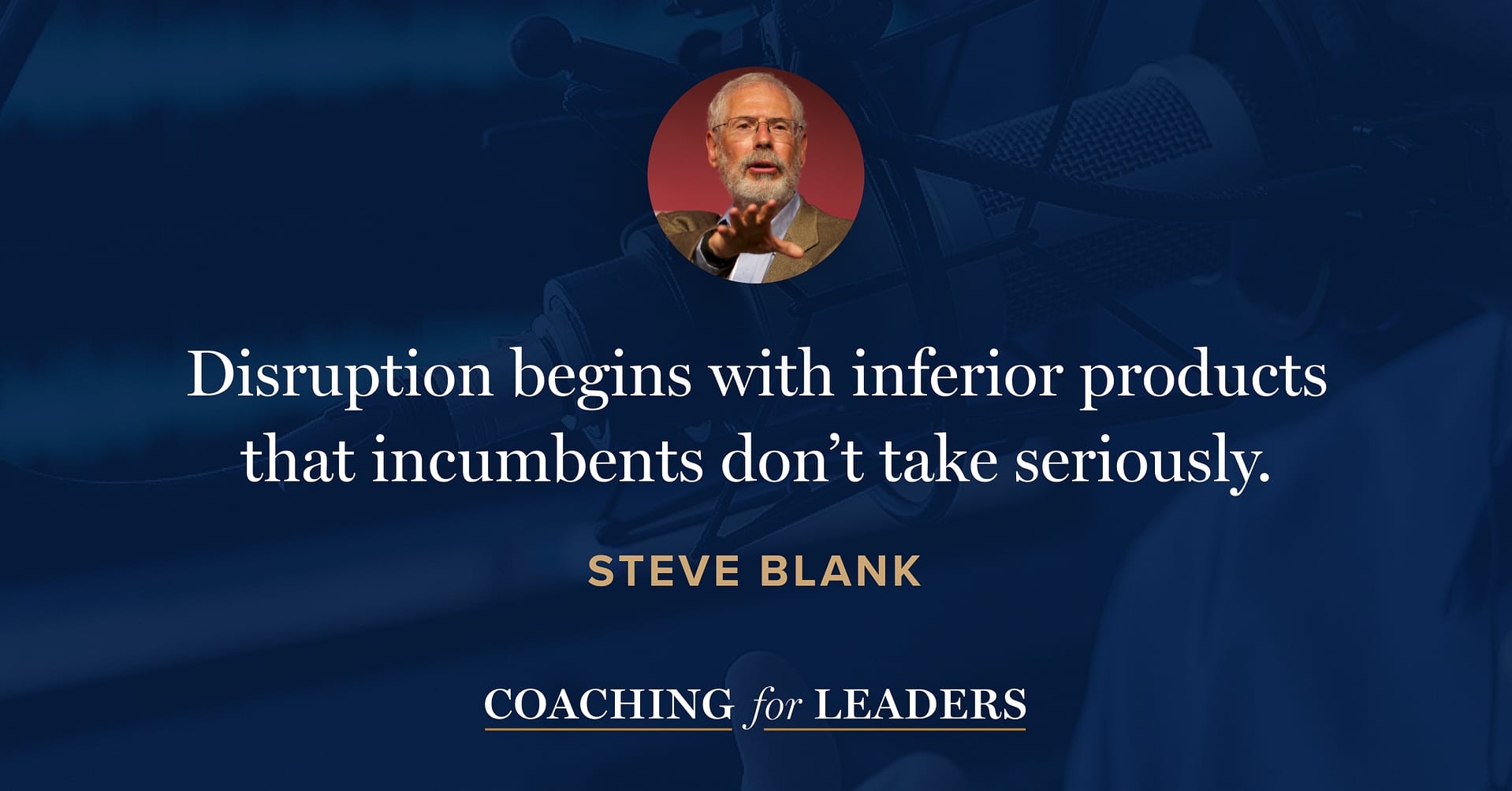
Disruption begins with inferior products that incumbents don’t take seriously.
https://media.blubrry.com/coaching_for_leaders/content.blubrry.com/coaching_for_leaders/CFL761.mp3

Podcast: Download

Follow:
Apple PodcastsYouTube PodcastsSpotifyOvercastPocketcasts

Steve Blank: Blind to Disruption

Steve Blank is an Adjunct Professor at Stanford and co-founder of the Gordian Knot Center for National Security Innovation. Credited with launching the Lean Startup movement and the curriculums for the National Science Foundation Innovation Corps and Hacking for Defense and Diplomacy, he’s changed how startups are built, how entrepreneurship is taught, how science is commercialized, and how companies and the government innovate. Steve is the author of The Four Steps to the Epiphany and The Startup Owner’s Manual and is the author of his recent article at steveblank.com: Blind to Disruption: The CEOs Who Missed the Future.

Leaders may see the future coming, but we aren’t always incentivized to act on it. In this conversation, Steve and I discuss what we can learn from the common patterns of disruption so we don’t miss what’s next.

Key Points

  • In the 1890s, there were approximately 4,000 carriage and wagon makers in the United States. Only one company made the transition to automobiles.
  • In each of the three companies that survived, it was the founders, not hired CEOs, that drove the transition.
  • Studebaker recognized that it wasn’t in the business of carriages; it was in the business of mobility.
  • Clayton Christensen taught us that disruption begins with inferior products that incumbents don’t take seriously.
  • The real problem isn’t that companies can’t see the future. It’s that they are structurally disincentivized to act on it.
  • Parsing innovation theatre vs. innovation means paying attention to what’s actually shipping. If nothing is and you want to innovate, look elsewhere.
  • Bubbles in the market are normal. Timing may be off, but that doesn’t mean disruption isn’t happening.

Resources Mentioned

  • Blind to Disruption: The CEOs Who Missed the Future by Steve Blank

Related Episodes

  • How to Start Seeing Around Corners, with Rita McGrath (episode 430)
  • How to Build an Invincible Company, with Alex Osterwalder (episode 470)
  • How to Pivot Quickly, with Steve Blank (episode 476)

Discover More

Activate your free membership for full access to the entire library of interviews since 2011, searchable by topic. To accelerate your learning, uncover more inside Coaching for Leaders Plus.
Notice Disruption and Innovate Through It, with Steve Blank

Download

Dave Stachowiak [00:00:00]:
Leaders may see the future coming, but we aren’t always incentivized to act on it. In this episode, what we can learn from the common patterns of disruption so we don’t miss what’s next. This is Coaching for Leaders, episode 761. Production Credit: Produced by Innovate Learning, maximizing human potential. Greetings to you from Orange County, California. This is Coaching for Leaders, and I’m your host, Dave Stachowiak. Leaders aren’t born, they’re made. And this weekly show helps you discover leadership wisdom through insightful conversations.

Dave Stachowiak [00:00:41]:
There’s a famous line in Ernest Hemingway’s book The Sun Also Rises that asks, how did you go bankrupt? And the answer, two ways, gradually, then suddenly. So often when disruption is happening around us, there’s signs that it’s happening, but we don’t notice it until it’s already changed substantially. Today, a conversation on how we can lead better through times of disruption. And I can’t think of anyone better to have that conversation with than Steve Blank. I’m glad to welcome Steve back to the show today. He’s an adjunct professor at Stanford and co-founder of the Gordian Knott center for National Security Innovation, credited with launching the Lean Startup movement and the curriculums for the National Science Foundation, Innovation Corps, and Hack for Defense and Diplomacy. He’s changed how startups are built, how entrepreneurship is taught, how science is commercialized, and how companies and the government innovate. Steve is the author of The Four Steps to the Epiphany and The Startup Owner’s Manual, and is the author of his recent article at steveblank.com, Blind to Disruption: The CEOs Who Missed the Future.

Dave Stachowiak [00:01:51]:
Steve, lovely to talk to you again. Welcome back.

Steve Blank [00:01:53]:
Thanks for having me. Dave, great to be here.

Dave Stachowiak [00:01:56]:
This article you wrote recently really captivated my attention, first of all, because it takes us out of the today and takes us on a bit of a history lesson back to the 1890s, which is not the time a lot of us spend time thinking about each day. And yet you went back there. What is it about this time that got you thinking about this? And an analogy for disruption.

Steve Blank [00:02:19]:
Yeah, but, you know, I’m going to answer your question with a maybe a preamble. This whole conversation started with, as you can imagine, everybody’s thinking about AI and disruption and was having coffee with someone named Alexander Osterwalder, who your audience might know from this Model Canvas and Business Model generation.

Dave Stachowiak [00:02:37]:
Yeah, he’s been on the show before.

Steve Blank [00:02:39]:
Right. And so Alex and I are friends and we. He was Going to guest lecture at my class on wicked problems in Imperial College in London. And so we were sitting there having coffee, thinking about what were some examples? And we threw a couple out and none of them, like, felt right to me. And so I left kind of thinking about what were some clear examples of industries that like, were so dominant and then literally disappeared, you know, in the classic Clinton Christensen manner. You know, every technology since the fire and the wheel have forced leaders to adapt or die. And so I was trying to find a good example and I found one, which turns out to be, you know, horse and buggy and carriage manufacturers in the United States in the early 20th century. And the story of what happened to them and who survived and how, it was just, to me, just such an illustrative example.

Steve Blank [00:03:31]:
If I was a product manager instead of a large company, I’d really like the hair would be standing up in the back of my neck. So that’s the, that was the preamble to the story.

Dave Stachowiak [00:03:41]:
Well, you set the scene in your article and write, “they were the backbone”, and they as carriage and wagon makers, “they were the backbone of mobility and the precursors of automobiles used for personal transportation, goods delivery, military logistics, public transit and more. These companies employed tens of thousands of workers and formed the heart of an ecosystem of blacksmiths, wheelwrights, saddle makers, stables and feed suppliers. And within two decades, they were gone.” And it was the automobile that came for them, right?

Steve Blank [00:04:13]:
Yeah, it was pretty amazing. It was. When I started looking at the data, there were 4,000 plus or minus carriage manufacturers in the United States. And the center of this happened to be the midwest of the U.S. south Bend, Indiana, Flint, Michigan, Cincinnati, Ohio. I mean, as you said, there were factories and equally important, as you pointed out, entire ecosystems around them. But these were hand built by essentially artisans, I mean, carriages, and then more basic wagons for hauling goods. And what’s really interesting is of course, the first cars or the prototypes of what might call cars, appeared in the 1890s, mid-1890s.

Steve Blank [00:04:51]:
And they were essentially science experiments. I mean, they were steam powered and then electric, then gasoline. And of course, if you were a carriage maker, you kind of laughed. They were loud, unreliable, you know, where do you get fuel? I mean, it wasn’t like a gasoline industry. You had to use kind of refine your own kerosene. The roads in the United States are all over the world.

Steve Blank [00:05:13]:
They weren’t paved. They were dirt roads for horses. So every car for the first 10 or 20 years were worse on every key dimension that mattered to customers. And the More. I thought about perfectly matched what Clayton Christensen’s innovator dilemma described. That disruption begins with inferior products that, you know, the incumbents just kind of laugh at. I mean, you would have laughed that I would have laughed at it. You know, this thing like, bang, bang, bang.

Steve Blank [00:05:43]:
And it made a lot of noise and was belching smoke and was scared the horses and whatever. So, you know, that was step one. But underneath that was something more interesting. But I’ll, I’ll pause here.

Dave Stachowiak [00:05:54]:
Yeah, well, I think it is really interesting. We think about it like, here’s these, this new thing. But they were loud and unreliable and expensive and hard to repair. And like, by and large, people looked at this at the time, especially folks in the carriage and wagon industry, and said, really, like, just laughing at this and like thinking about this, this experiment. And I also think, like, what’s really interesting is the early cars looked like carriages without the horse, because that’s the model everyone knew.

Steve Blank [00:06:28]:
Right? Right. So, I mean, if you think about it, the real invention at the time was an internal combustion engine with some kind of drive mechanism that made the wheels go, rather than having a horse. But gee, what you sat in was kind of, oh, I understand that. That’s a carriage. And so the early automakers just borrowed from carriage designs. They borrowed leaf springs. There were no shock absorbers, so they used leaf ring damping, which made them bouncy. But the speeds were low and carriages used solid steel or wooden axles.

Steve Blank [00:07:02]:
The early cars did the same. The car bodies were wood framed, just like a carriage. The upholstery was like a carriage. In fact, there was a company named Fisher Body that used to come from the carriage business and they continued on to the automotive motive stuff. So the early cars looked like carriages without the horse, because they were. But it took a while over time, and we’ll, we’ll talk about what happened in a second. But, but to answer your question, yeah. And the reason why, again, these were techies trying to get horseless carriages on the road, not automobiles.

Steve Blank [00:07:35]:
They were just inventing a technology and they were just impressed. This thing would, like, drive. And I think we could think of a lot of technologies like that today where the equivalent is. We’re stunned that ChatGPT gives us answers. Sometimes they’re wrong, but holy cow, look what it’s doing. But the form we’re dealing with is kind of one we’re familiar with. You could imagine that the ultimate way we’ll be dealing with AI might be completely different from the way we’re interacting with it. Now, but I digress.

Dave Stachowiak [00:08:05]:
Well, if we fast forward two decades from when cars first made their appearance, you write, “one company out of 4,000 carriage and wagon makers pivoted to automobiles, only one.” And the company that that pivoted is Studebaker. And they did something a little bit different. What did they do?

Steve Blank [00:08:27]:
Well, Studebaker was a large wagon supplier during the US Civil War. In the 1860s they supplied wagons to the Union army. And eventually they became the largest manufacturer of carriages and other horse drawn vehicles in the world. But in 1902 they started making electric vehicles. And then two years later, they started making in 1904 gasoline vehicles, first by outsourcing the engine and chassis and eventually they made the entire car by themselves. And they understood two things, and I’ll explain them tactically and then I’ll translate them for today is number one, the future wouldn’t be horse drawn. And two is the company’s core capability wasn’t in carriages. And here’s the key part, it was in mobility.

Steve Blank [00:09:16]:
And that’s the strategic part of this, is they realized their business model was not the carriage, that their business model was mobility and transportation. And that’s a big lesson to me for existing incumbent companies. You know, we could use that same model for the railroads in the 20th century. Should they have been also in the transportation business, which would have included trucking and airlines. But instead they slowly went out of business as those other industries responsible for transportation took over moving goods and services around the United States. I would be asking that same question inside of every existing company is that are we so focused on the existing product we make and not on the business model of what it is that we’re providing? So back to your point. Studebaker had that insight and they made the painful shift in manufacturing. They retooled the factories, they retrained their workforce, and by the 1910s, they were a full fledged car company.

Steve Blank [00:10:15]:
So it’s just Amazing out of 4,000 companies, 4,000, everybody seeing the same stuff, but only one of them understanding that their business model needed to change. That was the lesson for me. And the classic Christensen innovators dilemma problem.

Dave Stachowiak [00:10:31]:
Yeah, boy, there’s two things there that said that really struck me. One, like minor point. I think it’s really fascinating that Studebaker started with electric vehicles and actually then pivoted to gas, I mean, how, how interesting how things come full circle, isn’t it? And absolutely, you know, thinking today. But then the larger point which I think about, we’ve mentioned Clayton Christensen, a Couple times already. And his model of, like, jobs to be done, of like, what’s the job that your product or service is actually doing for the customer? And Studebaker got this like, they weren’t in the business of carriages, they were in the business of mobility. That’s actually what they were doing.

Dave Stachowiak [00:11:11]:
That was the job the customer was hiring them to do, get me from one place to the other. And so when the disruption happened, yes, it was still difficult, but they were able to see a path to the future because they were in the business of mobility, not in the business of carriages.

Steve Blank [00:11:26]:
And your audience, I’m sure, lives this day to day when, when you’re a product manager or even a CEO or VP of sales, you’re focused on the product, right? Not, not the job to be done. You’re selling a product, you’re managing a product, you’re adding more features to the product, et cetera, but asking the big questions of, well, what’s the business going to look like, you know? Another classic company that managed disruption and one that didn’t was Blockbuster versus Netflix. Netflix, when they were shipping CD DVDs around, was an ankle biter, meaning, you know, like, yeah, Blockbuster kind of patted them on the head. But eventually Reed Hastings saw the future was digital distribution. And Blockbuster thought their business was physically renting VHS tapes. We could take multiple examples of that. But if you’re not focused on what job does your customer want you to solve and what can you solve in a different way? And of course, the cost of solving this and the cost of making these bets are enormous.

Steve Blank [00:12:29]:
You’re essentially betting your company on seeing where the future is going to be. And there are intermediate steps you could take, obviously to ensure that perhaps you’re on the right path. But one out of 4,000, amazing number. The other thing I should mention is there are two other companies that kind of did this. I mentioned one of them earlier. Fisher Body was founded in 1908 by Fisher Brothers, and they had made carb bodies. And so their key innovation was making steel car bodies. And for 50 years after GM acquired them, body by Fisher was actually stamped into millions of GM cars.

Steve Blank [00:13:09]:
But the most interesting kind of carriage Pivot was a guy named Billy Durant and his company, Durant Dort, made carriages. And the company didn’t pivot, but Durant himself did. The apocryphal story is he saw one of the first automobiles drive up from Detroit to flint, Michigan, about 90 miles, belching smoke, breaking down, seeing a lot of noise, scaring horses. And he looked at this car and literally it was a Friday. He was at a bar, and next Monday he puts his company up for sale. And he wasn’t a technologist, but he goes down to Detroit and he realizes that this is going to be the future. And so he founded a company called Buick and then set up something called General Motors and acquired Oldsmobile, Cadillac, and 11 other car companies and accessory companies.

Steve Blank [00:13:56]:
But those are kind of the three in the history of this major transportation shift, and only three, one company that was in the carriage business and two associated with it, actually survived out of 4,000. Just amazing lessons for folks today.

Dave Stachowiak [00:14:13]:
You write on that point, “in each of the three companies that survived, it was the founders, not the CEOs, that drove the transition.”

Steve Blank [00:14:22]:
You bet.

Dave Stachowiak [00:14:22]:
What’s significant about that?

Steve Blank [00:14:24]:
Well, founders tend to always be looking over the horizon. That’s both the curse and their skill, which could be incredibly disruptive when, you know, less than 100% of founders think they’re visionaries. And data says about 98% of them are hallucinating. But it’s the 2% that move the world forward. They see things that other people don’t. Founders are closer to artists than in any other profession. They hear things that other people don’t.

Steve Blank [00:14:53]:
And they’re driven to take what they see and hear where other people can’t see it yet and create the future. And they’re fearless. Whereas other companies were willing to preserve their business and just kind of watch it sink into the ground, the founders of Studebaker and Billy Durant and others were willing to bet everything on moving it forward. Hard to do when you have activist investors today and when you have focused on maximizing shareholder return. But it’s why you see the founders of SpaceX or other companies again, I mentioned Netflix and Amazon and whatever make these bets about businesses. Where you go, I don’t see it yet. It’s hard, but that’s the nature of creative destruction in capitalism.

Steve Blank [00:15:42]:
Some figure out where disruption is happening and see where to go, and others just kind of keep plodding along in their existing business until, as you mentioned, when you start, how did you go bankrupt? Two ways. Gradually and then suddenly. That’s the nature of what happens. Yeah.

Dave Stachowiak [00:15:58]:
And so many of us have learned the lesson from Clayton Christensen that you pointed out earlier, of disruption begins with inferior products that the incumbents don’t take seriously. And part of this is an identity thing, too. Like you point out that the carriage builders didn’t see themselves as engineers or industrialists. They were Artisans and the cars that they were seeing were these dirty, noisy like, kind of like beneath them in a way.

Steve Blank [00:16:29]:
And their identity was tied up in that. I mean that’s who they believe they were. You know, I just want to pivot if I can for a second. This, you mentioned it and I kind of didn’t quite answer the question. Dealing with disruption takes a different kind of leader. Let me just be clear. Large companies get large because they master process, procedure and scale. That’s not who entrepreneurs are.

Steve Blank [00:16:52]:
They like by their very nature will put up with that. But as I said, they’re always looking over the horizon. But if you built a large company and you look around your exec staff and more importantly your board of directors, you typically find people with MBAs and financial backgrounds, which is great for scaling a company for execution, but for exploration, you know, this is thing between exploitation and exploration. They’re great at exploiting an existing business model, but they’re not particularly wired for exploration of new ones. And it doesn’t mean they can’t learn that. But again, back to your point, why are founders better at that? Well, founders are always exploring and in the time of disruption I have found that unless you have a, if you’re not going to change, your CEO might be necessary. I’ve done that once before on a board. You at least want a number two who’s whispering in their ear where they’re paying attention to the changes that are occurring around them and the consequences of missing them.

Steve Blank [00:17:57]:
And so at minimum, lessons to me for large corporations, boy, if you’re not exploring and testing and running a whole set of suite of, of new things in either labs or as private label brands etc. To kind of test out, in this case AI. But it could be 15 other new technologies. You’re going to miss this thing. And what I’ve suggested tactically to CEOs is that what you don’t realize inside your company, there’s already innovators in the bottom of your stack somewhere who are already playing with new technology, whether it’s AI or drones or make your list, you just don’t know about them yet. And so I would insist that every 90 days the C level staff get briefed on what the bottom of the organization is doing, playing with this new tech and actually start thinking about, oh, we’re already doing some of this, oh my gosh, this is what our competitors are going to be doing or an incredibly well funded startup and therefore connecting the strategy with the technology you.

Dave Stachowiak [00:18:58]:
Write on this point, “the real problem isn’t that companies can’t see the future, it’s that they are structurally disincentivized to act on it.”

Steve Blank [00:19:06]:
You bet. And the best example of this just dawned on me is Microsoft in the beginning of the 21st century. Microsoft had great people working on mobile, they had great people working on search, they had great. But if you just, you would even ask Steve Ballmer, the, you know, the issues were that their business model was all about Windows and Microsoft Office and if it didn’t fit into that structure, it wasn’t a business. Well, that’s not like how the world emerged that mobile was a business, search was a business. And so when your business model says we only do X and you don’t quite understand that these other things might be changing your business model again, Microsoft, if it wasn’t for Azure, would have been like a footnote on technology. They’re one of the whole nother conversation at some other time is about how they managed to pull the airplane out of the dive to the ground.

Dave Stachowiak [00:20:01]:
Yeah, indeed. That’s a fascinating example on this. And, and it is really like when you think especially of larger organizations, of course they are incentivized to keep going on what they’ve been doing. And if I’m someone who’s a director VP at a large organization and I kind of get this, I’m like, okay, you sold me. I know that like we should be innovating, we should be thinking about the future. I should be looking for those people in our organization that are doing this. But I don’t see the C suite moving in that direction. I don’t see the conversations happening about this and kind of taking these new things seriously.

Dave Stachowiak [00:20:43]:
What do you do? Like where do you start as far as just kind of nudging a bit this way?

Steve Blank [00:20:48]:
Well, it’s, to be honest, I would give you a long soliloquy about how to get your organization to move. If this was a 20th century conversation, but in the 21st century, I would simply say update your resume and go join a startup or join something that’s actually going to make a difference. I’ve now concluded that, and again, it might be wrong, but at least my conclusion is mid level managers trying to steer a large corporation towards disruption is an exercise in futility. If senior leadership is not willing to do that, if the board is not willing to do that at scale, I mean there’s a ton of innovation theater activities. Oh we have these accelerators and incubators and whatever. Oh yeah, but our VPS sale says it causes channel conflict or illegal, says we can’t do that or whatever. If the C suite is not actually fixing those broken things and you haven’t built an ambidextrous organization, one that executes but actually innovates simultaneously. Life is too short to kind of put up with that.

Steve Blank [00:21:51]:
But I’m not suggesting you should all leave. I’m suggesting you should all look around and say is the company structurally built to deal with innovation disruption? And I don’t mean by demos, I mean by delivering things. We sometimes confuse innovation activities inside a corporation with gee, look, we have beanbag chairs and posters and coffee cups and whatever. And then when you ask, well how much did this drop to the top or bottom line? And people change the subject and they could tell you all the reasons why the company isn’t structured to do that, that needs to come from the top that you sometimes need to restructure about. How do we build an innovation pipeline? How do we have true ambi dexterity in our company? How are we, what type of Horizon 1, 2 and 3 investments are we making either directly or by acquisition? Those are the things that a mid level manager ought to be asking and then ought to be reevaluating their careers inside that company. If they want to contribute to something exciting.

Dave Stachowiak [00:22:52]:
Yeah. And maybe they want to keep going. I love the distinction I think Safi Bahcall makes between soldiers and I think it’s soldiers and artists of like, kind of like who are you in your organization? How are things structured? And if he it, if you love doing the, keeping things going, moving on the system that’s already there, like great, wonderful, like keep doing that. And if you’re the kind of person that loves to create and innovate and challenge the status quo, then maybe you find a place within your organization to do that. But if you don’t see that to your invitation, Steve, there’s somewhere else where you can do that. There’s lots of opportunities out there of like finding that place of joy for you. And it, it made me think of, I did my graduate work in organizational behavior and I came out of part of that program initially being really sort of depressed about the possibility to influence change in an organization. Because like once you study, you get into it, you read all the case studies, you look at the examples, you think like, wow, how hard it is to affect change inside of a large system.

Dave Stachowiak [00:23:55]:
And once I got past that initial response, I realized like, once you sort of get that and you make peace with that then you can decide, where can I affect change? Like, where do I make peace with the system that is, and if I want to affect change, where do I find that within the system? And also where do I maybe get out of the system and go somewhere new?

Steve Blank [00:24:18]:
Absolutely. I think what you just articulated is a much more sophisticated discussion of what I said. But truly, if you’re interested in innovation inside your company, you should be looking around and asking, are we creating innovation theater or are we actually delivering innovation? They’re not the same. And therefore you should be asking yourself, is this where I want to keep banging my head against the wall.

Dave Stachowiak [00:24:42]:
When you say innovation theater versus actual innovation. I think almost every company has some version of innovation theater. Much fewer actually are doing innovation. How do you know the difference?

Steve Blank [00:24:54]:
Well, you know, I, I tend to be maybe simplistic, but I’d rather describe it as practical. How much of the stuff is that that you’re actually, quote, innovating on is being delivered to customers, Period. And if, and by the way, not how many fail because you built an MVP and customers didn’t want it, but that your own internal processes killed it? Remember, large companies build processes and procedures for scale so that things don’t go off the rail. Or you don’t have individual mavericks spending a million dollars doing the wrong thing, but those same processes and procedures, which work great for execution, strangle innovation in its crib. The classic is BPS sales saying, well, that’ll create conflict with our channel. Or gee, that’ll confuse our customers. Or you can’t pre announce that. Or worse, the general counsel saying, well, I’ll go to jail for that.

Steve Blank [00:25:46]:
Well, guess what? You just killed Uber or Airbnb or whatever that should have been done by Marriott or Avis or something else. Or gee, the state attorney generals are going to go after us. Well, that would have killed PayPal or, or gee, all the auto dealers are going to sue us. Well, that would have killed Tesla distribution in the United States. And, or gee, we have no travel budget for that. Well, you’re an innovator. You need to go to these conferences. So if we don’t have a, what I call an Appendix A to all the processes and procedures that make sense for 99% of the company, but we don’t have different procedures for people who are in what I call an innovation pipeline to accelerate delivery and deployment with again, guardrails against.

Steve Blank [00:26:32]:
Let’s not kill the brand. Let’s make sure we’re not violating any federal, state and local laws, etcetera. But Unless those, those alternate pathways exist, you’re going to be doing a lot of demos and the CEO will take a lot of photos and whatever, but stuff to get out of the building. Pretty low hit rate. That’s how I would measure innovation versus innovation theater.

Dave Stachowiak [00:26:54]:
I love the distinction. We undoubtedly are in the midst of a disruption right now with AI and what it looks like next is of course hotly debated and nobody really knows. And one of the narratives that’s emerging right now is that, okay, is this perhaps a bubble? Is it like the dot com bubble back in 2000? And I just saw last night, the conference board noted that CEO confidence is down. And of course there’s all this geopolitical change. We’re way overdue for a market correction and have been for years. If it is a bubble and there is a huge correction coming in, AI, how does that change how leaders should be thinking about disruption and innovation during this time?

Steve Blank [00:27:47]:
Well, this is kind of funny. It’s probably the third or fourth bubble I lived through when history talks about tons of bubbles, starting with the Dutch tulip mania in the 1500s. And the railroads had a bubble in both the UK and the US and the Internet bubble was interesting not just for software companies, but actually telecom companies. They laid tens of thousands of miles of fiber optics and then they were unused. But it turns out they were only unused for five or 10 years and that dark fiber eventually became the backbone of Web 2.0. Someone else bought those assets and were able to build on top of them. I think what’s really interesting is to me, distinguishing what happens in a bubble and out of a bubble is a pretty good metric. And it goes as follows.

Steve Blank [00:28:36]:
In a bubble, revenue and valuation become extremely disconnected. Guess what? Take a look at everything that has the word AI in it and look at its market cap versus the actual revenue. Very few companies, though some accepted like OpenAI, are actually delivering real revenue, but others are just delivering valuation for their investors. And so it’s a financial engineering game in the bubble. When the bubble pops, here’s what happens. Note to all startups that what investors immediately flip back to is great, wonderful valuation you had in that bubble. Show me your revenue. And if you’re not delivering revenue and profit when the bubble bursts, then you’re going to go out of business because all the capital you raised is all the capital you’re ever going to raise.

Dave Stachowiak [00:29:23]:
And I think you paint a picture of the long game too on this. I remember when I moved to California in 1999, within my first month or so here there was this company that had, remember they had a peach symbol on the side of their truck. It was a dot com start. I can’t remember the name of the company, but they delivered groceries to your house, Steve. It was amazing. I remember the truck pulling up and I ordered the groceries. Steve Blank: it’s called Webvan.

Dave Stachowiak [00:29:53]:
Okay, good. You remember. So the ice cream was a little melted. They had forgotten something the first order. But I remember like I still remember sitting there looking at all the groceries on my counter that I didn’t go to the store for and thinking to myself, oh my goodness, this is amazing. And six months later that company was gone along with a lot of the other dot com companies. And yet the bigger and, and the story and the narrative was like, okay, like big mistake. All these companies were wrong. All that. And nowadays I order.

Dave Stachowiak [00:30:27]:
We order groceries like multiple times a week or doordash or whatever. And we don’t even think about it because it’s so part of the infrastructure. And it wasn’t that they were wrong, it’s just they were early on their timing, but they actually were right. It was. And if you look at it over the long game, how much changed during that time?

Steve Blank [00:30:45]:
So. So Dave, the Webvance story has a couple more since you started it. I’ll embellish it a bit. They went out of business because they were building these massive distribution centers which cost hundreds of millions or billions of dollars each, way ahead of their the number of customers they had, which was fine when capital was free and floating around and they went public on that and their investors sold off in the IPO or soon after and made a ton of money. But when the bubble popped, they didn’t have enough cash. They went out of business. And so Webvan was thought of as a failure and people miss the story.

Steve Blank [00:31:24]:
The company failed and employees lost their jobs, but the VCs, they cleaned up the investment banks, they did fine. And so I just want to go back to differentiating. Who makes money is sometimes completely divorced from what products you’re delivering, whether you’re making revenue and profit and the difference between the company succeeding versus your investors succeeding.

Dave Stachowiak [00:31:50]:
Steve Blank is the author of the article Blind to Disruption: The CEOs Who Missed the Future. You can find it and all of his writing at steveblank.com Steve, always appreciate your perspective and wisdom. Thanks for being here.

Steve Blank [00:32:03]:
Thanks for the time, Dave.

Dave Stachowiak [00:32:10]:
If this conversation was helpful to you, three related episodes I’d recommend. One of them is is episode 430. How to Start Seeing Around Corners. Rita McGrath and I talked about how to get better at seeing the future. Yes, you can do better at developing practices to start seeing the future. Developing practices that will make it more likely that you’ll notice the kind of disruption that we talked about in this conversation. Episode 430 for more on that and how to begin. Also recommended episode 470 How to Build an Invincible Company. Alex Osterwalder was my guest on that episode and we talked about the practices of companies that do make the leap and the example Steve shared today of the one, the one company, the carriage company, that actually did make that transition. One of the things that they learned is what Alex talks about in that conversation, which is they learn to reinvent themselves.

Dave Stachowiak [00:33:02]:
Episode4 70 for more on how to do that. And then finally, I’d recommend the last conversation with Steve Blank. Episode 476 How to Pivot Quickly, Steve and I recorded that back when the pandemic was just at the beginning and of course so many organizations were needing to pivot quickly. But I keep coming back to that conversation over the years and realizing how timeless it is. It is a great complement to what we talked about today and so many of the starting points for pivoting quickly. And one key one is to start talking with the people you’re serving much earlier than most organizations do. Again, episode 476 for that all of those episodes you can find on the coachingforleaders.com website. There is an entire suite of episodes around innovation that we’ve aired over the years.

Dave Stachowiak [00:33:49]:
So many expert thinkers along with Steve and Alex and Rita and so many others who have been on the podcast. If you’re looking for more, go set up your free membership at coachingforleaders.com that’ll give you access to be able to sort the episodes that are most relevant to you right now. Whether it is under Innovation or coaching skills or management skills or handling tools, tough situations. Whatever you’re thinking about right now, the free membership allows you to do that. You can access all of the episodes that I’ve aired since 2011 on all the public apps. However, it’s hard to search by topic there. So we’ve made the free membership available for you so that you can find what’s going to be relevant to you. Plus, there’s a ton more inside the free membership.

Dave Stachowiak [00:34:29]:
My weekly guide, all of my interview and book notes, the audio courses, tons more. Go over to coachingforleaders.com set up your free membership and you’ll be off and running with us. Coaching for Leaders is edited by Andrew Kroeger. Production support is provided by Sierra Priest. Next Monday, Claude Silver and I are going to be discussing how to show up better, faster. Join me for that conversation with Claude and I’ll see you back on Monday.

Topic Areas:InnovationStrategy
cover-art

Coaching for Leaders Podcast

This Monday show helps you discover leadership wisdom through insightful conversations. Independently produced weekly since 2011, Dave Stachowiak brings perspective from a thriving, global leadership academy of managers, executives, and business owners, plus more than 15 years of leadership at Dale Carnegie.

Listen Now OnApple Podcasts
  • More Options
    • YouTube Podcasts
    • Spotify
    • Overcast

Activate Your Free Membership Today

Access our entire library of Coaching for Leaders episodes from 2011, searchable by topic.
Listen to the exclusive Coaching for Leaders MemberCast with bonus content available only to members.
Start Dave’s free audio course, 10 Ways to Empower the People You Lead.
Download our weekly leadership guide, including podcast notes and advice from our expert guests.

... and much more inside the membership!

Activate Your Free Membership
IMAGE
Copyright © 2025 · Innovate Learning, LLC
  • Plus Membership
  • Academy
  • About
  • Contact
  • Dashboard
×

Log in


Forgot Password

Not yet a member?

Activate your free membership today.

Register For Free
×

Register for Free Membership

Access our entire library of Coaching for Leaders episodes from 2011, searchable by topic.
Listen to the exclusive Coaching for Leaders MemberCast with bonus content available only to members.
Start Dave’s free audio course, 10 Ways to Empower the People You Lead.
Download our weekly leadership guide, including podcast notes and advice from our expert guests.

... and much more inside the membership!

Price:
Free
First Name Required
Last Name Required
Invalid Username
Invalid Email
Invalid Password
Password Confirmation Doesn't Match
Password Strength  Password must be "Medium" or stronger
 
Loading... Please fix the errors above