• Skip to primary navigation
  • Skip to main content
  • Skip to primary sidebar

Coaching for Leaders

Leaders Aren't Born, They're Made

Login
  • Plus Membership
  • Academy
  • About
  • Contact
  • Dashboard
  • Login
Episode

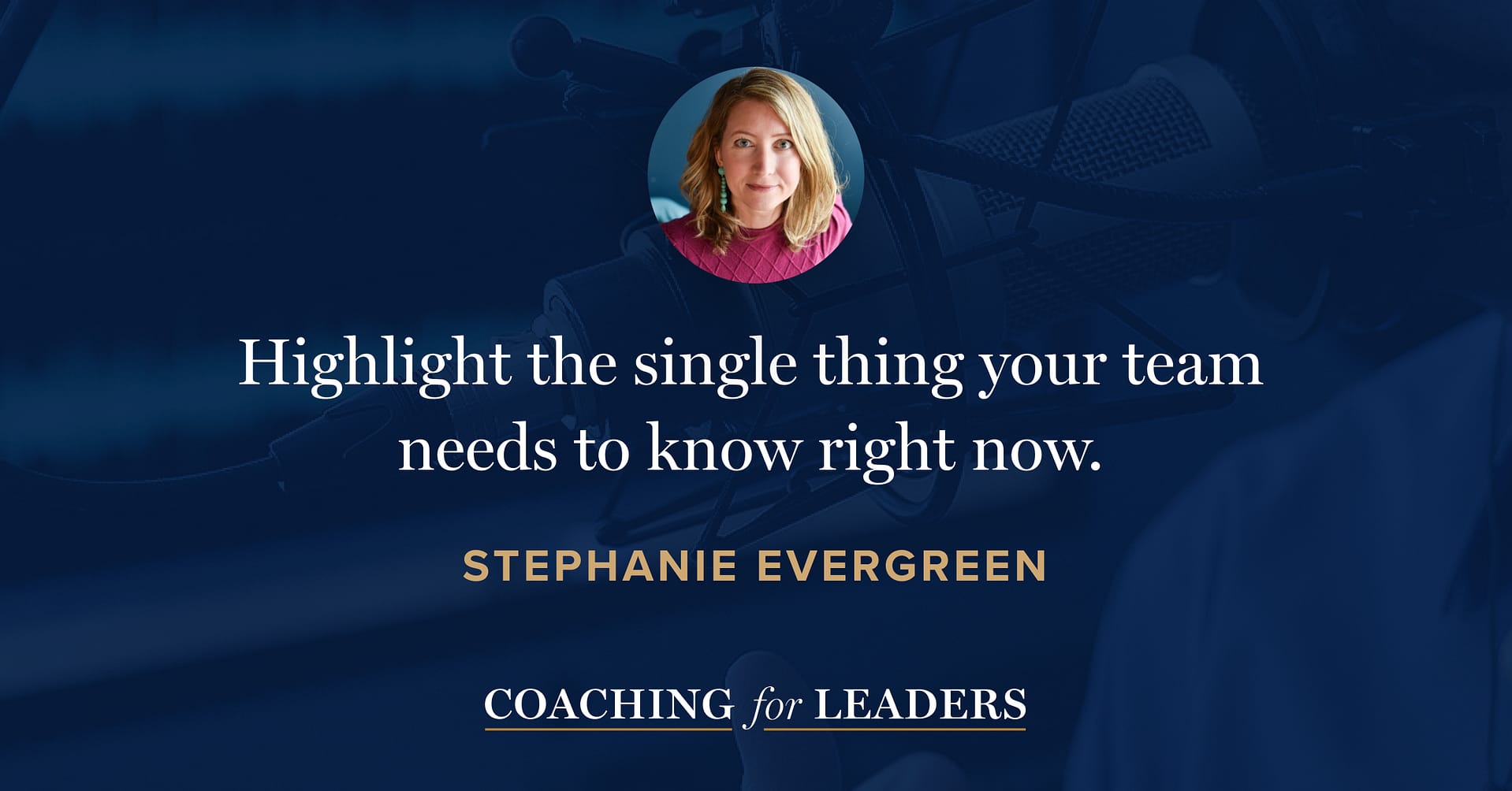
800: Make Your Message Clear, with Stephanie Evergreen

Highlight the single thing your team needs to know right now.
https://media.blubrry.com/coaching_for_leaders/content.blubrry.com/coaching_for_leaders/CFL800.mp3

Podcast: Download

Follow:
Apple PodcastsYouTube PodcastsSpotifyOvercastPocketcasts

Stephanie Evergreen: Build a Data Culture

Stephanie Evergreen is a data visualization and design expert. She has trained future data nerds worldwide through keynotes and workshops, for Fortune 500 clients like MasterCard and Facebook and mission-aligned clients like the United Nations, the Boys and Girls Club, AARP, and The Alaska Native Tribal Health Consortium. She has three books and a popular blog on data visualization.

Data: we’ve all got tons of access to it these days. But perhaps almost too much – how do we actually make sense of it and then communicate clearly with it? In this conversation, Stephanie and I explore how a leader can best use data to make their message land.

Key Points

  • Many of us are overwhelmed by access to data, but lots of leaders find that much of the data isn’t actionable for increasing performance.
  • Because dashboards attempt to answer many questions, they often result in doing a poor job of highlighting a key message or insight.
  • Instead of showing every data point you’ve ever collected, use smart formatting to highlight the single thing your team needs to know.
  • Decide in advance what the key message of a slide, chart, or presentation should be. Then, design for that clear message.
  • Answer the burning question that your audience is likely asking.
  • Leaders set the tone for transparency with data that isn’t good news. Encourage and reward hearing the honest story to establish a culture where truth is shared and addressed.

Resources Mentioned

  • Build a Data Culture by Stephanie Evergreen
  • Why Data-Packed Meetings Miss the Mark (And What to Do About It) by Stephanie Evergreen

Related Episodes

  • Performance Measurement That Gets Results, with Stacey Barr (episode 419)
  • The Way to Influence Executives, with Nancy Duarte (episode 450)
  • How to Respond When You Don’t Have Resources, with Laura West (episode 699)

Discover More

Activate your free membership for full access to the entire library of interviews since 2011, searchable by topic. To accelerate your learning, uncover more inside Coaching for Leaders Plus.

Make Your Message Clear, with Stephanie Evergreen

Download

Dave Stachowiak [00:00:00]:
Data. We’ve all got access to tons of it these days, but perhaps almost too much. How do we actually make sense of it and then communicate clearly with it? In this episode, how a leader can best use data to make their message land. This is Coaching for Leaders, episode 800.

Dave Stachowiak [00:00:20]:
Production Credit: Produced by Innovate Learning, Maximizing Human Potential.

Dave Stachowiak [00:00:28]:
Greetings to you from Orange County, California. This is Coaching for Leaders, and I’m your host, Dave Stachowiak. Leaders aren’t born; they’re made. And this weekly show helps leaders thrive at key inflection points. I know one of the things that we all have on our mind is our messaging- the messaging that we have in our conversations, in meetings, in influencing stakeholders- and how do we make our message as clear as possible? Today, I’m so glad to welcome an expert who is so effective at helping people and organizations to do this well, and also effective at helping us think about the big picture and some of the nuances behind making our ideas clear. I’m so pleased to introduce Stephanie Evergreen. She is a data visualization and design expert and has trained future data nerds worldwide through keynotes and workshops for Fortune 500 clients, like Mastercard and Facebook, and mission-aligned clients like the UN, Boys and Girls Club, AARP, and the Alaska Native Tribal Health Consortium. She has 3 books and a popular blog on data visualization at stephanieevergreen.com.

Dave Stachowiak [00:01:37]:
Stephanie, such a pleasure to have you on the show.

Stephanie Evergreen [00:01:40]:
Thanks, Dave. I’ve really been looking forward to this conversation.

Dave Stachowiak [00:01:43]:
Me too. And one of the reasons I’ve been looking forward to it is because I’ve been thinking so much about your work and how we all have this— I shouldn’t say all, but a lot of us certainly have this desire to make our messaging really clear, especially when it comes to data and information. And I was struck by something that you wrote in a blog post. And it says, I’ve listened to everyone, from data analysts to CEOs, lament that they’re up to their eyeballs in data, but it isn’t effectively used to inform decisions and actions that increase performance. And I thought about that, and was thinking, wow, how I hear that a lot too from leaders and stakeholders. And I’m wondering, what do you see most often when you see people running into that and struggling with it, with just overload?

Stephanie Evergreen [00:02:38]:
So this is a good question and a common problem. And I think that the reason we got here is different for the different kind of employee group that we are talking about. In my experience, my background is in data. I used to be like the analyst kind of person. And we are trained so deeply to understand data and the context and how to read charts that we can see a chart and immediately read into it and pull out the story that it’s trying to tell.

Dave Stachowiak [00:03:11]:
Hmm.

Stephanie Evergreen [00:03:11]:
But our audiences do not have that kind of background. Our audiences aren’t knee-deep in the data every minute of the day. So they need a little more help. They need us to explain the story that we think should be evident to everyone else so that they can understand it. So we see that we have decision makers. Sometimes those decision makers are the public. Sometimes it’s the analyst’s boss or the boss’s boss. And we’re talking to the decision makers that are in the C-suite.

Stephanie Evergreen [00:03:37]:
But those people need the data to be translated a little bit, so that the things that the analyst thinks are evident are actually articulated.

Dave Stachowiak [00:03:47]:
One of our fellows, Jesprit, is a big fan of your work and introduced us originally. And she was talking with me about some of your work. And she made the point to me that a lot of us got trained in school, in graduate programs, in formal trainings, where sort of the mantra in the academic world is you put all your data out there, you share it with everyone, then you put it out, and you kind of let people pick it apart and review it, and come to whatever conclusion they’re going to come to. And I think it’s just really interesting how it’s so different in the workplace. Nobody has the time and bandwidth to really do that. And so it’s this really interesting disconnect for where a lot of us were trained and then, what actually works in the context of an organization that’s trying to do work.

Stephanie Evergreen [00:04:41]:
I completely agree with you. And I think when you come from an academic background in data, You’re actually told you can’t make a point and that you’d be biasing your audience if you were to tell a story that is in the dataset. So it is actually the exact opposite of what we wanna see when we’re in the workplace. And people with deep data backgrounds have a hard time making that kind of adjustment. I was just talking to a reader who told me that she’s actually seen this used in court cases where people bring up research and academic literature that doesn’t ever draw a conclusion and always says, we will always need more research to ever be able to say something definitive about this. And they’ve used it to say, see, even academics don’t think that such and such a thing is true. So this academic habit of hedging is harming us when we’re out here in the real world.

Dave Stachowiak [00:05:38]:
One of the ways that data shows up a lot in organizations is in creating and monitoring dashboards. And I think some of that comes into this too, is there’s— it’s really well-intended to get all that data out there, but they can be problematic too, right?

Stephanie Evergreen [00:05:56]:
I have rarely seen a dashboard actually work, if I’m being honest with you, Dave. And when I tell this to the organizations that I consult with, I get a room full of laughter because everybody knows that that’s true.

Dave Stachowiak [00:06:10]:
Hmm. What is it that doesn’t work? Because, like, so often we’re like clamoring to make dashboards and to make things more visible.

Stephanie Evergreen [00:06:17]:
Yes, yes. I think there are a couple of different things that are happening that make dashboards not successful. First of all, I think we try to make too many people happy in one dashboard, but that’s not going to work, because our audiences are all going to have very different questions that they need the data to answer in order for them to do their job effectively. The CEO is going to have different questions than the COO, who is going to have different questions than maybe your direct supervisor, who may want to, like, dig down into the weeds a little bit more. But because those audiences all have very different questions, we’re trying to make everyone happy by answering all questions in one dashboard. And then we have a dashboard that is so crammed and so hard to get through and has a bunch of stuff that’s irrelevant to the particular viewer, that no one actually likes using it.

Dave Stachowiak [00:07:09]:
This kind of comes back to the earlier point of all of a sudden you have all this data and information, and you’re up to your eyeballs in data, and yet there isn’t necessarily a clear message. And one of the things that I hear in your work, in you inviting people to do, is get really clear on the message that you want to send and get down to a single thing. What does that sound like when you’re doing that better?

Stephanie Evergreen [00:07:37]:
So what that looks like in practice is that we walk through one thing at a time. One of the things that we know about human cognition is that our working memory struggles to multitask. We’ve seen this fact show up in lots of different ways in our lives, but it also shows up in how we consume data in, like, a review meeting. We can really only process one point at a time. So trying not to cram too much into one slide or into one dashboard, that’s going to help just ease the cognitive load on people’s working memory. And sometimes that goes against company culture, because some companies have rules like, you can only have 6 slides. And so we try to cram as much in there as we can. This requires a little bit of organizational culture change.

Stephanie Evergreen [00:08:28]:
Then I think another piece of this that’s very important is making sure that we use the chart title space, or if it’s in a PowerPoint, that slide title space to just plainly tell people the story that the data is showing. Like, we use a full sentence, and we just articulate the whole point. So for example, rather than saying something like campaign performance review, we might say something like direct traffic converted twice as much as paid social, right? Like we’re going to say a whole point so that our audiences don’t have to do all of the heavy lift to dig into what we were originally showing about campaign performance review to pull out what’s important and actionable.

Dave Stachowiak [00:09:14]:
There’s a really big piece of this that I think you’re saying that is just so important, even more so than the design and what it looks like. It is I, as the person who’s bringing the information, the data, have decided in advance what is the most important thing, the most important message that this audience needs to hear from this particular slide, data point, presentation, whatever. And I’ve made that decision, and then I’m doing the tactical things and the design things to support the decision that I’ve made to get that message across.

Stephanie Evergreen [00:09:50]:
That’s exactly right. And the way to know what you should be saying is to go back to the audience that’s going to be in the room. The decisions that are going to be on the table, and what your audience’s biggest burning questions are going to be. That’s, that’s all that you really need to know to be able to figure out, out of the giant mountain of data that we have collected, what pieces you will pull out, and what kind of answers you will construct based off of that data. You’re just going to pull out the data that answers those big burning questions for that audience in that room at that time.

Dave Stachowiak [00:10:25]:
And once you know what that is and you’ve determined that, then the design part, like how you highlight it, the message you put on the slides, the simplicity of all that becomes a lot easier tactically to decide, “All right, here’s what I’m going to highlight. Here’s what I’m going to leave out for this particular audience”. Or maybe, like, “I’ve got the slide, but I don’t necessarily show it because I want to highlight this particular message because I know that’s what this audience needs to hear”.

Stephanie Evergreen [00:10:48]:
Exactly. It even helps you edit how much data am I going to put on the slide or what pieces of the, of this dataset can I edit out because it’s irrelevant to the point that we’re trying to make here. And that simplifies what we are all looking at at the same time so that we can just have the conversations that we need to have and make the decisions that, that we need to make and get on to the business that we’re here to do.

Dave Stachowiak [00:11:11]:
I was thinking about what you said a moment ago too, of like, there’s an aspect of culture for every organization too. Like some cultures have, “hey, we just have a 6-slide limit or a way we present data”. And, I was thinking back to an engineering firm that I supported years ago. And the culture of that firm was everything that’s ever been thought about, discussed, considered, dreamed about went on the PowerPoint slide. And it was like you would look at their slides, and it was absolute madness, like just to decipher anything that was there. And they would push back on me because I was— part of the reason I was there was to help them to get clear on their messaging. And they would say, “well, hey, I get it that my message should be clear. But if I walk in with a slide that only has one line and just the simple message, the vice president in the room is going to be like, ‘ Where’s the rest of the data?” And one of the things that I think is really interesting about what you said is once you’ve decided that, you could still have the crazy slide, like if that’s what your organization needs culturally.

Dave Stachowiak [00:12:20]:
But you could then say, “Here, you know, here’s the slide, and I’m putting a circle around the part that’s really relevant, and I want you to see and notice”. And you can still point out, if you’ve decided in advance, you can still point out what the message is and really tell the story that that audience needs to hear.

Stephanie Evergreen [00:12:37]:
That’s a great point. You absolutely can do that. My philosophy is that if you have a slide’s title that is crystal clear about the message, and then the evidence that you’re showing to support that point is messy or chaotic or cluttered, then it’s still probably going to do half the job because you’ve already done the pre-work to know what the story is. A lot of data analysts don’t have that kind of training in business environments and in business decision-making. So I think it can take a bit of time to get comfortable expressing claims and viewpoints that the data show because of that business mindset that has to happen. But you were working with engineers, and that’s— that matches my experience too. The smarter the organization, the more they hold on to those vestiges of academia that say you have to show all of your work or else we don’t trust you.

Stephanie Evergreen [00:13:38]:
In academia, your work is always supposed to be replicable. So you have to show every detail of everything you’ve done in case anybody wants to go double-check any part of it.

Dave Stachowiak [00:13:47]:
Right.

Stephanie Evergreen [00:13:48]:
But in the business world, people don’t want to see that. In fact, they kind of hired you because they trust that you know what you’re doing. And they probably still hope you have those details saved somewhere on your hard drive, but they don’t need you to walk them through it every time. And that’s a big culture shift.

Dave Stachowiak [00:14:05]:
Yeah, and when you work with a team or a leader, and they start to make that shift a bit from the, “OK, I just need to share everything and have all of my i’s dotted, t’s crossed, all of that”. And they make the shift a little bit to say, “OK, I get that I need to still have the data, and it’s somewhere if we need it”, but to have a more simplified, concise message. What is it that they do, either in practice or their thinking, that helps them to bridge that gap just a little bit?

Stephanie Evergreen [00:14:39]:
When we train people on effective data storytelling, we tell them that you want to make a particular point based on your data to a particular audience, and you want that point to answer your audience’s big burning questions. But most of the time, the people that I am training don’t know their audience’s big burning questions. They don’t know the big stuff. They, they think they know what they hear their boss asking for once in a while. But there seems to be a bit of a black box there, where the staff don’t really know exactly what their leadership wants to see from them. So they’re guessing in the dark. So if I was a leader, I think the thing that would help the most is to tell everybody what the main questions are for whatever meeting their team is coming to, so that they don’t have to guess and they can just pull the right stuff. What I see analysts often tell me is that they just get a request for data.

Stephanie Evergreen [00:15:42]:
I want to see the campaign performance review from Q2, but they’re not asking a question. So the analyst can’t really figure out how to answer it correctly. So rather than ask for a data pull, let’s get specific questions that your analyst can help answer.

Dave Stachowiak [00:16:00]:
Love it. Thank you. So helpful. Okay. There’s a nuance to this too. And the nuance is— and I’ve had this happen in my career, and I’m sure you have too, and I know a lot of other folks have too— is you show up for a meeting and you put slide number 3 up on last quarter’s results. And there’s a couple of data points in row 3 on column D, whatever, that do not tell a good story. And they don’t tell a good story about your team, your organization…

Dave Stachowiak [00:16:33]:
Someone dropped the ball. Something wasn’t figured out. There was a mistake made. And I think we’ve all been in that situation. And sometimes we’ve sort of consciously thought, hmm, maybe I’m not going to call attention to the number on the slide that doesn’t look so good, right? And I think sometimes subconsciously, we just do it too. Like, we sort of go through that mode of, I owe it to my stakeholders, whoever they are, to show the data and tell the story as accurately as possible. But I might not call attention to, like, that row where there’s a story that maybe isn’t something I want to highlight.

Dave Stachowiak [00:17:09]:
And I’m wondering, when you see people run into that or you start talking about making a clear message and the story isn’t so good, how do you approach that with someone?

Stephanie Evergreen [00:17:18]:
You know, nothing makes an analyst run faster backward to their lack of storytelling than having to deliver bad news. I have seen it time and again. I have seen it in Fortune 500s, where it seemed that it was actually intentional to make messy slides so that bad performance couldn’t be spotted. But most of the time I would say it’s unintentional; people just don’t know how to go about doing this. But the reason that I think this happens is because of company culture, where people don’t feel like it’s safe to tell the truth, where being courageous in a meeting has gotten people fired. That’s the thing that has to be fixed, where there has to be a sense of psychological safety. And I can tell you a story about this.

Dave Stachowiak [00:18:10]:
Please.

Stephanie Evergreen [00:18:10]:
This story comes from a book written by a friend of a friend, that is Bryce Hoffman. He wrote a book called American Icon, and it’s about the transformation that happened at Ford. For a while there, Ford was not performing well, and so they brought in Alan Mulally, who was the CEO at Boeing, and he had been credited with turning around the airline industry after 9/11, when nobody was buying planes anymore. So he was hired in at Ford, and he brought with him his management style, which was to have very regular meetings, like weekly meetings with all of the leadership. And he said he wanted just like, one slide about what was happening in your department, and he wanted it to have a red, yellow, or green dot to show whether performance was good or bad or what. And people were coming with their one slides but with no dot. And he would get really frustrated and just dismiss the meeting because he was like, “This is wasting my time. I’m not getting what I need to get out of this”.

Stephanie Evergreen [00:19:13]:
But the culture at Ford, and I think this is the culture at many large companies, was so difficult that people were afraid to tell the truth. So after weeks of dismissing people because they weren’t doing what he said, the first person finally showed up with, I think it was a yellow dot on his slide, with the courage to tell the truth about what was happening. That person was Mark Fields, who ended up succeeding Alan Mulally as the next CEO of Ford. But, like I said, that’s not a unique situation. I see it even in small nonprofits. I see it in like, public health departments where there’s this culture where we can’t just be honest because we feel like there’s going to be some kind of blowback.

Dave Stachowiak [00:19:54]:
And sometimes there is, isn’t there? Like, that’s why people make the choice to either, again, consciously or unconsciously, like, I’m not sure I really want to, like, go into the details of this, even though I see something that didn’t work last quarter or didn’t work with our team. And part of this comes down to how the leader responds. And I’m thinking about the story you just told about Alan Mulally. And I’ve heard that story as well, too. And part of it was like the— I think, if I’m remembering it correctly, the first person who showed up with the yellow dot, he really, really called attention to that in a positive way. The leader sets the tone for that. And I think so often there’s the tendency to shoot the messenger on the person who brings the data or calls out something that isn’t working. I think it’s such a reminder to me from a leadership standpoint that when someone shows up and calls attention to something that’s not working and says that very publicly, that that’s really a gift for a leader and for an organization to then do something about it.

Stephanie Evergreen [00:20:57]:
Exactly so. I mean, this is what we all want to see, that if performance is going down, show me so that we can step in and fix it. I think that if you’re smart when you’re presenting, you know, that the numbers in Q3 were down, you’re also bringing explanation and you’re bringing solutions and ideas so that you’re not just presenting problems, but you’re presenting fixes. You’re explaining caveats of why things were a certain way. You’re kind of providing some context around that to help decision makers take the next appropriate action that they need to take. The number one piece of pushback I see when I teach the staff how to do this kind of work, and they’re in my workshops, is that they say, ” My boss isn’t going to like these changes”, which to them sounds like— the boss isn’t endorsing clear, courageous data storytelling. And that means it’s going to take so much longer to see the organizational culture shift and to get the payoffs, like faster to market, because that means that the staff are going to have to somehow find courage to tell the truth, even when it’s bad news. And manage up in the process, trying to teach their boss that this is actually good, when that’s, that’s going to be so delicate and such an incremental process that it’s going to take years for it to happen.

Stephanie Evergreen [00:22:23]:
But when leadership comes in from the beginning to say, “This is what I want; you will not get fired if you tell me the truth”, that’s what we need to see that sets people up for more success. I have actually seen leaders who have come in to say, not only will you not be fired, if you have a direct supervisor who gives you any kind of pushback about this, report it to me directly, and I will handle it. And that’s what real leadership looks like.

Dave Stachowiak [00:22:48]:
And I think— and of course, there’s the opportunity for all of us, yes, to do that for ourselves, but also to be an example of that with our peers, and maybe even managing up a bit ourselves, right? Like, maybe we do a decent job at that, but our boss isn’t so great at not shooting the messenger. Sometimes a little bit of upward influence from us might be helpful for the entire team, the entire organization, to get a little bit better at this. And it comes back to one of your blog posts. I noticed you worked with a large Fortune 500 team on a situation very similar to this. And one of the pieces of feedback that came back I thought was interesting was— and I’ll just read what was written: Our feedback on the weekly call was that the boss liked the new charts. He didn’t like what they said because the numbers were going down, but he liked that they identified the issue clearly. And I think that’s a really great place to get to of, OK, maybe the news isn’t good, but if it’s presented in such a way where the message is very clear, then there’s something to do with it. And if you can influence that as a leader a little bit and get people moving in that direction, super healthy for everyone.

Stephanie Evergreen [00:24:02]:
Agreed. And the flip side of that is that when the data is good news, well, we also tell that story very loudly and clearly. And then we have things that we can celebrate and places where we can double down. I mean, this, this works all around.

Dave Stachowiak [00:24:15]:
It’s a both/and, isn’t it?

Stephanie Evergreen [00:24:17]:
It is. And I’ll just— to give credit to your podcast, I think one of the things that I love about being a consultant is being on the outside, because I can come in without the constraints of the existing company culture and say, “This is what the best thing is. Do this. This is the data storytelling method to adopt”. Even when there are usually people inside who have been trying something like this for a while and haven’t been getting any kind of traction. Your podcast is doing this exact same thing right now, because there are often people that are in senior leadership positions who have been there for a while and are kind of used to their ways of doing things and not necessarily open to hearing fresh ideas that are coming from below. But when we on the outside here can be a little birdie on their shoulder whispering to them better strategies, we can help influence that too.

Dave Stachowiak [00:25:12]:
Indeed. And there’s— I have heard on a number of occasions throughout the time hosting the show of someone who will pass along an episode to a colleague or a boss and to be helpful to them. And sometimes there’s a little bit of strategy involved in that too, of like, you know, this may be something I’ve been talking about a little bit for a while, but “hey, you might want to listen to this episode. And I’m curious, like, what you think and have a conversation about it”. And it’s interesting that sometimes, in a way, it sort of seems like, oh, and it’s just an obvious small thing; it’s kind of silly. But actually, those are often the moments that, if you can find an opportunity to enter into a conversation, even if it’s just a short one, get someone thinking a new way, it is the starting point for really shifting. And that can be very profound for an organization.

Stephanie Evergreen [00:25:57]:
I agree. And I’ll just add to this: why else do we have all this data? I mean, why have— why do organizations invest so much time and money and people power into collecting data and gathering it and building dashboards if we’re not going to actually be able to use it to increase our performance? Right? It just doesn’t make sense. Like, for a while there, we didn’t really have data to make decisions off of. We were just kind of going off of, I don’t know, CEO gut instinct, I guess. But then we spent decades building data systems and structures to track and to collect. But for what, right? If we’re not going to actually use that data to look at the truth of what it’s telling us and let it guide our next steps. What’s it for? It feels very expensive in that case.

Dave Stachowiak [00:26:52]:
Yeah, it does. And to go the entire other way, something that’s really free and a good starting point if you’re looking to get better at this is one of the resources that you have at buildadataculture.com. There’s a free resource there for folks who want to get better at this for themselves, for their teams. When folks go there, what will they find as a, as a starting point just to begin this process?

Stephanie Evergreen [00:27:15]:
I pulled together some of the success strategies that I have seen my clients use over the years, where they have really adopted a data-driven culture thoroughly, and how they were able to make it so. Where everyone embraces data, the, the good or the bad, the ugly, and the right data storytelling principles to be able to make use of it. So I pulled my previous clients and pulled together some of their best ideas for ingraining that data culture. And I just put it together into a little free class to take. Not all of the ideas will work for everyone, but some of them in there are likely to work for you and help you take that next step.

Dave Stachowiak [00:27:59]:
Brilliant. We are going to have a link in the episode notes and this week’s message as well; buildadataculture.com is where to go. Stephanie, one last question for you. I often ask people what they’ve changed their minds on in their work, and I’m curious: in all of the data that we’re all in the middle of, and AI, and everything that’s been happening the last few years, I’m curious, as you work with leaders and teams to help them to get better at this, what, if anything, have you changed your mind on, maybe in the somewhat recent past?

Stephanie Evergreen [00:28:28]:
I would like to have a long list, but I don’t. I feel like I am seeing things circle back to where they used to be, or maybe it’s the pendulum swinging back the other way. I just finished a workshop with a major corporation who said to me, “I hope it’s okay, in the workshop, we are telling people to close their laptops now. We’re kind of going back to a company culture where we talk to each other, and we are not distracted by our inboxes”, which is something that I tell people to do at the beginning of all my trainings anyway. But it was refreshing to see. It was refreshing to see people pull out pens and pencils and notepads and, like, actually write things down by hand. It was lovely.

Stephanie Evergreen [00:29:12]:
At the same time, I’m seeing folks run very hard in a high-tech direction where they’re using AI, for example, to make data dashboards and to make their graphs and things like that. And then they’re learning very quickly that those aren’t very good. They look like they were what we were making in, like, 1998, and that it’s not all it’s cracked up to be. So we’re seeing that pendulum swing back a little bit more toward let’s just get the fundamentals of really good storytelling figured out first, because the AI isn’t going to be able to do that part. So it’s interesting to watch the pendulum continue to swing back and forth on these things. And I’m sure that that’s going to continue.

Dave Stachowiak [00:29:56]:
And it comes back to where we started of, have a clear message. And if you have that, then the tools can help; then the design, the tactics can help, but the start with that message and make that decision. If you do that, you’ve got a great starting point.

Stephanie Evergreen [00:30:07]:
That’s right. You have to have the judgment and the discretion and the knowledge of the context in order to be able to pull out the right story. That’s the real— that’s the real value and the real human work right there.

Dave Stachowiak [00:30:18]:
Stephanie Evergreen’s blog is at stephanieevergreen.com and the resource for all of us, buildadataculture.com. Thank you so much, Stephanie, for your work and sharing it with us.

Stephanie Evergreen [00:30:28]:
Thank you, Dave.

Dave Stachowiak [00:30:35]:
If this conversation was helpful to you, 3 other episodes that will also be useful. One of them is episode 419: Performance Measurement That Gets Results. Stacey Barr was my guest on that episode. And we talked about the realities that a lot of organizations run into when they start thinking about using data more intentionally in dashboards and spreadsheets and tracking, and where a lot of that goes wrong. And we’ve hit on a little bit of that in this conversation. Stacey and I, in that conversation, talked more from a framework of how do you start thinking about it from a performance measurement standpoint, and how do you use a framework that’s simple and practical to do that to get started? I think it’s a great complement to this conversation. Episode 419 is where all the details are. Also recommended, episode 450: The Way to Influence Executives.

Dave Stachowiak [00:31:20]:
Nancy Duarte was my guest on that episode, an expert in presenting, an expert in communicating with executives. And we talked in that conversation on how do you frame data and information in a way that’ll be appealing to executives? And also, how do you handle it when you get the inevitable interruptions from executives? If you’ve ever presented to an executive or gotten in a room with them and pitched something, you know exactly what that’s like. And we talked about how do you handle that effectively and professionally. Episode 450 to walk you through that. And then finally, I’d recommend an episode that I was just reminded of a few days ago from one of our members that’s a fabulous conversation with Laura West, one of our former Coaching for Leaders fellows. Laura and I talked about how to respond when you don’t have resources. If you are regularly getting asks from stakeholders or senior leaders that seem, well, let’s just say either impossible or really, really, really hard to do without the resources that come along with it, or if you’re getting requests that you need more resources in order to complete them, either you or your team, episode 699 is a must-listen. Laura and I talked about 5 things you can do to respond, again, effectively and professionally to other stakeholders when you don’t have the resources, but they’re still expecting you to do the work. It’s a really helpful conversation, episode 699, for that.

Dave Stachowiak [00:32:40]:
All those episodes you can find on the coachingforleaders.com website. And one of the new tools that we now have available to all of our Coaching for Leaders Plus, Pro, and Academy members is Ask CFL. It is a new tool on the website that has indexed the entire podcast library since 2011, every word that we’ve ever said here on the podcast, all of my writing, everything. And we’ve made an interface really easy for you to be able to ask questions. Just recently, I went and was talking with it about a past conversation I had with Patrick Lencioni here on the podcast. And I remembered that he talked about the importance of leaders being the chief reminding officer, but I was trying to find the exact reference. It went ahead and pointed me to the right episode, even pulled up the link to the episode and the timestamp for exactly where I could hear that conversation with Pat. It’s one of many, many things that Ask CFL has been helpful for me on personally, and we’ve now made it available to all of our Plus, Pro, and Academy members.

Dave Stachowiak [00:33:41]:
If you’d like to get access to it, along with all the other benefits inside of Coaching for Leaders Plus, just go over to coachingforleaders.plus. You’ll see all the details there about Ask CFL, as well as a number of other benefits as part of our membership. Coaching for Leaders is edited today, as always, by Andrew Kroeger. Next Monday, I’m glad to welcome Sebastian Wernicke to the show. We are going to be talking about how to leverage data for lasting transformation, a great follow-up to this conversation today. Join me for that conversation with Sebastian. Have a great week! And see you back, as always, on Monday.

Topic Areas:Data and AnalyticsExecutive PresenceInfluencePresentation Skills
cover-art

Coaching for Leaders Podcast

This Monday show helps you discover leadership wisdom through insightful conversations. Independently produced weekly since 2011, Dave Stachowiak brings perspective from a thriving, global leadership academy of managers, executives, and business owners, plus more than 15 years of leadership at Dale Carnegie.

Listen Now OnApple Podcasts
  • More Options
    • YouTube Podcasts
    • Spotify
    • Overcast

Activate Your Free Membership Today

Access our entire library of Coaching for Leaders episodes from 2011, searchable by topic.
Listen to the exclusive Coaching for Leaders MemberCast with bonus content available only to members.
Start Dave’s free audio course, 10 Ways to Empower the People You Lead.
Download our weekly leadership guide, including podcast notes and advice from our expert guests.

... and much more inside the membership!

Activate Your Free Membership
IMAGE
Copyright © 2026 · Innovate Learning, LLC
  • Plus Membership
  • Academy
  • About
  • Contact
  • Dashboard
×

Log in

This site is protected by reCaptcha and the Google Privacy Policy and Terms of Service apply.
 
 
Forgot Password

Not yet a member?

Activate your free membership today.

Register For Free
×

Register for Free Membership

Access our entire library of Coaching for Leaders episodes from 2011, searchable by topic.
Listen to the exclusive Coaching for Leaders MemberCast with bonus content available only to members.
Start Dave’s free audio course, 10 Ways to Empower the People You Lead.
Download our weekly leadership guide, including podcast notes and advice from our expert guests.

... and much more inside the membership!

Price:
Free
First Name Required
Last Name Required
Invalid Username
Invalid Email
Invalid Password
Password Confirmation Doesn't Match
Password Strength  Password must be "Medium" or stronger
This site is protected by reCaptcha and the Google Privacy Policy and Terms of Service apply.
 
Loading... Please fix the errors above