• Skip to primary navigation
  • Skip to main content
  • Skip to primary sidebar

Coaching for Leaders

Leaders Aren't Born, They're Made

Login
  • Plus Membership
  • Academy
  • About
  • Contact
  • Dashboard
  • Login
Episode

801: How to Make Better Decisions With Data, with Sebastian Wernicke

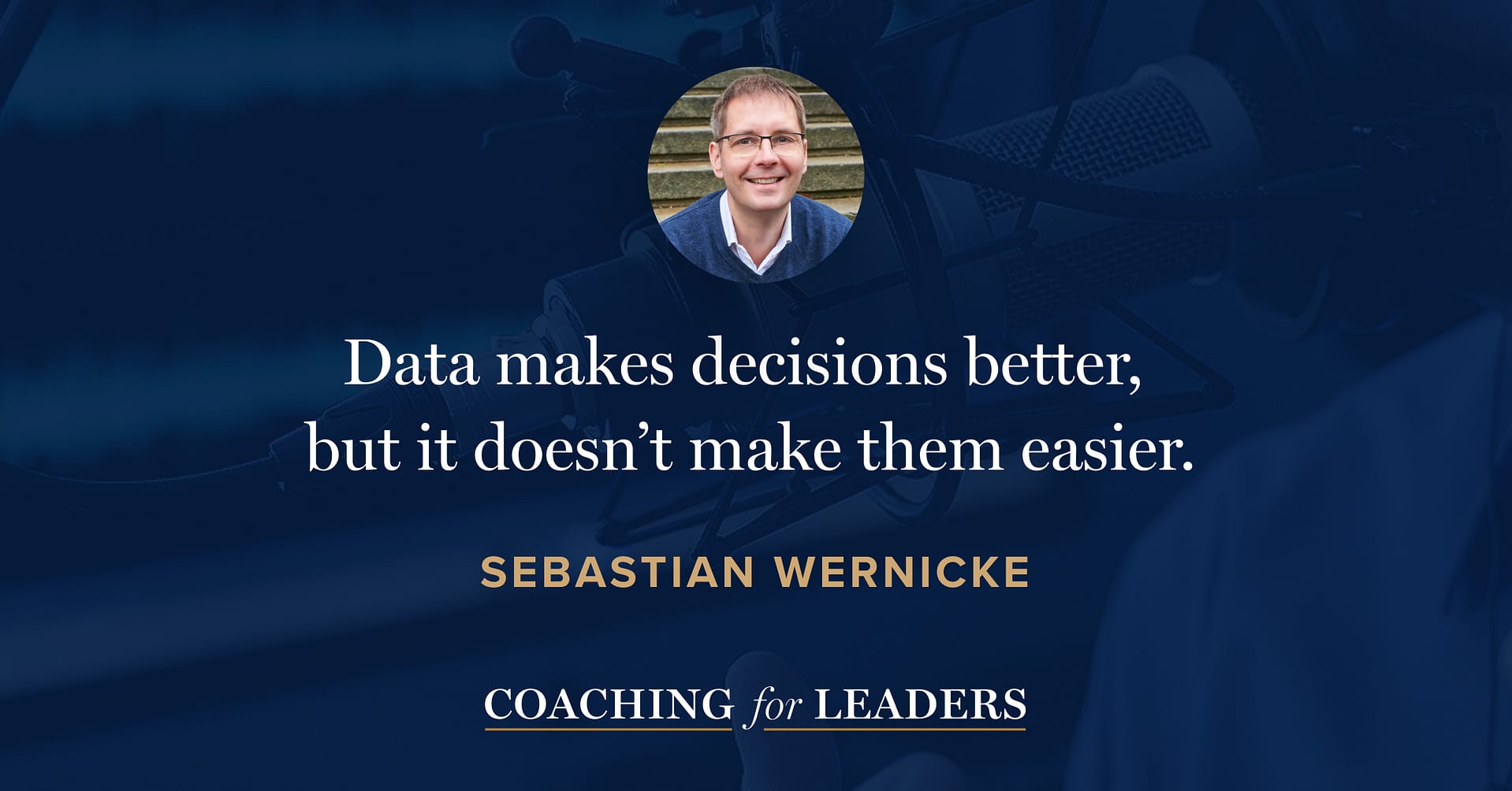
Data makes decisions better, but it doesn’t make them easier.
https://media.blubrry.com/coaching_for_leaders/content.blubrry.com/coaching_for_leaders/CFL801.mp3

Podcast: Download

Follow:
Apple PodcastsYouTube PodcastsSpotifyOvercastPocketcasts

Sebastian Wernicke: Data Inspired

For over 20 years, Sebastian Wernicke has guided organizations around the world to harness the power of data and AI to achieve breakthrough transformation. His three acclaimed TED Talks have reached over 5 million viewers. He is the author of Data Inspired: Building an Organizational Culture of Inquiry for Lasting Transformation (Amazon, Bookshop)*.

We all have more access to data than ever. That means we should be making better decisions than we ever have before, yes? If only it were that simple. In this conversation, Sebastian and I explore who you can actually use all that data to make better decisions.

Key Points

  • Data initiatives don’t necessarily fail, but often do something worse: make your organization stay the same.
  • Better data does not automatically result in better decisions. An organization also needs the cultural maturity to be swayed by the data.
  • Nobody makes decisions that look like the logical decision-making processes we see in books. In addition, the emotions we put into decisions are actually critically helpful.
  • During uncertainty, more data tends to make us more uncertain. Once we’ve decided something, we tend to discount contrary data.
  • Decisions are rarely made entirely by one person and heavily influenced by the team or organization’s culture.
  • Leaders can help integrate helpful data by saying things like, “I’m looking for data to tell me where I am wrong.”
  • Bringing in structure such as written notes or memos before or at the start of meetings can help data be considered before we discount it.

Resources Mentioned

  • Data Inspired: Building an Organizational Culture of Inquiry for Lasting Transformation (Amazon, Bookshop)*

Interview Notes

Download my interview notes in PDF format (free membership required).

Related Episodes

  • How to Involve Stakeholders in Decisions, with Eric Pliner (episode 586)
  • How to Change People’s Minds, with Michael McQueen (episode 676) – contradictory data not swaying people
  • How to Lead Engaging Meetings, with Jess Britt (episode 721)

Discover More

Activate your free membership for full access to the entire library of interviews since 2011, searchable by topic. To accelerate your learning, uncover more inside Coaching for Leaders Plus.
How to Make Better Decisions With Data, with Sebastian Wernicke

Download

Dave Stachowiak [00:00:00]:
We all have more access to data than ever. That means we should also be making better decisions than we ever have before, right? If only it were that simple. In this episode, we explore how you can actually use all that data to make better decisions. This is Coaching for Leaders, Episode 801.

Dave Stachowiak [00:00:20]:
Production Credit: Produced by Innovate Learning, Maximizing Human Potential.

Dave Stachowiak [00:00:29]:
Greetings to you from Orange County, California. This is Coaching for Leaders, and I’m your host, Dave Stachowiak. Leaders aren’t born; they’re made. And this weekly show helps leaders thrive at key inflection points. I think one of the assumptions that we all have as leaders is that if we have more data, better data, we’re going to make better decisions. That is sometimes true, but unfortunately, it is not that simple. Oh, I wish that it was. But today, a perspective on how we can actually do way better at being able to leverage data for the lasting transformation that so many of us want in our organizations and teams. I’m so pleased to welcome to the show today Sebastian Wernicke. Sebastian, for 20 years, has guided organizations around the world to harness the power of data and AI to achieve breakthrough transformation. His 3 acclaimed TED Talks have reached over 5 million viewers, and he’s the author of Data Inspired: Building an Organizational Culture of Inquiry for Lasting Transformation.

Dave Stachowiak [00:01:35]:
Sebastian, welcome to the show.

Sebastian Wernicke [00:01:37]:
Hey, Dave. Great to be here.

Dave Stachowiak [00:01:39]:
I am so looking forward to this conversation because of the perspective that you bring and also the challenge that you bring to so many of us as leaders and how we think about data. And it comes right down to the first line of the book, the first line of the introduction, which you write: Most data initiatives don’t fail. They do something worse. They succeed at making your organization very good at staying the same. Tell me more about that. What is it that we miss?

Sebastian Wernicke [00:02:15]:
Yeah, I mean, if you just think about the last data initiative that your organization has done. So, I mean, everybody in the audience will know the last project that built a dashboard or implemented a kind of forecasting algorithm, maybe. And then you think about what came out of it. Usually, it didn’t outright fail, right? You got the data, you got the dashboard in the end. And so the question then becomes, what is the ultimate effect of that? And if you look back in 2 or 3 years and you look at that dashboard or you look at the project, there’s a very high chance that you may say, “Hmm, I produced something that’s useful, and that is creating some value for me, but actually I was hoping for a bit more change. I was hoping for some sort of breakthrough transformation”, right? We wanted to change our business model. We want to change how the company is running with all of these new exciting capabilities that we get out of data. But that isn’t quite happening.

Sebastian Wernicke [00:03:18]:
And when it comes to questions such as, are we building scalable data capabilities? Are we achieving meaningful value? Are we ready to transform the business? Then oftentimes the answer is no. So, you have all of this data around, you have all of these projects and pilots that are producing the results you’re asking, but somehow it feels like you’re not making that big change that everybody was promising and, of course, also not getting that disruptive amount of value out of the data that you have around.

Dave Stachowiak [00:03:51]:
And that leads to the assumption that I mentioned in the introduction that if we have better data, we’ll make better decisions. And I think a lot of us assume that. And you say that that’s a misconception. What is the misconception part of it?

Sebastian Wernicke [00:04:10]:
Yeah, I like to refer to that as the data deficit theory. So, the assumption that all we lack is data, and as long as we get data to the right person at the right time, then magic will happen, and our decisions will improve. And I think that’s sort of the intuitive assumption and the hope that we have with data. That in a world that is ever more complex, ever more fast, that all we need is data; then we will know what’s going on and it will point us the way, and we can avoid all of these complex and difficult decisions that we have to make as leaders. Now, there’s a couple of issues with that assumption. One is that data can even do that; data is capable of giving us a full picture, of pointing us in the direction. I mean, most businesses, they don’t operate in a lab setting, right? It’s not a petri dish where you can repeat your strategic decisions over and over to collect enough data to tell you where you’re going.

Dave Stachowiak [00:05:12]:
Right.

Sebastian Wernicke [00:05:13]:
And that’s one issue. But the other issue, which I think is even more counterintuitive, is that assumption that if we are confronted with data that will challenge our assumptions or that will challenge what we’re doing, that then we will just change our minds. And that goes against decades of psychological research. It goes, if we’re honest about it, against our experience. And yet we are tempted to believe it. We are tempted to believe, if only we see the data, we’ll change our minds, we’ll decide differently, which in the end, of course, would be nice because that is the purpose of data. I always like to say the purpose of data is for you to change your mind. Because if you don’t change your mind and you decide as you used to, what’s the purpose of data in the first place, right? Then it becomes a very expensive hobby. And you’re not a data-driven business.

Sebastian Wernicke [00:06:07]:
In a way, you’re just a data-decorated business. But data needs to create change. And that is not as easy as it seems.

Dave Stachowiak [00:06:14]:
Well, and speaking of decorating things, there are some lovely graphics in the book. And one of them is what you refer to as a typical decision-making model. And I looked at it, and I have seen, like you, hundreds and hundreds of versions of a model like this over the years. It’s understand the situation, define the problem, define objectives to figure out the solutions. And it’s in this, like circular pattern, step by step. And you, quite lovely, beautifully point out that nobody makes decisions that way. It’s just like not at all reality of these models that we see in books. And I think that leads to a really key point that you make.

Dave Stachowiak [00:06:56]:
And you write that even having the best data is futile if an organization lacks the cultural maturity to be swayed by it. And yeah, I’m wondering how culture plays a role in this from a data lens.

Sebastian Wernicke [00:07:11]:
Mm-hmm. Yeah. So we know from research that whenever data challenges something that we believe, the default mode of our brain is not to change our mind, but to start attacking the data or discounting the data, right? So, when we envision a classical decision model like I just described, and also like I have in my book and that you can find everywhere, there’s one single step where the data comes in, and it starts forming the decision. So, it’s sort of the moment of decision-making. And if we introduce data at that single moment, and oftentimes it will be a high-stakes situation, so you will have some leadership around that has already committed to a certain path of doing things, maybe, or to a certain product, or to a decision that they need to make. And if we introduce data then, they will have exactly that same reaction to it, where the data will not challenge them properly, but rather the tendency will be to say, ah, you know, I don’t quite trust those numbers, or we need to run the numbers again, or the data sources seem sketchy. So this is where culture comes in because the default mode of decision-making and the default mode of how we humans function in an organization, in a group of other people, in a hierarchy, is not really receptive or perceptive to data when it comes in. So what we need to think about is: how do we consciously and deliberately engineer our decision-making so that data can actually have an effect, so that data comes in? So maybe just to give a hands-on example, could you imagine, for example, that the most junior analyst in the room can successfully challenge the most senior person in the room with an analysis that they have done, even if it goes against the beliefs or the commitments of that senior person? And I think in most organizations, the answer would be, ah, that analyst would quite quickly learn how helpful or unhelpful such analyses are perceived.

Dave Stachowiak [00:09:29]:
Yeah.

Sebastian Wernicke [00:09:30]:
And so in a data-inspired culture, I think this whole thing turns around. So, you’re actually not looking to data for confirmation or for comfort, but rather you are saying, I look for data to tell me where I’m wrong. And data challenging our beliefs is not just something that is welcomed, but something that we actually expect. So, every single day when we go into a meeting, we ask ourselves, where does data show us that there’s something that we believe strongly, but it’s wrong? And thus, we trigger not just optimizing what we do today, but we trigger the deeper change and the transformation from that.

Dave Stachowiak [00:10:17]:
I’m thinking about what you’ve just said and just the reality of our norms and our human behavior when we’re confronted with something that does not match what we expect. And you have a beautiful few lines in the book that I think capture this well. And it’s sort of, I think in a way, it can be very frustrating thinking about this. So what you write is, by default, data moves our minds in exactly the opposite direction that would be useful. When uncertain, more data will often increase the uncertainty rather than provide clarity. Conversely, when we are confident, we are likely to unconsciously filter out the very data that could reveal we’re mistaken. And as I’ve thought about that reality, and of course noticed it and seen it and heard about it in the research, there’s a— the first sort of place I go is a place of thinking, well, why even bother? Why even bother with going through the effort with data if either you’re just going to create more uncertainty or you’re just going to have people dig in their heels, which we’ve all seen a million times happen in our organizations? And I think the part that’s hard to think of is like, okay, how do we get past that? Just knowing that that’s the reality, how do we get past that point where we can introduce it at exactly the right moment and create that perspective that you were just mentioning?

Sebastian Wernicke [00:11:44]:
Oh, there’s a lot to unpack there.

Dave Stachowiak [00:11:46]:
So it’s basically like the entire book I’m asking you about right now.

Sebastian Wernicke [00:11:51]:
Summarized so succinctly, yeah. So I think the first notion we need to let go of is that there is actually a moment of decision-making. So the reality of decision-making is, if I had to sum it up, it’s a mess, right? So there is data, there is politics, there is emotion, and then there’s the whole time aspect of it. I mean, I think everybody listening to this, if you think about your organization, are decisions really made in the decision meeting? Usually the answer is no, right? The decisions are made—

Dave Stachowiak [00:12:25]:
Right.

Sebastian Wernicke [00:12:26]:
before when you start talking to individuals, when you’re trying to find out where do the stakeholders stand, who has power here, who do I need to move, how do I get things done here? And data cannot be introduced at just a single moment. Data needs to be introduced throughout that process. And from what we know from brain research, it should be introduced as early as possible. So, we start out with noise, and then there’s convergence, and then there’s a point of no return. And we have to introduce data before the convergence and the point of no return happens. After that, it’s gone. So, if we have the notion that there would be a single decision meeting where the decision-makers make their decision, usually we’re already past that point of convergence and past that point of no return. So, we have to introduce data into the initial discussions as the opinions are forming, as the decisions themselves are forming.

Sebastian Wernicke [00:13:28]:
And of course, then again comes in that cultural aspect. So, we also need to have a culture that is receptive to that, where leaders have made the active commitment that they are going to have a period of being very open to the data. And you asked a very important question, of course, which is, why introduce data in the first place? Well, if we introduce it early enough, of course, we can turn from gut feelings to evidence-based decision-making. So, data clearly has a value. Data gives us all of this rich picture of the complex world that’s out there. And in my mind, data is the only way to deal with all the complexity that we’re seeing around us. But we have to introduce it early on. And I think we also have to let go- like, you just cited from the book- we have to let go of the notion that data is going to simplify things.

Sebastian Wernicke [00:14:19]:
It’s going to give us a richer picture of that complexity. It will allow us to engage with complexity, but it’s not going to get rid of it. It’s actually going to make it even more uncomfortable. So, the way I like to sum it up is maybe that data makes decisions better, but it doesn’t make them easier at all.

Dave Stachowiak [00:14:44]:
That’s a huge distinction. And as I’m thinking about what you just said, I mean, one of the other messages that I got so clearly from your work and the research that’s out there is that I think sometimes, often, I know I have thought about data and then the other side of it, like the emotions and the cultural aspects of it as either/or. Like if we do a better job getting away from the just emotion and the gut instincts and get more into the data, we’re going to make better decisions. And you really point out that actually our emotions, the cultural aspect, are really crucial for our ability to make good decisions. It’s not that we want to set that aside. It’s very much a both/and here, right?

Sebastian Wernicke [00:15:36]:
Yeah, the emotions are essential for the point where data has said everything that it can say, so when all of the information is out there, and if you think about any complex decision scenario, so let’s say you’re trying to introduce a product into a new market, the data is never going to give you exactly the answer you’re looking for, right? The data is not going to say, yes, you should do it, or no, you shouldn’t do it. It’s going to give you all of these little bits and pieces and say, you know, well, here’s the demographics in that market. Here is how past product launches have gone in similar markets and all of these other things that you can find in the data. But then, data has done its job. Data has given you all of the information it can. And so then what? And it turns out that the human capability for decision-making is closely linked to emotions. And we know this from studies of brain patients.

Sebastian Wernicke [00:16:36]:
So patients that have a certain kind of damage to their brain from an accident or from a surgery, where they cannot process emotions anymore. And when you interact with these people, they will seem perfectly normal. You can have a perfectly normal conversation. They are smart; they’re conversant. The only thing that they cannot do is make decisions. So even— there’s a wonderful study from a researcher named Anthony Damasio who writes about this patient who had this kind of damage. And even if he was asked, what are you going to have for lunch? He was not able to make up his mind because he was trying to find the perfect rational reason to go, let’s say, for the sandwich or the salad. And he would go back and forth in an infinite loop and basically say, well, the one thing’s going to taste better, the other one’s going to be healthy, but I had this last time, right? Trying to come to a decision just with data, just with rational thought, and it was impossible.

Sebastian Wernicke [00:17:40]:
So, we know that emotion is the crucial thing that will tip the scale once data has said everything that there is to say from data. And so we shouldn’t discount it. And I think we should also just acknowledge that if data could make all of the decisions, then we wouldn’t need decision makers in the end.

Dave Stachowiak [00:18:03]:
Mm-hmm.

Sebastian Wernicke [00:18:04]:
So the role of the decision maker will be at some point to say, yes, all the information has been laid out. I’ve heard all the opinions, and here’s where I believe we should be going. And that part is not going to go away. Otherwise, we wouldn’t even need people, right? We could just automate the entire enterprise if we wanted to.

Dave Stachowiak [00:18:23]:
Yeah. And yet, when we get into situations where we’re trying to influence decision makers or the culture, it’s interesting how we often swing to one side or the other, isn’t it? Like, either we think about the gut feeling, the emotional pieces, and we tend to ignore or very quickly discount the data, or we approach it purely from a data standpoint, and we try to make the logical argument to whoever has power in those situations. And we either dismiss, or we get really frustrated then when the emotional aspects come into that, and we think, like, well, why can’t they just see the data? And I think the mindset shift here for me is thinking about this as the both/and of approaching making good decision-making, of approaching emotion and data, of that if you are willing to hold both and to do that a bit better, like, it can really help the organization to make better decisions.

Sebastian Wernicke [00:19:22]:
Yeah, totally. And I mean, neither of these things is going away, right? I mean, intuitive decision-making isn’t as good as we like to think it is, but that’s, again, another bias. So, our brains love to tell us that we have a great intuition where, in fact, we don’t.

Dave Stachowiak [00:19:37]:
Yeah.

Sebastian Wernicke [00:19:37]:
Except when we are experts in something. So there is such a thing as expert intuition. But let’s take the example of the product launch in a certain market. You know, you’ll never find a decision maker who has launched 10,000 products in 10,000 markets. So that intuition is just not going to be there. So we need to bring data in. And at the same time, I fully agree, you cannot just rely on data. So you have to also acknowledge and value the intuition part.

Sebastian Wernicke [00:20:05]:
And I think the organizations that get this right, the main thing that they have done is not necessarily that they have found a certain point of balance between the intuition and data, where I would say that is the gold standard. I think this is different for whichever organization you work for, whatever function you work in, right? So if you’re in finance, probably you want to rely a bit more on data and less on intuition. But if you are in a product space, maybe that’s exactly the other way around. But the one thing that successful organizations all have in common is that they have thought about this deliberately so that they have architected their decision-making, that they have asked the question of, how do we want to make decisions here? And how and at what point do we want to bring in data? And so I think it’s probably, in a way, less important where exactly you land on that spectrum of the balance between the data and the intuition. What’s much more important is that you have actually made it a conscious discussion, one that you’re actually having. Because if you think about most organizations, decision-making itself is never really discussed. And the decision-making culture, it’s just not a topic that even comes up. And I think that’s a gap that you definitely need to fill.

Dave Stachowiak [00:21:25]:
Agreed. I run into this all the time with our members and listeners that when we’re having conversations about decision-making, the most common response that I hear when we get into the how does the organization do that is, “We haven’t really consciously talked that out or made a decision on it”. And that is— it sounds like that’s really, in a way, the starting point for this is to, knowing that it’s going to be a little bit different in every organization and industry as far as how much you weigh on each side. But a big part of this is starting. And I— there are people listening who are thinking, we’ve never had any of those conversations in our team or organization.

Sebastian Wernicke [00:22:06]:
Yeah.

Dave Stachowiak [00:22:06]:
And for someone who is having that thought, when you see a team, maybe even an individual leader, start to nudge an organization to get a little better at this, or maybe just a team, to be a little more conscious of this, where do you see them start that tends to work just to start to get a little bit of traction?

Sebastian Wernicke [00:22:28]:
So, one thing that I love to recommend is that in your next meeting, whenever the time is appropriate, you can ask one question. And that question is: what is something that we strongly believe today where data might prove us wrong? And that question does a lot of things at the same time, which is why I think it’s so valuable to get started with that. One is, it creates that opening. It creates that space, right? You’re saying, okay, let’s take something that we hold dear. Let’s take something where we all think, oh yeah, that’s obvious. And it could be wrong. You know, you’re inviting that dissent. You’re inviting data to prove you wrong.

Sebastian Wernicke [00:23:12]:
And then once you’ve done that, as a follow-up, what that question also does is it immediately afterwards sparks a discussion about, well, okay, but how is data going to do that? What data can we collect? And once we have it, how do we present it? Who do we need to present it to? So, that’s why I like this one. It’s a really good starting point that gets you on a lot of the right tracks without having a— theoretical or philosophical discussion about the merits of data and intuition. It’s very practical, and it gets you on the transformation track at the same time.

Dave Stachowiak [00:23:51]:
You talk a bunch in your work about the notion that we often just assume that data is— so many analogies are used to describe data. Gold mine would be one of them that comes up a lot, like, oh, all this data is a gold mine of information. And if I further that analogy a bit by, of course, even in a gold mine, there are only tiny spots where the real valuable gold is, right? And by asking the question of where does, where does the data show us that maybe we’re wrong? I think what’s, what’s interesting, really so interesting about that is you open up the possibility of people to be able to look and consider options of where to actually find the best data. Because, like nobody’s suffering from a lack of data these days, right? I mean, there’s so much. I mean, just AI.

Sebastian Wernicke [00:24:49]:
Yeah.

Dave Stachowiak [00:24:49]:
Any of us can access it. So by the leader actually signaling, hey, I, I’m looking for where the information is that changes the assumptions that we’re making, I think it helps you to actually find the things that quote unquote could really be the gold.

Sebastian Wernicke [00:25:04]:
Yeah, absolutely. And I love how you’ve taken that tired analogy and actually made it work. So thank you for that. You need to look for the nuggets. That’s exactly it. And when most people say data is gold, it’s just like, oh, it’s valuable. Well, and everybody’s like, duh, of course we know it’s valuable, right? And I really like where you took this one. And I think that’s exactly right.

Sebastian Wernicke [00:25:28]:
And if I take that and put it back to data, what does that mean? That means we need to look for the anomalies. We need to look for the outliers. We need to look in those parts of the data that might get cleaned away if we just look at the dashboard and say, how are we doing on average if we look at the summary metrics? And the nuggets will be when we dive in. And for example, we see a customer using our product in a way that we never intended it to be used, but that might just have the hint of a new business segment, a new way of selling it, maybe even changing the business model ultimately. Those are the things that we need to look for, and where we need to create the space for people to become data divers and dive deep into the data to search for the nuggets you just described.

Dave Stachowiak [00:26:20]:
And I’m guessing a big part of this too is assuming you do a decent job of starting to open up that possibility in that conversation. Then when some of that gets surfaced, a big part of it is also how the leader responds or doesn’t to contradictory information, something that suggests that they’re wrong. When you see people approach this in a really mature way of some data shows up that people weren’t expecting, and theoretically, we’re all like, OK, this is good. But knowing human nature, how does a leader respond in a way that actually helps them to integrate this in their decision-making process?

Sebastian Wernicke [00:26:58]:
Yeah, so it comes down to the culture of inquiry that you mentioned in the beginning. And I think a culture of inquiry is characterized by constant curiosity. So, whenever that interesting data point arrives, the reaction is, huh, that’s interesting. Where did that come from? What is it telling us? And then, of course, it needs to survive the contact with the wider organization, which is, of course, also a very common breaking point. And I think that is partially a leadership and culture aspect, but ultimately also something where I think you have to build the processes around that. So that it doesn’t always come down to the individual leader of making that bold decision, but that you actually have institutionalized that process of taking new contradictory information and turning it into transformation and turning it into change, so that you have the right roles that people know where to turn to. And in this way, it moves from individual heroism, if you want to, to something that defines an organization where they say, “We as an organization or we as a team define ourselves by constantly looking for the outliers and being curious about them”, rather than saying, you know, let’s make sure we just continue safely on the path that we’re already on.

Dave Stachowiak [00:28:33]:
Have you seen an example of an organization that has institutionalized that a bit better? And if so, I’m curious, what is it that they did to help them to get there?

Sebastian Wernicke [00:28:44]:
So, I would say that I’m lucky enough to actually work for a company that has institutionalized some of that, and we do it in a similar way like Amazon does it in their decision meetings. So, maybe for those in the audience that are not familiar with that, Amazon is quite famous for, at the beginning of each decision meeting, they will circulate a 6-page memo where somebody has taken the time to write down all of the data. They outline the decision. They outline the decision options. They outline where the data agrees or disagrees. And everybody makes sure at the beginning of a meeting to actually read the memo. So at Amazon, they actually take time in the meeting. At Oxera, where I work for, we do it before the meeting, but we give the data the space, the written page, in order to be able to express all of that nuance around it and say, okay, here are the various components of the data. This is where we see it disagreeing.

Sebastian Wernicke [00:29:47]:
This is what’s new. And in this way, we give everybody the time and space to process that. And what that leads to is that we create a space where everybody can engage with the data and the new information on their own. And then when it comes to the discussion and to the meeting, everybody has engaged. And then at the end, we have a clear decision coming out of that. And I think that for me is a very, very effective way of institutionalizing that. So we have a clear way of: This is how you get to a decision. You have the memo, you have the decision options.

Sebastian Wernicke [00:30:24]:
At some point, there will be a meeting where it will be decided which of these options to take, and then we execute on those. But we create the space upfront to say we want to lay the full information out there. We don’t want to just present that at the moment when everybody’s in the meeting. We want to give it to them beforehand, and so they can engage, they can ask questions. Usually there’s an FAQ at the end of the document. I find that to be very effective. It feels unusual to people that are not used to that process. But once you get into it, you don’t want to turn back.

Dave Stachowiak [00:31:01]:
And what you just said, every single leader could do. And whether it’s a small team or an organization or a meeting, it’s a practice everyone could institute. And as you were saying that, I was thinking, wow, I went down that path over years of working with our Academy groups. When we get together to have conversations about a situation that someone’s facing in the workplace, we have a very structured process for bringing notes to that conversation. It follows 3 steps every time. And we take the first 5 minutes of the conversation to read the notes to everyone who’s in attendance at the meeting to frame the conversation. And the first couple of times I did it, it was awkward because it was different than we had ever done before, and it was a little weird, but it was really interesting to me how after like 1 or 2 iterations, everyone virtually was like, oh, this is a really helpful process to surface what we’re all starting on the same page. What’s the information we need? What’s some of the data? And by doing that at the start, and to your point earlier, introducing it earlier in the discussion, the decision-making process, it doesn’t make it easier, to your other point earlier, but it does keep the group and the organization from missing as many big details that would become blind spots.

Sebastian Wernicke [00:32:27]:
Yeah, and it also, I mean, these memos, so I always like to say, we do them in the vertical paper format, not the horizontal, which means we write it out. We write it out as a Word document. We don’t have PowerPoint to do it. And that also forces the person presenting the data and presenting the options, I think, to think through what the data is, what it means, the scenarios, much more deeply beforehand. So that also makes it quite hard. The writing of these memos is hard, but you are creating a much deeper engagement with it, where it also allows you to deal with things such as nuance, for example, which is very hard to do in a compressed setting. And again, if you’re looking for the outliers and the transformative insights, nuance is what gets you there. Otherwise, you’re back at averages.

Dave Stachowiak [00:33:19]:
It’s so interesting to hear you say that because we’ve landed in the exact same place. It’s a text Word doc versus slides. And what’s really, really interesting when I think about what you just said and when I think about all the meetings I’m in, is oftentimes we’ll end up zeroing in on one sentence. And it’s often kind of a throwaway sentence, like someone just included it. It was like, oh, just by the way, this one thing. And several other of us sort of latch onto it like, actually, this thing you mentioned is a really big factor as far as the data piece of this and making a decision. And the person who’s bringing it often doesn’t recognize it that way. But when you— there’s something about writing it out, and it’s not long, by the way; it’s only like a page and a half, but there’s something about writing it out that captures some of those data points that you miss if it’s just like bullet points on a slide.

Sebastian Wernicke [00:34:13]:
Oh, that resonates so much. Yes, exactly the same experience. Okay, so people will now listen to this and think we’re insiders of some— the cult of the memo.

Dave Stachowiak [00:34:20]:
Maybe, yeah, maybe.

Sebastian Wernicke [00:34:23]:
But it’s true. I mean, these things are unusual; they’re hard, but boy, do they work well.

Dave Stachowiak [00:34:28]:
You have put together this masterpiece of a book of really looking at how we use data better. And we are zeroing in on just a few pages for if you’re hearing this conversation and thinking, okay, we as an organization, my team, my project, my organization, we need to get better at bringing in data intentionally. The book is just a beautiful, a beautiful path of following to go through the details and the tactics. And I am curious, Sebastian, as you put together the book over these last couple of years and you’ve worked with so many organizations and supporting leaders, what, if anything, over the last year or two, have you changed your mind on?

Sebastian Wernicke [00:35:06]:
Yeah. So this book is now my 200-page memo that I needed to put together.

Dave Stachowiak [00:35:11]:
Right.

Sebastian Wernicke [00:35:13]:
I think the book for me clarified something. I would say I had an intuition about before, but the writing made that even more clear, which was this need to relentlessly focus on the human element and the stakeholders when I’m trying to get something done with data. And that was always something I was conscious about. Well, maybe not 20 years ago when I started out. I came in as a believer of the data deficit theory when I built my first dashboards and Excel tools. But writing about it, getting deeper into the psychology, and also thinking a bit about what now happens as we replace some of the human decision makers with AI decision makers, it just dawned on me, understanding how the human part of an organization functions and how the individual humans function, what they care about, is so important. It just underlined and highlighted that importance for me.

Dave Stachowiak [00:36:17]:
Sebastian Wernicke is the author of Data Inspired: Building an Organizational Culture of Inquiry for Lasting Transformation. Thank you so much for sharing your work with us. I so appreciate it.

Sebastian Wernicke [00:36:29]:
Thank you, Dave. This was fantastic.

Dave Stachowiak [00:36:37]:
If this conversation was helpful to you, 3 other episodes I’d also recommend. One of them is episode 586: How to Involve Stakeholders in Decisions. Eric Pliner was my guest on that episode. We talked about the uncomfortable reality where most leaders don’t just get to independently make their own decisions. They do actually have to involve other people. Sometimes it is just to get their view. Sometimes they have veto power. And there’s lots of things in between.

Dave Stachowiak [00:37:03]:
We talked exactly how to do that and to think that through with a great model in episode 586. Also helpful, episode 676: How to Change People’s Minds. Michael McQueen was my guest on that episode, and he pointed out that contradictory data does not sway people, not by itself. We’ve all had that experience in our personal lives where we’ve shown someone very clear data that obviously contradicts something they believe in. And do they immediately say, ah, of course you were right. I’ve been completely wrong all my life? No, of course not. And it doesn’t work that way in the workplace either.

Dave Stachowiak [00:37:39]:
Michael talks us through that reality. How we can do more effective at being able to communicate well. And episode 676 has a great framework for that. And then finally, I’d recommend the episode we did with Jess Britt, episode 721: How to Lead Engaging Meetings. Jess has a wonderful invitation in that episode of how to begin, where to start, and so much of it is not just about data, but how we communicate and utilize the data and the content of our meetings. Wonderful conversation. So helpful.

Dave Stachowiak [00:38:10]:
So many people have told us, Jess and I, that that conversation was really helpful in improving their meetings. It’s a great starting point for you: episode 721. All of those episodes you can find on the coachingforleaders.com website. And I’m inviting you today to consider joining Coaching for Leaders Plus. You can find out more at coachingforleaders.plus. Every single week, I am writing a journal entry, and I’m sharing it with our members. Recently, I wrote an entry on how to win with change. And I talked about how do you address naysayers- the people who, in your organization, are the ones that when you announce a change, or maybe you’re talking about making a cultural shift, are the people who don’t say much or actually sometimes are actively working against it.

Dave Stachowiak [00:38:52]:
What do you do? Well, you talk to those people last. Details in a recent journal entry on that and so many other topics that come up regularly for leaders. You can find it as part of Coaching for Leaders Plus. If you’d like to join in and go beyond the podcast, go to coachingforleaders.plus for more. Coaching for Leaders is edited by Andrew Kroeger. Next Monday, I’m glad to welcome Priya Parker back to the show. Priya and I are having a conversation on how leaders turn conflict into progress. Join me for that conversation with her.

Dave Stachowiak [00:39:24]:
Have a great week, and see you back next Monday.

Topic Areas:Data and AnalyticsDecision-Making
cover-art

Coaching for Leaders Podcast

This Monday show helps you discover leadership wisdom through insightful conversations. Independently produced weekly since 2011, Dave Stachowiak brings perspective from a thriving, global leadership academy of managers, executives, and business owners, plus more than 15 years of leadership at Dale Carnegie.

Listen Now OnApple Podcasts
  • More Options
    • YouTube Podcasts
    • Spotify
    • Overcast

Activate Your Free Membership Today

Access our entire library of Coaching for Leaders episodes from 2011, searchable by topic.
Listen to the exclusive Coaching for Leaders MemberCast with bonus content available only to members.
Start Dave’s free audio course, 10 Ways to Empower the People You Lead.
Download our weekly leadership guide, including podcast notes and advice from our expert guests.

... and much more inside the membership!

Activate Your Free Membership
IMAGE
Copyright © 2026 · Innovate Learning, LLC
  • Plus Membership
  • Academy
  • About
  • Contact
  • Dashboard
×

Log in

This site is protected by reCaptcha and the Google Privacy Policy and Terms of Service apply.
 
 
Forgot Password

Not yet a member?

Activate your free membership today.

Register For Free
×

Register for Free Membership

Access our entire library of Coaching for Leaders episodes from 2011, searchable by topic.
Listen to the exclusive Coaching for Leaders MemberCast with bonus content available only to members.
Start Dave’s free audio course, 10 Ways to Empower the People You Lead.
Download our weekly leadership guide, including podcast notes and advice from our expert guests.

... and much more inside the membership!

Price:
Free
First Name Required
Last Name Required
Invalid Username
Invalid Email
Invalid Password
Password Confirmation Doesn't Match
Password Strength  Password must be "Medium" or stronger
This site is protected by reCaptcha and the Google Privacy Policy and Terms of Service apply.
 
Loading... Please fix the errors above