• Skip to primary navigation
  • Skip to main content
  • Skip to primary sidebar

Coaching for Leaders

Leaders Aren't Born, They're Made

Login
  • Plus Membership
  • Academy
  • About
  • Contact
  • Dashboard
  • Login
Episode

763: Leading with Poise When the Stakes are High, with Eileen Collins

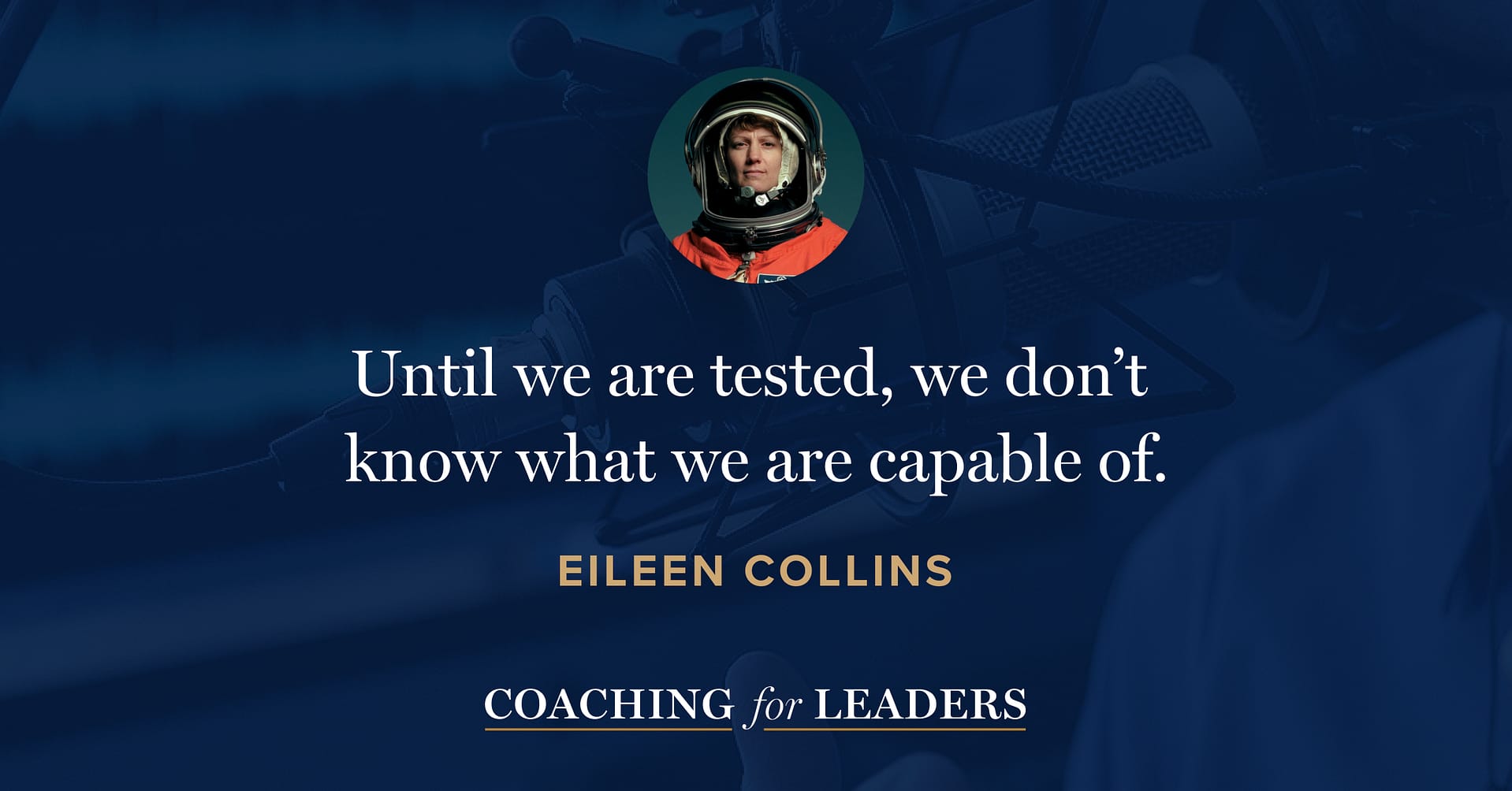
Until we are tested, we don’t know what we are capable of.
https://media.blubrry.com/coaching_for_leaders/content.blubrry.com/coaching_for_leaders/CFL763.mp3

Podcast: Download

Follow:
Apple PodcastsYouTube PodcastsSpotifyOvercastPocketcasts

Eileen Collins: Through the Glass Ceiling to the Stars

Colonel Eileen M. Collins, USAF (retired), earned a place in history as the first American woman to pilot, and later to command, a space mission. She flew on the space shuttle four times, twice as commander – including the 2005 “return to flight” mission after the tragic Columbia accident. She is the subject of the documentary movie Spacewoman and author of the book Through the Glass Ceiling to the Stars: The Story of the First American Woman to Command a Space Mission (Amazon, Bookshop)*.

We all have times in our careers where all eyes are on us. In this conversation, Eileen and I explore the critical moments of her career and how she stayed grounded while soaring among the stars.

Key Points

  • Until we are tested, we don’t know what we are capable of.
  • Nerves creep in at times for all of us. When they do, it’s helpful to think about representing your role instead of representing yourself.
  • When decisions become difficult, always come back to, “What’s the mission?”
  • Train for the skill, not for the task.
  • During high-stakes times, remember your family and personal life. They will help you stay grounded.

Resources Mentioned

  • Through the Glass Ceiling to the Stars: The Story of the First American Woman to Command a Space Mission by Eileen Collins (Amazon, Bookshop)*
  • Spacewoman documentary, featuring Eileen Collins

Interview Notes

Download my interview notes in PDF format (free membership required).

Related Episodes

  • How to Lead and Retain High Performers, with Ruth Gotian (episode 567)
  • The Way to Handle Q&A, with Matt Abrahams (episode 681)
  • How to Start the Top Job, with Scott Keller (episode 752)

Discover More

Activate your free membership for full access to the entire library of interviews since 2011, searchable by topic. To accelerate your learning, uncover more inside Coaching for Leaders Plus.
Leading with Poise When the Stakes are High, with Eileen Collins

Download

Dave Stachowiak [00:00:00]:
We all have times in our careers when all eyes are on us. My guest today knows that reality better than anyone. On this episode, Eileen Collins, the first woman to command a US Space mission, On Leading with Poise When the Stakes are High. This is Coaching for Leaders, episode 763. Production Credit: Produced by Innovate Learning, maximizing human potential.

Dave Stachowiak [00:00:29]:
Greetings to you from Orange County, California. This is Coaching for Leaders, and I’m your host, Dave Stachowiak. Leaders aren’t born, they’re made. And this weekly show helps you discover leadership wisdom through insightful conversations. One of the realities for almost every leader is being able to keep poised to perform and to do our best when the stakes are high. Every single one of us navigate that at some point in our careers. And if you’re like today’s guest at many points in your career, today’s guest is an example of someone who has done this so beautifully in so many different situations. I’m so pleased to introduce Colonel Eileen Collins.

Dave Stachowiak [00:01:13]:
She earned a place in history as the first American woman to pilot and later command a space mission. She flew on the space shuttle four times, twice as commander, including the 2005 return to flight mission after the tragic Columbia accident. She is the subject of the documentary movie Spacewoman and author of the book Through the Glass Ceiling to the Stars: The Story of the First American Woman to Command a Space Mission. Eileen, welcome to the show.

Eileen Collins [00:01:41]:
Well, hello Dave, and thanks for having me on with you today to kind of share my story with you.

Dave Stachowiak [00:01:48]:
I would love to get into your story and I’m starting this conversation at the end actually of your book. You write something in the afterword that caught my attention and this is what you wrote, “I definitely had no outstanding athletic, intellectual or other special abilities. I grew up as an unremarkable lower middle class American. Nothing in my early years would possibly have led anyone to guess what I would be doing a few decades later.” And I think about what you wrote and also what you’ve said, that more recently, until we’re tested, we don’t know what we’re capable of. And you were tested very young. Your family navigated a big challenge with your dad.

Dave Stachowiak [00:02:34]:
How did that test you?

Eileen Collins [00:02:37]:
Well, I will first of all say everything I wrote there is 100% correct. I was very shy as a child. I think that’s really more part of my genetic makeup, the fact that I was so shy, I stuttered. I was afraid to speak up in school. Not sure why I was like that because my siblings were not and I had to get over that. And I remember probably second grade, my first memory of trying to overcome a struggle was when my mother sent me to speech lessons to get over stuttering. And then you mentioned my dad, he moved out. My mom asked him to move out when I was nine years old because he was coming home drinking, and she just couldn’t live with that anymore.

Eileen Collins [00:03:20]:
And we never knew what we were going to get. Was dad going to come home and be a great dad, or was he going to come home and he was drinking and end up in a fight with my mom? And that would really be frightening to all of his kids. So I had to learn how to cope with that. And there’s actually a whole area of study, adult children of alcoholics, which I find very interesting, because you can come out of that as, you know, the children of alcoholics, you can come out of that stronger, or you could come out of that really devastated. And that would depend a lot on the situation. For me, I would say I still had a great relationship with my father. It was devastating when he moved out, but yet it turned out it was the right thing because, I mean, it was better for my mom to not have to deal with the stress. But on the other hand, for us kids, we were able to focus more on our lives and our work.

Eileen Collins [00:04:12]:
And my dad would come home on the weekends, he would still be drinking. But I think it was, I think, trying to understand. My dad always told me, put yourself in the other person’s position. So I would actually try to do that with him. And I think that my mom always talked about the fact that alcoholism is a disease. And I think it’s probably a way that a person copes with their anxiety and their problems in life. And what I learned through Alcoholics Anonymous was don’t run away from your problems.

Eileen Collins [00:04:44]:
Take one day at a time. Know what the Serenity Prayer is? You can look that up. The Serenity Prayer talks about what you can control and what you can’t control. And there was also the 12 step process that I would read about. And so I think I got a lot of wisdom from watching my dad struggle. And my mom struggled also later in her life. And I think I got a lot of wisdom through watching how they overcame their struggles. So it’s kind of a long answer to your question.

Eileen Collins [00:05:14]:
It really is something that you could go on and talk about for almost an hour. But I think it’s important that if you’re a parent, that you make sure your children know that you love them and no I’m not a perfect parent, but I love my kids and I’m going to do the best I can to raise them. And I think that’s really all the kids need is really a sense of security.

Dave Stachowiak [00:05:35]:
Almost every leader that I know has moments in their lives and in their careers where suddenly all eyes are on them. And that has happened for you in a big way at a number of points in your career. Perhaps most significantly at the White House when President Clinton announced that you’d be the first woman to command a space mission. And you write about this moment in the book and say “someone came in and said it’s time. I walked across the reception area to the Roosevelt Room and peeked in the door. The place was packed. Cameras, media, people and bright lights lined the entire back wall of the room. I saw Sam Donaldson and many other reporters I recognized from the national news.

Dave Stachowiak [00:06:19]:
Sally Ride was in the front row. For perhaps only the second time in my life. I had a full on feeling of panic.” What happened for you in that moment?

Eileen Collins [00:06:30]:
Well, the first time was I panicked was when I was babysitting and I was worried about the safety of the kids. And maybe I managed to get through that situation. This the second time I had a little speech ready to go and I didn’t realize that this was going to have as much national media attention as it did. I am the kind of person who likes to have a mission and know what that mission is and go out and execute it. And it has always been flying for me or some military mission that I had done previously in my life. And as an astronaut, I was capcom. And I had trained and trained and trained for all of those situations. Well, I had not trained to walk into the Roosevelt Room in the White House and make a speech with the President and the first lady and the NASA administrator.

Eileen Collins [00:07:22]:
It was not something I had trained for. And I remember saying to my husband, I’m not going in there. And he said, actually he was kind of stunned, like what you have to. And so the way I overcame that is I said to myself, Eileen, just go in there and be the first woman commander. You don’t have to be. Eileen, just go in there and be the first woman commander. And that was my strategy. I went in, I read my speech, I smiled for the cameras, and then I walked out and I said, now I’m going to go back to being myself again.

Eileen Collins [00:07:54]:
And so I kind of. I don’t know if that’s the best strategy to use, but that was how I overcame getting through something that I hadn’t trained for. I don’t really like the spotlight, but I will say I love a challenge. A challenge like being the commander of a space shuttle mission is something that I felt like I prepared for, I had trained for. I felt like I was really good at doing those types of things. I was never really good at the media stuff. And maybe that goes back to the shyness I had when I was a child.

Eileen Collins [00:08:24]:
But if you’re going to be an astronaut, you have to be able to get up in front of the world and explain what your mission is. So I started working on that. And throughout my first command as space shuttle commander, I worked on being articulate and describing what our mission is and why we’re doing it. And so I know I needed to be trained. If I don’t, I mean, really, how do you avoid a panic situation? You have to be trained for it. So I think that was something I learned in that situation.

Dave Stachowiak [00:08:54]:
I think it’s so interesting that in that moment you had the sense of mind to think, hey, it’s. It’s not for this moment, me, Eileen Collins. It’s space shuttle commander. And to walk in and it’s. It’s a nobler motive, a bigger picture, a bigger purpose beyond just you that, that bigger, nobler why, by stepping into that, like, what a great way to really transcend and be successful in that moment.

Eileen Collins [00:09:22]:
Yeah. And I think it’s so important to define what your mission is. And whatever I’ve done in life, anything I want to spend time on, I think it works to define what is that mission. And this works even if you’re, let’s say, the CEO of a company, or maybe you’re an executive and you have a certain area of that company that you’re responsible for, you have to know the company’s mission and then have your own mission. How do you execute that and make sure that you can articulate that to the people that work for you? And that is so important because throughout life, we’re constantly distracted and so many distractions coming and going. And some of the distractions are important, like if you have a family situation that needs attending to. But some of these distractions are not important, like your phone buzzing all the time. And maybe you need to cancel some of those notifications you’re getting because they distract from the mission.

Eileen Collins [00:10:18]:
Those are maybe some examples that I could give. But focus, focus, focus is always something that I would use to keep myself on track with the mission. And another thing I learned very early on in my career was. And this was in the flying world, my instructor would say to me, what’s next, Lieutenant Collins? What’s next? And I’d be executing a maneuver, and he’d say, what’s next? You have to be thinking about what is your energy level, what is your, I want to say, your flow and your procedures. And, you know, don’t just sit there and let your eyes kind of glare out into the. Into the clouds. You’ve got to be constantly thinking. And for that to work, you have to be, I want to say, in good physical shape and good mental shape to be able to stay focused and thinking about what’s coming next.

Dave Stachowiak [00:11:09]:
You have mentioned a couple of times already the importance of the mission, and you talk about that in the book. And when a leader is in the spotlight, especially in the way you were, you tend to get a lot of requests and you have to make a lot of decisions. And one of those speaking of being the spotlight, Hillary Clinton, who was first lady at the time, asked to come visit your crew and you right before the launch down at the Kennedy Space Center. And you write about this, that you were thrilled to have her support, but that you ultimately had to say no. And I’m curious, what’s different about making decisions like that when you’re in the spotlight?

Eileen Collins [00:11:48]:
Well, that particular situation with the First Lady, I was flattered that she asked to come meet the crew. But on the other hand, when we’re in quarantine, we cannot be having people come in to visit us. And I think it was also important for me to not set a precedent where we were inviting people into quarantine that were not the doctors or, you know, the only people allowed in there were the doctors and the cooks, and we had a couple. We had maids come in occasionally, and they all had to be checked out by a physician. And I felt that by inviting in the first lady or answering yes to her invitation, I would be setting a precedent for all the crews to follow me. Were they going to have to have the First Lady come in, or maybe politicians come in, or maybe a person who’s running one of the companies that supports the mission. We just can’t be doing that. So I think that she understood her people understood that we can’t be doing that, and I thank them very much for the invitation.

Eileen Collins [00:12:49]:
Now, when it comes to making decisions, I find that. And let me go way back to when I was the second lieutenant. I was new in the Air Force. I remember the guys around me being very frustrated that the boss would not make a decision. I didn’t understand that at the time because I had, you know, I was pretty new, and I had to kind of see what the culture was around me. But people were frustrated. Man, that guy just can’t make a decision. And so I started trying to internalize that and understand what that is and tell myself, I don’t want to be the type of leader that can’t make a decision.

Eileen Collins [00:13:21]:
So I wanted to be, I would say, when it comes time to make a decision, my first question is, can I make this decision right now and get it out of the way, put it behind us? Is it something like the first lady asking to come in? You know, that was an easy no. And let’s just say no right now and get that behind us so it doesn’t keep, I want to say, getting in the way of other things that we need to be doing. And then there are some decisions that are very, very difficult. And I’ll just maybe bring one of them up was, do we add a fourth spacewalk to our mission? And we had three spacewalks scheduled. And the decision to do a fourth spacewalk was not something that I could make myself on, maybe just right off the cuff. It was the kind of thing I had to ask my two crew members that do the spacewalk. I had to ask the team. I had to make sure the people in Mission Control were able to support it.

Eileen Collins [00:14:10]:
So some decisions, you have to bring the team in. And I think it takes experience and a little bit of wisdom to really take these. And I’m trying to think of a good example right now that’s kind of in the gray area. But there are examples in the gray area where, you know, do I make this decision now and put it behind me and then end up getting criticized for making the wrong decision? Well, we just can’t be worried about being criticized and what other people are complaining about the decision that we made. That’s why, you know, we used to say, that’s what you get paid the big bucks for. You get promoted. Now you’re in a position where you have to make the decisions for the team. So my first question that I get when the decision comes is, can I make this now and put it behind us, or do I need to pull in the team and just go from there?

Dave Stachowiak [00:14:53]:
I think most people listening will remember the Columbia accident. It’s been a little over 20 years now since that happened. And you were slated to be the commander of the next shuttle mission after the accident. And you’ve written about believing at the Time that if the next mission failed, it would undoubtedly mean the immediate termination of the shuttle program. And as the commander of the mission that would return to flight, you’ve talked about having a broader leadership role as a symbol of hope. Tell me about that.

Eileen Collins [00:15:33]:
Well, the stakes were very high for that mission. People remember that there were two space shuttle accidents. I was the commander after the second accident. And obviously we had to, in my mind, get the shuttle flying again as soon as safely possible. But on the other hand, there were people outside of NASA saying the space shuttle, it needs to be discontinued. There’s been two accidents. We’ve killed 14 people. Why would we keep flying this spacecraft that is so dangerous? Well, if you study the accidents, yes, they were technical, physical causes of the accident, but there were also cultural mistakes that were made.

Eileen Collins [00:16:12]:
I would say decisions along the way, it gets pretty complicated. But decisions that were made along the way, that maybe if they had been made differently, then there would not have been those accidents. So I felt that we had a certain amount of control over the safety of our flight. I also knew that the seven crew members that died, my friends, did not die for a mission that was not worth it. Their mission was worth it. And it’s the mission of space exploration. Building the space station, getting people off planet Earth and into space. And that mission is so important, we need to continue it.

Eileen Collins [00:16:50]:
We need to keep the space shuttle flying. The space shuttle was initially built as the mechanism to build the space station, take the pieces up into space, and we needed to continue building the space station. So I found that I had to articulate that a little bit. But most of the people inside of NASA were in support of that mission. The key was to get, I want to say, the people outside of NASA, whether it’s in Congress or the Office of Management and Budget or the people that actually dole out the money to NASA to keep the space program flying, to convince them that continuing flying the shuttle was the right thing to do. And I’m happy to say that we agreed, get the shuttle flying again, get the space station built. And the final thing I’ll say on that is we did have a problem on our mission. We did have another incident.

Eileen Collins [00:17:44]:
I mean, it was falling foam that hit the Columbia that caused the accident. We had falling foam on my mission also. And it turned out that was a very difficult problem to solve. And because of that, the space shuttle program was shortened. We only flew, I think, 18 more missions, just enough to finish building the space station. And then the space shuttle was retired. And I’m happy to say it flew very safely through the. I mean, extremely safely through the rest of the shuttle program until it was finally retired.

Dave Stachowiak [00:18:15]:
There’s so much that went into what you did as a leader during that time, including you personally deciding to delay your retirement to be able to see the mission through and to do all the things you just described for not just you and your crew, but for the broader mission and the broader message that NASA is projecting into the world of exploration. It was a big change for you.

Eileen Collins [00:18:39]:
Well, after I had flown my first mission as commander, I had to make a decision. Do I want to fly another flight or not? I decided I wanted to fly a fourth flight, which ended up being my last one because I had not yet been to the space station. We were in the early years of building it. And I thought for myself to be valuable to the space program in the future, it would be important for me to have been to the space station and seen it firsthand and flown the shuttle there, which is a whole series of, I want to say, exercises that we do on the shuttle to rendezvous and dock with the space station. And that was something that I needed to do. So I made the decision along with my family. My husband and my kids were pretty young back then, but I did talk to them about it, that I would fly one more mission. Well, that mission should have flown in 2003, but five weeks from our launch, five weeks before we launched into space, we lost Columbia.

Eileen Collins [00:19:34]:
And now I had planned on retiring that summer. I knew we weren’t going to fly for another two, maybe three years. So I was going to stick with my mission. If it took five years, there is no way I was going to quit that mission. First of all, it would have looked very bad if the commander of the next flight quit. It would look like no matter what I said, it would have looked like I had no faith in the shuttle. And, you know, I didn’t want to look, frankly like I was a coward and I was afraid to fly the shuttle because I wasn’t. And I wanted to stick with my mission and my crew.

Eileen Collins [00:20:10]:
We had to. We changed a few of our crew members because the nature of the mission changed. But I’m happy to say that the NASA management, my immediate management, as well as the space shuttle program and NASA headquarters, was confident enough in me to keep me out as commander to fly the return to flight mission. And I had told them, I’m not going to quit this mission. I know this mission. I’m going to stick with it. I know it’s going to change. But I feel very well prepared.

Eileen Collins [00:20:38]:
I was very confident in my ability to do that and my crew. And by the way, I told my crew that you are the most trained, prepared, you are the top people to fly this mission in, hoping that that would give them confidence in themselves as they went through the training and the mission and made their decisions and executed the mission along the way. So I was very confident in myself. And I’m not patting myself on the back, I’m just saying the training that I had over the years had prepared me. It made me extremely confident to continue on with the mission.

Dave Stachowiak [00:21:14]:
There’s so much that happened leading up to that return to flight mission, which is really a test flight in many ways that I think a lot of folks in the general public were never aware of. And one of the issues that came up is there was a fuel cutoff sensor that kept failing. And NASA decided close to launch. And you supported the decision that it was prudent to waive one of the safety rules. And I was thinking about that and thinking that’s a hard decision, especially in the midst of, of an accident on the prior flight. How did you decide you could get behind it?

Eileen Collins [00:21:51]:
Well, those fuel cutoff sensors, by the way, they are there, they’re called low level sensors. And when the fuel tank runs out of gas, it will shut down the engines. Now, normally the engines shut down at a point in space. This is on launch. It happens at about eight and a half minutes after launch. The engines shut down when a command from the computer goes out to shut them down. But let’s say you’re leaking fuel and which happened on my third mission, by the way. If you’re leaking fuel and you run out of gas, the engines will cavitate and explode.

Eileen Collins [00:22:23]:
So you must have those sensors working. There was actually four of them. And they have to be working because twice in the history of the space shuttle program, the tank ran out of gas and the engines were shut down because of these low level sensors. Now, I don’t want to get too technical about it, but they had to be working. And because of that, now I had to put trust in management. At the time I was in quarantine when all this, well, it had actually happened before quarantine. And then they broke again while we were in quarantine. So when you’re dealing with a difficult mission like spaceflight or whatever it is that you have in your job in your life and things break, you gotta make a decision.

Eileen Collins [00:23:01]:
Am I gonna just like go ahead and do what I’m supposed to do and hope for the best or am I gonna stop what I’m doing and fix this problem? And, and I think that many times in the past in the space shuttle program, the management said, well yeah, we just make this an unexplained anomaly and we’ll just go fly anyway. And we probably had some got away with it many times. Well, right after an accident we’re not going to be taking chances. So we had to delay and delay and delay. And it was very difficult on management. And it turned out that on that particular problem I was not part of that decision as far as signing any paper, but I could have come in and said, hey, fix this thing or I’m not going to fly. And in that particular case I just put my trust in management and they did the right thing and fixed it.

Dave Stachowiak [00:23:54]:
The only issue that came up in the flight. And when you were in space, so many of the new procedures, the cameras that were now watching the roll process of the having the space station photograph the shuttle to make sure that the issue with Columbia didn’t repeat, they found a gap filler between the tiles on discoveries underbelly that were protruding and they could have caused a re entry issue. And it could have been a similar situation to Columbia. And the decision was made that the crew had to do a spacewalk to correct it. And nobody had trained for this. I mean this people spend years training for spacewalks and y’ all had about 45 minutes to like go through the training to figure out how you were going to do this. And you, you mention in the book this line about that you say “train for the skill, not for the task.” What’s significant about that?

Eileen Collins [00:24:51]:
Yeah, so really to define skill versus task. So the skill would be, I would say the very part task. Things like the skill. Meaning how do I use this tool? How do I use my techniques for using my arms, my gloves, techniques for getting in the foot restraints? Very. I would like simple things. Now the actual overall task, let’s say that would be like we need to add a platform to the outside of the space station. So the reason I say train for the skill is you might get up in space and be asked to do something that you haven’t trained for. So you need to have these little part task skills that you know how to do and then you get up in space, you’re asked to do something, let’s say a pull out, a gap filler that we hadn’t trained for, that would be the task.

Eileen Collins [00:25:44]:
So you can’t possibly come up with every possible task. You can’t. I mean, even if you could come up with them, there’d be no time to train for all of them because there’s so many. Yeah, so just train for the skill and. Which are the basics, know all the basics, and then you, you can put them together later, which is what my crew did. We found out those gap fillers had popped out. That was something I had never heard of, a gap filler until I was up in space on that particular mission. And we said gap fillers popped out in between the tiles.

Eileen Collins [00:26:16]:
I mean, I thought I knew the space shuttle pretty well, but I didn’t know there were gap fillers in between the tiles. And now they’re telling us, yeah, when we return home, the windstream could rip those tiles out if we don’t get those protruding gap fillers out of the way. I felt that my crew had trained sufficiently. My two EVA crew members, which were Steve Robinson and Soichi Noguchi, they had trained for so many years, and I was so confident in their abilities that I said, yes, I agreed to doing this. I have trust in my crew. They know what to do. They were confident in themselves, and they went out and did a task that.

Dave Stachowiak [00:26:53]:
They had not trained for and had an incredible success. And of course, the shuttle flew, as you mentioned, safely for the remainder of the missions. And it’s just a really think about being in the spotlight. It comes back to what you’ve said is like, the mission, what’s the mission? And putting that first. And as long as that first, that broader principle is there, then the tactical decisions become easier as you go.

Eileen Collins [00:27:21]:
Right. So one of the things we do is we start by defining what is our mission, what is our overall mission. And then from that we have a list of objectives. Now those objectives are in order of like 1 to 15 or however many you have. And in the case of the return to flight mission, well, I mean, I would say overall we need to find the mission is get the shuttle flying again safely and resupply the space station. So our number one objective was to transfer these very specific items to the space station. That was our number one objective because the space station was low on things like food and water and clothing. And then we went into the second objective, which is to bring the science experiments to the space station.

Eileen Collins [00:28:11]:
Now, I don’t remember the exact order of them, but the other, I want to say, of the objectives that we listed, like 1 through 15, were to execute the rendezvous pitcheron maneuver to make sure that that worked properly. One of the other objectives was to survey the outside of the space shuttle with our robot arm and the cameras and sensors on the end to make sure there was no damage to our heat shield. That’s what caused the Columbia accident. So that’s just. I just gave you four examples of objectives. So we have the overall mission. Get the shuttle flying in space again and resupply the space station and then objective 1, 2, 3, 4 through 15. So as the commander, I had to make sure those objectives were fulfilled.

Eileen Collins [00:28:51]:
Or if something unusual happens or if there’s a conflict, what is the order of priority of those objectives? And of course, I had mission control. They would help out with the order of priority. If, let’s say, trying to think of a good example. On that mission, we didn’t really have a whole lot break. But on my third mission, we had equipment breaking. And I would have to ask mission control, hey, we’re out a couple of our recording devices. Which one of these experiments do you want to cancel and which one should we continue? So it’s also a team effort. It’s not just the commander making the decision.

Eileen Collins [00:29:24]:
I’d always ask my crew. I would consult with mission control. We also had a flight surgeon, a medical doctor who, you know, because one of my crew members had some, I want to say, damage to his fingernails. And that was the kind of thing we needed to get flight surgeon help on. How do we get him in shape so he can go back out? You see this with football players. You know, they get injured all the time. And do you play him on Saturday or Sunday or not? We had to decide, do we send him out another spacewalk or not? So those kind of things happen. And it’s, I guess, my bottom line there is it’s a team effort on some of these decisions.

Dave Stachowiak [00:30:05]:
Speaking of team, we’ve talked about crew and NASA and the public relations piece of it and the news media. But there was also your family. And you had to prepare your crew, but you also had to prepare your family. And especially for that final flight, what was that like?

Eileen Collins [00:30:24]:
To me, that was a very big deal because, I mean, normally the commander will do things to take care of the family. For example, my first command was, you know, we hadn’t had an accident in a long time. And people were kind of like, operationally just executing, go, go, go. And my strategy then was to make sure that the families knew each other. So I’d have them over to my house, like on Sunday afternoon, everybody come over, we’re going to have sandwiches. We’ll kick the ball around in the backyard and make sure the spouses get to know each other, the spouses get to know the other crew members. And we also had help from NASA. So we had a simulator that was in our training flow where the spouses came out and they got to sit up in the front seat and experience a space shuttle launch themselves in the simulator.

Eileen Collins [00:31:10]:
And the children that were old enough, if they were tall enough, they could sit in the simulator and experience that. We had them come out to the pool where we train our spacewalks, and I could go on and on. But getting the families out to the training to understand what we’re doing and to get to know each other was a big deal. Now, I did that on my first command. NASA has a family support plan that is, I would say, relatively mature. And then when I flew my fourth mission, which was after the tragic accident, I really ramped up the family events in getting us together. I think I did that even more than I had previously in regard, you do your best and the family’s still going to worry. They worry through the launch, they worry through the return home.

Eileen Collins [00:31:57]:
Obviously, you know, we’ve had the two accidents and people would still think about that all the way up through the end of the program. So how do you. You know, I just. I would just tell everybody, I’m not going to fly this mission if I think we’re going to have an accident. Clearly, I don’t want to have an accident. I am going to be personally on board this spacecraft and I’m not going to go if I think there’s something that’s. That hasn’t been fixed. So I would tell my family that.

Eileen Collins [00:32:24]:
I would tell my crew members that I think they understood. And by the time we were ready to launch, I felt. I felt extremely confident. And you know, I think the other thing in the last thing I’ll say is the attitude of the commander is very important. If it looks like the commander is nervous or maybe has their mind out in the clouds somewhere else and not really staying focused, that attitude is going to make the crew or the team nervous. And of course, I didn’t feel that way. I felt very confident. And I think my attitude leading up to the mission and even on launch day was very positive.

Eileen Collins [00:33:03]:
1 like, let’s go, we’re all ready, charge. We’re going to go do the mission, the one we’ve been training for for so long. And so I think the attitude positive, maybe even a happy attitude of the commander that, hey, we’re finally here, we’re finally executing this mission. Today’s the day of the big game, the game we’ve all been waiting for. And I think that’s an unspoken way to help people deal with the other. I would say otherwise anxiety that you would have on a launch day.

Dave Stachowiak [00:33:37]:
We both have daughters and I had a brief conversation with our 11 year old last night about talking to you. And I would characterize the nature of the conversation as unremarkable in all the best ways. It was one of those like, well, of course a woman commanded a space shuttle. And I got to thinking about that later and thinking that what a joy it is to see the generation behind us see space travel, regardless of gender and race and all those things as something that is possible and expected for everyone. And I’m so grateful to you for helping create a world where that’s possible for all our kids.

Eileen Collins [00:34:23]:
Yeah, well, thank you. I do see our young people a lot. I speak in schools and colleges and sometimes I’ll tell them that there was a time when women were not allowed to fly military aircraft. There was a time when women were not allowed to be astronauts. And it’s almost. They almost can’t believe it. And I think that it’s really more of a cultural thing. It’s the way I think the human race has evolved over the years.

Eileen Collins [00:34:50]:
And now that we’ve become very technical society, it just makes sense that women, we’re not women aren’t all the same, just like men aren’t all the same. There’s women that want to be astronauts and there’s women that don’t want to be astronauts. And the important thing today is not that we have 50% women in the astronaut program. I don’t think that makes sense. I think the important thing is for women that want to be astronauts, they have the opportunity to do that. And the last class of astronauts that was hired just last month had five women and three men. And they just hired the people that they needed with the skills that they needed for the Artemis program, which is the Lunar Mars program that’s coming up in the future. Actually, it’s here now.

Eileen Collins [00:35:37]:
We’re actually in the Artemis program. And it’s not really, oh, we need to hire women or we need to hire men. It’s just we need to hire the skills. And I think we’ve all come to understand that.

Dave Stachowiak [00:35:48]:
The movie is Spacewoman and the book Through the Glass Ceiling to the Stars: The Story of the First American Woman to Command a Space Mission. Eileen Collins, thank you for your leadership.

Eileen Collins [00:35:59]:
All right, well, thanks for having me. On your show today. I appreciate it.

Dave Stachowiak [00:36:03]:
I appreciate you.

Dave Stachowiak [00:36:10]:
If this conversation was helpful to you, three related episodes I’d recommend one of them is episode 567, How to Lead and Retain High Performers. Ruth Gotian and I talked about her research into high performers and the question that so many leaders have, which is how do I keep them challenged? How do I best support them? The person who is overperforming in my organization, what do I do? Oftentimes we know what to do in most situations with employees. We know, difficult as it is often, how to handle an employee in an underperforming situation. But what do we do with our highest performers? In episode 567, Ruth walks us through some of the best practices and what she’s found in her research and practice. She also was the one who introduced me to Eileen, so thank you Ruth for that introduction as well. Also recommended episode 681 The Way to Handle Q and A. Matt Abrahams was my guest on that episode, host of the Think Fast, Talk Smart podcast. Matt and I talked about the speaking of leading with poise, the situation a lot of us don’t prepare for, which is we prepare the presentation, the formal event, the agenda.

Dave Stachowiak [00:37:15]:
But then the Q and A comes. How do we handle that? It’s a skill, and it’s a skill you can learn to get better at of handling that interaction that oftentimes can solidify so much of your message if you approach it with a little bit of forethought episode 681 with Matt, how to handle those Q and A sessions. And then finally, I’d also recommend episode 752 How to Start the Top Job, Scott Keller and I talked about their recent book on A CEO of For All Seasons. If you are moving into a top job or considering it in any capacity, it’s an important conversation to listen to. I just saw that Scott and his colleagues at McKinsey. Their book has been on the top 10 of the USA Today for many weeks. A wonderful read and so helpful if you’re in that position right now.

Dave Stachowiak [00:38:04]:
Episode 752 A good starting point for you. All those episodes, of course you can find on the coachingforleaders.com website. If you have not set up your free membership, please do so at coachingforleaders.com the reason is you’ll get full access to the entire library, searchable by topic, which you can’t do on the podcast apps, but we’ve made that available inside of the free memberships. You can search for whatever you’re looking for right now. Also, access to my weekly guide that will be coming to you in your inbox every single week with a summary of the episode, a few more links and resources, and more to come soon on that as well. All of that you can find at coachingforleaders.com plus a ton more resources inside the free membership. Coaching for Leaders is edited by Andrew Kroeger. Production support is provided by Sierra Priest.

Dave Stachowiak [00:38:54]:
I’ll be back next Monday for our next conversation. Have a great week and see you back then.

Topic Areas:Executive PresencePersonal Leadership
cover-art

Coaching for Leaders Podcast

This Monday show helps you discover leadership wisdom through insightful conversations. Independently produced weekly since 2011, Dave Stachowiak brings perspective from a thriving, global leadership academy of managers, executives, and business owners, plus more than 15 years of leadership at Dale Carnegie.

Listen Now OnApple Podcasts
  • More Options
    • YouTube Podcasts
    • Spotify
    • Overcast

Activate Your Free Membership Today

Access our entire library of Coaching for Leaders episodes from 2011, searchable by topic.
Listen to the exclusive Coaching for Leaders MemberCast with bonus content available only to members.
Start Dave’s free audio course, 10 Ways to Empower the People You Lead.
Download our weekly leadership guide, including podcast notes and advice from our expert guests.

... and much more inside the membership!

Activate Your Free Membership
IMAGE
Copyright © 2025 · Innovate Learning, LLC
  • Plus Membership
  • Academy
  • About
  • Contact
  • Dashboard
×

Log in


Forgot Password

Not yet a member?

Activate your free membership today.

Register For Free
×

Register for Free Membership

Access our entire library of Coaching for Leaders episodes from 2011, searchable by topic.
Listen to the exclusive Coaching for Leaders MemberCast with bonus content available only to members.
Start Dave’s free audio course, 10 Ways to Empower the People You Lead.
Download our weekly leadership guide, including podcast notes and advice from our expert guests.

... and much more inside the membership!

Price:
Free
First Name Required
Last Name Required
Invalid Username
Invalid Email
Invalid Password
Password Confirmation Doesn't Match
Password Strength  Password must be "Medium" or stronger
 
Loading... Please fix the errors above