• Skip to primary navigation
  • Skip to main content
  • Skip to primary sidebar

Coaching for Leaders

Leaders Aren't Born, They're Made

Login
  • Plus Membership
  • Academy
  • About
  • Contact
  • Dashboard
  • Login
Episode

751: Leadership Through Our Common Humanity, with Neil Ghosh

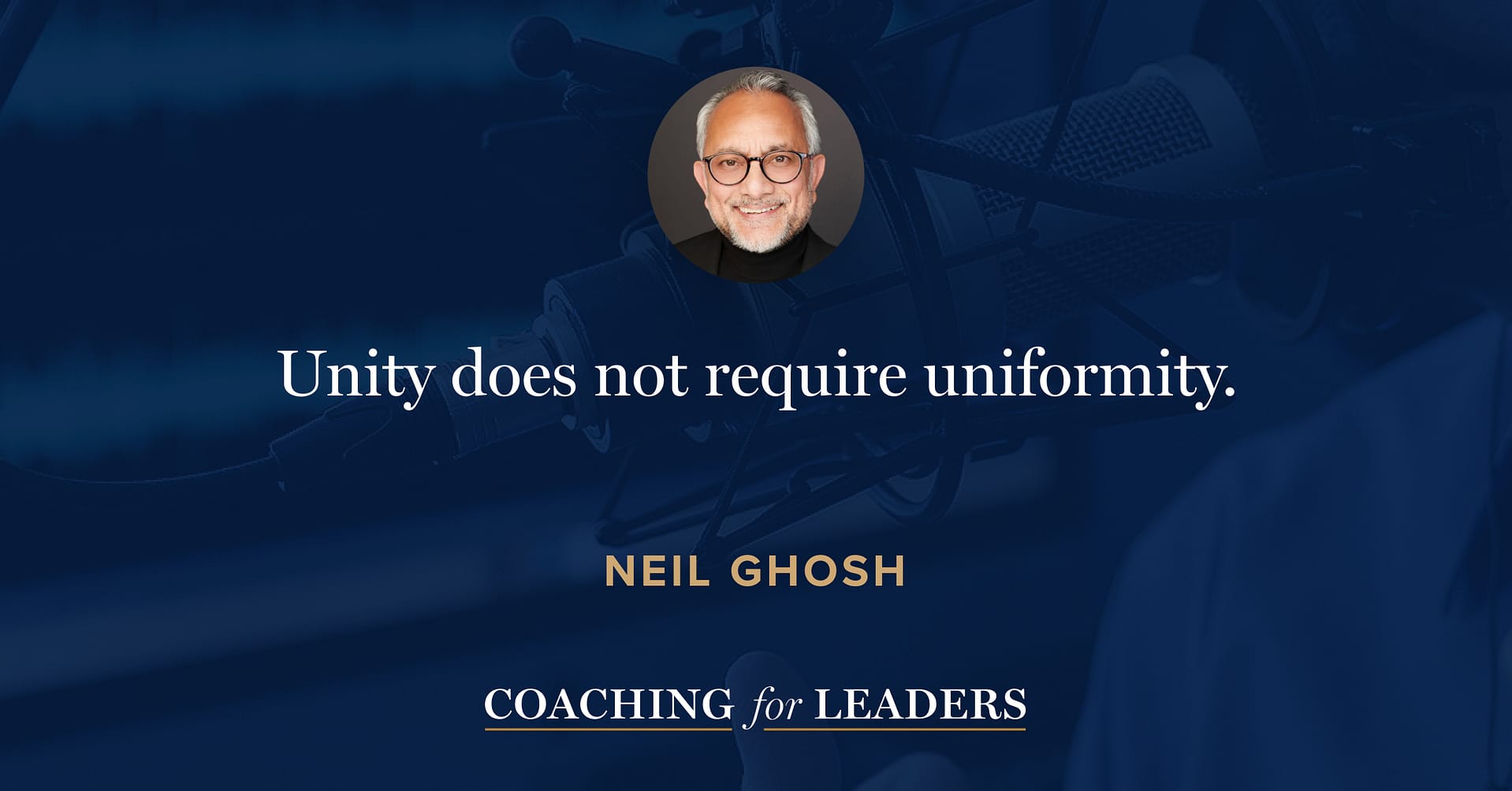
Unity does not require uniformity.
https://media.blubrry.com/coaching_for_leaders/content.blubrry.com/coaching_for_leaders/CFL751.mp3

Podcast: Download

Follow:
Apple PodcastsYouTube PodcastsSpotifyOvercastPocketcasts

Neil Ghosh: Do More Good

Neil Ghosh is a seasoned executive whose expertise spans the nonprofit, government, philanthropic, and private sectors. With 30+ years of experience, he has successfully launched and scaled both nonprofit and for-profit ventures, building teams, business models, partnerships, and strategies to drive impact and support vulnerable populations in more than 50 countries. His book is Do More Good: Inspiring Lessons from Extraordinary People (Amazon, Bookshop)*.

There are many differences in the world today, and those differences influence leaders just like everybody else. That’s why Neil Ghosh has this invitation for us: “Never let age or ideology come between learning and growth.” In this conversation, Neil and I explore how we can lean in on great leadership through our common humanity.

Key Points

  • In anyone we know, we can always find one positive attribute that we can learn from.
  • Never let age or ideology come between learning and growth.
  • The Dalai Lama reminds us to offer compassion and kindness, regardless of whether the recipient is in need.
  • Give back without expecting fanfare. Help people get what they want through peer mentoring.
  • Use your platform to promote unity and to be an advocate for others.
  • Befriend people who have different views. Join or start a book club that intentionally selects books from diverse viewpoints.

Resources Mentioned

  • Do More Good: Inspiring Lessons from Extraordinary People (Amazon, Bookshop)* by Neil Ghosh

Interview Notes

Download my interview notes in PDF format (free membership required).

Related Episodes

  • How to Connect with People Better, with Charles Duhigg (episode 670)
  • Turning Down the Temperature on Outrage, with Karthik Ramanna (episode 711)
  • How to Bring Out the Best in People, with Donna Hicks (episode 724)

Discover More

Activate your free membership for full access to the entire library of interviews since 2011, searchable by topic. To accelerate your learning, uncover more inside Coaching for Leaders Plus.
Leadership Through Our Common Humanity, with Neil Ghosh

Download

Dave Stachowiak [00:00:00]:
There are many differences in the world today and those differences influence leaders just like everybody else. That’s why today’s guest has this invitation for us: never let age or ideology come between learning and growth. In this episode, how we can lean in on great leadership through our common humanity. This is Coaching for Leaders, episode 751. Production Credit: Produced by Innovate. Learning, maximizing human potential. Greetings to you from Orange County, California. This is Coaching for Leaders and I’m your host, Dave Stachowiak.

Dave Stachowiak [00:00:43]:
Leaders aren’t born, they’re made. And this weekly show helps you discover leadership wisdom through insightful conversations. One of the things that I hear very regularly from our members and folks in our listening community is our shared goal of leading in the context of finding a common ground in our humanity. So many of us care so deeply, not only for results, of course that’s important in all of our organizations, but whether it is from the lens of a for profit or a nonprofit or a government work or a faith based community of really tapping, tapping into and empowering the humanity that is part of our shared experience for all of us. Today, I am so pleased to welcome a guest who has really been at the forefront of thinking about this and of course living it throughout his career, as you’ll hear today, and some of the wonderful examples of some of the most well known leaders and also some that aren’t so well known that can help us to do a better job at really finding our common humanity. I’m so pleased to welcome Neil Ghosh. He is a seasoned executive whose expertise spans the nonprofit, government, philanthropic, and private sectors. Over 30 years of experience, he successfully launched and scaled both nonprofit and for profit ventures, building teams, business models, partnerships and strategies to drive the impact and support vulnerable populations in more than 50 countries.

Dave Stachowiak [00:02:14]:
His book is Do More Good: Inspiring Lessons from Extraordinary People. Neil, what a pleasure to know you and to get into your work. Welcome to the show.

Neil Ghosh [00:02:25]:
Thank you very much, Dave. It’s a pleasure and honor. I was also fortunate to listen to some of your earlier podcast. I’m very glad to be here. Thank you.

Dave Stachowiak [00:02:34]:
Well, the pleasure is very much mine. And there is a quote early in the book, “I never let age or ideology come between my learning and growth. As a result, my mentors and mentees are both old and young, conservative and liberal.” That is something that so many of us aspire to and so many of us fall short on. And I’m wondering what you did to get there, to be able to learn from so many different kinds of people.

Neil Ghosh [00:03:11]:
If I can take you Back. Dave, if I may, and I’ll come to your point in a minute. I think all of us are kind of shaped by our childhood and our environment. It’s just the way all our senses started absorbing things when you were very young. And I grew up at a home where I always say there were lack of resources but not lack of empathy. And I think I mentioned somewhere in the book that my mother was almost kind of a 24 hour empathy machine and she didn’t discriminate who was receiving it, whether they’re reciprocating or not. So I think that stayed with me as I started growing up. Another thing I observed that my father who was much quieter and at times we will have a young person joining our family vacation.

Neil Ghosh [00:04:01]:
Some of them has drug issue or alcohol issue. And I think because he kind of believed in second chance and rehabilitation. So I think if you think about those two things, it’s kind of stuck with me that change is possible and empathy is strategic, not a soft thing. It’s something, it builds resilience. As I grew up and started- I think you mentioned at the beginning of the conversation, I was fortunate to work in the private sector for many years. I also worked as a US government contractor, had a top secret clearance from the US Department of Defense. Once upon a time I worked in nonprofit. I worked for the Dutch, for Austrian, I was working for the Australian government for some time.

Neil Ghosh [00:04:43]:
And I traveled, I traveled extensively to not just within the United States, but also to East Africa, West Africa, Latin America, Asia and Europe, and of course many parts of the Middle East. What I realized that small action can deliver humongous change. It’s not that little action give little result. What I’ve seen repeatedly as a child and as I grew up, the small action can give significant result. And I came to believe that this is one sentence I use quite a bit, that unity does not require uniformity. Unity does not require uniformity as long as we have a shared commitment to the common good. I think that premise helped me to answer your question directly, to learn from people I disagree with. And I also say sometime that disagreement is healthy because it creates innovation, right? So I think those strategy, those understanding those values had shaped my thinking and I was able to learn and interact even today with people.

Neil Ghosh [00:05:53]:
I have very little in common when it comes to some of the belief system, but they’re my good friends from all shape of life. So I think that’s my way of leading life which allowed me to learn from people from all ages and all spectrum of politics.

Dave Stachowiak [00:06:12]:
You mentioned your diverse experience and that is one of the reasons I was so interested in talking with you because you have led in so many different industries as the listeners of our show do, government, nonprofit, the for profit world, and, and so extraordinary of your relationship building, like the people you’ve met. I mean, this book is really a kaleidoscope of all the relationships and people you’ve been connected to, many of the names that we recognize throughout world leadership. And the thing that strikes me about so many of the people you feature in the book, and we’ll, we’ll, we’ll dive into some of the examples here in a moment, but is how many of them have that worldview as well, of regardless of age, regardless of political belief, regardless of religion, that they find and prioritize relationships and humanity above all of those other things in order to find some of that common ground. And I just think it’s really extraordinary how many of the leaders we all admire put this value first and yet so many of us struggle with it.

Neil Ghosh [00:07:24]:
Right. I think the one word I have seen repeatedly, and I think you also mentioned that, yes, a lot of them in the book are well known, but a lot of them are not the word I, whether they used it in a particular sentence or not. But what I observed in their action is shared value. Shared value. I have seen it again and again and again. And I think that whether I talk to somebody, a community leader in our neighborhood where I live in Maryland, or when I spoke with in His Holiness Dalai Lama, I think His Holiness talked about compassion not as a passive ideal, but as a practical strength. Right. I think he talks about, he emphasized the inner capacity building.

Neil Ghosh [00:08:12]:
I think that is kind of a trait I have seen across the board in the characters of the book.

Dave Stachowiak [00:08:20]:
Indeed. And the Dalai Lama, who also wrote the foreword to the book, is such a wonderful example of this. And you highlight his leadership and you do zero in in the book of one of the lessons you’ve learned from him, of his advocacy for what you just said, inner capacity building versus just external capacity building. Could you tell me more about that distinction and what you’ve seen from him that has been insightful to you on that?

Neil Ghosh [00:08:53]:
I think the first thing comes to mind is simplicity. Dave, I think in a lot of time whether, and you know, you have talked to many, many people and I was looking at your podcast, so you have experience that we come from all walks of life and sometimes we have a tendency, not necessarily deliberately, but making things more complicated than it should be. So I think one of the Main thing I noticed with His Holiness, his ability to simplify, no matter what profound or complicated questions that we were asking him, he had the unique ability to simplify into small pieces that is tangible, doable, understandable, and with uttermost clarity. So I think that was one of the huge takeaway from His Holiness. Able to simplify a very complex matter. Not that he’s undermining the complexity, but ability to explain in a way that is understandable to all of us.

Dave Stachowiak [00:09:55]:
There’s an invitation there for us in thinking about that inner capacity to often we do think about when trying to help make something better, whatever that is, whether it’s in the business world or in the nonprofit world or government is, we think about the resources and the funding and the commitments and the relationships and all those things. But what I hear you saying is yes, yes. And the inner capacity there is also the ability to surface what’s really key, important and simple and a next step. And the Dalai Lama is an example.

Neil Ghosh [00:10:34]:
Of that, no question about it. I will go one step farther, as we are looking at in the world today, whether the country where I am in or across the world, because I traveled quite a bit. And this is not just to be fair, not just His Holiness, but I think I’ve seen across a character in the book is what I call acknowledgement. And I value this today maybe more than ever before, because what we are seeing in many part of the world, including where I am, a lot of division, disruption and digital overload. And I was looking at an article in the Hill and it talked about we are living in an age of fear. We are fear for our government, our leaders. We fear for crime and violence, inflation and climate change, illegal immigration, misinformation, all kind of stuff. We fear fear itself.

Neil Ghosh [00:11:27]:
And in this particular climate, I think what I heard from His Holiness, not necessarily in this context, but is about responsibility to act. And I think that is also resonated with me across the characters I met. And what I mean by acknowledgment is if you feel certain way, Dave, whether I agree or disagree with you, but I must acknowledge that you’re feeling that if I don’t acknowledge that, it’s very hard to build a relationship with Dave or anybody else because then I’m ignoring your fear and that’s a non start. Does that make sense?

Dave Stachowiak [00:12:05]:
It does. And also complements so well one of the other things you say about the Dalai Lama. You write, “we generally think of having compassion as a matter of acting mercifully towards someone who is suffering and yet not only is that a limited way of defining compassion, but it also fails to recognize the power of simple kindness, whether or not the recipient is quote, unquote, in need.” And I think about you surfacing that. And one of the invitations that you make in the context of learning from the Dalai Lama is to compliment the unsung hero, to acknowledge, as you just said, and the invitation for us all to do that regularly.

Neil Ghosh [00:12:50]:
It’s extremely important. And I think that’s part of the journey that we all should try in our own way, whether in a worker, employee, employer structure, whether in our daily life, whether we are in a religious institution, whether whatever place we are in. I think that’s definitely something changes the dynamics. And now you are the other person. They are a lot more receptive to what you are saying and what your discussion is about. I think you will find a lot a different kind of audience when you do that.

Dave Stachowiak [00:13:27]:
A less known leader in your life that you mention in the book and dedicate a chapter to is Asok Motoyed. I don’t know if I’m pronouncing his name correctly.

Neil Ghosh [00:13:37]:
It’s close. It’s Ashok Motide. Yep.

Dave Stachowiak [00:13:39]:
Thank you for the pronunciation. And one of the. You talk about his mentorship in your life, and one of the things you highlight that he is so good at is giving back without expecting fanfare. And I. I wonder what it is that you’ve seen in him that he does so well in doing that so genuinely.

Neil Ghosh [00:14:06]:
Yeah, one of them. I mean, of course, among many characters, I got to know him maybe the longest. So I observed. I had a pretty long time to observe and understand how he operates and the one you just pointed out may be the most attractive to me because it’s very difficult for most human because at the end of the day, it’s not just by human nature we want recognition. Nothing wrong in that, but just the way we operate. And I think what I’ve seen in him over the years that I heard from other people because he would never mention any of them. And I heard from multiple sources how he played a critical role in their business success or in their time of need.

Neil Ghosh [00:14:54]:
But I would have never known this because it’s not written anywhere. He never, of course, never talked about it. So I found that character so appealing. We all, at least I tried for that. It’s not easy to achieve that. I have to be honest with you. It’s not easy. And I found that true leadership through humility and service.

Neil Ghosh [00:15:14]:
I think that’s something what I Call a quiet generosity embodies Mr. Mouth. And I found it extremely inspiring. Extremely inspiring.

Dave Stachowiak [00:15:25]:
Neil, years ago, I came across the work of Zig Ziglar and listened to a lot of his lectures and speeches over the years. And I always appreciated his quote and have tried to build my work and my career around it. “You can have everything in life you want if you’ll just help enough other people get what they want.” And I, I heard Seth Godin, who’s been on the podcast before, talking about that quote. He’s also a fan of Zig Ziglar and saying, isn’t it nice to get to a place where the first part of that doesn’t even matter so much to you anymore, that you don’t worry so much about what you want and what you’re getting of just coming to the place of helping everyone get what they want? And I hear that in his example. I hear that in what you just said, of wonderful, of course, for you and the other party to both benefit and to get accolades, right? But boy, what a great thing if we can get to a place where we can give without expecting anything in return. As a starting point and something that we all aspire to, I certainly do.

Neil Ghosh [00:16:35]:
Let me give you a couple of examples before I actually forget. It’s kind of interesting. Zig Zaggler. Mr. Motard and I talked about Zig Zaggler almost 20 years ago. We both had cassettes, the whole series of cassette of Zig Ziglar. Oh, no kidding.

Dave Stachowiak [00:16:47]:
Me too.

Neil Ghosh [00:16:47]:
It is so funny. And to be honest with you, I would go one step farther. You may or may not realize I came to United States when I was 22 years old and I was consuming anything I can possibly get to understand Zig Ziglars of the world. So I, I listen to a lot. The point I was trying to make about you talked about helping and the quote you mentioned from him, I, I was going to share. I think it’s a Chinese wisdom. I’m not quite sure, but this is what I heard.

Neil Ghosh [00:17:16]:
The story goes like this, that if you want to be happy for an hour, take a nap. If you want to be happy for a day, go fishing. If you want to be happy for a month, maybe win a fortune and win a lottery. But if you want to be happy for a lifetime, help someone. It’s kind of, you know, I think that is beyond the talk and beyond. It sounds good. There are enough scientific evidence by major universities that actually proven that generosity fuels personal growth, happiness, and even longevity. There are actually also benefit to that model you just talked about.

Dave Stachowiak [00:17:58]:
Indeed. And you invite us, as one of the actions in this part of the book, to start a peer mentoring group in your workplace that you take on the first step to begin. And there are so many things we can do. That’s one of many that we can often take the first step to do.

Neil Ghosh [00:18:16]:
Right. Dave, I think I will hone down what you just said. Mentoring, which is of course excellent, because that’s what Ashok. I kind of position him as one of the best mentors I’ve seen in my entire life. But I think this brings back another point which I don’t want to miss out is small action. Sometime when we think about giving and doing, we get overwhelmed. And I keep reminding people that sometimes just a small action, the one you just explained, is equally important in our life. Sometimes it’s not a big action, but just a tiny example of action that we can take that change somebody else’s life.

Dave Stachowiak [00:18:59]:
So much of our division in the world right now, and of course has been throughout human history, is on religion. And you highlight Imam Elyasi as an example of someone who has been a leader at interfaith dialogue, and you quote him in the book and say in his words, “humanity is foremost, religion comes next.” And I think that’s a really interesting quote from someone who’s a religious leader of noticing the critical nature of our shared humanity and being able to encourage and embrace interfaith dialogue. It is hard to do, and yet it is so powerful, isn’t it?

Neil Ghosh [00:19:43]:
It is. And among many things in life worries me. This is definitely on top of that list. One of the top of the list is lack of understanding of another faith before even I talk about humanity and what Ameliasi told me and others. And I am literally, as we speak, reaching out to as many people as I can. And recently I was in a podcast with a gentleman, Safi Kaskas. He actually translated the Quran in English to make it understandable to people who do not read Arabic language. And I’m really admiring people who are trying to make religion simple because at the end of the day, I’m not a religious scholar any stretch of the imagination.

Neil Ghosh [00:20:27]:
But I talk to enough. I have friends who are evangelical Christian. I have friends who are, as I said, a Muslim scholar. I have friends who are Hindu scholar and Jewish scholar. And across the board, they all tell me one simple thing that they did not articulate maybe exactly the way Elias did. But if you go through the proper scriptures, you’ll come to the same conclusion. The unfortunate thing is a lot of time we define some of the sentences based on somebody else’s interpretation, not what the actual religious scripture said. Coming back to Imam Eliasi, I actually went to Delhi and spent half a day with him.

Neil Ghosh [00:21:09]:
And I was so energized to meet people like him who is doing the best he can under the circumstances to build bridges, whether with the Jewish population, whether with the Hindu population. He actually went to Israel many years ago and there was a lot of controversy in India within his community for him to do that. And for me, those kind of bold action is so much necessary today because we are all afraid of saying things, of doing the right thing. And whenever somebody does the right thing, I think that’s the best thing I can do or we can do at this particular moment.

Dave Stachowiak [00:21:47]:
So many of us aspire to be the kind of leader that he is. That is, yes, a tireless advocate for beliefs and values and also willing to communicate and understand and have empathy across different belief systems. When you’ve observed him and seen him in action and listened to his thinking, what is it that he does to approach his thinking, his conversations that allow that to emerge?

Neil Ghosh [00:22:21]:
I think the same thing I feel about Dalai Lama, which we did not talk as much in my chapter. He has taken a similar approach to Imam Eliasi in interfaith, although I did not focus on that part in my writing with him. But coming back to the specific question you asked, I think the common thing I’ve seen with His Holiness, Imam Elyasi and other religious leaders I met is not coming from the space of dogma that I’m better than you, my religion is better than you, my belief is better than you. I think that’s what I felt. I mean, with all his love and conviction of his own religion and belief system, I don’t think I felt he was. When he’s talking to somebody else, that’s not a starting point. I think his starting point was, can you tell me about your religion? And as a matter of fact, I mentioned another name to you a few minutes ago. He I just talked to.

Neil Ghosh [00:23:17]:
I just got to know him last couple of months ago. He lives right in my area. He’s an Islamic scholar. He goes to church to learn to understand better, different part of Bible. So I think coming back to Eliasi, what I felt was his openness in learning and not coming from a place that my scripture or my religion is better than your religion.

Dave Stachowiak [00:23:42]:
You invite us as one action in thinking about his work to use social media to promote messages of peace and unity across different religious groups. And I was thinking about that invitation and how almost everyone who listens to this podcast has a platform or a voice in some way. It might be inside their organization, it might be inside their industry. It might be even broader than that. But almost all of us do in some way. And how often we think to use social media, our platforms, our resources, to convey our message. Right. And we often don’t think about it through the lens of how could I promote somebody else and get their message out, even if I may not agree with them on some of the beliefs and logistics.

Dave Stachowiak [00:24:35]:
But that is someone that I can respect from their shared humanity. And I think it’s just a wonderful invitation for all of us who all have people I know that come to mind when we think of that we may not agree on everything, but that we can use our platform to be a voice and an advocate for them. What a wonderful invitation that is.

Neil Ghosh [00:24:55]:
Well, thank you. Thank you. It’s also very timely right now.

Dave Stachowiak [00:24:58]:
Yeah, indeed it is. One of the other folks that you highlight in the book is a name many people, of course, know, Ruth Bader Ginsburg. You had a chance to interact with her near the end of her life, and I just think, like, what an extraordinary example she is of what you talk about in the book, shared humanity. And I’d love to read a quote that came from her in eulogizing Antonin Scalia, who, for those not familiar with US Politics, the Supreme Court, Ruth Bader Ginsburg was probably, you know, our leading liberal voice on the Supreme Court for many, many years. And then Antonin Scalia was the leading conservative voice for many, many years. And they were close friends. And she, at his funeral, eulogized him and said this:

Dave Stachowiak [00:25:53]:
“From our years together at the D.C. circuit. We were best buddies. We disagreed now and then. But when I wrote for the court and received a Scalia dissent, the opinion ultimately released was notably better than my initial circulation. Justice Scalia nailed all the weak spots, the applesauce and the argobargle, and gave me just what I needed to strengthen the majority opinion.” And I read that, Neil, and I think, like, first of all, I love the phrase where she says, we disagreed now and then. Of course, they disagreed on almost everything when it came to the law. Right. But I think even in the context of, of course, that deep disagreement and different approach to the law and the decisions, boy, what a shared humanity and friendship between the two.

Dave Stachowiak [00:26:41]:
What an incredible example of what you talk about in this book.

Neil Ghosh [00:26:45]:
It is. It is. And I mentioned, I think, maybe casually when we started talking, that One of the things I really nowadays talk a lot about, that disagreement is healthy. And this is a classic example when you read the code, because of the disagreement, her writing, her views got stronger because she was able to improve upon it. Right? Disagreement is healthy and that is a beautiful way of looking at disagreements. So instead of shunning them and not talking to somebody. So. Yes, indeed.

Neil Ghosh [00:27:13]:
Yes, indeed.

Dave Stachowiak [00:27:14]:
And also interesting how much she, in her life and her work put humanity first. And there’s also a really fascinating example. Those again, familiar with our politics here in the States. Brett Kavanaugh was, was nominated to the court and it was a very controversial process and, and again on a very different side of the political spectrum than she was in beliefs. And yet she reaches out and offers to help support him in preparing for his nomination hearings. I just think an extraordinary example of someone who is so willing to put humanity first and set aside beliefs and disagreements on other things. Just, just incredible.

Neil Ghosh [00:27:57]:
It is, it is.

Dave Stachowiak [00:27:59]:
When you think. about her, her legacy, her example, her interaction with you and one of the organizations you were leading, what is it about leaders like her that they are able to do that, that so many of us are not?

Neil Ghosh [00:28:19]:
I will say in a general term that I think not just her across the board when I there are many examples and I intentionally each of them. There are many lessons to be learned from all of them, but I deliberately chose one so we can hone down on one and do something about it. Right. So if you look at all the characters in the book, I kind of picked one. And Ruth Bader Ginsburg, the lesson I deliberately mentioned there, learn from everyone, etc. Etc. So but the general thing, what I found is across the board is whether you call it humanity, you will call it shared value, I will say that gratitude, empathy, mindfulness, service to our community and speaking up for what’s right. I think those are, I would say consistently I have seen across the board, whether they are unsung heroes in the book or some of the well known characters in the book.

Dave Stachowiak [00:29:18]:
And there are so many of them from government, from the sports world, from your own personal life. I mean, just really an extraordinary kaleidoscope of voices and inspiration for us. So we’ve only hit on four of them today. There’s many more in the book that I hope folks will take the next step and go learn from. And I also love how intentional you are on each one of those lessons. And then an invitation, a very practical one for us. And in particular highlighting some of the wonderful organizations in the world that are representing their beliefs and interests and this shared humanity. And Neil, as you were putting together this book and putting and thinking about all the relationships that have emerged in your life and thinking about this shared humanity, I’m curious, as you put together all the stories and have shared this with others, what if anything have you changed your mind on?

Neil Ghosh [00:30:17]:
I think I would say I’m more focused on taking some action and I’m more focused on the unity because we are too divided at particular time. So I think if anything has changed is my intention and my focus on how do we unite better on our common ground of our common shared value and common humanity.

Dave Stachowiak [00:30:42]:
Neil Ghosh is the author of Do More Good: Inspiring Lessons from Extraordinary People. Neil, thank you so much for your work.

Neil Ghosh [00:30:51]:
Grateful thank you Dave.

Dave Stachowiak [00:30:58]:
If this conversation was helpful to you, three related episodes you’ll also want to check out One of them is episode 670, how to connect with People Better. Charles Duhigg was my guest on that episode. Best selling author of several books, including his most recent Super Communicators. We talked about what do the best communicators out there, the folks he calls super communicators, do in order to connect well and what are the tactics that we can borrow and implement ourselves in our own relationships. A good complement to this conversation of building relationships across ideology, age generation, industry perspectives. So many opportunities to do that. Episode 670. A good starting point for that.

Dave Stachowiak [00:31:39]:
Also recommended episode 711 turning down the Temperature on Outrage. Karthik Ramanna was my guest on that conversation and we talked about the reality that almost all of us face at some point in our careers and organizations, some of us regularly, which is there’s outrage going on because of something that’s happening inside the organization, with stakeholders in our industry, because of geopolitics, whatever’s happening. And Karthik reminds us in that conversation, leaders have the responsibility to notice that, to stop and understand it, and then to take the leadership to turn down the temperature on outrage a bit so that people can work together collaboratively. The organization can do the work it needs to do. How to begin on that episode 711, if you’re in the midst of that right now, I’m so sorry if you are. And that conversation may be a helpful starting point for you. And then finally, I recommend episode 724, how to bring out the Best in People. Donna Hicks was my guest on that episode, an expert in looking at dignity and the dignity that every human being is deserving of.

Dave Stachowiak [00:32:42]:
And she makes the distinction in that conversation. Not everyone is deserving of respect, but everyone is deserving of dignity. And we talk how to play out that distinction and what that means for us and how we lead episode 724 for that. All of those episodes you can find on the coachingforleaders.com website and I’m inviting you today, if you’ve never done so before, to set up your free membership at coachingforleaders.com because it’s going to give you access to the entire library, searchable by topic, that I’ve heard since 2011. So you can find exactly what you’re looking for, plus several other free resources that are part of the membership. One of them is an entire suite of free audio courses, and one of them I’m thinking about in the context of this conversation is an audio course I aired a while back called Making the Most of Mentoring. I talk in that course about how to discover and engage with the three kinds of people who can help support your development. I think a great complement to this conversation, it is there for you.

Dave Stachowiak [00:33:41]:
If you have your free membership, go ahead and just log in, click on courses inside of the website and you will see that as one of the courses as well as many others available to you. And if you don’t yet have your free membership set up, just go over to coachingforleaders.com set up your free membership right on the homepage there and you will be off and running with us. Coaching for Leaders is edited by Andrew Kroeger. Production support is provided by Sierra Priest. On Monday, I’m glad to welcome McKinsey partner Scott Keller back to the show. We are going to be talking about how to start the top job in the organization if that’s you or that may be you in the future. Don’t miss that conversation with Scott next week and see you back this coming Monday.

Topic Areas:NetworkingPersonal Leadership
cover-art

Coaching for Leaders Podcast

This Monday show helps you discover leadership wisdom through insightful conversations. Independently produced weekly since 2011, Dave Stachowiak brings perspective from a thriving, global leadership academy of managers, executives, and business owners, plus more than 15 years of leadership at Dale Carnegie.

Listen Now OnApple Podcasts
  • More Options
    • YouTube Podcasts
    • Spotify
    • Overcast

Activate Your Free Membership Today

Access our entire library of Coaching for Leaders episodes from 2011, searchable by topic.
Listen to the exclusive Coaching for Leaders MemberCast with bonus content available only to members.
Start Dave’s free audio course, 10 Ways to Empower the People You Lead.
Download our weekly leadership guide, including podcast notes and advice from our expert guests.

... and much more inside the membership!

Activate Your Free Membership
IMAGE
Copyright © 2025 · Innovate Learning, LLC
  • Plus Membership
  • Academy
  • About
  • Contact
  • Dashboard
×

Log in


Forgot Password

Not yet a member?

Activate your free membership today.

Register For Free
×

Register for Free Membership

Access our entire library of Coaching for Leaders episodes from 2011, searchable by topic.
Listen to the exclusive Coaching for Leaders MemberCast with bonus content available only to members.
Start Dave’s free audio course, 10 Ways to Empower the People You Lead.
Download our weekly leadership guide, including podcast notes and advice from our expert guests.

... and much more inside the membership!

Price:
Free
First Name Required
Last Name Required
Invalid Username
Invalid Email
Invalid Password
Password Confirmation Doesn't Match
Password Strength  Password must be "Medium" or stronger
 
Loading... Please fix the errors above