• Skip to primary navigation
  • Skip to main content
  • Skip to primary sidebar

Coaching for Leaders

Leaders Aren't Born, They're Made

Login
  • Plus Membership
  • Academy
  • About
  • Contact
  • Dashboard
  • Login
Episode

792: Create Leadership Paths That Work for Everyone, with Ludmila Praslova

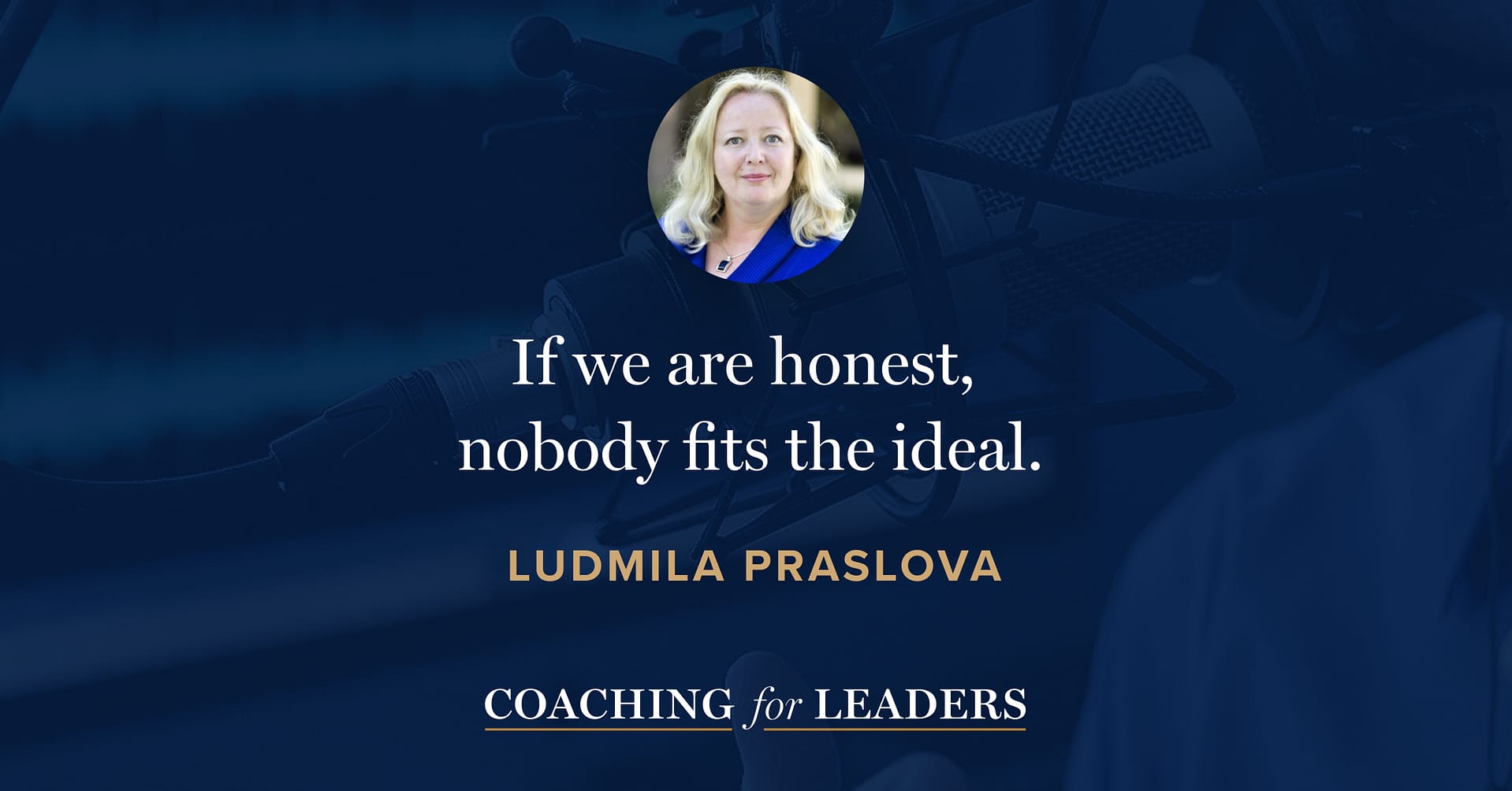
If we are honest, nobody fits the ideal.
https://media.blubrry.com/coaching_for_leaders/content.blubrry.com/coaching_for_leaders/CFL792.mp3

Podcast: Download

Follow:
Apple PodcastsYouTube PodcastsSpotifyOvercastPocketcasts

Ludmila Praslova: The Canary Code

Ludmila Praslova is a Professor of Industrial-Organizational Psychology at Vanguard University of Southern California and regularly writes for Harvard Business Review, Fast Company, Psychology Today, and Forbes. She’s the recipient of the 2025 Talent Award from Thinker50 and has been named a LinkedIn Top Voice. She is the author of The Canary Code: A Guide to Neurodiversity, Dignity, and Intersectional Belonging at Work (Amazon, Bookshop)*.

We’ve all seen career paths that sound like this: analyst 1, analyst 2, senior analyst, lead analyst, manager of analysts, etc. Those paths to leadership work for some people, but they don’t work for others. In this conversation, Ludmila and I explore how to create leadership paths that work for everyone.

Key Points

  • Canaries were used in coal mines because they were more sensitive to early indicators of problems – in a way that helped everyone. The same is often true for neurodivergent leaders in organizations.
  • The “ideal leader” is a myth. If we are honest, no individual fits the ideal profile.
  • Having different paths to leadership makes more sense in a complex world. Many of the best leaders are specialists in something.
  • Instead of looking for “culture fit,” challenge yourself and your organization to do a “culture add.” Neurodiverse leaders can be less susceptible to bias and have higher levels of divergent thinking – huge benefits strengths for many organizations.
  • In addition to people management, consider paths for leadership that focus strength and skill on system and process, strategy, expertise, though leadership, global leadership, and creative ideation.
  • Making the workplace more accessible and equitable for one population almost always makes it better for everyone.

Resources Mentioned

  • The Canary Code: A Guide to Neurodiversity, Dignity, and Intersectional Belonging at Work by Ludmilla Praslova (Amazon, Bookshop)*

Interview Notes

Download my interview notes in PDF format (free membership required).

Related Episodes

  • The Mindset Leaders Need to Address Burnout, with Christina Maslach (episode 608)
  • The Neurodiversity Edge in Organizations, with Maureen Dunne (episode 694)
  • How to Motivate Younger Employees, with David Yeager (episode 775)

Discover More

Activate your free membership for full access to the entire library of interviews since 2011, searchable by topic. To accelerate your learning, uncover more inside Coaching for Leaders Plus.
Create Leadership Paths that Work for Everyone, with Ludmila Praslova

Download

Dave Stachowiak [00:00:00]:
We’ve all seen career paths that sound like this: Analyst one, then analyst two, then senior analyst, lead analyst, manager of analysts, and on and on and on. Those paths to leadership work for some people, but they don’t work for others. In this episode, how to create leadership paths that work for everyone. This is Coaching for Leaders, episode 792.

Dave Stachowiak [00:00:27]:
Production Credit: Produced by Innovate Learning, Maximizing Human Potential.

Dave Stachowiak [00:00:35]:
Greetings to you from Orange County, California. This is Coaching for Leaders, and I’m your host, Dave Stachowiak. Leaders aren’t born; they’re made. And this weekly show helps leaders thrive at key inflection points. One of the inflection points in many of our careers, not only our careers, but the careers of the people that we support on our teams, is thinking about what’s next. What’s the talent development, the leadership development path that works, or doesn’t, for people to continue to grow their careers? And oftentimes there’s a traditional path in many organizations, either officially or unofficially. But what often is not the case is that there’s a lot of different paths that can work for everyone with all the different talents and strengths that we bring into our organizations.

Dave Stachowiak [00:01:26]:
Today, a conversation for all of us on how we can create leadership paths that really work for everyone. And I’m so pleased to welcome Ludmila Praslova as our guest today. Ludmila is a professor of industrial-organizational psychology at Vanguard University of Southern California and regularly writes for Harvard Business Review, Fast Company, Psychology Today, and Forbes. She’s the recipient of the 2025 Talent Award from Thinkers50 and has been named a LinkedIn Top Voice. She’s the author of The Canary Code: A Guide to Neurodiversity, Dignity, and Intersectional Belonging at Work. Ludmila, such a pleasure to have you on.

Ludmila Praslova [00:02:07]:
Thank you. I am thrilled to be here. Thank you, Dave.

Dave Stachowiak [00:02:11]:
Bonni and I have been following your work for many, many years, and cheering you on, and seeing all the incredible things you’ve been doing. Bonni and you have been fortunate to work together on many projects over the years. And when your book came out, it changed so much of the conversation around neurodiversity, how we think about it in organizations, but even more importantly, how we think about doing better for everyone. And I would love to get into that. But before we do, I’m curious about the title of the book. You’ve titled it The Canary Code, and you use the analogy of a canary in your work. And I’m wondering if you could share a bit about how the canary showed up. And how does this relate to thinking about making things work well for everyone?

Ludmila Praslova [00:02:56]:
Absolutely. I think many people use the expression “canary in the coal mine” and sometimes they just use it as an expression. They don’t even think there’s something real behind it. Right? You’ve used it probably.

Dave Stachowiak [00:03:12]:
Oh yeah, many times.

Ludmila Praslova [00:03:14]:
And there is a very real story, and it’s not a myth, it’s not a legend. And in fact, in UK, for example, every coal mine was required to employ two canaries. And the practice was only discontinued in the 1980s. And there is a very real reason for it. So people might have heard that canaries are more sensitive to toxic air. So before we had electronic detectors for poisonous gases, people took canaries down in the mines, and they monitored how they were feeling. It’s a myth that they just let them die, by the way, it was not that horrific.

Ludmila Praslova [00:04:002]:
They actually took them out when they would see signs of distress. They even had canary resuscitation devices and giving them oxygen if needed. Yes. And why canaries are more sensitive is also very interesting thing. Not because they’re weak or defective. It’s actually because they have this incredible strength and ability to fly and ability to sing. And birds process oxygen more intensely than humans, and they process it on inhale and exhale. So they just have more intense air metabolism that allows them to do what they do, what humans cannot.

Ludmila Praslova [00:04:48]:
So people kind of capitalized on that strength before canaries were able to retire from coal mines. Because now we have, you know, electronic carbon monoxide detectors.

Dave Stachowiak [00:05:01]:
Yeah, indeed. And I think something you said just a moment ago really is so critical. And when we think about this from the standpoint of, both neurodiversity and leadership, the canary is superior in a number of ways to humans and can do things that human beings can’t do. And we often think about something like hypersensitivity in the example of a canary as a deficit. And what you’ve invited us to do through this analogy and through your work is thinking about all the things that it allows the canary to do that, yeah, are really different than human beings, but actually are incredible strengths and add to the biodiversity of the system. And of course, in the case of the coal mine, makes things better for everyone, right?

Ludmila Praslova [00:05:48]:
Exactly. Well, that’s the whole point of the canary code, that if canary can breathe, then it’s safe for everyone, and it’s safe for humans and for all the other oxygen-consuming organisms. Because if a bird is okay with its intense metabolism, it means that air is really good for everyone. So that’s really the idea that’s applicable pretty much anywhere from school to workplace to any kind of environment where you have multiple people and groups. If you try to find those who are more sensitive, whether it’s in a sensory processing, or people who have very intensely working brains and process a lot of information in a short period of time. If those people are not picking up on problematic things, that means that they’re quite likely not to be problematic things. And those more sensitive people will catch those issues before others are going to notice them. Because by that time it might be a little too late.

Dave Stachowiak [00:07:00]:
Yeah, indeed. And I think that’s, it’s such a critical mindset shift for a lot of us, and especially leaders. I think oftentimes, we think about someone who is more sensitive to something for whatever reason, as a challenging situation or maybe an annoyance, or I have to work around this person’s preferences or this particular signal. And what we don’t think about is the bigger picture that you just articulated, which is this person who’s more sensitive to something for whatever reason, oftentimes, not always, but oftentimes, is an indicator of things that aren’t working for everyone. They’re just the first people to see it.

Dave Stachowiak [00:07:46]:
They’re just the first people to bring attention to it, to verbalize it. And if we take that as a key indicator and then take action with it, it can make the work, and the lives, and the careers of everyone better in our organizations.

Ludmila Praslova [00:08:02]:
Exactly. Before we start saying, ” Oh, this person is too sensitive”, which is, in some situations is used as an insult. But really, is it really a bad thing to be sensitive to things like injustice or poor work environment because toxic behaviors, bullying, incivility, lacks ethical standards? Those things tend to accumulate when we don’t pay attention. So when there are people who do pay attention to those things, it’s really much better for all of us not to label them too sensitive, but actually pay attention to the signal.

Dave Stachowiak [00:08:43]:
Yeah, indeed. Well, and this is a perfect lead into one of the invitations that you make in your work, which is to really think very strategically and intentionally about creating leadership paths that work for everyone. And as I mentioned in the introduction, there’s a lot of organizations that have, if not officially, certainly a cultural norm on what a leadership path looks like. You go from this level to this level, and you do this kind of work, and it’s very intentional and very structured. And oftentimes, there’s rubrics and paths and larger organizations to articulate that. And there are some, unfortunately, some myths that we run into, and a lot of us just assume that we don’t necessarily think about. And I’d love to highlight a few of them that you talk about in your research. And one of them is what you call the ideal leader myth of working through a leadership development path and continuing to develop your career. What is the ideal leader myth, and where do we run into it?

Ludmila Praslova [00:09:46]:
Well, it’s really a prototype, a cognitive schema of what we think leaders should be, which is kind of a composite of famous people and famous leaders throughout the history. That kind of makes it, a) not realistic and b) every situation is different. So sometimes organizations can still adjust it to their environment, but it’s still very generic. And it kind of expects someone to be able to do everything, to inspire people, and to be competitive, and to have very interesting strategic vision, and maybe have technical skills. And it’s kind of like everything plus personality characteristics. So we often put a lot of weight on extroversion, on kind of external signs of drive, even though everyone wears their energy differently, but we’re looking for those external signs. And so then we have this ideal, and then we’re trying to recognize people who kind of resemble that, and we’re trying to mold people into that, which again is not really realistic, because we do have very different abilities and some abilities pretty much don’t coexist together in most people and typical people. And then we start expecting too much.

Ludmila Praslova [00:11:23]:
And very often it’s not actually what a particular situation, or particular time, or particular type of leadership requires.

Dave Stachowiak [00:11:34]:
You say on this, if we are honest, nobody fits the ideal. Boy, that’s so true, isn’t it?

Ludmila Praslova [00:11:41]:
Absolutely. And there’s just so many different ways. I’m not going to even go into neurodiversity. Do you know the Ricet model for occupational interests? So realistic, investigative, artistic, social, entrepreneurial, and conventional. And even if you just look at that one, usually people have one or two dominant strengths, but somehow we expect leaders to be all of it, maybe except for realistic, because that’s working with your hands. But everything else, we expect them to be academic and creative and great with people and have entrepreneurial drive and to be good with administrative tasks. And that’s just not a realistic thing.

Dave Stachowiak [00:12:25]:
Yeah, there’s always trade-offs. I mean, I think in my career, of the people that I’ve worked with, the people I’ve hired, and I’m sure the experience is true for you too, where you get in a conversation about is someone the right fit? Are they ready to move into the role? There’s always trade-offs. There’s always things that they do really well. There’s always things that are not strengths in their areas. There, there isn’t, there isn’t ever an ID and a quote-unquote ideal or perfect person. It’s always a trade-off conversation.

Ludmila Praslova [00:12:51]:
Exactly. And we just keep deluding ourselves that we’re going to find that ideal leader. Which is why in other places I’m saying let’s just take this stress off one individual and focus more on balanced leadership teams with different abilities.

Dave Stachowiak [00:13:10]:
One of the other myths is the pipeline myth. What’s different about this myth than the ideal leader myth?

Ludmila Praslova [00:13:16]:
Well, that’s kind of how that ideal leader can be formed. And the idea is that you start usually with somewhere more of the administrative tasks and one-on-one people management, and maybe grow into more people management, more people development, and then maybe eventually you grow into strategy and vision-type tasks. Which seems kind of logical. And you mentioned the rubrics and ideals. But again, the problem is it doesn’t align with how actual humans function. If someone is very high in their interest in, let’s say, ideas and concepts, and they like looking at data, and they like strategic thinking. And we’re saying before you can get there, you have to do 10 years of direct people management. Okay, they can do it; they can force themselves.

Ludmila Praslova [00:14:20]:
But we have someone spending 10 years doing something that’s not their best strength, that’s not good for them, and that’s not good for the people they’re managing. Or we’re going to have someone who is wonderful at people management, and then we finally promote them to strategy and systems, and they hate it. So I have one of the case studies in my book about a person who loves people management, and that’s what he wants to do. He wants to develop people, and then he was promoted, and he promoted and got a better salary, and now he was doing strategy and documents and data, and he was miserable. Because now, kind of like the classic, he promoted out of his area of strength and out of his area of talent. And eventually, he ended up giving this position and the money and just going into learning and development specifically, because he likes people and he likes to develop people.

Ludmila Praslova [00:15:25]:
So he was doing the right thing going through the pipeline, and he was really good at a part of the pipeline. And then he went to the next part, and that just didn’t align with who he was. And then we can think of many other people who either break on the one-on-one people management level. Even so, they would have been incredible at the level of strategy, and data, and long-term planning, but they never get there. Or again, they slog through people management and make everybody miserable, including themselves.

Dave Stachowiak [00:16:00]:
There was a time, and unfortunately, there still is a time in many organizations, where there is just one traditional path to leadership. And I’m, I’m not sure that ever worked brilliantly for many organizations. I’m sure for some it worked well for a time. But we live in a really complex world now. I mean, things are changing so much more quickly. And you write on this: Having different paths to different types of leadership makes a lot more sense in a complex world. And I think about that in the context of what you just said that.

Dave Stachowiak [00:16:34]:
And going back to our earlier point, the best leaders are often specialists in something. It doesn’t mean they can’t do other things, but they, of course, we all bring strengths in our own areas. If there’s multiple different paths to that pipeline of how you lead and how you influence an organization, it opens up so much more opportunity to play to strengths and also, by the way, help the organization in a world that’s increasingly complicated 100%.

Ludmila Praslova [00:17:01]:
And that’s exactly what I’m saying, that we are way past that early factory environments that were in turn influenced by military environments. And we need so many more different types of strengths and different types of litters that the pipeline is really constricting.

Dave Stachowiak [00:17:25]:
The final myth you highlight is the culture fit myth. And you make a distinction between culture fit and what you call culture ad. Tell me about that distinction.

Ludmila Praslova [00:17:35]:
This might be something that people might be familiar, but some people may not. And culture fit is stressed in so many job descriptions, promotion expectations, leadership expectations. But fit is only good to certain extent before we become too homogeneous, too rigid, before we get into groupthink and lack differences in perspective. So what I talk about culture ad, we can look for feet in things like core values, but then we expand culture fit to all kinds of things like personality characteristics and very, very narrow specific organizational ideals and perspectives that then translate into demographics and all kinds of other things. But if we think about culture ad and what can someone bring as far as perspectives, knowledge, and experience that is actually enriching our collective cognition and our ability to see the world from multiple perspectives. That is something that is really going to also strengthen complex organizations functioning in a dynamic world where we need to predict unpredictable things as well as we can. And having this diversity of experience and perspective in the form of culture ads, really helps us create much more flexible environments. Because a clone, clone army can only do so much.

Ludmila Praslova [00:19:20]:
You really want people who have different talents and different abilities and different perspectives rather than sameness. And we need that throughout the organization, and we need that in leadership as well, because someone needs to be able to challenge that group thing on the highest level.

Dave Stachowiak [00:19:41]:
And this comes right back to the canary analogy that we talked about at the beginning. That oftentimes, when we think about folks who show up in a different way or are more sensitive than the typical population, we think about that first and foremost as a deficit, a lot of us. And we don’t think about the strengths that that brings, especially in an increasingly complex world. And you write on this research suggests that autistic people are predisposed to think systemically and are less susceptible to bias. ADHD is associated with higher levels of divergent thinking and lower levels of convergent thinking, a cognitive style that may facilitate thinking outside the box. And it just, it’s just another reminder to me of, like, when we think about this from a culture ad standpoint, that, yes, people show up differently. Yes, they have different sensitivities.

Dave Stachowiak [00:20:33]:
Yes, they have different strengths. That is a net plus in a world where the complexity is we’re running into every single day. And by having folks who are on our team that we’re not only supporting, but paying attention to those signals. Wow. Hugely helpful.

Ludmila Praslova [00:20:47]:
Yes. And research shows that we need different types of people on teams. It might take a little bit more time to gel and get to know each other, but once you have all those differences in the team and people had time to learn how they work, we do have diverse teams outperforming those that are the same. So having all those strengths, and again, every individual will not necessarily fit even what research shows for averages for the group. And there’s all kinds of individual combinations of talents, but that’s really what makes people fun and work fun. If you have all those different talents and you create a team that is complementary to each other rather than fitting together like the same blocks.

Dave Stachowiak [00:21:41]:
Yeah. And it really does start with a senior leader having a mindset shift on this, or maybe a group of senior leaders in an organization thinking a little differently on this. And I think it might be fun to look at some of those different focuses. Like, intellectually, it always sort of makes sense to us. Like, okay, yeah, we should bring in different people with different strengths. We should have different paths. But you’ve highlighted some of the key ones that I think are really fun to think about as we think about different paths that people may take to leadership. And there’s the obvious one that we mentioned earlier: people management and development.

Dave Stachowiak [00:22:16]:
Like there are many people in our audience who have a real talent and a strength for that and a, and a passion and a care for it. But there’s a whole bunch of others too, and one of them is system and process leadership. When you think about that, how’s that different than something like people management?

Ludmila Praslova [00:22:34]:
Sometimes you need to take a look at the entire, let’s say, challenge management, or operations, or production, or technology and innovation. You just need to look from the point of view of process improvement and systems thinking. So one thing is to think about, okay, how do we, you know, use interpersonal skills and emotional intelligence, and inspiration when we’re in people management? But when we’re looking at it from the perspective of systems and processes, we need to be able to identify bottlenecks. We need to be able to look at something from the point of view of a complex system that has multiple moving parts, human and non-human moving parts, and try to figure out how they best fit together. So that’s more of a systems and process leadership where you are, well, let’s say now looking at someone who’s trying to sell you, let’s say AI agents, and you’re like, okay, so we have our people, we have our tasks, does that particular system that people are trying to sell us, actually, will it solve our actual problems? That’s thinking about it from the systemic perspective. Or is it going to be something that we’re going to replace, something that’s already working, and the bottleneck and the problem is still going to be there because that technology, however fashionable it might be and however wonderful the sales pitch is, is not doing what we need to be doing.

Ludmila Praslova [00:24:24]:
So that’s the way of looking from more of a zoom out perspective and seeing how different pieces of the organizational system fit together and knowing where to mess with things and maybe where improvement is needed, and where you don’t mess with a good thing, which I think many organizations really have a hard time with it, and they really need systems thinker who will know, “okay, there’s a bottleneck, there’s a problem, and we need, let’s say technology that will solve this problem”, rather than saying, okay, so we’ve got technology, where can we stick it? And pardon me, but that’s exactly why we’re having all those problems right now, because we don’t have people who look at it from the systemic level and asking a question, which problems do we actually need to solve? And then you have disruptions for the sake of disruption.

Dave Stachowiak [00:25:21]:
So many leaders have a strength, especially in one area, and they may be effective in other areas or maybe not as much. But I think about what you just described of that skill set, of that systemic ability to be able to see the big picture, look at the organization, and the kind of people who are also good at people management and development. And there are some people who are truly world-class on both of those, but there’s not many. You know, like when you think of people’s strengths, I mean, the kind of person who’s really great at the people management development person may not be, in fact, often isn’t the same person who’s really good at the systemic, the big picture kinds of things, and maybe not be good at some of the other things we’ll talk about here in a moment. And again, it comes back to like thinking about, okay, all of these people have the capacity and the ability to lead, and yes, there’s areas they need to, like, you know, sometimes do that may not be their strengths as much. But thinking about this, of a lot of different ways to come to leadership and a lot of different ways those roles and those pipelines look in the organization.

Ludmila Praslova [00:26:22]:
Right, and we all can do those things. It’s just we don’t want someone to be stuck spending 80% of their time on something that’s not their strength. We all understand that sometimes you need to do things that are not ideal. Okay, so 10% of your time on one thing that’s not ideal, another 10% on another thing that’s not ideal. But give me 80 to 70% of where I am best, you’re just going to get a better performance, and then other people just fill those gaps. Everyone is working with their strengths. Overall performance of an organization is exponentially better.

Dave Stachowiak [00:26:57]:
Yeah, indeed. And that comes back to that cultural ad point, right, of like adding in the strengths that we don’t have on the team. One of the other focus areas you highlight is expert leadership focus. What does that look like?

Ludmila Praslova [00:27:09]:
Well, I mean, we all talk about ability of organizations to lead in sometimes technical, sometimes, maybe even philosophical, always. And just show that we are cutting edge in whatever that is we’re doing. And some people, again, do not necessarily want to do policies. They don’t necessarily want to do people management, but they are world-class at their specialized area of expertise. It could be engineering, or it could be writing, or it could be any kind of invention. And sometimes we just don’t know what to do with those people, and they end up getting stuck in, you know, individual contributor roles, and then they get bored because there’s nowhere to grow. We’ll just say, okay, so this is good enough. But we don’t give people opportunities to develop into really top world-class experts.

Ludmila Praslova [00:28:14]:
And that’s an opportunity where you can have someone who a) is doing something they love, is really good at it, contributing really good insights to the economy, and also becomes a person that your organization can be really proud of, and be someone that everyone identifies as this incredible name that is associated with your organization. So that’s the expert path. Something that is specialized but developing beyond just really good individual contributor, but towards elite, world-class expert in whatever it is that your organization is doing.

Dave Stachowiak [00:29:03]:
As you were saying that, Ludmila, I was thinking about a client I had years ago in a large technology company, and this company had this amazing- this is years ago; they were really ahead of the curve. They had a, they had a path just for expert leadership in their career path and in their organization. And the- I remember one of the people who had gone down this path and had reached the highest level, and they had a, they had a fancy name for the title when you got to this place. It was a technical fellow or something like that. I don’t remember the exact title.

Dave Stachowiak [00:29:40]:
But he had zero interest in managing people, did not… And everyone agreed he would not be good at doing that. Like, including him, he was the person who was like, no, that should not be my job. But he was an amazing technical expert, and he had patents, and he had… But he was amazing; he was great at mentoring people, and customers loved him, stakeholders loved him. The whole team rallied around him. He had such a position of reverence in the organization, and people loved bringing him on the teams because that’s what he did really well. And to the organization’s credit, they had a career path for that.

Dave Stachowiak [00:30:10]:
And he was extraordinarily well compensated. He was extraordinarily well recognized in the organization, and there were many others like him in the organization that, because the organization was forward thinking to look at, hey, there’s, there’s an expert leadership path that you may not want to manage people, you may not want to become a director, VP or whatever, but you could go down this path that was totally different. And it was incredible how much the organization benefited from that in the ecosystem. And it just illustrates everything you just said of like, that importance of being willing to just open up to, “Hey, there’s different paths to leadership that work great for everyone”.

Ludmila Praslova [00:30:48]:
Exactly. Just think of the motivation for other people to develop and to contribute and to invent and to mentor, and not think that the only way to have a better salary and respect for what you do is to become administrator and never do the thing that you love anymore. It doesn’t make sense.

Dave Stachowiak [00:31:09]:
Yeah. Indeed. Indeed. And I think this just comes back so much to how everyone benefits from this. And I think about another version of this conversation that came up 30 or 40 years ago in the United States, when the Americans with Disabilities Act was being debated and became law, I think in the early 90s. And there was some criticism of the time, at the time of- you know, yes, this is a nice thing to do for a population of people in our country, but, like, why would we put all the expense into changing out all the buildings and making them accessible and making curbs easy for people to get over and all of that? And what’s really interesting over time, which a lot of people said at the time and has become true, is that, yes, having curbs that are easy to get over for folks who are in a wheelchair, for example, is extremely helpful. But you know who else it’s really helpful for? Parents.

Dave Stachowiak [00:32:09]:
Yeah, parents with strollers. Right? People who are moving large objects, someone who’s had an injury and is on crutches, someone who’s elderly and has a difficult time getting around, kids on bicycles. I mean, there’s really like the- when you design for the, for one population and, you think about who might be a little more sensitive to something for whatever reason because of ability, because of neurodiversity, and you, you open up so much opportunity for it to be better for everyone. And so many different kinds of career paths are so much better for everyone in the organization, and to bring their strengths in their own unique ways.

Ludmila Praslova [00:32:46]:
Exactly. You just have talented people that maybe otherwise you would have lost at some point or not even hired. And it’s not doing anything special for people. It’s just removing unnecessary barriers for everyone. So you just have a larger talent pool, and people with talent are able to do more interesting things with their abilities. And it’s really something that benefits the entire organization as well as, again, talent that comes in whatever shape or form.

Dave Stachowiak [00:33:24]:
I know there are some people listening who are thinking about what we’ve said in this conversation and thinking, I’m on board. I’m with you. I totally get it. We need to have more options for a path to leadership in our organization. And for whatever reason, the organization just isn’t there. More senior leadership isn’t there; culturally, people aren’t there. For someone who’s in an organization that maybe isn’t bought into thinking about this more holistically at the big picture, what might a leader do within just their own team that might be a starting point for starting to think about this a little more proactively?

Ludmila Praslova [00:33:59]:
You can really do a lot even if you have a team of two people and if you have, you know, a team of five people. It’s everything from how you organize meetings. Are your meetings accessible? Do you allow people to submit, let’s say, their feedback in writing or after the meeting? Or do you only allow those who are able to interrupt everyone and shout louder than others to have their voice? And how people are able to bring in their input? How is the physical space arranged? Are you alienating anyone has any kind of sensory sensitivities by just the space where you just have random music blaring all the time, or something else that doesn’t work for particular populations? So there are many ways we can start as individual, even individual people within organizations, but definitely as leaders of whatever size unit. How you arrange work? How do you, let’s say, slice time? Because your often organizations are quite irrational and we just slice everybody’s time into one-hour blocks. Even though we know that some people need three to four hours for focused work, and other people do best with 30 minutes. Well, how about we’ll just give people focused blocks, and if they need to slice them into 30-minute segments, they can do it. And just that kind of time flexibility in many jobs is going to be absolutely priceless.

Dave Stachowiak [00:35:41]:
Ludmila Praslova is the author of The Canary Code: A Guide to Neurodiversity, Dignity, and Intersectional Belonging at Work. Ludmila, thank you so much for your work and taking the time to share it with us.

Ludmila Praslova [00:35:53]:
It’s wonderful to talk to you, Dave, and thank you for this incredible podcast.

Dave Stachowiak [00:35:58]:
My pleasure.

Ludmila Praslova [00:35:59]:
You and Bonni are just superstars with what you do with your podcasts.

Dave Stachowiak [00:36:03]:
Well, thanks. I so appreciate it. If this conversation was helpful to you, three other episodes I’d recommend: one of them is episode 608: The mindset leaders need to address burnout. Christina Maslach was my guest on that episode, and we talked about the realities of what organizations and leaders tend to do when an employee or group of people are experiencing burnout. And the most common recommendation and action taken is to give someone time off. And that does help in the short term, as Christina talks about in that episode, but it doesn’t really address the root issue.

Dave Stachowiak [00:36:43]:
The reason I’m thinking about her, she also uses the analogy of the canary. If you had a canary that was showing signs that there was poisonous gas in the mine, you wouldn’t just remove the canary, allow it to recover, and then place it back into the mine without having addressed the systemic issue that caused it in the first place. And yet, we often do that with burnout in many organizations and teams. And Christina invites us, especially as leaders, what we can do to do better at actually addressing the root cause of burnout in our teams and organizations. Episode 608 for that. Also recommended, episode 694: The neurodiversity edge in organizations. Maureen Dunne was my guest on that episode.

Dave Stachowiak [00:37:23]:
We talked about the edge, the strength that neurodiversity brings in teams, and organizations, and leadership. Unfortunately, many teams and organizations see neurodiversity as a deficit, not as a strength. And if you haven’t done some thinking on how neurodiversity may be helpful to your team and organization, episode 694 is a great starting point for you and your team to be able to really think about how the workplace works better for everyone and how your team and organization can actually bring in those strengths to be even more competitive, and all the things that you’re trying to do. Episode 694 again for that. And then finally, I’d recommend episode 775: How to motivate younger employees. David Yeager was my guest on that episode. And speaking of things that work for everyone, a lot of times as leaders, we think about what worked for us and motivates us.

Dave Stachowiak [00:38:15]:
And we don’t often think about what’s different in motivating someone who’s younger than us, especially people maybe coming into their careers for the first time, entry-level positions. Relates right back to our conversation today, and David’s research has really uncovered so much that we can do to do a better job at motivating young people in our workforces and, of course, in our personal lives as well. Episode 775 for that. All those episodes you can find on the coachingforleaders.com website. And I’m inviting you today to set up your free membership at coachingforleaders.com. When you do, it’ll give you access to our entire library of episodes searchable by topic. One of the areas this episode is going to be filed under is talent development. How do we develop talent in our organizations? Dozens of conversations about talent development over the years.

Dave Stachowiak [00:39:02]:
You can find all of it at coachingforleaders.com inside of the free membership, plus all of the other benefits as well. Coaching for Leaders is edited by Andrew Kroeger. Next Monday, I’m glad to welcome Chris Bailey to the show. We are going to be talking about a very important skill and behavior for every leader, and that is how to finish what you start. Join me for that conversation with Chris next Monday, and hope you have a great week. Take care.

Topic Areas:Diversity and InclusionTalent Development
cover-art

Coaching for Leaders Podcast

This Monday show helps you discover leadership wisdom through insightful conversations. Independently produced weekly since 2011, Dave Stachowiak brings perspective from a thriving, global leadership academy of managers, executives, and business owners, plus more than 15 years of leadership at Dale Carnegie.

Listen Now OnApple Podcasts
  • More Options
    • YouTube Podcasts
    • Spotify
    • Overcast

Activate Your Free Membership Today

Access our entire library of Coaching for Leaders episodes from 2011, searchable by topic.
Listen to the exclusive Coaching for Leaders MemberCast with bonus content available only to members.
Start Dave’s free audio course, 10 Ways to Empower the People You Lead.
Download our weekly leadership guide, including podcast notes and advice from our expert guests.

... and much more inside the membership!

Activate Your Free Membership
IMAGE
Copyright © 2026 · Innovate Learning, LLC
  • Plus Membership
  • Academy
  • About
  • Contact
  • Dashboard
×

Log in

This site is protected by reCaptcha and the Google Privacy Policy and Terms of Service apply.
 
 
Forgot Password

Not yet a member?

Activate your free membership today.

Register For Free
×

Register for Free Membership

Access our entire library of Coaching for Leaders episodes from 2011, searchable by topic.
Listen to the exclusive Coaching for Leaders MemberCast with bonus content available only to members.
Start Dave’s free audio course, 10 Ways to Empower the People You Lead.
Download our weekly leadership guide, including podcast notes and advice from our expert guests.

... and much more inside the membership!

Price:
Free
First Name Required
Last Name Required
Invalid Username
Invalid Email
Invalid Password
Password Confirmation Doesn't Match
Password Strength  Password must be "Medium" or stronger
This site is protected by reCaptcha and the Google Privacy Policy and Terms of Service apply.
 
Loading... Please fix the errors above