• Skip to primary navigation
  • Skip to main content
  • Skip to primary sidebar

Coaching for Leaders

Leaders Aren't Born, They're Made

Login
  • Plus Membership
  • Academy
  • About
  • Contact
  • Dashboard
  • Login
Episode

807: Lead With Unreasonable Hospitality, with Will Guidara

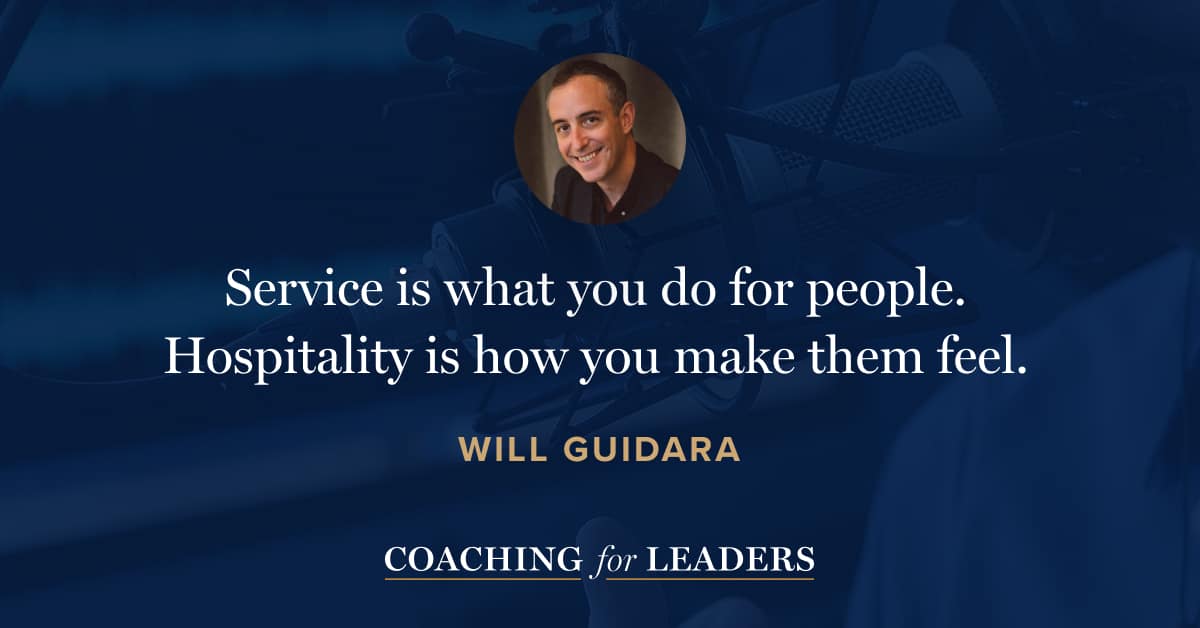
Service is what you do for people. Hospitality is how you make them feel.
https://media.blubrry.com/coaching_for_leaders/content.blubrry.com/coaching_for_leaders/CFL807.mp3

Podcast: Download

Follow:
Apple PodcastsYouTube PodcastsSpotifyOvercastPocketcasts

Will Guidara: Unreasonable Hospitality: The Field Guide

Will Guidara is the former co-owner of Eleven Madison Park, which under his leadership received four stars from the New York Times, three Michelin stars, and in 2017 was named #1 on the list of the World’s 50 Best Restaurants. He is the author of the New York Times bestseller Unreasonable Hospitality: The Remarkable Power of Giving People More Than They Expect and now his newest book, Unreasonable Hospitality: The Field Guide (Amazon, Bookshop).

Every leader is called to serve people. How we serve people matters. And the way people feel when we are serving matters a lot. In this conversation, Will Guidara shows us how to lead with unreasonable hospitality.

Key Points

  • Sometimes magic is just being willing to invest more energy into an idea than anyone else would deem reasonable.
  • Service is what you do for people. Hospitality is how you make them feel.
  • First impressions matter. Leaders have a key role in setting the standard for this.
  • Find a meaningful way to make magical the part of an experience that is normally neglected.
  • Identify persistent pain points and address them generously instead of reductively.
  • People remember both the peak and final moments of an experience. Stick the landing.

Resources Mentioned

  • Unreasonable Hospitality: The Field Guide by Will Guidara (Amazon, Bookshop)*
  • Unreasonable Hospitality: The Remarkable Power of Giving People More Than They Expect by Will Guidara (Amazon, Bookshop)*

Related Episodes

  • The Power of Leadership Through Hospitality, with Will Guidara (episode 688)
  • How to Bring Out the Best in People, with Donna Hicks (episode 724)
  • The Way to Notice People Better, with Zach Mercurio (episode 733)

Discover More

Activate your free membership for full access to the entire library of interviews since 2011, searchable by topic. Go beyond the podcast to find the right ideas and apply them with confidence inside Coaching for Leaders Plus.
Lead With Unreasonable Hospitality, with Will Guidara

Download

Dave Stachowiak [00:00:00]:
Every leader is called to serve people. How we serve them matters. And the way people feel when we are serving them matters a lot. In this episode, Will Guidara returns to show us how to lead with unreasonable hospitality. This is Coaching for Leaders, Episode 807.

Dave Stachowiak [00:00:21]:
Production Credit: Produced by Innovate Learning, Maximizing Human Potential.

Dave Stachowiak [00:00:29]:
Greetings to you from Orange County, California. This is Coaching for Leaders, and I’m your host, Dave Stachowiak. Leaders aren’t born; they’re made. And this weekly show helps leaders thrive at key inflection points. I’m so glad that Will Guidara joined me a while back on the show here to talk about the importance of hospitality in leadership. Today, we’re continuing a conversation we started back on that last episode on the how-to, because so often we have such a passion to take care of people, whether they are our customers, whether they are donors, our patients, and of course, our employees too. But we don’t necessarily know where to start. Today, a conversation on where to begin.

Dave Stachowiak [00:01:15]:
And I’m so pleased to welcome Will Guidara back to the show. He’s the former co-owner of Eleven Madison Park, which under his leadership received 4 stars from The New York Times, 3 Michelin stars, and in 2017 was named number 1 on the list of the world’s 50 best restaurants. He is the author of The New York Times bestseller, Unreasonable Hospitality: The Remarkable Power of Giving People More Than They Expect, and now also his newest book, Unreasonable Hospitality: The Field Guide. Will, a pleasure to have you back.

Will Guidara [00:01:45]:
I’m so happy to be here. Nice to, nice to hear your voice, and I’m looking forward to the conversation.

Dave Stachowiak [00:01:51]:
I always love hearing your voice too. And one- that’s one of many reasons I went back and listened to our last conversation this week. And I noticed a word we didn’t talk about in the last conversation, and that word is magic.

Will Guidara [00:02:07]:
Hmm.

Dave Stachowiak [00:02:07]:
And I know how intentional you are about words, and the word magic shows up a lot in the Field Guide, and there’s a lot behind that word. And I’m wondering how you think about the word magic and why it’s significant for hospitality.

Will Guidara [00:02:23]:
I love that you caught on to that. You know, I’ve always loved magic. I’ve loved magic for, since I was a kid. When I talk about magic in this context, I mean, actually, magicians. And I think as I’ve gotten older, rather than like it less, the opposite has proven to be true. I like it more. Because I just don’t think that there are many things left like it. It’s so easy for us to, through a quick internet search, to figure out how everything is done.

Will Guidara [00:02:55]:
And yet there are few feelings more beautiful than that childlike wonder of not knowing. And that’s what I get when I see an amazing magician do an amazing trick. I love that feeling that… The tingling in my body, where it just feels joyous and surprising. And so it’s probably not a surprise that I ended up talking about the magic that can exist through hospitality so often with the people on my team. One of the quotes I’d use most often with them when I would, in a daily huddle, try to inspire them to really believe in the importance of our work, the nobility of serving others, was that— We had an opportunity, perhaps even a responsibility, to create our own little magical world in a world that desperately needed more magic. And what I mean by that is that we were bringing creativity and intention to create these little moments for people that made them feel genuinely seen or gave them that beautiful sense of belonging that made them feel genuinely welcomed because I believe now more than ever, if you can do that consistently and authentically, it is— well, in many ways it feels like a magic trick because it happens less and less often. One of my favorite quotes about all of this, it comes from Teller of the magician duo Penn and Teller. He said, sometimes magic is just being willing to invest more energy into an idea than anyone else would deem reasonable.

Will Guidara [00:04:32]:
And I think that kind of sums it all up because, listen, nothing I talk about is actually hard. It just requires being the person willing to try a little bit harder. And if you are willing to do that, to care a little bit more, to try a little bit harder, you can show up in other people’s lives in a way that is nothing short of magical.

Dave Stachowiak [00:04:54]:
Thinking about what you just said and my mind instantly went to a trip our kids and I took a couple weeks ago. We went to Japan for 9 days and backpacked around the country.

Will Guidara [00:05:08]:
Hmm.

Dave Stachowiak [00:05:08]:
And we often think about the beautiful moments of hospitality in the context of visiting somewhere new, going to an amazing restaurant and having an incredible experience. Being welcomed at a hotel in such a wonderful and beautiful way. And then, we think about work as heading up a cardiology department or being a senior manager of finance or an executive director. And we don’t really think about hospitality in the context of the workplace that a lot of us have, especially if it’s outside of the quote-unquote hospitality industry. And I think about this book, the follow-up to Unreasonable Hospitality, The Field Guide. This is an invitation for, I hear it, a big part of it is the rest of us to think about where do we start and how?

Will Guidara [00:06:02]:
Yeah, it’s been, I’ll tell you, it’s been one of the most delightful and in some ways surprising parts of my experience in the last few years since Unreasonable Hospitality came out. Is the, the wide range of industries where I’ve seen it embraced and brought to life. And it was most certainly unexpected and very surprising, although when you pause for a moment to think about it, it’s actually not that surprising. Listen, I believe that lessons from life inspire those at work and vice versa. And the reason that’s true is because most of the greatest lessons in each center around one thing that is common to both: relationships. I don’t care what you do, you are in the business of relationships. You’re either serving other human beings, or you are working for human beings, you are leading human beings, you are collaborating with human beings. And gosh, I think one of the greatest competitive advantages that any individual or organization can have is through hospitality, through consistently and generously, and creatively investing in those relationships.

Will Guidara [00:07:23]:
Because relationships take a long time to build, and if you build them in the right way, the loyalty you will earn will take an incredibly long time to erode. And it doesn’t matter to me whether I am serving you dinner, or whether I am treating you medically, or whether I am renting you a car or selling you a bike. Or selling you insurance or representing you in court, I am still engaging with you. I am a human being. You are a human being. And if I bring all of my humanity into that relationship, it will give me an advantage. Not to mention the fact that it just feels so much more uplifting and fun and purpose-filled when you approach it in that way.

Dave Stachowiak [00:08:08]:
Yeah.

Will Guidara [00:08:09]:
And so, as many of these different companies and organizations across industries as I’ve seen embrace, or rather be inspired by the book, the one thing that came up over and over again was that people were having a little bit of a hard time or just wanted a bit more guidance on how to bring the ideas to life, either in how they were leading the people on their team and building a culture or in how all of those people were collectively serving their customers. And that’s what led to the Field Guide. If Unreasonable Hospitality was the why, this book is the how. It’s meant to be a very clear articulation in how to start to build momentum if you’re inspired by, by this as an approach.

Dave Stachowiak [00:08:55]:
Well, and that’s exactly why I’m so glad you came back to look at the how of this. And you do make an invitation in the book to map out the customer experience. And I think about that invitation, and I think a lot of organizations have either done that or they’ve certainly thought about it. Of, okay, when the customer shows up here, how do we handle it? Or when the patient first interacts with us, or the donor is thinking about building a relationship with us, they’ve mapped out that experience. Maybe they’ve done it on paper, maybe they’ve got it in their heads. But I think the thing that often doesn’t happen is they don’t take the next step, because so often mapping the customer experience comes down to service. What are the things that we have committed to do as an organization that we need to show up and do well? And that, of course, is really foundational.

Dave Stachowiak [00:09:52]:
What I hear you inviting us to do is, yes, be present to service and look at the customer experience map also through the lens of hospitality. What’s the distinction between the two?

Will Guidara [00:10:05]:
The difference between service and hospitality is important, and it’s something that too many people don’t fully understand. Way, way too many conflate the 2 words as being one and the same, but they are not. And the extent to which an organization understands that, I think, is big; it has a lot to do with how they are set apart from others. Service is the thing that you do. It’s a part of the product. In a restaurant, it’s delivering the right plate of food to the right person within the right frame of time. That is effectively table stakes. It’s you fulfilling the base-level promise you’ve made to those you serve the day you decide to go into business.

Will Guidara [00:10:42]:
Hospitality is how you make them feel.

Dave Stachowiak [00:10:46]:
Hmm.

Will Guidara [00:10:46]:
It’s the depth of connection you establish with them. It’s the extent to which you offer up a piece of yourself so that they will do the same in return. It’s how you create genuine relationships with others. And you’re right, I have seen people, some of these organizations, do some customer journey mapping. And you’re right that they don’t necessarily do enough with those maps once they do. But I’d actually take it a step further in saying that I don’t even think they’re mapping the journey as well as they need to. You look at a hospital, you’ve mentioned that a couple times now, the amount of attention to detail that goes into every detail of bringing that product and service to life is wild, right? Every piece of machinery in there only exists because of countless human beings that were unreasonably focused on bringing the most fully realized version of that product to life.

Will Guidara [00:11:46]:
The people that work in those buildings have invested so many hours into learning their craft and passing all the tests they needed to pass, and then the training and the Debt of medical school, and then the buildings themselves and janitorial, like, the amount of energy that goes into creating these spaces is wild. It’s impossible to articulate. And yet, way too often, I see people investing just a fraction of that energy into how they engage the people that breathe life into those spaces. I see people doing journey mapping almost as if something they need to do, but they’re not nearly as detailed as they need to be in journey mapping and, by definition, are leaving some of the greatest opportunities on the table. I talk about this all the time in my restaurant. As we were evolving, we did some pretty cool innovations to how we welcomed people through the door, how we deliver their food, how we engaged them. But one day I had a moment of realization that we were focusing only on the most obvious touchpoints, which by definition were the same ones our competitors were focusing on.

Will Guidara [00:12:55]:
It’s one thing I’ve come to realize, not just in restaurants, but across industries, is most organizations don’t truly understand every touchpoint, every opportunity, because they’ve never slowed down for long enough to genuinely understand the experience as a whole. I’ve found that when I started focusing on the most overlooked touchpoints- dropping the check, washing your hands in the bathroom, that moment when a guest would step outside for a cigarette mid-meal- that’s when I had the opportunity to create the most impact, because when you do that, you’re saying very clearly to the people you serve: I’m willing to care about things that no one else has even paused for long enough to consider. And so the first thing I see people do incorrectly is just, they kind of phone it in on the mapping. They don’t… Because they rush through the exercise, seize on every opportunity they have, every moment of interaction, to make the people they serve or the people they work with feel genuinely seen or cared for. And then, yeah, to your point, once they do that, once they have a journey map, they’re just not bringing nearly as much of their creativity into how to make as many of those little touchpoints just a little bit more awesome. I use that word awesome a lot. I feel like we get older, we feel the need to be more mature, act more professionally. We stop using words like awesome.

Will Guidara [00:14:09]:
But if you’re in the business of serving other people, which I now believe that everyone on earth, to some extent, is in that business. It’s a big part of your job, just making as many little things just a little bit more awesome as possible. And by the way, that is the fun part. It’s the most fun part of the entire thing is to look at all of these little moments of interaction and figure out how can we just elevate them just enough where, well, maybe people can actually remember that, or will feel a little bit more cared for through our energies.

Dave Stachowiak [00:14:42]:
You have a really concise and clear invitation for us as we get started with this. And you say in the book, if you do nothing else, do this. And it’s 2 words: start strong. What’s so significant about that?

Will Guidara [00:14:57]:
Well, I mean, this is a life thing there. You only have one chance at a first impression. And I think about so many businesses where the first impression with it is just a disaster. I just think everyone, no matter what you do for a living, look at that first moment, where someone engages with you or your company, the people in it, the brand generally, and ask yourself, am I proud of this? Is this really the way I want to begin this relationship? Is this the first impression I want to make? And I’m quite certain, based on my experience, that for many, the answer will be no. Not because they’re incapable of doing it well; it’s just because they’ve never focused on it. At a hospital, the energy is invested into that moment where the doctor finally walks into the room. But that moment where you walk through the doors of the hospital, 17 floors down, is dreadful in comparison.

Dave Stachowiak [00:15:52]:
Hmm.

Will Guidara [00:15:53]:
And take that same idea and juxtapose it against so many other experiences. Make the first impression count because it is you working very intentionally at the very beginning to say, “We care about you. We are worthy of your trust. Come on in and let’s do something together”.

Dave Stachowiak [00:16:13]:
One of the things that’s so beautiful about your work is you have invited so many people to share stories of hospitality, both ones from their organizations and ones they’ve experienced from others. When you’ve seen a story that really delighted you on this of starting strong- maybe an organization that hadn’t really thought about it much before, and they did this well- what’s an example where that really shone through for you?

Will Guidara [00:16:37]:
I mean, I’ll tell you one. This is not a story I’ve heard, but it is an experience I just had yesterday. I was with my entire team on our annual team retreat, and I’m in Nashville now. My team is split between New York City and Nashville. And we went to a resort in Tennessee, like 30 minutes outside of Knoxville. And so the New York crew flew down and met us there. We drove from Nashville there.

Will Guidara [00:17:04]:
And as we were driving back yesterday, we stopped at Buc-ee’s. Just get some gas, use the restroom, grab a beverage for the last 2 hours of the drive. And we walked in. And everyone raves about Buc-ee’s for a bunch of different reasons. People feel a genuine connection to that brand. They talk about how clean it is, especially how clean the bathrooms are, how inexpensive the gas is. And now all of that is true.

Will Guidara [00:17:29]:
The food’s good. It’s cool. But the thing that overwhelmed me yesterday was we walked into this giant place, giant. And the moment we stepped foot through those doors, at least 6 Bucky’s employees said: Hey, welcome in! Almost in unison.

Dave Stachowiak [00:17:47]:
Hmm.

Will Guidara [00:17:48]:
It is such a big operation that, I mean, the idea that we did not feel lost in it, or rather invisible in it, is remarkable. And all it took was one gesture, a bunch of people yelling, “Welcome in!” The moment we walked through the doors. Now, how did that happen? Well, it was a series of things. It was someone who runs that organization deciding that they want people who are walking into such a large environment to feel seen and welcomed. And they said, hold on, what if that’s just the rule? Anytime someone walks through the doors, everyone that is close to that door, that is their responsibility to just yell, ” Welcome in”. But that’s not enough. It doesn’t matter how well-trained a group is. If they’re not inspired to want to do the thing, they’re not going to do it consistently well.

Will Guidara [00:18:35]:
So then it required them building the kind of culture where they over and over and over again remind people why that matters, why it’s important to make people feel that way, how much more you’re going to enjoy your job if you do it consistently and genuinely. And by the way, leadership is a marathon. It’s not a sprint. It means that whoever’s running that company needs to talk about that for the rest of their lives

Dave Stachowiak [00:18:59]:
Yeah…

Will Guidara [00:18:59]:
order to make sure that the idea is consistently embodied there. But they created, they had an idea of what they wanted to accomplish. They created a system through which they would accomplish it. And then over and over and over again, they’ve reinforced that system and inspired the people on their team why they should want to take part in it. And all of that led to 3 people walking through the doors, hearing that, that beautiful expression directed at us, and feeling really good as a result. And there’s so many things that people talk about with that place. That is the thing that I’m holding on to today.

Dave Stachowiak [00:19:30]:
Whenever I read a book like yours, either one, I often come away with the thought of, “Wow, like I’m so inspired. There’s so much I could do”. And then I don’t always do a lot because there’s so much I could do, right? And it’s, it’s, it’s like the overwhelm of where to begin. And that’s why this invitation for me is so powerful, because every single organization has a starting point with someone. Every single, like the hospital example, the nonprofit, the gas station down the street, every single organization has a point where an employee or a customer or a stakeholder interacts for the first time. And the invitation I’m really hearing is: think about that moment, really stop and think about that moment if you haven’t before. And not just like, what do you do at that moment? Like the service component of it.

Dave Stachowiak [00:20:21]:
Yes, do that, of course. But what would really delight people in that moment? And that’s like a great place to begin. And to your point, if you do nothing else but that, wow, it sets you apart right away. And also it makes you feel great about bringing people into connection with you.

Will Guidara [00:20:37]:
Yeah. By the way, in the brainstorming, I think you started to get to this, which is too many— I was— anyone who’s worked with me for any measure of time has heard me say, “don’t ruin a story with the facts”. Which is my way of saying, too often people only allow themselves to come up with ideas that they know are implicitly possible to execute, and in doing so, hold themselves back from doing things that are truly groundbreaking. I just encourage audacity in brainstorming, coming up with ideas that are perhaps even impossible to ever bring to life. But until you’ve dreamed a little bit too big, I don’t think you have the capacity to dream quite big enough.

Dave Stachowiak [00:21:21]:
You said something a few moments ago that I’d love to come back to because it’s such an opportunity, I think, for so many of us, is to elevate the overlooked. What does that look like, and who have you seen do that well?

Will Guidara [00:21:38]:
I mean, the example that I love is Five Guys. When I ask a room filled with people who have been to Five Guys, what do they think of when they think of Five Guys? Most people will say, “the peanuts”.

Dave Stachowiak [00:21:52]:
Yeah.

Will Guidara [00:21:53]:
And why is that? Because someone at Five Guys had the wherewithal to recognize that the time spent waiting for your food to be cooked is a touchpoint in the experience, and they decided to do something with it. Now, say what you will about what they did. They put out a box of peanuts. They take some, rip them out of the shell, you eat them while you wait. Maybe it’s to make the wait go by more quickly. Maybe it’s to offer up a dose of generosity. Whatever the reason, it doesn’t matter because the fact that they do something during a part of the experience that no one else does anything, I’d argue it almost gives them an unfair competitive advantage.

Dave Stachowiak [00:22:26]:
Hmm.

Will Guidara [00:22:27]:
So many people have these touchpoints that they’ve just never thought about. And it’s one of the things I encourage people to do. To your point, it’s easy to read a book and put it down, and you feel super inspired, and then you do nothing with it. The same is unbelievably true at events. If I’m speaking to a big company at their annual corporate retreat, the biggest fear is that people are going to leave feeling so connected and inspired, and then they go home, and they get wrapped back up into the business of their day-to-day and nothing changes.

Dave Stachowiak [00:22:57]:
Yeah.

Will Guidara [00:22:57]:
And so one of the challenges I always give people is, “Hey, just commit to this in the next month. Just identify one touchpoint in the experience that you’ve never done something about. Make that part of the experience just a little bit more awesome. And stand back and look at the impact it will have. And the overlooked is always where you can most surprise and delight people”. Like, if you have an office that people visit, there’s an expectation that the moment they walk into the lobby of your office, once they’ve reached the floor of that building, that they’re going to be on the receiving end of some amount of graciousness. But what if it started in the elevator? Or what if there was something waiting for them in their car when they leave that meeting? That’s going to be the thing they actually go home and say, dude, I went to my lawyer’s office, and I got back in the car after the meeting, and there were 2 cold bottles of water in the cup holder.

Will Guidara [00:23:54]:
They might have just saved you $50,000 because they figured out a more creative approach to managing whatever case they’re working on with you. And you’re going to talk more about the bottled water in your car than anything else because it’s that unexpected.

Dave Stachowiak [00:24:10]:
Yeah.

Will Guidara [00:24:11]:
Now, there’s many people out there that’d be like, “okay, that’s ridiculous. It’s irrelevant to my core business”. And if that’s your reaction, you’re missing the point. The thing that is relevant to your core business is the extent to which your customers or the people you work with feel cared for by you. And you, if you’re limiting the ways in which you care for people only based on the specific job that you are doing for them, you’re leaving so many opportunities on the table.

Dave Stachowiak [00:24:38]:
I’m staring right now at the guest journey from 11 Madison Park that is highlighted in the Field Guide, and you go to pains to point out that this is very abridged. I can only imagine what the real— the main version looks like. And there’s 36 steps on it. And when I look at each one of them, I think, how often organizations, if they’ve done this customer map or journey mapping, have missed steps and not thought about getting in the car, going up the elevator, the waiting time for the food, right? Those are the kinds of things that aren’t necessarily, quote-unquote, service points, so we don’t think about them. And so part of the invitation I’m hearing from you on elevating the overlooked is, if you’ve done the mapping, what’s the space between each one of those points that maybe you’re not even thinking about? But boy, sure shows up for the person you’re trying to serve.

Will Guidara [00:25:35]:
Yeah, just keep pushing until you are absolutely certain there is nothing else you can add to that list.

Dave Stachowiak [00:25:42]:
You also invite us to transform a pain point, and you write on this: Take a persistent, pernicious issue in your business and solve it, not by chipping away at the service you’re offering, but by being generous. Tell me more about that, and like, where does that show up, and what have you seen work to make that better?

Will Guidara [00:26:04]:
I mean, I think it’s honestly, it’s probably the best second step after how the experience begins is looking for the moments that are most painful because I think way too many people just accept the painful moments as being painful and fail to recognize that, well, in that moment you can actually create some of the most beautiful impressions. I’ll give you a terrible example of this and what I believe to be a good example of this.

Dave Stachowiak [00:26:31]:
Please.

Will Guidara [00:26:31]:
And they both involve airplane delays. I was delayed for a couple of hours one day on one of the major airlines, and we’re at the gate, and someone pushes over this really rickety little rack on wheels, and on it are, like, 30 little bags of Goldfish and a bunch of little bottles of water. And the person at the gate says, ” We’re so sorry for the delay. We’ve brought out some refreshments to make this experience a little bit more pleasurable for you”. Okay. That is still better than nothing, right? They looked at a pain point, and they said, how do we make this a little bit less painful? Now, the problem is that some of the best money you can spend is to recover your customers in the moments where they are the most angry, and they could have spent just a little bit more and had that actually achieve its goal of being caring and generous, as opposed to— it looked as sad as the delay felt. And so it didn’t actually achieve its desired purpose. The one that did work really well actually cost nothing at all.

Will Guidara [00:27:39]:
It just did require a little bit more generosity of spirit. This time I was on the plane. We pulled away from the gate, and then we’re on the tarmac. The plane stops. That dreaded announcement comes out over the loudspeaker from the pilot, who said, ” Ladies and gentlemen, There’s something wrong with the plane. We’re going to be delayed for a little bit. Like, I’ll come back to you as soon as I have more information”. And these are the worst delays because now you’re just waiting for information.

Will Guidara [00:28:03]:
And during that wait, you can’t even get up and go to a Starbucks anymore. You’re stuck on the plane. Not to mention the fact that there’s always some other guy on the plane that lets out that loud groan of exasperation and tries to get other people to share in his negative mood.

Dave Stachowiak [00:28:16]:
Yes, there is.

Will Guidara [00:28:17]:
But this time, something different happened. The pilot came out of the cockpit. You see, there were 3 families on the plane, 3 parents with children. He goes up to the first set and says to the kids, ” Do you guys want a tour of the cockpit? The kids got so excited, which made the people around them happier. Does the same with the second family, does the same with the third family. Now there’s no families left. We’re still delayed. He stands up in the alley— aisle and just says loudly to the plane, ” Do any adults want a tour of the cockpit?”

Dave Stachowiak [00:28:43]:
That would totally be me.

Will Guidara [00:28:44]:
Adults started taking— adults started doing it.

Dave Stachowiak [00:28:47]:
Nice.

Will Guidara [00:28:48]:
Finally, we take off. I’m a student of this stuff. I asked the flight attendant, “What was that?” And she goes, ” He’s the best. Every time we’re delayed on the tarmac, that’s what he does”. He had taken a pain point, a painful moment in the experience, and at minimum made it a little bit less painful. In my experience, I was actually grateful for the delay because of how much joy I got to witness on the faces of strangers. When you look at these pain points, the things that happen over and over and over again, and stop accepting them as being painful parts of someone engaging with you or your business, and look at them instead as, how do I make this incredible? One more example. There’s a lawyer.

Will Guidara [00:29:29]:
I spent some time with this big law firm, and they reached out to me a couple months later. And anyone who’s, like dealt with really big, you know, legal situations in life knows that you never know when they’re going to come, but you’re going to get an email at some point. You’re going to open it up, and the bill is going to be like nausea-inducing from the lawyer. And he was like, “Hold on, we can make that more hospitable”. And his fear, which, by the way, I think is well-founded because I’ve experienced it myself, is you’re sitting around having dinner with some people, you quickly check your email, and it’s the bill from your lawyer. And now you’re completely distracted from connecting with the people that you are desperate to connect with. And so all he did was something simple. And people might think this is great, others might disagree with it, but he’s doing something, and that’s, that’s all that matters, or a big part of what matters.

Will Guidara [00:30:21]:
He just calls the person and says, “Hey, I’m going to be sending your bill out tomorrow. It’s kind of a big one. Open it when you have some time to look through it, and I’m here to talk about it whenever you’re ready”.

Dave Stachowiak [00:30:32]:
Hmm.

Will Guidara [00:30:33]:
Even just that, the simple gesture of setting expectations, that someone isn’t caught on their back foot, it shows that you’re at least looking at the moment through the lens of the person you’re serving. And that’s a pretty beautiful way to engage trust.

Dave Stachowiak [00:30:48]:
3 other words that you invite us to consider: Stick the landing. What’s important about that?

Will Guidara [00:30:56]:
Well, so interestingly, I— listen, I believe that how you begin an experience is so unbelievably important. Yet there’s this thing called the peak-end rule, and it’s a scientific principle on how people remember experiences. And the 2 moments in the experience that most define someone’s memory of it are the peak and the end. So the end, obviously, the absolute end of someone’s relationship with you, whether on an ongoing basis or in that moment. And then the peak, which means the furthest deviation from zero, for better or worse. Now the end, yeah, stick the landing. What is the final memory of the time? Make sure that you let that, or that you make that count. A friend of mine is this restaurateur.

Will Guidara [00:31:45]:
He tells this story, which I love. That he had a particularly difficult guest. This guy would come to his restaurants all the time, and every time he’d complain about something. And my friend is a competitive guy, and so he was like, you know what? No, I’m going to have one time when he comes in and leaves saying everything is perfect. So the guy made a reservation. My friend went to that restaurant he was going to and, during pre-meal with the team, said, guys, we’re going to get it right. We are going to get it right. We are leaving nothing to chance tonight.

Will Guidara [00:32:12]:
Like, we win with this guy. And the guy came in, and they nailed every single detail. It was a perfect meal. The guy left the restaurant and looked at my friend. He goes, ” Hey, you crushed it. Like, this was a perfect dinner”. The guy leaves the restaurant. My friend’s like high-fiving all the servers.

Will Guidara [00:32:31]:
He’s a good leader. He understands the— Like gamifying moments like that is a great way to build culture. 5 minutes later, the guy walks back into the restaurant. My friend had forgotten about valet parking, and the people at valet parking lost the guy’s ticket. He was out there—

Dave Stachowiak [00:32:44]:
Oh no.

Will Guidara [00:32:45]:
The whole time waiting for his car, and in one moment ruined everything. You gotta stick the landing because that is the final memory, and it’s going to be one that people carry with them. But back to the peak, I find the idea that the peak, either the furthest deviation from zero for better or worse, is the other thing that people remember as being incredibly comforting. Because what that says to me is when you mess up, you can always fix it just by making the positive peak a little more significant than the negative one that the mess-up just caused, is. And it reinforces the need for athletic hospitality to create a culture where people are willing to do whatever it takes to make things right. And there is so much data that backs this up. If you come into my business and you have a good experience, you’re going to talk about it a little bit. If you come into my business and have a bad experience, you’re going to talk about it quite a bit more, obviously.

Dave Stachowiak [00:33:41]:
Yeah.

Will Guidara [00:33:41]:
But if you come into my business, you have a bad experience, and I do whatever it takes to make it right again, that’s the experience you are going to talk about the absolute most. There’s almost a business case to be made that you and I should start a business where we intentionally mess up with every single person we serve just so we can make it right. And yet with that knowledge, I’m struck by the fact that so many businesses spend so much money on marketing and not nearly enough on customer recovery, which I think is the greatest form of marketing that exists.

Dave Stachowiak [00:34:11]:
You wrote Unreasonable Hospitality, and it took off over a course of a couple years, and it’s ended up on the New York Times bestseller list. Amazing. Congrats.

Will Guidara [00:34:22]:
Thank you.

Dave Stachowiak [00:34:24]:
You, as a result, have been speaking all over the place, all over the world, talking to organizations, influencing so many different industries now, well beyond hospitality. And I’m curious, as you’ve been down that journey these last few years since the book came out, the original one, what have you changed your mind on?

Will Guidara [00:34:43]:
You know, I’ve changed my mind on plenty of things over the course of my career. The last few years, and I’m not someone that is not open to changing opinions on things. In fact, I relish in those moments. But as it pertains to the things in the book, I’m only more convicted about all of them. And I think how the world has changed in these past few years has only made the ideas in it more relevant. I mean, I wrote the book during COVID. I had an inability to reflect on the pandemic while writing it because I was living through it. But when I think about what’s happened over the past several years, I think the pandemic was the season where we were all reminded of our basic and innate need for human connection, either because we were deprived of it for so long, and sometimes you need to lose something in order to know how much you need it, or because in that time and space, where people were re-engaging with their families, they were losing it in one sense and rediscovering it in another. Then after that, with remote and hybrid workplaces that have at this point become the norm, we were already in a loneliness epidemic, and that’s just been supercharged where people— there’s so many people that are just alone all day in front of a screen.

Will Guidara [00:36:06]:
Or when it comes to leadership, where the people who you work with are no longer organically connecting around the watercolor or after work during happy hour. Like, part of leadership needs to center around hospitality and creating the conditions for people to connect and develop genuine relationships, because outside of that, a culture struggles to thrive. And now, with how AI is supercharging the digital transformation and replacing so many moments that were so human with moments that are decidedly not. I think we’re just in a season where the human moments need to be as human, as humanly possible, where hospitality and graciousness are some of the greatest superpowers anyone can have. And honestly, the experience over the past few years has just given me more conviction that lessons from a restaurant are applicable across all facets of work and life.

Dave Stachowiak [00:37:08]:
Will Guidara is the author of Unreasonable Hospitality: The Remarkable Power of Giving People More Than They Expect, and now the companion, Unreasonable Hospitality: The Field Guide. Will, always a pleasure to talk with you. Thank you so much for your generosity and sharing your work.

Will Guidara [00:37:24]:
Thank you, Dave.

Dave Stachowiak [00:37:31]:
If this conversation was helpful to you, 3 other episodes you should check out. One of them is the last time Will was on the show, episode 688: The Power of Leadership Through Hospitality. Will and I had a wonderful conversation that hit on different aspects than we talked about today. And one of my favorite parts of that conversation is the story he tells in that episode about his mom, right at the beginning. It’s worth listening just for that: episode 688. Also recommended, episode 724: How to Bring Out the Best In People. Donna Hicks was my guest on that episode. We talked about the importance of dignity, and dignity, of course, shows up so much in how we treat people and hospitality and just lines up so well with this conversation today with Will. Episode 724, a great compliment.

Dave Stachowiak [00:38:17]:
And then also recommended episode 733: How to Notice People Better. Zach Mercurio was my guest on that episode, and noticing people is one of the beautiful acts of hospitality. And as Zach says in that conversation, when people feel like they matter, they act like they matter. Episode 733 for that. All those episodes you can find, as always, on the coachingforleaders.com website. And you can search for everything you’re looking for behind the free membership. Set up your free membership at coachingforleaders.com. It’ll give you access to everything inside of our free membership, including a number of audio courses, all my interview and book notes, my own personal library, and a ton more.

Dave Stachowiak [00:39:01]:
You can get access just by going to coachingforleaders.com. Coaching for Leaders is edited today, as always, by Andrew Kroeger. Next Monday, I’m glad to welcome Christoff Poppe to the show. We are going to be talking about how to find the person to replace you, an important conversation for every leader. Have a great week, and I’ll see you back on Monday. Bye.

Topic Areas:Customer ServiceOrganizational Culture
cover-art

Coaching for Leaders Podcast

This Monday show helps you discover leadership wisdom through insightful conversations. Independently produced weekly since 2011, Dave Stachowiak brings perspective from a thriving, global leadership academy of managers, executives, and business owners, plus more than 15 years of leadership at Dale Carnegie.

Listen Now OnApple Podcasts
  • More Options
    • YouTube Podcasts
    • Spotify
    • Overcast

Activate Your Free Membership Today

Access our entire library of Coaching for Leaders episodes from 2011, searchable by topic.
Listen to the exclusive Coaching for Leaders MemberCast with bonus content available only to members.
Start Dave’s free audio course, 10 Ways to Empower the People You Lead.
Download our weekly leadership guide, including podcast notes and advice from our expert guests.

... and much more inside the membership!

Activate Your Free Membership
IMAGE
Copyright © 2026 · Innovate Learning, LLC
  • Plus Membership
  • Academy
  • About
  • Contact
  • Dashboard
×

Log in

This site is protected by reCaptcha and the Google Privacy Policy and Terms of Service apply.
 
 
Forgot Password

Not yet a member?

Activate your free membership today.

Register For Free
×

Register for Free Membership

Access our entire library of Coaching for Leaders episodes from 2011, searchable by topic.
Listen to the exclusive Coaching for Leaders MemberCast with bonus content available only to members.
Start Dave’s free audio course, 10 Ways to Empower the People You Lead.
Download our weekly leadership guide, including podcast notes and advice from our expert guests.

... and much more inside the membership!

Price:
Free
First Name Required
Last Name Required
Invalid Username
Invalid Email
Invalid Password
Password Confirmation Doesn't Match
Password Strength  Password must be "Medium" or stronger
This site is protected by reCaptcha and the Google Privacy Policy and Terms of Service apply.
 
Loading... Please fix the errors above