• Skip to primary navigation
  • Skip to main content
  • Skip to primary sidebar

Coaching for Leaders

Leaders Aren't Born, They're Made

Login
  • Plus Membership
  • Academy
  • About
  • Contact
  • Dashboard
  • Login
Episode

765: How to See What’s Holding You Back, with Marty Dubin

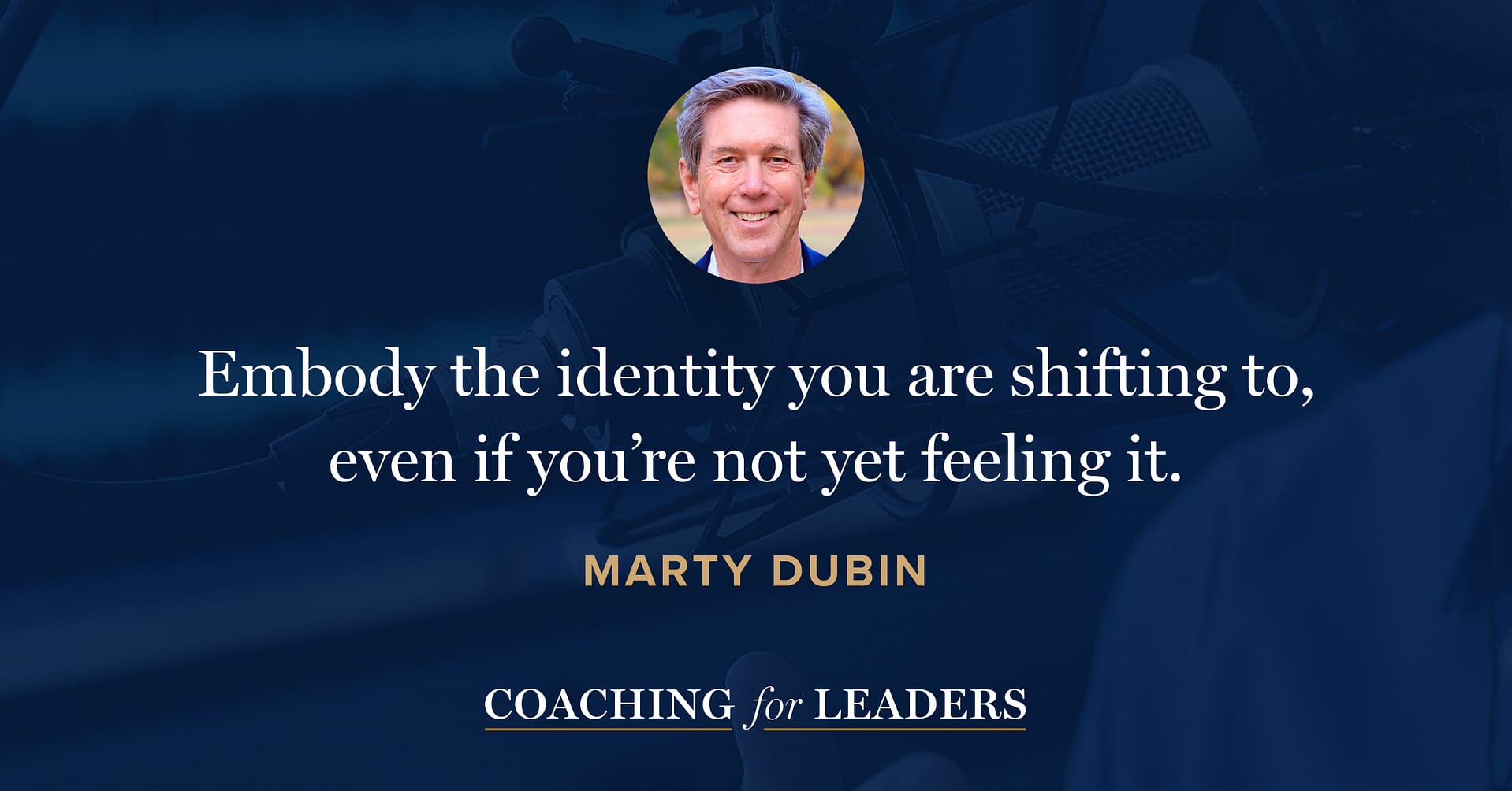
Embody the identity you are shifting to, even if you’re not yet feeling it.
https://media.blubrry.com/coaching_for_leaders/content.blubrry.com/coaching_for_leaders/CFL765.mp3

Podcast: Download

Follow:
Apple PodcastsYouTube PodcastsSpotifyOvercastPocketcasts

Marty Dubin: Blindspotting

Martin Dubin is a clinical psychologist, serial entrepreneur, business coach, and adviser to C-suite executives and Silicon Valley entrepreneurs. He has founded several companies, including a multimillion-dollar health-care company where he also served as CEO. He is the author of Blindspotting: How to See What’s Holding You Back as a Leader (Amazon, Bookshop)*.

Whenever I ask leaders, “What’s getting in the way of you moving forward?” the most common answer I hear is, “Myself.” In this episode, Marty and I explore what’s likely holding you back and how you can take the first steps to get traction.

Key Points

  • Many leaders don’t recognize the need for change and succumb to an identity blindspot.
  • You don’t have to change your identity, but there’s a mismatch between role and identity, that’s a major problem.
  • Shifting your identity is not changing who you are. Identities help us to sort through people and situations so we know who we are in relation to them.
  • An identity that many have worked before can get in the way today. Common ones are: imposter, independent thinker, rule follower, unworthy, entitled, rebel, and peacemaker.
  • Look back through your calendar over the past three months and determine how well your activities match up with the identity your role demands.
  • Embody the new identity you are aiming to shift to, even if you’re not yet feeling it.

Resources Mentioned

  • Blindspotting: How to See What’s Holding You Back as a Leader by Marty Dubin (Amazon, Bookshop)*

Interview Notes

Download my interview notes in PDF format (free membership required).

Related Episodes

  • Six Questions Every Leader Should Ask Themselves, with Margaret Andrews (episode 750)
  • How to See What Others Miss, with Kirstin Ferguson (episode 758)
  • Show Up Better, Faster, with Claude Silver (episode 762)

Discover More

Activate your free membership for full access to the entire library of interviews since 2011, searchable by topic. To accelerate your learning, uncover more inside Coaching for Leaders Plus.

How to See What’s Holding You Back, with Marty Dubin

Download

Dave Stachowiak [00:00:00]:
Whenever I ask leaders what’s getting in the way of you moving forward? The most common answer I hear is “myself”. In this episode, what’s likely holding you back? And how you can take the first steps to get traction. This is Coaching for Leaders, episode 765

Dave Stachowiak [00:00:00]:
Production Credit: Produced by Innovate Learning, Maximizing Human Potential.

Dave Stachowiak [00:00:00]:
Greetings to you from Orange County, California. This is Coaching for Leaders and I’m your host, Dave Stachowiak. Leaders aren’t born, they’re made. And this weekly show helps you discover leadership wisdom through insightful conversations. A conversation that comes up a lot in my work is with leaders, especially leaders who have hit an inflection point recently on trying to figure out what is holding them back.

Dave Stachowiak [00:00:57]:
They have a title, a role, things on the outside seem to be going okay. And yet, something doesn’t quite feel right yet. Today, a conversation about how we can better see what’s holding us back, and be able to move forward to be so helpful to, certainly our own work, but more importantly, for our teams and our organizations to help others thrive. I’m so pleased to welcome Marty Dubin. Marty is a clinical psychologist, serial entrepreneur, business coach, and advisor to C-suite executives and Silicon Valley entrepreneurs. He has founded several companies, including a multimillion-dollar healthcare company where he also served as CEO. He is the author of Blindspotting: How To See What’s Holding You Back as a Leader.

Dave Stachowiak [00:01:44]:
Marty, what a pleasure to have you.

Marty Dubin [00:01:46]:
Thank you, Dave. Really looking forward to the conversation.

Dave Stachowiak [00:01:49]:
Me too! You talk in the book about co founding a company and you’ve had several iterations of your career. And in the company you co-founded, things were going great for a long time, over 15 years, and then, they weren’t. And you write on this: I later realized that my blind spots were part of the reason for our failure. The biggest one concerned my identity. When you think about that, what did you run into around identity?

Marty Dubin [00:02:20]:
So I started out, I’m a clinical psychologist by training, and I started out that way and I had a private psychotherapy practice for a dozen years or more. And then moved into the business world, and we managed the mental health, behavioral health for large insurance companies. And we would bid on a contract and then pay all the bills and manage all the doctors and hospitals and so on. And had, as you said, had been doing that quite well. And then we bid on a new contract and, after maybe four or five months into the contract, we realized we were losing money month after month. And our bidding was based on they would give us data of their historical experience and then we would look at it and decide if we could help them. And we realized that that they had actually given us some bad data. Not, you know, any fault, but it was just our bidding then was based on bad data. And at the time, that was the problem. And then I thought about it, you know, many years later, as I was doing the coaching, and it was like, what role did I have in that? I must have been…

Marty Dubin [00:03:29]:
I was a CEO, I signed the contract. Why did I sign a bad contract? And in looking back, all the time that I was running the company, my identity was still as a psychologist. I was enjoying the business aspects, but I really, at the core, my identity was a psychologist. And I think in that way, I didn’t approach the, even though we had done well and we’d grown the company, I still wasn’t really identifying myself as a business leader, as a CEO, as a business owner, primarily. And I think if I had that lens on, I would have been much more conscientious about the bidding process, about where the data came from, about making sure our actuarial and data scientist information was top-notch.

Marty Dubin [00:04:15]:
And I think because I had not really focused that much on that, I was interested in the mental health and psychological aspects of the business we were doing, equal to the business aspects. That identity just, in a way, kind of eroded what we were doing. And I think that often happens with identity mismatch between your role and your identity. It kind of creeps up on you, and then something presents itself, and you’re not up to the task.

Dave Stachowiak [00:04:45]:
Thank you so much for sharing that. And as you were saying that, I was thinking how true that is for so many of us, that often our identity is wrapped up in the thing that we were trained to do, the earlier part of our careers. And, one of the things I appreciate now, Marty, more than I did when I started this show is, a lot of times people reach out to me or start listening to the podcast because they’re at some kind of an inflection point. They have showed up in a different role, a different organization, they have a new title, and it is very, it’s a very different kind of job than it was before. And you write on this from leaders of workers, people become leaders of leaders.

Dave Stachowiak [00:05:32]:
The roles are different, but many people don’t recognize the need for change, and they succumb to an identity blind spot. When you see people run into that, could you tell me more about that? What does that look like?

Marty Dubin [00:05:44]:
Yeah, so I talk about a number of blind spots in the book. But this identity one, I think is maybe less obvious to a lot of people and is more of a “aha!” kind of experience. And the identity blind spots are when our identity and our work role are not fully aligned. And we have multiple identities, and some we’re very consciously aware of. If somebody asks you introduce yourself, you’d start to say who you are and what kind of is the top things in your identity. And like back to my personal story, I probably would have answered the question, “I’m a psychologist”. That would have been probably the first thing I would have said rather than, “I’m a CEO”.

Marty Dubin [00:06:30]:
And if just in the example you brought up, if you’re an engineer and, by training, and as often happens, the most talented engineer becomes promoted to being a manager of their previous colleagues.

Dave Stachowiak [00:06:44]:
Yeah.

Marty Dubin [00:06:45]:
And if your identity is still as an engineer, then that’s really is what your, our identities serve to kind of focus our attention, what we pay attention to, and what we don’t pay attention to. And you know, it aligns with our passions and what motivates us. And, so, if you’re not in that role shift, if you’re not now saying, I’m a manager, meaning, now I need to really learn about management and be tuned into all those intricacies, and those subtle things going on with my team, and how to get team members to perform at their, at their top. And if you’re still trying to be the subject matter expert, and if you’re still very emotionally connected to all the exciting things in engineering, you’re going to be doing those management things, but not with a full part of who you are and with your identity fully enmeshed into that new role.

Dave Stachowiak [00:07:41]:
You write in the book that you don’t necessarily have to change your identity, but if there is a mismatch between role and identity, then one of those actually does have to change. And sometimes that means the role needs to change, and sometimes that means it’s the identity. You can look at it both ways, but you do need to look at it both ways, right?

Marty Dubin [00:08:05]:
Right. And when promotions happen, companies pay a lot of attention to skill development, and the leader being promoted thinks about that a lot. So, it’s not that in that example, not that that engineer didn’t take management 101, or whatever other kind of courses that the company probably gave them to help them begin to think about being a manager. But this is a process, and it’s a psychological process in addition to skill development and knowledge acquisition. And the psychological process, if you think about it, if you’re going to take your key identity and now move it down a notch or two, manager is now ahead of engineer, that’s a loss. Which means that you’re going to have some feelings of grief, and a feeling of all those probably stages of grief that people go through to be able to get to a level of adjustment. And, I think the real tragedy is when the person and the company don’t realize all of this.

Marty Dubin [00:09:06]:
And in the example you said, if the role turns out not to fit the person, then it becomes a real, it becomes a sense of failure for the leader. The company starts to see it that way, it can be a real career derailer for somebody. But if both the company and the individual saying hey, we think this is going to work, but who knows, you know, you’re going to have to try the new roll on like a new suit of clothes, and let go of some of the older things you were doing. And let’s see, let’s hope it works, and we’re going to give you the most support as a company to get you through this process. And if there’s that dialogue that goes on, and then at least the leader’s open to say, you know what, I don’t think this is working. Can we figure something else out? Rather than go through all that trauma and pain and problems of a sense of failure.

Dave Stachowiak [00:09:53]:
Identity is one of these words and concepts that I think it’s often easy to see in others. It’s hard sometimes to see in ourselves, and it’s hard to get our minds around it. And I think it’s really interesting that you talk about in your work that as part of your training as a psychologist that, if you know what to listen for, it can become clearer. And one of the points you make is that noticing both the first things people say and also the last things people say in interactions can be really useful. Could you tell me a bit more about that of like what are you listening for when you’re listening for that?

Marty Dubin [00:10:31]:
Right. So that was part of my training as a clinical psychologist to kind of listen to how the patient identifies themself, or the client identifies themselves themselves when they come into my office. And what you hear right away is what’s important to the person. How they introduce themselves is kind of tells how they see themselves. I give an example in the book of, I was doing a work with a company of helping them select the next president of a large division. And in doing those, doing that assignment, I would interview all a lot of people around the 360 that worked with the particular candidate. So there were three candidates, and one of the people that I had interviewed, after the whole process was over and the new president was selected, she reached out to me and said, “I want to talk to you about why I wasn’t even in consideration for the job”. She was a number two to a president in one of the divisions.

Marty Dubin [00:11:31]:
And she really had, she really wanted this promotion. She’d been very happy being a number two for a good part of her career, but now she really wanted to move up. And her identity as the number two was to just really get things done, and in her words, be the glue that happens, and to solve the problems before her leader even knew they were there. She called herself “the invisible glue in the company”. And, so after she had kind of described herself that way a couple different ways, I stopped her and I said, “Now you’re telling me you’re invisible? Now do we have the answer of why you weren’t even thought of for the job?”

Dave Stachowiak [00:12:09]:
Yeah. It’s fascinating when you think about it. Like, here she is coming to you with this reality that, she seems invisible in the organization. And she starts off the interaction by telling you she’s the invisible glue in the organization. Like, literally telling you that she was trying to be invisible, the very thing that’s getting in her way, and it speaks right to that identity of just how we think of ourselves. And you go on to talk about in the book that part of, it’s just her upbringing, her childhood, her experiences of seeing that. That really worked for a long time.

Dave Stachowiak [00:12:46]:
Until it didn’t.

Marty Dubin [00:12:48]:
Yeah, I mean, she was phenomenal, Eeverybody loved her. And she had followed a couple different leaders from company to company because when they got a new job, they wanted her as their number two because she was so phenomenal. So it worked. And just as you said, it worked until it didn’t. If she didn’t want a promotion, if she was happy with that number two role and identity for the rest of her career, no problem there. But, when she was really thinking about, I really can do that top job, and I really want that top job, then it really necessitated her to begin to think about how she needed to show up differently. This isn’t changing who she is.

Marty Dubin [00:13:26]:
It’s changing in the identity blind spot, it’s changing the story she writes about herself as the protagonist of her own narrated story. So it changes how she shows up in the story and how she presents herself. It’s a brand change, is often how I can talk to business leaders because they certainly are very aware of the brand and their company and what’s involved if you’re doing a brand change, and this is really a personal brand that gets changed.

Dave Stachowiak [00:13:54]:
Yeah, and you said something really significant there, which is, a lot of times when we get into a conversation like this with someone, I think the tendency is for people to sometimes feel like they have to change who they are and that they feel like they’re selling out. And that someone will say, like, well, that’s fine, I could do that, but I’m not going to be me anymore, I’ve sold out. When you hear something like that, how do you. How do you respond? How do you help people to think about that?

Marty Dubin [00:14:23]:
Well, then it’s like, well, okay, let’s really dig into who you are. And that’s both identity and kind of motivation, which is another one of the six blind spots I talk about in my book. So, really trying to get a sense of, what motivates you? What does bring you satisfaction? What are your values that emerge from what you’re passionate about, and that you’ve thought about? I worked with one leader who, her identity was: Speak Truth to Power. And she was always the one team members would look to to, naturally stand up and push back against some policy from up above. And she did that in a very appropriate way, and was thoughtful about it.

Marty Dubin [00:15:06]:
But it was, she was the first to speak in that way, and that certainly was her identity. And then, like the previous example, she wanted a promotion to the management. So now she’s going to be the enemy that she’s been pushing up against, if you will. And that was a big shift for her to think about how she, did she really want that? And she did. And for this situation, it was more about, how can you take your ability to see the elephant in the room and talk about it and have that courage? That was really more her identity than being a rebel. She had identified it as a rebel, but as we stripped it away, it was much more about being a truth speaker.

Marty Dubin [00:15:50]:
And so she was able to actually get, probably have a better sense of who her identity was. And then that identity could fit with being upper management and being the, being the person in upper management that was not going to be caught up in just kind of drinking the kool aid, that she could speak about what she was thinking.

Dave Stachowiak [00:16:09]:
Yeah, I think really fascinating that you mentioned her a bunch in the book and that, had she made this really wonderful shift to still being the truth teller, but now doing it in the way that really reflected the new role she had in senior leadership, of being the person who would explain and convey what senior leadership was thinking to the rest of the organization. And so, it was still leveraging that strength, but just leveraging it in a way that was really reflective of the current role she had. She shifted her identity in order to do that.

Marty Dubin [00:16:50]:
Yeah. And it was actually super effective for upper management. They didn’t have that person who really had the trust of the next level down and a sense of empathy for that. So that she, when she talked about unpopular decisions that upper management needed to make, she could convey that information in a way that, you know, even if the organization didn’t love the answer that or the direction she was talking about, they got a better sense of the reason behind it. And it didn’t feel like it was top-down. It was more of, you know, we’re all in this together, she was able to kind of bridge that gap.

Marty Dubin [00:17:26]:
And, that was really effective for both levels of, within the organization.

Dave Stachowiak [00:17:31]:
And I also think how that could have entirely gone the other way too, right? Like someone who embraces that rebel speaking truth to power sort of identity. And I think many of us have known someone in an organization or had a colleague who’s had an identity like that. And, if she had not made that shift, like how that would not have worked well in that role, and how that would have been a huge tension. And even if she got to it in the first place, which a lot of times you don’t if you’re not able to make that shift or make that identity.

Marty Dubin [00:18:03]:
Yeah, and I appreciate you mentioning that. It just speaks to what I said earlier about, this is a process, and so we should take as much time and attention to this identity shift. The psychological process when you change roles, significant role changes as we do the knowledge that you need to have in that new role, and the skills you need to develop in that new role, and all those things are super important. And companies do a lot with their L and D to help prepare leaders for new roles. But this psychological point process usually just kind of lacks the full attention that I think it deserves.

Marty Dubin [00:18:40]:
And it’s just, you know, it can be tragic in some situations, which is just unnecessary.

Dave Stachowiak [00:18:47]:
Yeah, and of course, everyone is unique. And at the same time, there also are some common patterns on this, and you identify seven of them. Seven common personal identities that it can often cause blind spots and start to rub the wrong way, especially as roles and jobs change. And we’ve mentioned a couple of them already: rebel, we talked about imposter. There’s a few others too:

Dave Stachowiak [00:19:13]:
Independent thinker, being a rule follower, feeling unworthy, being entitled, being the peacemaker. When you think about those common ones that sometimes people run into, how do they begin to see that, and identify if one of those is getting in the way?

Marty Dubin [00:19:32]:
Yeah, and there are, there’s really an endless list of those, right? Because we’re all very unique. The place I typically start, and it’s kind of where you started the podcast, is thing I work with successful leaders who then have problems at certain points or realize that they could be at risk for problems. So I approach it like, what you’ve been doing and who you are has worked for your career to get you where you’ve gotten. So, let’s first figure out what’s the strengths in what you have been doing? Whether that has been, you know, being a rule follower or a consensus builder or an independent thinker, whatever it might be.

Marty Dubin [00:20:14]:
Those things probably, if they’re identities, it’s something that works for you. You know, you’re not going to, you know, we all are given identities throughout our life from society and family and so on, and we absorb the ones that fit. Sometimes we absorb ones that don’t fit, and they’re more kind of less, less conscious to us. But we typically are making choices about those identities. So I first approach it as, this has worked for you, let’s figure that part out first, and then let’s figure out what are the demands of the new role and take.

Marty Dubin [00:20:47]:
It’s almost like two sheets of paper. One sheet of paper is your identity and, let’s write about all of those and kind of get a sense of the priorities there. Now let’s take a unbiased, objective look at this new role and what are the demand requirements of the role? What kind of team do you have? Who do you report to? What’s happening in the company culture and in the company direction? And then start to look at where there’s a match and where there’s a mismatch between your identities and their role requirements.

Dave Stachowiak [00:21:17]:
And one of the things I really love about the book is you give us some really great action steps to take and consider in looking at the different aspects of the model. And one of the things you invite us to do goes right along with what you just said, which is: Looking back, and I know you invite clients to do this often is like, look back at your calendar over the past three months or so and just, see where you’re spending your time, and how does that match up with the role that you have today? And it gives you a data point to start to look at. All right, where am I spending my time, right? And how does that line up with identity?

Marty Dubin [00:21:57]:
Right, exactly, it’s really eye-opening. And I often ask, let’s kind of rate these things about where you spend, what do you like doing? What do you feel like you’re really good at? Where do you feel like you make a difference? Where, from the company’s point of view, are the critical things you should be doing? And as you start to look at those lists, and then see where you actually spend your time, there’s usually these kind of, aha experiences of, “oh, my God, why am I doing so much of that? I didn’t even realize I was doing it”. So, spending so much time there. You know, if you think about it, it’s what I said earlier, it’s. Identity acts as a filter to filter in what we do and filter out what we don’t do.

Marty Dubin [00:22:39]:
If you decide to take up golf and you really, it catches on and you’re, that’s part of your identity now is, “I am a golfer”. Well, then you’re not playing tennis, and you’re not doing other things, and you’re getting up earlier or whatever you’re doing. It has reoriented your life in a particular way, and you’re paying attention to all sorts of things golf, and you’re not paying attention to other kinds of things. So it’s very subtle, but very powerful in terms of how it organizes our lives.

Dave Stachowiak [00:23:09]:
And I think it’s really interesting, too, that sometimes, coming to it in a little bit of a circuitous route of rather than, trying to answer that question, like, what identity am I holding? Which takes a lot of deep reflection for us to really do that objectively, but to really, like, come to look at something that’s very practical of, like, calendar, and where am I spending my time? If you look at that, where you’re spending your time and your resources. It reflects the filter that’s already there, right? Because it’s the, it’s the result of the things you have been filtering. And it starts to give you a sense of like, oh, here’s what I really value and here’s what’s been important to me, at least up to this point.

Marty Dubin [00:23:48]:
Right, right. And it’s, when I shifted from being a, you know, I had these three careers, but when my psychotherapy, clinical psychology colleagues would ask me, what do you do as an executive coach? I mean, how is that different than psychotherapy? And I used to have kind of a long explanation of that. And then I realized, and this came to me in writing the book, that my whole career really both as a psychotherapist and as a business coach has been about helping people become more self-aware. And that is really what this is about, and that’s where the title Blindspotting comes from.

Marty Dubin [00:24:25]:
There are things about ourselves that we aren’t aware of, and once we can become aware of them, then we can do what you just said. We can then be deliberate and decisive, and we have the power to make decisions at that point rather than just go on, on default.

Dave Stachowiak [00:24:40]:
And there’s an element here too of, if we can be proactive, it can be really helpful too. A lot of times a conversation like this starts about identity when something’s not working in a role. And yet, we could also think through, okay, let me go look at my calendar over the last three months, and thinking about the role that I want to take on next in my work or the next opportunity or next position, or maybe the next project. And thinking about how do I start to proactively shift my time, my attention and of course, my identity around that to be able to position myself. Well, it’s something a lot of people don’t think to do, but boy, when they do, it makes such a big difference.

Marty Dubin [00:25:23]:
Well, and that’s what I mean when I say this is a process, it’s a transition. And there is the, I talked about the after part of kind of grieving for your previous identity and coming to terms with that. But as you’re bringing up so astutely, there’s the pre part. And, that woman who I worked with who was invisible, I first had to talk with her about do you really want this new role? and what skills are going to be different? And all of that. And it really was a match for her and, so then we really talked about how can you prepare for that? And what I usually tell people is, act as if, as if you’re already in the role. Now this doesn’t mean to be obnoxious about that, but begin to put on that new suit of clothes and just begin to, you know, even in your own head first, imagine what it would be. And for her there were meetings where she was attending the meetings and yet she was taking a back seat in meetings because of her thinking of herself as a number two.

Marty Dubin [00:26:26]:
And all she really, we worked on was for her to begin to speak up a little bit more, and mostly it was in asking questions, and being a thought partner in the meeting rather than what she had been doing with her number one was, after the meeting, talk to that person about the idea she had and so which kept her invisible. But that little tweak, small change, but had a huge impact of her beginning to speak up more and more and try on that new role. And then other people started to see her that way, which they hadn’t seen her that way before.

Dave Stachowiak [00:26:58]:
And it works too, like she is really consistent at doing that and other things, and ultimately moves into a role where she is the top person. It’s fascinating how sometimes shifting the identity and then some consistent actions that start to then line up with that identity, all of a sudden we see it filtering out a very different reality.

Marty Dubin [00:27:20]:
Yeah, and I’d be interested to your comment on this as an executive coach as well. I think there’s a term in executive coaching that I wish would get removed, and that is: transformation. It sounds wonderful, all these talks about “you’re going to have a transformative experience, and will transform you”. And I mean, who really wants to be transformed? And I’ve never transformed anybody, nor should I, or could I, or would I. So these really are small changes. That was a very small change.

Marty Dubin [00:27:52]:
But we live in these inner, we’re all interacting all the time, and it’s like the pebble in the pond. You make a change, and it ripples around, and it has feedback loops which cause you to change differently, other people to react to you differently, and it just kind of propagates in that way. And I think that helps people kind of get a sense of being able to go through this kind of process we’re talking about, or have a coach help them. This is not about changing who you are, this is really about becoming more aware of who you are and making small behavior changes that can have huge impacts.

Dave Stachowiak [00:28:28]:
I’m so glad you said that. And yeah, I see that a lot too. And in fact, when folks apply to our academy, and we meet for the first time, one of the things I often say is: The best, biggest thing that I’m doing as your coach, as a facilitator, is to try to get you to do less. And people sort of like, laugh and they’re like, wait, really? I’m like, yeah, because the kind of people who show up, who work with me and you, Marty, and in our community, are the kind of people who are really high achievers. They set the bar high. They like to go big on everything they do and do it with excellence.

Dave Stachowiak [00:29:05]:
And oftentimes they burn out pretty quickly. Like, they try to shift something and like, oh, gosh, I can’t transform myself in three days, or a week or whatever time they’ve set for themselves to do it. But they can make a small change, and they can do that consistently. And when they commit to doing that, and a lot of it’s around identity, it’s miraculous how five minutes a day showing up and making a comment in a meeting, but doing it consistently, how it shifts so much over the time. It goes right back to what you said about the woman who appeared invisible to everyone else, not to her, but then she starts showing up with a different behavior and making small shifts. And when you do it consistently, it makes a big difference.

Marty Dubin [00:29:45]:
And it is that point you’re making. I mean, this is no different than deciding you want to go on a diet, or go to the gym, or become a better golfer or whatever it might be. It is just consistency, it’s discipline, it’s focus on what are those really meaningful changes? That will get you in the direction you want to go, and then being very disciplined about it, and consistent about it until it becomes a new part of your default personality and it becomes automatic.

Dave Stachowiak [00:30:12]:
Yeah. And speaking about it, feeling like it’s a new part of you, you write on, you write something else that I think is really significant. You say, one of the most important things you can do is to try to embody the new identity you’re aiming to shift to, even if you’re not yet feeling it. Tell me what’s so significant about that.

Marty Dubin [00:30:35]:
Yeah. So in personality, theory, and in theories of psychotherapy, of psychotherapeutic change, you know, there’s a lot of thought about the different ways you create change, in yourself and as a coach and others. And you can do that certainly through insight, helping somebody understand something, and then they get thoughtful about it. You can do it by helping somebody work with their emotions, and getting in better kind of regulation of their emotions. But sometimes, the quickest way is just to create a behavior change. And we as human beings try to be consistent internally. Our thoughts, our feelings and our behavior, if one of them is out of whack, we try to bring so that they’re all in alignment. So if you’re not feeling like you could be assertive enough, maybe, you know, taking the example with the woman in the chapter in the book, just do it first, act as if.

Marty Dubin [00:31:30]:
And what you’ll find is, because your behavior is, you’re acting that way, all of a sudden your feelings start to change. And it feels a little uncomfortable at first, and you know, you’re wobbly about it and not well-balanced. But if as you do it more, it starts to feel more a part of you. Your feelings start to change because your behavior changed first, and then your thoughts, your identity, how you think about yourself, your awareness catches right up with the new behavior. So it’s, it’s a very important thought for all coaches about, what’s the pivot point for change with this particular individual that’s coming in to see me? Is it working with their feelings, or their thoughts, or their, or their behavior? And you know, it’s an art about how you manage through all of that. But the feeling starting with behavior is often a very, you know, interesting way to begin.

Dave Stachowiak [00:32:22]:
It’s really so fascinating on, how much we can shift if we have a bit more awareness on this, and we’re willing just to try things. And the mention you made a moment ago about it feels weird, it feels wobbly at the start. That’s actually a good indicator, like, if you feel that discomfort, that strangeness, that weirdness about it, it means you are doing something different, and you are shifting the way you think, and you’re shifting how you think about yourself and your identity. And a lot of times that’s, that’s an indicator of a really good step in the direction and, I hope that folks listening will hear this as an indicator to start. We are just, we are literally scratching the surface on this model. The model you have presented in the book is six different areas and, the identity is the outer piece of it.

Dave Stachowiak [00:33:14]:
So we are just looking at the surface. There’s so much more to go on this if you’re looking for, seeing what’s holding you back more. So I hope folks will get into the book, and really take the next step and go through the entire process. Marty Dubin is the author of “Blindspotting: How To See What’s Holding You Back as a Leader”. Marty, thank you so much for sharing your work with us.

Marty Dubin [00:33:33]:
Thank you Dave, for the opportunity. I love the conversation.

Dave Stachowiak [00:33:42]:
If this conversation was helpful to you, three related episodes I’d recommend, one of them is episode 750: 6 questions every leader should ask themselves. Margaret Andrews walked us through that conversation in detail. So many of you told us those six questions have been so helpful to you, and one or more of them may be a starting point for thinking about some of the identity aspects we talked about in this conversation, episode 750 for that. Also, recommended episode 758: How to see what others miss. Kirstin Ferguson was my guest on that episode. I’m thinking about her because the books are the same title, Blindspotting, for both Marty and Kirsten, but a perspective that’s different.

Dave Stachowiak [00:34:24]:
I think the books complement each other really well. Kirsten and I talked more about how to see the blind spots that others are missing. Of course, this conversation today, more about the internal identity blind spots, great compliment to this conversation, episode 758. And then finally, I’d recommend episode 762: Show up better, faster. Claude Silver and I had a conversation about some of the stuff that gets in our way, holds us back, a lot of it’s the internal things as we talked about in this conversation. Again, I think a great compliment to this conversation today, episode 762 for that. All of those episodes you can find on the coachingforleaders.com website. And if you have not already, I’m inviting you today to set up your free membership at coachingforleaders.com. It’s going to give you access to the entire library of episodes that I’ve aired since 2011, searchable by topic. In addition, you’ll get access to my entire personal library.

Dave Stachowiak [00:35:18]:
Every time I am finding something that I think is going to be helpful to leaders and including it in our regular messages, I’m databasing all of that. It’s freely accessible to you inside of Dave’s Library. If you set up your free membership, you’d be able to click on Dave’s Library, be able to search for whatever you’re looking for, whether it’s a podcast episode from another podcast, or maybe an article in the Wall Street Journal, or New York Times, or Harvard Business Review. Or, maybe it’s a YouTube video on a topic you’re looking for that’d be helpful to you or your team. I’ve databased all the things I’ve been finding in recent years. It’s part of your free membership, again, coachingforleaders.com to set that up. Coaching for Leaders is edited by Andrew Kroeger.

Dave Stachowiak [00:35:59]:
Next week ,I’m glad to welcome Ruth Gotian back to the show. We are going to be having a conversation about how to use AI to make networking easier. Networking, a challenge for so many of us, and of course, AI has provided more tools to help us to do that a bit better. Ruth’s got some great ideas for us. Join me for that conversation with her, and see you back on Monday.

Topic Areas:Career GrowthExecutive PresencePersonal Leadership
cover-art

Coaching for Leaders Podcast

This Monday show helps you discover leadership wisdom through insightful conversations. Independently produced weekly since 2011, Dave Stachowiak brings perspective from a thriving, global leadership academy of managers, executives, and business owners, plus more than 15 years of leadership at Dale Carnegie.

Listen Now OnApple Podcasts
  • More Options
    • YouTube Podcasts
    • Spotify
    • Overcast

Activate Your Free Membership Today

Access our entire library of Coaching for Leaders episodes from 2011, searchable by topic.
Listen to the exclusive Coaching for Leaders MemberCast with bonus content available only to members.
Start Dave’s free audio course, 10 Ways to Empower the People You Lead.
Download our weekly leadership guide, including podcast notes and advice from our expert guests.

... and much more inside the membership!

Activate Your Free Membership
IMAGE
Copyright © 2026 · Innovate Learning, LLC
  • Plus Membership
  • Academy
  • About
  • Contact
  • Dashboard
×

Log in

This site is protected by reCaptcha and the Google Privacy Policy and Terms of Service apply.
 
 
Forgot Password

Not yet a member?

Activate your free membership today.

Register For Free
×

Register for Free Membership

Access our entire library of Coaching for Leaders episodes from 2011, searchable by topic.
Listen to the exclusive Coaching for Leaders MemberCast with bonus content available only to members.
Start Dave’s free audio course, 10 Ways to Empower the People You Lead.
Download our weekly leadership guide, including podcast notes and advice from our expert guests.

... and much more inside the membership!

Price:
Free
First Name Required
Last Name Required
Invalid Username
Invalid Email
Invalid Password
Password Confirmation Doesn't Match
Password Strength  Password must be "Medium" or stronger
This site is protected by reCaptcha and the Google Privacy Policy and Terms of Service apply.
 
Loading... Please fix the errors above