• Skip to primary navigation
  • Skip to main content
  • Skip to primary sidebar

Coaching for Leaders

Leaders Aren't Born, They're Made

Login
  • Plus Membership
  • Academy
  • About
  • Contact
  • Dashboard
  • Login
Episode

806: How Leaders Escape the Hero Trap, with Bill Flynn

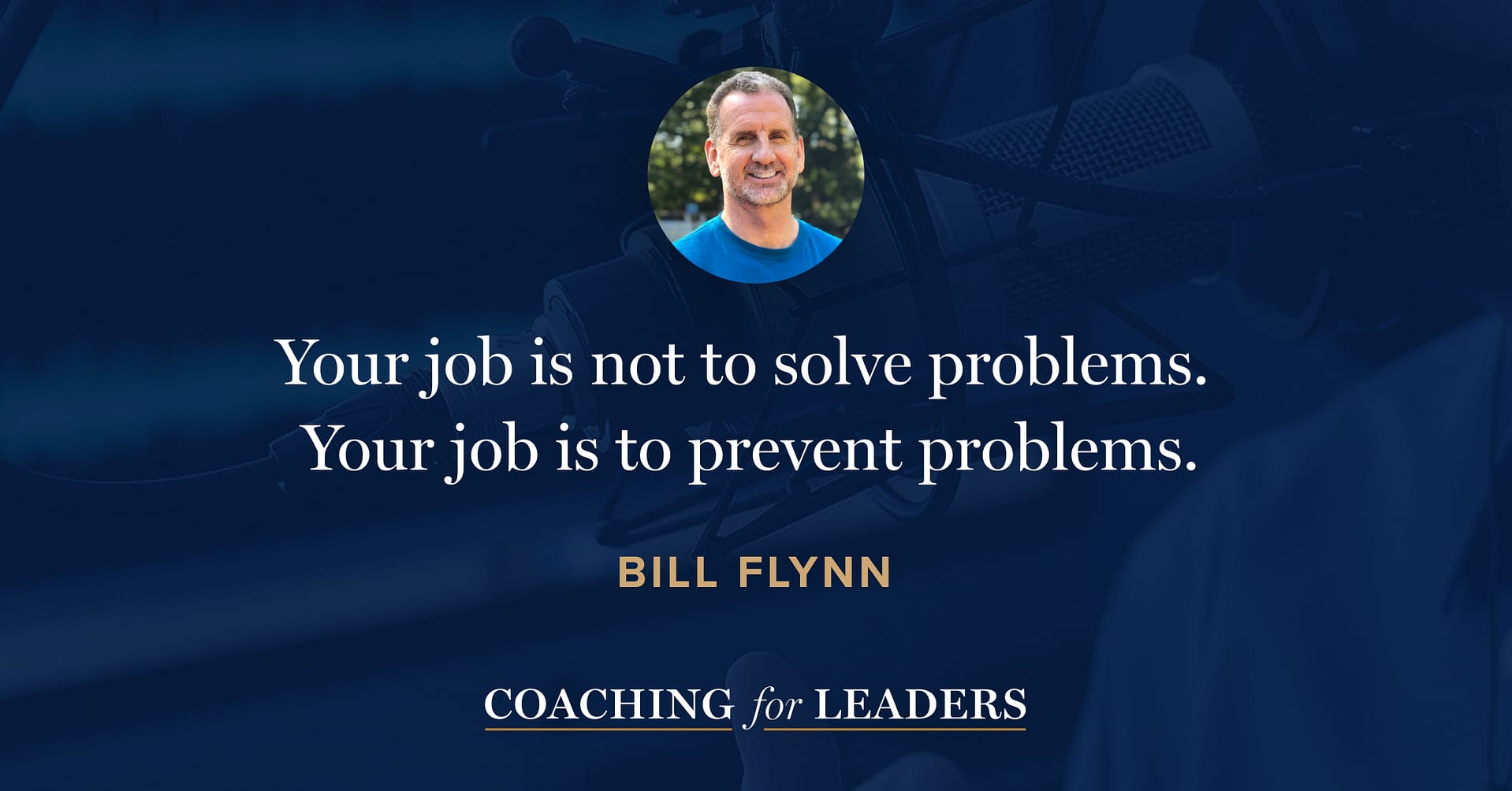
Your job is not to solve problems. Your job is to prevent problems.
https://media.blubrry.com/coaching_for_leaders/content.blubrry.com/coaching_for_leaders/CFL806.mp3

Podcast: Download

Follow:
Apple PodcastsYouTube PodcastsSpotifyOvercastPocketcasts

Bill Flynn: The Hero Trap

Bill is CEO of Catalyst Growth Advisors and a member of Marshall Goldsmith’s 100 Coaches Agency, a global community of the world’s top executive coaches. His writing appears in Harvard Business Review, Training Magazine, and ATD. He is the author of The Hero Trap: The Leader’s Shift from Doing to Designing (Amazon, Bookshop).

As their teams get larger and their titles get bigger, a lot of leaders work longer and harder. If you think about that for a moment, that’s obviously not sustainable. In this conversation, Bill and I explore how leaders recognize – and get out of – the hero trap.

Key Points

  • If you keep working harder as your team grows, you may be a victim of the hero trap.
  • Leaders fall into the hero trap because they care too much to let things break.
  • A key inflection point every leader hits: scale yourself or scale your systems.
  • Getting out of the hero trap is about shifting your identity.
  • Controllers solve problems. Builders show others how to solve problems. Architects design systems that solve problems.
  • Controllers thrive on recognition, urgency, and control. Builders find satisfaction in teaching. Architects find fulfillment in creating systems that outlast them.

Get out of the hero trap through:

  • The 10-minute prevention reflex. For new issues, ask, “What’s your first step?” and explain as you solve. For recurring issues, ask, “What would prevent this from happening again?”
  • The Netflix test. Test what happens when you take off an hour, a day, or an entire week. Notice what breaks and address the systems to prevent future problems.
  • The thinking partnership. Instead of a command and control mindset, invite others to think through problems with you.

Resources Mentioned

  • The Hero Trap: The Leader’s Shift from Doing to Designing by Bill Flynn (Amazon, Bookshop)*

Interview Notes

Download my interview notes in PDF format (free membership required).

Related Episodes

  • How to Ask Better Questions, with David Marquet (episode 454)
  • The Habits That Hold Leaders Back, with Marshall Goldsmith (episode 696)
  • Stop Solving Your Team’s Problems, with Elizabeth Lotardo (episode 764)

Discover More

Activate your free membership for full access to the entire library of interviews since 2011, searchable by topic. To accelerate your learning, uncover more inside Coaching for Leaders Plus.
How Leaders Escape the Hero Trap, with Bill Flynn

Download

Dave Stachowiak [00:00:00]:
As their teams get larger and their titles get bigger, a lot of leaders work longer and harder. If you think about that for a moment, that’s obviously not sustainable. In this episode, how leaders recognize and get out of the hero trap. This is Coaching for Leaders, Episode 806.

Dave Stachowiak [00:00:21]:
Production Credit: Produced by Innovate Learning, Maximizing Human Potential.

Dave Stachowiak [00:00:29]:
Greetings to you from Orange County, California. This is Coaching for Leaders, and I’m your host, Dave Stachowiak. Leaders aren’t born; they’re made. And this weekly show helps leaders thrive at key inflection points. An inflection point that many of us hit as leaders— I know I have many times— is running into the hero trap. We’re going to talk more about that today and how we can shift from the hero trap to being more effective as how we process systems better. And I’m so pleased to welcome Bill Flynn to help us to do that. Bill is CEO of Catalyst Growth Advisors and a member of Marshall Goldsmith’s MG100, a global community of the world’s top executive coaches.

Dave Stachowiak [00:01:14]:
His writing appears in Harvard Business Review, Training Magazine, and ATD. He is the author of The Hero Trap: The Leader’s Shift. From Doing to Designing. Hello, Bill. Glad to have you on.

Bill Flynn [00:01:27]:
Hi, Dave. Thanks for having me on. I’m looking forward to it.

Dave Stachowiak [00:01:30]:
Me too. I- when I heard about your work, when I got into your book, I thought to myself, this is so common, not only in my own experience, but the leaders I support. I see this happen all the time. And you write in the book: If you’ve ever found yourself working harder as your team grows larger, if success seems to demand more of you than less, you’re already in the hero trap. Which, of course, begs the question, what is the hero trap?

Bill Flynn [00:02:02]:
Sure. It’s this success paradox, for lack of a better phrasing. Is I’m sure you’ve had this, I’ve had this, and a lot of my friends have. You know, you did well early on in school, in other things, in other pursuits, then you started your professional life, and those things that were reinforced and rewarded for you, once you get to that level, and as you know, Dave, we kind of have this verticality in at least Western business culture that, in order to grow in a business, you’re generally growing up, right? So you’re taking over a team, and as soon as you take over a team, almost everything that you learned and that which was reinforced begins to work against you. Unfortunately, it’s a slow process, and it’s almost like that proverbial frog in the boiling pot. You don’t really realize it until it becomes too late. The other side of that is your present also works against you because if you employ all of those strategies and tactics and things that you did that get you to be successful, being the great decision maker, coming in and swooping in and being the hero, winning a deal or figuring out a problem that was difficult, those people that work for you, when you begin to realize that you’re in this trap, as you noted from my book, they don’t want you to get out of it, because they’re now used to it and they’re going to resist it. So not only is your past sort of a vice grip on one side, your present is also on the other.

Bill Flynn [00:03:28]:
So it becomes even more difficult to pull yourself out of this. And I had this happen to me, not for my own doing, but a team I took over, which was run by an engineer, and I came into this company to help them sell it, and I was asked to sort of take over sales. And the founder at the time said, “You know, make me look as big as possible”. And eventually I took over marketing, who was run by the other co-founder, and he employed what he was comfortable with, which was sort of a Scrum model. And every morning he’d gather the marketing team around, and he’d sort of point at people and say, ” Do this and do this and do this”. And at the end of the day, they’d get together, and they did this for a long time. And then I took over, and I said, I’m not doing that. Not my style, nor was I a marketer.

Bill Flynn [00:04:12]:
I was a marketing thinker, but I didn’t really understand social media at the time or SEO or whatever. So I said, “Look, I’m gonna have to trust that you guys know what you’re doing. I’d like to set the direction of marketing and the vision of marketing, and I’d like you to be involved in that. But once we decide that, then go do your job and tell me what I can do to help you be successful”. And Dave, they hated me for months. And eventually they came to appreciate it, and they were glad that I was respectful of their talents. And eventually I became their resource.

Bill Flynn [00:04:46]:
When I left, and they left the company, I became one of their references for years. So it works eventually, but it is a struggle if you’re in it and you wanna get out of it for so many reasons.

Dave Stachowiak [00:04:56]:
Yeah, well, I’m so glad you mentioned this because I see this all the time with the leaders we support as well is they make a positive shift to be a little bit more coach-like, to think a little bit more on systems, to step out of the day-to-day, and they get pushback. And one of the things you point out in the book is that teams that are trained to depend on a hero don’t feel empowered, at least not initially, when the hero steps back. They feel abandoned, don’t they?

Bill Flynn [00:05:28]:
Yeah. And that’s sort of the last piece of this is, you can’t just decide that you want to do this. You have to begin to put systems in place, so you’re not as necessary, and they’re already feeling the autonomy and the agency as you go. And I know we’re going to talk a little bit about some of the ways to do that later. But if you just do that, it’s sort of like being a dry drunk, if you will, right? I mean, it doesn’t mean you’ve solved anything, it’s just you stopped drinking. You have to also put the systems around you so you continue to not drink. Same thing with this is you have to be in a situation where you create the environment so you’re not as necessary.

Bill Flynn [00:06:07]:
And, and I use that sort of addiction metaphor purposely because it is this— it’s an addiction. Endorphins and dopamine are surging through your system when you’re the hero because it feels really good. And it feels like caring. It doesn’t feel like you’re being overbearing or anything; it actually feels right. So it begins to feel wrong when you start to do it, which is why many folks get pulled back in because the systems aren’t allowing them to stay out of it. So you have to put all of those things in place to have it work.

Dave Stachowiak [00:06:38]:
Well, as I think about that, I think oftentimes if you’re someone who’s in an organization who’s led by someone who’s fallen into a bit of that hero trap, what it looks like and feels like is micromanagement. It feels like that person’s a bit of a control freak. And you say that most of the people who fall into the hero trap, most leaders, aren’t really doing it because they’re control freaks. They do it because they care so much about not wanting things to break. And I think that’s a really critical distinction.

Bill Flynn [00:07:13]:
Yeah, exactly. You know, that’s why it’s sort of an insidious issue and why I think many people just easily fall into it because it feels like the right thing to do. And it is reinforced, right? Because you are, I’m sure you’ve done this, you’ve been in a meeting, and then you’ve had this epiphany, and then you sort of say, you know, “Hey, hang on, I have an idea”. And then people look at you like you are from outer space. You’re this genius. Like, how did you come up with that, Dave? Who wouldn’t want that?

Dave Stachowiak [00:07:40]:
Yeah, indeed. And it’s so easy to go down- It’s so easy to go down that path. And there you’ve, you’ve identified a framework for this. And as I, as I look at the framework and I’ve been thinking about it this week, I’m like, wow, okay, this is, this has certainly been my journey, and I see it all the time. And there’s 3 steps in the model. There’s starting off as falling into that trap of being the controller, then there’s the builder, and then there’s the architect.

Dave Stachowiak [00:08:05]:
Could you explain those 3 different- I don’t know if we call them like archetypes, but how they play out and what that looks like at those different stages?

Bill Flynn [00:08:16]:
Yeah, archetype works, I call them identities. And what I found is, so I’ve done a bunch of startups, and I work with usually smaller-ish companies and help them because of that background. And most of them are hero-like, right? They are the controller. And when you’re at the beginning of a business, you have to be. You have to solve the problem. You have to be in the meeting. You have to be making the decisions that move the company forward.

Bill Flynn [00:08:39]:
And often that works. It’s getting stuck in that mode or understanding that that is not the only mode that you need to be in or the only identity that you have to, sort of, d”on. So the 3 are controller, builder, architect. And it’s super simple. Controller is “I solve, builder is “I teach”, and architect is “I design”. And there’s one thing that I don’t put in here, but there’s really this sort of 3A, which is once you become an architect of architects, you’re now creating other architects. That’s really the nirvana of the process. But the main model is around those 3 things.

Bill Flynn [00:09:15]:
So, for instance, let’s say this example I just gave with you; you made this great epiphany. And then if you sort of walk away and you sort of leave it and you feel good about this problem that you’ve solved, you’re not doing your team the service that you need to be doing. You then need to say, okay, let me teach all of you how I just did that, because I’m sure you have some heuristic or some sort of rubric or whatever that you use to think through problems, et cetera. I know that I do in most of my stuff. And showing them how you think is the builder, right? That’s, you’re teaching them how you think. So at least when that thing comes up again or something very close to it, hopefully they remember it, and they’re able to either solve it themselves on their own or say, “Hey, this has come up, Dave. I think this is the best way to solve it. Here’s why”.

Bill Flynn [00:10:07]:
And you just say, ” Great, go ahead”, as opposed to them coming to you saying, “Dave, here’s this thing came up”. It feels like the other one, but I’m not sure. Can you help me solve it? Which, you know, there may be a path to that eventually, but you want to then teach them how you think. This is very similar to, I can’t remember if you’ve had David Marquet on your show or not- but this is very similar to his model, Turn the Ship Around, right? Is, he eventually said, I’m not making any decisions, right? He only kept one decision-making. Right? And he basically said, ” Think like me”. He said, you know, what do you think I’m thinking at this moment? And they said, ” Oh, are we safe?” And so that’s where he was being the teacher.

Bill Flynn [00:10:43]:
But he eventually created the systems so people could do the “I intend” model, so he could just say, ” Go ahead”, as opposed to giving orders. And that’s the next step, which is being an architect and designing systems so people can think on their own and use their own brains and will probably solve them better than you would, either as an individual or as a group, because they’re just closer to the information. They have a different perspective of doing things. This is very similar to what Jeff Bezos built at Amazon with its 14 principles. The freedom and responsibility stuff that Netflix did with Reed Hastings. Toyota has been doing this for 75 years with the Toyota Production System. They’re all- these are architect systems, right? Where people are given the opportunity to contribute in ways beyond what we normally have them contribute, which is sort of a command-and-control model, or even a coaching model, which is a good model, but it makes it, without the system, it makes a hero that delegates better, or that makes a better decision, as opposed to someone who’s an architect who creates systems so other people can delegate better or make better decisions.

Bill Flynn [00:11:52]:
So that’s sort of the model between controller, builder, and architect. And what I’ll say is, as a final point, is I’m not saying that controller is bad. I’m saying that controller is an identity that sometimes you have to don because it requires it, but it is not the only option for you as you go through things. And you should always be trying to move towards architect. So that’s, that’s sort of the essence of what the CBA model is.

Dave Stachowiak [00:12:17]:
Yeah. And I hear also in what you just said that this isn’t— it’s not like you take on the identity being the builder and you’re the builder of everything all at once. There’s elements of things- you may step back into being controller, or you may be the builder in some areas. You may be really intentional about getting to the architect in other areas. But part of this is being really intentional about what identity you’re taking on. And I’d love to come back to that word because you said, okay, these 3 are identities… Because you make the point in helping leaders get better at this, that shifting from controller to builder, shifting again eventually from builder to architect, that it’s not really about skills so much; it’s about identity. What do you mean by that distinction?

Bill Flynn [00:13:03]:
Yeah, and that’s sort of what I mentioned earlier is that- So, we’ve been in this leadership development thing for about 50 years, give or take, right? If you look back to the ’80s and ’90s, that’s really the origin story of when we started to think about leadership development. And I believe the premise was, “Oh, if we create better leaders, we’ll create better companies and organizations”. And as far as I can tell, David, and I’d love to get your thought on this since you’ve been doing this a long time as well, is it’s not working. We are making better leaders, right? I was at a NeuroLeadership Institute conference a number of years ago, and the woman who, at the time, was running learning and development said that she’d learned so much from David Rock and the team because they had to rewrite, she said, about 70% of their content because it wasn’t brain-friendly. So we’re getting better at it. But you’d think that the metrics that we would say, here’s what great leaders create, which are great companies and great organizations, thriving organizations and delighted customers, would get better. Yet, you know these numbers, but I’ll repeat them just for effect.

Bill Flynn [00:14:05]:
The stuff that Gallup does with employee engagement is still the same. It’s between 25% and 35%. I think it’s at 21% right now; that was the last number I saw. CEO tenures are shrinking by about 20%, 30% over the last few years. Fortune 500 and S&P 500 companies used to be on those indexes, the indices, for 50, 60, 70 years, on average. Now it’s 15. And I don’t know if you read this recently, these up-and-coming talented millennials and Gen Xers don’t want to go into management of people. They are opting out.

Dave Stachowiak [00:14:39]:
Yeah.

Bill Flynn [00:14:39]:
So that’s not good either, right? So these metrics are saying whatever we’re doing, I’m not going to say is wrong, but I don’t think it’s enough. And this hero trap model that I’m talking about is part of a larger thesis that I have, which is, I think we have to start doing things differently moving forward because the world we’re living in is more complex. We’ve gone from VUCA to BANI, if you’re familiar with those terms. We’ve got this hero trap model that I think is here. And complexity, especially with AI, is sort of turbocharging complexity tremendously. Our brains just can’t handle it. So we have to start doing things differently. We can’t rely on one or a few people anymore.

Bill Flynn [00:15:17]:
We have to create systems that make up for our limitations as flawed human beings in this extremely complex environment. So that’s sort of what I mean by building skills is great, but I don’t think it’s enough anymore. We have to teach people how to create this environmental, this adaptive, complex environmental system that does this for us. And we can have what has been called eyes-on, hands-off leadership from the day-to-day, right? I’m not talking about the business in general. Your job as a leader, in my opinion, is to look out, not to look down. And so I wanna create, help people create environments where looking down is not as necessary, and you’ll spend a lot more time creating the future of the business versus running it. So that’s what I mean by that.

Dave Stachowiak [00:16:01]:
You and I, of course, are both fans of Marshall Goldsmith’s work. And I think about what are the things that traditionally don’t work well in leadership development. And we tend to- and by we, I mean the industry of, working, coaching, mentoring, training leaders, tends to do a lot of, like skill development: what you need to start doing. And one of the things I remember Marshall being really big on, still is, 20 years ago when I read What Got You Here Won’t Get You There, is we don’t often have the conversation about what you need to stop doing as a leader. And that’s one of the things that really came up really strongly for me in thinking about this hero trap is, oftentimes, we index further and try to get better at and work harder at the things that have worked traditionally for us earlier in our careers, earlier in the stage of our organizations. And we get to a point where, to that great quote from the book, what got you here won’t get you there. You do have to shift.

Dave Stachowiak [00:16:58]:
And which brings me right back to one of the things you say is that every leader eventually hits the same inflection point is, rather than scaling yourself, the invitation is to scale your system. And that is a big distinction, isn’t it?

Bill Flynn [00:17:16]:
It is, it is. And to be honest with you, though, Marshall is the foreword of my book on purpose because of what- the book you mentioned, What Got You Here Won’t Get You There. To me, I believe I’m extending what he started 20, 30 years ago with his book. Because his book is mostly on behaviors, and my book is not just on behaviors. It’s really about systems that you need to build so you don’t have to be a great leader. One of my sort of iconoclastic phrases is, “In my opinion, great leaders now build great organizations that don’t need great leaders”. So that, and that’s sort of a paradox again. And, but I think that’s what we need.

Bill Flynn [00:17:54]:
You need, we need to do that because again, we’re not going to be able to be the hero anymore; it’s just going to get worse. AI in the last 2 years has really changed a lot. And I’m going to tell you, in the next 2 or 3, it’s going to accelerate at an exponential rate, which will make it even worse.

Dave Stachowiak [00:18:10]:
Yeah. Which comes right back to, all right, how do we get better at this, and how do we break this hero habit a bit? And you have some great starting points for this. There’s a ton in the book, by the way, that we’re not going to hit on in this conversation. But there are, there are what you call a fast track: 3 things that we could start with to begin. And I think, like, almost when I think about these 3 things and see the situations that are coming up with the leaders we’re serving and just my own experience, I’m like, “Yep, all, any one of these is a great starting point”. And as a progression, like thinking about how you can begin here, just to get out of that habit a bit and start to nudge you forward. And also, to your point, you start to shift your identity a little bit on how you start thinking about this too, of not coming in just as the hero.

Dave Stachowiak [00:18:59]:
And the first thing you suggest, the first framework here is something you call the 10-minute prevention reflex. Tell me about that.

Bill Flynn [00:19:08]:
So, 10-minute prevention reflex, it’s just another way of saying what we already know, which is when someone comes to you with a problem, before jumping right in and solving it for them, step back and, one of my favorite questions is, what do you think we should do? And sort of slow your brain down so you’re not just jumping in and solving. And just like meditation or other things, as you do it more and more, you’re training your brain to not solve first, which is its inclination, and training your people, also, to think for themselves. So that first one is you sort of say, okay, you brought this to me. And you ask yourself and them, so have we seen this problem before? And if you haven’t, then maybe you need to do that sort of controller-builder thing, right? Where you help them solve it, or solve it and then teach them how you solved it. But if you have seen it before, you should say, “Okay, I don’t want to keep solving this or some near derivation of this thing over and over again”, which Peter Drucker has been telling us for 50 years, right? Most problems are solved- the same problem or a variation of it- solved over and over again. And if you do that, then you’re helping yourself slow down. You’re now saying, “Okay, let’s solve the problem, but also let’s solve the problem that we believe is causing the problem, which will hopefully make any versions of this go away”.

Bill Flynn [00:20:27]:
So that’s sort of the 10-minute prevention reflex. Again, it’s a neuroscience geeky thing.

Dave Stachowiak [00:20:32]:
I think there’s, like, so many things there that are really huge; it’s like, okay, I hear this recurring problem. It’s not so much, how do I keep solving the problem or help people solve the problem? It’s how do we— the shift I’m hearing there is how do we prevent this from happening again? And in fact, that’s maybe the question you literally ask is, you notice as a leader, “Ok, we’re going down this path that we’ve gone down 2, 3, 5, 7 times before, or at least variations of it. What can we do to elevate a bit and think about how do we actually change the system a bit?” And to your point— Asking that question out loud, that’s huge on making that, making that work.

Bill Flynn [00:21:10]:
Exactly. Yeah. And, and just to, to reinforce that, when I bring on my clients, I do an intake interview and I, I use the stuff from Marcus Buckingham, and I say, what do you love to do? What gives you energy? And I would say 50, 60, 70% of the leaders that I talk to- these are the senior leadership team, CEO and SVPs or whatever you wanna call ’em. And most of them say, “I love to solve problems”. And then I tuck that away in my first meeting with them, I let them down, and I say, okay, I’m gonna disappoint many of you, and I’m gonna tell you that what I’ve learned is: Your job is not to solve problems. Your job is to prevent problems. And then I just wait and watch their faces, and a lot of ’em are like, what do you mean I don’t solve problems? Because that’s really your job.

Bill Flynn [00:21:51]:
Your job is to, at least from the running of the day-to-day, your job is to prevent things from happening. I think Dan Heath and Chip Heath do a great job in some of their books, and they talk about this. One of them is Upstream, I think that’s Dan’s book. He says, ” Your job is not to solve the problem in front of you alone. It is to solve the problem that’s causing the problem that’s in front of you. And if you keep looking upstream, eventually you get to the root, and all of those problems that kept recurring will then go away. By the way, it may cause other problems that you have to solve, but at least it will stop that stream of them and allow you to focus more time and energy on, again, looking out versus looking down”.

Bill Flynn [00:22:25]:
So that’s really the essence there.

Dave Stachowiak [00:22:27]:
Yeah. And I’d love to reinforce one of the other things you said too, is, maybe you come— a problem comes up in a conversation or in a situation or staffing or whatever that is not something that has recurred. This is a new problem, a new situation. And it is a situation where maybe you, as a leader, jump in and you’re doing some more of the controlling; you’re doing the problem-solving. But even in that situation, like the invitation I hear from you is “Hey, if you’re going to be solving the problem, at least talk through out loud what your thinking is as far as how you’re approaching that”. So if you’re working with a peer, a colleague, one of your employees you’re developing, you’re thinking through the process, you’re sharing what’s going on so that you start to give that person the context of how you make decisions. And you’re getting toward that builder identity a bit more. Not only for them, but perhaps even more importantly for you.

Dave Stachowiak [00:23:20]:
You start identifying as a builder. I’m not just doing this myself; I’m saying this out loud with the intention of building the skill in someone else.

Bill Flynn [00:23:29]:
Exactly.

Dave Stachowiak [00:23:30]:
Huge. All right, the Netflix test, that’s number 2. What’s that?

Bill Flynn [00:23:35]:
Yeah, so No Rules Rules is a book that came out recently about Netflix, and I’ve been a Reed Hastings follower for many- for many years because I just love the way he thinks, and he’s a great example of this, because you might remember, a number of years ago, they decided, Netflix decided, and he did it very publicly, he was gonna create Qwikster, and he would split the 2 businesses of, you know, mail-in stuff to digital stuff as 2 different businesses. And the, you know, and people revolted.

Dave Stachowiak [00:24:04]:
Yeah. Yeah.

Bill Flynn [00:24:05]:
Because he applied his engineering hat. It’s like, what’s the problem? And he solved the problem, and he probably solved it himself or in a small group. And he was wrong. So then he stepped back, which I loved about him; he stepped back and said, okay, hang on, what, what happened? And then from that, I believe the freedom and responsibility seed was planted. ‘Cause it wasn’t until after that he started to say, “I don’t wanna do this again”. He didn’t just solve that problem. He said: I don’t want this to happen again where I’m the main source of solution, and I’m wrong.

Bill Flynn [00:24:33]:
I didn’t leverage all the assets and all the resources and all the information available to me. I wanna do it differently. So one of the things he did- he didn’t do this on purpose, but it certainly worked out is, he wanted to demonstrate to his team that taking time off was really important. Netflix is an intense culture, and he knew that, and he didn’t wanna change it to be less intense. He said, ” But you need to recharge”. So he started taking 6 weeks off. And what happened was, when he came back that first time, he found things that broke, and he found things that got better when he wasn’t there.

Bill Flynn [00:25:05]:
And he completely unplugged; he was gone for 6 weeks. You could not reach Reed Hastings. And Brian Chesky at Airbnb did the same thing, but he did it deliberately. He said, I’m going to— I think it was 2 weeks. And then he found out what broke. And that’s when he realized, “Okay, I need to start building systems in the things that broke and the stuff that’s working great. What can we learn from that and make even a broader scope within the company?” So eventually, I’m not necessarily, I’m not necessary at all, or very little, for the day-to-day and the running of the company.

Bill Flynn [00:25:35]:
So that’s sort of the Netflix test. Take a vacation. You can do it slowly. When I, you know, people say, well, I can’t take 2 weeks off or 6 weeks off. I’m like, well, just take an hour off. In a meeting where you’re, like, the person that runs the meeting and you’re like in there solving stuff, just say to the team, I’m not gonna do that in this meeting anymore. I’m gonna ask clarifying questions.

Bill Flynn [00:25:57]:
I’m not gonna give any answers. I’m gonna ask and help you come up with your own answers. And then as long as they fit with, you know, our core values and our purpose and all those, you know, sort of those fundamental things, we’re just gonna give it a try. And it starts you off, and then eventually you can feel comfortable doing that, and then you can maybe extend it to eventually taking a few weeks off and being okay with that. So that’s sort of what the Netflix test is.

Dave Stachowiak [00:26:21]:
Which gets to your point of like, your job’s not to solve the problems; your job is to prevent problems, right? And if you don’t— I think it’s really interesting. Oftentimes, with our Academy members, they’ll be working on trying to start to make the shift a bit and take on this new identity. And one of the tests we’ll use is if they take a few days off or if they’re gone for a week. And sometimes folks will come back if they’ve done this well, and they’ll say some version of, you know, I took 3 or 4 days off, and it’s kind of like nobody noticed.

Bill Flynn [00:26:56]:
Yeah.

Dave Stachowiak [00:26:56]:
And that is— when I hear that, we’re like, “hooray, great”. Now, we’re not trying to, like, have someone take 6 months off and no one notice, right? But to get to the point where operationally people can make decisions, they feel empowered to make decisions, the systems are in place for that to happen, that is such a healthy place for a leader to be, but also for an organization, because you don’t have then a single failure point, system or person that’s reliant on everything. You’ve developed a system to be able to do that better.

Bill Flynn [00:27:28]:
Yeah. And, and get back to the thing that you mentioned earlier, well, I agree with you. That’s wonderful. It can be a bit daunting for that person who’s just realizing this for the first time, because then they’re, then they ask themselves, well, why am I here?

Dave Stachowiak [00:27:43]:
Yep.

Bill Flynn [00:27:44]:
What am I supposed to do every day? And then, and, and that’s, again, that’s, you have to help them and say, “Look, it’s about looking down that we don’t want you to do. We want you to look out”. So, I say there’s 2 constituencies that you should always be thinking about and trying to make their lives better. Those that work for you, how I make the lives of the people that work for me better or easier or whatever. And your clients or your customers. And sometimes it’s an internal customer, and sometimes it’s an external customer, ’cause you may be handing something of your stuff off to another group in the company, or you may be delighting a client. There’s a lot of stuff you can do and a lot of time and energy you can take to make sure that you’re doing that well. And that’s where I start to say, look, this is where I want you to start spending your time and energy.

Bill Flynn [00:28:24]:
And now you have time to do that. And there’s plenty of things that, you know, I actually wrote a whole bunch of; I put like 20 things down because one of my clients asked me that. And so I said, “Here, lemme give you a list”. And I gave them the list, and they said, oh, okay, there’s plenty of stuff I can do. So you also have to reinforce that, hey, you’re not gonna get fired. We want you to be thinking at a higher level. We want you thinking out 2, 3 years for the business, not 2 or 3 weeks.

Dave Stachowiak [00:28:48]:
Yeah, exactly. By the way, this is one of the things I really love about the book is, and, and if you’re listening to this and thinking, okay, I’m a little bit in the hero trap, and we all are to some extent, you do a really great job of, like, detailing out the language that you’re going to hear in conversations when you’re in this trap and also the language that you will hear shift when you move out of the trap. And it’s really helpful. Like when I look at that language, oh yeah, that was— that used to be me and still is sometimes in some situations, right? Being able to listen for and tune yourself to that language, all of a sudden you start seeing things in a different way and at elevation, which gets to the system invitation that you made earlier. So the third invitation is what you call the thinking partnership. Tell me about that one.

Bill Flynn [00:29:38]:
Yeah, we’ve kind of touched on it a little bit already. Here’s an example I like to give to my clients is: Let’s say we’re in a meeting, Dave, and you’re my boss, and I’m running the meeting, and it’s our regular meeting, and it ends, and it went okay. And you noticed it went okay. Not great, not bad. What often we do, what the hero does, and then, and often inadvertently, puts us into threat mode is that, you know, we, we, you tap me on the shoulder and say, “Hey Bill, can you come to my office with me? I wanna give you some feedback on this meeting”. Now what you did right there is you sent me into threat mode. One, you know, you probably called me out. People are probably still in the room.

Bill Flynn [00:30:11]:
You called me out in some way. They’re like, oh, Bill’s gonna go to Dave’s office and get the talking to, or whatever. They don’t know what your intentions are, but that’s what they think. I’m thinking, “Oh my God, what happened?” I’m following you to your office, and I’m starting to catastrophize as we get to your office. And then you sit behind your desk, which is a status symbol and a protective metaphor. I’m sitting in a chair which is wide open, and by the time I sit down, my brain is in full threat mode. And whatever you say next, I’m probably not going to remember because I’m sweating, my heart is beating, et cetera.

Bill Flynn [00:30:42]:
Now, what you could have done, as a thinking partner, is waited till everyone left and then sat down next to me and said, “hey, Bill, how do you think that meeting went?” And as long as I’m not delusional, I’m going to say, “You know, it went okay. There were parts I was a little uncomfortable with”. And you say, “You know what? Me too. So why don’t we do this? Why don’t you set some time on my calendar in the next few days? Come to that meeting with 2 or 3 things that you thought went really well, and we should try to figure out how to make even better if we can. Come with 1 or 2 things that you thought didn’t go so well. I’ll do the same thing. And then you and I are gonna meet every week until we agree or align on that this is the best possible version of this meeting”.

Dave Stachowiak [00:31:22]:
Hmm.

Bill Flynn [00:31:22]:
That’s a thinking partnership. The other is a hero model.

Dave Stachowiak [00:31:27]:
Ah, and it- just the description of you walking through not only the language, but also the environment, how it’s presented, how it’s shaped, what rooms you’re in. It totally changes how— and that’s where this gets to identity, right? It’s not just the skill piece. It’s the- how am I actually thinking about who I am and how I show up as a leader in these situations? And if I’m identifying it as a partnership, and again, back to the builder and architect framework, it totally changes how I approach it.

Bill Flynn [00:32:01]:
Yeah. Yeah.

Dave Stachowiak [00:32:02]:
Speaking of change, so much about learning and growth for all of us is about change and changing our minds. You have been supporting leaders for many years, helping them to get better at this, helping them to get out of the hero trap. I’m wondering, as you’ve worked with people and helping them to do this better, what’s one thing you’ve changed your mind on?

Bill Flynn [00:32:26]:
So I’ve been studying neuroscience, as I mentioned, or might’ve just alluded to, for about 25 years. And what I’ve changed is what I would call how compassionate I am. I used to be a bit of a hero leader and a bit of a hard-ass, to be honest with you. And my affect also, and my demeanor gives off an intimidating vibe, even though I don’t think I’m intimidating at all. I’m kind of a goofball and love to joke around and that kind of stuff. But I’ve heard that from people. And what I’ve learned since, I realized that this brain that we have, that we’re borrowing from our ancestors 10,000 years ago, is working against us on a daily basis. And it’s causing us to act in ways that we don’t even realize we’re doing. I’ve just become much more compassionate to myself, where I’m much more forgiving of myself when I fall into these things, and of others.

Bill Flynn [00:33:16]:
So I’ve taken a much more sort of nurturing approach, probably since I’ve been a coach, and even during that process over the last 10 years, where I would sort of wag my finger at people at the beginning, I don’t do that anymore, because I realize that this brain that we have is not designed to be doing the things that we’re doing. It’s designed to keep the scaffolding and the plumbing alive, and it’s better at running away and avoiding than it is at actually jumping in and doing stuff. So I would say that is definitely something I’ve changed in… I would love to say it was sort of an epiphany, but I think it evolved over the last 10 years. The only time I’m a hardass with my clients is when they write their priorities, and I tell them upfront, I said, you know, I’m not letting you get away with a horribly written, non-measurable, et cetera priority. Other than that, I’m going to give you big hugs on a regular basis.

Dave Stachowiak [00:34:07]:
Bill Flynn is the author of The Hero Trap: The Leader’s Shift from Doing to Designing. Thanks for giving us a bit of a hug on how to get better at this, Bill. I really appreciate it.

Bill Flynn [00:34:19]:
My pleasure.

Dave Stachowiak [00:34:26]:
If this conversation was helpful to you, 3 other episodes I’d recommend. One of them is episode 454: How to Ask Better Questions. David Marquet was my guest on that episode, author of Turn the Ship Around, also of Leadership Is Language, a book I think about all the time. Because of David’s lessons on how we can do a better job as leaders of asking questions and actually listening to learn. So many key principles we talked about in that conversation. One of the most downloaded episodes we’ve ever had, episode 454. A great listen if you haven’t heard it before. Also recommended, episode 696: The Habits That Hold Leaders Back.

Dave Stachowiak [00:35:05]:
Marshall Goldsmith was my guest on that episode, and we talked about the lessons from his book. What Got You Here Won’t Get You There, one of the top bestsellers for leaders of the last 20 years. And we talked about a number of the common traps that we all run into in leadership, a great complement to this conversation. And also, I’m thinking about it because Marshall wrote the foreword to Bill’s book. So episode 696, a good complement to this. And then finally, I’d recommend episode 764 with Elizabeth Letardo: Stop Solving Your Team’s Problems. Well, you know exactly why I’m thinking about that in the context of this conversation. Another good message and a reminder from her on what we can do to stop jumping in, especially when it’s not helpful to help others to learn and grow.

Dave Stachowiak [00:35:49]:
Episode 764 for that. All those episodes you can find on the coachingforleaders.com website. And if you set up your free membership at coachingforleaders.com, you’re going to get access to a whole suite of benefits inside of the free membership, including my weekly FocusFice message: 5 things that I know will be helpful to you each week. And if you scroll to the bottom of those, you’re going to always see this week’s episode there, the links and references to all the episodes that I just mentioned every single week. All of that’s included as part of your free membership. And if you’re looking for just a bit more and want to get beyond the podcast, every single week I am writing a journal entry, a message directly from me, something I’ve learned, reflected on, coming from one of our guests or coming from one of our conversations we’ve been having inside of our community that I know will help you. And now we are also including it as a members-only podcast. Yes, it’s called Dave’s Journal, the podcast.

Dave Stachowiak [00:36:46]:
I am airing about a 10-minute episode every single week that expands upon my journal in written form and goes way beyond it, more of a fireside inside chat kind of a perspective. It’s not available on the podcast apps, though. So, if you’re looking for it, you’re going to need to get access to it by going over to Coaching for Leaders Plus. It’s just available to our Academy, Pro, and Plus members. But if you’d like to have more in audio form as well, in addition to the written form, Coaching for Leaders Plus is where to go. It’s one of the benefits now inside of Coaching for Leaders Plus. More details at coachingforleaders.com. Coaching for Leaders is edited by Andrew Kreoger.

Dave Stachowiak [00:37:25]:
Next Monday, I’m glad to welcome back to the show Will Guidara, author of Unreasonable Hospitality. Will and I are going to be having a chat about how, as leaders, we can practice unreasonable hospitality inside of our organizations. Join me for that chat with Will next Monday, and I’ll see you back then.

Topic Areas:Management SkillsPersonal Leadership
cover-art

Coaching for Leaders Podcast

This Monday show helps you discover leadership wisdom through insightful conversations. Independently produced weekly since 2011, Dave Stachowiak brings perspective from a thriving, global leadership academy of managers, executives, and business owners, plus more than 15 years of leadership at Dale Carnegie.

Listen Now OnApple Podcasts
  • More Options
    • YouTube Podcasts
    • Spotify
    • Overcast

Activate Your Free Membership Today

Access our entire library of Coaching for Leaders episodes from 2011, searchable by topic.
Listen to the exclusive Coaching for Leaders MemberCast with bonus content available only to members.
Start Dave’s free audio course, 10 Ways to Empower the People You Lead.
Download our weekly leadership guide, including podcast notes and advice from our expert guests.

... and much more inside the membership!

Activate Your Free Membership
IMAGE
Copyright © 2026 · Innovate Learning, LLC
  • Plus Membership
  • Academy
  • About
  • Contact
  • Dashboard
×

Log in

This site is protected by reCaptcha and the Google Privacy Policy and Terms of Service apply.
 
 
Forgot Password

Not yet a member?

Activate your free membership today.

Register For Free
×

Register for Free Membership

Access our entire library of Coaching for Leaders episodes from 2011, searchable by topic.
Listen to the exclusive Coaching for Leaders MemberCast with bonus content available only to members.
Start Dave’s free audio course, 10 Ways to Empower the People You Lead.
Download our weekly leadership guide, including podcast notes and advice from our expert guests.

... and much more inside the membership!

Price:
Free
First Name Required
Last Name Required
Invalid Username
Invalid Email
Invalid Password
Password Confirmation Doesn't Match
Password Strength  Password must be "Medium" or stronger
This site is protected by reCaptcha and the Google Privacy Policy and Terms of Service apply.
 
Loading... Please fix the errors above