• Skip to primary navigation
  • Skip to main content
  • Skip to primary sidebar

Coaching for Leaders

Leaders Aren't Born, They're Made

Login
  • Plus Membership
  • Academy
  • About
  • Contact
  • Dashboard
  • Login
Episode

777: How to Help Employees Handle Tough Moments, with Anthony Klotz

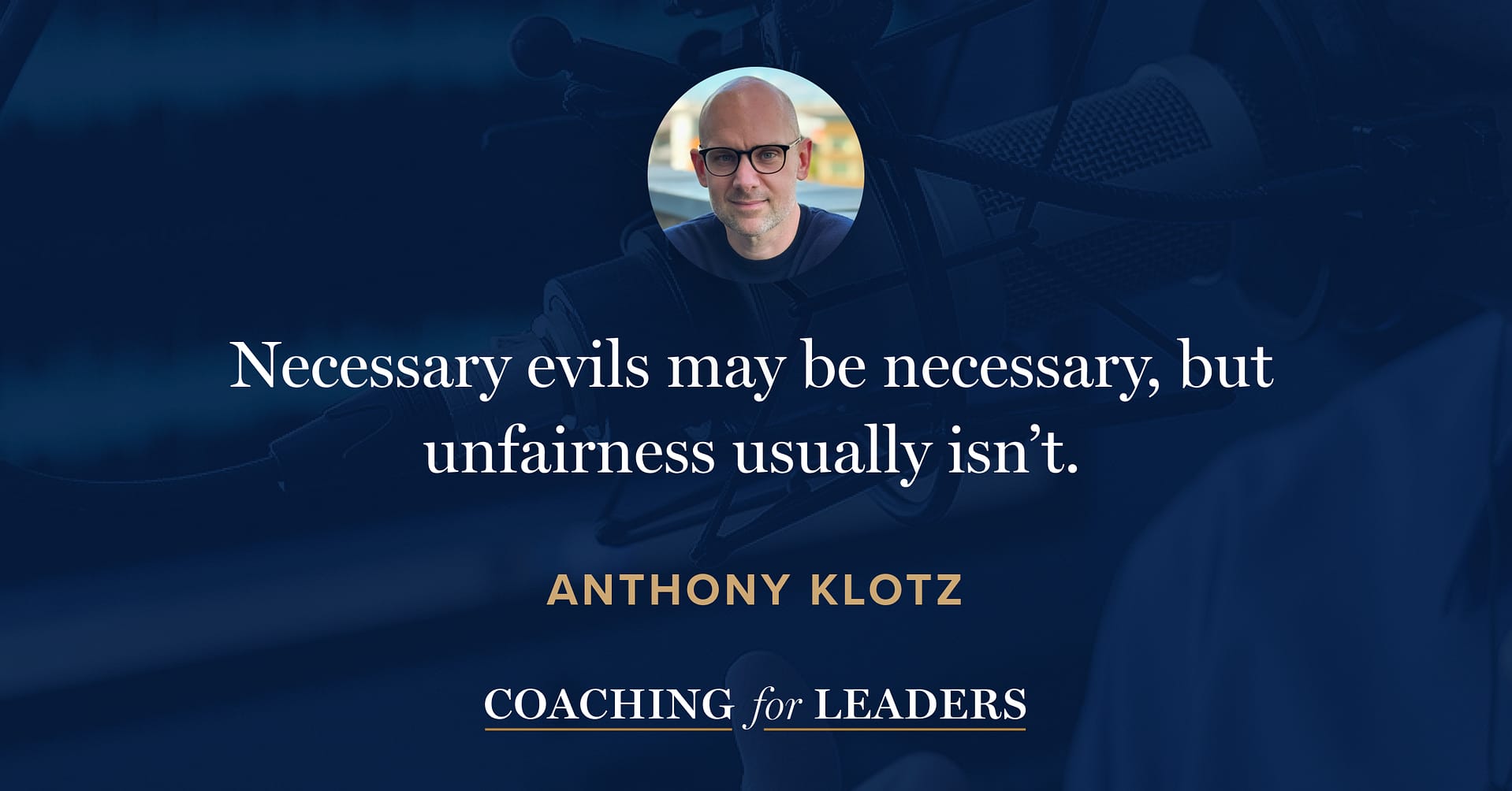
Necessary evils may be necessary, but unfairness usually isn’t.
https://media.blubrry.com/coaching_for_leaders/content.blubrry.com/coaching_for_leaders/CFL777.mp3

Podcast: Download

Follow:
Apple PodcastsYouTube PodcastsSpotifyOvercastPocketcasts

Anthony Klotz: Jolted

Anthony Klotz is an organizational psychologist and Professor of Management at the UCL School of Management. He is the person who both predicted and coined the term “The Great Resignation,” and his groundbreaking research on quitting, work design, and employee performance has made him a leading voice on the future of work. He is the author of Jolted: Why We Quit, When to Stay, and Why It Matters (Amazon, Bookshop)*.

Most of us have attempted to support an employee dealing with a tough career moment. Not all the time, but certainly sometimes, we see those moments coming. When an employee is dealing with a big jolt – or about to – this conversation with Anthony will show you how to help.

Key Points

  • Jolts have an outsized influence on people’s overall relationship with their work.
  • Managers play a deciding role in how people respond to jolts and are in the best position to insulate the negative effects and amplify the positive effects.
  • Managers can often anticipate and predict jolts to employees. The plans leaders have often become the jolts that others experience.
  • If people can make sense of a jolting event, they are better able to deal with it constructively.
  • The perception of how fair and event is and how fair the process was leading up to the event massively impacts how people perceive it.
  • A clear explanation of why change is happening and what it means can substantially minimize the negative effects of career jolts.
  • The tendency for organizations to delay bad news often is counterproductive to helping managers and employees navigate jolts.
  • Partnership with others (managers, friends, family members) helps most of us better process what we might otherwise attempt to do alone.

Resources Mentioned

  • Jolted: Why We Quit, When to Stay, and Why It Matters (Amazon, Bookshop)* by Anthony Klotz

Interview Notes

Download my interview notes in PDF format (free membership required).

Related Episodes

  • Engaging People Through Change, with Cassandra Worthy (episode 571)
  • How to Quit Bad Stuff Faster, with Annie Duke (episode 607)
  • Stop Solving Your Team’s Problems, with Elizabeth Lotardo (episode 764)

Discover More

Activate your free membership for full access to the entire library of interviews since 2011, searchable by topic. To accelerate your learning, uncover more inside Coaching for Leaders Plus.
How to Help Employees Handle Tough Moments, with Anthony Klotz

Download

Dave Stachowiak [00:00:00]:
Most of us have attempted to support an employee who’s dealing with a tough career moment. Not all the time, but certainly sometimes we can see those moments coming when someone’s dealing with a big jolt, or they’re about to. This episode will help. This is Coaching for Leaders, episode 777.

Dave Stachowiak [00:00:21]:
Production Credit: Produced by Innovate Learning, Maximizing Human Potential.

Dave Stachowiak [00:00:29]:
Greetings to you from Orange County, California. This is Coaching for Leaders, and I’m your host, Dave Stachowiak. Leaders aren’t born, they’re made. And this weekly show helps leaders thrive at key inflection points.

Dave Stachowiak [00:00:43]:
One of the inflection points that happens for all of us in our careers is something called a jolt. We’re going to talk about it today in this conversation, and most significantly for leaders, how we can respond, support, and even insulate employees when they hit jolts in their careers. Today, a conversation that will help us to do that, better, lead more effectively, and, of course, be even more helpful to our organizations. I’m so pleased to welcome Anthony Klotz. Anthony is an organizational psychologist and professor of management at the UCL School of Management. He’s the person who both predicted and coined the term the Great Resignation. And his groundbreaking research on quitting, work design, and employee performance has made him a leading voice on the future of work. He is the author of Jolted, Why We Quit, When to Stay, and Why It Matters. Anthony, so wonderful to have you on the show.

Anthony Klotz [00:01:38]:
Thank you, Dave. It’s great to be here.

Dave Stachowiak [00:01:40]:
This is a fascinating book. The research, fascinating. And I’m so excited to get into this because there’s so many implications for leaders. Before we get into some of those, though, the obvious question is the title of the book, Jolted. What is a jolt? And what’s significant about it for our careers?

Anthony Klotz [00:02:01]:
Yeah, great question. So a jolt is an event, and the event could be big or small. It could be in your personal life or your professional life. But what sets a jolt apart from other events is that jolts make you stop and rethink your relationship with work. Take a critical look at your job and your relationship at work. And these jolts are pretty common, and they’re becoming more common. But it hasn’t been until fairly recently that we’ve really started to understand the implications of these big events, these jolts, on our careers and our relationship with work. So, often these jolts cause emotions in us, and we often make bad decisions in the wake of them that don’t set us up for career success or professional success.

Anthony Klotz [00:02:49]:
And so what we’re trying to understand better is what is a roadmap or a toolkit that we can have in the wake of these jolts to respond to them in ways that they serve wake up calls, and bring us into new career moments and more positive career success when we need that, but as critically understanding when to ignore them and just continue on a resilient path. And so, what I’m hoping to do is provide a toolkit to respond to these jolts that lead us to higher career success.

Dave Stachowiak [00:03:20]:
One of the things that I’ve really found fascinating in looking at your research and thinking about this is that the point you make, that people spend a lot of their energy reflecting on only a fraction of things that actually make up their overall relationship with work. And I think jolts become really significant for that, don’t they?

Anthony Klotz [00:03:42]:
Yeah, that’s right. Because jolts signal that some element of our relationship with our job or work is, is deficient or needs some attention. And so by that very nature, our attention goes there, as it should. But what we often end up doing is overweighting whatever one element that is that caused the jolt in the first place. And of course, we want to take a step back and take a more holistic view of our job when we’re making big decisions about, should I look at the job market, should I think about making a career change, or should I stay? So jolts are powerful and that they can open our eyes up to new career opportunities or changes that we need to make. We all get in default mode every once in a while and need that wake-up call. But they can also lead us astray by focusing on only a small element of our job that really makes up our overall satisfaction with it.

Dave Stachowiak [00:04:35]:
You write about the significance of this for leaders and say, and I’m quoting you, “for leaders, the stakes are multiplied. Jolts can wreak havoc on the well-being and performance of workers and teams. And the frustration and quitting caused by jolts are not just disruptive, but also contagious. At the same time, leaders are arguably in the best position to insulate workers from the negative effects, and amplify the positive effects of jolts before, during, and after they occur”. And I was thinking about that, and one of the points that you make is that managers specifically play a deciding role in how someone processes a jolt, whether that’s good or bad. What is it that makes the manager so significant?

Anthony Klotz [00:05:17]:
Well, the biggest factor that makes managers so significant is they have the power, often, to make changes that buffers the negative effects of jolts on employees or amplifies the positive effects on employees. And so, you know, when- when employees go through a jolt, they often feel like, well, a solution to this would be making a small change to the work tasks that I do to my work schedule, or if I could just have this one sort of thing differently. But my manager will never go for that. And so that’s a good example of where, in many cases, managers are open to that, and if they have this open line of communication with their employees, they can make those adjustments.

Dave Stachowiak [00:06:01]:
And I think also, it’s really interesting thinking about the manager perspective on this, because a lot of times we think about, at least when I think about jolts, I think, first of all, of my own career and times that I’ve been jolted and how oftentimes it feels like it was, especially in the moment, that it was very random, it wasn’t predictable, I couldn’t have seen it coming. But that’s not as true from the manager perspective. And one of the points that you make is that managers often can predict jolts. They can see them coming, especially as it affects their employees. That’s a really significant difference, I think, in how we think about this.

Anthony Klotz [00:06:41]:
Yeah, there is a bit of a crystal ball element here if you’re in the managerial role. And that has to do with where a lot of these jolts come from. And so you can imagine that a lot of the big decisions you make as a leader, often when it comes to organizational changes, those decisions will become jolts for some percentage of your workforce, for some percentage of your employees. And so it doesn’t take much effort, not that it’s easy, but it doesn’t take much effort when it comes to organizational planning to say, okay, we’re going to roll out this change. Who in our organization is especially likely to be jolted by this or to experience it as a career potentially changing event? And what could we do to make sure that we mitigate this or retain these individuals, especially if that group happens to be some of your high performers or some of your most valuable employees.

Dave Stachowiak [00:07:32]:
Yeah. And to the prediction piece of this, a lot of times, a jolt can be something like a leadership change, a merger, layoffs, there’s some sort of thing that’s a precipitating event. That, again, to your point, is leaders often know that is coming, maybe not with a lot of advance notice, but they certainly know it’s coming before the broader employee population. And I think, like, interesting that you talk about that. The first reaction from people is like, whenever something like that happens is employees tend to talk amongst themselves, and try to make sense of like what is going on, what happens? And I was thinking about that, and thinking back years ago, I was in a situation where a firm I was working for got acquired, and there was sort of, on the day it happened, there was a lot of conversation around the logistics of it. But the larger why this happened wasn’t really answered clearly at all.

Dave Stachowiak [00:08:34]:
And, the very first thing everyone did is, as soon as like we walked out of work that day is everyone called each other that night and had long conversations about, what does this mean? And why did this happen? And I’ve seen that again and again in so many situations. It’s so common, isn’t it?

Anthony Klotz [00:08:51]:
Of course, yeah. As you know, as humans, we don’t make sense of any of these things in a vacuum. And so, if an organization gives us a really solid just why behind a big organizational change, we still might talk about it, but we’ll talk about that why. If that, if that why behind the change is deficient, that’s when it’s going to cause some confusion, and we get together and do some collective sense making and figure it out on our own. And as groups, we may come to the right conclusion, or we may come to the completely wrong conclusion, but from a leadership perspective, that’s one of the last things you want is all of this back channeling and sense making happening in sort of an out-of-control way.

Dave Stachowiak [00:09:37]:
And this could be me over-indexing on my own experience, and it’s an n of 1. But to your point, when my colleagues and I went through that years ago, we had to piece together like what’s the why? And we were right ultimately. Like we came to the conclusion of the why, like once things became apparent. However, because we had to come through that ourselves, it really changed the dynamic of how we thought about that event versus if the leaders in the organization had been very clear about the why and the bigger picture up front. Like it’s not just enough of where you end up, it’s the how in order to get there.

Anthony Klotz [00:10:13]:
Yeah, that’s right. I mean, it comes down to trust, which I think is critical in organizational transitions. And if employees feel like we’re not getting the whole truth, even if they, like in your case, circle back and figure out the whole truth, the trust has been lost. There’s been some withholding, at least perceived withholding of information that has happened. And that’s just again, not a great way to start out an acquisition or a next chapter of an organization’s life.

Dave Stachowiak [00:10:45]:
Yeah, indeed. Well, thinking about truths. There’s, there’s two things that really came up for me so significantly in thinking about this from a leadership standpoint. One of them is the thing we’ve already been talking about, that a lot of jolts are predictable, certainly not all of them, but a lot of them in organizations are, because leaders can see them coming if they stop and think about it. But the second thing that I think is really significant, too, is if people can make sense of a jolting event, they’re a lot better to deal with it constructively. Tell me more about that.

Anthony Klotz [00:11:19]:
Yeah, so when we can’t understand the source of a jolt, or it’s confusing for us, we stay in this rumination zone longer, and that’s a negative space to be in, and we tend to end up with making negative conclusions about the source of the jolt. So when we’re treated rudely by someone, we often don’t know if they treated us rudely intentionally or whether it was just a bad day for them and really had nothing to do with us, or we are misreading the situation. So researchers have shown that in the wake of rudeness, we really struggle to make sense of it. Like, is it something wrong with me? Is it this person, or is it just a misunderstanding? And so you can extrapolate that out to bigger sources of jolts, and employees end up in this space where they’re ruminating and trying to make sense of what just happened rather than focusing on moving forward with it. You can contrast that with a situation where a leader is delivering bad news that’s going to be jolting, but they go on and say, here’s the reasons behind this bad news. Here’s how we made the decision. Here’s why you’re being affected by it the way that you are.

Anthony Klotz [00:12:38]:
You still might not like the solution, but you’ll at least understand, oh, here’s how they made the decision. Here’s the world as it is. I’ve got that, and now I can plan accordingly from a much more emotionally stable place. So there’s one of the most robust findings that, say, in organizational psychology is that people can take bad news as long as the procedures via which that bad news came to be were explained and they deem them fair. If they don’t know what those procedures behind the decision were, or if they feel like, okay, those procedures were completely unjust, then you get the really bad reactions. And there’s some, I say fun studies, but there’s some interesting studies that have shown that when you’re giving employees bad news, whether it’s a pay cut or layoffs or something like that, an extra 40 or 50 seconds of explaining the procedures behind the decision have these huge impacts on how employees respond to those types of jolts.

Dave Stachowiak [00:13:41]:
That word fair seems so significant in this. And there’s a line in the book that says, necessary evils may be necessary, but unfairness usually isn’t. What is it about fairness that’s so significant for this?

Anthony Klotz [00:14:00]:
Yeah. So often in the wake of jolts, we’re thinking about our relationship with work, and often that comes down to some pretty simple calculus in terms of, like, what am I putting into my job, what am I putting into this relationship, and what am I getting back out of it? It’s just like other relationships in our life as well, personal and professional. And so we’re sensitive to being on the wrong end of that equation, or being on the downside of that equation. It signals to us something is severely wrong. I’m putting in much more resources that I’m getting back out. And so we’re always on the lookout for ending up in that type of situation. And jolts are this moment that calls to mind that relationship that we have. And this is where, again, leaders, if they explain clearly what’s going on.

Anthony Klotz [00:14:49]:
And one way you could imagine bad news like a pay cut, and leaders saying, look, this is rough, here’s the pay cut. Versus look, here’s the pay cut, and we’re taking the pay cut as well. And just that little element can shift it from being, this is really unfair to being like, okay, this isn’t the best outcome that I was hoping for today, but at least we’re all in it together. Leadership is getting cut pay as well, and it just changes the math that you’re doing in your head of what you’re putting in and what you’re getting, what the organization’s giving back.

Dave Stachowiak [00:15:25]:
There’s a distinction of levels you also highlight in fairness. One of them is just did whatever just happened, is it fair or unfair? The other thing that we tend to pay attention to, whether we’re conscious of it or not, is the process that led to the decision being made. Was the process fair? What is it that’s significant about that distinction?

Anthony Klotz [00:15:48]:
Yeah, I see this a lot when I, you know, as a professor, when you give out grades to students that, you know, students will be upset with a bad grade, for sure, but then they’re quickly scanning the comments that I give them, and seeing if the feedback is valid, right? Is the process by which you determined this grade fair? And sometimes they feel that it is, and you can see, all of a sudden, they flip from upset to mere disappointment, more in themselves than in anything else. Of course, if they determine, I don’t know how Anthony came up with this lower grade that he gave me, then this- that adds this extra dash of, like, not only is this a bad outcome, but I’ve been treated unfairly. Like, I’ve for some reason been treated possibly different than other people, I’m being targeted here.

Anthony Klotz [00:16:41]:
And it elicits this just notion to- to get even. And research has shown that in the case of something like pay cuts, to the extent that an explanation behind the pay cuts are given, versus no explanation given, employees react differently in terms of theft and turnover. So, merely explaining a pay cut better will reduce the subsequent theft that happens in the organization and reduce the subsequent turnover. So these words, these explanations really matter. Part of the mantle of leadership is delivering bad news. Necessary evils.

Anthony Klotz [00:17:20]:
And you might think when you’re delivering bad news, it doesn’t matter how you do it, it’s bad news. People are gonna react poorly. But that’s not what the research shows at all. How you deliver that news has a huge impact on how it’s received, and how people behave going forward.

Dave Stachowiak [00:17:36]:
You mentioned some fun studies that have come out of the research over the years, and there’s one in the book that is just, like, so powerfully illustrates this. And granted, it’s one study, but I think it just, like, zeros in on so much of what you were saying. And it’s not even a recent study, it’s from a few decades ago. I don’t know how they set this up, but there was a manufacturing company that had three different plants, and they needed to do pay cuts. And a researcher convinced them to do this as a study. And it really highlights, I think, just what you said. Could you paint the picture of, like, what that study was looking at and how it played out in the results that we found?

Anthony Klotz [00:18:14]:
Yeah. And this is the type of research that I don’t think we could get approved by the ethics committees even anymore. But somehow, yeah, this. This manufacturing company with three fairly similar manufacturing plants in different locations, they were doing pay cuts, 15% pay cuts. And the researcher said, can we treat these three plants as three different conditions? And we deliver this news in three different ways, and in one condition, we will have a procedurally fair explanation for what’s going on here. We’ll say, we know these pay cuts are painful, but here’s the necessity of them. Here’s how long they will last, the leadership is taking a pay cut as well.

Anthony Klotz [00:18:57]:
So, you know, maybe an extra few minutes of explanation. And then there was another condition where the plant just got a perfunctory explanation, 15% pay cuts, that’s the way it is. Were the bosses, you know, sort of back to work? And then the third condition was the third plant was the control condition, where nothing happened. They didn’t have the pay cuts at all, just so they could track. And, and then the, the outcome variable that was studied in this was in the subsequent months, how much employee theft there was in terms of, you know, missing ingredients, missing shop supplies, office supplies, those sorts of things.

Dave Stachowiak [00:19:37]:
Right.

Anthony Klotz [00:19:38]:
And they found that in the plant where everything stayed the same, there was no pay cuts, theft stayed the same. And in the plant where a- the pay cuts were there with a just explanation, theft went up a few points, maybe 4% or so. But, but what was interesting and supports this thesis is that in the plant where there were the pay cuts plus the perfunctory explanation, theft went much higher, over double than what it was in the second plant. And why we probably can’t conduct this research nowadays is what they also found is, in the plant where a fair explanation was given for the pay cuts, nobody quit during the study period. But in the, but in the plan to where the perfunctory explanation was given, multiple people quit their jobs over it. And so obviously, as a researcher, not ideal that you would actually affect people’s career with your study design. But that just goes to show the power of these short explanations of the power of fairness in how people react to bad news that leaders give.

Dave Stachowiak [00:20:51]:
It’s, it’s such a powerful example. And, it is also really interesting when you think, especially in this particular study, like the only difference was a little bit more information about context of what was happening. The situation, the, the working population was essentially the same, and how much of a difference it makes. Again, getting back to fairness, right? Fairness itself, but also the process that was used. And I also think really interesting, I mean, one of the other things you talk about in the book is just how people tend to leave organizations and whether or not they burn bridges or they sort of leave in a courteous way. And a lot of times we sort of think about that as a leader of, oh, how people handle how they depart is related to how quote unquote, good or bad a person they are. But it turns out that the more significant factor is what are the events that happened leading up to that as to how someone departs and leaves. And that’s much more significant.

Dave Stachowiak [00:21:53]:
And it just speaks to this point of how powerful it is of how leaders frame jolts or anything else that happens in the organization.

Anthony Klotz [00:22:00]:
Yeah. Some of my research has shown it’s not just how you treat employees or their fairness perceptions. How fairly they believe they treat- they’re being treated affects whether they’ll stay or go. It affects how they’ll stay or go. And so, looking into individuals who burn bridges or who impulsively quit, right? Just walk out the door.

Anthony Klotz [00:22:20]:
I’ve fallen into this trap in my leadership career as well. The people who do that are bad employees. They’re individuals who are bad apples, and it’s probably best for them to leave anyway. Well, well, then I studied it, and it turns out these individuals are, are not low performers, are not bad apples, are not troublemakers. They’re not people who have any bad personality traits. What it is, they’re- they’re individuals who have been treated poorly by their boss or who have been treated unfairly by their organization.

Anthony Klotz [00:22:50]:
And the resignation period is the last chance to get even. And many of us refrain from that impulse to get even, but many of us don’t in these situations. And so often when I talk to HR teams, I encourage them to study the ways that people resign. Because if there’s a spot in your organization where you’re seeing a number of quits, where employees are not giving much notice, and they’re quitting in sort of negative ways, you probably have a fairness or a manager problem in that area. So it’s not just about, do we have turnover in these different parts of the company? It’s about tracking, also, how is the turnover happening? How are these individuals resigning?

Dave Stachowiak [00:23:36]:
Yeah, well, and thinking about that too, on just. Especially when change is happening, or change is coming. I think one of the things that a lot of organizations tend to default to is when they know something’s happening that’s probably going to be perceived negatively by employees. A pay cut, a layoff, a restructuring, a manager everyone loves who’s moving on for whatever reason. The tendency is sort of, well, people aren’t going to handle this news well either way, so we might as well delay till the last possible minute to share that news. And the impact’s going to be the same anyway, so why preempt it? And one of the things I think that’s really interesting is, like, when you look at how this plays out, not necessarily true, is it?

Anthony Klotz [00:24:22]:
No, not at all. Like, people realize once you deliver that bad news, how long you’ve been sitting on it, and that they could have been using that time to plan and make career changes and make decisions, and that you’ve essentially held off on telling them because it’s convenient for you as a leader, not because it’s convenient for them. And this is probably one of those fairly hard to do, but simple areas of leadership where following the golden rule makes a lot of sense. Like, if the organization above you is making a big change, would you want to know about it sooner or later? And yeah, this is something that Ray Dalio talks about in his book Principles, Is that being radically canderous, or radically transparent, whatever you want to say, that this is a moment to do it, to be upfront with employees. And that may mean some of your high performers leave right away because they’re the most marketable, but that’s still the right thing to do, is to share that information upfront. And in the long term, it’s going to build trust with your remaining employees that fuels future growth.

Dave Stachowiak [00:25:32]:
One of the really interesting lenses you look at throughout the book is a question related to people winning the lottery, because, of course, that relates to work. Like, if you won the lottery, would you keep working? And if you won the lottery, would you keep working at this job? Like, it’s a really, it’s a really interesting thought exercise and one that’s like, an indicator of folks and how happy they are in their work. And one of the really sort of, like, kind of interesting tidbits that comes out of looking at that research is, it’s interesting that there are people who win the lottery and don’t tell anybody. Like, literally don’t tell their partners. Let things… isn’t it? And the reason I mentioned that, it might seem sort of like a throwaway point of, like, oh, that’s kind of interesting. Like, why do people do that? But I think it illustrates a larger point that people,

Dave Stachowiak [00:26:24]:
a lot of times when a jolt happens, there’s a tendency a lot of times for us to navigate it alone. Like, we don’t think about bringing other people in and asking for help. And there’s part of that that’s just a bit of human nature. And I think, like, how interesting that as a manager, sometimes we can really help someone to not navigate a jolt alone.

Anthony Klotz [00:26:47]:
Yeah, navigating these jolts are difficult and kind of confusing. And part of why I wrote the book was hopefully to give people more of a of a vocabulary to talk about these moments. I’ve been jolted, and your colleagues or your partner or your boss would know what you’re talking about and know what, what the situation is. And because it’s confusing, it’s often something we keep in our head, especially if it comes. If the jolt comes from a strange source, like a far away event that sort of made you reflect on work and change how you feel about it. Or maybe you’re a new employee who’s only six months in, and you’ve experienced this jolt, you know that that’s kind of awkward and confusing.

Anthony Klotz [00:27:26]:
And sometimes these jolts come from really, like I said, small events, like just being treated rudely by your boss in a morning meeting. And so it doesn’t feel like something that you necessarily want to bring up to other people, but that sets you up for making the journey alone, making bad decisions, and it being harder on your well-being than it needs to be. I think we could all think about the best managers and leaders that we’ve worked for in our career, and what made them so great. And I bet what you could think of is like, even if I had this jolt and it made me think about quitting, I could talk to that leader about how I was feeling in that moment, and they would be open to having that conversation. And what a huge relief. Often, these jolts cause us to rethink our relationship with work. Our bosses have a lot of control and power over the way that our work is structured and how we work. And so if, if that person can be a go-to person, a sounding board, when you experience these moments, you create the situation where your employees can navigate these jolts in the optimal way possible.

Anthony Klotz [00:28:34]:
And by the way, as a leader, if your employees are approaching you with these jolts that they’re experiencing, it gives you a heads up that this person may be considering moving on, may need to take a leave of absence, or something like that. So it also gives you a bit of an early warning system, in terms of disruptions coming up for your work group.

Dave Stachowiak [00:28:55]:
I wish I could remember when it was, but we had a recent episode where we talked about this phrase that people have used, kind of this cliche phrase of, as a manager, don’t bring me problems, bring me solutions. And that, that can actually end up being pretty unhelpful to say that out loud or to act that way. And I think it comes so clearly to this point, you echo that as being unhelpful too, in that you actually want to have people be comfortable sharing problems like as a, as a leader, like taking your invitation to sit down, listen, hear about what is, what’s difficult for folks, what are they struggling with? Because the thing that is just a non-event for one person might be the thing that really jolts someone else. And to our earlier, earlier part of our conversation, you can then predict that like you know what’s coming. A lot of times as a manager you have that broader perspective, and if you know something is going to jolt someone, you can do some things much more proactively early on to intervene, help insulate that so it doesn’t seem like such a, such a shock to someone when it happens.

Anthony Klotz [00:30:04]:
Yep, yep. I mean, to the extent that you listen to your employees, have good relationships with them, they’re upfront with you, you’re going to be able to get to know them at a level such that when you see changes coming, you’ll know Sheila and Bob are not going to care about this one bit. But Anthony, it’s going to flip his world upside down. And so, I’m going to need to spend some extra time and to deliver this in a certain way to, to him. But of course, you’re not going to be able to predict and see all jolts. So what you need to do is to build a system where you can hopefully detect them fairly quickly when they happen. And this is where, you know, listening to employees and, and having a trust-based relationship that with them is really helpful, and where sayings like don’t bring me problems, bring me solutions, are really unhelpful because often a jolt reveals a problem with our relationship with work. And if our boss has been saying don’t bring me problems, we think, well, she’s not open to talking about this.

Anthony Klotz [00:31:04]:
But if our boss has said, hey, if something’s going on, if you have a problem, come and talk to me. And what that may end up doing is that opens the door to you bringing that person the problems that you discover through these jolts. Now, sure, occasionally the that means your employees are going to bring you problems that they should have solved on their own. But then that really just becomes a coaching moment for you, and part of the development program. It’s not that big of a headache. I think the benefits of opening that door of trust and listening far outweigh the little inefficiencies of people sometimes bringing you problems they could have solved on their own.

Dave Stachowiak [00:31:43]:
All right, two reasons you should pick up this book. One is the conversation that we’ve been having in this episode, which is, if you have something coming in your organization, a change, a restructure, a layoff, those kinds of things happening, that is going to potentially jolt people. Boy, this perspective, from the leadership perspective, huge. The other one is the thing we haven’t at all talked about in this conversation is, if you yourself have just been jolted or are thinking about, do I stay? Do I go? How do I handle this? Do I speak up? Do I sort of just lean back a little bit in my work right now? There’s so much we’re sidestepping in this conversation. This book is a fabulous guide for that, so I hope folks will get into it. Anthony, I’ve got one last question for you. As you think about all this research you’ve brought together, looking at organizations, looking at how leaders process this, I’m curious is in the last few years, as you put the book together, what, if anything, have you changed your mind on?

Anthony Klotz [00:32:40]:
Yeah, that’s a great question. In putting this book together, I thought about the power that you were just talking about, of navigating this process alone and how challenging it is. And then I thought about the collective and the team, and the effects on the team, and how the team can help people navigate these jolts. But as I worked on the book, I saw more and more, a key to navigating these jolts well is something that I hadn’t really thought as much about, which is partnership. And partnership with an individual, a trusted friend outside the organization to talk through these moments with you. And we were just talking about partnership with your manager to help through these situations. And so more and more, I got even if it doesn’t show up as much in the book, I’ve become more and more interested in these dyads. And I think often we’re focused on the individual star performers, the individuals, and we’re focused on teams.

Anthony Klotz [00:33:35]:
And those are two important foci. But what I’ve started to change my mind on and shift towards is the power of partnerships in organizations, and outside as well.

Dave Stachowiak [00:33:46]:
Anthony Klotz is the author of Jolted: Why We Quit, When to Stay, and Why It Matters. Anthony, thank you so much for doing this work and sharing it with us. Really appreciate it.

Anthony Klotz [00:33:56]:
Thank you, Dave. I’ve had a great time.

Dave Stachowiak [00:34:04]:
If this conversation was helpful to you, three related episodes I’d recommend. One of them is episode 571: Engaging People Through Change. Cassandra Worthy was my guest on that episode and we talked about the reality of change. That is true often that we talk about the change and the structure and the tactical things, and we don’t often think about and support people through the emotional change. I think it’s a great complement to this conversation. Episode 571 Cassandra walks us through how to think about it through the emotional lens. Also recommended episode 607: How to quit bad stuff faster. Annie Duke was my guest on that episode.

Dave Stachowiak [00:34:39]:
We talked about the question of, how do I know when to quit? And the reality is that there are things that we all should quit at times in our lives, in our careers. And the lie that winners never quit is indeed a lie. People quit all the time who are successful and need to. The question is how do you do it, and when do you do it? Episode 607, Annie, walks us through some of the thinking and some of the best things we can do, and also the people we can talk to and the questions we can ask to be able to make that determination for ourselves. And then finally, I’d recommend episode 764: Stop solving your team’s problems. Elizabeth Lotardo was my guest on that episode, and we talked about the tendency that a lot of us have as leaders, especially early on in our leadership careers, is we often will very well-meaning jump in and try to help and often end up doing the work for our team. Elizabeth reminds us that that is actually not the most helpful thing to do in many cases and also, cautions us on some of the terminology we often attempting to develop people, which is one of them is don’t bring me problems, bring me solutions. It’s well-intended, but it often has the opposite effect.

Dave Stachowiak [00:35:50]:
We talk about how to actually do better at being able to step aside a bit from jumping in and solving problems that the team should be solving. But how to do that in a way that’s proactive, that helps develop people, that uses coaching. Episode 764, lots of details there. All of those episodes you can find on the coachingforleaders.com website. And one more resource that I’d invite you to find in relation to this episode. It’s not a past episode, but Seth Godin has been on the show a number of times over the years, and we’ve never talked about this book that he wrote on the show, but he has a little book called The Dip, and it’s a book about, should you stay or should you go? And if you’re wondering that in your role right now, it’s a great book to pick up, you can read it in one sitting, and it’s got a powerful message.

Dave Stachowiak [00:36:34]:
The Dip by Seth Godin. Again, all those resources you can find on the coachingforleaders.com website and if you haven’t already, I’d invite you today to set up your free membership@coachingforleaders.com it’s going to give you access to a whole bunch of resources inside the free membership and as well as my new Focus 5 mailer, I recently transitioned from the weekly guide to a new Focus 5 format, each week. It is five tips that will help you to move forward as a leader. One of the more recent ones was how to find a great mentor. I walked through five steps for doing that, and there’s a much more detailed version of that inside of the audio courses inside the free membership. You can get access to both by going over to the free membership@coachingforleaders.com, setting it up, it’ll give you access to those Focus 5 mailers every single week, and also access to all the free audio courses, coachingforleaders.com to access all of that. Coaching for Leaders is edited by Andrew Kroeger. Next Monday, I am glad to welcome Marcus Buckingham to the show.

Dave Stachowiak [00:37:36]:
Marcus and I are going to be talking about how to help people flourish, a huge charge of leadership, and we’re going to do a deep dive with one of the top researchers, who’s put together Strengths Finder, and First Break All the Rules, and Now You Discover Your Strengths, and contributed so much over the years to all of our learning. Join me for that conversation with Marcus. Have a great week and see you back on Monday.

Topic Areas:Career GrowthEmployee Engagement
cover-art

Coaching for Leaders Podcast

This Monday show helps you discover leadership wisdom through insightful conversations. Independently produced weekly since 2011, Dave Stachowiak brings perspective from a thriving, global leadership academy of managers, executives, and business owners, plus more than 15 years of leadership at Dale Carnegie.

Listen Now OnApple Podcasts
  • More Options
    • YouTube Podcasts
    • Spotify
    • Overcast

Activate Your Free Membership Today

Access our entire library of Coaching for Leaders episodes from 2011, searchable by topic.
Listen to the exclusive Coaching for Leaders MemberCast with bonus content available only to members.
Start Dave’s free audio course, 10 Ways to Empower the People You Lead.
Download our weekly leadership guide, including podcast notes and advice from our expert guests.

... and much more inside the membership!

Activate Your Free Membership
IMAGE
Copyright © 2026 · Innovate Learning, LLC
  • Plus Membership
  • Academy
  • About
  • Contact
  • Dashboard
×

Log in

This site is protected by reCaptcha and the Google Privacy Policy and Terms of Service apply.
 
 
Forgot Password

Not yet a member?

Activate your free membership today.

Register For Free
×

Register for Free Membership

Access our entire library of Coaching for Leaders episodes from 2011, searchable by topic.
Listen to the exclusive Coaching for Leaders MemberCast with bonus content available only to members.
Start Dave’s free audio course, 10 Ways to Empower the People You Lead.
Download our weekly leadership guide, including podcast notes and advice from our expert guests.

... and much more inside the membership!

Price:
Free
First Name Required
Last Name Required
Invalid Username
Invalid Email
Invalid Password
Password Confirmation Doesn't Match
Password Strength  Password must be "Medium" or stronger
This site is protected by reCaptcha and the Google Privacy Policy and Terms of Service apply.
 
Loading... Please fix the errors above