• Skip to primary navigation
  • Skip to main content
  • Skip to primary sidebar

Coaching for Leaders

Leaders Aren't Born, They're Made

Login
  • Plus Membership
  • Academy
  • About
  • Contact
  • Dashboard
  • Login
Episode

782: How to Help a Team Get Unstuck, with Gustavo Razzetti

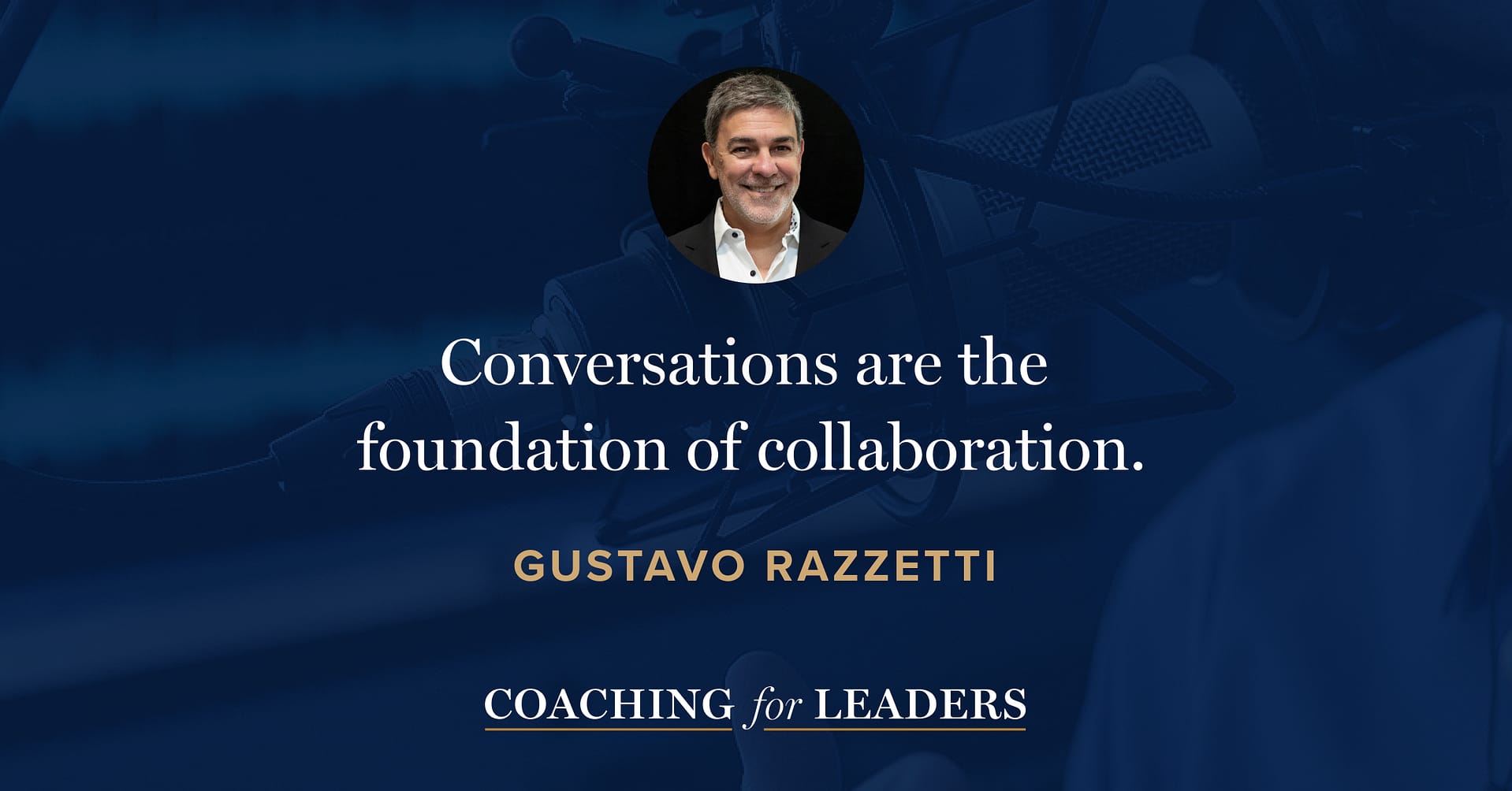
Conversations are the foundation of collaboration.
https://media.blubrry.com/coaching_for_leaders/content.blubrry.com/coaching_for_leaders/CFL782.mp3

Podcast: Download

Follow:
Apple PodcastsYouTube PodcastsSpotifyOvercastPocketcasts

Gustavo Razzetti: Forward Talk

Gustavo Razzetti is a culture change instigator, speaker, and
CEO of Fearless Culture, a culture design consultancy. He helps
leaders build teams that talk about what matters—even when it’s
uncomfortable–through his books and tools, including the Culture Design Canvas. He is the author of Forward Talk: The Bold New Method for Getting Teams Unstuck (Amazon, Bookshop)*.

The beauty of a team is that we can get so much more done with collaboration. It also means that sometimes we surrender our responsibility to others. In this conversation, Gustavo and I explore what to do when a team gets stuck.

Key Points

  • Conversations are the foundation of collaboration. Without them, teams quickly build conversational debt.
  • We don’t stay silent because we’re scared. Rather, we stay quiet because we surrender our responsibility to others.
  • Many of us overestimate our courage. We believe that we’ll say something, but studies show that often we do not.
  • Forward Talk accomplishes two things: (1) addresses the real issue and (2) focuses on the future.
  • See information as an opportunity instead of an obstacle. Courage can begin with admitting what you don’t know.
  • Perspective is the choice to share your views instead of surrendering your judgment to social pressure.
  • Responsibility is a commitment to understand the systemic issues instead of entering into blame.

Resources Mentioned

  • Forward Talk: The Bold New Method for Getting Teams Unstuck by Gustavo Razzetti (Amazon, Bookshop)*

Interview Notes

Download my interview notes in PDF format (free membership required).

Related Episodes

  • Getting Better at Internal Communication, with Roy Schwartz (episode 687)
  • Help Your Team Coach Each Other, with Keith Ferrazzi (episode 709)
  • What Really Matters for Team Success, with Colin Fisher (episode 748)

Discover More

Activate your free membership for full access to the entire library of interviews since 2011, searchable by topic. To accelerate your learning, uncover more inside Coaching for Leaders Plus.
How to Help a Team Get Unstuck, with Gustavo Razzetti

Download

Dave Stachowiak [00:00:00]:
The beauty of a team is how much more you can get done with collaboration. It also means that sometimes we surrender our responsibility to others. In this episode, what to do when a team gets stuck. This is Coaching for Leaders, episode 782.

Dave Stachowiak [00:00:20]:
Production Credit: Produced by Innovate Learning, Maximizing Human Potential.

Dave Stachowiak [00:00:28]:
Greetings to you from Orange County, California. This is Coaching for Leaders, and I’m your host, Dave Stachowiak. Leaders aren’t born, they’re made. And this weekly show helps leaders thrive at key inflection points.

Dave Stachowiak [00:00:42]:
One of the biggest inflection points that so many of us face in our leadership inside of organizations is how do we help a team to move forward? And specifically, how to help a team get unstuck. There’s lots of reasons that teams get stuck, and a big piece that tends to get in our way is communication and conversation, or the lack thereof. Today, a conversation about how we can do a better job at helping teams get unstuck by looking at some of the conversations that we can influence and inspire inside of our organizations. And I’m so glad to welcome back an expert who’s been on the show before, who’s done so much work on this, will help us to really think about how we can get our teams unstuck. I’m pleased to welcome back Gustavo Razzetti, and he is a culture change instigator, speaker, and CEO of Fearless Culture, a culture design consultancy. He helps leaders build teams that talk about what matters, even when it’s uncomfortable, through his books and tools, including the Culture Design Canvas, which we’ve featured on the show previously. He is the author of Forward Talk, The Bold New Method for Getting Teams Unstuck. Gustavo, always a pleasure to be in your work. Welcome back.

Gustavo Razzetti [00:01:54]:
Likewise, Dave. Super excited to be here.

Dave Stachowiak [00:01:57]:
There’s a line in the book that I highlighted the minute I saw it, and the line says: Conversations are the foundation of collaboration. And the reason I highlighted it is because it just struck me when I think about all the conversations I have with leaders and listen to the challenges, and also the successes with teams, that just strikes me as so unbelievably true.

Dave Stachowiak [00:02:23]:
And it’s also where a lot of times we get hung up, and one of the things you surface for us in your work is something you call conversational debt. Could you explain what that is and why does it get us into trouble, specifically with teams?

Gustavo Razzetti [00:02:40]:
Totally. The same way, I mean, people talk in the technical space, technical debt, but something more close to people is financial debt. Right? If you don’t pay your credit card statement if you don’t pay your mortgage, you start accruing interests. Well, the same happens with the conversations we don’t have. So whether because we don’t want to talk about it or because we dance around the issue, so the things that we avoid addressing as a team starts piling up, and just like financial debt, it starts piling up interest, and that harms trust, collaboration, and most importantly, results. So people tend to think that, oh, I’m not going to talk about that because it’s difficult. And they think that silence, basically, it’s the easy way out.

Gustavo Razzetti [00:03:31]:
But silence is not cheap. Not only you don’t solve the issue, but actually not solving the issue, the issue makes things even worse.

Dave Stachowiak [00:03:42]:
And of course, we’ve all done it, right? Like, we’ve all made the choice to stay silent, and because it feels, quote, unquote free in the moment. But of course, it adds up, as you point out. And you also said something a moment ago, which reminded me of one of the other things that really shows up in the research you’ve done. That we all know that people don’t say things because of fear, and at least I think we know that because one of the things that you’ve done when you’ve looked at the research on this, yes, fear is there, and it is a stopping point, particularly when people are asked about others. And what stops people from having conversations that really matter, that need to be have it. Oftentimes, people cite fear. But you uncovered an even more significant factor, especially when you ask people themselves, what is it that is stopping you from having conversations? Could you, could you share that?

Gustavo Razzetti [00:04:38]:
Sure. If the idea is what I call the pointlessness paradox, right? On one hand, we’ve been taught, and I’ve been working with psychological safety a lot, so with different teams for the past few years, seven, eight years in total, and we usually try to fix the fear problem. If people are afraid of speaking up, they’re not going to share their best ideas, they’re not going to ask the right questions. We’re going to miss important information. However, my research, I ask people two things, right? On one hand, why do you think other people don’t speak up? And when it comes about guessing why people don’t do that, 73.5% think that other people don’t speak up because of fear. But I’m asking, why don’t you speak up? Fear goes down to 30%. The number one reason is because people think things won’t change, so it becomes pointless. Nothing’s going to change.

Gustavo Razzetti [00:05:39]:
And this is about, if I talk to my boss, he’s not going to take my feedback. If I push back on an idea, my team members are going to get defensive. So nothing’s going to change. And that’s the number one reason where people stop speaking up. Another factor, going back to psychological safety, we think about the context being critical. It is, but it’s not the only factor. And I uncover like three different groups. There are people, I call them personality-driven contributors, that regardless of the environment, you can be working a safe place in an unsafe place, or anywhere in between.

Gustavo Razzetti [00:06:19]:
Those people are always going to speak up. There’s another group that are more sensitive to the environment, and depending on the safety signals, they might or might not share their ideas, or be honest, or ask questions, or push back. However, there’s a third group that are avoiders, that whether it’s a safe culture or an unsafe one, they’re never going to be either honest or raise a red flag or ask challenging questions. So in the end, the impact of the conversations or the perceived impact of our conversations matter most whether we participate or we disengage.

Dave Stachowiak [00:07:03]:
You write on this we don’t stay silent because we’re scared, rather we stay quiet because we surrender our responsibility to others. And I was thinking about that, and the result is the same, as people stay silent, but the underlying stopping point is very different. And what is significant about thinking about this through the lens of feeling like something’s pointless versus through the lens of feeling like, oh, I’m, I’m just feeling like I’m afraid?

Gustavo Razzetti [00:07:39]:
Great question. I think that it’s about understanding the consequences. When we put all the emphasis, I’m not saying that fear doesn’t matter, I’m not saying is maybe as important as we used to think. When we think it’s about the context and about fear, we are surrendering whether we engage or not in what other people do. When it’s about making sure that we’re going to create an impact, so basically, if I say something, things are going to change, we have to own the conversation.

Gustavo Razzetti [00:08:15]:
Yes, there are risks, you can be ignored, you can be punished, or maybe you sacrifice a reputation, whatever that is, and nothing changes. But still, you tried. The thing is, what I’ve been working with teams for many years is that if you don’t speak up, things are not going to disappear. The issues are not going to disappear. But if you engage, there’s a bigger chance that something’s going to change, or you might realize, well, in this team, nothing might change. So maybe I want to move on somewhere else. So that sense of ownership, ownership, you’re part of the problem. So if you want things to get better, you also need to contribute.

Dave Stachowiak [00:08:55]:
Indeed. And it just reinforces that analogy of debt and pointlessness that you mentioned earlier, that it’s almost like the avoidance becomes self-reinforcing over time. It’s like the debt spiral we think about financially. It’s so true with this, too, isn’t it?

Gustavo Razzetti [00:09:13]:
It becomes self-reinforcing because on one hand I say, I don’t, I’m not going to engage. And then nothing changed. And so you think, well, you see, what’s the point? And what’s the point? And then at some point you, you, you become part of the problem. When we talk about debt financially, it’s easy to spot the consequences, the interests you have to pay if you don’t take charge, if you don’t get in charge of your own financial management. Right? So you may not fix all your debt, but you can stop spending in certain areas and start finding some kind of a recovery. With teams, one of the things I realized is, we need to make more evident the impact of not speaking up, the impact of not surfacing disagreement. One thing that’s important when we talk about fear, we usually think about conversations that are difficult.

Gustavo Razzetti [00:10:08]:
Right? In a very difficult environment, maybe my leader is not open-minded. They’re not going to be willing to listen to a conflicting viewpoint. However, there’s also one manifestation in very nice cultures that people don’t challenge groupthink because they think that’s gonna harm the team spirit, harmony, so they stay quiet. And one thing I notice is that when we are in the room we looked at, everyone agrees, so everyone’s happy.

Gustavo Razzetti [00:10:40]:
We all are on the same page, that’s great. But then when people leave the room, that’s where misalignment happened, because actually we never had that conversation. We just went along with it.

Dave Stachowiak [00:10:54]:
Yeah, indeed. And there’s another piece of this that you highlight in your work that I think is also significant, that we tend to overestimate our courage. And I think, when I think about the debt aspect of this, of conversations, I think a lot of times I know I’ve made this thinking error of oh, we have this conversational debt that’s emerged and we need to, I need to be a little, have a little more courage to enter into a conversation in a team conversation, or a meeting or whatever the venue and oh, I’m going to do that next time. I’ll say something next time in the next, next interaction, in the next all hands, in the next one-on-one session. And it seems really easy to say that to yourself, at least for me. And I think about like overestimating our courage. But then in the moment, a lot of times we don’t necessarily follow through on that. And it’s a bit, it’s a bit self-reinforcing too, isn’t it?

Gustavo Razzetti [00:11:52]:
It is indeed. There are many. I use some research that talks about people. 95% of people say that they would confront someone cutting the line. Or nurses that say that they will speak up if doctors do X, Y and Z, and then they never do. Or workers, also 93% that won’t report safety issues at work, right?

Gustavo Razzetti [00:12:17]:
So on one hand, we say we will participate, we will engage, we will say something, but then we don’t. And this is not that, because we lack courage, but I think that we don’t trust our courage. I think courage is a personality trait. I mean, not only I think, there’s a lot of research that shows that, but also it’s a trait that can be developed. In the workplace, particularly working with teams, is that people surrender their courage to the organization. Right? I work a lot on culture, and it’s like people are expecting for the right conditions to do something, but the point is those conditions never show up. So what are you going to do? Financially speaking, if you’re waiting for the right moment to invest, that’s because you are trusting for the right moment to come. However, if you continue spending or overspending, or if my wife continues overspending, then we’re contributing to that.

Gustavo Razzetti [00:13:19]:
So our actions have an impact, and we need to become more aware of those and take care of those, as well.

Dave Stachowiak [00:13:26]:
Yeah, indeed. And one of the things that really gives me so much hope is, we can get better at this. Courage is not an on-off switch. Right? It’s something that we’re always working on. Leaders aren’t born, they’re made, right? Like we’re always working on getting better at this and we can get better at it.

Dave Stachowiak [00:13:42]:
And that’s what I love about the model that you’ve outlined in your work of, forward talk of, okay, how do we break this tendency, this cultural norm that a lot of us have? Because it feels like pointlessness in a team to speak up, to have that courage. And you say that forward talk accomplishes two things: It addresses the real issue, and it also focuses on the future. Could you paint the picture of what that looks like?

Gustavo Razzetti [00:14:14]:
Totally. I’m going to invite your listeners to imagine a two-by-two matrix. Right? Where those two axes basically craft not only where forward tog is, but also where the three enemies of effective conversations, right? So conversations can focus on the future, so what we want to accomplish, or they can focus on the past, what never happened, what we did wrong, mistakes we committed as a team. And on the other hand, the other axis is about addressing the issue or ignoring the issue. Right? Focusing more on the symptoms or actually dancing around it. That give us four quadrants, and we have on the top right, forward talk to your point, which is when we address the issue and we focus the energy of the team in resolution, in commitment, in moving forward. The other three elements are avoidance, blame, and groupthink. So blame happens when we get stuck in something that happened in the past.

Gustavo Razzetti [00:15:19]:
We cannot get over it, and we look to blame a colleague, our leader, the company culture, another department for something that went wrong. We get stuck, we discuss the issue, but we never try to see what we can learn, what we can do better to move forward. Groupthink, as I mentioned earlier, is when a team decides to either pretend that they agree or put harmony and the relationships before or on top of the idea, the outcome. So everyone feels happy, everyone feels okay, but in the end, we’re not having those conversations. We’re moving forward, but not necessarily solving the problem. And those issues are going to continue to appear and resurface.

Gustavo Razzetti [00:16:11]:
Lastly, avoidance, it’s an issue in itself, but also the consequence of the other two elements. So I can avoid a conversation because I think nothing’s going to change, and that’s about it. But the more blame and group thing that come to play, the more prone I am to also avoid conversations. So it’s a system that basically feeds off each other.

Dave Stachowiak [00:16:33]:
I’m thinking about the two elements that you just highlighted, of thinking about this two-by-two of the importance of time orientation, right? Is this a future conversation, or is this what went wrong in the past? And also the issue engagement aspect of it, right? Is this like the root cause, or is this just like symptoms, side topics, that kind of thing? And I’m curious about both. And maybe we look at the issue engagement piece first of really the, the opportunity here, and where of course we want to focus on is how do we get to the root cause versus getting caught up in symptoms, you know, things that aren’t pertinent really to the core issue. And I’m wondering when you see a team and a leader who really like, starts to change their language in team conversations, and is thinking more forward talk and talking that way, what is different about their language, if they’re getting to the root cause versus the noise, the symptoms, the things that aren’t really core to the issue?

Gustavo Razzetti [00:17:43]:
Yeah, great question. First of all, the things that comes to mind, I’m trying to connect not only research, but recent experiences working with teams, is they don’t take things for granted, and they don’t try to identify the problem too quickly. Sometimes in the workplace, we are trained to move too quickly, and that’s great, speed matters. But when it comes to understanding what’s the real problem, and you rush because you want to jump into the solution, maybe you’re fixing, or you end up fixing symptoms. So the other thing is about asking questions. Instead of trying to show other team members that they’re right or wrong, it’s tell me more about that. I want to understand asking why, however many times you want to ask why, to get into the what’s the real root cause? And lastly, it’s about seeing information not as an obstacle, but as an opportunity.

Gustavo Razzetti [00:18:46]:
So, when I contrast backward talk with forward talk, backward talk is when people get stuck in something. For example, we tried that before, and it didn’t work. And that feels that it’s absolute, you cannot do anything about it. That feels like a truth that we cannot change. However, when you say, okay, what can we do today, based on the current conditions, to make it work? You’re turning that obstacle into an opportunity. For example, we don’t have budget for that, well, what can we do with the budget that we have? Or how can we find funding for this project that we think is relevant for the team? So you reframe the obstacle into an opportunity.

Dave Stachowiak [00:19:29]:
I am just so struck by, by how often the behavior that comes up for leaders, and I see this in my interactions with our members regularly, is the difference it makes when someone, and especially someone who’s, who has power in some way, because they’re a manager, because they’re leading a team, because they’re facilitating the meeting. What a difference it makes when there’s a second question, or a third, that they don’t take the first thing that was said at face value. And I hear that invitation so strongly in what you just said that to get to what the root cause is, like asking that question, asking those whys, really getting curious, and not just assuming the first thing that’s heard is really the thing. And how much, even if you don’t get to the root cause in that, it so demonstrates the, the desire of that person and that conversation to go beyond the surface Stuff. And it sets the tone culturally, as of course, you do so much work on it, sets the tone culturally for doing so much better and having healthier conversations.

Gustavo Razzetti [00:20:37]:
Totally. You asked about courage earlier. Right? And I think that one of the biggest signs of courage is the willingness to admit that you don’t know or that you don’t have all the answers. So leading doesn’t mean being right, it means being curious about finding the right answer. And that probably is not going to come. You’re not going to be the one who comes up with the answer.
Your team is. That’s why you’re paying them a lot of money as well, right?

Dave Stachowiak [00:21:07]:
Yeah, indeed. Okay, so that other essential element is the time orientation, right? Like forward talk, no surprise from the name, is focused on the future. It’s the, what’s happening next, it’s how do we resolve, it’s not dwelling on what went wrong in the past.

Dave Stachowiak [00:21:25]:
And I think most of the time when we hear something like that, we think intellectually, like, oh, okay, that makes sense. I do want to be forward-thinking. I don’t want to like, rehash the past. I don’t want to blame people for the past. But then in reality, as you and I see a lot, when we actually get into conversations, how quickly we do often get into the what happened in the past, what went wrong, where are we pointing fingers kind of behavior. And I’m curious, when you see a leader who’s able to turn the corner on this, and get people thinking more about the what’s next, what’s happening in the future, what’s significant about their language that shifts, that really does get people thinking about the future orientation?

Gustavo Razzetti [00:22:05]:
The thing about the orientation, I think that you, you, you got it perfect in the sense that the model, intellectually, it’s easy to get. Everyone wants to move forward, everyone wants to make progress.

Dave Stachowiak [00:22:17]:
Yeah.

Gustavo Razzetti [00:22:18]:
However, our brain doesn’t work like that. So, especially in leadership positions, people want to win an argument. Right? And when you discussed the past, there’s always going to be a winner, and there’s always going to be a loser. Right? Someone screwed up, someone came and saved the day. So this opens the possibility for this heroic mindset that leaders basically want to solve all the issues or the problems that their teams created. So when it comes to move forward, the questions are more about what’s possible, what have we learned? So it’s about getting over things.

Gustavo Razzetti [00:22:58]:
I’m thinking about, I started working with a team that did the executive team, right? And most of the leaders have been in that organization for over a decade. So you would assume that people trust each other, that they know really well, etcetera. And we started doing a couple of exercises related to trust, right? I asked him to share with each other, I trust you because, and give them a reason.

Gustavo Razzetti [00:23:21]:
And also, I would trust you more if… So that was a request. So if you start doing X, Y, and Z, I would start trusting you more. And it was interesting, the level of conversation that opened up. People were carrying frictions, grudges, a lot of stuff from maybe five, seven, even ten years ago, that they never had a chance to discuss. So, sometimes we need to empty that bag or that backpack to make room for new things. We need to empty our regrets, our frustrations, our remorse in order to open our minds to the future. I think that’s something that I see a lot.

Gustavo Razzetti [00:24:00]:
People cannot make room to project those relationships into the future when they’re not willing to let go of what happened in the past with those team members.

Dave Stachowiak [00:24:10]:
Boy, there’s two big things that are coming up for me in what you just said in the last few minutes. One of them is, so many of us who have leadership roles are people who are very tuned to high achievers. We love to have accomplishments, we love to win. And how that’s a really great strength until it isn’t. And where it gets in the way is feeling like we need to win, we need to be right. And even though we don’t intend to project that onto a team, being willing to just set that aside, especially in a team conversation, especially when doing, thinking about forward talk, like, hey, I don’t need to win in this conversation, I don’t need to be right. What I’m trying to do is help the team move forward. And then the other piece of it is, what you just said of, hey, sometimes there’s a lot that’s there for years that’s been built up.

Dave Stachowiak [00:25:04]:
And there’s something that is helpful sometimes of spending some time unpacking that, even before you get to go further. And one of the things I love, by the way, in the book, there’s a whole chapter toward the end of the book of exercises for teams that you have been doing for years, and like really detailed out. I’m often asked by leaders, like, how do I, I’m doing an off-site, I’m doing an all-hands meeting. What would be an exercise I could do in order to help that? And there’s so many in the book that really are useful for that. So I hope people will, we’ll take our invitation to go get the book, just to use that as a starting point. So let me ask you about courage, too, because it’s part of, we’ve had the word come up a few times in this conversation, and one of the beautiful models you mention in forward talk is something you call CPR: Courage, perspective, and responsibility.

Dave Stachowiak [00:25:55]:
But it does start with courage. And what does that look like? Like, we kind of all know a little bit of what courage means, but what does it really look like in practice when we take that first step?

Gustavo Razzetti [00:26:06]:
Courage, basically, is about owning the consequences of your actions, but also of your inaction. I always said that inaction is not harmless. So if you don’t do anything about a situation, you’re also part of the consequences of that inaction. One thing that I learned in my career and early on is that someone, I mean, whether it’s because of personality, whether it’s because of values, being consistent with who we are and what we believe in, then we need to take a stand. And when we see that maybe a colleague is not being treated properly or respectfully, or maybe we’re about to make a decision that’s going to harm the team, or even the organization, that we have our part, we need to contribute to save the company from making that mistake.

Gustavo Razzetti [00:27:01]:
And I’ve seen a lot of people that they realize that the company is about to make a decision that’s really harmful and so evident. But no one wants to be the first to take the step and raise the flag. Why? Because no one else is doing so. Courage is about saying, well, it’s my chance. Why me? Don’t wait for someone else to do something. If you see something, do something. Well, that’s exactly, for me, it’s not about being brave or heroic or having a special superpower.

Gustavo Razzetti [00:27:31]:
It’s about owning your part. And I think that it’s something that I’ve been experiencing in life, not just at work. And the moment we realize that, we take our chances.

Dave Stachowiak [00:27:42]:
It comes up fairly regularly in conversations I have with leaders, Gustavo, in people asking some version of the question. I see my boss, executive leadership team, insert person with power here. I see them about to make a mistake, and I’m not sure, like, what they’re going to do if I were to raise this issue, like, how they’re going to respond. I’m not sure if they’re going to really take, kind of gets to the pointlessness paradox, right? And it’s feeling like I don’t, I’m not, I don’t really trust that they’re going to do anything if I said something, so why bother? But should I say something? And someone taught me this years ago, and I don’t remember who it was, but someone made the distinction of, it’s not your responsibility to fix all the problems, but it is your responsibility to say something.

Dave Stachowiak [00:28:38]:
And I found that that has been helpful for me in situations like this with courage to say, I don’t know what the person with power or stakeholder, client, what, whoever it is, I don’t know if this is going to change their behavior. I don’t know if this is going to cause them to make a different decision. But what I do know is that I have a responsibility to say something if I see a train wreck coming. And I found that that, oftentimes is just enough to, like, say the thing that needs to be said that’s courageous. And then people either do or don’t do something with it. And that’s the part that I don’t have control over, someone else doesn’t necessarily have control over. But I found that that’s helpful. And what’s interesting, and you point this out in your work too, is if you can just get to the point of just saying something that needs to be said, it is interesting how often that does start to influence change, and people thinking about things, and changes the culture of how people show up.

Gustavo Razzetti [00:29:31]:
Totally. And it’s also connected with regrets. Right? Daniel Pink did a huge research about regrets.

Dave Stachowiak [00:29:39]:
Yes.

Gustavo Razzetti [00:29:40]:
And that applies to conversations. We don’t regret the conversations we had, even if they go wrong and totally wrong, and maybe you get fired or whatever. What we regret are the ones that we never had. So in the heat of the moment, you feel safe, or you feel okay, or you feel, you know what, nothing’s going to change, so why participate? But when things go wrong, and you think, oh, my God, I should have said something about it, no one’s going to take that regret away from you. And that’s the most important thing that we learn, and sometimes, when we are too old, that if you don’t participate, you’re also part of the problem.

Dave Stachowiak [00:30:22]:
Indeed. Okay. CPR, Courage, perspective, responsibility. We talked about courage. What’s significant about perspective? That second part. And how is it different than courage?

Gustavo Razzetti [00:30:35]:
Courage is about acting, and perspective is what you bring when you act. Courage is about crossing that line between being a bystander, or being a protagonist, being a team member. Because actually, if a team member needs to be active, we don’t want someone in the team that doesn’t want to speak up their truth, whether they’re right or wrong, doesn’t matter. But we don’t want silent participants, that they’re watching the game, and they have ideas of how we can improve the game. And instead of helping us, they stay on the sidelines. Now, perspective is about what’s your point of view? We know the world is complex, and we need people who can see reality through different lenses. I’m not talking only about expertise, but I’m talking about personalities. We’re talking about roles, some people that might be more critical, people that might be more creative in terms of what’s the perspective that you’re bringing to the problem that can help us all.

Gustavo Razzetti [00:31:35]:
The sum of all those perspectives can get us see a more interesting way. And also to your point, to get to the what’s the real root cause? In order to uncover the root cause of our problem, we need different experts, we need different perspectives to understand what’s going on.

Dave Stachowiak [00:31:52]:
And then that leads to responsibility. And you say this is the commitment to understanding what went wrong systemically, instead of surrendering to the blame game. And I think that word systemically is really key when thinking about responsibility here.

Gustavo Razzetti [00:32:11]:
Totally, we talk about a lot about culture, right? And culture is something that we all build. And if you’re a team member, you’re part of the culture, so you are responsible for making it better. So it’s not that you- courage, it’s individual responsibility, is your commitment to the team. Not only you do it because you are brave or you’re taking the initiative, but that’s what’s expected. So it becomes an expectation. That’s something I work a lot with teams to set up. If you don’t contribute, if you don’t share your point of view, if you don’t challenge our thinking, if you don’t make our ideas better, then you’re not being a good team member. A good team member is not just about being nice.

Gustavo Razzetti [00:32:55]:
It’s about elevating the quality of ideas, the quality of the questions, even if it feels uncomfortable. But in the end, we care more about the outcome than just keeping it safe.

Dave Stachowiak [00:33:08]:
I so appreciate your invitation to help us elevate. And it’s just- we all run, even the most healthy teams get stuck and run into these patterns. And by doing a little bit of starting to think about the dynamics we’ve talked about, of thinking about time orientation and really getting to the core issue, and starting with courage, a little bit of that can go a long way to reset the team dynamics. So I hope folks will get the book because, in addition to a lot more that’s in the book that we haven’t covered, there’s tons of exercises, resources, so I hope folks will check that out. Gustavo, I have one last question for you. As you think about just your work that you’ve been doing with teams, you’ve been doing this work for many, many years, have written many books. In the last year or two, as you’ve put this book together and thinking about forward talk and inviting leaders to be more intentional here, what if anything, have you changed your mind on?

Gustavo Razzetti [00:34:05]:
Many things, but one of the things that comes to mind is that I’ve been working in promoting psychological safety and helping teams doing so. And I think that I went to the extreme, like many other people, focusing too much on the environment. And I’m not saying that’s not important, but I now learned that there are the elements that we need to work on. And sometimes waiting for the perfect situation, the perfect moment, the perfect environment, then we lose the opportunity. So rather than waiting for the perfect moment, we need to create the moment by acting.

Dave Stachowiak [00:34:45]:
So important for us just to get started. Gustavo Razzetti is the author of Forward: The Bold New Method for Getting Teams Unstuck. Gustavo, thank you so much for your work, and sharing it with us.

Gustavo Razzetti [00:34:59]:
Absolutely. Thank you, Dave, for hosting me.

Dave Stachowiak [00:35:08]:
If this conversation was helpful to you, three other episodes I’d recommend. One of them is episode 687: Getting better at internal communication. Roy Schwartz was my guest on that episode. One of the co-authors of Smart Brevity, Roy talks about the challenge that so many of us have in our organizations. How do we communicate well within our team? How do we communicate well between teams and throughout our organization? Oftentimes, we think about communication and getting a message out, and marketing. We’re thinking about it through the lens of external stakeholders, which of course, are very important. We don’t often think about, what are the right strategies and tools to be able to communicate well internally? Roy walks us through that step by step, gives us a number of tactics and tools we can utilize. Episode 687, if that’s on your mind right now.

Dave Stachowiak [00:35:53]:
Also recommended episode 709: Help your team coach each other. Keith Ferrazzi was my guest on that episode. Keith’s been on several times over the years. The author of Never Eat Alone and so many other books, Keith talks about the challenge and also the opportunity of getting your team to actually coach each other. Oftentimes, when we think about coaching and feedback, we’re thinking about it only in the direction of the manager giving coaching or feedback to the employee, or managing up. We don’t often think about it within a team. How to set the culture and environment where a team can not only feel safe to do that, but do that effectively. Episode 709 on where to start there. And then I’d also recommend episode 748: What really matters for team success.

Dave Stachowiak [00:36:40]:
Colin Fisher was my guest on that episode. We talked about three of the key things that matter a ton in how successful a team is. And the biggest and most important one is what happens before a team even starts. How you put together the structure of the team, who’s involved, the expectations, so many things in advance that the research says make a huge difference in our team’s success. Oftentimes, we don’t think about that at all. Episode 748, for a lot more there. Those great compliments to this conversation, and if you’re looking for more resources, I’d invite you to go onto the coachingforleaders.com website and set up your free membership. Because one of those resources you’re going to get access to is, every single week, my Focus 5 message.

Dave Stachowiak [00:37:24]:
I send a message to you on email each week, it’s titled Focus 5. It is five things for me that I think will be most helpful to you right now, to drive your leadership development. Just recently, I surfaced five videos that I have found that I think are essential for leaders to listen to on all kinds of topics. How to introduce yourself well, how to handle email better. How to think about leadership versus management. It’s one of the many messages I’ve sent out recently. Watch for that each week.

Dave Stachowiak [00:37:51]:
You can get access to it by setting up your free membership at coachingforleaders.com. Coaching for Leaders is edited by Andrew Kroeger. Next Monday, I am tackling a topic that’s a reality for a lot of us, which is, as leaders, we have a full day of work, a busy day. We often then stop work and maybe have dinner, spend a little time with our loved ones, and then some of us go back to work before we go to bed at night. I think we’ve all done that. Some of us do it a lot regularly. Next week I’m glad to welcome Guy Winch to the show. We are going to be talking about how to take back your evenings. Join me for that conversation with Guy, and see you back next week.

Topic Areas:ConversationTeam Leadership
cover-art

Coaching for Leaders Podcast

This Monday show helps you discover leadership wisdom through insightful conversations. Independently produced weekly since 2011, Dave Stachowiak brings perspective from a thriving, global leadership academy of managers, executives, and business owners, plus more than 15 years of leadership at Dale Carnegie.

Listen Now OnApple Podcasts
  • More Options
    • YouTube Podcasts
    • Spotify
    • Overcast

Activate Your Free Membership Today

Access our entire library of Coaching for Leaders episodes from 2011, searchable by topic.
Listen to the exclusive Coaching for Leaders MemberCast with bonus content available only to members.
Start Dave’s free audio course, 10 Ways to Empower the People You Lead.
Download our weekly leadership guide, including podcast notes and advice from our expert guests.

... and much more inside the membership!

Activate Your Free Membership
IMAGE
Copyright © 2026 · Innovate Learning, LLC
  • Plus Membership
  • Academy
  • About
  • Contact
  • Dashboard
×

Log in

This site is protected by reCaptcha and the Google Privacy Policy and Terms of Service apply.
 
 
Forgot Password

Not yet a member?

Activate your free membership today.

Register For Free
×

Register for Free Membership

Access our entire library of Coaching for Leaders episodes from 2011, searchable by topic.
Listen to the exclusive Coaching for Leaders MemberCast with bonus content available only to members.
Start Dave’s free audio course, 10 Ways to Empower the People You Lead.
Download our weekly leadership guide, including podcast notes and advice from our expert guests.

... and much more inside the membership!

Price:
Free
First Name Required
Last Name Required
Invalid Username
Invalid Email
Invalid Password
Password Confirmation Doesn't Match
Password Strength  Password must be "Medium" or stronger
This site is protected by reCaptcha and the Google Privacy Policy and Terms of Service apply.
 
Loading... Please fix the errors above