• Skip to primary navigation
  • Skip to main content
  • Skip to primary sidebar

Coaching for Leaders

Leaders Aren't Born, They're Made

Login
  • Plus Membership
  • Academy
  • About
  • Contact
  • Dashboard
  • Login
Episode

790: How to Help a Team Flourish, with Daniel Coyle

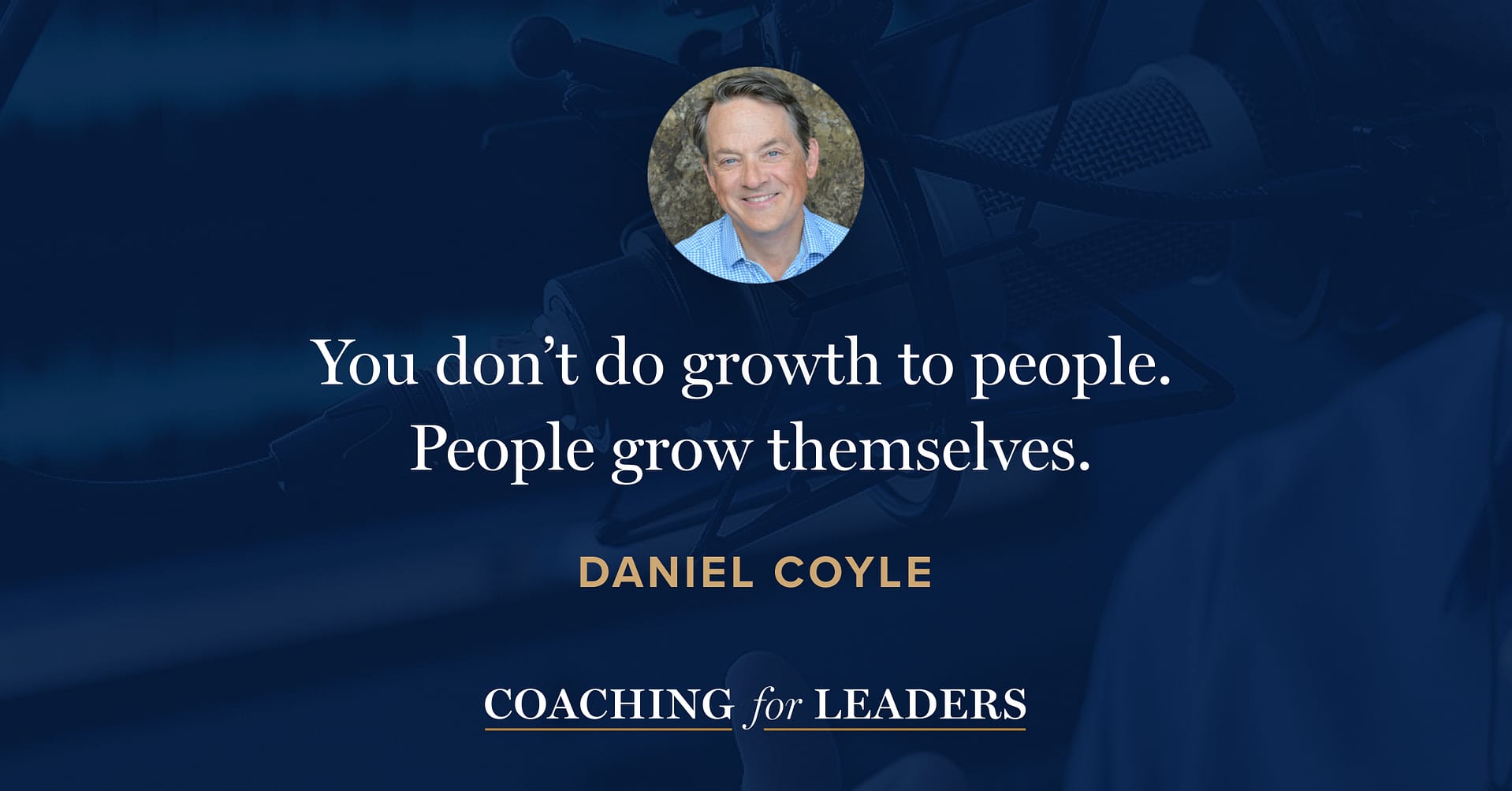
You don’t do growth to people. People grow themselves.
https://media.blubrry.com/coaching_for_leaders/content.blubrry.com/coaching_for_leaders/CFL790.mp3

Podcast: Download

Follow:
Apple PodcastsYouTube PodcastsSpotifyOvercastPocketcasts

Daniel Coyle: Flourish

Daniel Coyle is the New York Times bestselling author of The Culture Code, which was named Best Business Book of the Year by Bloomberg, BookPal, and Business Insider. He has served as an advisor to many high-performing organizations, including the Navy SEALs, Microsoft, Google, and the Cleveland Guardians. His newest book is Flourish: The Art of Building Meaning, Joy, and Fulfillment (Amazon, Bookshop)*.

When teams really thrive, it isn’t about luck or simply optimizing systems. Instead, it’s about intentionally creating spaces for connection, agency, and shared growth. In this conversation, Daniel and I discuss where to begin to help a team flourish.

Key Points

  • Life (and leadership) is treasure creation, not a treasure hunt.
  • Flourishing environments encourage experimentation, agency, and even mistakes, allowing ownership and innovation to thrive.
  • If leaders think like designers, using questions and constraints, they will more likely unlock people’s full potential.
  • Simple acts such as little “thank you’s” build psychological safety and lay the foundation for flourishing groups.
  • Some of the world’s greatest innovations emerged from environments that welcomed surprise, cross-pollination, and flexibility.
  • Value the art of asking good questions over having all the answers.

Resources Mentioned

  • Flourish: The Art of Building Meaning, Joy, and Fulfillment by Daniel Coyle (Amazon, Bookshop)*

Interview Notes

Download my interview notes in PDF format (free membership required).

Related Episodes

  • What Innovative Leaders Do Differently, with Linda Hill (episode 774)
  • How to Help People Flourish, with Marcus Buckingham (episode 778)
  • The Counterintuitive Secret to Creativity and Focus, with David Epstein (episode 789)

Discover More

Activate your free membership for full access to the entire library of interviews since 2011, searchable by topic. To accelerate your learning, uncover more inside Coaching for Leaders Plus.
How to Help a Team Flourish, with Daniel Coyle

Download

Dave Stachowiak [00:00:00]:
When teams really thrive, it isn’t about luck or simply optimizing systems. Instead, it’s intentionally creating spaces for connection, agency, and shared growth. In this episode, where to begin to help a team flourish. This is Coaching for Leaders, episode 790.

Dave Stachowiak [00:00:22]:
Production Credit: Produced by Innovate Learning, Maximizing Human Potential.

Dave Stachowiak [00:00:30]:
Greetings to you from Orange County, California. This is Coaching for Leaders, and I’m your host, Dave Stachowiak. Leaders aren’t born; they’re made. And this weekly show helps leaders thrive at key inflection points.

Dave Stachowiak [00:00:44]:
One of the things that we are charged to do as leaders, and one of the great joys of leadership, is leading teams. So many of us not only lead teams, work with teams, interact with other teams, work within our peer group. So much of our work as leaders is about teams and groups, and we have all had the experience of that not working well. And we’ve all had the experience of that working okay. And not all of us have had the experience of really flourishing in those environments. Today, I’m so glad to be able to have a conversation on how we can help our teams and the groups we work with really flourish. And I’m so pleased to welcome Daniel Coyle to the show. Daniel is the New York Times bestselling author of The Culture Code, which was named best business book of the year by Bloomberg, BookPal, and Business Insider.

Dave Stachowiak [00:01:30]:
He has served as an advisor to many high-performing organizations, including the Navy Seals, Microsoft, Google, and the Cleveland Guardians. His newest book is Flourish: The Art of Building Meaning, Joy, and Fulfillment. Daniel, welcome to the show.

Daniel Coyle [00:01:46]:
Thanks for having me, Dave. It’s so nice to be here with you.

Dave Stachowiak [00:01:48]:
I loved this book. I’ve heard your name so many times over recent years on the Culture Code, and I’ve enjoyed getting into your story. And you talk a bit in the early pages of the book about your parents and how they had passed away relatively close together. And you highlight a quote from one of our past guests, Barry Schwartz, who said, ” People mistakenly think that life is a treasure hunt. And it is not a treasure hunt. It’s more like a treasure creation”. What is it about that quote that got you thinking so deeply about this and this book?

Daniel Coyle [00:02:29]:
Well, I guess partly because I had spent so much of my time on a hunt. I’m a journalist focused on science and performance. And so I’m always, like a lot of people, sort of feeling like that answer is out there. If I find the right thing, if I play life like it’s a game, right? I want to figure out the game, optimize the game, maximize my ability, and win the game. And that’s a hunt. And when I kind of went through that, you know, it’s always a kind of a garden-variety experience in a way, a sort of a crisis that everybody reaches where you get a little bit older and people pass away, and you sort of take a longer look at life and what it’s all about. I think it’s a, you know, between the COVID experience and just life getting older, everything moving along, you sort of reach a point where you sort of ask yourself what’s, what’s it all about? And so I was kind of at that point and realizing that that quote hit me right between the eyes because I hadn’t thought of it as a creation, I hadn’t thought of it as a garden, I had been thinking of it as a game. And that sent me on this journey to go find places that really were creating that treasure.

Daniel Coyle [00:03:32]:
You know, places that were growing, creating joyful, meaningful growth, and creating thriving people. And so it sent me on this five-year journey to find these places and see what made them tick.

Dave Stachowiak [00:03:44]:
And as I mentioned in the introduction, I think some of us have had that experience of being involved with teams and groups and spaces where that has emerged. But it does, unfortunately, seem to be the exception. And sometimes I run into people who’ve really never had that experience of a group that’s flourishing. It requires us to sometimes suspend some of the belief that we have thought about with groups and teams and change our thinking on this a bit, doesn’t it?

Daniel Coyle [00:04:09]:
It really does. I mean, we’re sort of trained in the modern world to see performance and see ourselves as kind of this giant machine, right, that we want to, we want to figure it out, figure out the rules, optimize, maximize, figure out how to accomplish things. And then when we actually, you know, when you do this, when they do these studies of people on their deathbeds, when they look back at their life, or they do studies of fulfillment and joy, what you always find is that it’s not about that stuff; it’s about the relationships you create and the people. And so the fun part of this book was finding these places that were creating this joyful, meaningful growth, which is really the good definition of flourishing. Joyful, meaningful growth, shared. That’s the key. Nobody flourishes alone; nobody thrives alone. We’re kind of wired to become our best selves in and through other people.

Daniel Coyle [00:05:02]:
So finding the little town in Vermont, where they produce all these Olympians and they go back there to live, when their athletic careers are finished. Or finding the little deli in Michigan where they’ve- I met a woman who worked at this deli in Michigan. She had left the Ritz-Carlton in Paris to go work at this bakery. It was such a fulfilling, fun, thriving place to work. And so finding those places and realizing, wait a minute, this isn’t just sort of chemistry and luck, because that’s how we normally think about flourishing. It’s like, oh, you need the right resources, you need to get lucky, and it needs to be just kind of these magical things.

Daniel Coyle [00:05:37]:
And yet, there is a structure beneath it. There are moments, and there are elements that are in place where they’re creating meaning, and then they’re getting into group flow. You know, they’re creating meaning, and then they’re creating something new together. And those are the kind of places when we reflect on our own life, where we find thriving.

Dave Stachowiak [00:05:57]:
That was- that reflects, like, two of the things that were so hopeful for me. Looking at your research and coming away from the book is, on one hand, there are patterns and structures, and we’re going to get in and, of course, talk about a bunch of them in this conversation. The other thing that was really helpful for me is, it’s across industry, demographic, geography. I mean, when you really look at, like, there are examples in civic communities, there’s examples in sports, there’s examples in business, there’s examples in government. And you can do this in so many different places if you are really intentional about putting together the thinking around this and maybe just entering into a little bit of different thinking.

Daniel Coyle [00:06:37]:
The good news is that we’re kind of built to do it, right? The good news is that when these places, that that’s one of the themes in the book, that it’s kind of, it’s kind of right there, ready to happen. And I think that’s for leaders; that’s especially a liberating concept. I think we- a lot of us get trained on the idea that leading is about control, that leading is about building a perfect machine where people can create a specific result, a specific outcome. And the leaders that I met in the course of this book were immensely successful, but they weren’t successful because they controlled. They were successful because they were creating meaning, meaningful connection.

Daniel Coyle [00:07:13]:
And then, because they were creating spaces for people to experiment and explore together and to be messy, it sort of flipped the concept of what it means to be a great leader on its head. For me, it went from being, they weren’t the captain of the ship who understood every bolt and every rivet and every, every movement on the map. They weren’t. They were more like these gardener types who were really skilled at creating spaces where people grew, where concepts grew, where projects grew, where ideas grew, where capacity grew. And the thing about growth is that you don’t do growth to people. People grow themselves.

Daniel Coyle [00:07:53]:
That’s the places, the leaders in these places understood that they were in the connective energy business, not in the build-a-machine business. There’s a place to build clear, to build machines, and to be efficient and to control things very precisely. If you’re in a business where you want to make the exact same widget every single time and deliver it on time and get it to the people on time, yes, but there’s a lot of stuff around leadership that is not about that, that it is about how do I create meaningful connective energy and how do I create space. Places where people can grow themselves, where people are energized, exploring, failing together, fixing together, and creating something new. So those were the kinds of places. And, and for me, that was interesting because it feels like that’s where people come alive. That’s where, when you, when you sort of ask people, where do you feel most alive in your life? That’s the kind of stuff they talk about.

Daniel Coyle [00:08:51]:
And that’s the kind of stuff where you can create something genuinely new as opposed to simply delivering a predictable outcome.

Dave Stachowiak [00:08:59]:
Which leads to one of the big rules you surface from the research. And you said this word a moment ago: mess. And we don’t like to think about leadership, at least I don’t, and we don’t like to think about our organizations as a mess. Right? That’s not a word that typically we associate with leadership. And yet you say that, like, one of the ways that groups flourish is because of the rule of the beautiful mess. Tell me about that.

Daniel Coyle [00:09:26]:
I kept bumping into leaders there that were functioning not as leaders who had the answers, but as leaders who would create questions through design, who would, who would build specific structures that generated these explorative messes, which I call the beautiful mess. And for example, if you go watch the New Zealand All Blacks rugby team, they’re one of the best sports organizations on the planet, and very sustainable success over the last few decades. Every so often, they have the players organize practice for a week. Now, players are not great at organizing practice, right? The coaches are. Right? The coaches have got the clipboards and the whistles, but they, they, they put down their whistles, they put down their clipboards, and for a week the players organize the practice. Is it clean? Is it efficient? Not really.

Daniel Coyle [00:10:14]:
Not really. They try all kinds of stuff that doesn’t work. They make mistakes in planning. They, it doesn’t run nearly as efficiently as it does when the coaches are doing it. And what that does is it creates this level of agency, this level of empowerment, this level of deep connection where the players suddenly are flipped from being obedient responders to what the coach wants, to the owners of the process. They explore, they try new stuff. And the result of that is that when the game comes around on Saturday, they don’t need a pregame speech.

Daniel Coyle [00:10:49]:
The players are absolutely lit up in their agency and their ownership and their understanding of what they’re doing, and in their leadership. And so those leaders who, of that team are succeeding not because they’re leading more, but because they’re creating conditions where people can grow, where they’re creating conditions where people can get a little bit messy. I saw it on a smaller level there’s an, there’s an art teacher named Linda Berry who’s a very masterful teacher. And one of the most masterful things that she does is she pairs a master’s student who’s trying to get a master’s degree in art with a four-year-old. And what happens is, of course, not very predictable, it is not very efficient, it is not very results-oriented. In fact, you don’t know what’s going to happen. It’s this little experiment. But what ends up happening because she’s creating this constraint, this sort of, this connection.

Daniel Coyle [00:11:46]:
The master student kind of rediscovers the joy of art. And the four-year-old is lit up by the possibility of partnering with a full-grown adult. And they create something. What they create is sort of connective energy. And so the rugby team and the art and this little art project are in the exact same business. It’s not about coercing people to get to where you want them to go. It is about creating conditions where they can explore together and fail and make a little bit of a mess, and create something new and own it and have agency. And I think, you know, people deep down are allergic to coercion.

Daniel Coyle [00:12:27]:
People, you can get people to do what you want them to do as a leader; you can get that. But when you actually create conditions where they have agency and ownership, when you create a beautiful mess where they can explore forward, what you’re doing is you’re tapping into way, 10 times the connective energy. And you’re creating the possibility of building something new as opposed to creating something that you kind of already know you can make. So that’s when you look at thriving, when you look at joyful, meaningful growth, what they’re, what they’re doing is they’re using constraints, and they’re using, they’re thinking like a designer, not thinking like an answer man. They’re thinking, what question can I put in this environment? What constraints?

Daniel Coyle [00:13:07]:
And they’re really seeing their organization not as a machine, but as something that’s much more like a river. And when you want to sort of manipulate a river, you, you tilt it a little bit, you, you change the riverbanks, and then you let the river do whatever the river wants to do. And so that’s how they think as leaders, that’s how they design as leaders to say, okay, what are the constraints? What are the river banks? I’m going to put these people together. I’m going to give the players ownership of practice. I’m going to give them a clear horizon to go to. We want to win the game. We want to create some art project. And then I’m going to let whatever happens, happens.

Daniel Coyle [00:13:41]:
And that’s the beautiful mess, when you have constraints, horizon, and agency, you get something new. And even as a parent, I’ve seen that, I’m sure you have some parents out there. And as a parent, I would always sort of walk around the house. We have four daughters, and I would often say the words, “hey, clean your room”, and directing them, coercing them to do that. It turned out didn’t work that great. That is not a great way to get rooms clean, it turns out.

Daniel Coyle [00:14:08]:
And my wife, being smarter than I am, at some point put a list on the fridge of all the chores, and she said, “Hey, I don’t care when you do this, but everybody needs to pick three items on this list and do them once a week”. And next thing you knew, the list was filled out. And the next thing you knew, the house was way cleaner than it was. Not because we, we led them by coercion, not because we led them by treating them like cogs in a, in a machine, but because she tilted the river. She said, hey, here’s the constraint, here’s the horizon, and do whatever you want. Pick it. You guys pick. So that is the kind of thing that I think as, as leaders, it’s, it’s a really powerful insight and liberating insight that you’re not leading machines. You’re trying to tilt the river.

Dave Stachowiak [00:14:55]:
Yeah, indeed. It’s making me think about a conversation we had earlier this year on the podcast with Linda Hill at Harvard. And we were talking about innovation, and we talked a little bit about vision. And she made the point that traditionally we’ve thought about leadership, and what leaders need to do is articulate a clear vision, have as much detail as possible, tell people exactly where you’re going so people know that. And that, as we look at, like, what really works today, that it’s a much different version of that. Yes, vision is still important, of course, but it’s much more… It’s much more what you call like creating this, this North Star, a shared horizon versus dictating exactly how that will look or how that will happen. And by actually putting just a framework around it and creating the space for it, you get into a place where it’s- You have people show up with so much more ownership and autonomy, to your point, by being able to work within that framework versus it all being spelled out.

Daniel Coyle [00:15:54]:
That’s exactly right. The vision is still really powerful, but it’s way more powerful if people co-create it. You know, it’s way more powerful. People are sharing in that and genuinely feeling it. I find vision is a good word to use. Horizon, as you use, is also a good word because you don’t need to be super particular. It’s more directional. Right?

Dave Stachowiak [00:16:14]:
Yeah.

Daniel Coyle [00:16:14]:
We’re just moving toward this direction. And when we get there, we’re going to see things that we couldn’t imagine imagined before. And so this idea that there’s not some concrete, fixed place you’re going, but it’s more of an exploration. And there’s a. There’s a really interesting distinction in this conversation, I think, between complex and complicated things. And that’s one that really, really struck me as I was working on the book. Because those two words we use interchangeably, but in fact, they’re really deeply different dynamics. Complicated things come together the same way every single time, right? They’re a set of leg goes.

Daniel Coyle [00:16:50]:
It’s building a Ferrari, say. If you, I can give you the instructions and all the materials, and if you put them together in the same way, according to, you know, you can write all the instructions on a sheet of paper. You will always get what you want. You will always get a Ferrari. You will. If you have all the materials and all the instructions and you follow them, you will get that. Complex things are different.

Daniel Coyle [00:17:09]:
Complex things are alive. Complex things change when you interact with them. And every leadership journey is not complicated. It’s actually complex. It’s not building a Ferrari. It’s more like raising a teenager, where everything you do changes the interaction with your team. So as a leader, your role isn’t to, sort of, be crystal clear all the time about exactly where you’re headed. Your role is to create a conversation where you can kind of co-create that horizon together.

Daniel Coyle [00:17:42]:
And as you move toward it, understanding that it’s not a straight line, understanding that each of those squiggles and turns in that line toward that horizon is going to teach you something. It’s going to unveil something new. And so this leadership, complexity leadership is really, is really different. It’s more like a craft than it is building a machine. So understanding that different can be really a liberating idea.

Dave Stachowiak [00:18:10]:
Yeah, it’s so interesting you say that because part of what- I think you said the word flow a bit ago, and many of us have thought about flow from Csikszentmihalyi’s work and like, okay, we get in this place where we lose track of time and we’re really engaged in our work. And I haven’t thought about it as much from the concept of a group, though. And when you really think about it from group flow, there’s some really interesting things that emerge, and to the point you just made, a lot of times the things that we think of are not the things that really show up in groups who do this well and are really flourishing. And two of them are things you call looseness and intuition, which again are not the words we often think of when we think of good leadership, good groups. But that opens up a space for some of this to happen. To that point on, it’s really complex, isn’t it?

Daniel Coyle [00:19:03]:
It’s really complex and creating- And there’s a phrase that we’ve returned to a couple of times in this conversation, which is creating space. And it’s funny, I don’t know about you, but I’ve always kind of been allergic to that phrase, Dave. It’s kind of like when someone says, oh, I’m going to create space for you to do this. It sounds really kind of woo woo, doesn’t it? It sort of feels like we’re going to have some, we’re going to burn some incense, and, and through the course of this, that ends up being a really accurate way to think about that process, that space. Because space gives you that looseness and that intuition. You know, intuition has had a hard 10 years or so, right? Intuition has been denigrated by science.

Daniel Coyle [00:19:46]:
And we have this model of, this model of human cognition that is very based in the computer age, right? That, we think like a chip, and we make these decisions, and we have all these biases. But when you really reflect on your own life, when you really look at the top-performing groups, they are intuitive; they are tapped into their intuition. Intuition, it does have mistakes, we do have biases. We do make mistakes about mathematics. Daniel Kahneman would point out we do. We’re bad at estimating complex math problems.

Daniel Coyle [00:20:18]:
We tend to get anchored in what we see. There are problems with bias when it comes to intuition, but intuition is also immensely powerful. And what’s happening with these groups is like what happens in a great pickup basketball team, which is they’re creating space where people can genuinely own what they’re doing and genuinely be aware of what’s around them and respond without thinking to what’s going to happen next. And I saw those kind of spaces created over and over again where we’re not going to sort of treat people like these decision-making computers. We’re going to create space where they can navigate themselves, and we’re going to spark intuition by having a really clear horizon. This is where we’re headed. We all want to, we’re a baseball team. We all want to make our players better.

Daniel Coyle [00:21:03]:
If we’re at Apple, we all want to build beautiful devices. And then we’re going to give people that space to follow their intuition and to explore together and to see what emerges. And so, that looseness isn’t a problem in the system; it’s the core feature of it. To give people that space to make that mess, to have that emergence happen. And if we reflect on our own lives, where we feel the most ourselves, where our biggest breakthrough happened, it’s not in tight spaces where we’re deciding our way forward. It’s in spaces where we’re exploring our way forward along with other people in relationship and seeing something new emerge.

Dave Stachowiak [00:21:43]:
One of the themes that comes up in your research, and it came up in the culture code too, is the importance of what you call small courtesies. What is it that’s significant about that? When we think about teams and groups.

Daniel Coyle [00:21:58]:
Yeah, those small moments, those small courtesies, saying over, saying thank you. I would see that over and over again in these places I would visit. They wouldn’t need to. The person who did it the most actually is Greg Popovich, the coach of the San Antonio Spurs. At the end of, he’s now the, I think he’s the general manager there or something at the end of each year, he would tell these players, thank you for allowing me to coach you. Now these players are paid millions of dollars to play.

Daniel Coyle [00:22:27]:
It is not customary for the coach to say thank you. And yet they did. And what he was a genius at was just creating that sense of psychological safety. That’s the baseline. We have a deep need to feel psychologically safe with groups where we don’t feel safe, we start managing our status, and we show up about 20% of ourselves in these spaces instead of our whole selves. And smart leaders are continually sending these small courtesies that send a massive signal. I remember being at a great, is a great school called KIPP, and the 8th-grade math teacher that the students did fairly well on a math exam. And so the teacher sent a note to the seventh-grade math teacher and the sixth-grade math teacher and the fifth-grade math teacher, just saying, hey, I, our kids just did great on this exam, and you’re the reason why.

Daniel Coyle [00:23:19]:
Thank you for setting them up for success when they got to me, and that we were there able to succeed at a really high level. Again, not necessary, but necessary. But absolutely necessary. These small moments of courtesy, when we get that feeling of real belonging and real relationships. And the deeper truth is that relationships are not something you information your way to. There’s something you moment your way to. Those small courtesies are moments, and that’s when relationships happen through those moments.

Dave Stachowiak [00:23:54]:
Which maybe is a good lead into the second rule, the rule of surprise. And you write on this: When you explore toward a shared horizon, you create higher-order patterns that are impossible to foresee. And there’s a bunch of examples in the book about this, but the one that caught my attention was MIT’s Building 20. Could you share that story?

Daniel Coyle [00:24:15]:
Yeah, yeah. Building 20 was, was built in World War II. And the purpose was to house their effort to invent radar. So there’s MIT campus, they, they did a good job. And it was scheduled to be demolished at the end of the year, and they built it in two weeks. It was a giant, giant building, and they had to put it up all at once. So they just used the barest of materials.

Daniel Coyle [00:24:37]:
Bare plywood walls, exposed plumbing, no smoke detectors. It was like a, just this giant warehouse, right? A warren of small rooms. And after the war, it was scheduled to be demolished, but they needed room at MIT. So, for some reason, they didn’t demolish it. They left it stand, and it became like this coral reef attract this motley ecosystem of people who couldn’t have, they didn’t, they weren’t the smartest, they weren’t the highest in their department, but they were from all these different departments of the college.

Daniel Coyle [00:25:05]:
There were some people from linguistics, there was electrical engineering, there was sort of infancy of computers went there. It was mechanical engineering. And so this, this group, all unconnected, started spending time there, and it was a, there wasn’t a cafeteria or anything. So they, they cut a hole in the wall so they could pass sandwiches through at lunch. And they started developing these lunchtime meetings as a result, where people would share what they were working on. And there was an immense sense of ownership there because of the sort of primitive nature of the building. If you wanted to say, pull wiring or cut through a wall to make your lab bigger, you just got a saw and did it.

Daniel Coyle [00:25:51]:
You just cut up. There was a guy who was building a giant, he was building a big telescope and wasn’t room for it. So he cut out the floor to make a one-level story, a two-level lab. And so this kind of thing was happening and, and they, it started extending into other relationships. They started giving each other swim lessons because some of them didn’t know how to swim. Some of the scientists, they wrote an opera together. They were interested in an opera, so they wrote an opera together. There was this emergence of connections and creations that, that came out of that lab.

Daniel Coyle [00:26:27]:
Eventually, I think seven Nobel Prizes came out of that lab. The infancy of computing, the first video game was invented in that lab. Some key black hole research happened in that lab. The first completely anechoic or completely silent space happened in that, in that building. So building 20 became like the, one of the greatest incubators that the scientific world has ever known. And it was a complete accident on the one hand. And, and yet, when we look at it through the lens of complexity, through the lens of emergence, through the lens of flourishing, what they were doing was they were creating a beautiful mess. They were creating a space, a clearly defined space where people who are moving toward a similar horizon of inventing something new could interact however they chose.

Daniel Coyle [00:27:14]:
Who could, who could interact freely, unconstrained by departmental agendas, driven by their own curiosity. And so the messy part of Building 20 wasn’t actually a mess. And the fact that they didn’t know was going to happen, that they weren’t sure what the project was, that the projects would emerge, wasn’t a downside; it was the massive upside. That’s how new things come into the world. They don’t come through sort of planning, but they come through creating spaces where people can bump into each other, explore toward a horizon together in a, in a small space. And so that’s the pattern that I saw over and over again in these places. They were skilled at creating those constraints, creating these spaces, having shared horizons, and then kind of letting people do what they wanted to do in that space. Not coercing them but letting them co-create something.

Dave Stachowiak [00:28:12]:
There’s a bit of a paradox here in that the rule of surprise is, and Building 20 is a perfect example of that. A complete accident. No one ever intended anything like that to happen, especially in that particular space. In thinking about planning for surprise, like that’s the paradox, I wondered if you’ve run into an organization in your research that maybe was a little more intentional about doing this on the front end, but then also at the same time was able to then say okay, let’s create the constraints and all that, but actually let’s really be comfortable with letting surprise emerge. Have you seen that? And if so, how did they do it?

Daniel Coyle [00:28:49]:
Yeah, no, it’s funny. About 13 years ago, I was asked to work with a Cleveland Guardians baseball team, and they’re in a performance business, right? It gets measured on the field. Very, very difficult, very challenging, very competitive sport. And I think they’re the ones that I think of right away because that organization, which is I think, second smallest budget in Major League Baseball and made the playoffs, I think, eight times in the last 13 years, they’ve done it by embracing that. They originally, I don’t know, everybody knows about Moneyball, you know, and Moneyball is based on prediction. Moneyball is based on identifying the, using metrics to identify potentially great players. And for a while, the Cleveland was trying to Moneyball their way. They were trying to use metrics to predict who is going to be good.

Daniel Coyle [00:29:40]:
And what they realized is just like with any strategy, any algorithmic approach, it’s easily copyable. So Moneyball was effective for a little while, but then everybody started doing it, right? Everybody started using that playbook. And so at some point they decided to flip that on its head. And what they realized is, what if instead of trying to be precise and predicting what’s going to happen, what if we flipped that and said we don’t know how good any player can be? Because actually they don’t- Actually, it happens all the time in sports. You have a 25th-round draft choice who grows into a great player, right? And you have a first-round draft choice who doesn’t. What if we embrace that? They asked, and we simply built the organization around the question: how do we help every player improve? That’s it.

Daniel Coyle [00:30:23]:
What if we- how do we help every single player improve? And this- realizing that development is not linear, that development always has surprise built into it has been this improvement, immensely liberating shift for that organization. Now, instead of trying to provide a plan for every player, what they do is they help the player co-create goals, and then they revisit those goals all the time because surprises emerge. We thought this guy was going to be a power hitter. It turns out he’s not. It turns out he’s much more of a line drive hitter. Okay, now let’s adapt to that. We thought this pitcher was going to be a great starting pitcher. He’s not.

Daniel Coyle [00:30:59]:
He’s going to be a great reliever. Okay, let’s adapt to that. So it becomes rather than these, these, these, these concrete plans where we’re moving towards something fixed, it’s this constant group interaction where we’re always circling up everybody in the organization around the player and involving the player and saying what’s emerged, what’s new, how can we support you? How can we bring out these things that we’re seeing? And you know, I don’t know. There’s only been two teams that have been the youngest in baseball and won their division, and it’s been the Cleveland Guardians both times. 22 and in 24. They’re developing players; they’re creating a model where they’re showing that development is not about prediction, it is about support and surprise. And so this is a model I think that you could apply to sort of any leadership organization. Your job isn’t to, isn’t to predict.

Daniel Coyle [00:31:49]:
It’s to support and to be attentive together, and to circle up around what’s emerging and build that and then circle up around the next thing that emerges and help that grow. You don’t do growth to people. You help people grow. You create conditions where they can grow themselves. And it’s a team sport. Growth is always a team sport. So that’s, I think that’s the kind of model, and when we look at, when we look at, when I look at how the Navy Seals work, when I look at how a lot of sort of skunk work, teamwork, they absolutely follow that sort of model. So it’s, and it’s the model we see in the, in the natural world; it’s the model that, that living things are not machines.

Daniel Coyle [00:32:29]:
Living things grow in surprising ways. If all of us, our parents, know that, know that in our, in our bones, that our kids grow in ways that we can’t predict. Well, that’s not unique to them. That’s everybody. So aligning our organizations and our leadership skills with the natural rhythms and structures that create growth is, is, is a simple, liberating, and powerful thing.

Dave Stachowiak [00:32:51]:
Two things I’m hearing there. And at first it might sound like they’re opposites, but I think it’s so much of a both-and. Like, think about the Guardians example. On one hand, there’s a ton of structure, there’s a ton of conversation, there’s a ton of dialogue happening around, like just how we do stuff. And then within that structure, a ton of freedom, a ton of flexibility. And it’s the both-and of those, like you need both of those to be able to do this well, to find that flow, to find that growth. Like, if you can get there, if you can design around that. Super cool.

Daniel Coyle [00:33:23]:
That’s exactly right. And the, and the firmness is around questions. The firmness in that organ in that organization is people. Because if this was easy, everybody would do it. Right? There’s so many leadership jobs that are, that we think they’re all about providing firmness and answers. And really, it’s about providing firmness and questions. We need to circle up and talk about this.

Daniel Coyle [00:33:43]:
What is the answer? What is the question we can explore together? And having leaders that are continually radiating the signal. I don’t have the answer. What do you think? I don’t have the answer. What do you think? And bringing people in. There’s a, there’s always a moment when someone gets hired by the Guardians where they get shocked because they’ll be in a high-level discussion. Should we make this trade? Should we draft this guy? And the president of the organization will turn to the least powerful person in the room and say, what do you think? And the person is always thrown off because they’re not, you know, they’re sort of surprised to be asked their opinion. But it is a genuine question in that room. We need to build a big group brain here. These, these are hard questions to figure out.

Daniel Coyle [00:34:24]:
If they were easy, we would just have an algorithm do it. But let’s dig into it together. Everybody brings value to this conversation. And so a leader’s job is to embed the question in the landscape and make sure people are circling up around it and build the biggest group brain so you can explore it together. Notice the surprises, notice what emerges, and build on the good stuff.

Dave Stachowiak [00:34:45]:
You’ve been researching the space for so many years and, helped a lot of us with insights on culture and talent. And I’m curious, as you have put together this most recent book, done all the recent research, what, if anything, have you changed your mind on?

Daniel Coyle [00:35:03]:
Yeah, I think the thing that has hit me the most is, is the- I used to think having answers was a really powerful place to be. I really sought people, leaders, friends who could give me answers. And I don’t believe that anymore. I think answers are sort of temporary and inexpensive in a way. They’re cheap, they’re easy to provide in many ways, the thing that fascinates me are the people who can pose that question, the people who are in tune with those questions, and who can adapt to new questions. So I’ve become much less interested in answers and much more fascinated by creating great questions. If I can come up with one great question a day, that’s a really good day.

Daniel Coyle [00:35:57]:
And I think that’s been probably the biggest shift of this experience.

Dave Stachowiak [00:36:03]:
We haven’t talked about it at all in this conversation, but one of the things I love in the book is just how many questions there are. I have stolen a bunch of them, or we could have done a whole episode on that. I’ve stolen a bunch of them, and I’m going to ask them in our community because, like you said, if we can ask- If we can ask a great question, boy, it opens up so much possibility for doing what you’re inviting us to do, which is helps groups flourish even better.

Daniel Coyle [00:36:27]:
You know, answers don’t bring people together; questions actually do. Like, if you, if we think about the moments in our life where we feel most connected, I think it’s when we’re exploring in those kind of spaces together, and it’s also kind of fun, and it’s kind of liberating to put down the backpack of having to know all the answers.

Dave Stachowiak [00:36:43]:
Daniel Coyle is the author of Flourish: The Art of Building Meaning, Joy and Fulfillment. Daniel, so appreciate your work. Thanks for sharing it with us.

Daniel Coyle [00:36:52]:
Thanks, Dave.

Dave Stachowiak [00:36:59]:
If this conversation was helpful to you, three other episodes I think you’d benefit from. One of them is episode 774: What innovative leaders do differently. Linda Hill at Harvard was my guest on that episode, and we talked about her research on innovation. And one big shift that’s happened over the last decade or two is, we used to think about vision as the leader’s job to paint a picture of a vision for the future. And exactly what that looked like, at least the best the leader could see. And there are still aspects of that, of leadership. But today it’s so much more about creating the environment, the space, the trust so that the entire team can create the vision together. Episode 774 for that and so much more from Linda. Also recommended, episode 778: How to help people flourish.

Dave Stachowiak [00:37:44]:
Marcus Buckingham was my guest on that episode. We looked at flourishing not from as much the team standpoint, but from individuals. How do we help support and grow individuals? It’s a great complement to this conversation. Tons of Marcus’s research there, 778 again, the episode number for that. And then finally, I’d recommend the episode that aired just last week with David Epstein, 789: The counterintuitive secret to creativity and focus. We talked a bit about constraints in this conversation, and of course, David and I talked about that as well. We often think that if we just had every opportunity for time, resources, budget, that we could create anything. In fact, it’s the opposite, that’s mostly true.

Dave Stachowiak [00:38:26]:
Episode 789, check that out as well. All those episodes, of course, you can find on the coaching4leaders.com website. I’m inviting you today to set up your free membership over at coachingforleaders.com, because it’ll give you access to the entire library of episodes that I’ve aired since 2011, all searchable by topic. We’re filing this episode under Team Leadership and Organizational Culture. Dozens and dozens of episodes under both those topics that we have done over the years. You can find all of that inside the episode library, plus my episode and interview notes, book notes, highlights from many of the books, including Daniels, as well as free audio courses, a bunch of other resources, all inside the free membership.

Dave Stachowiak [00:39:06]:
You can access it for free by going over to coachingforleaders.com. Coaching for Leaders is edited by Andrew Kroeger. Next Monday, I’m glad to welcome Joanna Stern to the show. We are talking about the messy intersection of AI, work, and people. Join me for that conversation with Joanna. Have a great week and see you back on Monday.

Topic Areas:Organizational CultureTeam Leadership
cover-art

Coaching for Leaders Podcast

This Monday show helps you discover leadership wisdom through insightful conversations. Independently produced weekly since 2011, Dave Stachowiak brings perspective from a thriving, global leadership academy of managers, executives, and business owners, plus more than 15 years of leadership at Dale Carnegie.

Listen Now OnApple Podcasts
  • More Options
    • YouTube Podcasts
    • Spotify
    • Overcast

Activate Your Free Membership Today

Access our entire library of Coaching for Leaders episodes from 2011, searchable by topic.
Listen to the exclusive Coaching for Leaders MemberCast with bonus content available only to members.
Start Dave’s free audio course, 10 Ways to Empower the People You Lead.
Download our weekly leadership guide, including podcast notes and advice from our expert guests.

... and much more inside the membership!

Activate Your Free Membership
IMAGE
Copyright © 2026 · Innovate Learning, LLC
  • Plus Membership
  • Academy
  • About
  • Contact
  • Dashboard
×

Log in

This site is protected by reCaptcha and the Google Privacy Policy and Terms of Service apply.
 
 
Forgot Password

Not yet a member?

Activate your free membership today.

Register For Free
×

Register for Free Membership

Access our entire library of Coaching for Leaders episodes from 2011, searchable by topic.
Listen to the exclusive Coaching for Leaders MemberCast with bonus content available only to members.
Start Dave’s free audio course, 10 Ways to Empower the People You Lead.
Download our weekly leadership guide, including podcast notes and advice from our expert guests.

... and much more inside the membership!

Price:
Free
First Name Required
Last Name Required
Invalid Username
Invalid Email
Invalid Password
Password Confirmation Doesn't Match
Password Strength  Password must be "Medium" or stronger
This site is protected by reCaptcha and the Google Privacy Policy and Terms of Service apply.
 
Loading... Please fix the errors above