• Skip to primary navigation
  • Skip to main content
  • Skip to primary sidebar

Coaching for Leaders

Leaders Aren't Born, They're Made

Login
  • Plus Membership
  • Academy
  • About
  • Contact
  • Dashboard
  • Login
Episode

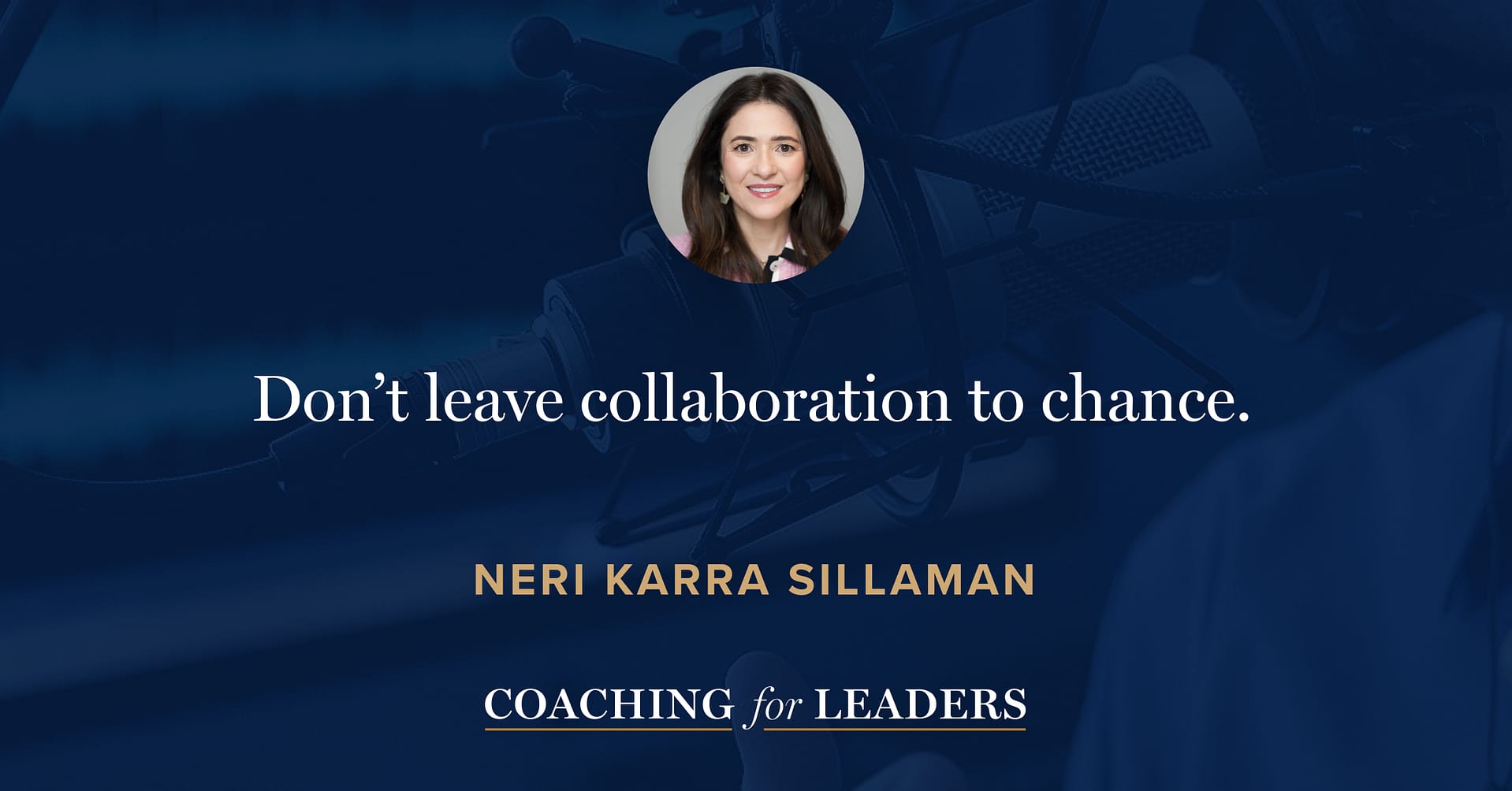
776: Forge Connections That Help You Thrive, with Neri Karra Sillaman

Don’t leave collaboration to chance.
https://media.blubrry.com/coaching_for_leaders/content.blubrry.com/coaching_for_leaders/CFL776.mp3

Podcast: Download

Follow:
Apple PodcastsYouTube PodcastsSpotifyOvercastPocketcasts

Neri Karra Sillaman: Pioneers

Neri Karra Sillaman is a refugee-turned-entrepreneur, academic, and author whose work focuses on the importance of resilience, purpose, and vision in business and in life. She is the recipient of the Thinkers50 Radar Award, an entrepreneurship expert at the University of Oxford, and the founder of Neri Karra, a global luxury leather goods brand. She is the author of Pioneers: 8 Principles of Business Longevity from Immigrant Entrepreneurs (Amazon, Bookshop)*.

We all know that the right connections can help in our careers, but how do we actually get more intentional about forging the connections that will be most meaningful and sustainable? In this conversation, Neri and I explore the key lessons from immigrant entrepreneurs and how their successes can help us all thrive.

Key Points

  • Robins and titmice have vastly different outcomes because of their divergent abilities for flocking. Social capital is critical for success.
  • Diversity brings many strengths – and it also introduces new challenges for connection. We can’t as easily rely on connections through traditional cultures or experiences.
  • All of us have the ability to forge connections based on value. This is perhaps the most powerful homophily tie and accessible to everyone.
  • The most successful immigrant entrepreneurs don’t rely on connections happening automatically and also don’t assume that relationships will be static.
  • Focus on what unites you with others. Strengthen ties with other networks to avoid the risk of communities that are too insular.
  • Be proactive and generous in sharing information and ideas to support others.

Resources Mentioned

  • Pioneers: 8 Principles of Business Longevity from Immigrant Entrepreneurs by Neri Karra Sillaman (Amazon, Bookshop)*

Interview Notes

Download my interview notes in PDF format (free membership required).

Related Episodes

  • Three People Who Will Help You Grow, with Andrew C.M. Cooper (episode 700)
  • The Way to Build Collective Power, with Ruchika T. Malhotra (episode 759)
  • Using AI to Make Networking Easier, with Ruth Gotian (episode 766)

Discover More

Activate your free membership for full access to the entire library of interviews since 2011, searchable by topic. To accelerate your learning, uncover more inside Coaching for Leaders Plus.
Forge Connections That Help You Thrive, with Neri Karra Sillaman

Download

Dave Stachowiak [00:00:00]:
We all know that the right connections can help a ton in our careers, but how do we actually get more intentional about forging the connections that are going to be most meaningful and sustainable? In this episode, the key lessons from immigrant entrepreneurs, and how their successes can help all of us thrive. This is Coaching for Leaders, episode 776.

Dave Stachowiak [00:00:25]:
Production Credit: Produced by Innovate Learning, Maximizing Human Potential.

Dave Stachowiak [00:00:33]:
Greetings to you from Orange County, California. This is Coaching for Leaders, and I’m your host, Dave Stachowiak. Leaders aren’t born, they’re made. And this weekly show helps leaders thrive at key inflection points. One of the ways that we thrive in our work, in our careers, in the inflection points of leadership, is having key connections and relationships in our lives, in our work that will help us to grow, that will be there to support us, to pull us up when we’re knocked down, and also to share so many ideas and resources.

Dave Stachowiak [00:01:10]:
Today, I’m so glad to welcome a guest expert who has spent so much work of, really researching some of the best practices and how we can learn from those who have come before us and, really explored some fascinating connections in how we can help connections to thrive. I’m so pleased to welcome Neri Karra Sillaman to the show. She is a refugee turned entrepreneur, academic, and author whose work focuses on the importance of resilience, purpose, and vision in business and life. She is the recipient of the Thinkers50 Radar Award, an entrepreneurship expert at the University of Oxford, and the founder of Neri Karra, a global luxury leather goods brand. She is the author of Pioneers: 8 Principles of Business Longevity from Immigrant Entrepreneurs. Neri, such a- such a pleasure to have you on, welcome to the show.

Neri Karra Sillaman [00:02:02]:
Thank you for inviting me, Dave. It’s a pleasure to be here.

Dave Stachowiak [00:02:05]:
I would love to go back in history to start this conversation, back to the 1930s and the early morning milk rounds in Britain, of all places, because I think there’s a story here that illustrates the power of connection. A couple of birds that we can learn a lot from. Would you share that story?

Neri Karra Sillaman [00:02:27]:
Absolutely, it’s titmouse and a robin. These are the two birds that actually teach us a lot about connection, working together, and innovation, and importance of community, in fact. So the story, this comes from in 1930s, up until 1930s in England, milkmen will bear the cold winter months and put the milk outside of each home. And the bottles will be open. So the titmouse and robin will feast on the milk round, the cream on top of the bottles. But one morning there was a surprise because there was an invention, and the milkman started to put these aluminium, red aluminium taps on top of the bottles. So the robin and the titmouse could no longer really eat and feast on the, on the cream of the milk. But something very interesting happened because robins, robins couldn’t really, even though they tried hard, they couldn’t really get to the milk round.

Neri Karra Sillaman [00:03:35]:
But it was the titmouse that managed to keep feasting on that. And the lessons come to us, the story of this comes to us from a professor at UC Berkeley. He was a researcher, Allan Wilson. And he studied bird behavior, and he identified how a species improve their survival prospects through very specific type of behavior, which is called flocking. And you need 3 things in order for that to happen. You have to have mobility within the group. You have to have innovation that comes from certain members of that group. You have to share those innovations with the community.

Neri Karra Sillaman [00:04:18]:
And funnily enough, titmice were able to do that because they are very social, they interact frequently, and they learn collectively, and they share what they’ve learned. So this is very much linked to innovation and creativity as well. But robins are very solitary, and they also tend to be territorial, so they couldn’t continue to eat. So this is quite an interesting story for us because I am a big believer that nature has a lot to teach us about business. So when I read this particular story, it teaches us about how we form relationships, how we continue to innovate, how we continue to thrive if we work together.

Dave Stachowiak [00:05:07]:
Yeah, it’s just, it’s a beautiful analogy for relationships and connections. And you have studied the success of immigrants who are entrepreneurs, and you’ve, you’ve surfaced 8 principles in your work. And one of the principles is forging connections based on identity and authenticity. And you point out in your work that it’s not news that social capital is critical for success. We have all heard that many times. We all know the value of that, even if we don’t necessarily do it ourselves and our behaviors. We certainly recognize the value of that.

Dave Stachowiak [00:05:46]:
But immigrants really, in so many ways, uniquely are so good at this. What is it that they do that works so well?

Neri Karra Sillaman [00:05:56]:
Of course, I think once again, we can— the example that I just gave about titmice and robins gives us some information into that, because I call it homophilic ties. This is the birds of a feather that flock together. They tend to flock together. And I use the concept, it comes from sociology, of homophilic ties in order to illustrate how immigrant entrepreneurs are so good at forming these ties. And of course, when they immigrate, when you are an immigrant, and you move to a new country, you lose many of the connections that you had back home. You lose that social capital, you lose the very thing that makes you thrive, the very thing that makes you continue living the way you did. So what happens when you become an immigrant is that you lose those connections. And when you are in a new country, they tend to put great emphasis into rebuilding those ties.

Neri Karra Sillaman [00:07:00]:
And they do so through what I call homophilic ties. So this comes, as I said, from sociology. But of course, it means that you are going to find people who are like you. It can be people from your own country, it can be people from your own culture, people who have gone through a similar experience. And in the book, I start with the example of Saeju Jeong and Artem Petakov, who are the founders of Noom. And they were able to bond together because they are both immigrants. So this is one way to use homophilic ties, because that’s a shared experience. And in the book, I talk about 3 different homophilic ties, which is, a shared heritage, shared experience, and having shared values. And I can go into more detail how they do that.

Dave Stachowiak [00:07:58]:
Oh, I think that would be really lovely because when I was thinking about those 3 different types of homophily, of of heritage, experience, and value. I think the things that we often think about when we think about this are heritage—folks who come from the same, same country, same ethnic background. That’s something that comes up, especially when we think about immigrants. And we also think very naturally about experience, and shared experiences. That tends to bring many of us together, whether we’re immigrants or not. The thing that I think we don’t often think about, though, as intentionally, and where you say in your work is very powerful, is the third one, value. Tell me more about that one and why that emerges as such a critical one.

Neri Karra Sillaman [00:08:48]:
Exactly. And this is a very important— in my opinion, it’s the strongest homophilic tie that you can use, and you can actively engage. You don’t have to have the same lifestyle, shared heritage or culture. You don’t have to come from the same country, but shared values can bond you much, much stronger than those cultural or shared experience ties that I talk about. I gave the example of Saeju and Artem. These are two friends who ended up creating the health app called Noom. And it was their commitment to preventative healthcare, their commitment to create something that didn’t exist, that will revolutionize the industry. So this was a shared value that bonded them together.

Neri Karra Sillaman [00:09:39]:
And I think this is a lot stronger because you don’t necessarily, and this is an interesting one, because you don’t necessarily have to come from the same culture, or the same background in order to do it. So, for example, I write about immigrant entrepreneurs, but the findings in my research, in my book tell you that you don’t have to be an immigrant in order to create a company of longevity, or in order to create a successful business. You can bond over shared values. What is it that you want to achieve together? What are the things that unite you together? And they don’t have to be, as I said, a country or a culture or a heritage or even an experience.

Dave Stachowiak [00:10:31]:
That’s what I think is so powerful about your work is, not only the research itself on immigrant entrepreneurs, but the lessons that are true for all of us. Because of the lived experience that they’ve had, and the things that tend to surface as principles even more strongly because of their lived experience. And this, you know, as we’re thinking about creating connections, especially based on value, I think one of the things that’s really interesting, and you show this in your research so much, is that oftentimes we just assume, if we haven’t had a major transition in our lives, like moving to a different country, or starting an organization, that these ties just sort of happen naturally. They happen automatically even. And one of the lessons I think that you really highlight from immigrants is that they don’t make that assumption because they can’t. They need to actually engage in these relationships, and they don’t rely on that happening automatically. They do that with a lot of intention, don’t they?

Neri Karra Sillaman [00:11:38]:
Absolutely, Dave, this is a very important point because even, let’s say, imagine you come from the same culture or background, there is no guarantee that you are going to bond together with that person. In my research, what I’ve seen that immigrants are very deliberate in how they form these connections. They will use, in my book I talk about strategic storytelling, and in my research also this is what emerged. They are very deliberate, very strategic, and they will find parts of their story to relate to the other person. One entrepreneur can be from Italy, another can be from Turkey. Their background is not going to be the same at all, but they will find, they will become very deliberate in finding commonality, especially storytelling. They are very good at storytelling. They are very good at finding something that is unique and common.

Neri Karra Sillaman [00:12:39]:
At the same time. And one mistake, the misconception about homophilic ties, these ties, they are going to happen automatically. And they are static, and they are not going to change. But those connections are actually very dynamic, and they change even if you bonded with someone, even if you created this strong bond, and strong social capital. It doesn’t mean that it’s going to remain the same. It evolves over time. And in order for them to thrive, they have to be nurtured. So there’s this strategy behind all of this.

Neri Karra Sillaman [00:13:19]:
There’s a very constant dynamic, dynamism that happens, and very active and deliberate way immigrant entrepreneurs will not only build, but maintain and nurture these relationships.

Dave Stachowiak [00:13:37]:
I think it’s such a fascinating call to action for all of us and a reminder, because sometimes we do build relationships with intention and find those relationships, and then we don’t necessarily nurture them in our professional communities. And immigrant entrepreneurs never assume static and unchanging relationships. Like you said, there’s a dynamic nature to it of— and again, because of their lived experience, so much is changing around them. Their, their world has changed. Their organizations are changing and growing. They just assume that the relationship work that they’re putting in is consistent and dynamic. And that’s such a big part of why this works so well for them and why they build such strong relationships.

Neri Karra Sillaman [00:14:22]:
Absolutely. I mean, one example is my own company. I am a refugee. My family is a refugee. When we started our business, we truly immigrated with two suitcases, no money, nothing at all. We were able to create this, you know, our entire business, one could say, is based on homophilic ties and social capital. At the very beginning of the business, we basically bought, we didn’t buy, we rented a tiny little apartment.

Neri Karra Sillaman [00:14:53]:
In the luggage trade area in Turkey where communism had just ended. This was the 1990s, and people from former communist countries were coming to Turkey in order to buy goods in their suitcases, bring them back to their country. I was 16 years old at the time, and I didn’t know I was using homophilic ties, but I suggested that we put up a sign that said, ‘Please come in for a homeland cup of coffee.’ It was to suggest we are the same. And it was written in different languages. It was not written in Turkish. It was written in Ukrainian, in Russian, in all the Romanian, all the former Soviet Republic languages, basically Bulgarian. And of course, we were also coming from post-Soviet culture. Because I grew up in Bulgaria, we grew up in Bulgaria during communism.

Neri Karra Sillaman [00:15:52]:
So when it was a— and people will come in, and literally just have coffee with us. And in the book, I detail how in the very early days, how we started our businesses, we will give our products, the products that didn’t even belong to us, because we were making commission out of the leather products and textile that we were selling. And we will say to those entrepreneurs, take it, sell it, and then come back with the money. So there is this immediate trust signaling. And trust is also very much part of the homophilic ties because, you almost signal to the other side, I trust you. But you also take a big risk in some ways by saying, I am taking the risk of giving you my product for free without taking any money from you, because I know you and I want the same thing. We are basically on the same boat together, and we want to succeed.

Neri Karra Sillaman [00:16:57]:
So there’s a, it’s quite a, and I can tell you when I started my PhD, this fascinated me because I didn’t see this particular topic of homophilic ties, altruism, kinship, and trust explored in this way in business. I’m talking 20, more than 20 years ago, when I started with my research. And I remember very clearly it was in London Business School when I presented my article, my research for the first time. There was a bit of a surprise, and I could say a bit of a backlash. How can it really be altruism? Can it really? Are you really acting in an altruistic way by saying, I want you to succeed, and here is what I do? It’s a fascinating topic for me.

Dave Stachowiak [00:17:49]:
It is so fascinating, and I think it speaks to the homophilic ties, particularly around value. And that is something that all of us have the opportunity to lean in on, and to highlight. And I think about, one of the challenges that you talk about just right now in our world with all the different things happening, and all the uncertainty, and diversity and so many, so many different ideas, and people working across cultures. And you write in the book, people nowadays are not only more remote from each other in the literal terms of where they sit to work, but also mentally more remote, in the sense that they come from an increasingly diverse range of backgrounds, and live at a time in which traditional cultures characterized by relative homogeneity of values are being splintered into a multiplicity of pieces that seem to drift even further from each other. And I, I’m highlighting that because I think almost always we think about diversity as a wonderful thing, and a thing that brings so much value into our lives. And you and I know believe strongly in that. And at the same time, it also does bring some challenges that you highlight, that because we have so much diversity of interactions across cultures and countries and different kinds of people in many of our organizations, that sometimes finding these ties that might have happened a bit more naturally a generation ago, become a bit harder today, don’t they?

Neri Karra Sillaman [00:19:18]:
They do. And that’s why we have opportunity. It’s because we have this diversity, I think, there’s two things here. One is we are becoming more and more, in some sense, individualistic, more and more removed from each other. The community that our grandparents grew up in doesn’t exist in the same way. We have the online communities, but on the other hand, you can also, one could argue, this can bring you together in some sense closer. We talk about diversity, it’s a good thing, but you have to, again, work actively. As I said, you have to work strategically in order to create these family-like ties.

Neri Karra Sillaman [00:20:07]:
And I talk about it again in my book and in my research. I call it a quasi-family, because family has a lot of advantages, and you don’t have to come from the, again, I will emphasize, from the same familial background, you don’t have to come from the same culture, but you can use some of these principles, and strategies in order to establish quasi-family-like environment, and nurture the community that you are part of. Because, as I said in the example of the titmice and robins, if only you work together, that’s when you can survive. That’s when you can thrive.

Dave Stachowiak [00:20:49]:
There are so many wonderful strategies that you highlight just in this chapter of the book, and I’d love to highlight a few of them, because I think that they’re strategies that any of us can lean in on, whether we’re an immigrant or not, regardless of experience level in our careers. And one of the strategies is to focus on what unites you. What’s critical about that?

Neri Karra Sillaman [00:21:15]:
Basically, you have to find some connection with the people you are dealing with. And I talk about strategic storytelling, narrative identity work, and you have a lot more in common. I think we are a lot more alike than we are different. And I still believe in that. That’s one thing I will not change my mind on, no matter how much the world is trying to tell us that we are very different than each other. We have a lot more in common, and we have to always focus on the commonality that we share. And you can use some of the advice I have: strategic storytelling, narrative connections that are dynamic. And this is a very, I think, one of the best ways you can strengthen homophilic ties.

Dave Stachowiak [00:22:08]:
Fred Rogers said that you can’t help but love someone once you’ve heard their story. And I think oftentimes we don’t think about making the space in our relationships, and in our organizations for sharing story. Immigrants do. They do make that space, they do. It’s so much a part of their identity and where they lead with. And I think it’s a great invitation for us to do more of that. We’ve talked a bit about that on the show over the years, and I’m going to mention later on at the end of this conversation, some resources for folks who want to get better at that.

Dave Stachowiak [00:22:38]:
And one of the other invitations you make here is strengthening your ties by joining other networks. What helps by reaching out across networks beyond the ones you’re already involved with?

Neri Karra Sillaman [00:22:52]:
Absolutely. And I think it’s a very good thing to focus on homophilic ties, but you also— it can also restrict you. That’s something that came up in my research because, you can become a tight-knit community, we call them. You can create a company that is based on homophilic ties. In the very beginning, you don’t necessarily, let’s say, have the social, the capital, the financial capital, and your social capital, your people who are like you, who share the same values as you, who come from your culture, background, heritage, let’s say. They can really help you build your business. But something that came up in my research is that the longer your company goes, let’s say in the later years, the longer it grows, those homophilic ties can start to restrict you. That’s an interesting point that, I think, this is the downside of homophilic ties.

Neri Karra Sillaman [00:23:54]:
But if you become too reliant on them, if you don’t get out of your comfort zone, if you don’t get out of your own tight-knit community. So joining other networks, are going to expand that for you. And I think that’s why one of the strategies I offer is that, go where your people may not be.

Dave Stachowiak [00:24:19]:
Yeah, and there’s such a both/and there too, like the strength, the power of the homophilic ties and around values and heritage and experience, of course, like super powerful, and also move beyond that, because there’s a risk in creating too tight a community, in getting into, as you say in the book, groupthink, or a little bit of the echo chamber. That being really intentional— the folks who do this really well, and have longevity, are really intentional about leveraging those relationships and also, finding opportunities to engage with new networks, new people, and building those homophilic ties in new ways, in new spaces. And it’s really interesting when they do that, like how powerful it is.

Neri Karra Sillaman [00:24:59]:
Absolutely.

Dave Stachowiak [00:25:01]:
The other invitation you make, and we hit on this a little bit earlier, but I think it’s worth referencing again, is not leaving collaboration to chance. And oftentimes, when we think about building relationships, building connections with others, many of us have relied on those things just happening naturally in the course of everyday events, work events, whatever. And immigrants, immigrant entrepreneurs don’t leave this to chance. They’re really intentional about it. And when you see them be really intentional about this, what is it that they do that seems to work so well?

Neri Karra Sillaman [00:25:40]:
Absolutely nothing. You know, as you said, we mentioned it a little bit. It’s not by accident that they suddenly form these relationships, or they have this strong social capital, but they are very deliberate. They don’t leave it to accident. And on that note, in the book, I also talk about luck. And in fact, all the principles sort of relate to each other, they work together. I call them they become luckier.

Neri Karra Sillaman [00:26:13]:
But not because it’s by chance. Again, they very strategically go out there, create connections for themselves, you know, joining other networks, as we just mentioned, asking for introductions, and even mentioning parts of their story that are going to relate to the other person, to the other group. And there’s, as I said, there’s a very deliberate, very strategic way that these connections happen.

Dave Stachowiak [00:26:45]:
And one of the things that they also do well— by they, I mean immigrant entrepreneurs, but also folks who really lean in on this well— is that they’re really proactive in sharing information. What is it that, what is it that they tend to do with that?

Neri Karra Sillaman [00:27:03]:
They are, they are very proactive for sharing information. And it’s not that they are proactive, but again, Dave, they are a little bit more— it’s not that they say everything about themselves, but they will nitpick and choose strategic parts of their own story. And for just an example came to my mind, Hamdi Ulukaya, for example, when he came to New York as a language student, and his teacher one day asked them to write an essay, something they know how to do. And he decided to write about how— making feta cheese. And when his teacher read the essay, she said to him, “You know how to do feta cheese?” And he said, “Yes, that’s my family. I come from a shepherd family.” She said, “We just bought a farm. I am looking for someone to help me in the farm. Will you come and help us with all the animals that we have, and in exchange of you staying in the farm?”, basically.

Neri Karra Sillaman [00:28:07]:
Again, it’s something in common. It’s a connection, and it’s a very proactive and strategic way of sharing what you know.

Dave Stachowiak [00:28:16]:
I think so often, especially in organizations, we are often, unfortunately taught, either literally, or more often culturally, to guard what we know and to be careful about that. And it is really interesting how many of the entrepreneurs you profile in the book, him especially, like he goes on to found this amazing organization that we all know now. And it, how the willingness to share, and the willingness to be generous, and the willingness to share information, and to also, to your point, doing it strategically too, in a way that is helpful to others, but also helps build their brand in a way that’s very powerful. And what a great invitation for all of us to take a little bit more risk to do that. And even if our organization may not be the safe place to do that, to do that in other networks, and other communities, and other associations, where we will more likely get some traction. And it’s just, it’s a great invitation to start.

Dave Stachowiak [00:29:25]:
You have done so much research on this, and by the way, we are, there’s 8 principles you highlight in the book that are really— that immigrant entrepreneurs have followed that really helped them to be successful. We’ve only hit on one in this conversation. There’s a lot more in the book. So I hope folks will go get the book, because one of the things I think is so fascinating for us to continue to do as leaders is to learn from so many different kinds of people who’ve had extraordinary success. And you highlight so many of them in the book. I think it’s just amazing that nearly half of the Fortune 500 companies were founded by immigrants. There’s so much to learn from their stories. And so I so appreciate you sharing it.

Dave Stachowiak [00:30:04]:
And I’m curious, as one final question, what you’ve changed your mind on? I often ask people what they’ve changed their minds on. You’ve been researching this for a long time and you’ve talked to so many successful immigrant entrepreneurs who have done incredible work. As you’ve talked with them, as you’ve put this book together, as you’ve taught so many people about their stories, I’m curious what, if anything, you’ve changed your mind on?

Neri Karra Sillaman [00:30:29]:
I think towards the end of writing my book and doing all my analysis, I don’t know if I changed my— it was more like a surprising finding. Because I’m interviewing these big names, let’s call them, quote unquote, big names, people who have done the impossible, who are very courageous. Who have left their countries and created companies that changed the world, changed industries. And they are in some sense the ideal version of a leader, let’s call it that. And towards the end of my book, as I am putting it all together, synthesizing all the information, what surprised me is that it was never about them. They are not at the center of the company. They are not this sun that illuminates it all, and people look up to them, and they have all the answers, and they are the quote unquote the big name that makes this company continue and thrive. And it’s a paradox. Of course, they are the founder.

Neri Karra Sillaman [00:31:38]:
They are the ones that make the decision, but they don’t see themselves as the end and be all. Instead, the question that they ask themselves is, how can I give? They listen to their employees. Most of the time, they involve their employees. They follow. Recently, there was an HBR article, great leaders are good followers, or great followers. And I couldn’t agree more with that. And this was a finding that surprised me in my own research, how they didn’t act as the center of the universe, or of their own company. And the fact that they have this generosity towards, not only how they are with their employees and suppliers, but generosity of spirit, generosity of sharing information, generosity of trying to make this world a better place. And that’s something that I would say puts it all together.

Dave Stachowiak [00:32:43]:
Neri Karra Sillaman is the author of Pioneers: 8 Principles of Business Longevity from Immigrant Entrepreneurs. Neri, thank you so much for your work.

Neri Karra Sillaman [00:32:52]:
Thank you, Dave. It’s a, it was a pleasure for me.

Dave Stachowiak [00:32:55]:
Me too. If this conversation was helpful to you, 3 related episodes I’d also recommend. One of them is episode 700: 3 People Who Will Help You Grow. Andrew C.M. Cooper was my guest on that episode, and we talked about the thing that we think about, I think, a lot when we’re thinking about building our professional networks are, who are the different kinds of people that we should connect with? We often think about people who are ahead of us in our careers, the mentors, people who are at organizations that maybe we might want to connect with better, or maybe be a future career path for us. We don’t often talk about the 3 people we talked about in that conversation, 3 people that can also challenge us in some new ways.

Dave Stachowiak [00:33:39]:
And Andrew invites us to bring those people into our network as well. If you’re doing some network building right now, building your relationships, episode 700 is a great framework for you to be thinking about. Also recommend episode 759: The Way to Build Collective Power, where Ruchika Malhotra was my guest on that episode. We talked about, in that conversation, the importance of working together, building a collective power amongst your network, amongst friends and family, amongst so many that can support you and help you move forward. Oftentimes, we think about competition when working with others, especially in our Western organizational context. And Ruchika really invites us to think about how to un-compete, and how we can actually work together and, by working together, actually build more power for everyone. It’s a wonderful conversation and a great complement to this conversation, episode 759. And then finally, I’d recommend the recent episode with Ruth Gotian, episode 766: Using AI to make networking easier.

Dave Stachowiak [00:34:37]:
Networking is one of those skills that most of us didn’t ever learn how to do. It’s not something that comes naturally to a lot of us, but we all recognize that it’s an important skill. And the wonderful thing about a lot of the AI tools is, they do not replace the human relationships and connections at all. And, they also can help us to accelerate some of what we’re doing to make connections and help to do a bit of the legwork that actually helps us to invest even more in those intentional connections that we’re making. And in episode 766, Ruth talks through some of those key tactics that she uses. She teaches us how to do it. I’ve put a bunch into practice in the last 6 months. It’s been super helpful to me personally.

Dave Stachowiak [00:35:14]:
So many of you told us that episode was useful, episode 766. For more, all of those episodes you can find on the coachingforleaders.com website. And if you haven’t before, set up your free membership at coachingforleaders.com, because it’ll give you access to the entire suite of the library of podcast episodes I’ve aired since 2011, plus a ton more inside. And speaking of making intentional connections, one of the reasons that we have the Coaching for Leaders Academy is being able to make those connections across industry with leaders that think a little differently than you do, have a little different perspective and objectivity, but are still rooted in the same values and the heart of helping people to grow and move forward. And if you are at an inflection point right now in your career, maybe taking on a new role, maybe taking on a team or new project, or you’ve got an opportunity in front of you, the Academy may be helpful to you. To find out more, go over to coachingforleaders.com/academy. You’ll see information there for being able to jump on our early invitation list for the next time that we open up the Academy for membership. Again, details at coachingforleaders.com/academy.

Dave Stachowiak [00:36:25]:
Coaching for Leaders is edited by Andrew Kroeger. Next Monday, I’m glad to welcome Anthony Klotz to the show. We are going to be talking about how to help employees handle tough moments, something that we all experience. And yet, we don’t really think very much about what we can do that will help. Anthony and I are having a detailed conversation on exactly what we can do that helps employees weather tough situations more effectively. Join me for that conversation with him, and I’ll see you back on Monday.

Topic Areas:EntrepreneurshipNetworking
cover-art

Coaching for Leaders Podcast

This Monday show helps you discover leadership wisdom through insightful conversations. Independently produced weekly since 2011, Dave Stachowiak brings perspective from a thriving, global leadership academy of managers, executives, and business owners, plus more than 15 years of leadership at Dale Carnegie.

Listen Now OnApple Podcasts
  • More Options
    • YouTube Podcasts
    • Spotify
    • Overcast

Activate Your Free Membership Today

Access our entire library of Coaching for Leaders episodes from 2011, searchable by topic.
Listen to the exclusive Coaching for Leaders MemberCast with bonus content available only to members.
Start Dave’s free audio course, 10 Ways to Empower the People You Lead.
Download our weekly leadership guide, including podcast notes and advice from our expert guests.

... and much more inside the membership!

Activate Your Free Membership
IMAGE
Copyright © 2026 · Innovate Learning, LLC
  • Plus Membership
  • Academy
  • About
  • Contact
  • Dashboard
×

Log in

This site is protected by reCaptcha and the Google Privacy Policy and Terms of Service apply.
 
 
Forgot Password

Not yet a member?

Activate your free membership today.

Register For Free
×

Register for Free Membership

Access our entire library of Coaching for Leaders episodes from 2011, searchable by topic.
Listen to the exclusive Coaching for Leaders MemberCast with bonus content available only to members.
Start Dave’s free audio course, 10 Ways to Empower the People You Lead.
Download our weekly leadership guide, including podcast notes and advice from our expert guests.

... and much more inside the membership!

Price:
Free
First Name Required
Last Name Required
Invalid Username
Invalid Email
Invalid Password
Password Confirmation Doesn't Match
Password Strength  Password must be "Medium" or stronger
This site is protected by reCaptcha and the Google Privacy Policy and Terms of Service apply.
 
Loading... Please fix the errors above