• Skip to primary navigation
  • Skip to main content
  • Skip to primary sidebar

Coaching for Leaders

Leaders Aren't Born, They're Made

Login
  • Plus Membership
  • Academy
  • About
  • Contact
  • Dashboard
  • Login
Episode

769: How to Connect Better with Remote Colleagues, with Charles Duhigg

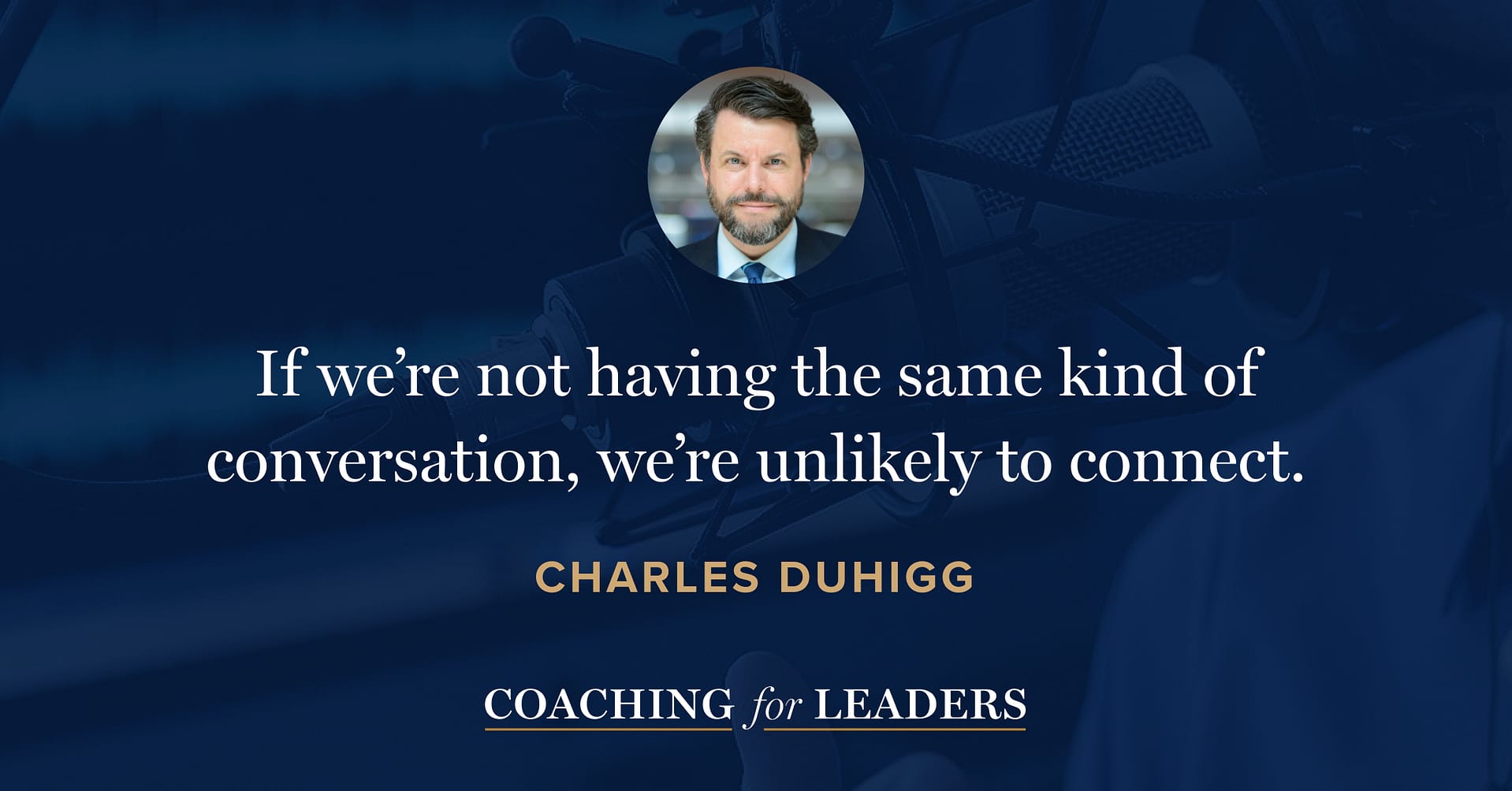
If we’re not having the same kind of conversation, we’re unlikely to connect.
https://media.blubrry.com/coaching_for_leaders/content.blubrry.com/coaching_for_leaders/CFL769.mp3

Podcast: Download

Follow:
Apple PodcastsYouTube PodcastsSpotifyOvercastPocketcasts

Charles Duhigg: Supercommunicators

Charles Duhigg is a Pulitzer Prize–winning investigative journalist and the author of The Power of Habit and Smarter Faster Better. He is a winner of the National Academies of Sciences, National Journalism, and George Polk awards. He writes for The New Yorker and other publications and is the author of Supercommunicators: How to Unlock the Secret Language of Connection (Amazon, Bookshop)*.

A lot of us grew up in a world where most of our relationships started in person. That means many of us are beautifully equipped for a world that no longer exists. In this conversation, Charles and I discuss how to get better at connecting in a remote-first world.

Key Points

  • When the telephone first became popular, people had to learn how to communicate with it. We’re at a similar inflection point with digital communication.
  • We all have three kinds of conversations: (1) What’s this really about? (practical/decision-making), (2) How do we feel? (emotional), and (3) Who are we? (identity).
  • Many of us tend to default to practical/decision-making conversations online and miss conversations about emotion and identity.
  • Ask questions that invite an emotional or identity response. Instead of, “Where do you live?” consider a shift like, “What do you love about where you live?”
  • Notice when people bring elements into a conversation that aren’t related to the topic. These clues, especially online, can point to entry points for emotional connection.
  • Supercommunicators pay just a bit more attention to how people communicate than the rest of us. A slight shift can make a big difference.

Resources Mentioned

  • Supercommunicators: How to Unlock the Secret Language of Connection by Charles Duhigg (Amazon, Bookshop)*

Interview Notes

Download my interview notes in PDF format (free membership required).

Related Episodes

  • The Way to Get People Talking, with Andrew Warner (episode 560)
  • How to Lead Engaging Meetings, with Jess Britt (episode 721)
  • How to Show Up Authentically in Tough Situations, with Andrew Brodsky (episode 727)

Discover More

Activate your free membership for full access to the entire library of interviews since 2011, searchable by topic. To accelerate your learning, uncover more inside Coaching for Leaders Plus.
How to Connect Better with Remote Colleagues, with Charles Duhigg

Download

Dave Stachowiak [00:00:00]:
A lot of us grew up in a world where most of our relationships started in person. That means many of us are beautifully equipped for a world that no longer exists. In this episode, how to get better at connecting in a remote-first world, this is Coaching for Leaders, episode 769.

Dave Stachowiak [00:00:21]:
Production Credit: Produced by Innovate Learning, Maximizing Human Potential.

Dave Stachowiak [00:00:29]:
Greetings to you from Orange County, California. This is Coaching for Leaders, and I’m your host, Dave Stachowiak. Leaders aren’t born, they’re made. And this weekly show helps leaders thrive at key inflection points. An inflection point we have all been through in recent years is doing so much more in communication, leading, managing, building, sometimes entire relationships online and remote.

Dave Stachowiak [00:00:56]:
How can we get better at being able to connect well with remote colleagues? Today, I’m so glad to welcome back a guest who’s an expert on communication, will help us to look at this in new ways. I’m so pleased to welcome back to the show Charles Duhigg. He’s a Pulitzer Prize-winning investigative journalist and the author of The Power of Habit and Smarter, Faster, Better. He is the winner of the National Academies of Sciences, National Journalism, and George Polk Awards. He writes for the New Yorker and other publications, and is the author of Super Communicators: How to Unlock the Secret Language of Connection, now available in paperback. Charles, good to have you back.

Charles Duhigg [00:01:37]:
Thanks for having me on, Dave. It’s good to visit with you again.

Dave Stachowiak [00:01:40]:
It’s good to see you too. And we both grew up in a world where people mostly connected in person to build relationships, and that’s how they worked. And that has changed, of course, a ton in our lifetimes, and especially in the last five years since the pandemic. And I’m curious, before we get into just how we do this better, how has this online shift changed how you interact with people, especially in these last five years?

Charles Duhigg [00:02:10]:
Well, it’s interesting, right, because I think that one of the things, you’re right, that when we were growing up, a lot of connection happened in person, but it also happened over the telephone, right? Like in middle school, I’m sure we both had these seven-hour conversations that were the most important conversations of our lives at that moment.

Dave Stachowiak [00:02:26]:
Yeah.

Charles Duhigg [00:02:26]:
And what’s interesting though, is that when the telephone was a new technology about a hundred years ago, when phones first started getting popular in the United States, there were all these articles that came out that said no one will ever have a real conversation on the phone, right? Because up till then all conversations had essentially happened face-to-face. And they said, look, if you’re on a phone with someone and you can’t see their facial expressions, you can’t hear their tone of voice with, like real clarity, you can’t see the gestures of their hands, there’s no way that you’re going to be able to connect with someone. It’s just you’re never going to have a real, a real conversation. And what’s interesting is, all those studies and all that prognostication, it was right. For about the next 15 years, people didn’t know how to talk to each other on telephones. If you look at the early transcripts of telephone conversations, it’s basically that people would use them the same way they used a telegraph.

Charles Duhigg [00:03:14]:
They would call up the grocery store and put in their order. Then the other person would say thanks, and they’d hang up right away, right? There was none of this sense of how to use a phone to connect with someone, huh? Now, by the time you and I were teenagers and everyone listening, we knew how to use phones automatically, right? We knew, we knew how to have great conversations on phones. I talked to my friends on phones all the time, and I feel closer to them. So what happened? What changed there? Well, what happened is that we learned the rules for using telephones. And these are rules that we’re not even aware of, but that we live by right now, when you’re talking on the phone, studies show you over-enunciate your words by about 30%, huh? You put about 20% more emotion into your voice. Now, you’re not aware that you’re doing this, right? And you’re not doing it on purpose, but there’s some part of your brain that knows if I’m on a telephone, the person can’t see my face, so I have to put more emotion in my voice. And sometimes, you know, when they can see my lips, I can mumble, and it’s okay, but on the phone, I really need to enunciate because they can’t see my lips move.

Charles Duhigg [00:04:12]:
We do this automatically. We’ve learned the rules for using telephones. We’ve learned them so well that we do them almost subconsciously. The same thing is happening right now with digital communication, right? Digital communication has really only been around for about 20 years, in a widespread way. And if you think about some things like Slack, or Instagram, or DMs, or texting, it’s even shorter. And so it’s not that surprising that we’re still trying to learn how to use it. And so when it comes to things like Zoom, what we have to do is we have to remind ourselves A. There are rules about communication and balance.

Charles Duhigg [00:04:46]:
And B. Those rules sometimes change slightly depending on the channel of communication that I’m using. That I need to speak more clearly when I’m on the telephone. I need to put more emotion in my voice. When I’m on Zoom, I might need to spend a little bit of time just having directionless conversation, the kind of conversation you would have in a conference room before a meeting starts, and everyone gets there, that feels very natural. Because that’s kind, that is the grease that makes our relationships work.

Dave Stachowiak [00:05:12]:
It’s so interesting, you sharing the history of the telephone, which I wasn’t aware of, and some of that, some of the numbers behind that. Because, when I think about Zoom and the online communication and the shift so many of us have made in the last decade especially, is when we first started doing that, how awkward it was. And the conversations would be strange, and awkward, and not kind of knowing what to do. And some of us still run into that in our work, especially when we’re talking to people that don’t do a lot of that. And yet that really is different now. It feels different, at least to me, than it did six or seven years ago.

Charles Duhigg [00:05:54]:
Absolutely. And think about when the pandemic first started, and everyone went onto Zoom. For most of us, for the first time, remember how hard it was with the interruption problem. Like, two people would start speaking, and it wasn’t clear how you like, how you sort of signal that you want to go first, or you should let the other person go first.

Dave Stachowiak [00:06:11]:
Yeah.

Charles Duhigg [00:06:11]:
Like it was just start and stop, start and stop, start and stop. Now, on Zoom calls, that hardly ever happens. Right? If it does occasionally. But for the most part, we kind of know how to pick up on the cues. We kind of know how to use the icon to raise our hand, how to do X, Y, and Z, to wait for someone to call on us. We’ve learned a set of rules for using Zoom. Now the question is, which are the rules that are really impactful, that maybe aren’t as obvious? Because we’re all going to learn how to interrupt each other on Zoom.

Charles Duhigg [00:06:40]:
We’re all going to learn how to take our turn speaking on some type of digital platform. Well, one of the things that we found is that when it comes to online communication, there’s a couple of things that are true that aren’t as true elsewhere. One of them is that politeness matters much, much more online than it does in the real world.

Charles Duhigg [00:06:59]:
There was this really interesting study that was done of Wikipedia editors. Right. So these are folks who edit Wikipedia pages, and they often get into fights. They get into disputes over what words should be used, or what should be allowed or what should be allowed. And sometimes these become flame wars. They’re just attacking each other. And what researchers found is that if one person in that conversation, just one person, starts saying please and thank you, the temperature of the overall conversation will go down, oftentimes by as much as 40%.

Charles Duhigg [00:07:27]:
Just one person saying please or thank you has a disproportionate impact on how people communicate with each other. And so that’s one of the rules for online communication, is that we remind ourselves, I should be more polite online than I usually am in the real world. Another one that I think people sort of intuitively know, but it’s worth pointing out, is that sarcasm works really well in the real world because people can hear the sarcasm in your voice, or they can see it in your expressions.

Dave Stachowiak [00:07:51]:
Yeah.

Charles Duhigg [00:07:51]:
But when you’re sarcastic online, there’s oftentimes very few signifiers that it’s sarcasm. And so they might take you seriously, and they might think that you’re saying something, something you intended sarcastically that you actually mean, and they get offended by it. Those are two sort of, basic principles of online communication. Be more polite, be less sarcastic. But then beyond that, when it comes to Zoom and work meetings in particular, particularly for leaders, we know what makes for a good meeting. Right? We know in an in person meeting, the meeting’s going to go well if a couple things happen. First of all, if people get a chance to just chat with each other while they’re waiting for the meeting to start, they’re going to get to just get caught up with each other.

Charles Duhigg [00:08:29]:
And that feels good. It feels like, it feels like we’ve made a connection there that’s important. Secondly, if that meeting is well-led, there will be what’s known as equality and conversational turn-taking. Which doesn’t mean that everyone speaks the same amount, but it means that in general, everyone at the table has something to say. They all feel like they’re participating. The third thing that happens in a good meeting is what’s known as ostentatious listening. This often starts with a leader.

Charles Duhigg [00:08:53]:
The leader proves that they are listening by saying things like, oh, what I hear you say is this. Or I want to go back to something you said before, Susan, because I thought it was really interesting. Because when one person starts listening ostentatiously, other people in the room start unconsciously or subconsciously mirroring them, and also listening ostentatiously. And that increases the listening of the whole group. So these three things often happen in a good meeting. We have to replicate them online when we’re in a Zoom meeting. Think about most Zoom meetings you go to. It’s all these squares on a screen, and no one’s talking to each other.

Charles Duhigg [00:09:24]:
Right? Maybe they’re like, maybe they’re private messaging each other, DMing each other in the background about like, why, I can’t believe that guy wore that thing today. But, but in general, we don’t have a culture where people can just kind of like chit chat before the meeting starts. And then that equality in conversational turn, taking that ostentatious listening, that’s something that only happens online if we, if we as leaders make sure it happens. And so those are some of the things to think about when we’re talking about Zoom conversations or online dialogues.

Dave Stachowiak [00:09:52]:
One of the things that we talked about last time you were on is that restating what people have said, not verbatim, but in your own words, to show that you’re listening, but then following up with some sort of empathetic follow-up, the connection to demonstrate that listening, that’s key. It’s key in all communications. How does that look different when it is Zoom, when it is a text message, that we can still tap into the principle of that, but that tactically maybe looks a little different?

Charles Duhigg [00:10:26]:
Yeah. So what you mentioned is known as looping for understanding. And there’s a couple of things that we know the best communicators do, that super communicators do consistently. And, it’s worth pointing out, we are all super communicators at one time or another.

Charles Duhigg [00:10:40]:
But there are some people who are consistent super communicators, who seem to consistently connect with almost anyone else. And one of the skills that they have, and these are skills that anyone can learn, is what’s known as looping for understanding. One of the things that researchers have realized is that simply listening to someone often isn’t enough. We have to show them or prove to them that we’re listening. There’s a saying, you know, you should close your mouth and open your ears. And that’s the first necessary step of listening. But that’s not where listening ends. What happens next is important.

Charles Duhigg [00:11:11]:
You have to prove that you’re listening. And as you mentioned, there’s this technique, looping for understanding, that particularly in conflicts, works really, really well as three steps. Step one is, I’m going to ask you a question, preferably a deep question, and we can talk about what those are. Step two is that I’m going to listen to you answer that question, and then I’m going to try and repeat back in my own words what I heard you say. And the goal here is not mimicry, right? The goal here is to, to show you that not only am I paying attention, but I’m thinking about what you’re saying. You know, you mentioned this really interesting thing, and it made me think of this other thing. Or here’s a follow up question. What do you think about X? And then step three? Most people do step one and step two intuitively.

Charles Duhigg [00:11:48]:
Once you’re kind of once, once you’re a leader, you’ve learned to do it. But step three is the thing that I always forget. And step three is, step three is, after repeating back what you heard the person say, ask them if you got it right. Did I hear you correctly? Because what we’re actually doing in that moment is we’re asking them for permission to acknowledge that we were listening. And if they acknowledge that we were listening, they become much more likely to listen to us in return. So how do we do this online, right? How do we do this in Zoom meetings, or how do we do it in other settings? The answer is, you just do it. It might not occur to you to do this if you’re on a Zoom meeting.

Charles Duhigg [00:12:24]:
Cause it feels like everything should be efficient and productive, and you should be sort of moving as fast as possible and getting off the screen. But what we know is that when we prove we’re listening by repeating back what we heard someone say, by asking them for a follow up, by asking follow up questions, by asking them, did I get you right? Whether we’re in person or on a screen, that is what helps resolve conflicts. That is what helps everyone feel listened to and heard.

Dave Stachowiak [00:12:50]:
You said something big a moment ago that I’d love to come back to, which is the natural interaction that a lot of times we tend to do when it’s in person, before or after a meeting, bumping in the hallway, all those kinds of things. And then how when we, when the meeting starts, or we get into the formal interactions, then you know, we tend to get a little more practical. We tend to get to the decision-making things. And for me, it just comes back to thinking about the three different kinds of conversations you talk about, that we all have. And the practical decision-making conversation is one of them. But there are two others. And I think the two others are the ones that, in a virtual environment, my experience is we do less. Like, we just don’t lean in on those as much.

Dave Stachowiak [00:13:35]:
And, maybe we should back up a bit and just frame those three types of conversations. And then, like, where we run into that with online, that doesn’t work as well?

Charles Duhigg [00:13:45]:
Absolutely. So one of the big findings of researchers over the last decade is that when we’re having a discussion, we think we know what that discussion is about, right? I’m telling my wife about my day, or we’re talking about where to go on vacation next year, or we’re talking about someone who pissed me off today. We think we know what that discussion is about. But if we look at people’s brains during those conversations, which we can kind of do for the first time, what we see is that they’re often having many different kinds of conversations all at the same time. And in general, these conversations, they tend to fall into one of three buckets, and they all use different parts of our brains. The first bucket is these practical conversations, which use the prefrontal cortex. That’s when we’re making plans together, or we’re solving problems together. But then there’s a second kind of conversation, which is an emotional conversation, which uses a completely different part of the brain, the basal ganglia and the interior structures of the brain, the amygdala.

Charles Duhigg [00:14:36]:
And in an emotional conversation, I tell you what I’m feeling, and I don’t want you to solve my feelings. I want you to empathize. And then finally, there’s the social conversation, which is about how we relate to each other, how we relate to society, the identities that are important to us. Talking about other people. And what researchers have found is that all three of these kinds of conversations are all equally legitimate. And in a discussion, you might have all three kinds of conversations, you might go from the emotional to the social to the practical, and back to the emotional. But if two people, two or more people aren’t having the same kind of conversation at the same moment, then they can’t fully hear each other, and they definitely won’t feel connected to each other. Think about how often this happens with your partner, right?

Charles Duhigg [00:15:20]:
Or your spouse, where you, you come home and, they’re complaining about their day and saying, this person pissed me off. And you try and solve their problems by saying, like, oh, you know, what you should do is you should go, and you should take them out to lunch and get to know each other. And they don’t appreciate the solution, right? They don’t want you to solve their emotions. They just want you to empathize with their emotions.

Dave Stachowiak [00:15:35]:
Yeah.

Charles Duhigg [00:15:36]:
And this is known within psychology as the matching principle, which says that successful communication requires having the same kind of conversation at the same time. So you’re exactly right. When we’re online, in Zoom, or in other settings, oftentimes we default to what sounds like that productive conversation. Right? That practical conversation. And what we’re missing, oftentimes, that we get in the real world when we’re sitting together in a conference room, is the social conversation. That talking to each other and saying, like, hey, what’d you do this weekend? And, like, oh, you know, I know that the, I know that you’re a big Braves fan, what do you think about their recent record?

Charles Duhigg [00:16:10]:
Those things that allow us to connect with each other on a social level, and the emotional conversation. Where we say, look, I’m feeling really stressed out, and if we don’t get this budget right, I’m really worried we’re gonna have to do layoffs.

Charles Duhigg [00:16:22]:
Those conversations are important. Those conversations are meaningful. And if someone is in a social mindset, or in an emotional mindset, simply coming at them with a practical discussion is not gonna work because they’re gonna, they’re not gonna feel like they’re ready for that conversation. You need to get matched first. You need to either match the kind of conversation they’re having, or you need to invite them to match you. And so thinking about that, for Zoom conversations, how do we get people to talk about who they are? If someone uses a feeling word, if they say on that Zoom call, I’m kind of stressed about this.

Charles Duhigg [00:16:55]:
Like, we really need to figure out the budget for next year. Before you figure out the budget for next year, dig a little bit into that stress. Now I’m really sorry you’re feeling stressed. I feel the same way. Like, tell me about, like, how that’s affecting you and kind of what we should do about it. Have that emotional conversation.

Charles Duhigg [00:17:10]:
When we’re more deliberate about it online, and we often have to be deliberate about it, that’s when we have a big breakthrough.

Dave Stachowiak [00:17:16]:
When I think back to what you said about talking on the phone, that we’ve just all sort of learned that there are things we need to enunciate more. There are things we need to do to show up differently as far as our volume level, like, we have just gotten used to doing that because we’ve used the technology for so long. And as I think about what we as a society, and certainly the interactions I have online, we have gotten pretty good over the last five, ten years on the practical decision-making kinds of conversations. The, what’s this about? conversation in the context of the virtual space? And the part that I don’t see as much is the, how do we feel, who are we? Conversations that you just described. And so I’m hearing you say two really big things is: One, those are important parts of communication. It’s not that the practical decision-making isn’t. It is important. It’s that the other two are also really important as far as our relationships that we’re building.

Dave Stachowiak [00:18:18]:
And secondly, that we need to be a lot more intentional, just like we would be on the phone, of enunciating more, we have to be a lot more intentional, of bringing that emotional, the identity conversations into our virtual interactions.

Charles Duhigg [00:18:32]:
I think that’s right. I think that’s exactly right. And I think being really deliberate about it. And that can sound harder than it actually is, and this is where we get into deep questions, because one of the things that we found that helps us bring in that emotional conversation, or that social conversation is asking the right kind of questions. One of the things that we know about consistent super communicators is that they ask many more questions than the average person. And some of those questions are just invitations.

Charles Duhigg [00:18:56]:
It’s like, oh, what’d you think about that? Or, oh, what you do this weekend? Right? Like, I’m just inviting you into the conversation. But some of the questions that super communicators ask are what are known within psychology as deep questions. And a deep question is something that asks me about my values, or my beliefs, or my experiences. And that can sound intimidating, particularly if you’re on a zoom call. But it’s as simple as if you meet someone like, who’s a doctor, instead of saying, oh, what medical school did you go to? You could ask them, oh, what made you decide to go to medical school? Right, that second question is a deep question because what it does is it invites that person to talk about their experiences, to talk about their values, about what brought them to where they are today. The first question is just about facts.

Charles Duhigg [00:19:34]:
Where do you work? And when we’re online in these Zoom calls, we can do the same thing we. In order to have those emotional conversations, or those social conversations, we don’t have to highlight the emotionality or the sociality of it. We can simply ask a deep question and let someone share with us what’s going on inside their head. So it could be as simple as saying, like, hey, Jim, you mentioned you were stressed. I want to talk about how, how that’s affecting you. Let me just ask, like, what’s the thing that you feel like is stressing you out about this the most? Right? That’s a deep question. It’s not a hard question.

Charles Duhigg [00:20:11]:
It’s not like I’m asking him to talk about his parents or cry on my shoulder. I’m just asking him, tell me what you’re feeling. Tell me what’s causing that feeling. Tell me how this aligns with your beliefs or your values. Tell me about the experiences you’ve had at other places, when you’ve confronted situations like this. When we ask those deep questions, we encourage people to have the other kinds of conversations without having to say, I’d like to have an emotional conversation now.

Dave Stachowiak [00:20:37]:
We’ve talked on the podcast before about in a virtual space, making more time intentionally, the first five or ten minutes of a conversation, or maybe on the back end of a conversation of asking a question, bringing an icebreaker, doing the kinds of things that we’ve learned to do in person, but really being intentional about it because people aren’t stumbling into those conversations naturally, because they haven’t been connected until the meeting’s going. What I don’t think we have ever explored as much, though, is what you just said of, rather than asking a question of an icebreaker, which might be, well, where’s everyone located? Where are you connecting in from today? Something like that is, what’s one thing you really like about the place you live? That is still a very simple question for people to answer. It doesn’t take any more time, but it comes back to that emotional identity piece that we just know we’re more likely to miss online.

Charles Duhigg [00:21:34]:
Yeah, no, I think that’s a great question. It’s a perfect question because you’re exactly right. What you’re asking is, you’re asking this person not, where do you live? And you can ask that, you know, do you live in the Heights or do you live in the Valley? But if the next question is, oh, what do you like about it? Like, what made you decide to move up to the Heights?

Charles Duhigg [00:21:50]:
You’re exactly right! What I’m asking them is, tell me about your values. Because they’re going to say something like, you know, it’s close to my church, or, I just have so many great neighbors up there, or, I went to college here, and I and a lot of my friends from college, they moved up to the Heights, so I wanted to be close to them. What you’re doing is you’re giving them a chance to tell you who, who they really are. And they’re inevitably going to tell you something about their identity. They’re going to have that social conversation, maybe even that emotional conversation. They’re going to tell you something that feels real and meaningful. And then the most natural thing on earth is to answer your own question and say, oh, that’s interesting.

Charles Duhigg [00:22:23]:
You live in the Heights because you went to college here. Actually I just moved here a couple of years ago, and I live in the Valley because they told me that, like, as a single man, like that’s probably where I’m going to meet my spouse is down in the Valley, not up in the Heights. Everyone’s married up there, right? I’ve told you so much about myself. I’m single, I’m looking for a partner. Like, it’s important to me to, to find someone to share my life with. It’s really easy when we ask these deep questions to allow the conversation to become more profound.

Dave Stachowiak [00:22:50]:
There’s a part of the book, I think so important for leaders, of making hard conversations safer. And part of that is beginning with vulnerability and shared purpose and building safety in a conversation explicitly. How does being online change the way that you try to approach that? Or does it?

Charles Duhigg [00:23:15]:
Well, let me ask you, because you spend a lot of time online.

Dave Stachowiak [00:23:18]:
I do.

Charles Duhigg [00:23:19]:
How do you feel like, how would you answer that question? When you look at your own communication habits, what do you do online to try and, and get over that hump?

Dave Stachowiak [00:23:28]:
I try to do nothing around decision-making, purpose, structure of a meeting for the first 5, or 10 minutes. It depends on the context or the scenario. But to start by asking a question, and then asking a couple of follow-up questions. And oftentimes it’s just one follow-up, to the point you just said about, okay, where do you, what do you like about where you live? Inevitably, someone will say something that is ties to who they are, their values, whatever it is, and I will try to follow that rabbit hole wherever they go down. Like, and I really try to take their lead. And then the other thing that I’ll do, especially if it’s someone that I’ve been introduced to by someone else, is Dale Carnegie taught me this years ago, is, to make a connection to whoever introduced us. So if I get on the line with someone I’ve never met, but we got introduced by someone else, I’ll say, oh, we got introduced by whoever. And how did you meet them the first time? Or what is it that you, what is it about being connected to them that’s been so helpful to you, and I’ll try to make that connection.

Dave Stachowiak [00:24:48]:
That’s something that we both have a common thread with, even if it is… Even if we don’t know each other at all.

Charles Duhigg [00:24:54]:
Yeah, I think that’s really smart. Because I think what you’re doing there is, when you’re trying to find a common social thread, you’re inviting someone to have a social conversation. Tell me who you are, oh, we both know Ben.

Charles Duhigg [00:25:06]:
So, like, why do we both know Ben? What is it about us or about Ben that puts us both in contact with him? That’s kind of interesting in and of itself. But then on top of that, we can expand that by saying, oh, it gives me a chance to tell you who I am. Right? The fact that I know Ben says something about me. And the more that I can share that with you, the more that I can have that social conversation. And I think that that’s really smart. I think that one of the things that happens when we’re online is that we just default to the practical conversation immediately. Right?

Charles Duhigg [00:25:33]:
Because it feels like online should be efficient. It feels like, like everyone always says, I don’t want to spend any time on Zoom. I want to spend as little time as possible. If I’m going to send this email, I want to make it a short email. I don’t want to burden you by writing a whole bunch of stuff. But the truth of the matter is that, like, most of our life is on,

Charles Duhigg [00:25:53]:
not most, much of our life is online now. And we’re not just using it for productivity, and efficiency, and practical decision making. We’re using it to look at photos of our nieces, or to look up new designs for interior decorating, or to find out what’s going on in the latest gossip with people that we follow. We use it like the same way that we use communication in the rest of our lives. And so we should create that space. We should purposefully create that space to have conversations that are not explicitly practical, but that allow us to share who we are, and allows other people to share who they are with us.

Dave Stachowiak [00:26:30]:
As you were saying that, I realized there’s one other thing I do, and this is where online actually sometimes helps and makes it better, is if I get an email, or a message, or a text from someone, I watch for and try to pay attention to what are the emotional and identity things that they mention, or what is it that they’ve put into the message that isn’t at all related to what we were talking about. Like, whatever the purpose of the conversation is, if we were talking about something practical, logistics, whatever, and all of a sudden there’s a mention to one of their kids, so there’s a mention to something they’re doing on the weekend, or there’s a mention to something that they’re stressed about, that doesn’t have anything to do with the context of the conversation. One of the things that I’ve learned to do is to ask about that. And I just assume that if they’ve put it into the conversation, that there’s a reason, that they want to talk about it. And what’s interesting, Charles, is like, when I’m able to like, stop and be present to that, I notice it a lot. It’s almost like we are all wanting more of that in our online communications. And if we can stop and be present to it, and notice it, what is interesting is those are the kinds of things that in person I would often miss, because it’s just part of the, like, the normal dialogue that we all have and we drop a mention in a conversation.

Dave Stachowiak [00:27:59]:
There’s something about it being on an email or text message, or up on Slack or wherever that if I’m just reading and I notice it, I can stop for a moment and reflect on it and think, huh, interesting that they mentioned that in the, in this chat or whatever, and then have a moment to think what would be the question I’d ask back that I probably would miss in person.

Charles Duhigg [00:28:20]:
Right. I think that’s a really, really good habit to be in, to think that. And it’s kind of interesting because what you’re saying reminds me of like, you know, when you’re reading a novel, and it’s like some thriller, and they mention some obscure detail early in the book, and you know that they’re mentioning it because that detail is going to come up again in the end of the book. Right? It’s gonna help explain everything. I think what you’re saying, and tell me if I’m getting this wrong is the same thing often happens in online communications, where if I’m talking to someone and they mention an obscure detail, it’s because the cost of talk is so low, right? It’s like very easy just to mention stuff. But when they do it on Slack, or in sort of a written form, I think, oh, they only took the time to type that out because this is something that’s important.

Charles Duhigg [00:29:04]:
And I think what it does is it brings our attention, and tell me if, tell me if this, if I’m looping you correctly here, that it brings our attention to the fact that we do the same thing in real life, too. When we mention something in passing, whether it be through typing it or saying it out loud, we’re sharing it for a reason. And really astute communicators, super communicators, they listen for those asides, they listen for those non sequiturs, and they say, there’s some reason the person mentioned that. I want to know what it is.

Dave Stachowiak [00:29:34]:
The world has been on quite a journey, especially the organizational world, since the pandemic of this debate ongoing of, do we do everything in person? Do we do things remote? And it’s so interesting just thinking about how this is being portrayed in media and how different organizations are handling it that I think most of the, I think most organizations have come to the realization of, like, having people sit next to each other literally eight hours a day, every single day is probably not practical in today’s environment. And at the same time, I also think we’re discovering a lot of us, who have gotten comfortable doing online and remote, that actually, never seeing each other, never interacting in person, is also not always the healthiest thing, like being really intentional about having interactions. And I think more of us are realizing that there’s a both-and here. I’m wondering, as you’ve researched this and think about communication, how do super, super communicators think about this, this both-and, and how are they processing that and thinking about communicating and relating to others?

Charles Duhigg [00:30:38]:
Well, I think first of all, they recognize that, what you said is true, is that it’s really about a balance, right? It’s about, it’s about a balance of being together and a balance of being apart. But they also recognize that that balance is different for different people in different kinds of settings, in different companies. So I have a friend who runs a software company, and they went fully remote during the pandemic. And he loves it. Like, they get together, I think, twice a year as a whole company, just to kind of spend time. And otherwise, many of his employees never see another employee, but they’re software engineers. They’re online all the time, they are texting, and they are slacking with each other almost constantly. So the physical distance doesn’t matter quite so much.

Charles Duhigg [00:31:17]:
Now, if you’re a marketer, where your job is very different, and understanding people, and understanding how to talk to people, and understanding, like, what someone, what someone says and what they really mean might be more, less clear, then being together is more important. So this is what we know about super communicators, is that being a super communicator is just having a handful of skills, right? It’s these skills of, of proving that you’re listening, being able to ask deep questions, understanding that there are different kinds of conversations, and looking for clues to recognize what kind of conversation this person wants to have, or how to invite them to have the same conversation that you want to have. But most importantly, overarching all those skills is, super communicators think about communication. Not a ton, it’s just like one or two extra percent of thought that they give towards it. But they spend time asking themselves, am I getting what this person really wants? Am I seeing? Am I seeing from what they’re saying in response, from their expressions, if we’re together, from how they, how they follow up with an email after that Zoom call? Am I understanding what they need and want out of this discussion, and am I connecting with them? And so the answer is, for super communicators, there is no, there is no one balance. There is no, no silver bullet about how you should divide being online versus in person. Because it’s different oftentimes from setting to setting, and company to company.

Charles Duhigg [00:32:38]:
And there might be a time in your company where you do need to be shoulder to shoulder for a week or a month, because you got a big project coming due, and then you can go six months and be remote, and it doesn’t matter. What matters is thinking about that, paying attention to it, giving it thought and attention and care, because that’s the thing that makes us great communicators. Sometimes they ask super communicators, or the best communicators, you know, were you always good at communication? Did you have the gift of gab as a kid? And inevitably they say no. And we know this, that nobody’s born a great communicator, it’s all learned. They say things like, when I was in high school, I didn’t have that many friends, and so I had to really pay attention to how kids talk to each other, so that I could make friends. Or my parents got divorced when I was a kid, and I had to be the peacemaker between them.

Charles Duhigg [00:33:24]:
What they’re really saying there is, I grew up paying attention to how people communicate. I just gave it a little bit more thought than the average person. But it’s just that little bit more thought, that little bit more attention that makes us into a great communicator.

Dave Stachowiak [00:33:38]:
The book has been out almost two years. Like so much of your work, it’s gotten amazing traction. And as you know better than anyone, learning does not stop when a book publishes. If you could go back now, and add five pages at the end on one thing you’ve discovered since the book came out, what would you say?

Charles Duhigg [00:33:59]:
I think what I would say is, that it really helps when we recognize that everyone else genuinely wants to connect. You know, like, we’re living in a time right now where if I have a lawn sign for a presidential candidate that’s different from your lawn sign, from a presidential candidate, we live side by side. It seems like that’s the biggest deal on earth, right? It seems like you vote for your guy, and I vote for my guy, and, like, we’re never going to get along. But the truth of the matter is, for both you and me, politics consumes probably what, 1% of our brain, right? Like, the things we actually care about are the things we have in common, which is that there’s this big pothole on the street that we need to get fixed. And both of our kids go to the local public schools. And, like, one, that one teacher is, like, kind of nutty. And we got to figure out, like, how to avoid getting into that person’s class. Those are the things that take up much more of our thought, and that we care about much more.

Charles Duhigg [00:34:48]:
And so I think one of the things that I would write is, when it comes to communication, people really do want to connect. And there’s exceptions to that, right? There’s people who, like, are so angry that they can’t. But for most good people, for most rational people, we want to connect with each other. And the more that we assume that good intent, the closer we get to being a super communicator with everyone around us.

Dave Stachowiak [00:35:13]:
Charles Duhigg is the author of Super Communicators: How to Unlock the Secret Language of Connection. Charles, as always, thank you so much for your work.

Charles Duhigg [00:35:22]:
Wonderful. Thank you so much for having me.

Dave Stachowiak [00:35:30]:
If this conversation was helpful to you, three other episodes I’d recommend. One of them is episode 560: The Way to Get People Talking. Andrew Warner was my guest on that episode. We talked about a number of strategies for inviting conversation. And one of them is something Andrew calls the shoved fact technique. What that is is, when someone brings something into a conversation that’s not germane or what you’re talking about, but is the thing that perhaps they really want to talk about. And once you hear it, you can’t unhear it. Andrew does a beautiful job in that conversation of surfacing that, also a number of other strategies that will help you to make connection well with others, whether it’s in person or remote.

Dave Stachowiak [00:36:11]:
Episode 560 for that. Also recommended episode 721: How to lead engaging meetings. Jess Britt, one of our Coaching for Leaders fellows, and I had a conversation about, how do we bring in better connection into our meetings? And, one of the things we talked about in that conversation is, how do we start? What are the questions we ask? What are some of the icebreakers that we bring in, in order to do that well? It gets to that emotional aspect that Charles and I talked about today. So many great principles from Jess. A lot of you told us that conversation was really helpful. Episode 721 for that. And also recommended finally, is episode 727: How to show up authentically in tough situations. Andrew Brodsky was my guest on that episode, and we talked about the assumption that many of us have heard, the good advice a lot of us have heard, that if you’re going to have a tough conversation or a difficult conversation, that having the richest possible medium for that conversation is best. Like if you can have that conversation in person, that’s always best. Next best is on Zoom.

Dave Stachowiak [00:37:12]:
Next best is maybe doing it over the phone, and so on and so forth. And he talks to that conversation that yes, sometimes that is really helpful advice, and sometimes it’s really not. Actually, there are some situations where sometimes changing up the medium, going to a lesser medium can be more helpful, both for you and the other party, of navigating a tough situation. I think it’s so central to remote connections, and many of the things Charles and I were talking about. A great compliment to this conversation, episode 727 for that. All of those episodes you can find on the coachingforleaders.com website. And if you’ve never set up your free membership, I’d love to invite you to do that today because you’re going to get access to a ton more inside of the free membership. You’re going to get the full episode library, searchable by topic.

Dave Stachowiak [00:37:57]:
You can find that on any of the podcast apps. It’s all available for free, but you can’t search by topic on most of the apps. We make that available inside of the free membership so you can find exactly what you’re trying to track down. Plus all of my interview notes, a number of our free audio courses, my own personal library, where I’m constantly databasing resources I’m finding online. It’s all completely free, accessible at coachingforleaders.com. Take 10 seconds, set up your free membership. You’ll have access to all of that and more, and be set to go with us as we continue our journey of learning a lot about leadership and how we all get better. Coaching for Leaders is edited by Andrew Kroeger. Next Monday, I’m glad to welcome Phil Gilbert to the show.

Dave Stachowiak [00:38:37]:
We are going to be talking about how to make change irresistible. Join me for that conversation with Phil. Have a great week, and see you back on Monday.

Topic Areas:ConversationEmployee EngagementRemote Work
cover-art

Coaching for Leaders Podcast

This Monday show helps you discover leadership wisdom through insightful conversations. Independently produced weekly since 2011, Dave Stachowiak brings perspective from a thriving, global leadership academy of managers, executives, and business owners, plus more than 15 years of leadership at Dale Carnegie.

Listen Now OnApple Podcasts
  • More Options
    • YouTube Podcasts
    • Spotify
    • Overcast

Activate Your Free Membership Today

Access our entire library of Coaching for Leaders episodes from 2011, searchable by topic.
Listen to the exclusive Coaching for Leaders MemberCast with bonus content available only to members.
Start Dave’s free audio course, 10 Ways to Empower the People You Lead.
Download our weekly leadership guide, including podcast notes and advice from our expert guests.

... and much more inside the membership!

Activate Your Free Membership
IMAGE
Copyright © 2026 · Innovate Learning, LLC
  • Plus Membership
  • Academy
  • About
  • Contact
  • Dashboard
×

Log in

This site is protected by reCaptcha and the Google Privacy Policy and Terms of Service apply.
 
 
Forgot Password

Not yet a member?

Activate your free membership today.

Register For Free
×

Register for Free Membership

Access our entire library of Coaching for Leaders episodes from 2011, searchable by topic.
Listen to the exclusive Coaching for Leaders MemberCast with bonus content available only to members.
Start Dave’s free audio course, 10 Ways to Empower the People You Lead.
Download our weekly leadership guide, including podcast notes and advice from our expert guests.

... and much more inside the membership!

Price:
Free
First Name Required
Last Name Required
Invalid Username
Invalid Email
Invalid Password
Password Confirmation Doesn't Match
Password Strength  Password must be "Medium" or stronger
This site is protected by reCaptcha and the Google Privacy Policy and Terms of Service apply.
 
Loading... Please fix the errors above