• Skip to primary navigation
  • Skip to main content
  • Skip to primary sidebar

Coaching for Leaders

Leaders Aren't Born, They're Made

Login
  • Plus Membership
  • Academy
  • About
  • Contact
  • Dashboard
  • Login
Episode

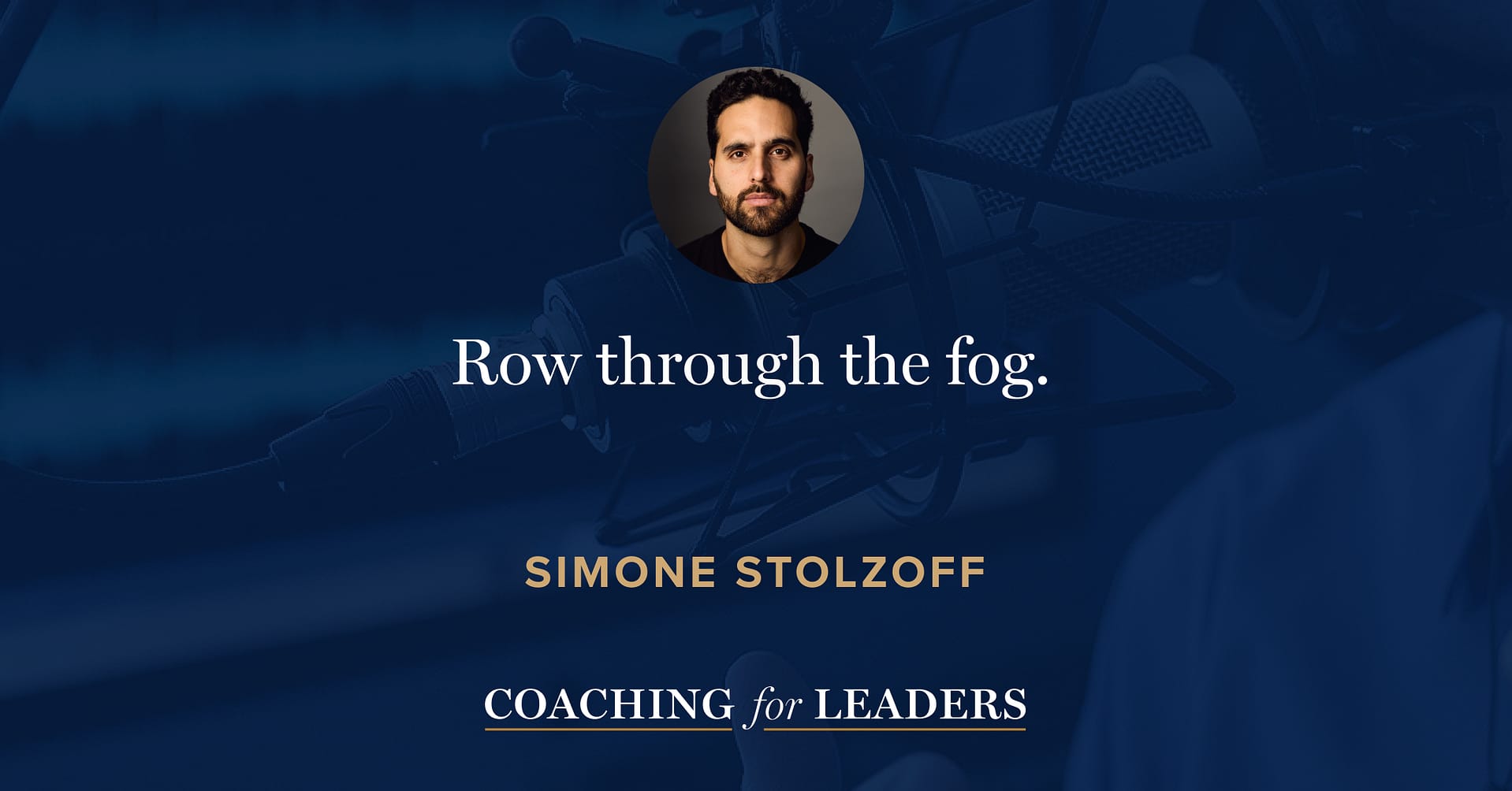
796: Build Your Tolerance for Uncertainty, with Simone Stolzoff

Row through the fog.
https://media.blubrry.com/coaching_for_leaders/content.blubrry.com/coaching_for_leaders/CFL796.mp3

Podcast: Download

Follow:
Apple PodcastsYouTube PodcastsSpotifyOvercastPocketcasts

Simone Stolzoff: How to Not Know

Simone Stolzoff is an author and journalist who explores big questions about work, meaning, and identity. A former design lead at the global innovation firm IDEO, his work has been featured in The New York Times, The Atlantic, The Wall Street Journal, The Washington Post, and on the TED stage. He is the author of How to Not Know: The Value of Uncertainty in a World that Demands Answers (Amazon, Bookshop)*.

I’m not sure about you, but I very much dislike uncertainty. And yet, basically the job of leadership is to not only deal with it but to help others thrive in the midst of it. In this conversation, Simone and I explore how to build your tolerance for uncertainty so you can lead much more effectively.

Key Points

  • We love certainty and our tolerance for uncertainty is decreasing due to the internet, smartphones, and AI access.
  • Organizations with higher uncertainty tolerance tend to be more innovative and adaptable.
  • We assume unwavering confidence breeds credibility, when in fact, research shows that those who admit what they don’t know are perceived as more credible.
  • Professional athletes have the same threshold for pain but a higher pain tolerance. We can develop a similar tolerance for uncertainty.
  • Find your anchor points. By knowing the key boulders you can hang onto in a storm, you are vastly better able to weather uncertain times.
  • Build to learn. Progress depends on uncertainty.
  • Row through the fog. Maintain faith that you will discover the next step by continuing to row.
  • Sometimes what we feel is most uncertain is actually more certain than we realize.

Resources Mentioned

  • How to Not Know: The Value of Uncertainty in a World that Demands Answers by Simone Stolzoff (Amazon, Bookshop)*

Interview Notes

Download my interview notes in PDF format (free membership required).

Related Episodes

  • How to Lead Better Through Complexity, with Jennifer Garvey Berger (episode 613)
  • Notice Disruption and Innovate Through It, with Steve Blank (episode 761)
  • The Counterintuitive Secret to Creativity and Focus, with David Epstein (episode 789)

Discover More

Activate your free membership for full access to the entire library of interviews since 2011, searchable by topic. To accelerate your learning, uncover more inside Coaching for Leaders Plus.
Build Your Tolerance for Uncertainty, with Simone Stolzoff

Download

Dave Stachowiak [00:00:00]:
I’m not sure about you, but I very much dislike uncertainty. And yet, basically the job of leadership is not only to deal with it, but to help others thrive in the midst of it. In this episode, how to build your tolerance for uncertainty so you can lead more effectively. This is Coaching for Leaders, Episode 796.

Dave Stachowiak [00:00:22]:
Production Credit: Produced by Innovate Learning, Maximizing Human Potential.

Dave Stachowiak [00:00:30]:
Greetings to you from Orange County, California. This is Coaching for Leaders, and I’m your host, Dave Stachowiak. Leaders aren’t born; they’re made. And this weekly show helps leaders thrive at key inflection points. And what do inflection points bring? Uncertainty. That’s just the nature of leadership. It’s certainly the nature of leadership today. And how we navigate uncertainty, and for leaders especially, how do we build our tolerance for uncertainty? It’s something that if we can do, helps us to be so much more effective in our work. Yes, for ourselves, but more importantly, for the people we lead, for the organizations that we have the privilege to support. Today, I’m so glad to be able to have a conversation to help us get better at this.

Dave Stachowiak [00:01:17]:
I’m so pleased to welcome to the show Simone Stolzoff. Simone is an author and journalist who explores big questions about work, meaning, and identity. A former design lead at the global innovation firm IDEO, his work has been featured in The New York Times, The Atlantic, The Wall Street Journal, The Washington Post, and on the TED stage. He is the author of How to Not Know: The Value of Uncertainty in a World That Demands Answers. Simone, such a pleasure to have you here.

Simone Stolzoff [00:01:47]:
Thanks so much for having me on, Dave.

Dave Stachowiak [00:01:48]:
Boy, the world does demand answers when we become leaders. Our tendency so much is to want to provide answers. And I think about how much, as human beings in general, we love certainty, and we just don’t have a lot of it right now in the world, especially now, do we?

Simone Stolzoff [00:02:10]:
Yeah, I think there’s 2 things going on. One is that the world is becoming more uncertain. So there’s this researcher from Stanford named Nicholas Bloom, and he’s been tracking global uncertainty since the early ’80s. And he’s found that the 5 highest measurements since he began collecting data have all occurred in the last 5 years. So you think about the pandemic and shifting tariff policies and wars overseas and AI. It’s no secret that the world is incredibly uncertain. But there’s another trend that’s less often discussed, which is equally important, which is that as a society, our tolerance for uncertainty is in decline. This is often attributed to the rise of the internet and, more specifically, the rise of mobile phones.

Simone Stolzoff [00:02:57]:
And the idea being that when we have access to limitless information, when we can track the real-time updates of the state of Hormuz or the real-time location of our children, access to more information hasn’t necessarily made us any wiser. It often just fuels our anxiety. Phones also create the expectation that answers should be readily available. I know for me personally, maybe 10 years ago, I would’ve been okay not knowing the name of a given actor, but now I feel an almost involuntary need to reach into my phone. So the world is getting more uncertain. Our tolerance for uncertainty is in decline, and that’s why so many leaders and the employees that they lead feel anxious and unmoored.

Dave Stachowiak [00:03:42]:
And isn’t it interesting how AI has just thrown gasoline onto that fire too, of wanting to have more certainty? I mean, I think about just the drives I have with our family in our car, of now that ChatGPT is literally a push button on the steering wheel where you can trigger it with CarPlay and ask any question.

Simone Stolzoff [00:04:03]:
Mm-hmm.

Dave Stachowiak [00:04:04]:
The conversations that come up in everyday interactions, just like in a vehicle, all of a sudden, you have this expert you can talk to at any moment, which on one level is super cool and interesting and rich. And on another level, I think it’s interesting how we don’t grapple with the, ah, I don’t know as much in conversations on a regular basis. At least I find that I’m doing that less. And it’s just like, it’s a powerful illustration of the point you just made.

Simone Stolzoff [00:04:36]:
Yeah, I think there’s 2 things. One is that these chatbots, or even Google before that, create the expectation that you should be able to get definitive answers to every question. And you and I both know there are some questions like, what is the future of my career? Or how will the economy progress in the next 2 years? That can’t be easily answered by a chatbot. The second thing is they rob us of the practice of sitting with what we don’t know. If we want to be able to build that capacity, to build that tolerance for uncertainty, we have to be able to expose ourselves to uncertain situations and not reach for the safest or the quickest way out. I think about this biologically. An ancestor of ours might have been in the jungle, and there’s a rustling in the bushes. If they don’t know the source of that noise, that uncertainty could be lethal.

Simone Stolzoff [00:05:29]:
The problem is that our brains are wired to seek certainty, even when it is not on offer. And so we lurch for the safe answer or the first answer, which isn’t always the optimal choice or the right way out.

Dave Stachowiak [00:05:45]:
I was thinking about that reality, and we had Lisa Feldman Barrett on the show a while back, just a brilliant neuroscientist, and she shared a bit of her research about when people get a terminal diagnosis, and they know the outcome is permanent, as in they’re likely to die from it, they actually report higher life satisfaction in their remaining time than people who have uncertainty about recovery. Like maybe they would recover, maybe they wouldn’t. And it seems like so counterintuitive on one level, like it’s a bit haunting. And at the same time, it’s such a strong indicator of like, what you just said of, how even when it’s of detriment to us personally, like the certainty the certainty we crave and the joy and happiness we find from that is so, so powerful, isn’t it?

Simone Stolzoff [00:06:40]:
One of my favorite studies is from the University College London. And what the researchers did is they separated the participants into 2 groups. And one group, they said, you have a 50% chance of receiving a painful electric shock. And the other group said, you have a 100% chance of receiving a painful electric shock. Now, you and I probably have an assumption about which group we’d rather be in. Put me in the 50% group, please. Then I might not be able to get shocked.

Dave Stachowiak [00:07:07]:
Yeah.

Simone Stolzoff [00:07:07]:
And in actuality, people in the 50% group were far more stressed and anxious than people who knew they were definitely going to be shocked. And it goes back to that point that you just made. We would sometimes rather know we were getting a bad outcome than have to grapple with the uncertainty of not being sure. Another example comes from the healthcare space. There was this great study of people who were going through a breast cancer journey, and they found that the period between getting a biopsy and getting a diagnosis was often the hardest part of the entire breast cancer process.

Dave Stachowiak [00:07:48]:
Hmm.

Simone Stolzoff [00:07:48]:
More difficult to deal with than chemo or surgeries. It was that not knowing, that uncertainty. And so you can extrapolate and think about all the ways that this might affect your team or your business. We have this aversion to ambiguity, this aversion to uncertainty. But the problem is that when we grasp certainty, especially about something in the future where certainty is a fallacy, it has this narrowing effect. It can close our minds. And yet when we are able to maintain a sense of not knowing, to be able to be uncertain and okay about it, we literally are open to more possibilities. And so that’s really the main argument of my book.

Simone Stolzoff [00:08:33]:
It’s that if we are able to build uncertainty tolerance as individuals, as professionals, as leaders, we can discover possibilities that are greater than what we could have ever imagined, that might be sitting on the other side of our discomfort.

Dave Stachowiak [00:08:48]:
And in a way, we sort of know that intellectually, but we so forget it. And you write on this: “Organizations with higher uncertainty tolerance tend to be more innovative and adaptable because of their willingness to take the types of risks that lead to breakthroughs”. And I think about that, and if we think about almost any organization that’s had a major breakthrough, that’s been a leader in their space, that’s been innovative in some way, almost always it’s the ability to work through uncertainty and to be able to have a higher tolerance for that. It is, it’s, it’s so important, and yet, like, we, we all struggle with that.

Simone Stolzoff [00:09:26]:
Yeah, definitely. I’ll give you one example to maybe make this a little bit more concrete. In the early 2010s, there was this startup in the Bay Area called Tiny Speck, and they built this massive online multiplayer game. This company was sort of the belle of the ball. They raised $17 million before they launched. Their launch was covered in the New York Times, and they had tens of thousands of active players from the very beginning. Yet the founder had this sneaking suspicion that something about the business wasn’t quite right, that they weren’t on a sustainable path. So less than 2 years into founding the company, he decided to do something that others thought was crazy.

Simone Stolzoff [00:10:07]:
He shut the game down. He offered to make his investors whole. He gave his employees that wanted to, the opportunity to walk away. He decided to pivot the company around this internal communications tool that they had built to collaborate across different offices. And if you talked to the founder at the time, he said, “At the moment, we did not know the opportunity we were chasing. We discovered that opportunity rather than planning for it”. And that tool that he decided to pivot the company around, you and I both know today as Slack. And that founder, Stewart Butterfield, became one of the most successful enterprise software executives of all time.

Simone Stolzoff [00:10:50]:
And as you can imagine, it’s a nice sort of bow on the end of the story that Slack sold to Salesforce for, I think it was a bajillion dollars. But what I like about it is that it shows that Butterfield’s willingness to turn toward what he didn’t know, to turn toward the uncertainty of what this new product could become, allowed him to discover an opportunity that was even greater than the opportunity that he was chasing when he was building this massive online multiplayer game. In statistics, they sometimes call this transcending a local maxima to find a global maxima. I like to think about it as a mountain climber who’s standing on a hill, who thinks they’re on top of the world, but unless they’re willing to descend that first hill, they’ll never discover a higher peak that might be waiting just around the corner.

Dave Stachowiak [00:11:41]:
And so often when folks step into big new roles, we feel like we need to have confidence and we need to have the answers. And even though we know intellectually that’s not always the right way to go, we just tend to— we tend to start there and often stay there too. And you write on this: “We have it backward. We assume unwavering confidence breeds credibility, when in fact research shows that those who admit what they don’t know are perceived as more credible. The most effective leaders are not know-it-alls”. And I think about what you wrote, and I think about my own experience of the people who have been the most effective leaders in my life are the people who were willing to talk about what they didn’t know and admit failure, and struggle through things. And yet, it’s so interesting when we get into many of those positions ourselves, our first inclination is to try to figure it all out and to have as much certainty as possible.

Simone Stolzoff [00:12:40]:
Yeah, it’s a balancing act. We also don’t want a leader that’s all the way on the other end of the spectrum who just throws out their hand and says, “I have no idea what’s happening. I don’t have a vision for this company”. I think we are all familiar with the hubristic leader who tells you exactly what’s going to happen. There’s a real allure, maybe like a cult leader, of someone who tells you exactly how the future is going to look or exactly what steps you’re going to take. I think you’re exactly right that the best leaders, the most innovative or progressive leaders, are the ones who are confident about what they know, who are willing to admit what they don’t know, and who are also willing to run experiments to learn. I think that last part is key. I think the business literature is riddled with different case studies of people who stayed too fixed to a strategic plan and weren’t able to notice the changing conditions around them.

Simone Stolzoff [00:13:33]:
So you need to have conviction, you need to make bets, you need to be able to put a stake in the ground, but also stay open-minded and understand that maybe if the data, or the world, or the economy around you is changing, you might need to update that plan as well.

Dave Stachowiak [00:13:50]:
You and I have both said the word tolerance already in this conversation, and I’m thinking about that a lot and like, how do we get better at navigating uncertainty? And there’s a study you talk about in the book that I have not been able to stop thinking about since I read it. And I was, I was thinking about it because it’s baseball season here in the States. And anytime I watch baseball on TV, or we go to a game, inevitably at some point in the game, somebody gets hit by the ball. And usually it’s the person who’s the batter. And they take a pitch in their arm or leg or something. And these balls, they’re coming at 100 miles an hour. And you see like them react with the pain when they get hit by it. And I think to myself, if I had gotten hit by that ball, I’d be down for days.

Dave Stachowiak [00:14:38]:
And, and then you see like a lot of the time, the batter will like, they’ll walk it off for a second. And then, they’ll go to base, and then they’ll end up staying in the game and scoring runs, and it’s like almost it never happened. And I mentioned that because of what you wrote in the book. You cite a study from the University of Heidelberg found that while athletes and non-athletes have the same pain threshold, the point at which they feel pain, athletes have a higher pain tolerance, the amount of pain that they’re capable of bearing. The researchers found that this tolerance is built when athletes experience pain, confront limitations, and push through. Similarly, when we confront uncertainty and the discomfort it may trigger, we get better at coping with it. And I was thinking about that, that it’s, it’s not necessarily— the pain isn’t any different, but what’s different is the response to it, isn’t it?

Simone Stolzoff [00:15:32]:
Yeah. You know, you think about an entrepreneur, and they’re exposed to the same market conditions as you and I. They still have to deal with the shifting winds around them. And yet I think what differentiates entrepreneurs or people that are true innovators is their tolerance for uncertainty, their tolerance for the sort of exposure that risk enables. And so it isn’t that they aren’t feeling the uncertainty or, in the metaphor, that they aren’t feeling the pain, they just have a higher tolerance for it. And you’re absolutely right, organizations that have higher uncertainty tolerance tend to be more innovative because they’re willing to take the types of risks that lead to breakthroughs. They tend to be more adaptive because they’re able to weather the inevitable ups and downs of market cycles.

Simone Stolzoff [00:16:24]:
But it also exists on an individual level too. People who personally have higher levels of uncertainty tolerance tend to be more creative. I think about things like a genre-busting artist, or a scientist looking to make a breakthrough. And in order to produce truly original work, in order to lead a team to do innovative things, you have to be willing to get to the threshold of what you know and to persist nonetheless. It isn’t sort of a blind optimism to say that we’re going to chart the course and we’re going to keep going no matter what we see. But in the words of a NASA scientist that I interviewed for the book, he said, when we make these mission plans, at the top of the sheet of paper we write, this is a plan from which we will inevitably deviate. And I like that way of thinking. You should still have a plan.

Simone Stolzoff [00:17:17]:
You should still be willing to take bets, but also keep your mind open to the inevitable uncertainty that you’ll find along the way.

Dave Stachowiak [00:17:26]:
One of the strong messages I hear in your work is that, hey, we can get better at this. We can build our tolerance for uncertainty. And by doing that, all the things you just mentioned, like, we get better at, having those outcomes for our organizations, for our teams. And I think about that: Leaders aren’t born, they’re made, that I say at the start of every episode. There are some ways we can really start to build our tolerance for this that is in service of all those positive indicators happening. And one of the invitations you have for us, to nudge us in that direction is something you call find your anchors. Tell me what you mean by that.

Simone Stolzoff [00:18:05]:
So the idea with finding your anchors is that when we are certain about some aspects of our life or our business, it makes it easier to hold uncertainty in others. So in your personal life, your anchors might be something like your commitment to live in a particular place or your commitment to your spouse. In a business context, it might be your commitment to your mission or to serve a particular set of customers or to a set of values. But when we have those anchors, they become like the steady boulders that will remain constant and that all of the changing winds around you. I’ll give you one example, which is—

Dave Stachowiak [00:18:44]:
Please.

Simone Stolzoff [00:18:44]:
In the beginning of the pandemic, in sort of early 2020, Airbnb was about to go public. It was this global travel company. It was heralded as potentially going to be one of the largest tech IPOs of all time. And then global travel shut down seemingly overnight. And could you imagine being the leader of Airbnb, being Brian Chesky in that moment in time? You go from your highest high about to finally take your company public to losing 80% of your business overnight. And he did something right when the pandemic was announced that was really inspirational to me, which is, he wrote down a series of principles that he wanted to abide by. Things like keep all stakeholders in mind, win the next travel season, don’t be the villain, look for the opportunity in this crisis. Those principles were the lighthouses, were those sort of guiding posts that allowed him to navigate this period of unknowns.

Simone Stolzoff [00:19:48]:
He found anchors in other ways too. Whereas he used to have biweekly all-hands meetings with the company, he changed those to weekly. Where he used to meet with his senior leadership team weekly, he changed those meetings to daily. The idea being those touchpoints became anchors. Even though he could not have certainty about the outcome, he brought more certainty to the process of being transparent, of overcommunicating. And some days the update was, “I’m sorry team, we don’t have an update for you today”. But by creating that scaffolding, it does a few things. One is it starts to chip into information void.

Simone Stolzoff [00:20:29]:
And in information voids, that’s where that catastrophizing or worst-case scenario thinking or anxiety tends to fester. And the second thing, is it created a scaffolding for him to incrementally find more certainty. Little by little, he would gather more information. He would take little bets. He would figure out what aspects of the business might be continuing to grow and are continuing to work. And by sticking to his principles and finding those anchors for his team, he was able to weather the storm, and they came out on the other side even stronger.

Dave Stachowiak [00:21:06]:
I love that analogy you paint of having a boulder, that if you have a boulder in a storm, and you know where it is, and you can grab onto it and hang on to it, that you’re going to stay in that spot; at least you’re gonna stay in that spot way longer than you would if that boulder wasn’t there. And by identifying where that anchor point is, when those times come, you are so much more likely to be able to tolerate uncertainty, not for the purpose of like, uncertainty, but because we know that leaders who do that better, more effectively, longer, are able to then really have the breakthroughs and take the risks that are going to lead to great outcomes.

Simone Stolzoff [00:21:46]:
Yeah, we need both uncertainty and certainty in order to lead. It isn’t just about being the person who’s always comfortable with the unknown or seeking out discomfort. Having a sense of certainty of what you stand for, as a team, as an individual, or as a business, those are the things that become those boulders that make it easier to hold uncertainty in other facets of your business.

Dave Stachowiak [00:22:09]:
Yeah, in a way, it’s kind of— you can almost think of it like a paradox. To get better at uncertainty, I actually am going to find a couple of things that I’m really certain about. And by indexing on those, it gives me the openness, the opportunity to then have the other things emerge, and to weather the storm in a way that I might otherwise not have. And it’s, again, so counterintuitive in a way, but by doing so, it makes all the difference.

Simone Stolzoff [00:22:37]:
I think about a great mission statement, and in many ways, I think a mission statement is to provide that anchor, to provide that sense of this is what our organization is trying to do in the world, or organizations that have really clear values. I think the values themselves may differ from organization to organization, but the important thing is that not just you have them, but you live them. You make them explicit. You make them clear for every employee so that they know that, okay, even if this is a down quarter, even if there are some headwinds to this business, we still know what we can hold onto. And doesn’t feel like we’re just getting blown by the wind.

Dave Stachowiak [00:23:23]:
You also invite leaders to build to learn. What does that look like?

Simone Stolzoff [00:23:28]:
So I cut my teeth at this global innovation firm called IDEO, and I’m sure many of our listeners might be familiar with the organization or with design thinking, the sort of mindset or process that we would bring to a lot of our projects. And what I think is most important from design thinking or human-centered design is this idea that the fastest way to learn is to build. We used to have this saying internally that you should never come to a meeting without a prototype. And the reason we would say this is because so often, especially in businesses full of very smart people, you can spend all day talking, you can spend all day discussing or debating what you might build, but until you actually build it, until you actually make it tangible, you’ll never learn what feedback you might need to make it better or to validate it or invalidate what you were thinking. So an example is that we were doing a project for Sesame Street and creating Sesame Street’s first-ever mobile app.

Dave Stachowiak [00:24:33]:
Hmm.

Simone Stolzoff [00:24:33]:
And it’s a high-profile project. You wanted to get it right. You wanted to impress the clients, but the team did something really smart. Which is, instead of spending weeks and weeks creating a software prototype that might have cost thousands of dollars, on the first day of the project, what they did is they cut out a picture of an iPhone, plastered it to a piece of cardboard, and cut out the middle that would’ve been the screen, and then had one of the teammates act out the different actions that maybe Elmo would do on the screen and showed it to the client right away. And by making it tangible in 2 hours, spending $5, they learned so quickly what might work or what might not work in the eyes of the client. And so I think about how you might be able to take this principle and apply it to other aspects of your business. I think it’s one of the upsides of these generative AI tools is that they make things tangible so quickly. And so next time you’re thinking about proposing a new pilot or have an idea for a new product or a program that you might want to try on your team, how can you give your team something tangible to react to or empower your teammates to bring that tangibility into the meetings that you are having? I think so often, particularly in large organizations, it’s easy to get caught up in the bureaucracy, the process, the Bermuda Triangle where 12 people have to sign off on a project before any steps can be made.

Simone Stolzoff [00:26:07]:
But I actually think that clarity comes from taking action. It is often the result of taking action, not a necessary precursor before you move.

Dave Stachowiak [00:26:19]:
Another invitation you have for us is to row through the fog. And you say that adaptability beats prediction. Tell me about that distinction.

Simone Stolzoff [00:26:34]:
So maybe we can start with a metaphor, which is that being a leader, being an innovator, can sometimes feel like you’re sitting in a rowboat on a lake that’s shrouded in very heavy fog. You might not be able to see very far in front of you. You might not be able to know exactly where you’ll end up. And that can be destabilizing, especially when there’s other people in the boat with you, looking to you for direction. But I think as a leader, you have 2 jobs. One is to maintain faith that you’ll eventually reach land. Remember, you’re on a lake. And the second is to keep rowing.

Simone Stolzoff [00:27:19]:
And I think that part is the key, that through the action, through the rowing, that’s how you start to move through the fog. Often we can fall into a trap of wanting to predict exactly what the future holds. Turn on the TV today, and you’ll see a pundit telling you exactly when the market is going to crash or who’s going to win the game, who’s going to win the election. But in actuality, when it comes to anything that hasn’t happened yet, you can’t know for sure. There’s this researcher named Phil Tetlock who collated 2 decades’ worth of predictions from some of the smartest people in the world, so economists and politicians and journalists, and then compared those predictions to what actually happened. And his canonical finding did not mince words. He says the average expert was roughly as accurate as a dart-throwing chimpanzee.

Simone Stolzoff [00:28:21]:
So one reason why you shouldn’t overly rely on these predictions is that, as a species, we’re not very good at making them. And the second is that I was interviewing a futurist for my book, someone who spends time trying to anticipate trends. And she says that when you’re certain about the future, it’s incredibly disempowering. I imagine if you’re listening to this podcast, you fancy yourself a changemaker, a leader, someone who wants to make an impact. But when you are certain about exactly what the future looks like, it robs you of the ability to shape it yourself. And so in this way, I think my book is a book of optimism, is to say that yes, we don’t know, and often we can’t know what the future holds, but isn’t that great?

Dave Stachowiak [00:29:13]:
Yeah.

Simone Stolzoff [00:29:13]:
Isn’t that where the magic and the serendipity and the surprise comes from?

Dave Stachowiak [00:29:18]:
Yeah.

Simone Stolzoff [00:29:18]:
Isn’t that where the empowerment and that sense that you can actually be the change that you wish to see is born? And so if you just take away one thing from the book, it’s that uncertainty is not necessarily a problem to be solved. In fact, it can be the birthplace of possibility.

Dave Stachowiak [00:29:36]:
And you have this beautiful passage in the book where you talk about, imagine knowing everything that was coming in your life. Imagine knowing everything for your family. Imagine going on a first date and knowing exactly how it was all going to play out. What would be the joy in that? Yes, you would have certainty, but what would be the joy in life? And I just think about that in the context of this, and also, just the reality that action often precedes clarity, like you were saying. As you were talking about that, I was thinking back to— I work with a subset of our members every year in our Academy. And we are working on building better behaviors as leaders, all of us, and being able to thrive through the inflection points that all of us deal with. And I remember one of our members a while back who was an executive director for a nonprofit; she came to us and said, one of the things I need to do is I need to have a better relationship with my direct reports.

Dave Stachowiak [00:30:32]:
I’m not doing that enough. I’m not sitting down; I’m not having enough one-on-ones. And we were all like, great, great, great starting point, you know. And she started working on having regular meetings with her direct, direct reports more so than she was. And she came back to us a couple weeks after starting that and said, I’ve been having all these meetings. And I realize how much worse the problem is than I thought. And what she had figured out by starting to have these meetings is not only did she not know what was going on, she realized that none of them knew what the other people in the organization were working on. Like, there were so many silos.

Dave Stachowiak [00:31:11]:
Like, she had sort of known that a little bit, but like sitting down and having those meetings, it became unbelievably clear how siloed the organization was, like more so than she had any idea of, like how bad it was. And I remember us having this conversation, her coming back and saying she was so discouraged, as any of us would be, like, as a leader having that experience. And a bunch of us listened to her, and we’re talking through it. And we said, in a way, as difficult as this is, now you know something you didn’t know because you started before. And what she did was— I’m thinking about your rowboat analogy of like, she started rowing in a different direction. Then she said, I don’t need to be meeting with them more. They need to be meeting with each other more. And she totally changed her tactics on getting people together and doing some team building and things.

Dave Stachowiak [00:32:04]:
And Simone, it changed everything.

Simone Stolzoff [00:32:06]:
Mm-hmm.

Dave Stachowiak [00:32:07]:
It changed everything about how her organization worked together, and it broke down silos over the next few months of people starting to know what was happening and what wasn’t. But the thing that, like, I think is really interesting about that experience is she would never have gotten there if she hadn’t just started rowing the boat and actually running in, going the wrong way at first. But by going the wrong way, and by rowing the boat, it actually preceded the clarity she needed. And it just comes back to every— your invitation of like, be willing to row through the fog. Don’t sit in one spot, start moving. Even if you go in the wrong direction, you’re just so much more likely to proceed something that’s going to be helpful to you and your team.

Simone Stolzoff [00:32:47]:
Yeah, the other thing I love about that story is that she was willing to admit that she didn’t know what the source of the problem was.

Dave Stachowiak [00:32:56]:
Yeah.

Simone Stolzoff [00:32:57]:
And I think so often as leaders, we have this sort of hubristic posture, where we assume that we have to know exactly what’s going on, or at least project a sense of certainty. But your client’s willingness to admit that she may be wrong, or that she didn’t know why there were so many silos in her organization, was the precursor to her finding out. Certainly, if we want to be able to grow or develop as leaders, we have to admit what we don’t know, which can be uncomfortable. It can be something that has to buck our status quo bias, or our desire to stay in these comfortable silos or bubbles that we tend to spend our days. But by being willing to expose yourself to that discomfort, you go from a place of stagnancy to a place of learning and growth and development.

Dave Stachowiak [00:33:57]:
Which is exactly why I often ask people at the end of conversations what they’ve changed their minds on in their work. And I’m curious, as you have studied uncertainty, helped people to grapple with it, get better at it, build their tolerance for it. As you’ve done that over the last few years, what, if anything, have you changed your mind on?

Simone Stolzoff [00:34:17]:
So much. One thing recently, at least, I’ve been self-employed for about 5 years or so, writing books and giving talks, and I often would daydream about the stability of working for a large organization. I spent many years in the corporate world and in large consultancies. And one thing that I’ve changed my mind on recently is I actually think that being in a large organization is not as stable as we often assume. And maybe this is just a recency bias based on the layoffs in the pandemic or in Silicon Valley as of late, but I actually think that building a business of one or building a sense of IP or building a portfolio career where you have many different streams of income is potentially even more stable in these uncertain, precarious times. It’s similar to how an investor benefits when they have a diversified portfolio of stocks. When, as a solo business owner, I have a sort of diversified portfolio of revenue, it can actually be a source of strength, particularly when the world around you is unstable, uncertain, and precarious. So who knows? I’m still open to changing my mind back and maybe getting another corporate job someday.

Simone Stolzoff [00:35:39]:
But I just like the idea that what I was romanticizing, I maybe already had.

Dave Stachowiak [00:35:44]:
The grass always looks greener on the other side, doesn’t it? On so many things.

Simone Stolzoff [00:35:48]:
It does indeed.

Dave Stachowiak [00:35:49]:
Simone Stolzoff is the author of How to Not Know: The Value of Uncertainty in a World That Demands Answers. Simone, thank you so much for your work.

Simone Stolzoff [00:35:58]:
Thanks for having me on the show.

Dave Stachowiak [00:36:06]:
If this conversation was helpful to you, 3 other episodes I’d recommend. One of them is episode 613: How to Lead Better Through Complexity. Jennifer Garvey Berger was my guest on that episode, and we talked about the distinction between what’s complicated and what’s complex. So many things are complicated, but they have a clear end goal or a clear answer. As these days, we all know, so much of leadership is not that. It is also complex, that the rules are changing as we go. There is not often a clear answer. Nothing is more uncertain than that.

Dave Stachowiak [00:36:35]:
In that conversation, Jennifer and I talked about how do we lead better in those situations, a great complement to this conversation, of course, episode 613. Also recommended episode 761: Notice Disruption and Innovate Through It. Steve Blank was my guest on that episode, and we talked about this inflection point we’re all at with technology and AI right now. But we didn’t talk about it as in right now, and models, and what does the future look like. We went back 100 years and looked at how did organizations and leaders make the transition from the companies that were building carriages to the automobile, another huge inflection point in technology. And there’s some fascinating insight on what organizations did, and leaders did and did not do that resulted in them being successful or not. So much that we can learn.

Dave Stachowiak [00:37:22]:
History doesn’t repeat itself but it rhymes very often. Episode 761 for that. And finally, I’d recommend the recent episode with David Epstein, episode 789: The Counterintuitive Secret to Creativity and Focus. How do we get more creative? How do we focus ourselves better? Well, it turns out it is not having all the time in the world, having all the budget and all the resources. In fact, it’s the exact opposite: having a limited constraint. And that constraint can often help us move forward. It’s counterintuitive.

Dave Stachowiak [00:37:51]:
And yet we see again and again in practice and in research how true that is. David’s most recent book highlights that. We talked about it in detail on episode 789. All those episodes you can find on the coachingforleaders.com website. If you haven’t before, set up your free membership at coachingforleaders.com. I’m inviting you to do that so that you get access to the entire library that I’ve aired since 2011, more importantly searchable by topic. All the episodes are available on all the podcast apps for free. What is not available, though, is the ability to search and find what you’re looking for by topic. So we’ve made that as easy as we can inside of the free membership so you can find what you’re looking for more quickly, plus all of my book and interview notes, my own audio library, tons more resources inside the free membership.

Dave Stachowiak [00:38:37]:
coachingforleaders.com is where to go in order to set that up. Coaching for Leaders is edited today, as always, by Andrew Kroeger. Next Monday, I’m glad to welcome Olivia Cabane to the show. We are going to be talking about how to improve your charisma. Yes, you can get better at charisma, and we’re going to talk about how next week. Join me for that conversation with Olivia. Have a great week and see you back on Monday.

Topic Areas:Personal Leadership
cover-art

Coaching for Leaders Podcast

This Monday show helps you discover leadership wisdom through insightful conversations. Independently produced weekly since 2011, Dave Stachowiak brings perspective from a thriving, global leadership academy of managers, executives, and business owners, plus more than 15 years of leadership at Dale Carnegie.

Listen Now OnApple Podcasts
  • More Options
    • YouTube Podcasts
    • Spotify
    • Overcast

Activate Your Free Membership Today

Access our entire library of Coaching for Leaders episodes from 2011, searchable by topic.
Listen to the exclusive Coaching for Leaders MemberCast with bonus content available only to members.
Start Dave’s free audio course, 10 Ways to Empower the People You Lead.
Download our weekly leadership guide, including podcast notes and advice from our expert guests.

... and much more inside the membership!

Activate Your Free Membership
IMAGE
Copyright © 2026 · Innovate Learning, LLC
  • Plus Membership
  • Academy
  • About
  • Contact
  • Dashboard
×

Log in

This site is protected by reCaptcha and the Google Privacy Policy and Terms of Service apply.
 
 
Forgot Password

Not yet a member?

Activate your free membership today.

Register For Free
×

Register for Free Membership

Access our entire library of Coaching for Leaders episodes from 2011, searchable by topic.
Listen to the exclusive Coaching for Leaders MemberCast with bonus content available only to members.
Start Dave’s free audio course, 10 Ways to Empower the People You Lead.
Download our weekly leadership guide, including podcast notes and advice from our expert guests.

... and much more inside the membership!

Price:
Free
First Name Required
Last Name Required
Invalid Username
Invalid Email
Invalid Password
Password Confirmation Doesn't Match
Password Strength  Password must be "Medium" or stronger
This site is protected by reCaptcha and the Google Privacy Policy and Terms of Service apply.
 
Loading... Please fix the errors above