• Skip to primary navigation
  • Skip to main content
  • Skip to primary sidebar

Coaching for Leaders

Leaders Aren't Born, They're Made

Login
  • Plus Membership
  • Academy
  • About
  • Contact
  • Dashboard
  • Login
Episode

794: Build the Resilience to Match Your Ambition, with Jia Jiang

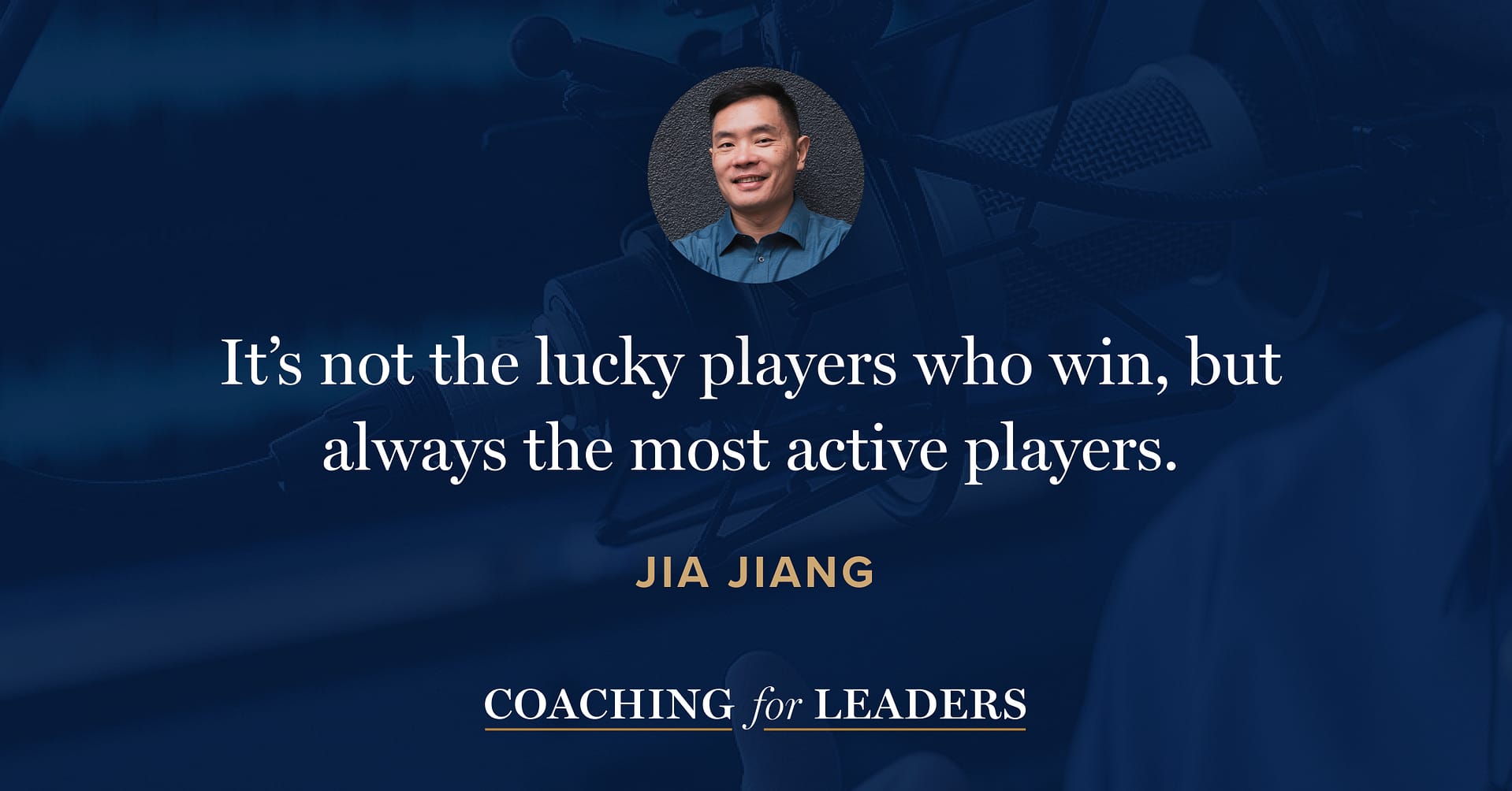
It’s not the lucky players who win, but always the most active players.
https://media.blubrry.com/coaching_for_leaders/content.blubrry.com/coaching_for_leaders/CFL794.mp3

Podcast: Download

Follow:
Apple PodcastsYouTube PodcastsSpotifyOvercastPocketcasts

Jia Jiang: Easy Discipline

Jia Jiang is an award-winning speaker, entrepreneur, and the bestselling author of Rejection Proof. His TED Talk is among the top 1% most viewed of all time, and he has spoken to over 400,000 people worldwide. He is also the creator of Rejection Therapy, a platform designed to help people overcome fear and build resilience, and is the author of Easy Discipline: An Unconventional Way to Achieve Ambitious Things (Amazon, Bookshop)*.

No pain, no gain. We’ve all heard that before – and it’s true that one way to achieve is through a lot of pain. Good news: there are other ways, too. In this conversation, Jia and I explore how to harness the ambition you already have through easy discipline.

Key Points

  • Pain tolerance is admired and celebrated. When greatness comes through pain, our society cheers it. When greatness comes through loving work, we are suspicious.
  • Hard discipline and easy discipline both produce results, but easy discipline does so with more joy and sustainability.
  • Ambitious people often suffer from High Eyes, Low Hands Disease. Higher ambitions create higher expectations that make a gap seem harder to transcend.
  • In the game of Catan, it’s not the lucky players that win; it’s the most active players. Professional learning follows the same pattern.
  • The momentum loop is the practice of early action generating greater fuel for later action. Even wrong movements are almost always superior to standing still.

Resources Mentioned

  • Easy Discipline: An Unconventional Way to Achieve Ambitious Things by Jia Jiang (Amazon, Bookshop)*
  • Jia Jiang’s speaking

Interview Notes

Download my interview notes in PDF format (free membership required).

Related Episodes

  • How to Change Your Behavior, with BJ Fogg (episode 507)
  • How to Get Out of a Rut, with Anne-Laure Le Cunff (episode 747)
  • How to Help People Flourish, with Marcus Buckingham (episode 778)

Discover More

Activate your free membership for full access to the entire library of interviews since 2011, searchable by topic. To accelerate your learning, uncover more inside Coaching for Leaders Plus.
Build the Resilience to Match Your Ambition, with Jia Jiang

Download

Dave Stachowiak [00:00:00]:
No pain, no gain. We’ve all heard that before, and there’s a reason we’ve heard it before, because it’s true. One way to achievement is through a lot of pain. Good news, though, there are other ways too. In this episode, how to harness the ambition you already have through easy discipline. This is Coaching for Leaders, episode 794.

Dave Stachowiak [00:00:25]:
Production Credit: Produced by Innovate Learning, Maximizing Human Potential.

Dave Stachowiak [00:00:33]:
Greetings to you from Orange County, California. This is Coaching for Leaders, and I’m your host, Dave Stachowiak. Leaders aren’t born; they’re made. And this weekly show helps leaders thrive at key inflection points. One of the realities that happens at an inflection point, whether it is a new challenge, a new opportunity, a new position, or we just find ourselves being challenged in new ways. Is that so many of us have such high ambitions for ourselves, for our work, for our learning, for our growth, as we should, right? But the resilience that we often need to match that ambition doesn’t show up consistently. At least it doesn’t show up in the long run. A lot of times we are very good at starting strong, but then we fall short.

Dave Stachowiak [00:01:23]:
Today, a conversation on how we can help our resilience match our ambition. And I’m so pleased to welcome an expert who’s done so much thinking on this, is going to help us to do this so effectively. I’m so pleased to welcome to the show Jia Jiang. He is an award-winning speaker, entrepreneur, and the best-selling author of Rejection Proof. His TED Talk is among the top 1% most viewed of all time, and he has spoken to over 400,000 people worldwide. He is also the creator of Rejection Therapy, a platform designed to help people overcome fear and build resilience. And is the author of Easy Discipline: An Unconventional Way to Achieve Ambitious Things. Jia, what a pleasure to have you on the show.

Jia Jiang [00:02:06]:
Hey, Dave, thank you for having me. I’m so glad to be here.

Dave Stachowiak [00:02:09]:
I am too, because I love the way you think, because it’s different than the way I think about so many things; you have just a wonderful gift for taking some of the conventional wisdom stories, mantras that we think about, and thinking about it in a new way that’s so helpful. And one of the stories you talk about in your work that comes out is the ancient Greek story of Sisyphus. I think many people have heard it. But I’m wondering if you could remind us of the story. But more importantly, perhaps how you think about this story a little differently, because you have a way of looking at it that I’ve never heard before. And I think it’s really powerful.

Jia Jiang [00:02:50]:
Sure. So when you think about Sisyphus, this is a classic story of the man pushing a rock up a hill. You see, in Greek mythology, Sisyphus is a very smart and even cunning king, and he cheated death. He made Zeus really mad, so the Greek god, and he put a curse on him: he would push up this rock on the hill forever. Every time before the rock hits the top of the hill, it will roll back down to the bottom, and Sisyphus would have to push it again, and this goes down eternally. Right?

Jia Jiang [00:03:24]:
And it’s just like all Greek mythology stories. It’s, it’s meant to teach us something. It teaches us the futility of ambition, right? You try but never win. You almost make it, but you don’t. A lot of people take that as they see this in their own lives, that they repeat, their ambition doesn’t come to fruition. The thing is that, so that’s a classic story, right? You, you, you, I’m sure you’ve heard of this story.

Dave Stachowiak [00:03:49]:
Oh yeah.

Jia Jiang [00:03:49]:
Yeah, but when I think about this story, I see it otherwise, and I just ask myself a question: what is Sisyphus thinking at that moment? Is he even thinking at all? So if he’s not, meaning he’s just brain-dead, right? The curse is on him; he just does this. Then I’m like, well, that’s not a tragedy per se. It’s not even a curse because the guy’s dead, right? He’s just like a zombie doing this, like a horror show. However, if he had agency, right? If he’s actually thinking, that means he must have chosen to go back down to the bottom and push rock again. He’s a smart guy, right? Smart king. He knew this wouldn’t succeed. He tried the first time, the hundredth time, and the millionth time, right? He never gets to the top.

Jia Jiang [00:04:35]:
He’d be like, let me try something else. Let me buy some ice cream. Let me get some coffee. You know what I mean? Let me get something. Let me try another endeavor. Let me maybe run a marathon instead of pushing this rock up forever. So if the curse is only on the rock, not on him, just he could never get to the top. The fact that he’s still pushing, it only means one thing.

Jia Jiang [00:04:54]:
He loves pushing the rocks, right? He’s just the one who decides to keep pushing even though he can never win.

Dave Stachowiak [00:05:00]:
Hmm.

Jia Jiang [00:05:00]:
Now, the thing is, in real life, if we think about Sisyphus in the real world, I mean, it doesn’t exist, right? This is a— this is a Greek mythology. But if that person does exist, we would make statues for him. We would think that guy has the best work ethic ever. And that guy would not only get to the top, he would get to one top after another, because with that type of determination and discipline, he would accomplish so many things. But the thing is, real, real-world Sisyphus, like my version of Sisyphus, do exist in this world. They’re the people who use the love of the work, not just for the ambition to drive them. Those are the people who actually succeed in the long term. You know, from the outside you think, wow, they work really hard, they got great work ethic.

Jia Jiang [00:05:47]:
But if you ask them, they’re like, you know, I just love the work. I just want to— I enjoy what I’m doing. I’m using my enjoyment to fuel myself. They get to the top of industries. They are the real leaders of the world, and they change industries to change the world. So that’s how I see my version of Sisyphus. And I think there’s so much learning we can go from there.

Dave Stachowiak [00:06:08]:
Indeed there is. And I think that goes right to the distinction you paint in your work between hard discipline and easy discipline. Tell me about that distinction.

Jia Jiang [00:06:18]:
So hard discipline is this classic idea that we need to have discipline. The discipline is we need to tolerate pain. We need to do things, like, to succeed, we need to do things we don’t want to do. I grew up in China. I was trained in this classic Chinese idea. The word is called chī kǔ. It means eating bitterness. It just means you have an ambitious goal, a noble goal.

Jia Jiang [00:06:42]:
So what you want to do is just do the things you hate, right? If you eat enough bitterness, you come out to the other end, you achieve your goal. So that’s, that’s, you know, I translate that into hard discipline and the classic way we see discipline. The thing is, I hate hard discipline. I hate chī kǔ. I hate eating bitterness.

Dave Stachowiak [00:07:05]:
Me too.

Jia Jiang [00:07:06]:
Because I’m not good at eating bitterness. I don’t want to eat bitterness my whole life. Who wants to do that? And moreover, it doesn’t work because you’re going against human nature. You look at all these New Year’s resolutions we do for us personally, right? And also people set up these goals, these corporate goals. The thing is, the vast majority of them, you know, are not kept. So there’s only 9% of people who make New Year resolutions keep them, because it’s based on hard discipline. You want to lose weight, you want to make more money, you want to have a— make more sales. So let’s do hard things.

Jia Jiang [00:07:42]:
You can do that for a week or two, and then by the third week, you are like, this is tough, let me try something else. And then you fall— it falls by the wayside; you fail. Now, if you flip that, instead of using hard discipline, instead of saying, I’m just going to have a goal, then try to eat bitterness my way to that goal. What if you have easy discipline? What if you set your goals to be like, I’m going to enjoy this? I’m going to figure out ways to actually love the work, to do the work itself. And I mean, of course I want to get the result, but let me focus on doing what I’m doing, like the input goals. And enjoy the input goals, and the outcome will take care of itself if I can do this for long term. So it’s much more sustainable, but also you become much more creative and innovative because you love the thing you do.

Jia Jiang [00:08:31]:
You start experimenting, you start trying, you become think, like an artist, and then you start changing things. You start doing things that’s going with your human nature rather than against it, and that’s how you succeed in the long term.

Dave Stachowiak [00:08:45]:
Yeah. And going back to the Sisyphus example, it’s not about like, okay, I didn’t get to the top of the hill. It’s enjoying the process of moving the stone up the hill, right? And I think what’s really interesting about this, and you zero in on this so much in your work, is the cultural aspects and narrative, especially in Western culture around this, that we all have sort of bought into. And you have a paragraph in the book that just paints this picture beautifully, and I’m going to read it. You say: Moreover, pain tolerance is much more admired and celebrated because hard discipline goes against human nature. It’s seen as a superior and even superhuman ability. If someone tells you she has achieved greatness because she can tolerate much more pain than you, you tell her she is a superhero. But if another person tells you that she has achieved success because she loves her work so much that she can’t stop, you call her a workaholic and tell her to see a therapist.

Dave Stachowiak [00:09:47]:
And I read that, and I was like, wow, it’s so true, isn’t it? That’s how our society paints this picture, doesn’t it?

Jia Jiang [00:09:54]:
Absolutely. Absolutely. And if you see, especially in the past 10, 15 years, you see these Navy SEALs and monks, they write books about how they’re declaring war against themselves, right? They’ve gone through extraordinary lengths to do things that are- sound amazing and hard. And a lot of people are trying to follow that step. And what they end up happening is they, they can get motivated and inspired, but they hate— if they hate what they’re doing, they have bitter lives, and they quit. And they quit pretty fast, and they started losing confidence. So I think it’s counterproductive to glorify this pain-eating, this war, you know, self-war proclaiming type of way of life.

Jia Jiang [00:10:42]:
I really feel like we should develop more people who just figure out ways to love, to, to, to love their way to the top rather than suffer their way to the top. I’m pro-loving, you know, I’m anti-suffering.

Dave Stachowiak [00:10:55]:
Me too. And, uh, but like you, I’ve been down the other path as well for a long time. And there’s a story that you tell about just your own career in the book that resonates with me because I have almost, not the exact same story, but a very similar story where you essentially got fired and rehired for a job in the same day. Could you tell us, could you tell me what happened? Like, I just think it’s a fascinating look at, like, this distinction between hard and easy discipline.

Jia Jiang [00:11:21]:
Yeah, I’m a very ambitious person. You know, I, I met Bill Gates when I was 14, and I saw him speak, and I was like, I’m gonna be the Chinese version of Bill Gates. Let me, I’m gonna build my own company. I’m gonna replicate his life. I read everything possible about him. I was like, I mean, he’s American. And I’m like, I’m gonna go to America. I’m gonna— he learned computer science.

Jia Jiang [00:11:42]:
I’m gonna learn computer science. He went to Harvard. Well, I didn’t get into Harvard. But you know what, I’m gonna start going to college when I was 17. I’m gonna be this boy genius just like him. I’m gonna learn programming. I’m gonna build my own version of Microsoft. Let me just replicate his success so I can— So I modeled everything after Bill Gates.

Jia Jiang [00:12:00]:
And as it turned out, there’s a big problem with that. It was— I hated programming, and I was not good at it. I was not made for it. My mind is way more, like, attuned to writing and verbal communication rather than computer programming. So, but the thing is, I had this ambition. So I’m like, I’m going to suffer through this. I’m going to just do the hard work. And in the end, I suffered so much in college.

Jia Jiang [00:12:27]:
Not only I didn’t get what I wanted, you know, my mental health suffered. I almost couldn’t graduate.

Jia Jiang [00:12:32]:
By the skin of my teeth, I graduated with a computer science degree and then got my job as a programmer. And I kept suffering. I’d be like, and I was hating myself. I’m like, why am I not succeeding at this? I work so hard. Why am I not Bill Gates yet? You know? And then one day, so I kind of, I lost one job after another. And one day, I have another job, and I had a good time hanging out with the people, and people really liked me, and they saw how hard I worked.

Jia Jiang [00:13:01]:
So my boss called me in, and he’s like, you know, consider yourself fired. I’m like, okay, again, I’m fired again. What’s new? But then he said, Jia, I really like you. We all, we all like you. We see how hard you work. You’re genuine with people. So what if we give you another job? Like, we hire you right here for another job. I’ll give you the same salary, but instead of you doing programming, how about you work with our customers, with our clients? You write software, or you write scripts for them and help them to solve their problems.

Jia Jiang [00:13:36]:
And I will come up with a name called client services engineer. I’ve never heard of client services engineer since and before. So he just made up the job for me, you know, because he liked me. And you know what? I, after that job change, I, I succeeded. Like, I excelled. I love that job. I love to solve problems. And that’s where the first time in my life I felt Wow, maybe it’s not me.

Jia Jiang [00:14:04]:
Maybe I’m not just dumb. Maybe I’m not just like, you know, couldn’t, couldn’t make it. I have all kinds of flaws, and I used to focus on all that, but now I’m doing something that I love, right? Working with people, working with customers. I can actually do this. I can succeed. And people, people love me. My new manager loved me. My client loved me.

Jia Jiang [00:14:23]:
I succeeded, and my confidence grew. And so, uh, that, that goes to show that sometimes it’s the thing that, that you do. If you hate the thing you do, or if you’re not good at the thing you do, it doesn’t matter how hard you work at it. Sometimes if you just tweak, you can go from a B player to an A player. And because you have that desire to succeed, it will go far. So, um, that was my story of doing— getting fired and hired on the spot, which is kind of crazy.

Dave Stachowiak [00:14:52]:
Yeah, indeed. Well, the kinds of folks who are part of our community are really ambitious, hardworking, motivated people, folks who have done, like me and you, like the hard discipline things really well over their careers. And they often fall into the trap, though, of when they are trying to— they’re at an inflection point of trying to shift. And you talk about this through a Chinese term called the high eyes, low hands disease. Tell me about that term and what that means.

Jia Jiang [00:15:31]:
So it’s a, it’s a, it’s a classic word that describes people who have a lot of ambition, right? They have great ideas. They have a goal, noble goal, but they can’t execute. They can’t, they can’t do it. The problem is a lot of times we think ambition is good, but having ambition without embracing the work to get there, that’s actually a curse. Because wherever you are, and you see you’re not getting closer to your goal, you become very anxious. You become— you lose confidence. You’re like, okay, maybe this is not what I… meant to do this, right? And then you started just trying, and then in the end you give up. That’s the classic high eyes, low hands disease.

Jia Jiang [00:16:18]:
And I see this everywhere. Individuals, leaders, they have ambition. They come back from a conference, they hear a podcast, and they’re like, all fired up. And like, I’m going to do this. And then they have a new goal. And then they don’t like the work. They don’t embrace the work. They like the result.

Jia Jiang [00:16:36]:
What ends up happening is they abandon it, and then they lose. They chase the next thing, and they go on this loop. So in this way, they are almost like a Sisyphus. Like a classic version of Sisyphus, which is a tragedy. You got to embrace the work. You got to be able to internalize the path as your destination rather than your ultimate— where you just want to end up. If you embrace the path, you go way past your destination you set for yourself. You start discovering things.

Jia Jiang [00:17:05]:
You started going to places that you couldn’t even think possible. I mean, it might not even be in your imagination. Because you can go far.

Dave Stachowiak [00:17:14]:
This is absolutely the number one stopping point I see for our Academy members that I work with daily on what keeps them from making progress. And I think BJ Fogg came on the show years ago, and he had this great point that we all tend to overestimate our future motivation. And that, I think, what you just said lines up so perfectly with that. Like, we have this high ambition for ourselves, as we should, right? And yet, then when we get into the work, we haven’t really thought about the path, the work, the journey as the part that really is the part to embrace. We’re only thinking about the ambition, having our expectations really high, and there’s a huge disconnect there. And so many people either get stopped there permanently, or it really is a lot of friction on helping them to get started.

Dave Stachowiak [00:18:11]:
And of course, there’s, there’s ways around this and ways to approach it better, which we’re going to talk about. But it is such a common thing we all run into. I run into it too, all the time. And it’s an easy trap to fall into.

Jia Jiang [00:18:21]:
100%. And the thing is, when people tell you, right, their big goal, when they tell themselves their big goal, right, and what ended up happening is they receive a lot of dopamine with that proclamation, you know, that we were setting that goal. And then it’s almost as if setting that goal would give them the goal, and our brain will feel that satisfaction. But the problem is the reality hits, right? When you’re not getting closer to that goal because the work you’re doing, you don’t enjoy it, you kind of— you try it and you try it again, you try something else and didn’t work, and you get frustrated. That’s where the problem occurs. You’re not getting dopamine through the work itself. You’re getting dopamine from that imagined end result. So that disconnect is really what the high eyes, low hands disease is about.

Jia Jiang [00:19:16]:
The trick here though, is try to get dopamine, try to get satisfaction from the work itself, right? How can you build some sort of a loop, build some sort of momentum, build some sort of satisfaction from the thing, every day thing you do? If you can do that, then you can go far.

Dave Stachowiak [00:19:33]:
It’s, it’s back to Sisyphus again, of like the, the presence, the motivation is the moment of the pushing the rock up the hill versus thinking like, my goal is just to get the rock to the top of the hill. And it’s all the pain and suffering to get there. It’s actually embracing the process of it. And I don’t think there’s a better analogy for this than something you talk about in the book, which is the game of Catan, which is sort of ironic because I, for the holidays this year, bought our family the game of Catan, because someone had shared with me that it was really a great game, and we have not opened it and played it yet. So this is really helpful to like think about what this would look like. And, and it is, it is a very popular game. I know many people have played it, and it illustrates this concept and thinking about the game and how you are successful. And I’m wondering if you could illustrate that for us.

Jia Jiang [00:20:24]:
Yeah. Yeah, so I first played this, uh, uh, Catan. It was called Settlers of Catan back then. So in my book, I wrote a whole feature on why this game became successful, because it really mirrors, uh, lives, right? The best games mirror lives. And in this case, Catan is a great game for business, for entrepreneurship, and even for leadership, because everyone has the same turn, right? Everyone has the same action. They have the same— it’s a turn-based game, and everyone can… They can gather, you know; they can roll the dice and see what kind of resource they get. They build stuff, they trade. Now the trade is the big part.

Jia Jiang [00:21:05]:
The people who play Catan well are the very aggressive people. Meaning aggressive, meaning they’re aggressively building up momentum. At the early stage, they try to negotiate. You can trade whatever resource you have for the resource you need, right? The more trading you do earlier, the more things you build, the more cities and settlements you build. When you build them, they actually give you more resources, right? So the passive player would just sit there and try to get lucky, right? And they can get lucky if the dice roll their way; they get resources. If they don’t, they don’t. And they just sit there. They just hope again; they hope things happen to them.

Jia Jiang [00:21:48]:
But the people who win are the people who are making things happen. They trade, they build things early. And I’ve seen people like, as threatened, like they would cajole, they would beg to make those trades, and they would try to even borrow. I’ve seen people actually say, I’ll pay you $5 if you trade with me right now. That’s crazy. And I’ve seen people threaten you. It’s like, you know what? The secret, the secret you told me, if you don’t trade with me, I’ll tell your girlfriend. And I’ve seen that.

Jia Jiang [00:22:15]:
It was good when— but those are the people who win because they build up. If you build momentum, especially early, those momentum will start catching on its own. Those people who are aggressive early, they build up things early. Later on, you see the things they built, the assets they built, started bringing more resource to them themselves. Now, I’ll give you an example in the workplace, right? Let’s say you get hired to a new place. Most people would want to put their head down and to say, all right, I get to work. I get to know the workplace. I get to work.

Jia Jiang [00:22:50]:
I try to perform well, right? You get— you’re motivated and stuff. But the people who are really— they excel later, not even later, not in the pretty near future, you start seeing them making differences, are the people who spend the first maybe month or 50 days or 100 days getting— just talking to as many people as possible. They expand their network because the people you know early, they will tell you more information. They will bring you more resource. They make your job easier, and your network expands. And then you have more influence. When you have more influence at work, that means the thing becomes easier for you, right? The things that take someone else maybe 2 days to get things done, for me, just a couple of phone calls because you know more people. So those are the people who build up early momentum.

Jia Jiang [00:23:41]:
And that, that I call this momentum loop, right? The loop started going faster and faster because of the early asset you build in. So I encourage people, whether it’s leaders or people in their, um, in whatever job they do, don’t think about just doing the same thing over and over again and try to linearly succeed. Try to build up momentum at the very beginning. You know, and I mean, it doesn’t— I mean, if you miss the beginning, it’s fine. You can build up momentum today, right? And get to know people, build up assets that will bring more resources. That’s how you succeed.

Dave Stachowiak [00:24:16]:
I see this every single day, exactly what you described, with leaders who are trying to shift and change their behavior. And folks who are in our academy will sometimes ask me, what is the difference maker between the people who are successful in this and the people who are less successful? And my answer is always the same. It’s the people who show up and keep going and trying new things and iterate, and consistently and keep the momentum going. And the people who try to start off by shifting something as leaders, and they try to like perfectly plan everything out and get it exactly ideal and get it all, all perfect, tend to go slower. And the people who almost universally make tons of progress are the ones who, they start, they try something. It works, or it doesn’t. They quickly iterate. They try something else.

Dave Stachowiak [00:25:05]:
They start talking to people. They talk to me. They talk to other members in our academy. They’re working with their colleagues. They are doing the momentum loop you talk about. And going back to the game of Catan, they’re the players that jump in and are the most active and are asking questions, and they’re negotiating, and they’re having conversations. And inevitably, those are the people who make the most progress. It’s again and again so consistent how momentum really makes a big difference.

Jia Jiang [00:25:34]:
You mentioned something really interesting, and I think it’s worth talking about. It’s this idea of grand planning. You know, I’ve heard so many people with big ambitions, you know, leaders and also aspiring leaders. And, you know, as people want to have a great career, people want to make things happen, they will start telling me this step-by-step plan, right? I’m going to do this. Then when this happens and becomes really big, I’m going to do that. And I’m going to leverage that into this and become really big. And then I do that. So, and I’m looking at this like, none of that’s going to happen.

Jia Jiang [00:26:05]:
You know, there’s— I mean, I’m sure you’ve heard the saying, you know, everyone has a plan until they get punched in the mouth. Life punches us in the mouth all the time. What you want to do is you want to spar with reality. You want to be able to, instead of just saying, I’m going to have this plan and somehow it’s just going to lead me to an amazing destination. What if you just focus on what you do right now, like build momentum? Like do things, really just do things, do things more faster, more aggressively than other people, build more relationships, get more support and get things done, build up resources and assets. When you do that, when you catch momentum, you start like those plans will go back, but it will go by the wayside because you are exceeding them. But also when you do that, though, other people started just following you. People are like, oh, he knows what he’s doing.

Jia Jiang [00:26:56]:
She’s getting things done. She has influence. I’m gonna follow her. So, you see that all the time. It’s the people who are aggressive, who are making things happen. They start to catch momentum. That momentum will carry them to places that a lot of times a whole team or even themselves are like, oh, I don’t know where this is going, but it’s going to great places. So, I’m anti-grand planning, you know, this step-by-step grand planning.

Jia Jiang [00:27:22]:
I’m very much pro momentum, then be iterative, you know, be adaptable.

Dave Stachowiak [00:27:30]:
Yeah. Well, and you invite us to really embrace this momentum loop. And there’s 3 lenses that you suggest that we lean in on this. And I think you’ve mentioned all 3 of them already: relationships, support, and knowledge. You said relationships a few minutes ago and mentioned just the building relationships, especially at an inflection point. Maybe you’ve taken on a new job, you’ve got a new team, you’ve got a new set of responsibilities. That’s the place to lean in on this. A lot of people miss this, don’t they?

Jia Jiang [00:27:59]:
Absolutely. Relationship is really just everything. Like, a lot of times we go to work, we focus on tasks, right? That’s what we’re getting paid for. No one is paying us to having coffee with colleagues or other industry leaders. No one is doing that. People are like, I’m paying to get this thing done. But the thing is, the people who get things done in the long term, they really know the power of assets. And relationship is probably the most important asset of them all.

Jia Jiang [00:28:26]:
The people you get to talk to, right? The coffee you’re having with people, the Zoom meetings you’re having with people away from you, just a chat. You learn so much about the industry. You learn so much about what other people are doing. You learn so much about, within your own company, right? Across different teams, the different stakeholders and what they are doing and what their dreams, and they can influence you both from a strategic long-term level but also on a tactical level, right? What you’re doing every day, and those people will teach you. So spend the time, get to know people. I try to, you know, I’m not saying I’m doing this amazingly, but I try, right? Because I’m down deep down, I’m an introvert, right? I’d rather not talk to people than do. I— but I have to fight over this part of my nature, and I come up with tools for it. But I would know anytime in my life I have this amazing turn of events, right? I have this amazing elevation in my career.

Jia Jiang [00:29:25]:
It’s because of, I know someone, because someone who will be like, okay, I know someone who can help you with this. And those relationships turned into like amazing elevations in my own career and my own life. So yeah, build your relationships. They are like the little houses, the little cities, the little settlements inside of Catan; they bring you assets over and over. And the same thing for them. It makes your life more fulfilling as well. And when you help them—

Dave Stachowiak [00:29:56]:
You say support is also important. What does support look like in the context of momentum?

Jia Jiang [00:30:03]:
Support… Okay. A couple of contexts, right? So one is with my own work. So I’m a writer. And a lot of people, when they think about writing, they think about going away, just coming up with a book and then publish the book. Right?

Jia Jiang [00:30:16]:
And in the meantime, and then, hope and pray that someone will read their book. Throughout the years, I try to get support from people that I’m doing. I write blogs, you know, and I, I try to connect with— I try to gather emails with my speaking engagement, and I try to gather momentum this way. You know, so when I’m writing books, I already have this support system. You know what, I’m— when I’m having these people, right, that’s following me and on my email list, they give me feedback on what I write, and they’re like, they like, you know, maybe they like this, maybe they don’t. And I will feel like, oh, they really like what I’m saying. So a lot of my new book is based on this momentum from my newsletter. You know, the things I’m writing, people are responding to the most.

Jia Jiang [00:31:01]:
People feel they can, and those ideas turned into this book. So my book is a combination of momentum, not something completely new. And I- the same thing with companies, right? A lot of times, if you, you want to be in a place where you just close the door, close your doors and build this amazing product, but I would rather get people behind this first, get behind the concept first, and then iterate and support you and get- Then when you have the momentum from people who give you feedback, give you support of a product or your career or whatever you’re doing, right, then, then you can go way much faster and you end up to places that are much closer to what people want anyway.

Dave Stachowiak [00:31:43]:
And then you also highlight knowledge as important in momentum. And you write on this, when you accumulate knowledge and know-how, your later actions become that much more powerful. And I read that, and I thought, wow, you know, couldn’t agree with it more. And I wonder how that shifts in the AI age. Like so many of us now have access to so much more knowledge and context that we didn’t have in traditional search just a couple of years ago. How at all does that change how you think about knowledge and momentum?

Jia Jiang [00:32:14]:
So a quick, quick story, right? So I became famous because I did this thing called 100 Days of Rejection Therapy. Over a decade ago.

Dave Stachowiak [00:32:24]:
Right.

Jia Jiang [00:32:24]:
I would film myself getting rejected every day because I want to overcome my fear. And most people, when I started this thing, most people would be like, you know, this is crazy. You’re so much— you’re, you’re, you’re so brave by doing this. I can never ask for rejections for 100 days.

Jia Jiang [00:32:40]:
And, but then I said, actually, no, I had so much fun because I built momentum from early on. Right. The first day I asked for $100 from a stranger. The second day I tried to get a burger refill. And then I tried to get a haircut at PetSmart. I tried to speak, you know, on Costco, go to Costco and ask to speak on their intercom. The thing, all these are crazy stuff, but every time, when they say no, I learn something. I learned, okay, how I can do better, how I can actually try these things I’ve read in the book somewhere about how to negotiate.

Jia Jiang [00:33:13]:
How do I apply that knowledge here? And quickly people start to say yes to me. I got a lot of yeses. I played soccer in someone’s backyard. I flew a plane. I drove a police car. They said yes to me because I started applying this knowledge that I learned from early to later. And by the end, I feel I could ask anything from anyone anywhere. And there’s a decent chance they say yes to me because I learned to apply those knowledge.

Jia Jiang [00:33:35]:
It’s like a snowball of knowledge you can apply. Now, if you’re talking about AI, right? AI is really interesting. It knows almost anything, right? It feels like it knows almost anything, but the knowledge it has is very general. It’s very bland, meaning it applies to everyone. It doesn’t necessarily apply to you.

Dave Stachowiak [00:33:58]:
Hmm.

Jia Jiang [00:33:59]:
The things what you are doing is you want to generate momentum, and the knowledge that you generate from your action are very specific. Does AI— would the AI know this? Yeah, if you give it enough prompt, it will tell you that. However, it will never get there organically. It doesn’t matter what kind of a question you ask. It doesn’t matter what you do. AI will not give you that specific knowledge and momentum, what you will get, by trying your own things, by really just, you know, when rubber meets the road, right? When your idea and your work see real world, right? Then the thing, the knowledge, the momentum is very personalized. It’s very— and that AI would never be able to do that because AI does not have lived experience. It can just give you really this common knowledge, this thing that— and I will say AI is like a 90th percentile smart person when it comes to knowing.

Jia Jiang [00:34:53]:
I mean, it knows a lot of things, right? But if you ask AI to give you ideas, it generally gives you ideas that are pretty bland and applicable to most people. It doesn’t have your momentum. It doesn’t have your lived experience.

Dave Stachowiak [00:35:06]:
Jia Jiang is the author of Easy Discipline: An Unconventional Way to Achieve Ambitious Things. Jia, thank you so much for your work.

Jia Jiang [00:35:14]:
Thank you for having me. I had a great time.

Dave Stachowiak [00:35:16]:
Me too. 2 thoughts coming out of this conversation. The first one is I had the privilege of seeing a number of Jia’s messages to audiences and giving keynotes on this topic. He really has so much energy and humor. It is so fun to learn from him. And if your organization’s looking for someone who brings this message in a fun and exciting way, I think his speaking page is worth a look. I’m linking to it in the episode notes. And the other thought I keep coming back to in reflecting on this conversation is the importance of movement and trying things and even making mistakes rather than standing still.

Dave Stachowiak [00:35:58]:
It is probably one of the biggest things I see that holds leaders back. And that’s because a lot of us, me too, got trained to be very careful, methodical, plan things out. And in a lot of our technical work, especially earlier in our careers, that pays off for us in some really wonderful dividends. But when it comes to working with people and at the inflection points so many people are at in our listening community, movement is so important, even making those mistakes in order to learn and to grow, as you heard in this conversation. And it’s one of the reasons in our academy that we’re so intentional about movement and 5-minute small actions every day, consistency over intensity, in order to develop and get better at the discipline we talked about in this conversation. And if getting some support on that is helpful for you right now, go over to coachingforleaders.com/academy, and you can find a place there for some more information, but also a place to add yourself onto our early invitation list for the next time that we open up applications to the academy. Again, that’s at coachingforleaders.com/academy.

Dave Stachowiak [00:37:05]:
If this conversation was helpful to you, 3 other episodes I think will also be a benefit. One of them is episode 507, How to Change Your Behavior. BJ Fogg was my guest on that episode. We talked about the importance of starting small. His book Tiny Habits, a great way just to begin and take that invitation for 5 minutes or less to shift each day. I think it’s a great complement to this conversation. Episode 507 for that. Also recommended episode 747: How to Get Out of a Rut.

Dave Stachowiak [00:37:35]:
Anne Laure Le Cunff was my guest on that episode. And we talked about the importance of experiments, trying things, being willing to fail, and to do that in small ways so that you are continually learning and growing. Again, a great complement to this conversation. And I think a really simple and powerful way to begin this process, episode 747. And then finally, I am thinking about the conversation recently with Marcus Buckingham, episode 778: How to Help People Flourish. We talked in this conversation today about the importance of easy discipline and finding work you love. And Marcus has a wonderful message about love and flourishing in that episode. And again, I think it just pairs so wonderfully with the message today.

Dave Stachowiak [00:38:19]:
All those episodes you can find on the coachingforleaders.com website. And if you haven’t done so before, your free membership will give you access to the entire library, searchable by topic- everything I’ve aired since 2011, weekly here on the podcast. You can find just about any topic on leadership you’re looking for. And you can access all of it by setting up your free membership. Go to coachingforleaders.com; that’ll give you access just in moments to the free membership, plus tons of other resources— my weekly FocusFive message, all of our free audio courses, my own personal library, tons more resources there. coachingforleaders.com for access to all of it.

Dave Stachowiak [00:38:57]:
Coaching for Leaders is edited by Andrew Kroeger. Next Monday, I’m glad to welcome Neil Shore to the podcast. We are going to be talking about the question that frees up an hour a day if you can get good at asking it of others, and most importantly, yourself. Join me for that conversation with Neil, and I’ll see you back on Monday.

Topic Areas:Personal Leadership
cover-art

Coaching for Leaders Podcast

This Monday show helps you discover leadership wisdom through insightful conversations. Independently produced weekly since 2011, Dave Stachowiak brings perspective from a thriving, global leadership academy of managers, executives, and business owners, plus more than 15 years of leadership at Dale Carnegie.

Listen Now OnApple Podcasts
  • More Options
    • YouTube Podcasts
    • Spotify
    • Overcast

Activate Your Free Membership Today

Access our entire library of Coaching for Leaders episodes from 2011, searchable by topic.
Listen to the exclusive Coaching for Leaders MemberCast with bonus content available only to members.
Start Dave’s free audio course, 10 Ways to Empower the People You Lead.
Download our weekly leadership guide, including podcast notes and advice from our expert guests.

... and much more inside the membership!

Activate Your Free Membership
IMAGE
Copyright © 2026 · Innovate Learning, LLC
  • Plus Membership
  • Academy
  • About
  • Contact
  • Dashboard
×

Log in

This site is protected by reCaptcha and the Google Privacy Policy and Terms of Service apply.
 
 
Forgot Password

Not yet a member?

Activate your free membership today.

Register For Free
×

Register for Free Membership

Access our entire library of Coaching for Leaders episodes from 2011, searchable by topic.
Listen to the exclusive Coaching for Leaders MemberCast with bonus content available only to members.
Start Dave’s free audio course, 10 Ways to Empower the People You Lead.
Download our weekly leadership guide, including podcast notes and advice from our expert guests.

... and much more inside the membership!

Price:
Free
First Name Required
Last Name Required
Invalid Username
Invalid Email
Invalid Password
Password Confirmation Doesn't Match
Password Strength  Password must be "Medium" or stronger
This site is protected by reCaptcha and the Google Privacy Policy and Terms of Service apply.
 
Loading... Please fix the errors above