• Skip to primary navigation
  • Skip to main content
  • Skip to primary sidebar

Coaching for Leaders

Leaders Aren't Born, They're Made

Login
  • Plus Membership
  • Academy
  • About
  • Contact
  • Dashboard
  • Login
Episode

759: The Way to Build Collective Power, with Ruchika T. Malhotra

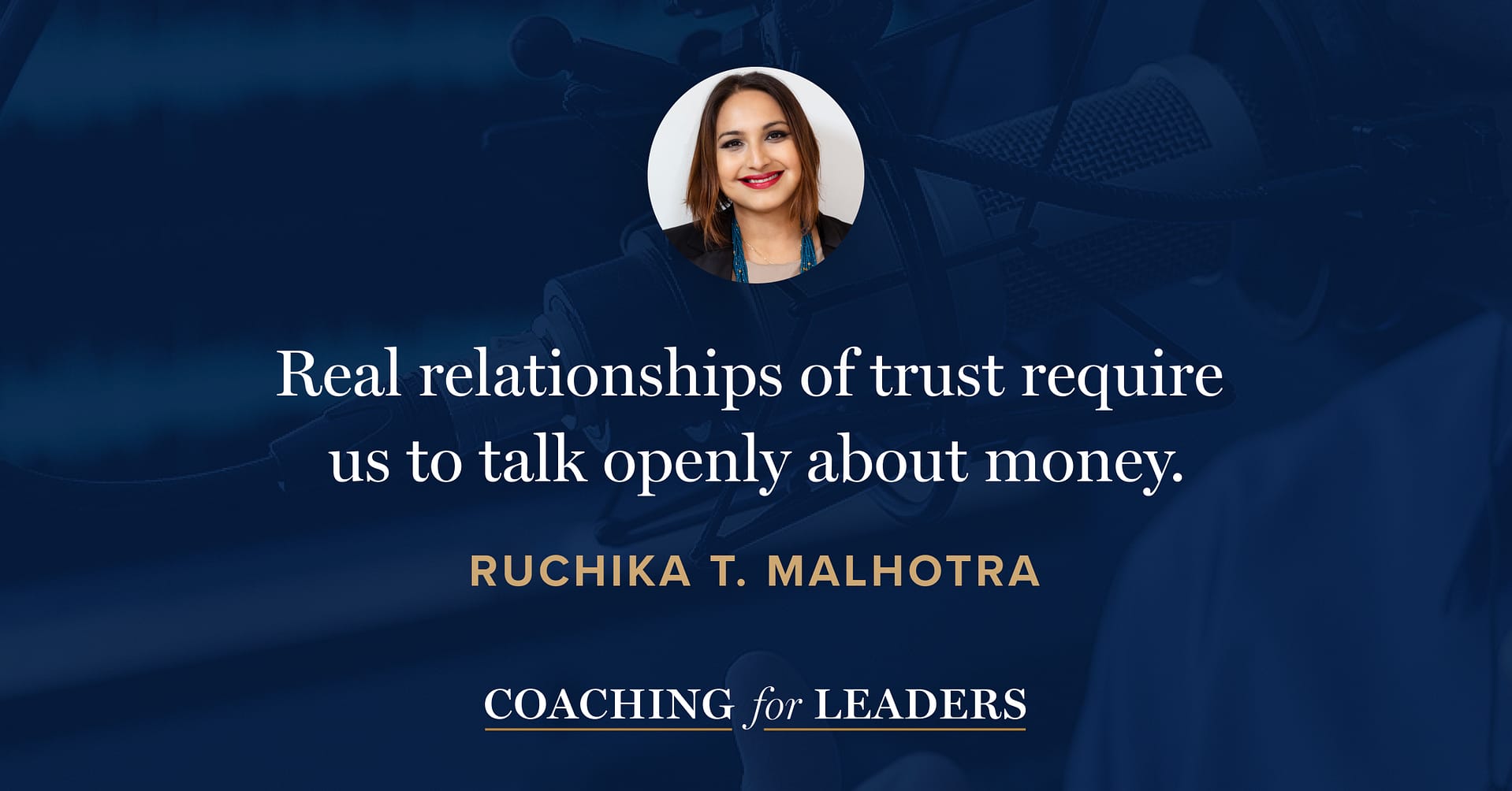
Real relationships of trust require us to talk openly about money.
https://media.blubrry.com/coaching_for_leaders/content.blubrry.com/coaching_for_leaders/CFL759.mp3

Podcast: Download

Follow:
Apple PodcastsYouTube PodcastsSpotifyOvercastPocketcasts

Ruchika T. Malhotra: Uncompete

Ruchika T. Malhotra is the founder of Candour, a global inclusion strategy firm that has worked with some of the world’s biggest organizations. She’s been recognized multiple times by Thinkers50 and co-wrote one of Harvard Business Review’s top 100 most-read articles in history: Stop Telling Women They Have Imposter Syndrome. She is the author of Inclusion on Purpose, MIT Press’s top-selling book of 2022 and now her newest book, Uncompete: Rejecting Competition to Unlock Success (Amazon, Bookshop)*.

A lot of people think about work as a competition for resources. But what if, by inviting others to the table, you created more for everyone? In this conversation, Ruchika and I explore the opportunity for all of us to uncompete.

Key Points

  • Many of us are so socialized to compete that we don’t realize the benefits of collective collaboration.
  • Reach out to someone who inspires you. Praising someone for something awesome about them, without an accompanying ask, is so rare.
  • Display genuine curiosity. Don’t confuse “nice” small talk for depth. Ask bigger questions that get to the heart of who people are.
  • As you build trust, talk numbers. In the professional context, real relationships of trust demand this kind of transparency.
  • Take regular stock of relationships. Take people at their word and also watch how their actions line up – or don’t.
  • Invite others to the table. The bigger your circle, the more you create for everybody.

Resources Mentioned

  • Uncompete: Rejecting Competition to Unlock Success by Ruchika T. Malhotra (Amazon, Bookshop)*

Interview Notes

Download my interview notes in PDF format (free membership required).

Related Episodes

  • End Imposter Syndrome in Your Organization, with Jodi-Ann Burey (episode 556)
  • How to Create Inclusive Hiring Practices, with Ruchika Tulshyan (episode 589)
  • Doing Better Than Zero-Sum Thinking, with Renée Mauborgne (episode 641)

Discover More

Activate your free membership for full access to the entire library of interviews since 2011, searchable by topic. To accelerate your learning, uncover more inside Coaching for Leaders Plus.
The Way to Build Collective Power, with Ruchika T. Malhotra

Download

Dave Stachowiak [00:00:00]:
A lot of people think about work as a competition for resources. But what if by inviting others to the table, you created more for everyone? In this episode, the opportunity for all of us to uncompete. This is Coaching for Leaders, episode 759. Production Credit: Produced by Innovate Learning, maximizing human potential.

Dave Stachowiak [00:00:29]:
Greetings to you from Orange County, California. This is Coaching for Leaders and I’m your host, Dave Stachowiak. Leaders aren’t born, they’re made. And this weekly show helps you discover leadership wisdom through insightful conversations. Now, one of the things that as I reflect on my career is a human being as a leader, as an employee. Like how often I have seen the word competition come up in my work and in the organizations and also in my own thinking. And oftentimes, as much as we talk about leadership and as much as we talk about teamwork and working together in community, we often default to somewhere else. Today, a conversation on how we can build collective power through relationships and through thinking about this word, compete in a very different way.

Dave Stachowiak [00:01:26]:
I am so pleased to welcome back to the show an expert who’s going to help us to hopefully shift our mindset just a little bit on this and take the next step to help us all do a bit better. I’m pleased to welcome back Ruchika T. Malhotra. She is the founder of Candor, a global inclusion strategy firm that has worked with some of the world’s biggest organizations. She’s been recognized Multiple times by thinkers50 and co wrote one of Harvard Business Review’s top 100, read most articles in history, Stop Telling Women They Have Imposter Syndrome. She is the author of Inclusion on Purpose, MIT Press’s top selling book of 2022 and now her newest book, Uncompete: Rejecting Competition to Unblock Success. Ruchika, such a pleasure to have you back. Welcome.

Ruchika T. Malhotra [00:02:11]:
So great to be back, Dave. Thank you.

Dave Stachowiak [00:02:14]:
I would love to ask you about one of your friends to start off. You know, so often as much as we talk about collaboration and teamwork, as I mentioned in the introduction, we do end up thinking about things individually. And one of your friends I think is just a wonderful example of the message you’re sending in this book. Iko Bethea, could you tell me a bit about her and what is it about your relationship with her that has been such a blessing to you both?

Ruchika T. Malhotra [00:02:42]:
This is such a great question because I think that we don’t talk about friendship and leadership nearly enough and I don’t think we, we have really found how much having relationships that inspire us Motivate us to do better and also remind us that the wins are collective. I don’t think we talk about that enough. So Iko Bethea is also a leadership expert and very much focuses on equity and inclusion, although one conversation we’ve had for years on end is how much does it benefit us to talk about it as DEI versus just core leadership requires us to be inclusive and equitable. And years ago, I write in the book, this is the best part of having some friendships and relationships in your life where you’re like, how did we even meet? What was that tie? Who introduced us? And honestly, neither of us can remember, but Iko is sort of very legendary in this field of equity and inclusion practitioners. Very well known speaker. She’s advised some large organizations. There’s an entire chapter dedicated to her expertise in Brene Brown’s latest book, Strong Grounds. So here’s someone who’s like, really a badass in every way.

Ruchika T. Malhotra [00:04:04]:
By the way, can I say badass on this podcast?

Dave Stachowiak [00:04:08]:
Sure.

Ruchika T. Malhotra [00:04:10]:
Because, you know, I think that there’s a huge intersection between being a badass and being a leader. Right. Anyway, so when Aiko and I first met, I think it’s very easy, especially as both entrepreneurs, but also as leaders, it’s very easy to see each other as rivals. Right. And often you’re taught in a competitive system that you’re fighting for the same opportunities or you’re fighting for the same recognition, or you need to beat each other out in competition to succeed. And I think the two of us just looked at each other and we said, we’re not, like, we’re not going to do that. And, you know, again, it wasn’t as deliberate as sitting down and looking at each other and saying those words. But I think there was a, there was a deep unspoken recognition like, we don’t want to play by those rules, even though we could both think of people in our industry who very much played by those rules.

Ruchika T. Malhotra [00:05:02]:
And so we’ve supported each other for years on end. I would say, you know, as someone with a lot more experience and expertise than me, she’s definitely been the person I’ve turned to when, you know, I’ve had some moments in my business or in my work where I’m like, I’m not sure what I’m doing. Do you have any advice on this? One year we literally competed for the same contract and her business won. And I’m so thrilled that happened. And I think there’s a lot of, we take the short term View in a competitive system, like what’s going to feel good right now, what’s going to feel good for our immediate win rather than thinking about it from a long term perspective. Taking the long view, and I would say my friendship and my sort of both collaboration professionally as well as that personal friendship with someone like Iko Bethea is a perfect example of how we can all cultivate those relationships with people who might be doing very similar work to us, might be in the same industry as us, but it’s not approaching it from that short term win expectation, but from a long term view.

Dave Stachowiak [00:06:09]:
It’s one of the things I really love about your work and your example is that. And when I see you on social media and see photos at events, it’s the ability to really think about this in a different way. The competition that often we default to. And it’s so interesting that. And you talk about this in the book, your own experience too of like how envy is so powerful. Like and we, we often don’t even think about doing it a different way, do we? Like we get in these competition frameworks, we get in organizations and in industries where that’s the default setting. And it just doesn’t occur to us to think about different way. And I think it’s one of the reasons this word emerged for you.

Dave Stachowiak [00:06:52]:
Uncompete. Tell me about that word.

Ruchika T. Malhotra [00:06:55]:
Somebody recently asked me what was that aha moment where this word came to you? And I said I can’t remember again. Clearly I have a terrible memory. I mean this is the second time you passed me for something and I’m like, I don’t remember. So maybe that’s the takeaway from this, you know, start to forget things. But I have to say I can’t remember this aha moment. But what was really interesting is of course as soon as I started thinking about and ruminating on this, you know, competition is everywhere, at all costs, all the time, winner take all, zero sum thinking from like going to my kid in elementary schools parent evenings or caregiver evenings and someone next to me will be like, oh, so you know, I’m taking my kids to like six activities so that in 12 years when they apply for college they’ll be able to write that and sort of be able to like beat out others and the applications to certainly work rivalry to certainly other rivalries in our social circles.

Ruchika T. Malhotra [00:07:54]:
And I started realizing that actually yes, these systems exist and yes, we often default to them and they’re a choice. So if competition is a choice so should the part where you don’t compete, that also can be a choice. And so as I started thinking of, like, what could it be when you opt out of competition? What would that sound like? And to me, the uncompete undoing, sort of thinking, the op, like, in many ways being very intentional about, like, this is the opposite of what I want to engage in. That’s sort of how the concept of uncompete came to me.

Dave Stachowiak [00:08:32]:
As you were saying that, sharing that story of going to a parent night, I was thinking how often that has happened for me. I mean, just in personal life, running into friends, parents, family, kids at school, and they’ll mention something like, oh, we’re doing this summer activity. And my first reaction almost always is, oh, should we be doing that?

Ruchika T. Malhotra [00:08:56]:
You know, it’s visceral.

Dave Stachowiak [00:08:57]:
It is. It’s such a human thing. And professionally, too. Like, someone says, ooh, I’m going to this conference, or I’m doing that. I’m like, ooh, should I be doing that? And I think part of what I sort of. You don’t. I don’t think you say this explicitly in the book, so I may be putting words in your mouth, but part of what I hear, tell me if I’m wrong is like, part of this experience of being human is knowing you’re going to have that reaction. But the invitation I hear from you is to also know that you can then make a choice not to go down that route if you choose.

Ruchika T. Malhotra [00:09:36]:
And, Dave, I bet you and I can both think of leaders we’ve worked with who do that, who kind of exemplify that. Right. And they approach good news that they hear of people around them, including, again, people who they would consider peers, not necessarily employees or someone who’s reporting up to them, who are, like, genuinely excited for other people’s wins. Right. And I. And I have to say, I’m really inspired by people like that. Maybe I was a good example. There are others I write in the book where you kind of know, when you’re around the folks who say, like, I’m so thrilled that’s happening for you.

Ruchika T. Malhotra [00:10:12]:
I can’t wait to hear more. Versus the ones who are like, oh, I’m so jealous. Oh, like, that’s that. How did that even happen? And. And I think that there’s something here where. When you model that, especially, I mean, most of all as leaders, I think we have a real opportunity to model this. I think we can all also think of leaders where that scarcity, you know, part of some of the Sort of frameworks that are or the foundations of competition as we see it in our society today include scarcity thinking, zero sum thinking, winner take all approaches. And again, I think that there’s this really genuine opportunity for leaders to lead really by example and say, like, hey, yes, there’s only one promotion, but we’re not going to pit people against each other for it.

Ruchika T. Malhotra [00:10:59]:
We’re going to figure out the way that we, yes, promote the person who’s the most qualified for the job. And we also very much invest in talent development. Right. It’s not this one person gets the promotion, everyone else is the loser. And I think that, I mean, again, I’ve been doing research and I wrote some of it for the book. I’ve been doing more now independently of the book. I’ve been collating research around like what zero sum thinking in politics. What are some of the challenges as a result of that zero sum thinking in sort of our social lives and our relationships in our communities.

Ruchika T. Malhotra [00:11:34]:
So I really think as leaders, like, there’s an opportunity here which is kind of unparalleled.

Dave Stachowiak [00:11:40]:
I love that you surfaced some key lessons for all of us on how to do this, like how to build our collective power and to get into community with people and peers and other leaders personally and professionally. And I thought we’d zero in on a few of the lessons you share because I think they just really are wonderful starting points for this. And the first one you invite is reaching out to someone who inspires you. What does that look like in a way that really works.

Ruchika T. Malhotra [00:12:15]:
One of the things that I sometimes feel sad that in our general overwhelm of life has happened to me personally is I have have less and less time to reach out to role models and heroes from afar and just say like, hey, I love you know what you’re doing. Thank you so much. Please do more of it. You know, when I was a kid, I was very happy to write to my favorite like celebrities. Of course, never heard back. Once in a while I’d get like, you know, thank you so much. You know, you know, so and so Mariah Carey is thrilled. Like, yeah, okay, I’m glad some intern took the time to return this.

Ruchika T. Malhotra [00:12:52]:
But now at this stage of my life, I do feel sad that I don’t, you know, I just, yeah, it’s the overwhelm of life is there obviously to be able to tell people like, hey, you’re doing great, keep going. But even I just want to say that this is so important because when I receive letters like this and actually now, sadly, I’ve become someone, and I don’t have a huge team like Mariah to respond to notes. But when I receive a note, even if I don’t respond or I don’t have the bandwidth to respond in that moment, I will still always carry it with me that someone appreciates what I’m doing. And so I do think that, again, in a competitive society, so much is focused on what am I doing personally and how do I get ahead personally and less about what are others doing that inspires us and how can we cheer them on. And so with this part of the book, what I really wanted people to take away is can we reach out to someone who inspires us? It could be one person in- again, really, given your bandwidth, it could be one person a year, but a peer who could be in the same industry as you, someone who’s doing something that’s exciting in a field that maybe you’re trying to get into, but someone who excites us, and then we really just genuinely compliment them, tell them what we like about them, what we admire about them quite specifically, and that’s it. Right. It’s not.

Ruchika T. Malhotra [00:14:14]:
Let me. You know, I love what you’re doing. By the way, do you mind having a look at my resume? Or by the way, should we build, like, a business connection? But it’s this reminder that not every relationship needs to be about getting something from someone immediately. It’s about building sort of collective power where you connect with someone you genuinely admire.

Dave Stachowiak [00:14:35]:
You write on this, “praising someone for something awesome about them without an accompanied ask is so rare.” I think about what you just said. And like you, I’m in a place of privilege that I get notes from people and oftentimes there’s a nice message and there’s an accompanied ask with it, which is like, very privileged to get. And I try to help wherever I can. Of course, like you, I run into the bandwidth issues as well. The notes that really catch my attention, though, are the ones that are just as you described. Like, someone reaches out and either personally or professionally, and they express some gratitude for something, whatever it is, and it’s just that.

Dave Stachowiak [00:15:19]:
And wow. Like, those are the ones I always try to respond to, but even if I don’t, it’s so meaningful. And oftentimes those are the places where a relationship does start and does build. And those are the people that are so fun to build those relationships with because they are thinking about it from a relationship first standpoint.

Ruchika T. Malhotra [00:15:41]:
Absolutely. And I think, again, we have to remember how Rare. It is. I think there’s this belief that, like, oh, they’re not even going to care. But it is. I mean, I was somebody who’s really been inspiring me recently is a recent author, Megan French Dunbar. And she wrote 75 handwritten notes to people to thank them for being part of her, like, launch and book community and other people who are just interested in the work that she was doing. And I literally thought to myself, 75 handwritten notes.

Ruchika T. Malhotra [00:16:16]:
And she’s like, yeah, like, in a world where people get one or two word DMs, imagine what a handwritten letter can do. And that was really inspiring to me.

Dave Stachowiak [00:16:28]:
You invite us also to display genuine curiosity as we’re building collective relationships and we’re starting there. When you think about doing that, how do you do that? What kind of questions do you ask?

Ruchika T. Malhotra [00:16:45]:
Great question. I have to say, one of the things that did surprise me about American culture, so I’m an immigrant, I was born in Singapore and I’m still Singaporean. I have to say, one of the things that was surprising to me is that overall, and I hate to generalize because obviously I’ve met some incredible people who display such genuine curiosity, but I think there’s research to show that we’re more, much less curious than we’ve ever been before. Right. And there’s much less, like genuinely trying to understand, like, if you’re different than me, where does that difference come from? And what is your point of view? And how do we, how can we connect? Maybe there are more similarities than differences. So I have to say, one of the things that I’d love to see more often, one of the things I think is a through line between all the work I’ve done is displaying genuine curiosity. And so as it relates to building collective power and as you’ve, you know, when you’ve connected with someone who you really imagine they’re going to be part of my community, I’d love to be in community with them. I’d love to maybe build something.

Ruchika T. Malhotra [00:17:53]:
Maybe we can just support each other. I really like to ask variations of questions like, what is the purpose of your life? How do you define success? You know, how does impact making factor into your life? Are you a collaborative person? And what does that actually mean to you? And I think you can gauge a lot from people from those answers. And obviously they’re big questions and not everyone’s going to have. Maybe some people haven’t even thought about it. But I think when you hear what people are kind of grappling with or thinking about in terms of what they want their life to look like, it can really fuel true connection.

Dave Stachowiak [00:18:32]:
You have such a better perspective on this than I do as having lived in different countries and I’ve only lived here in the States. And as you were saying that, I was thinking back to a book I read by John Steinbeck, like 25 years ago. It’s called Travels with Charlie, and it’s supposedly a nonfiction book, although some of it, I think is fictionalized. People have decided that. And it’s his story late in life of taking his dog on a road trip around the United States and the experience of just showing up in random places and what that was like. And it sounds super boring, but it’s actually a really interesting book. And one of the observations he makes is that Americans have this really interesting default, a lot of us, to being genuinely kind to strangers. Like, there’s sort of like a kindness.

Dave Stachowiak [00:19:27]:
Like you walk into a restaurant in wherever and someone’s good morning, and you get into a conversation and it’s very friendly. And it’s like you’ve known each other for 20 years in some ways. And as I think about that and what you just said, I think sometimes we confuse that with curiosity. And as I’ve watched more of those interactions over the years and had more conversations like the one I’m having with you right now, where we, like, really go into depth on things, I think, well, yes, and- we often don’t get to questions that are actually meaningful and get to depth. And I think we confuse the two. And. And it comes all the way back to what you just said a moment ago.

Dave Stachowiak [00:20:08]:
Those questions you asked of those are questions that like, yes, you start with the small talk and the casual things, but you actually get to a place where you’re willing to ask that second or third question and get to a place of depth with people. And that’s what really genuine curiosity is.

Ruchika T. Malhotra [00:20:25]:
Thank you for sharing that. And you know, the interesting thing is, so this also kind of links to my origin story. So as an immigrant to this country, you’re often taught like, okay, build connection and community with people who look like you or who have had similar experiences than you.

Dave Stachowiak [00:20:43]:
Sure.

Ruchika T. Malhotra [00:20:44]:
But if you just go with that sort of surface level kindness sort of connection. If we’re talking about true curiosity, it’s only in being curious that I realized and asked good questions. I think about values alignment in different ways that I realized that a lot of my community was very much built among people who don’t look like me and who haven’t had the same experiences as me and who really like, in many ways, it’s like, huh, how did the two of you end up as friends? And I think that curiosity is so important to build and bridge relationships across difference. And I think, again, what more important thing to talk about in this time than that bridging of those gaps and those differences?

Dave Stachowiak [00:21:33]:
Yeah, indeed. Well, the first two invitations we talked about, of reaching out to someone who inspires you and displaying genuine curiosity, I hope people take to heart. And I also think, like, most people would say, okay, I’ve heard that advice before, that doesn’t surprise me. I think the third one might surprise people a little bit, though, which is. And particularly in a professional space, you say, once you’ve built trust, talk numbers. Tell me about that.

Ruchika T. Malhotra [00:22:04]:
Possibly one of the things that I’ve had to. One of the practices I’ve actually had to practice so very much because being socialized as a woman, as an Asian woman born outside this country, just talk, like, talking numbers at any given time was very stressful for me. And sort of, you don’t talk about your salary, you don’t talk about, like, raises. You don’t talk about numbers. I was one of those very typical sort of the data show that I walked into many of my first few workplace negotiations. And I didn’t make, you know, I didn’t negotiate. I was just like, oh, you want to give me this? Yeah, sure. Okay, great.

Ruchika T. Malhotra [00:22:44]:
And then later, people were like, why didn’t you negotiate? So, you know, there is a lot of, like, challenge with this, of, like, not wanting to appear unlikable. And I know there’s a lot of data around gender and how gender plays into this as well, but I actually think that one of the ways that we can really resist these systems that are opaque and make us feel like we’re losing out or there’s this competition is by becoming very transparent with numbers as we can. And I think what that has meant for me, and it’s always been easier to recommend and ask on other people’s behalf. So if someone comes up to me and says, hey, do you know someone who would be a good speaker or consulting project or I’m trying to hire an executive director or leader for my organization, I’ll always ask, hey, what are you paying? Right? And what are the numbers we’re talking about? And relay that, and it’s easier to do on someone else’s behalf. But I actually have started not only becoming better at doing that for myself, and this is part of as you grow as a leader, as a business owner, you get more comfortable with it. But also then turning around and saying to people, hey, here’s how much I got paid for this. I hope you’re getting paid this much or more even.

Ruchika T. Malhotra [00:23:58]:
And I think this breaks down some of those silos and those barriers that I think we’re often expected to operate in in a competitive society. And I think it’s one of the very powerful ways we can uncompete.

Dave Stachowiak [00:24:11]:
Yeah. And the real like, boy, the real loud message I hear is like, being able to start doing that, like you said, not just for yourself, but also within community, within your network, within the people that you’ve built power with and are building wealth together with of like finding those people and having those conversations. And those are for all the reasons you mentioned, conversations that a lot of us don’t tend to have in many relationships. But when you’ve built trust, especially from a professional standpoint, like starting to figure out like, okay, how can we all help each other to support each other and work in a different way than sometimes the system tells us we need to and being able to do that and open those doors huge.

Ruchika T. Malhotra [00:25:01]:
Absolutely. And in the book I talk about how wealth and power really are so much more meaningful and long term and create better, greater good for society when it’s collective rather than again, that zero sum, winner take all approach to power and wealth building.

Dave Stachowiak [00:25:21]:
You remind us to take stock of our relationships as well as we go. Sometimes things change. Of course, our first impressions always line up with what happens in the long run. When you think about taking stock of relationships, what are you looking for?

Ruchika T. Malhotra [00:25:36]:
Dave, I bet we can all think of examples of people we’ve been in community with, relationships with workplace or otherwise, where that relationship really outlived its time for us and actually caused us insecurity or intimidation or feeling diminished and invalidated. And I think many of us, again in a competitive society, I think we’re taught that you just have to sort of press on and it is what it is. And I should, I should focus on like what I’m getting out of the relationship. And I think a big part of learning to uncompete is, is understanding and reminding yourself that you’re worthy of being validated and supported and in community with people who also approach community with collaboration and abundance. So I really talk about taking stock of relationships from the standpoint of if you’re around someone or if you’re around people who don’t really elevate you and it’s interesting because I hear this so much from leaders and I hear this from. And again, this could just be reflective of the communities I’m in. I’ll hear so much from very powerful women leaders in business and in sort of their professional career who will often say that in their personal life, they’re still- they don’t feel supported in the same way or they might even feel taken advantage of.

Ruchika T. Malhotra [00:27:06]:
And I think what we need to understand is where does that come from? How do we take stock of the relationship? How do we understand that true power is building with people who support us and who want to see us succeed, too? It’s never just, you know, and using Adam Grant’s technology, it’s not just the takers. We don’t want to be just givers, but it’s really about how can we build collaboratively with people who are healed, you know, and there are going to be people who are unhealed, who want to talk about relationships with scarcity and zero sum and all of that. And it’s really about saying, no, I’m going to set those boundaries with them.

Dave Stachowiak [00:27:43]:
You write on this. “I’ve worked to build strong partnerships with people who say the right things about collaboration and abundance, but then follow up with actions that don’t align with those words.” And the reminder I’m getting from that is, like, sometimes, like, someone says all the right things, and then we get three, four months into a relationship, like, the actions don’t really line up with the things that they’re saying. And the reminder for myself is like, okay. When I see that is like, that’s okay. And that’s also a time to just maybe move on or and to really watch for, like, actions over time. Do the actions line up with what someone espouses?

Ruchika T. Malhotra [00:28:23]:
That’s so true. And I have to say, this is one of those parts of leadership I don’t think we always talk about because it’s tricky and it’s hard, and it’s also something we don’t want to admit. But those relationships that give us discomfort or pause, we really have to lean into the instinct. And if possible, once we extricate ourselves from it, once we set those boundaries, it is important to ask yourself, what is this teaching me about my leadership? Like, what is this teaching me about how I trust people and build relationships? And what are the lessons here that I can take to expand my community?

Dave Stachowiak [00:29:02]:
Yeah, indeed. And speaking of expanding, the invitation you make at the end is the reminder to us identify others to join the community. And you say, “the bigger the Inner circle gets, the more wealth and influence we can generate.” And I’m thinking about just my own experience of being intentional, creating some communities like this in my own life. And you can get a good amount of the way through doing that and then sort of forget, oh, I mean, this is just me. Like, oh, I don’t have to stop. Just with this group. I could actually invite more people into this group.

Dave Stachowiak [00:29:42]:
And sometimes, like, at least I don’t think to do that. And this, like, I love the reminder just to remind us like, okay, expand, we can.

Ruchika T. Malhotra [00:29:50]:
And I think there are two things here. One is, I think there’s a reminder that we must learn to expand. And you’re so right. I’m the same. I have, you know, and again, some part of it is bandwidth issues, some part of it is, you know, we’ve really been conditioned to be, to focus on like, okay, this is who’s in our community and this is who’s not. And I think there’s interesting research and important research about in group and out group, group and all of those sort of dynamics as well. But I think for me, what I’m really trying to say with this isn’t to tell people, especially busy people, especially leaders, hey, you should sit down and do much more work in your life to expand the circle. I’m actually saying that if we kind of empower people in our lives as well to expand the circle, if we take even a few minutes, it could be in a week, it could be in a month to think about, like, what are ways that we can really support other people and expand the circle.

Ruchika T. Malhotra [00:30:48]:
You know, I write examples could be very quick. Like I’ve recommended people for roles like through a text or an email, right. You know, done filled out like online reference forms or done a review for someone’s new book or new podcast. Well, not your podcast. It’s not new, Dave, but you know, it doesn’t have to be this huge, time consuming endeavor, but it’s more- it’s saying that these little actions I take a few minutes in a week is really enriching the community beyond me. And again, I think that in a competitive, what about me? Am I getting behind? Is my book doing as well as the other person’s book? Is my podcast reaching as many listeners? Am I climbing the ranks as quickly as my peers at work? I think that genuinely takes away from us being able to think about expanding our community.

Ruchika T. Malhotra [00:31:43]:
And part of what I’m recommending here is resist that urge and be very intentional about choosing a different way.

Dave Stachowiak [00:31:51]:
You were last on the show a couple years ago and we talked about inclusion on purpose and congratulations on all the traction. The book’s gotten so cool and you’ve done a ton since then. And of course, this new book, you’ve advised so many organizations. As you reflect on the last couple of years, I’m curious what you’ve changed your mind on since then.

Ruchika T. Malhotra [00:32:14]:
This is so hard. There are many things I’ve changed my mind on, I think in writing this book. Actually. It’s not that I ever. I would say it’s not that I approach the world with the belief that people weren’t genuinely good generally. I mean, I did. But I have to say, when I wrote this book and as I wrote this book and as I looked for research and examples, maybe it’s confirmation bias, but I definitely changed my mind on that there’s still a significant percentage of people around the world out to get you.

Ruchika T. Malhotra [00:32:49]:
And I think what I did is, as in writing this book, I really started looking for examples and being reaffirmed that actually largely people are genuinely good. And I know, especially people who’ve traveled a lot. Someone like the late, great Anthony Bourdain said most people in the world are so much more similar than we are different. And again, this is something that I think there’s a part of me knew, but I can say for sure that I completely like. I was very, very affirmed in this belief when I wrote this book and in the sort of activities leading up to promoting the book as well.

Dave Stachowiak [00:33:28]:
Ruchika T. Malhotra is the author of Uncompete: Rejecting Competition to Unlock Success. Ruchika, thank you so much for your work and sharing it with us.

Ruchika T. Malhotra [00:33:38]:
Dave, thank you so much for having me so excited. This conversation was so beautiful.

Dave Stachowiak [00:33:49]:
I grew up with the worldview that working in an organization, organization was not about how much money you could make or getting the biggest title or winning at every opportunity. But those things were tactical considerations at times, of course. But the real driver of work and the purpose behind work was to make things better for the people you serve, to make the world better in some way through your organization and industry and work across industry in some cases. And as a result, I found along the way that I don’t always have alignment with others on that worldview. In fact, I found that what Ruchika and I talked about today tends to be often in the minority of how a lot of people think about work and competition. And perhaps you’re there too. And if you are, it’s a very normal view to have of thinking about competition and how we position work. And I would invite you if something resonated in this conversation.

Dave Stachowiak [00:34:47]:
Something you may want to try is just to experiment a little bit. When I have seen folks experiment with some of the things that Ruchika talked about today, oftentimes it opens up an opportunity to do more for the world, to open up the table a bit, to bring others in in a way that helps support everyone and often brings in some really cool opportunities not only for others and for the organization, but also comes back to you too in some really neat ways. If this conversation was helpful to you, I hope that you’ll Also check out three other conversations. One of them is episode 556, End Omposter Syndrome in Your Organization. Jodi-Ann Burey was my guest on that episode. I’m thinking about her because she was the co author with Ruchika of that Harvard Business Review article that I mentioned in the introduction. We talked in detail about Imposter syndrome and that term that comes up for so many of us and we think about it often in terms of ourselves. What we don’t often think about is how the organization influences that and actually may be triggering that in many cases.

Dave Stachowiak [00:35:49]:
Episode 556 we do a deep dive on that of how us as leaders leaders can do a better job of supporting so many in organizations and being able to end imposter syndrome or at least be able to reduce it pretty substantially. Also recommended my last conversation with Ruchika, episode 589, How to Create Inclusive Hiring Practices. We talked about some of the real tactical things we can do in our hiring and recruiting that help us to create a more inclusive opportunity. And I shared with Ruchika recently that I took some of her advice from that episode, brought it into the applications for our Academy and our Academy community these days looks even more diverse than it did at the time. And I think part of the reason is because of those tactical steps I took from that conversation and not only more inclusive but more diverse episode 589 for more tactics on that. And then finally I’d recommend episode 641 doing better than Zero Sum Thinking. Renee Mauborgne my guest on that episode, co author of the blockbuster bestseller Blue Ocean Strategy and several of the follow up books. We talked about non disruptive competition in that conversation that what an opportunity for so many leaders today rather than trying to compete for scarce resources to look for the opportunity to compete in totally different ways and actually not even compete but actually to do it in such a way where you don’t disrupt existing industries and organizations. We talked in detail in episode 641, a great complement to this conversation.

Dave Stachowiak [00:37:21]:
All of those episodes, of course, you can find on the coachingforleaders.com website. And if you haven’t set up your free membership, do so today at coachingforleaders.com it’s going to give you access to the entire library of episodes, searchable by topic that I’ve aired since 2011, plus tons of other resources inside of the free membership, free audio courses, my interview notes, weekly guides, tons more. All of its activities coaching4leaders.com Coaching for Leaders is edited by Andrew Kroeger. Production support is provided by Sierra Priest. Next Monday I’m glad to welcome back Shannon Minife, she is the CEO of Box of Crayons, the firm behind Michael Bungay Stanier’s best selling book, The Coaching Habit. We are going to be having a conversation about the kind of curiosity we often miss.

Dave Stachowiak [00:38:10]:
There is a kind that we often, often don’t think about and set aside. We’re going to look at that in detail. See you back on Monday with Shannon. Take care.

Topic Areas:Career GrowthDiversity and InclusionNetworking
cover-art

Coaching for Leaders Podcast

This Monday show helps you discover leadership wisdom through insightful conversations. Independently produced weekly since 2011, Dave Stachowiak brings perspective from a thriving, global leadership academy of managers, executives, and business owners, plus more than 15 years of leadership at Dale Carnegie.

Listen Now OnApple Podcasts
  • More Options
    • YouTube Podcasts
    • Spotify
    • Overcast

Activate Your Free Membership Today

Access our entire library of Coaching for Leaders episodes from 2011, searchable by topic.
Listen to the exclusive Coaching for Leaders MemberCast with bonus content available only to members.
Start Dave’s free audio course, 10 Ways to Empower the People You Lead.
Download our weekly leadership guide, including podcast notes and advice from our expert guests.

... and much more inside the membership!

Activate Your Free Membership
IMAGE
Copyright © 2026 · Innovate Learning, LLC
  • Plus Membership
  • Academy
  • About
  • Contact
  • Dashboard
×

Log in


Forgot Password

Not yet a member?

Activate your free membership today.

Register For Free
×

Register for Free Membership

Access our entire library of Coaching for Leaders episodes from 2011, searchable by topic.
Listen to the exclusive Coaching for Leaders MemberCast with bonus content available only to members.
Start Dave’s free audio course, 10 Ways to Empower the People You Lead.
Download our weekly leadership guide, including podcast notes and advice from our expert guests.

... and much more inside the membership!

Price:
Free
First Name Required
Last Name Required
Invalid Username
Invalid Email
Invalid Password
Password Confirmation Doesn't Match
Password Strength  Password must be "Medium" or stronger
 
Loading... Please fix the errors above