• Skip to primary navigation
  • Skip to main content
  • Skip to primary sidebar

Coaching for Leaders

Leaders Aren't Born, They're Made

Login
  • Plus Membership
  • Academy
  • About
  • Contact
  • Dashboard
  • Login
Episode

773: How to Align Your Motivation, with Nir Eyal

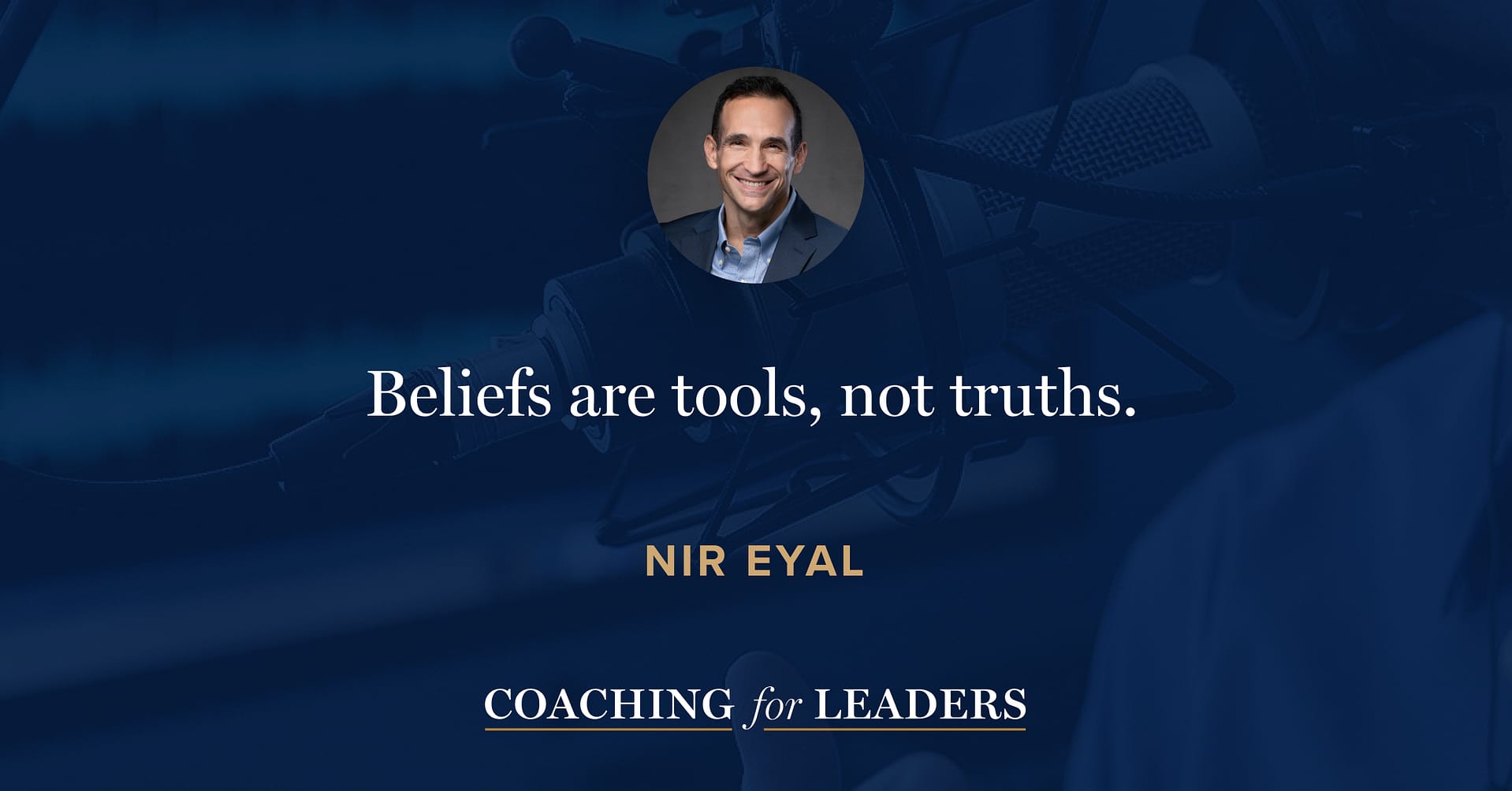
Beliefs are tools, not truths.
https://media.blubrry.com/coaching_for_leaders/content.blubrry.com/coaching_for_leaders/CFL773.mp3

Podcast: Download

Follow:
Apple PodcastsYouTube PodcastsSpotifyOvercastPocketcasts

Nir Eyal: Beyond Belief

Nir Eyal writes, consults, and teaches about the intersection of psychology, technology, and business. He is the author of two bestselling books, Hooked and Indistractable, selling more than a million copies and translated in over 30 languages. He is the author of the new book, Beyond Belief: The Science-Backed Way to Stop Limiting Yourself and Achieve Breakthrough Results (Amazon, Bookshop)*.

Most of us recognize that a huge part of what motivates us – or not – is our own thinking. In this conversation, Nir and I explore where our beliefs get in the way and how we can align them just a bit to help us move forward.

Key Points

  • A sentence starting with “I am…” can be among the most dangerous in any language. Often, our beliefs limit us.
  • Belief is the foundation of the motivation triangle that includes benefit and behavior. Yet, we often overlook beliefs.
  • Curt Richter’s study of rats in the 1950s shows how an animal’s belief system can massively influence its behavior.
  • The real question isn’t “Is this belief true?” but rather, “Does this belief serve me?”
  • You can choose beliefs based on usefulness, not certainty.
  • Difficulty may mean we are not cut out for something, but it might also be evidence of growth. Too often, we quit too soon.
  • Progress comes from consistent action, not perfect plans.

Resources Mentioned

  • Beyond Belief: The Science-Backed Way to Stop Limiting Yourself and Achieve Breakthrough Results (Amazon, Bookshop)* by Nir Eyal.

Interview Notes

Download my interview notes in PDF format (free membership required).

Related Episodes

  • How to Win the Long Game When the Short-Term Seems Bleak, with Dorie Clark (episode 550)
  • How to Quit Bad Stuff Faster, with Annie Duke (episode 607)
  • How to Better Manage Your Emotions, with Ethan Kross (episode 719)

Discover More

Activate your free membership for full access to the entire library of interviews since 2011, searchable by topic. To accelerate your learning, uncover more inside Coaching for Leaders Plus.
How to Align Your Motivation, with Nir Eyal

Download

Dave Stachowiak [00:00:00]:
Most of us recognize that a big part of what motivates us, or not, is our own thinking. In this episode, where our beliefs get in the way? And how we can align them just a bit to help us move forward? This is Coaching for Leaders, Episode 773.

Dave Stachowiak [00:00:19]:
Production Credit: Produced by Innovate Learning, Maximizing Human Potential.

Dave Stachowiak [00:00:27]:
Greetings to you from Orange County, California. This is Coaching for Leaders. And I’m your host, Dave Stachowiak. Leaders aren’t born, they’re made.

Dave Stachowiak [00:00:37]:
And this weekly show helps leaders thrive at key inflection points. All of us hope and wish to be the kind of people who are motivated, consistently moving forward on the things that are most important to us and not get in our own way. And yet, of course, we know that that is an ongoing challenge for all of us on, really getting to the results we want to get to. Today, a conversation on how to stop limiting ourselves so we can really get to where we want to go, and keep ourselves motivated along the way. I’m so pleased to welcome back to the show Nir Eyal. Nir writes, consults, and teaches about the intersection of psychology, technology, and business. He’s the author of two bestselling books, Hooked and Indistractable, selling more than a million copies and translated in over 30 languages. He is the author of the new book Beyond Belief: The Science-Based Way to Stop Limiting Yourself and Achieve Breakthrough Results.

Dave Stachowiak [00:01:34]:
Nir, such a pleasure to have you back. Welcome.

Nir Eyal [00:01:36]:
Hi, Dave. Great to be back. Thank you for having me.

Dave Stachowiak [00:01:39]:
I came across a post that you put up recently on LinkedIn that said the two most dangerous words in any language are “I am.” And I got to thinking about that, and thinking about your work, and thinking about this book. And I thought, “wow, there’s so much truth there”. Could you say a bit about what it is about those two words that is so dangerous for so many of us?

Nir Eyal [00:02:06]:
Yeah, it’s pretty shocking actually, how empowering and dangerous those words can be. They’re not only dangerous, they can actually be quite liberating as well, because whatever we put after those two words, I am, we begin to anticipate actually happening. So if you say, one thing that I used to say all the time, oh, I’m having a senior moment, even though I’m not that old, I’m in my late 40s, right? I would say, oh, I’m starting to have a senior moment, or I’m struggling with my ADHD, or I’m a morning person. When you say that, it turns out your brain does two things. One, it focuses attention towards that identity, towards that label that you’ve made for yourself. And two, it’s redirected attention away from what you could actually do about whatever difficulty that prompted you to say that thing, whatever frustration, and instead, focused on your limiting belief. And that’s really what Beyond Belief is all about. It’s about how do we identify these limiting beliefs that are holding us back, and convert them into these liberating beliefs.

Nir Eyal [00:03:04]:
Because, you know, I interviewed all sorts of people, and let me tell you, we all have these limiting beliefs. Whether you’re a billionaire or you’re broke, you have these limiting beliefs in your life in one area or another, whether it’s your physical health, whether it’s your mental wellbeing, whether it’s your business, whether it’s your family, your relationships. We all carry around these limiting beliefs, but we don’t realize we have these hidden limiting beliefs. Of course, other people see them. It’s sort of like your face, right? That you carry around your face all day, but you can’t see it. You can’t see your face. Unless you hold it up to a mirror. And that’s really what this book is meant to do.

Nir Eyal [00:03:37]:
It’s meant to illuminate these hidden limiting beliefs that we have in our life, so that we can do something about them and meet our full potential.

Dave Stachowiak [00:03:45]:
I am reminded just about daily how easy it is often to see the limiting beliefs of others, and how difficult it is to see our own limiting beliefs. And it’s, it really does take, need, require a step back for each of us to see it a bit. When you catch yourself, and you see others near, starting with that I am, that limiting belief, whatever it is, what is it that helps to bring a little bit of awareness that gets you thinking, hmm, this is something that maybe is holding me back?

Nir Eyal [00:04:22]:
Well, I think it starts from asking ourselves if that belief is serving us or hurting us, because, you know, the big revelation for me is that I had a restriction on what guided my behavior. You know, we, we tend to think that behavior is all about the behavior itself, and the benefit of why you do it. So this is how standard economics kind of works. You know, you, you pay people a salary, that’s the benefit, and you get them to do a behavior. And that, that’s— we think of it as a straight line, right? You have the incentive, and you’ll get the behavior. And I’ve, you know, we, we all kind of know this intuitively. I think the part that we’re missing is that even when you know what to do, and we all know what to do these days, right? We’re flooded with information on how to get in shape, or how to make money, or how to have good relationship with our family. You know, if you don’t know the answer to one of these questions, just Google it or ask ChatGPT. The questions are all out there.

Dave Stachowiak [00:05:15]:
Yeah.

Nir Eyal [00:05:15]:
It’s not good enough just to know what to do. It’s not even good enough to want the benefit. If it was as easy as, hey, here’s what I want, and here’s what I have to do to get it, we’d all have six-pack abs and be multimillionaires, but it’s not that easy. And the thing that is missing, I think, are these beliefs. That motivation isn’t a straight line, it’s more of a triangle. That on one side is the behavior, on one side is the benefit, and at the base of that triangle is the belief. If I don’t trust you as, let’s say, my boss, to give me the benefit, to give me that promotion, to give me the, the bonus that I’m, I’m expecting, or much more common, if I don’t believe in myself to do that behavior, then I won’t do it. And so that to me was a revelation, and it, it actually came to me because of my last book.

Nir Eyal [00:05:58]:
In my last book, I do these office hours. I still do these office hours, where anybody who’s read one of my books can call me and ask me a question, and we can talk about it and, you know, hopefully help them after they’ve, they’ve read the book if they’re stuck on something. And maybe one out of every, I don’t know, 20 calls or so would sound like this, Dave. Somebody would call me up and say, hey Nir, I read Indistractable, I really liked it, but it didn’t work. I say, oh wow, it didn’t work? You know, I spent 5 years writing it, and it has 30 pages of peer-reviewed studies. I’d love to hear what happened. What, what didn’t work for you? Tell me about step 1. How did step 1 go? And they’d say something like, you know, I read step 1, I read it, I read it.

Nir Eyal [00:06:35]:
I just didn’t, I just didn’t do it, is the thing, you know? And I’d say, okay, no problem. Maybe you skipped step 1. Tell me about step 2. How’d step 2 go? Yeah, you know, I didn’t do that either. And I hear what, you know, they wait for me sometimes for months to get on the phone with me so that I can tell them to do the thing that was in the very book that they told me they had bought and not read. And so I thought, I started thinking, you know, what’s wrong with people? What’s going on here? What am I not understanding? And then when I looked in the mirror, of course, I realized that I do this too, all the time. I have countless books telling me great advice that I haven’t implemented. I, I’ve paid consultants and gurus to, to give me action plans that I haven’t put into place.

Nir Eyal [00:07:12]:
And so that’s when I really realized that it’s not good enough to just know what to do, and why you do it. You have to understand the underlying beliefs. And so the first place to start, to answer your question, Dave, of how do you identify these beliefs and do something about it, is to look for the areas where you are consistently stuck. And we all have them in one area of our life or the other, right? What, what’s the thing on your annual New Year’s resolution that you’ve had on that New Year’s resolution for year after year? What’s that aspiration, that dream that somehow hasn’t happened, that hasn’t materialized for you? Whether it’s, I’ve always wanted to write a book, or I’ve always wanted to, to start a business, or what, you know, what’s that thing that you keep coming back to that for one reason or another isn’t happening? What’s that relationship? Maybe it’s a relationship that either you haven’t found love, or maybe you have a broken relationship that you haven’t been able to repair. That’s where we tend to look for these limiting beliefs. And we, we tend to think, well, we just must not know the answer. If someone would only tell me what to do, I would do it. And I would argue that, that basically we know what to do in these areas.

Nir Eyal [00:08:13]:
What we haven’t analyzed are what are the limiting beliefs that prevent us from doing those things we know we want to do.

Dave Stachowiak [00:08:19]:
I think the power of this so much is these three things together. It’s the belief, as you say, the foundation, and it’s the benefit and the behavior also. And certainly, you’re not advocating for, hey, if we just sort of name it and claim it, if we just have this belief that we can do anything, that that’s enough in and of itself. But it’s really the totality of the three, of putting them together, of yes, the belief’s there, yes, there’s a benefit, and yes, the behaviors that follow it. By addressing all three and thinking about it as all three, it’s powerful. And to your point, the belief is the one area that oftentimes we don’t tend to put as much attention to.

Nir Eyal [00:08:57]:
That’s right, that’s right. And it’s— we know that all three are important, clearly. I think what, what shocked me is how we can use those to sustain our motivation. That’s— that really is what this book is about, that the defining characteristic of success in life, it turns out, if you look at, okay, what really defines success for, for an aspiration, for a goal, it’s not necessarily intelligence. That helps, certainly. It’s not necessarily even luck. It’s not that, you know, there’s been these studies on successful people, and people tend to think that successful people got lucky. Turns out that that’s not true, that people who we see as lucky, it’s not that more lucky things happen to them, it’s that they see opportunities that others don’t see.

Nir Eyal [00:09:38]:
If you’ve met a lot of very successful people, you’ll find that they actually fail more than the people that you think are not very successful, because they’ve taken more shots on goal. They tend to fail more. So, so what’s important here is that we realize that in order to sustain our motivation, in order to have the most important trait, that most important trait that determines success in life, turns out, is persistence. That’s it. Well, persistence and adaptability. Those tend to be the top two criteria. And so what this book is really about is, how do we focus on sustaining that motivation in life, sustaining that persistence so that we can get those things that we want?

Nir Eyal [00:10:17]:
And it turns out that these limiting beliefs are beliefs that sap your motivation. They decrease your persistence, whereas limiting beliefs, they supply your motivation. And so what’s absolutely critical is to identify where those lie in our life. And what I’ve added to the conversation are these three, what I call the three powers of belief. And those are that beliefs have the power to change what you see, that we know that entrepreneurs literally see things differently, that optimistic people, that people who have positive expectations about their life, see reality differently. I’m not saying figuratively, they actually see things differently. And there’s wonderful experiments that demonstrate this. You know, they, they had an experiment where they, they took people who were self-identified as optimists versus pessimists, and they had them look through a magazine and count the number of advertisements.

Nir Eyal [00:11:10]:
And the pessimistic people, the self-identified pessimistic people, just counted the ads. They just, okay, 1, 2, 3, 4. The optimistic people were much more likely to see one ad that said there are 25 ads in this paper. You’ve counted them all. Go, go claim your prize. Go claim your $250. Because they literally saw an opportunity that other people didn’t see, that the pessimistic people didn’t see. So our beliefs change what we see, they change what we feel, they change our expectations of the future based on what we feel.

Nir Eyal [00:11:40]:
And third, and most importantly, they change what we do. So those 3 criteria— changing what you see, what you feel, what you do— what I call anticipation, attention, and agency, that really defines— those are the toolkits that we can use to make sure that we are empowering ourselves to stay motivated, and of course to empower others, to empower our teams to stay motivated as well.

Dave Stachowiak [00:12:01]:
There are so many examples in the book, and from research of, how belief is so powerful, and one of the most striking examples is from a study back in the 1950s, before we had some of the ethical protections and humane protections that we have today on research. But it is still worth looking at, because it is a really powerful example of this. Kurt Richter’s study of rats in the ’50s and like thinking about motivation and persistence. Could you share a bit of that? I mean, it’s a very dark study in a way, but it also is very powerful.

Nir Eyal [00:12:35]:
I know. Yeah, it’s, but it’s the- the insights are not to be ignored, they’re amazing. So what Kurt Richter did back in the 1950s, and again, you couldn’t do this kind of study today, he, he took these wild rats, and he put them in cylinders filled halfway with water.. And at first, he, he tracked how long these rats could swim for, and it turned out that a stressed wild rat could swim for about, about 15 minutes. Okay, 15 minutes. That’s how long they could swim for. And then Richter did something interesting.

Nir Eyal [00:13:06]:
He would let these rats keep swimming and swimming until about 15 minutes, and then right before he knew they would succumb and drown, he would plunk his hand in pull the rat out, dried the rat off, let him catch his breath, and then plunk back into the water the rat went. And now he started the timer again, and he wanted to see how long the rat would survive the second trial. And he did this a few times. He would pull them out right before the 15-minute mark. And what he found was that these rats, when they had been conditioned, could survive way, way longer than original. So they didn’t swim for 15 minutes, they didn’t swim for 30 minutes, they didn’t swim for an hour. They swam for 60 hours. Okay, not 60 minutes.

Nir Eyal [00:13:52]:
These rats, who had previously swam for only 15 minutes, swam 240 times longer. They swam for 60 hours. Now why? What was going on? Nothing in their bodies had changed. Nothing in the experiment had changed. Same cylinders, same water. What had changed was something in their mind. Their beliefs had somehow shifted. Of course, we can’t ask the rats what, what they thought differently, but clearly, if it wasn’t physical and if it wasn’t in the environment, something has shifted in their brains.

Nir Eyal [00:14:18]:
And we think it was that their beliefs had somehow changed, that they had now this sense of hope that salvation was possible if they persisted. And so the big lesson for us is, when are we giving up after the 15 minutes in our life? What are those areas of our life, whether it’s that goal that we’re not achieving, or maybe it’s a health goal, maybe it’s a work goal, maybe it’s a relationship goal— what’s that goal that we think, oh, I’m exhausted, I can’t anymore, I give up? Up, and that’s the 15-minute rat, versus this unlocked capability that was always there. They were always able to persist for 60 hours, but when something shifted in their brains, now they could persist way longer. They could persist for those 60 hours. And so that’s, that’s really the toolkit that we can use to upgrade our own capabilities. Because again, if we know that the defining trait of success, the most likely element of success, is that you don’t quit, is that you persist, how, you know, I think that it’s imperative that we figure out how to unlock that through our beliefs.

Dave Stachowiak [00:15:19]:
You write, choosing a belief is a strategic decision, not self-deception. The real question isn’t, is this belief true, but does this belief serve me? I was thinking about that distinction and thinking like, how key is that? Because we do often think about beliefs as things that are absolutely true for us. And you invite us to think about it of, is it serving me? Tell me about that distinction.

Nir Eyal [00:15:46]:
Yeah, this— so this is super important because I think many of our interpersonal problems, our company problems, even our societal problems come from the fact that we misattribute our beliefs. I’ll tell you what beliefs are not. Beliefs are not facts. Facts are objective truths. They are things that are true whether you believe in them or not. The world is more like a sphere than it is flat, and it doesn’t care what you think. That is an objective fact. On the other end is faith.

Nir Eyal [00:16:13]:
Faith is a conviction that does not require evidence. So that’s something, you know, your beliefs about the afterlife, for example. No evidence is required to have faith. That’s by definition what faith is. It’s a conviction that does not require evidence. A belief is neither of those things. A belief is a strongly held conviction, open to revision based on new evidence. And so the big aha! moment for me was that I could release myself from making decisions solely based on what I thought had to be facts,

Nir Eyal [00:16:44]:
Because frankly, the important decisions in life can’t be made with facts, right? Should I marry this person? Should I start this business? Should I make this hire? Should I take this job? Should I move to the city? None of this is based on objective truth. It’s all based on belief. And so the big aha! moment for me was realizing that beliefs are tools, not truths. Let me say that one more time. Beliefs are tools, not truths. We don’t have to require something to be an absolute truth in order to believe in it. We just have to believe that it is useful, that it benefits us. And so many of the beliefs that we are carrying around, you know, a common question I get is, well, isn’t this self-delusion? Aren’t I gaslighting myself? Like, I can just pick my beliefs? Well, one, they have to be based on evidence, right? That’s, that’s part of the definition, right? But two, I would argue, you already are gaslighting yourself.

Nir Eyal [00:17:36]:
You already are deluding yourself. You think that you see reality clearly? No, we know that the brain does not see reality clearly. It uses what’s called predictive processing. We are literally seeing the world through this tiny keyhole of attention. We are only processing about 50 bits of information out of the 11 million bits that our, our sensory system is taking in. The, the light entering your retina, the sound of my voice entering your ears, the chair against your butt, all these things. This is sensory input that your brain is taking in, but you’re only able to process about 50 bits out of those 11 million bits. How do you do it? How does your brain possibly do it? Well, it predicts a future reality in, in microseconds based on your beliefs.

Nir Eyal [00:18:21]:
And so that’s why beliefs change what you see, feel, and do, because it is the filter of our attention, anticipation, and agency that determines what we do. And so it’s— I think it’s, it’s fascinating how, how important these beliefs are. And if we’re not careful, we go through life deluding ourselves with these very harmful beliefs. And so that’s why it’s so imperative that we actually take these beliefs out. We analyze them for the first time in many cases, and figure out which ones serve us and which ones hurt us.

Dave Stachowiak [00:18:50]:
Yeah, I think it’s such a wonderful nudge of thinking about this from a place of usefulness, not just certainty, as we often think about beliefs. And you also point out that some of the— it’s helpful to think about distinctions, and one of them that I was noticing in the book is that this, this belief that we often have that if something’s difficult, it means we’re not cut out for it. And you invite us to think about difficulty as evidence of growth, and struggle means I’m getting better at something. And I’m wondering how you know the difference, because sometimes that’s not true, right? Like, sometimes difficulty, struggle means, hey, it is not the right thing for me. I should not be focused on this. I should be delegating this. I should find someone else that, in my organization that can do this better.

Dave Stachowiak [00:19:37]:
How do you know the difference?

Nir Eyal [00:19:39]:
Oh, that’s a great question, and it’s, it’s so important because, you know, if we know that the, the number one determinant of whether someone will fail at a goal is whether they will quit— you know, it’s not lack of resources, it’s not the wrong strategy, it’s persistence— and so if we accept that, then when do— how do we know when to quit? Is quitting always wrong? Definitely not. I mean, Lord knows I’ve quit on all kinds of things. I’ve quit on relationships, I’ve quit on businesses, I’ve quit on jobs, I’ve quit on book projects. Lots of things I’ve quit on. There, there there definitely is a time to quit. But quitting— so quitting isn’t the problem, it’s quitting too soon. That’s the worst, when you quit on something and then, you know, for example, I, I started a couple companies and one of the companies didn’t work out, and then I saw someone else succeeding with that pretty much the same business idea. Oh, that’s the worst.

Nir Eyal [00:20:25]:
It hurts so bad. Yeah, and that’s when you live a life with, with a regret, that— and that’s what I try and avoid. In life. And so understanding that, that is the— that’s what, what we’re trying to avoid is quitting too soon when you could have persisted, and persistence would have made a difference. So how do you know when is it— when is it okay to quit, so to speak? Number one is, I think, to set a deadline, uh, or I call it a checkpoint, not just a deadline but an actual checkpoint. Why? Because you don’t want to quit just because something is hard. The difficulty is always part of the process. Everything worth having in life is on the other side of hard.

Nir Eyal [00:21:02]:
And so anticipating that difficulty by having a checkpoint, saying, hey, I’m going to try this for 30 days, I’m going to try this for 90 days, and I know it’s going to be hard. If you don’t set that checkpoint, you’re going to quit when it’s difficult, as opposed to when it’s the right time. So that’s the first thing, is to set that checkpoint. The next thing is to ask yourself, are you still learning? So if you set that number of days and then you get to that checkpoint, you say, hey, am I still learning here, or have I kind of tapped out? Is there nothing more that I’m learning by persisting? So if you’re not learning, if there’s nothing that you can keep changing and altering and trying and playing with to see if you can, you continue to grow, okay, you, you have permission to quit. And then the third criteria is, would persistence make a difference? There are some things where persistence really does matter. For example, if you have a physical fitness goal, well, part of physical fitness, you will reach plateaus. That’s going to happen.

Nir Eyal [00:21:54]:
And so, in order to overcome that plateau, you have to persist. You just have to keep training. You just have to keep going, and then eventually you’re going to get stronger. You’re going to overcome that plateau. So however, in some things, persistence doesn’t make a difference. So for example, if you’re working at a company with a really bad culture, and those people who are driving you nuts, you know, you’re not going to wait them out. You’re gonna, you’re gonna die by the time those people leave that company.

Nir Eyal [00:22:16]:
So you can’t— so just persisting is not going to get you where you want to go. So that might be a place where you say, okay, this isn’t for me because these people aren’t going anywhere. I’m not going to sit here and wait for them to leave, so I might be the one who leaves. So those 3 criteria, I think, are much smarter than I think what, what we tend to hear, which is never quit, right? That’s not good advice either, that’s just a platitude. I think there is a right time to quit, but you want to quit for the right reasons, not because it’s hard, but because it makes sense.

Dave Stachowiak [00:22:42]:
Yeah, and, and really make peace with the reality that things are going to be difficult. And when our members come through our Academy, Nir, one of the things that we talk about when we are setting our 60-day commitments and working toward taking on a new identity— speaking of beliefs, we frame it that way— is what am I likely to notice when I’m on track? And we notice we write down the positive things, but I’ve increasingly found myself over time encouraging people to write down the things that they’re likely going to struggle with as they go. And I’m in the middle of this myself, actually. I’ve taken on a little side project this year to learn a little bit of Japanese, and I always thought it would be fun to learn an Asian language. I knew it would be hard, and our kids are both interested in going to Japan someday, and we don’t have any plans to go yet, but down the road, I’d love to. And, so I’ve taken on this goal and hired a tutor, and working on it every day as part of my learning commitment right now. And one of the things, thankfully, because of the work of you and so many others who’ve come on the show over the years, and my own experience, I’ve learned, okay, I’m going to be really excited about this for a week or two. And what I started, and I know that there’s going to be this, this big dip that’s going to happen as soon as I get into it, and it’s hard, and it’s not fun anymore.

Dave Stachowiak [00:24:03]:
And sure enough, already have been through it, been through a couple actually, in the last 2 months since I started. And it doesn’t make the dip any more fun, but I, going through it and just thinking about those 3 things you’ve said, and sort of like going through that experience and realizing like, okay, this is part of the process, and am I still learning? Absolutely, right? And do I have checkpoints along the way? Absolutely. And it has helped me to not stop prematurely and keep going, and actually been really consistent as a result of that over these last few months. And what you say just works so well on helping to stick with it and not quitting too soon.

Nir Eyal [00:24:43]:
So what you’re doing, whether you know what, what it’s called or not, is, is exactly the right thing to do. It’s called mental contrasting, and it’s a big, big difference from, I think, what a lot of people do, which is magical thinking. And we, unfortunately, this is very popular these days, this idea of visualizing, and mood boards, and manifesting. Yeah, that, that kind of stuff is not wrong, it’s just incomplete. But if you don’t do it properly, if you don’t do it the way you’re doing it, I’ll point out exactly what you’re doing that’s so smart. If you don’t do it properly, it’s actually actively harmful. There was a study done by Gabrielle Oettingen who, she connected people to blood pressure monitors. As they were visualizing their goals, right? That’s what we’re told to do.

Nir Eyal [00:25:26]:
We’re supposed to visualize, and manifest, and get our vibrations aligned, and the universe will bring good things to us. That’s not how it works. In fact, what was so harmful about this is that people who just did the visualizations, just did, oh, you know, I visualize myself in Japan speaking fluently, I visualize wealth, I visualize, you know, six-pack abs, all these things, they actually became less likely to act on their goals. In fact, she found that their blood pressure decreased as they were visualizing, as if their bodies had already accomplished the thing they want. They actually started relaxing, and so that’s not enough. What you want to do, what you’re doing, is called mental contrasting. Mental contrasting is when we think about the goal, but then we also, and more importantly, think about the obstacles in the way of that goal.

Nir Eyal [00:26:15]:
That’s what athletes really do when athletes visualize. That is true that athletes will visualize. They’re not visualizing getting the gold medal. They’re not visualizing winning the, the match. They’re visualizing their opponents. They’re visualizing what they will do when there’s an obstacle in their way. And so that’s exactly what we need to do when we say, I’m gonna visualize and manifest my diet. What you need to manifest and visualize is what you will do when someone offers you that, that glass of wine or that chocolate cake at a party.

Nir Eyal [00:26:41]:
What do you have a script in your head ready to go so that you’ll know what to do when, when something gets in your way? That’s the right way. And, testing those beliefs in advance is, is incredibly important because, what we find is, that it’s kind of a way out just to visualize. What we need to do is to test these deeper assumptions around why I am doing what I plan to do or not plan to do. That tends to be the fulcrum where we can get the most leverage.

Dave Stachowiak [00:27:06]:
Yeah, and it gets us into action too. And that dovetails just so beautifully into something else you point out is that, our tendency is to want to find the perfect approach before we start, and we’re not going to continue if we’re not doing it right. And one of the points you make is progress comes from consistent action, not perfect planning. And I see that in myself in learning a foreign language of like, it’s so— and part of this is just fun, and it’s like we all do this of like, okay, I’m gonna go find the perfect app, the perfect deck of cards, the perfect tutor to work with, all that. And yes, there’s value in going down a little bit of that path, right? But at the end of the day, like if you start over-planning, and you don’t just start and begin consistent action, that’s, that’s the thing that really in the long run is the thing that’s most important.

Nir Eyal [00:27:55]:
And, and to build on that, I would, I would posit that you should stop looking for better options. I mean, this is what happened to me with dieting, I used to be clinically obese. Today at 48, I’m in the best shape of my life, but I, I was actually clinically obese. And a big reason why I was clinically obese was that I kept switching diets all the time. Because as soon as I, you know, I, I used to be a vegetarian, then somebody told me that’s not good for you. And then I started counting fat calories. No, that’s not good for you.

Nir Eyal [00:28:21]:
Now do Adkins, now do this, now do that. And I realized that the problem was that every time I had my beliefs shattered, I would quit altogether. I said, well, if that’s not the perfect system, if it’s not a fact, then I give up. Well, that’s, that’s not very helpful. You know, we have what we call the what the hell effect, which says that when you fall off track, the, the smart thing to do, the liberating belief would be like, okay, well, I fell off track, I ate that pizza when I was, you know, feeling like it, but now I’m going to do the right thing with the next thing I put in my mouth. But what the hell effect says, and what I used to do all the time, was, I ate that pizza, what the hell? Okay, bring on the fries, bring on the beer. You know, my day’s shot anyway, my diet starts tomorrow. That’s a very limiting belief.

Nir Eyal [00:29:04]:
A much smarter belief is that we can get back on track with the next thing that we put in our mouth, and we can persist despite those bumps in the road.

Dave Stachowiak [00:29:13]:
Nir Eyal is the author of Beyond Belief: The Science-Backed Way to Stop Limiting Yourself, and Achieve Breakthrough Results. Nir, thank you so much for your work and sharing it with us.

Nir Eyal [00:29:24]:
My pleasure, Dave. Thank you.

Dave Stachowiak [00:29:31]:
If this conversation was helpful to you, 3 other episodes from our library that I’d recommend. One of them is episode 550: How to Win the Long Game When The Short Term Seems Bleak. Dorie Clark was my guest on that episode, a fabulous leader. She’s had so much wonderful perspective for us over the years. And we looked at this reality that so many of us face in our careers, which is we’re in a season where things are really hard. And how do we actually work through that season, and think about and be positioning ourselves for the long game, and how to know when that’s the right thing to do, and when it’s not. And one of the things Dorie talks about in that conversation is, oftentimes we give up too quickly.

Dave Stachowiak [00:30:14]:
Episode 550, a good perspective there. Also recommended Episode 607: How to Quit Bad Stuff Faster. Annie Duke was my guest on that episode. We talked about the myth that winners never quit. Of course, most successful people quit stuff all the time. It’s a matter of what they decide to quit. And I realize that may sound completely opposite from what I just mentioned with the episode with Dorie Clark on that oftentimes people give up too quickly, but sometimes we also stay with things much too long. The key is knowing the distinction between what is working and what isn’t.

Dave Stachowiak [00:30:48]:
That’s why I think both of those conversations, both with Dorie and Annie, are great complements to each other and support each other so well. And if you are at a place right now where a belief or an action or something is holding you back, being able to decide whether that’s working for you or not, I think those conversations will really help. And finally, I’d recommend episode 719: How to Better Manage Your Emotions. Ethan Kross was my guest on that episode. A number of the tactics he talks about in that conversation, come right back to Nir’s message, a bunch of the research that’s cited in both their books. I think it’s a wonderful complement to this conversation. Again, that’s episode 719, How to Better Manage Your Emotions. All of those episodes, of course, you can find on the coachingforleaders.com website.

Dave Stachowiak [00:31:30]:
This episode is getting filed inside of our free membership under personal leadership. And we have done so many episodes on personal leadership over the years, because while leadership is not about us, it does start with us. It starts with our thinking, our own behaviors, how we are approaching our thoughts, and our shifts that we’re making or not, that impacts so many people around us, especially for those of us who are managers, leaders in organizations. Not only does it affect us and our colleagues and our peers, but the people who report to us in the organization. Spending a little bit of time and getting just a bit better here influences so many people potentially in a real positive way. And that’s why I’d invite you to go into the free membership if you haven’t already. Go over to coachingforleaders.com. Set up your free membership.

Dave Stachowiak [00:32:13]:
It’s going to give you access to be able to find all the past episodes on personal leadership, but also the dozens of other topic areas inside of the library that I’ve aired since 2011. You can access everything just by going over to coachingforleaders.com, plus tons more resources inside of the free membership. Coaching for Leaders is edited by Andrew Kroeger. Next week, I am glad to welcome Harvard professor Linda Hill to the show. We are going to be having a conversation on what innovative leaders do differently. Fabulous research she’s been doing for many years, her and her team, on that question. We’re going to look at the details next week. Join me for that conversation with Linda and have a great week. Take care.

Topic Areas:Personal Leadership
cover-art

Coaching for Leaders Podcast

This Monday show helps you discover leadership wisdom through insightful conversations. Independently produced weekly since 2011, Dave Stachowiak brings perspective from a thriving, global leadership academy of managers, executives, and business owners, plus more than 15 years of leadership at Dale Carnegie.

Listen Now OnApple Podcasts
  • More Options
    • YouTube Podcasts
    • Spotify
    • Overcast

Activate Your Free Membership Today

Access our entire library of Coaching for Leaders episodes from 2011, searchable by topic.
Listen to the exclusive Coaching for Leaders MemberCast with bonus content available only to members.
Start Dave’s free audio course, 10 Ways to Empower the People You Lead.
Download our weekly leadership guide, including podcast notes and advice from our expert guests.

... and much more inside the membership!

Activate Your Free Membership
IMAGE
Copyright © 2026 · Innovate Learning, LLC
  • Plus Membership
  • Academy
  • About
  • Contact
  • Dashboard
×

Log in

This site is protected by reCaptcha and the Google Privacy Policy and Terms of Service apply.
 
 
Forgot Password

Not yet a member?

Activate your free membership today.

Register For Free
×

Register for Free Membership

Access our entire library of Coaching for Leaders episodes from 2011, searchable by topic.
Listen to the exclusive Coaching for Leaders MemberCast with bonus content available only to members.
Start Dave’s free audio course, 10 Ways to Empower the People You Lead.
Download our weekly leadership guide, including podcast notes and advice from our expert guests.

... and much more inside the membership!

Price:
Free
First Name Required
Last Name Required
Invalid Username
Invalid Email
Invalid Password
Password Confirmation Doesn't Match
Password Strength  Password must be "Medium" or stronger
This site is protected by reCaptcha and the Google Privacy Policy and Terms of Service apply.
 
Loading... Please fix the errors above